




Abstract
We examine the effects of conflict and conflict asymmetry on creativity in interdisciplinary teams. Testing our hypotheses on teams working on graduate-level nanobiotechnology projects, we found task conflict to have a positive relationship with creativity whereas relationship conflict had a negative relationship with creativity. Our results also revealed that relationship conflict asymmetry had a positive effect on creativity. Examining the two components of creativity separately, we found that relationship conflict asymmetry explained variance in the novelty component, whereas task conflict, team size, and functional diversity explained variance in the usefulness component.
Research advocates that interdisciplinary teams, comprised of specialists from different functional areas, possess the potential for creativity (Keller, 2000; Lovelace, Shapiro, & Weingart, 2001). Interdisciplinary team members can generate and exchange diverse ideas to develop solutions that are novel and useful, two components necessary for creativity (Amabile, 1996; Oldham & Cummings, 1996). This exchange of diverse ideas is purported to lead to creativity when team members engage in productive task conflict (De Dreu, 2006; Neale, Mannix, & Chen, 2006). Moreover, because relationship conflict has been shown to accompany task conflict (De Dreu & Weingart, 2003; Simons & Peterson, 2000), interdisciplinary teams that can enhance task conflict while keeping relationship conflict in check will be most creative.
The link between any sort of conflict and actual creative outcomes, however, has been difficult to clarify. To disentangle conflict types, researchers have been careful to link only certain conflict types to certain types of performance, such as quality of production or negotiated outcomes (e.g., De Dreu & Weingart, 2003). Here, we explore an alternative approach to addressing the conflict–creativity debate. We consider how conflict asymmetry as a property of the team might explain creativity in interdisciplinary teams. Rather than a focus on what is shared or similar within teams (e.g., Klimonski & Mohammed, 1994), a focus on what is dissimilar or inconsistent among team members has emerged in recent years (e.g., Cronin & Weingart, 2007). One of the most promising ideas in this approach is that members’ perceptions of conflict are asymmetric, and this asymmetry may explain important team processes and outcomes (Cronin, Bezrukova, Weingart, & Tinsley, 2011; Jehn, Rispens, & Thatcher, 2010).
Conflict asymmetry refers to the degree to which team members differ in their perceptions of how much conflict there is in the team (Jehn et al., 2010). For example, although some members perceive a high level of task conflict within the team, others may perceive a low level; this dispersion of conflict perception is the team’s task conflict asymmetry. Previous work has drawn on shared mental models and collective cognition to understand and explain the effects of conflict asymmetry (e.g., Cronin et al., 2011). For instance, research on shared mental models has shown that consistency increases team performance (e.g., Marks, Sabella, Burke, & Zaccaro, 2002). To achieve superior performance, team members must share a common understanding of the information and goals of the team (Hinsz, Tindale, & Vollrath, 1997). However, it is not clear whether the same results will be found in interdisciplinary teams that may be more likely to experience conflict asymmetries due to their functionally diverse nature and whether these asymmetries are beneficial for interdisciplinary teams striving for creativity.
To address this research question, we studied interdisciplinary teams working on graduate-level projects to design nanobiotechnology devices. We used online surveys to collect data on team conflict at different points during the semester and gathered expert ratings of creativity at the end of the project. In so doing, we contribute to the study of conflict and creativity by showing that both conflict and conflict asymmetry explain variance in creativity and have different effects on the novelty and usefulness components of creativity.
Creativity in Interdisciplinary Teams
Creativity involves combining diverse perspectives to generate novel and useful solutions (Amabile, 1996; Sutton & Hargadon, 1996). Organizations often rely on interdisciplinary teams to work on projects that require creativity because such teams are equipped with a diverse pool of knowledge, skills, and expertise (Keller, 2000; Lovelace et al., 2001). Researchers in this area typically study interdisciplinary teams under the rubric of functional diversity (Bunderson, 2003), a phenomenon that has been studied in both the laboratory and the field. For instance, early research conducted on ad hoc laboratory teams demonstrated that expertise diversity improved problem solving (Hoffman & Maier, 1961). Other research shows that team members with specific information (Gruenfeld, Mannix, Williams, & Neale, 1996) provide alternative perspectives that lead to novel solutions (Nemeth, 1986). Because interdisciplinary teams comprise members with more heterogeneous sets of skills, information, experiences, and social networks, they enjoy an enhanced capacity for creativity (Sutton & Hargadon, 1996; Taylor & Greve, 2006).
Conflict and Creativity
Functional diversity, however, also sets the stage for potential conflict (Pelled, 1996). As teams form and develop, members seek information about each other and demonstrate their own expertise and task competencies as they work to perform as a team (Gersick, 1988; Tuckman, 1965). In interdisciplinary teams, pride in one’s specialty can lead to protecting intellectual turf and the use of jargon can cause communication barriers between team members to the further detriment of team integration (McGuire, 1999). Moreover, social categorization can also lead to an us-versus-them mentality in which the formation of subgroups can lead to exclusion and distrust (Mackie, Gastardo-Conaco, & Skelly, 1992). Thus, interdisciplinary teams must work through the conflict associated with functional diversity to realize their creative potential.
Interdisciplinary teams focused on creativity must experience at least some degree of conflict to function successfully (Cronin & Weingart, 2007). Conflict emerges from different opinions and ideas that team members must share and combine to generate and select ideas as part of their creative process (Nijstad, Rietzschel, & Stroebe, 2006). Thus, conflict enables greater consideration of the diverse perspectives presented by each team member. However, the type of conflict team members experience and the way they manage it are critical to their success. Specifically, team members must be able to distinguish between conflict that is task-focused and relationship-focused (Jehn, 1995).
Task (or cognitive) conflict is driven by differences in opinions or perceptions of the task being performed by the team. Moderate levels of task conflict have been shown to benefit team performance in various problem-solving and complex cognitive tasks (Jehn & Bendersky, 2003; Jehn & Mannix, 2001). In many cases, teams benefit from differences of opinion and improve their decision quality as members share and adopt each other’s perspectives (Schwenk, 1990).
Research on the link between task conflict and performance in teams remains fraught with divergent findings. A large body of literature demonstrates a negative link between the two (see De Dreu & Weingart, 2003). However, other research has shown a positive link when factors such as positive team atmosphere (Jehn & Mannix, 2001), trust (Simons & Peterson, 2000), and conflict resolution strategies (Behfar, Peterson, Mannix, & Trochim, 2008) are in place. In addition, recent empirical work lends support to the proposition that task conflict will help some types of creative performance. For example, Matsuo (2006) found task conflict to positively affect innovation in Japanese sales departments, which in turn was related to increased departmental performance. De Dreu (2006) also found support for this notion by showing that a moderate amount of task conflict positively relates to innovation, where innovation is most often associated with the usefulness component of creativity (Amabile, 1996). Thus, we expect creativity is best enhanced when task conflict is higher.
In contrast, relationship (or interpersonal) conflict may include personality differences, annoyance, and hostility between individuals. Research has predominantly found relationship conflict to have a negative impact on performance (De Dreu & Weingart, 2003; Pelled, 1996). Team members experiencing relationship conflict can be distracted from the task at hand through an increased focus on interpersonal relationships rather than work-related issues and are therefore less cooperative and less likely to perform (Jehn & Mannix, 2001). When members are focused on interpersonal issues, their willingness to work together for team goals may also be reduced (Jehn & Bendersky, 2003). This may be particularly true in interdisciplinary teams, where team members may be less affectively integrated (Cronin et al., 2011). Thus, we expect creativity is best enhanced when relationship conflict remains low.
This line of reasoning, however, assumes that all team members perceive the state of the team and its processes in the same manner (e.g., De Dreu & Weingart, 2003; Jehn, 1995). Yet social cognition research has long acknowledged that people have different experiences of the same reality (Searle, 1995). Management scholars have addressed these perception differences theoretically as well as empirically (e.g., Salancik & Pfeffer, 1978), but only recently have scholars begun to look at the impact of asymmetries on processes and outcomes in teams (Jehn et al., 2010; Weingart, Todorova, & Cronin, 2010). The question remains whether similarity in perceptions is beneficial for teams and their members, and on what types of outcomes. One perspective is that teams must have some level of cognitive integration—a shared representation of the task and the ability to incorporate and accept others’ perspectives—to reach optimal performance (Cronin et al., 2011). For instance, teams without cognitive integration are unable to use divergent information and as a result, performed less effectively (Cronin et al., 2011). Other work has seen mixed results. For example, Jehn and colleagues (2010) used a logic task to look at the relationship between conflict asymmetry, team performance, and self-reports of team creativity. They found that higher levels of relationship conflict asymmetry decreased objective performance in terms of errors on the logic task, but task conflict asymmetry had no effect on performance, although lower levels of task conflict asymmetry did increase self-reports of team creativity (there were no effects of relationship conflict on self-reports of creativity). However, creativity as a task outcome was not measured directly in this study because the task did not lend itself readily to an objective assessment of creativity. Therefore, it remains somewhat uncertain exactly how, and to what extent, conflict asymmetry is related to team creativity.
Conflict Asymmetry and Creativity
Our aim is to take a closer look at the link between conflict asymmetry and performance on a task that can be assessed on its creativity. Because people expect others in the team to have perceptions similar to their own (Swann, Polzer, Seyle, & Ko, 2004), it is possible that asymmetric perceptions of conflict within interdisciplinary teams may be the result of the formation of coalitions and specialized subgroups. We know from social categorization research that diverse groups are more prone to subgroup formation (Earley & Mosakowski, 2000): Subgroups form along similar values and viewpoints, tighten their ties, and interact less with other subgroups, thereby enhancing conflict asymmetries. For example, one member of the team may view himself or herself as part of a tight knit subgroup (thereby viewing overall conflict in the team as low) whereas another member might view himself or herself as part of a larger team that has been split into specialized areas (thereby viewing overall conflict in the team as high). Both of these are members of the same team, but their subjective appraisals of the overall conflict differ greatly based on their individual perspectives. Therefore, on the one hand, conflict asymmetries associated with a decrease in interactions between team members could be disruptive to creativity. On the other hand, conflict asymmetries could coincide with subgroups taking a deeper dive within their specialized areas, which can be particularly important for the development of highly technical and novel solutions to difficult and complex problems. In sum, the differentiation into specialized subgroups, and its incumbent conflict asymmetry, may disrupt or enhance creativity. We argue that whether this differentiation enhances creativity depends on the nature of the conflict asymmetry.
Following Jehn et al. (2010), we argue that task conflict asymmetry is likely to be disruptive to creativity because it impedes a common understanding of team goals and as a result, impedes information exchange (between subgroups) important to performing the task effectively (Hinsz et al., 1997). Communication problems may inhibit idea generation and novel contributions, particularly if there are disagreements about the team’s task and goals. When members have disagreements about what and how to complete the task at hand, their willingness to work together for team goals may also be reduced (Jehn & Bendersky, 2003). This may be particularly true in interdisciplinary teams, where team members find it hard to resolve and integrate conflicting task goals and perspectives (Cronin et al., 2011). However, it is critically important that interdisciplinary teams find a way to resolve and integrate these task conflicts given the importance of convergent thinking to the implementation of novelty into useful solutions (Sawyer, 2006; Skilton & Dooley, 2010). One fundamental requirement for resolving task conflict is that every member works toward having the same perception and understanding of the conflict (Cronin & Weingart, 2007), resulting in less asymmetry. Thus, we propose that a lower level of task conflict asymmetry leads to greater creativity.
The link between relationship conflict and creativity is less clear. Relationship conflict has been found to have negative effects on team performance (Jehn et al., 2010) and motivation among individual team members (Jehn, Rupert, & Nauta, 2006). However, findings have been equivocal in terms of self-reported creativity (Jehn et al., 2010). Similarly, affective integration (i.e., lower relationship conflict asymmetry) is positively related to satisfaction among individual team members but equivocal in terms of team effectiveness (Cronin et al., 2011).
We posit that relationship conflict asymmetry is likely to enhance creativity in interdisciplinary teams because it fosters a multifaceted understanding of the task. For example, the heterogeneous nature of interdisciplinary teams is likely to encourage interpersonal tensions to increase over divergent ideas with individual members moving into subgroups. Subgroup formation results in lower affective integration (i.e., higher relationship conflict asymmetry) within a team and increases dissatisfaction with the status quo (Cronin et al., 2011). We further reason that team members who perceive higher levels of relationship conflict are also likely to experience higher levels of dissatisfaction and therefore focus on changing the status quo by arguing against others’ ideas (e.g., creative abrasion, Skilton & Dooley, 2010). At the same time, team members who perceive lower levels of relationship conflict are likely to experience lower levels of dissatisfaction and therefore focus on enabling divergent ideas to be heard and combined without the team becoming dysfunctional. Thus, relationship conflict asymmetry creates a multifaceted understanding of the task through a dual mechanism with some team members focusing on generating differences while others focus on combining these differences.
Moreover, findings from a recent study (Breugst, Patzelt, Shepard, & Agunis, 2012) suggest that team members who perceive more relationship conflict engage in less biased information processing, are more accurate at assessing team performance, and have lower identification with the team, all of which enhance a team’s ability to stay focused and have a more accurate and multifaceted understanding of the task during problem solving (Trope & Liberman, 2010). Because focus and a multifaceted understanding of the task enhances creativity (Amabile, 1982), we predict that the following:
Conflict Asymmetry on Novelty and Usefulness
Recent work suggests the benefits of studying the novelty and usefulness components of creativity separately (Fleming, Mingo, & Chen, 2007; Taylor & Greve, 2006; Uzzi & Spiro, 2005). The novelty component of creativity depends on the exchange, combination and transformation of unique ideas into new, never before seen ideas. Combining and transforming unique ideas to generate novelty are about bridging the gap between differences (Cronin & Weingart, 2007). In other words, novelty not only requires team members to be exposed to ideas different from their own, but more importantly, it also requires them to change their ideas. Thus, it may be that changing ideas within an interdisciplinary team is more of an emotional challenge than an intellectual one. First and foremost, it requires each team member to acknowledge the limitations of their own ideas and knowledge (Edmondson, 1999; Lee, 1997). Second, it requires a certain level of interpersonal trust to recognize the usefulness of integrating other team member’s ideas (Simons & Peterson, 2000). Simply put, for a team member to change his or her ideas requires being vulnerable to other team members. Such vulnerability is often an emotionally challenging experience because team members develop personal ownership of their ideas and in making these ideas a part of how they see themselves, tend to be defensive against ideas that diverge from their own (De Dreu & Van Knippenberg, 2005). Thus, team members are likely to take changes to their ideas personally and to interpret accepting the change as acknowledging that they fell short somehow (Jehn & Mannix, 2001; Lovelace et al., 2001; Simons & Peterson, 2000). Moreover, seeking novelty requires team members to search for differences through experimentation and exploration, always thinking of something different, and playing devil’s advocate. This can result in a never-ending process of creative abrasion (Skilton & Dooley, 2010), leading to associated feelings of lack of progress and frustration among some team members. Thus, relationship conflict asymmetry might drive the novelty of component of creativity in interdisciplinary teams by encouraging divergent thinking with little or no felt interpersonal tensions (Sawyer, 2006).
In contrast, the usefulness component of creativity depends on resolving differences directed toward practical issues and implementation constraints. Because members of interdisciplinary teams are likely to diverge in their approach as they strive toward identifying the best ideas or novel combinations of ideas that are useful, creativity in interdisciplinary teams entails “selection processes that groups use to pick the most promising ideas for further exploration” (Girotra, Terwiesch, & Ulrich, 2010, p. 592). These selection processes involve determining which novel ideas or combination of novel ideas are feasible, practical, and implementable (Baer, 2012). Thus, the usefulness component of creativity reflects the extent to which novel ideas or novel combinations of ideas have been thoughtfully considered and applied to solving the problem task at hand. Differences in approaches regarding the usefulness of novel ideas are therefore more directly related to task facts and are less likely to involve interpersonal differences. In other words, because task conflict asymmetry reflects a lack of task conflict resolution, task conflict asymmetry should negatively affect the usefulness component of creativity whereas relationship conflict asymmetry should have no effect.
Method
Sample
Participants (N = 169) were assigned to 35 teams ranging in size from 3 to 7 (M = 4.83, SD = 1.04). Participants were a mix of graduate (38%) and undergraduate (62%) students enrolled in a graduate-level nanobiotechnology course at a university in the eastern United States. Participants came from a wide range of academic majors, including animal science, applied physics, biology, biotechnology, chemistry, computational biology, biomedical engineering, chemical engineering, food science, mechanical engineering, microbiology, neuroscience, and physiology; teams were organized to maximize functional diversity. The majority (69%) of participants were male; 56% were American with the remaining 44% represented by 27 other nationalities. The teams were assigned to work on a semester-long project to design a working nanobiotechnology device.
Procedure
At the start of the semester, all participants completed a survey that captured their disciplinary area, academic major, specific expertise, and any relevant experience. Participants also described their experience working in teams and provided demographic data including race, sex, and nationality. Based on the responses, the course instructors assigned participants to teams of between three and seven members, each team organized to comprise interdisciplinary diversity with sufficient expertise to complete the final project (design a nanobiotechnology device).
The course structure required teams to submit a proposal for their device design at the midpoint of the project life cycle. At this point, after teams had submitted their proposals, we administered a survey to assess members’ perceptions of task and relationship conflict within each team (Jehn & Mannix, 2001; Jehn et al., 2010). We chose the midpoint because studies have identified teams to engage primarily in creative idea generation up to the midpoint of the project life cycle (e.g., Farh, Lee, & Farh, 2010), after which they engage primarily in getting work tasks completed to meet deadlines. Correspondingly, the teams in our sample focused on submitting their creative design of a nanobiotech device at the midpoint. Because approval of their device design was needed to proceed to the next phase, the period leading up to the midpoint was likely to be more difficult and stressful than the second phase. Hence, task and conflict levels at the midpoint are more likely to be predictive of team creative performance (Jehn & Mannix, 2001).
Dependent Variable
Adopting a consensual assessment approach (Amabile, 1982, 1996), we measured creativity at the end of the project life cycle using expert ratings of the nanobiotechnology device designs. Each team submitted its device designs comprised of a literature review, a product proposal of the device, and a nanofabrication plan. Two experts evaluated each team’s device design using a 12-item scale constructed by the authors. 1 The scale comprised 6 items measuring novelty and 6 items measuring usefulness (see the appendix). We constructed the novelty measure to capture the different ways novelty has been conceptualized, including novelty (e.g., Taylor & Greve, 2006), originality (e.g., Oldham & Cummings, 1996), and new combinations (e.g., Fleming et al., 2007). We constructed the usefulness measure to capture the different ways usefulness has been conceptualized, including task relevance (e.g., Sawyer, 2006), practical feasibility (e.g., Farh et al., 2010), and value contribution (e.g., Uzzi & Spiro, 2005). Factor analysis using varimax rotation revealed three components (factor loadings ranged from .63 to .91): novelty (6 items, Cronbach’s α = .93), feasibility (3 items, Cronbach’s α = .87), and value contribution (3 items, Cronbach’s α = .70). Together, these three components accounted for 76.97% of the variance. That the factor analysis revealed three separate components initially seemed to contradict the construct of creativity as comprising novelty and usefulness. However, three separate components—one related to novelty and two related to usefulness—can be expected when using a consensual assessment approach. For example, Amabile (1982) stated that an important feature of a consensual assessment approach is the possibility of distinguishing a novelty component of artistic creativity from a usefulness component related to technical goodness and a usefulness component related to aesthetic appeal. Analogously, because our factor analysis revealed a distinction between a novelty component from a usefulness component related to feasibility and a usefulness component related to value contribution, we aggregated the three components of novelty, feasibility, and value contribution to operationalize creativity.
Predictor Variables
We measured task conflict using scales adapted from Jehn and Mannix (2001). We used a four-item measure of task conflict (Cronbach’s α = .80): (a) How much conflict of ideas was there within the team? (b) How different were your viewpoints on decisions? (c) How much did you have to work through disagreements about your varying opinions? and (d) To what extent did you disagree about the way to do things within your team? Following Jehn et al. (2010), we aggregated individual member responses as a measure for task conflict (ICC[3, k] = .79), and operationalized task conflict asymmetry by using the standard deviation of task conflict within the team.
We measured relationship conflict using scales adapted from Jehn and Mannix (2001). We used a four-item measure of relationship conflict (Cronbach’s α = .87): (a) How much emotional tension was there within your team? (b) How often did people get angry while working within your team? (c) How much personality clashes were evident within team? and (d) How much interpersonal friction was there within your team? We aggregated individual member responses as a measure of relationship conflict (ICC[3, k] = .86) and operationalized relationship conflict asymmetry by using the standard deviation of relationship conflict within the team.
We controlled for team size (M = 4.83, SD = 1.04) and functional diversity in our analyses. We operationalized functional diversity using Blau’s (1977) index where disciplinary expertise is based on each individual member’s subject/program major (M = 1.36, SD = .34; range = 0.56-1.95).
Results
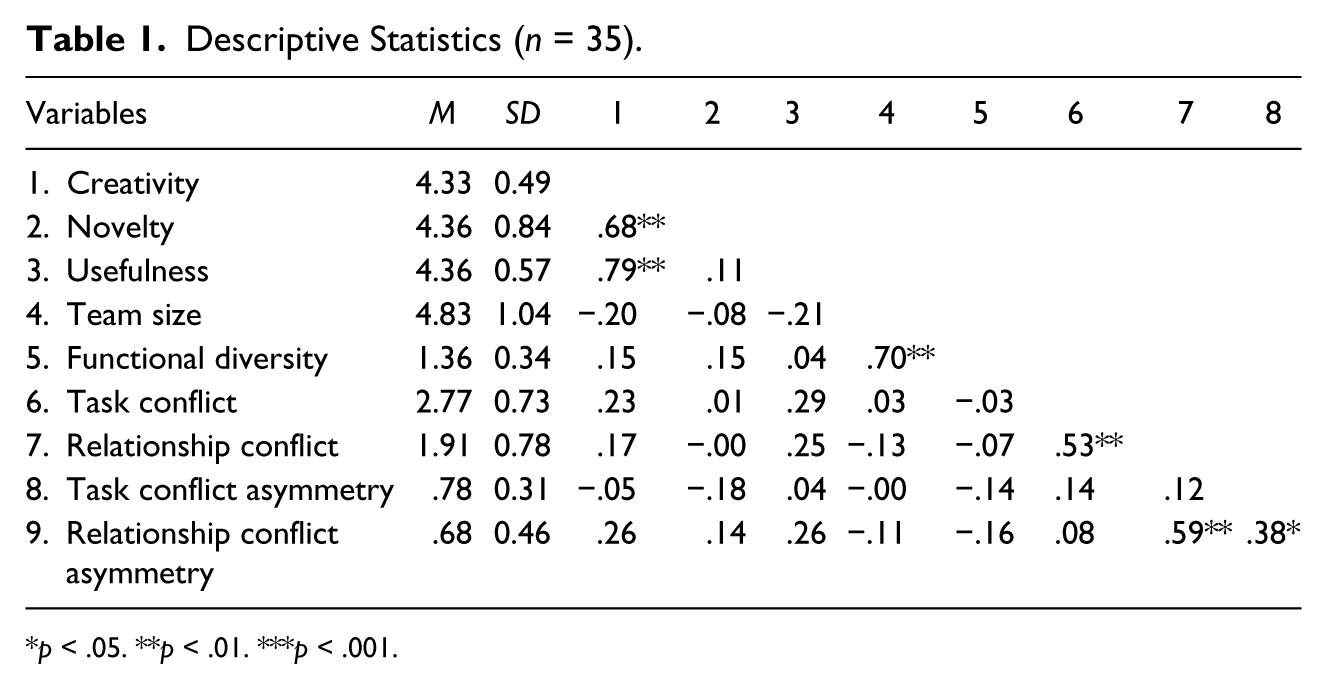
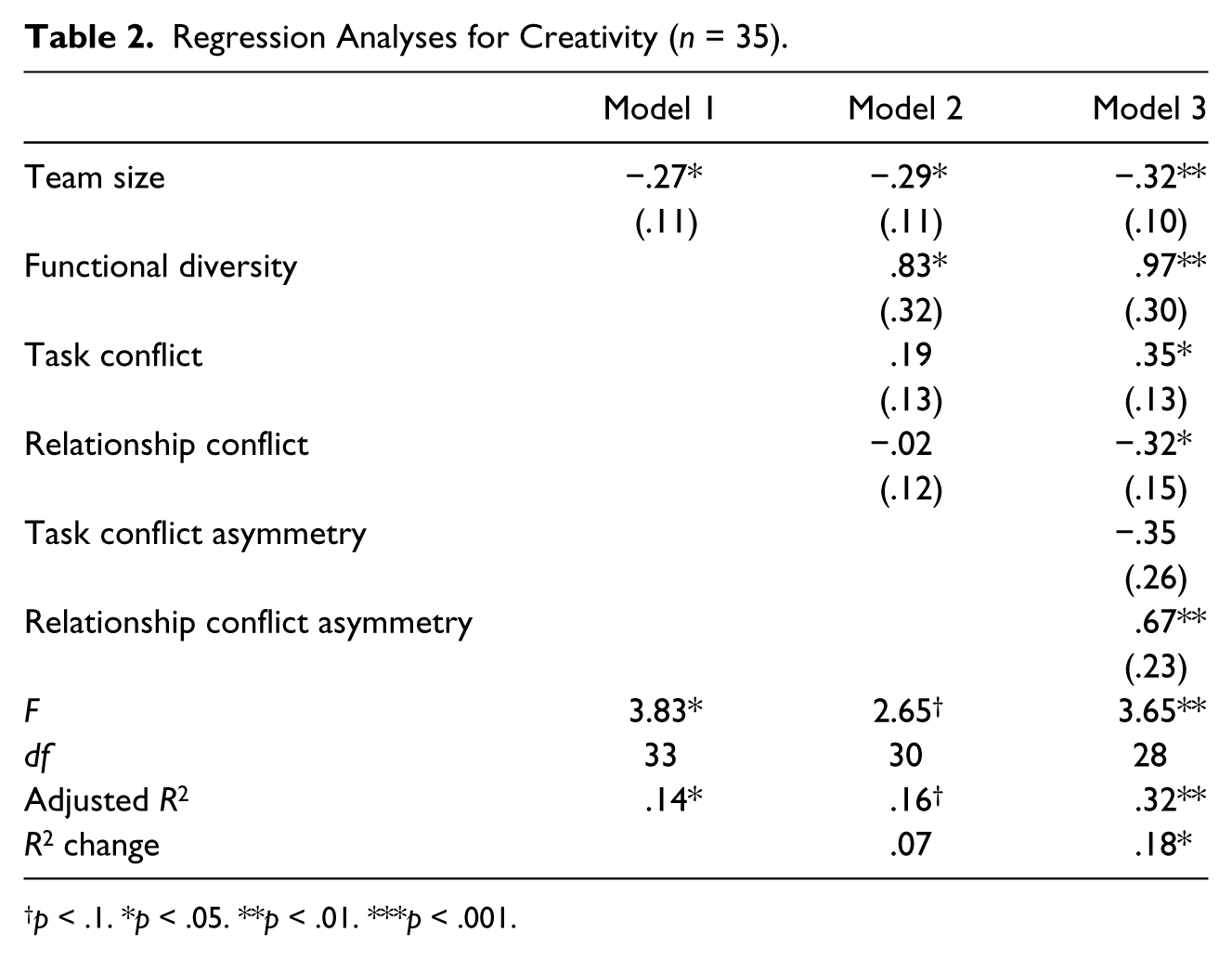
Table 1 presents the means, standard deviations, and correlations among the variables. We predicted that task conflict would be positively related to creativity (H1a) and relationship conflict would be negatively related to creativity (H1b). The simple linear regression model explained a significant amount of variance (adjusted R2 = .32; F = 3.65, p < .01) and provided support for these hypotheses (see Table 2): Task conflict had a significant positive effect on creativity (β = .35, p < .05), and relationship conflict had a significant negative effect on creativity (β = −.32, p < .05).
Descriptive Statistics (n = 35).
p < .05. **p < .01. ***p < .001.
Regression Analyses for Creativity (n = 35).
p < .1. *p < .05. **p < .01. ***p < .001.
We also predicted that task conflict asymmetry would be negatively related to creativity (H2a) whereas relationship conflict asymmetry (H2b) would be positively related to creativity. Analyses did not support H2a but provided support for H2b (see Table 2): Task conflict asymmetry had no significant effect on creativity (β = −.35, p = .19), whereas relationship conflict asymmetry had a significant positive effect on creativity (β = .67, p < .01).
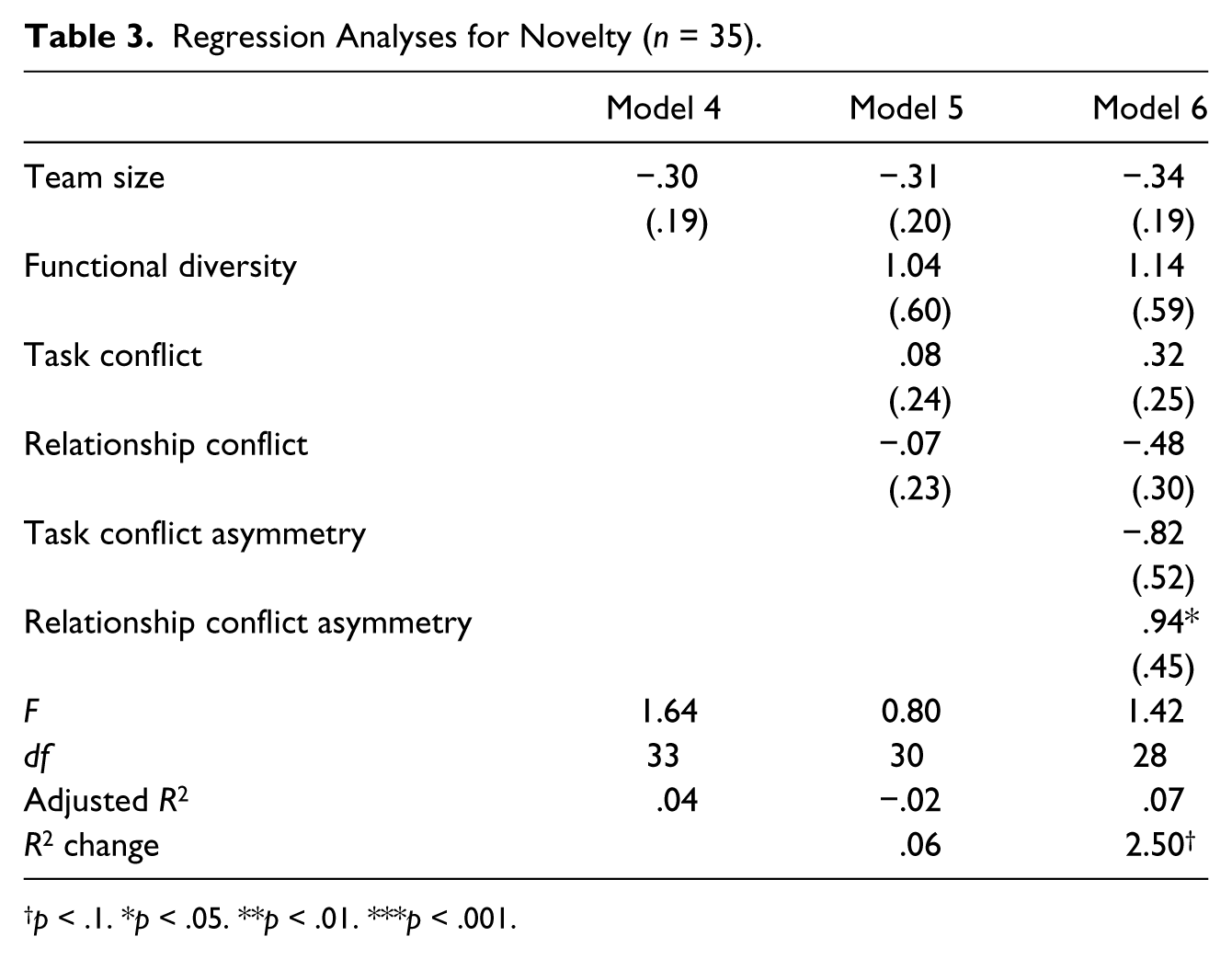
We tested the idea that relationship conflict asymmetry might be positively related to the novelty component (H3a). Analyses showed that relationship conflict asymmetry had a significant positive effect on novelty (β = .94, p < .05; see Table 3) but did not have a significant effect on usefulness (β = .55, ns; see Table 4). Thus, relationship conflict asymmetry seems to primarily affect the novelty component of creativity, providing support for H3a.
Regression Analyses for Novelty (n = 35).
p < .1. *p < .05. **p < .01. ***p < .001.
Regression Analyses for Usefulness (n = 35).

p < .1. *p < .05. **p < .01. ***p < .001.
We tested the idea that task conflict asymmetry might be negatively related to the usefulness component (H3b). Analyses showed that task conflict asymmetry had no significant effects on both usefulness (β = −.18, ns; see Table 4) and novelty (β = −.82, ns; see Table 3). However, team size (β = −.30, p < .05), functional diversity (β = .80, p < .05), and task conflict (β = .35, p < .05) were significantly related to usefulness (see Table 4). Thus, although we did not find support for H3b, task conflict, team size, and functional diversity seem to primarily affect the usefulness component of creativity.
Discussion
We examined the effects of conflict and conflict asymmetry on creativity in interdisciplinary teams within a nanobiotechnology setting. We found task conflict to have a positive effect, relationship conflict to have a negative effect, and relationship conflict asymmetry to have a positive effect. However, task conflict asymmetry did not have an effect. Moreover, when we separated creativity into its novelty and usefulness components, we found relationship conflict asymmetry to be the primary driver of novelty whereas task conflict, team size, and functional diversity to be the primary drivers of usefulness. From these results, we suggest that relationship conflict and relationship conflict asymmetry affect creativity by stimulating divergent thinking to generate novelty, whereas task conflict, team size, and functional diversity affect creativity by stimulating convergent thinking to generate usefulness.
Theoretical Implications
Researchers have only recently examined conflict asymmetry in teams (Jehn et al., 2010), and much is unknown about its effects on team creativity. For example, researchers have so far only examined the effects of conflict asymmetries on team members’ self-reported perceptions of creativity (Jehn et al., 2010). Extending this research, we examined the effects of conflict asymmetries on creativity and the separate components of novelty and usefulness by using the consensual assessment technique to measure team creativity (Amabile, 1996). In so doing, we make several contributions to explaining how conflict affects creativity in teams.
First, our findings are consistent with previous research in that relationship conflict was negatively related to creativity and task conflict was positively related to creativity. However, we did not find the predicted effect of task conflict asymmetry. We think that teams benefit from members constructively challenging each other’s opinions and ideas; it should not matter to creativity if members have the same perceptions of task conflict. What matters is that task conflict exists—at least to a moderately high level. Furthermore, task conflict is usually accompanied by relationship conflict, and it can be difficult for team members to separate the two (Simons & Peterson, 2000). Thus, teams will benefit from task conflict to the extent that team members are able to voice their differences with other members perceiving little or no interpersonal tension (i.e., relationship conflict asymmetry). Relationship conflict asymmetry, therefore, plays a role in keeping relationship conflict low as task conflict increases to stimulate creativity. This positive link between relationship conflict asymmetry and creativity may be critical for interdisciplinary teams faced with the difficult challenge of communicating, absorbing, and applying new ideas from different areas of expertise to generate creative solutions (Taylor & Greve, 2006). Specifically, team members who perceive more relationship conflict drive the effective communication and application of divergent ideas in interdisciplinary teams because they are more focused, engage in less biased information processing, and have a need for a multifaceted understanding of the problem task (Breugst et al., 2012).
Second, our findings around the two components of novelty and usefulness advance our understanding of how interdisciplinary teams problem-solve. Others have examined these components (e.g., Taylor & Greve, 2006; Uzzi & Spiro, 2005), but the findings presented here provide some of the most concrete demonstrations of how the novelty and usefulness components of solutions come about. For instance, that we found a positive link between task conflict and usefulness regardless of task conflict asymmetry points to usefulness being a coordination issue. Specifically, team processes that increase the task conflict of a team help creativity, regardless of whether team members share the same perception of task conflict levels. At the same time, that we found relationship conflict to be negatively linked to novelty whereas relationship conflict asymmetry is positively linked to novelty suggests that interpersonal dynamics play a central role in the generation of novelty in interdisciplinary teams. Specifically, team processes that keep the overall level of relationship conflict low while maintaining a sense of creative abrasion among some team members could be very effective at generating novelty.
One implication is that previous work that has found a link between task conflict and creativity may have been explaining variance in the usefulness component of creativity. Specifically, the usefulness of novel ideas—and thus creativity—may have been enhanced by team processes that foster greater differences in viewpoints on task decisions and having to work through disagreement brought about by a greater variety of approaches to implementing novel ideas. Our findings on the link between task conflict and creativity, however, could be the result of the boundary conditions of our sample. Specifically, moderate levels of task conflict populate the upper bounds of task conflict in our sample, and the device design task requires the generation of novel and useful solutions but not their implementation (Baer, 2012). This is consistent with recent research that found creativity to be highest at moderate levels of task conflict (Farh et al., 2010). This same research found that this link exists only for the early phase of the product life cycle, whereas task conflict was unrelated to the latter phase of the product life cycle. Moreover, these product life cycle phases correspond to the oft-made distinction between two distinct activities underlying innovation, where the generation of novel creative ideas is distinguished from the implementation of creative ideas into new products or organizational processes (Baer, 2012). Thus, considered together with the aforementioned studies, our results suggest that task conflict explains variance in usefulness in the sense of the implementation potential of novel solutions rather than the actual implementation of novel solutions. This is a testable hypothesis that would make a contribution to the creativity and innovation literatures.
Another implication is that the observed link between the relationship conflict variables and novelty suggests that lower shared perceptions of emotional tension, anger, personality clashes, and interpersonal friction explain variance in the novelty of solutions. However, there is more that can be learned about how relationship conflict really affects novelty. For instance, we have argued that while the formation of subgroups due to divergent perspectives creates relationship conflict that inhibits creativity, relationship conflict asymmetry fosters creativity and, in particular, novelty. This implies that relationship conflict asymmetry mediates the link between subgroup competition and creativity in interdisciplinary teams. This is a testable hypothesis that would make a contribution to the literature linking creativity with intergroup competition.
Finally, several questions emerge from our research. For instance, how does conflict asymmetry emerge in functionally homogeneous teams? Indeed, what causes the kind of conflict asymmetry that leads to creativity in non-interdisciplinary teams? And what effects might status differences and mixed motives have on conflict asymmetry and creativity in these teams?
For example, research suggests that status differences could create the kind of conflict asymmetry that fosters creativity (Sutton & Hargadon, 1996). This is especially likely in situations where the high-status team member represents a minority viewpoint. As we know, although minority viewpoints are critical to creativity (Nemeth, 1986), those who hold a minority viewpoint are reluctant to voice their unique ideas for fear of aggravating conflict within a team (Edmondson, 1999). However, we might expect higher status team members to perceive less conflict than others and therefore be more likely to voice and defend their unique ideas. For instance, because higher status is often conferred on those who produce the most creative outputs (Sutton & Hargadon, 1996), higher status team members could perceive lower conflict in part due to their prior experiences dealing with conflict inherent to team creativity and in part due to their area of specialization in the team. In our study, graduate biology majors were worth more than undergrad engineering majors because graduate biologists were in shorter supply. However, status differences associated with specialization can also lead to turf wars that lead to greater conflict. Thus, scholars might consider how status dynamics accounts for the link between conflict asymmetry and creativity.
Mixed motives, occurring when individual incentives and group incentives diverge, could also cause the kind of conflict asymmetry that stimulates creativity. We can expect individual incentives to be associated with higher conflict asymmetry whereas group incentives are associated with lower conflict asymmetry. When team members are individually incentivized, their respective perceptions of conflict could be closely tied to whether they have achieved their individual goals. That is, those who have achieved (or are close to achieving) their goals perceive less conflict whereas those who have not achieved (or are far from achieving) their goals perceive more conflict. In contrast, when team members are incentivized collectively, perceptions are more similar than not. Hence, individual incentives could cause conflict asymmetry that stimulates creativity whereas team incentives would have the opposite effect.
Limitations and Future Directions
This study has limitations that provide opportunities for future research. For one, the nanobiotechnology setting limits the generalizability of the findings. Specifically, nanobiotechnology work requires interdisciplinary collaboration among team members with specialized knowledge from different scientific domains. Moreover, given the open-ended nature of nanobiotechnology work, the relationships we observe may be specific to work characterized by non-routine, complex tasks. Questions remain regarding the mechanisms in work settings that do not require interdisciplinary teams with specialized knowledge. Would we observe the same relationships in functionally homogeneous teams working in routinized, non-complex tasks?
A second limitation regards the causal link between conflict asymmetry and creativity in interdisciplinary teams. Although studying teams working on real scientific problems over a period of several weeks offers a number of advantages, our study does not provide definitive proof of causation. For instance, our analyses were based on the link between conflict asymmetries measured at the midpoint of the project life cycle and creativity measured only at the end point of the project life cycle (i.e., after submission of the final version of the project). Hence, the creativity of the project should not account for variations in conflict asymmetries observed at the midpoint. However, it is possible that working on a creative project could cause conflict asymmetries to emerge at the midpoint. For example, although we have argued that relationship conflict asymmetry creates a multifaceted understanding of the task through a dual mechanism with some team members focused on generating differences whereas others focused on combining these differences, it is plausible that teams who organize themselves in this manner inadvertently create relationship conflict asymmetries. This causal direction is unlikely because self-organizing teams are more likely (than not) to develop a shared mental model that reduces conflict asymmetries; but we cannot rule this out. This is a question for future research.
A third limitation is that although we theorize that conflict asymmetries emerge according to the degree by which interdisciplinary teams subdivide along disciplinary specializations, we do not have definitive evidence of this theoretical mechanism. However, in an in-depth study of team collaborations in the domains of art, writing, and psychoanalysis, Farrell (2001) noted that collaborations subdivide into pairs of collaborators on the basis of shared perspectives on how to solve the problem at hand. This is consistent with our theory that teams subdivide along disciplinary specialization. Moreover, Farrell (2011) also noted that relationship conflict is most often the primary reason for collaborations to dissolve. This is consistent with our theory that relationship conflict asymmetry is important to team creativity. Future research could test these ideas to provide a precise explanation of how relationship conflict asymmetry affects creativity.
Finally, it is worth noting that we observed relatively low levels of conflict in our research setting, which raises questions about the validity and generalizability of our findings. We know that teams perceive even small amounts of conflict to be uncomfortable and counterproductive (Pelled, 1996) and many teams opting for harmony over performance (Behfar et al., 2008). We also know that people avoid teamwork with others with whom they have interpersonal conflict—even if these potential team members have the relevant expertise necessary for team performance (Casciaro & Lobo, 2008). Thus, our findings might be generalizable across all levels of conflict. However, research has shown that creativity is optimally achieved at moderate levels of task conflict whereas creativity is weak at the lowest and highest levels of task conflict (De Dreu, 2006), which implies that our findings might be generalizable only to the lowest and highest levels of conflict. Furthermore, because there is no clear definition of what a moderate level of conflict entails (Farh et al., 2010), it may be helpful to build on Harrison and Klein’s (2007) taxonomy of team diversity to define low, moderate, or high levels of task conflict in terms of different configurations of team members’ varying conflict perceptions. Future research could build on these ideas to empirically test whether the pattern of relationships between conflict, conflict asymmetry, and creativity is the same across all levels of conflict or whether there are distinct patterns for low, moderate, and high levels of conflict.
Practical Implications
Limitations notwithstanding, this study presents several useful practical implications. In addition to assembling a team with the right mix of expertise to get the job done, managers should encourage asymmetric perceptions of relationship conflict among team members to achieve creativity. This is not to say that managers should stir up trouble between two but not all team members. Rather, managers should organize teams in such a way that creative abrasion occurs naturally (cf. Skilton & Dooley, 2010). One way to do this is to include members with specialized expertise in functionally diverse areas so that subgroups form within the team. Subgroup differences help stimulate conflict, but managers have to keep the perceptions of conflict asymmetric. One way to keep conflict asymmetric is to include individual members with different status levels. Low-status members likely perceive higher levels of relationship conflict compared with high-status members, laying the groundwork for conflict asymmetry.
Conclusion
Although a large body of research has provided insights into how conflict fosters creativity in interdisciplinary teams, there is much we can learn about team creativity by also examining the asymmetric perceptions of conflict among team members. Specifically, our study shows that relationship conflict asymmetry is positively related to creativity and explains variance in the novelty component of creativity. That is, relationship conflict helps foster creativity as long as all team members do not perceive the same level of relationship conflict. This offers a solution to the challenge of fostering creativity by keeping task conflict high and relationship conflict low when task conflict and relationship are inextricably linked (De Dreu & Weingart, 2003; Simons & Peterson, 2000). More generally, examining the effects of conflict asymmetry on creativity in interdisciplinary teams offers insights into how team members perceive, understand, evaluate, and use functionally diverse knowledge to change their own and others’ thinking to generate new solutions that are both novel and useful.
Footnotes
Appendix
Novelty items:
Usefulness items:
Declaration of Conflicting Interests
The author(s) declared no potential conflicts of interest with respect to the research, authorship, and/or publication of this article.
Funding
The author(s) received no financial support for the research, authorship, and/or publication of this article.