




Abstract
This study examined how leaders’ internal and external activities mediate the relationship of functional heterogeneity and interteam goal interdependence to team effectiveness (in-role performance and innovation) in interdisciplinary teams. The results of the structural equation model from a sample of 92 interdisciplinary teams indicate that leaders’ internal activities fully mediate the relationship of team functional heterogeneity and interteam goal interdependence to team in-role performance. The leaders’ external activities were found to fully mediate the relationship of interteam goal interdependence to team innovation. We discuss the implications of these findings for both theory and practice.
Interdisciplinary teams are rapidly becoming more prevalent as a means to improve organizational responsiveness to dynamic environments (Bonifas & Gray, 2013; Bronstein, Mizrahi, Korazim-Korösy, & McPhee, 2010). An interdisciplinary team is a group of colleagues from two or more disciplines or functions in the organization with complementary skills, who share a common purpose, goals, and accountability (Clark, Spence, & Sheehan, 1996). Often, interdisciplinary endeavors are necessary to address complex problems and deal with subject matter that cannot be adequately addressed through any one discipline alone (Reich & Reich, 2006). Interdisciplinary teams are frequently expected to offer a broad scope of expertise and a higher level of performance (Fiore, 2008; Polzer, Milton, & Swann, 2002). However, studies also suggest potential weaknesses to which interdisciplinary teams may be prone. This may be due to the competing social identities and commitments to other organizations and teams that the members of an interdisciplinary team might have (Cooper, Carlisle, Gibbs, & Watkins, 2001; Cronin, Bezrukova, Weingart, & Tinsley, 2011). This can create an inherent sense of instability and uncertainty within the team, which may cause the deterioration of relationships among team members (Hackmann et al., 2002; Van der Vegt, Van de Vliert, & Oosterhof, 2003). Therefore, the unique composition of interdisciplinary teams can provide both benefits and challenges. If properly managed, the heterogeneity of interdisciplinary teams can promote enhanced team effectiveness.
Team leaders are often in a unique position to see the big picture. Therefore, leaders’ activities can have a substantial impact on interdisciplinary teams by meeting the challenges while bringing out the unique strengths offered by interdisciplinary teams (Lyanage & Barnhard, 2003; Nancarrow et al., 2013). The team management literature has depicted specific behaviors, such as boundary activities, in which leaders can engage to promote team effectiveness (Zaccaro, Heinen, & Shuffler, 2009). Specifically, the leaders’ internal activities are directed toward the team, sharpening the team boundary from within (Campion, Papper, & Medsker, 1996). The leaders’ external activities are directed toward external agents in the team’s focal environment to acquire resources (Ancona & Caldwell, 1992a). Recently, scholars have recognized the importance of maintaining a balance between leaders’ internal and external activities to achieve better team performance (Yukl, 2012). Accordingly, this study proposes that leaders’ internal and external activities facilitate interdisciplinary team effectiveness.
Although some scholarly attention has been given to advancing research on team leadership in general and interdisciplinary team leadership in particular, several gaps remain in the literature (Crow & Pounder, 2000; Marrone, 2010). Interdisciplinary teamwork is often expected as an important contributor to effectiveness (Hammick, Freeth, Koppel, Reeves, & Barr, 2007). Yet, few studies have examined the role of the leader’s activities in enhancing team performance (Ravet, 2012). Our goal was to extend our knowledge about the mechanisms that might facilitate interdisciplinary team effectiveness by highlighting the boundary activities in which team leaders can engage to unlock the benefits inherent in interdisciplinary teams. First, more traditional views of leadership, which address leader-subordinate interaction instead of leader-team dynamics, are overrepresented and do not increase our understanding of team leadership (Crevani, Lindgren, & Packendorff, 2009). Second, more research is needed to deepen our understanding of the differential relationship between a leader’s internal and external activities and team outcomes (Drach-Zahavy & Somech, 2010). Few studies have investigated the combined relationship of or the potential trade-off between internal and external activities as activities initiated by the team leader. Only one study has suggested that effective leaders engage in both internal and external activities (Druskat & Wheeler, 2003). Third, studies have highlighted that contextual factors and team composition may influence the leaders’ management activities (Marrone, 2010). However, few studies have focused on exploring how contextual antecedents and a team composition can simultaneously influence leaders’ internal and/or external activity tendencies.
This study examines the mediating role of the leader’s internal and external activities on the relationship between functional heterogeneity and interteam goal interdependence and team effectiveness (in-role performance and innovation; see Figure 1). This study attempts to offer insights into the development and improvement of interdisciplinary teamwork in relation to the role of the leader’s internal and external activities. Specifically, the focus on mediating mechanisms is rooted in more general team performance models (Mathieu, Maynard, Rapp, & Gilson, 2008). These models explain performance outcomes as determined by the processes and emergent states through which members interact to combine their expertise. Team leadership activities thus shape emergent cognition and behavioral processes that facilitate team effectiveness (Kozlowski, Watola, Jensen, Kim, & Botero, 2009). We propose that leadership takes place as an outcome of team inputs, and is then used as a source in future process and performance episodes (Marks, Mathieu, & Zaccaro, 2001). We have chosen functional heterogeneity and interteam goal interdependence because they tap into the unique characteristics of interdisciplinary teams and potentially address their fundamental need for leaders’ activities. The hypotheses developed are intended to offer insights into the relationship of inter and intrateam dynamics with the leader’s activities. We have used in-role performance and innovation because these outcomes tap into the different dimensions of team effectiveness. These dimensions represent the inherent tension of trying to engage in out-of-the-box innovative thinking while maintaining routine in-role duties (Lovelace, Shapiro, & Weingart, 2001).
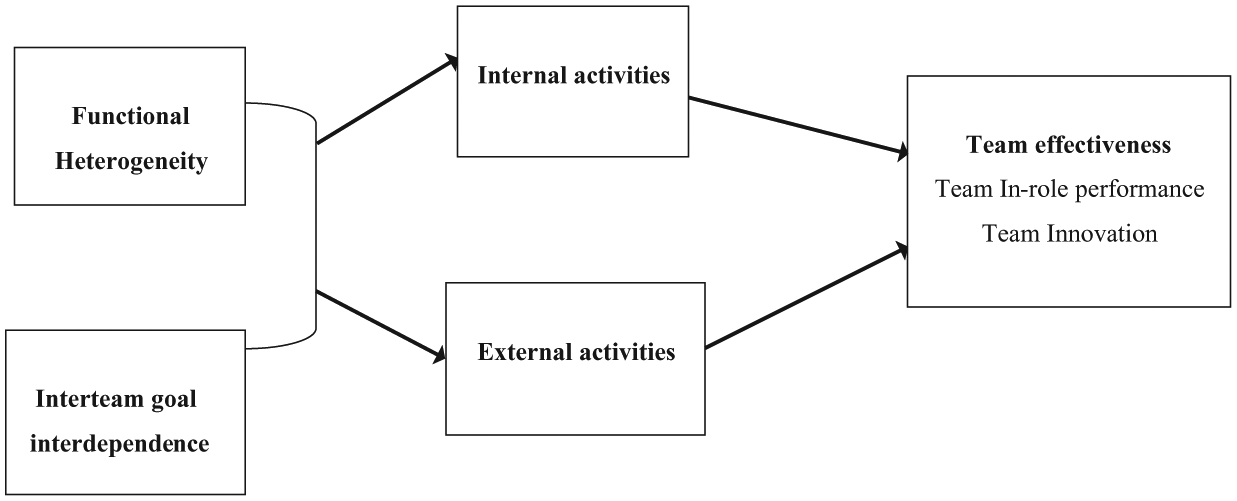
Research model: Leader’s internal and external activities mediate the relationship between interteam goal interdependence and functional heterogeneity and team effectiveness.
Theoretical Background and Hypotheses
An interdisciplinary team is founded on the premise that a variety of expertise and complementary skills, knowledge, and disciplinary perspectives are required to achieve optimal team performance and innovation (Van Knippenberg & Schippers, 2007). However, the underlying disciplinary differences in education and conceptual frameworks among team members can often lead to divergent values, goals, and interests (Ovretreit, 2002). Research has shown that interdisciplinary teams can be effective by enabling team members to learn from one another and facilitate coordination across boundaries. Yet, these characteristics may also raise social barriers that hinder cooperation and information sharing within the team (Harrison & Klein, 2007; Yong, Sauer, & Mannix, 2014). To summarize the trade-off, the same unique interdisciplinary team characteristics that can increase team effectiveness by utilizing the diverse backgrounds of team members can also impede the team in its efforts to realize its full potential due to this same diversity.
The functional leadership approach asserts that a leader’s job is to do, or arrange to get done, whatever is needed for the team to function well and achieve its potential (Hackman & Walton, 1986). According to this approach, leadership is perceived as a form of social problem solving. Leaders are called upon to prevent any potential problems that could impede the team’s ability to identify and implement appropriate solutions. Team needs, meaning the things that enable a team to regulate itself to accomplish its goal, are shaped by the team and its organizational context. Team leadership is a significant force in satisfying team needs (Hackman & Walton, 1986). Thus, functional leaders can facilitate the success of the interdisciplinary team by monitoring the team, scanning the team’s environment for events and information, and interpreting these inputs for the team members. For example, Morgeson, DeRue, and Karam (2010) suggest specific behaviors in which leaders can engage to promote team performance, acknowledging that the role of team leadership can vary depending on the unique needs of the team.
Much early team leadership research has proposed that a leader should be focused primarily on the team internal processes occurring within the team boundary (Cohen & Bailey, 1997). Only in the 1990s, after the pioneering work of Ancona and Caldwell (1992a, 1992b), did perspectives on team functioning begin to strongly emphasize an external perspective (Faraj & Yan, 2009). Ancona and Caldwell (1992a) classified a team’s outwardly focused activities into four major types—ambassadorial, scouting, guarding, and integrating—and linked these types to team performance. However, only recently have scholars questioned the distinct roles and boundary activities that team leaders initiate and perform to promote team effectiveness (Druskat & Wheeler, 2003; Mathieu et al., 2008).
More recently, Yukl (2012) classified all types of leadership activities into four categories by which effective leaders identify the specific activities that are relevant to the situation. This involves task-oriented activities (e.g., clarifying goals and monitoring progress), relations-oriented activities (e.g., supporting and empowering employees), change-oriented activities (e.g., encouraging innovation and facilitating learning), and external activities (e.g., networking, representing, and boundary spanning). However, the importance and uniqueness of boundary activities and behaviors associated with these activities have led these researchers to classify boundary activities as a separate meta-category. Our conceptualization draws on Druskat and Wheeler’s (2003) typology, which was the first to offer a theoretical framework that emphasizes both an external and internal perspective relative to the team. Druskat and Wheeler indicated that effective leaders perform both internal boundary activities, focused on the internal team processes, and external boundary activities, focused outward toward the team’s external environment.
Leaders’ Boundary Activity Typology
Leaders’ internal activities
Leaders’ internal activities are activities directed toward the team involving various intrateam processes occurring within the team boundary (Day, Gronn, & Salas, 2004). Several scholars have posited convincing arguments for why internal activities might also be classified as part of boundary management (Yan & Louis, 1999). According to these scholars, internal activities may differentiate the team from its environment by establishing its own workspace, work time, task structure, and goals sharpening the team boundary from within (Campion et al., 1996; Choi, 2002). The typology of Druskat and Wheeler (2003) proposes four internal activities: Relating activities are those that involve the extent to which the leader demonstrates behaviors such as building team trust and caring for team members. By focusing on their teams’ best interests, leaders cultivate a positive social climate within the team. Research has acknowledged that trust can lead to enhanced knowledge exchange and shared understanding in interdisciplinary teams (Sonnenwald, 2003). Scouting activities are those geared toward gathering information about the needs and problems of the team and its members by diagnosing and investigating problems systematically. By speaking up, and raising ideas, questions, and concerns, the members of an interdisciplinary team can learn from each other (Edmondson, 1996). Persuading activities involve the extent to which the leader engages in activities directed toward influencing the team members to understand the implications of their decisions and actions. Leaders define the team’s mission and ensure that all team members have a common understanding of this mission affecting the similarity of team mental models (Zaccaro, Rittman, & Marks, 2001). Team mental models are an emergent state that provides a collective and structured understanding of performance objectives and the environment, enabling members to integrate efforts and perform effectively as a unit (Mohammed, Ferzandi, & Hamilton, 2010). Research has shown that a leader may help to establish shared cognitive schemas of shared problems to enhance the team members’ ability to integrate diverse perspectives (Wickson, Carew, & Russell, 2006). Empowering activities involve delegating authority and exercising flexibility with respect to team decisions, followed by ongoing coaching. This function also entails the extent to which leaders encourage team members to act autonomously, thereby providing opportunities for the exchange of knowledge (Arnold, Arad, Rhoades, & Drasgow, 2000).
Leaders’ external activities
Leaders’ external activities are activities directed toward agents external to the team’s focal environment to acquire resources and toward monitoring the team’s external environment. Also, leaders’ external activities involve buffering the team from external forces and events to integrate the team’s work into the rest of the organization (Morgeson et al., 2010). In organizational systems, the environment is often defined in terms of boundaries as “everything . . . outside the system’s boundary” (Immergart & Pilecki, 1973, p. 36). The boundary refers to the domain of interactions of a system with its environment to maintain the system as a system and to provide for its long-term survival (Yan & Louis, 1999). Leaders may cross the boundary between the team and other teams within the same organization. However, leaders may also cross the boundary beyond a single team’s host organization, serving to link the team and its organization with other organizations (Mathieu, Marks, & Zaccaro, 2001). Accordingly, the team’s external environment refers in the present study to the team’s embedding environment outside the team’s own boundary. This may include actors residing within or outside the team’s host organization.
The typology by Druskat and Wheeler (2003) proposes three types of external activities: Relating activity involves developing political and social awareness. This type of activity refers to the extent to which the leader demonstrates an understanding of the organization. A leader continually manages the relationships between the team and the larger environmental context by communicating and coordinating with key constituencies outside the team. Scouting activity involves the extent to which the leader searches for information from people external to the team to clarify organizational needs. A leader may identify important environmental events, interpret these events, and communicate this interpretation to the team. The purpose of the search is to acquire knowledge and resources that may be useful to the organization. Such activities may help members to develop a common understanding of the needs and demands of the team’s (and the organization’s) external stakeholders (Zaccaro & Marks, 1999). Persuading activity involves the extent to which the leader focuses on obtaining external support and acquiring resources for the team. This involves presenting the team to other teams and stakeholders in a way that maximizes the support available to the team (Druskat & Dahal, 2005). This activity is similar to the ambassadorial activity, which involves protecting the team from outside pressure and persuading others to support the team (Ancona & Caldwell, 1992a).
This study suggests that if an organizational structure or the composition of the interdisciplinary team either supports or harms cooperation with other teams, it may create unique team needs that must be met. This may give the leader more reason to engage in internal and/or external activities. Similarly, if the organizational structure or the composition of the interdisciplinary team threatens teamwork and commitment within the team, the leader may be motivated to alter his or her internal and external activities accordingly. Team functional heterogeneity and interteam goal interdependence are proposed as antecedents of leaders’ internal and external activities.
Antecedents of Leaders’ Internal and External Activities
An organizational structure and a team composition may harm cooperative relationships among team members (Li, Ford, Zhai, & Xu, 2012). From a functional leadership approach, we posit that such characteristics may, thereby, generate the requirements for effective cooperation and collaboration among team members and between teams. All of these factors may encourage team leaders to alter their internal and/or external activities accordingly (Chen & Tjosvold, 2005; Morgeson et al., 2010).
Team functional heterogeneity
Team functional heterogeneity refers to the “the diversity of organizational roles embodied in the team” (Jackson, 1992, p. 353). Functionally heterogeneous teams assemble people from different functions who have pertinent expertise in the proposed course of action (Earley & Mosakowski, 2000). A team will be characterized as possessing increased functional heterogeneity if different types of professionals are grouped together as a multidisciplinary team. Functional heterogeneity is related to diversity with respect to the team members’ ability to generate more alternatives and perspectives through their specific knowledge and skill sets (Williams & O’Reilly, 1998). On one hand, functional heterogeneity facilitates communication with individuals from outside the team, enhancing scanning and exchange, and providing the team with broader informational resources and knowledge (Drach-Zahavy & Somech, 2002). Research has shown that members of highly heterogeneous teams bring specific knowledge and experience to their teams, as well as provide diversity of cognitive resources (Hülsheger, Anderson, & Salgado, 2009). Also, members’ diverse expertise enables them to tap into a broad array of information and knowledge (Lovelace et al., 2001). These teams are, therefore, able to connect to a larger pool of potential external advisors with diverse areas of expertise. Such a large pool of information may enable the team members to benefit from knowledge accumulated by close contacts and associates (Sapsed, Bessant, Partington, Tranfield, & Young, 2002). Indeed, research has indicated that social relationships provide individuals with a unique opportunity to create, retain, and transfer knowledge (Argote, McEvily, & Reagans, 2003). Thus, some members may actively seek feedback from external constituencies in the course of their work. Such internal inflow toward the team is not likely to create pressure on leaders to engage in external activities aimed at building relationships or scouting for information.
On the other hand, this frequent interaction with outsiders to the team and the divergent views they represent are related to increased conflict within the team, resulting in less cohesion (Chatman & Flynn, 2001; Li et al., 2012). High functional heterogeneity has been shown to slow the speed of decision making, and is associated with dysfunctional conflict and deficient social integration (Bunderson & Sutcliffe, 2003). These negative outcomes may be due to social categorization processes that can produce negative cognitive, emotional, and behavioral biases when individuals perceive others as different from themselves (Hogg & Terry, 2000). In-group favoritism toward one’s own area of interest may harm the willingness to share knowledge or value the contributions from team members who belong to other disciplines. Accordingly, leaders may be encouraged to reduce biases among members and to enhance team members’ willingness to consider the contributions of diverse members. Leaders of such teams may be enhanced to engage in scouting activities to identify team problems and weaknesses so as to help team members to understand their differences and to acknowledge the feelings and views of all sides. By creating a common overriding identity around the team’s goals and outcomes and promoting a team identity, biases may be reduced (Kane, 2010). Also, leaders may be encouraged to engage in relating and persuading activities. Those activities may be particularly important in the context of high functional heterogeneity because relating involves building team trust and persuading can facilitate the creation of a shared team vision. All of these factors can help to ensure that all team members have a common understanding of the task. Finally, a higher level of heterogeneity may motivate leaders to empower and delegate authority to the team. This has been shown to enhance the exchange of knowledge among team members (Kirkman & Rosen, 1999). Each of these activities may sharpen the team boundary from within by establishing the team’s own unique workspace, work time, task structure, operational rules, and goals. Accordingly, in line with the functional leadership approach, leaders of highly heterogeneous teams may well be encouraged to redirect the team members’ energy toward a shared and common mission. This can be accomplished by engaging in internal activities of relating, scouting, persuading, and empowering, to improve communication and information sharing within the team.
Interteam goal interdependence
Interteam goal interdependence refers to the degree to which a team believes it has been assigned team goals or given team feedback that is aligned with the organization’s goals (Drach-Zahavy & Somech, 2010). Interteam goal interdependence can be seen along a continuum, ranging from a low to a high degree of interdependence. A low level is marked by no apparent common goal and no need for cooperation between teams to achieve the goals of the organization. A high level is marked by a well-defined common goal, which cannot be attained without interteam work and cooperation (Campion et al., 1996). Meta-analyses suggest that the dynamics and outcomes of goal interdependence operate the same way on the interteam level as on the interpersonal level (Stanne, Johnson, & Johnson, 1999). Highly interdependent goals are recognized as central to the development and maintenance of effective working relationships between teams. Such relationships involve the exchange of resources and the discussion of views with an open mind (Taggar & Haines, 2006). Consequently, when there is a high degree of interteam goal interdependence, teams may be confident that they can exchange views and share information to accomplish complex tasks, allowing positive interteam relationships to develop (Johnson, 2003). Therefore, a higher level of interteam goal interdependence can create greater coordination between teams (Van Vijfeijken, Kleingeld, Van Tuijl, Algera, & Thierry, 2006). This may lead to high-quality problem solving and productive work between teams because the sharing of information adds to the collective pool of knowledge. Such processes are not likely to create pressure on team leaders to engage in external activities aimed at enhancing cooperation and information sharing between teams (Tjosvold, 1998).
However, team members must first develop a shared understanding of how best to coordinate their own actions within the team and work together to accomplish their goals (Hofmann & Jones, 2005). It is acknowledged that by possessing a shared understanding of the goals to be performed or the resources at the team’s disposal, team members are better able to coordinate their efforts (Volpe, Cannon-Bowers, Salas, & Spector, 1996). Leaders may thus be encouraged to enhance the team’s internal cohesion, and to strengthen the team’s internal communication and coordination (Edmondson, 2003). Accordingly, in line with the functional leadership approach, this can create a requirement on the leader’s part to engage in the internal activity of scouting to help team members to better understand what to expect from other members. Also, a high degree of interteam goal interdependence can motivate team leaders to build team trust and foster a shared understanding of external demands among the team members. This gives team leaders an incentive to engage in the internal activities of relating and persuading, because congruent mental models have shown to be important for teams with a high degree of interteam interdependence (Alge, Wiethoff, & Klein, 2003). These activities can help ensure that all team members are able to express their concerns, and may also help to reduce ambiguity about effort allocation so that team members can interpret decisions in a similar way. Furthermore, to improve motivation and foster a sense of responsibility among the team members toward the team, leaders may be encouraged to delegate authority. Indeed, through empowering team members, team leaders may enable the team members to set their own performance and output goals. The team members will likely find these goals more meaningful, enhancing their commitment toward the team (Locke & Latham, 1990). All of these activities, both individually and together, can help to ensure that the team’s activities better contribute to organizational goals. Therefore, the following hypothesis is proposed:
Leaders’ Internal and External Activities and Team Effectiveness
In investigating team effectiveness, we use in-role performance and innovation. A review of the team literature shows that both internal and external activities facilitate goal accomplishment and team effectiveness (Druskat & Wheeler, 2003). Although each of the internal and external activities may compete for the leader’s limited time and resources, research indicates that whether internal or external, each of the subdimensional activities remains crucial to team effectiveness (Choi, 2002; Druskat & Wheeler, 2003). Accordingly, we posit that both internal and external activities facilitate team effectiveness.
In-role performance
In-role performance refers to the extent to which a team accomplishes its goals and generates the intended, expected, or desired results (Chatman & Flynn, 2001). Research has shown that leaders’ internal activities of relating and scouting relate to various intrateam process management functions, such as building team trust and investigating problems systematically. These activities can thus help to optimize the strengths and minimize the weaknesses of a team with a diverse membership (Zaccaro et al., 2009). Also, through persuading activities, a leader may promote a shared understanding that may help the team to align its goals with those of the organization, providing greater mission clarity (Zaccaro et al., 2001). This shared understanding, which converts organizational objectives into interim goals, is viewed as essential for effective team performance (Klimoski & Mohammed, 1994). Once information has been adequately shared among team members, the interdisciplinary team must try to achieve sufficient understanding of the team members’ diverse perspectives to integrate that knowledge. The team leader’s internal activities can improve the team’s internal processes and help team members to resolve unnecessary ambiguity and uncertainty because a shared team vision may effectively remove obstacles (interpersonal conflict) within the team. Research has indicated that through empowerment, leaders can help team members to develop their own rules and procedures, giving them a greater sense of participation in the day-to-day functioning of the team (Kirkman & Rosen, 1999). Members of such teams will likely have a more meaningful work experience and increased autonomy, leading to improved performance (Chen, Kirkman, Kanfer, Allen, & Rosen, 2007). Through each of the internal activities, the leader may help to bridge gaps in communication to clarify concepts that may hold different meanings for team members with diverse disciplinary backgrounds, enhancing team performance.
Team leaders’ external activities involve building relationships between the team and external constituencies, scouting for resources, and obtaining support for the team. Through these activities, leaders can foster the learning of new perspectives. Such learning can strengthen the knowledge and capabilities of team members, thereby enhancing in-role performance (Easterby-Smith & Lyles, 2003). Research has shown that scouting and sharing knowledge across teams enhance performance by enabling teams to better integrate and synthesize information (Salas, Cooke, & Rosen, 2008). This is important because such activities may enhance diversity in the information obtained in ways that facilitate team performance (Marks, DeChurch, Mathieu, Panzer, & Alonso, 2005). Research has also indicated that presenting the team to other teams and stakeholders in a way that safeguards the interests of the team and maximizes the support available to the team enhances team performance (Zaccaro & Marks, 1999). From this perspective, working to meet team needs by building team trust but also by connecting and presenting the team to its external environment can enable the leader to help team members to fulfill their roles effectively.
Innovation
Innovation refers to the introduction or application, within a team, of ideas, processes, or procedures that are new to the team and designed to be useful (West, 2002). Research has indicated that innovation involves two stages: the creative stage, namely, the generation of new ideas, and the implementation stage, namely, the successful implementation of creative ideas (George, 2007). Accordingly, innovation depends on a team not only having a good idea but also developing that idea beyond its initial state (Choi & Chang, 2009).
From a social networks perspective, Perry-Smith and Shalley (2003) underlined the importance of interpersonal relations with people outside one’s own team in fostering creativity and, in turn, innovation. Research has shown that successful collaboration and the sharing of information across teams is important for team creativity and innovation, as it may allow teams to transform new ideas and individually held knowledge into innovative procedures (Axtell et al., 2000). This is because subgroup dynamics is an important consideration with respect to the creation of knowledge and innovation (Eppler & Mengis, 2004). Thus, leaders’ external activities of relating, and scouting for resources and information, may contribute to team creativity by exposing team members to a greater variety of unusual ideas facilitating creative thinking (Amabile, Conti, Coon, Lazenby, & Herron, 1996; Sawyer, 2006).
Innovation implementation refers to “the process of gaining targeted employees’ appropriate and committed use of an innovation” (Klein & Sorra, 1996, p. 1055). Maximizing the conditions fostering creativity is unlikely to translate directly into innovation implementation because it encompasses much more than idea generation. Previous research has suggested that an effective implementation of employees’ innovative ideas depends on generating support for new ideas and their implementation on the part of managers and coworkers (Shin & Zhou, 2003). Research has also shown that a feeling of safety in their interactions with one another becomes increasingly important (Madjar, Oldham, & Pratt, 2002). Team members must be able to take the risk of openly proposing new work methods and alternative problem-solving methods. For example, Okhuysen and Eisenhardt (2002) found that teams were more likely to use and integrate knowledge when formal interventions encouraged team members to draw on one another’s knowledge. The internal activities of relating and scouting involve building team trust and properly diagnosing strengths and weaknesses of team members. Persuading activities are aimed at providing the team with clear objectives and that sense of mission that is essential for genuine collaboration among members. Also, leaders’ internal activities can include empowering and delegating authority to team members. Teams that have been empowered have been found to more readily attack problems and improve the quality of their work by initiating changes in the way work is carried out (Kirkman & Rosen, 2000; Wellins, Byham, & Wilson, 1991). Such activities can help in establishing a work context within which a team member is empowered to implement creative alternatives (Jung, Chow, & Wu, 2003). Therefore, through these internal activities, a leader may enhance the team’s environment for innovation by anchoring a shared understanding and shared norms in the team’s mission. This creates a unique sense of belonging and team identity. Thus, provided with a common frame of reference, team members may increase information sharing within the team. Moreover, the attention of team members can be better focused on the team’s central task at the implementation stage of innovation (Faraj & Yan, 2009).
Mediation Model
Finally, based on the above discussion, our model proposes complete mediation of leader internal and external boundary activities in the relationship between structural variables and team effectiveness. This study postulates that the contextual variable of interteam goal interdependence and the team composition of functional heterogeneity influence leaders’ tendency toward internal and/or external activities. These activities in turn influence the team effectiveness outcomes of in-role performance and innovation. Therefore, functional heterogeneity and interteam goal interdependence may have an indirect effect on effectiveness through the mediating variable of the leader activities. Internal and external activities are the vehicle through which team needs are satisfied (Morgeson et al., 2010). This model is consistent with input–mediation–output models of team functioning, which propose that mediating mechanisms exist between inputs and outcomes that better explain the transformation from inputs to outputs (Ilgen, Hollenbeck, Johnson, & Jundt, 2005). In the traditional inputs–process–outputs framework for teams, processes were considered a link between inputs and outcomes (Hackman, 1987; Pelled, Eisenhardt, & Xin, 1999). In this framework, inputs are the structural variables of the constellation of individual characteristics and resources on multiple levels (individual, team, organization). The process domain in recent research has been broadened to include emergent states that dynamically represent how a team is doing and vary over time with team inputs, processes, outcomes, and context. Specifically, and according to input–mediator–outcome models (Ilgen et al., 2005), the present model proposes that team functional heterogeneity and interteam goal interdependence (inputs) shape the pattern of leader boundary activities—either by focusing on the internal team processes or by focusing on external team management (mediators)—and this pattern of boundary activities will determine the level of team effectiveness (outputs).
Method
Sample and Data Collection Procedure
To test the proposed relationships, we utilized a multisource survey design from a sample of interdisciplinary teams and their leaders in an education setting. Data collection was performed in several steps. After the research project was approved by the Ministry of Education, schools were randomly chosen from a list provided by the Ministry of Education. We first contacted school principals, explained the purpose of the study, and that anonymity was guaranteed, and emphasized the importance of candid answers. After agreeing to have their organization’s management team participate, the questionnaires were distributed. Only employees and leaders who had worked in the organization more than 1 year were included. This was to ensure that all respondents had sufficient time to develop perceptions about their organization and their coworkers.
Data were collected from two sources (team leaders and team members) to minimize problems associated with same source bias (Avolio, Yammarino, & Bass, 1991). This was also an efficient way of collecting a large amount of data without overburdening respondents. Data were collected from 92 management teams from 92 public educational organizations in Israel. A management team, by definition, is a team that holds supervisory responsibility. This includes setting major policy and making routine management decisions on behalf of other faculty members, whose views the team represents in some measure (Troman, 1996). In addition, the management team’s responsibilities may include the development and implementation of interdisciplinary curriculum and teaching strategies based on student needs. The team’s work typically involves the development of coordinated interventions and management strategies to address student learning and/or behavioral problems. The team can also work at coordinating communication with parents. Moreover, professional support staff (e.g., guidance counselors, psychologists, and special education teachers) can be integrated into these specific teams. Some of the management team members can be managed via a distinct chain of command with distinctive objectives and a diverse payment system. School administrators, usually the principal, typically serve as the leaders of these teams.
Of the teams participating, 60% were from elementary schools, 11% from middle schools, and 29% from high schools. Schools had an average of 617.32 enrolled students (SD = 449.02) and an average of 60.25 teachers (SD = 45.87). Team size ranged from 3 to 10 with an average of 5.79 (SD = 1.93). As for the team leaders, 79% were women. Their average age was 49.28 years (SD = 6.67), and their average tenure as team leader at the present organization was 9.28 years (SD = 7.74). Of the 525 team members who were asked, 295 agreed to participate, with an average of 3 or 4 participants per team (response rate = 60%). Ninety-one percent of the participants were women; their average age was 43.93 years (SD = 9.05), and they had an average of 10.33 (SD = 7.00) years of seniority in the current organization.
The scale of team leaders’ internal and external activities was determined through the evaluation of the team members who also completed a questionnaire on interteam goal interdependence. Next, team leaders evaluated team effectiveness through a survey of team in-role performance and team innovation. They also provided demographic information on team composition.
Measures
Except where otherwise noted, respondents indicated their agreement by using a 5-point Likert-type scale with anchors ranging from 1 (strongly disagree) to 5 (strongly agree). Information for functional heterogeneity was provided by team leaders. Functional heterogeneity was measured by the diversity index recommended by Blau (1977) and used by Simons, Pelled, and Smith (1999): 1 − Σπ2, in which π is the proportion of the total team represented by each function category. The functional categories used to calculate the index were deputy head, grade-level coordinator, pedagogical coordinator, school counselor, educational advisor, coordinator, middle school leader, secondary high school leader, disciplinary coordinator, and psychologist. In our sample, 20.8% were grade-level coordinators, 17.3% were deputy heads, 20% were school counselors, 14% were educational advisors, 11.4% were disciplinary coordinators, and 10% were coordinators.
Interteam goal interdependence was measured based on scale developed by Van der Vegt et al. (2003). The questionnaire was revised slightly to accommodate the organizational level (e.g., “Our team have a number of explicit organizational goals to be achieved at the school level”; three items; α = .86).
To assess the leader boundary activities, team members answered the Team Leader Questionnaire adapted from Druskat and Wheeler (2003). The questionnaire was slightly revised to accommodate the educational context. A combination of both exploratory (EFA) and confirmatory factor analysis (CFA) was used to map the domain of the construct and refine the measure and meaning of the questionnaire. Generally, the factor loadings were strong, above .50; items that loaded on more than one factor at .40 or above, or that loaded lower than .35 on any one factor, or that reduced the reliability of the subscales were deleted. The EFA results indicated that all the items loaded predominantly on their predicted factors producing a 30-item instrument. The scale consisted of seven subscales with eigenvalues ranging from 14.50 to 2.12, explaining 67.30% of the variance.
A CFA using maximum likelihood estimation also supported the seven-factor structure, χ2(384) = 996.07, comparative fit index (CFI) = .89, Tucker–Lewis index (TLI) = .86, incremental fit index (IFI) = .89, root mean square error of approximation (RMSEA) = .068. Standardized parameter estimates from items to factors ranged from 0.64 to 0.93. The fit of this seven-factor model was also compared with the fit of a (a) one-factor model, χ2(405) = 2564.05, CFI = .60, TLI = .54, IFI = .61, RMSEA = .137; (b) a two-factor model, χ2(433) = 2429.56, CFI = .63, TLI = .58, IFI = .64, RMSEA = .128; and (c) a four-factor model, χ2(399) = 1630.11, CFI = .77, TLI = .74, IFI = .77, RMSEA = .105. In every instance, the fit of the seven-factor model was significantly better than the fit of any alternative model.
The EFA and CFA analyses provided evidence that the measures of the seven activities point toward a model of seven related but distinct factors representing each leadership activity: external relating (four items, for example, “How well does the leader understand school politics,” α = .83); external scouting (six items, for example, “How often does the leader seek information and advice from peers for the team’s benefit,” α = .89); external persuading (seven items, for example, “How often does the leader act as a representative of the team with parts of the school environment” [parents, educational ministry, district], α = .92); internal relating (three items, for example, “How often does the leader show team members that he or she cares about them,” α = .84); internal scouting (four items, for example, “How often does the leader gather information about the needs and problems of the team,” α = .89); internal persuading (four items, for example, “How often does the leader convey information to the team about how their work helps the school to achieve its goals,” α = .84); and empowering (two items, for example, “How often does the leader delegate responsibility and decision-making authority,” α = .84).
Team leaders used a seven-item scale adapted from Settoon, Bennett, and Liden (1996) to measure team effectiveness as in-role performance (e.g., “The team adequately fulfills assigned duties”) with respect to an overall evaluation of the team’s job performance, role fulfillment, and professional competence (α = .78). Innovation was measured by a five-item scale adapted from West and Wallace (1991) reflecting the extent of team-initiated changes in the previous 6 months (e.g., “The team developed innovative ways of accomplishing work objectives,” α = .87).
Control variables
We choose to control for the interteam task interdependence because previous research has shown that the effects of interteam task and goal interdependence may depend on how they are combined (Drach-Zahavy & Somech, 2010). For example, task interdependence may signal the need as well as the opportunity for cooperation and coordination. However, goal interdependence may further dictate whether this opportunity will be realized or turned into competitive behaviors (Saavedra, Earley, & Van Dyne, 1993).
Level of Analysis
In the research hypotheses, the team is identified as the unit of analysis. Therefore, team innovation and team in-role performance were assessed by the team leader, the principal. Interteam goal interdependence and leader internal and external activities were represented by an aggregate of team member responses. Thus, it was critical to demonstrate high within-team agreement to justify using the team average as an indicator of team-level variables; a value of .70 or greater is suggested as an adequate amount of within-group interrater agreement (rWG, James, Demaree, & Wolf, 1993). In the current study, all scales exceeded this level (see Table 1). Prior to aggregating individual-level scores to the group level by mean, intraclass correlations (ICC) were calculated. ICC(1) reflects the extent of within- versus between-group variability, and ICC(2) provides an estimate of the reliability of the group means (Bliese, 2000). Values were ICC(1) = .22, ICC(2) = .47 for interteam goal interdependence; ICC(1) = .36, ICC(2) = .64 for internal relating; ICC(1) = .2, ICC(2) = .54 for internal scouting; ICC(1) = .26, ICC(2) = .53 for internal persuading; ICC(1) = .26, ICC(2) = .52 for empowering; ICC(1) = .21, ICC(2) = .46 for external relating; ICC(1) = .30, ICC(2) = .57 for external scouting; and ICC(1) = .25, ICC(2) = .51 for external persuading. As indicated by Bliese (2000), ICC(1) generally ranges from 0 to 0.50 with a median of 0.12. All scales slightly exceeded the median score and support the use of the average scores as organizational measures.
Descriptive Statistics and Intercorrelation Matrix for Study Variables, N = 92.
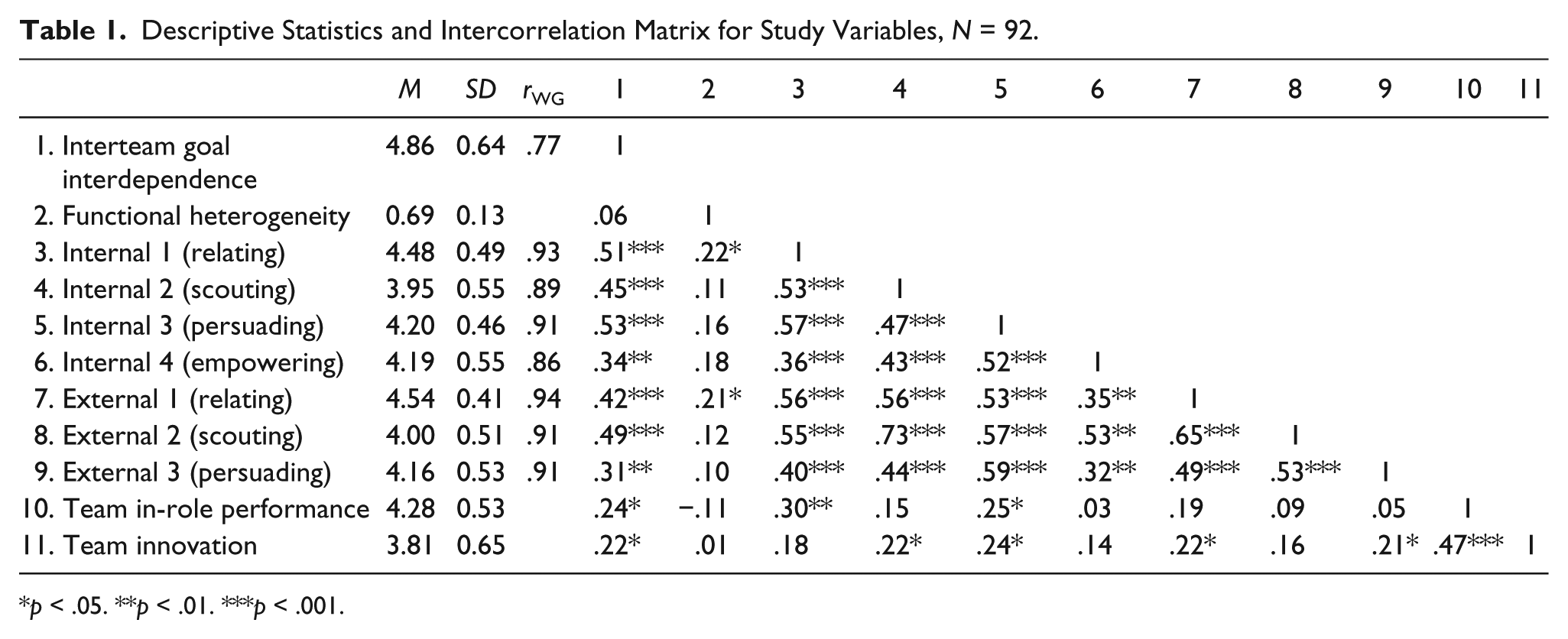
p < .05. **p < .01. ***p < .001.
Data Analysis
We used the two-step approach recommended by Anderson and Gerbing (1988) whereby CFA is used to test the measurement model and structural equation model (SEM) is used to test the structural model. This approach is preferable to the commonly used Baron and Kenny (1986) method. First, it allows for the testing of full as well as partial mediation (James, Mulaik, & Brett, 2006); if one is testing for partial mediation, a direct path is added from the initial variable to the outcome variable. Second, a simultaneous test of the significance of both the path from an initial variable to a mediator and the path from the mediator to an outcome (the test SEM applies) provides the best balance of Type I error rates and exhibits greater statistical power relative to other approaches (MacKinnon, Lockwood, Hoffman, West, & Sheets, 2002). Because SEM is primarily based on model fitting and selection, several statistics were used to specify how well the estimated models described the input data set. To gauge model fit as recommended by researchers (Jöreskog & Sörbom, 1993), we used several goodness-of-fit indices in assessing the fit of the research model. The goodness-of-fit of the models was evaluated using absolute and relative indices. We report chi-square values, which provide a statistical basis for comparing the relative fit of nested models. We tested the mediation effects of internal and external activities by comparing an alternative, nested model: the fully mediated model (hypothesized model) and a partially mediated model. A significant improvement in the fit of the fully mediated model over the partially mediated model would confirm the mediation effects of leaders’ internal and external activities. Finally, we used the bootstrapping method with bias-corrected confidence estimates in AMOS, based on a 2,000 bootstrap sample size, to ascertain the presence of indirect effects (Preacher & Hayes, 2008). The bootstrapping approach to analyze indirect effects is recommended by a growing number of researchers when testing for mediation in small samples. This is due to biased variance and standard error estimates using conventional mediation approaches (Hayes, 2013; Preacher, Rucker, & Hayes, 2007; Shrout & Bolger, 2002).
Preliminary analysis
To assess whether there were significant differences in the proposed variables among elementary, middle, and high schools, we used MANOVA. The results indicated no significant differences between the elementary, middle, and high schools for each of the outcome variables (internal and external activities, in-role performance, and innovation, p > .05).
Measurement model
We validated the construct measures for the leaders’ internal and external activities and team effectiveness using CFA, which is most suitable for confirming whether construct measures load on their respective a priori defined constructs (Browne & Cudek, 1993). The measurement model provided a good fit to the data, χ2(20) = 22.43, CFI = .99, TLI = .98, IFI = .99, RMSEA = .037 (Hoyle & Panter, 1995), and all of the indicators had statistically significant (p < .01) factor loadings (>.50) on their intended constructs, establishing the posited relationships among indicators and constructs (Hair, Anderson, Tatham, & Black, 1998).
Results
Table 1 indicates the means, standard deviations, correlations, and rWG for the study variables.
Tests of Hypotheses
The SEM in Figure 2 summarizes the hypothesized fully mediated model (M1). M1 presented a good fit to the data, χ2(45) = 54.22, CFI = .97, TLI = .97, IFI = .98, RMSEA = .047, indicating that M1 fits the data well. Findings (see Figure 2) indicate that the variables of team functional heterogeneity and interteam goal interdependence explained 51% of the variance in internal activities. Interteam goal interdependence explained 34% of the variance in external activities. External activities explained 13% of the variance in team innovation and internal activities explained 16% of the variance in team in-role performance.

Internal and external activities as mediators in the relationship between functional heterogeneity and interteam goal interdependence and team performance and innovation.
The findings (see Figure 2) support H1a; functional heterogeneity was positively and significantly related to the leader’s internal activities, β = .18, p < .05; however, for H1b, functional heterogeneity was not related to the leader’s external activities, β = .17, p = .09. The findings support H2a, as interteam goal interdependence was positively and significantly related to the leader’s internal activities, β = .68, p < .001. However, contrary to H2b, interteam goal interdependence was also positively and significantly related to external activities, β = .56, p < .001. As for H3a, the results indicated that the leader’s internal activities were significantly and positively related to team in-role performance, β = .40, p < .05. The results indicated that leaders’ external activities were significantly and positively related to team innovation, β = .36, p < .01, providing support for H4b. The results do not support a significant relationship between leaders’ external activities and in-role performance, H3b, p > .05, or leaders’ internal activities and team innovation, H4a, p > .05.
We follow the procedure outlined by Baron and Kenny (1986) as well as revisions in mediation procedures as discussed in Kenny, Kashy, and Bolger’s (1998) work for testing full mediation. Thus, we used SEM to test the mediating effect of internal activities in the relationship of functional heterogeneity and interteam goal interdependence to team in-role performance and the mediation effect of leader’s external activities between interteam goal interdependence and team innovation. We compared the fit of our hypothesized model (M1) against a competitive model to see whether it offered significant gains in explanatory power; a partial mediating model for the team effectiveness outcomes (M2). Specifically, the proposed alternative model M2 tested a possible direct effect between functional heterogeneity and interteam goal interdependence with team in-role performance and between interteam goal interdependence and team innovation. Although this model exhibited good fit indices, χ2(42) = 49.36, CFI = .98, TLI = .97, IFI = .98, RMSEA = .044, it was not a significant improvement over the fully mediation model M1, Δχ2(3) = 4.86, p > .1, confirming that M1 fits the data better than M2. Accordingly, these results indicated that leaders’ internal activities are full mediators of the relationships between interteam goal interdependence and functional heterogeneity to team in-role performance providing partial support to H5a. Similarly, these results partially support H5b that leaders’ external activities are full mediators of the relationships between interteam goal interdependence and team innovation.
As noted above, to provide a more rigorous test of whether the mediated effects found in the model were statistically significant, we conducted bootstrap analyses, as suggested by Shrout and Bolger (2002). The indirect effect of functional heterogeneity via internal activities on team in-role performance was .22 (lower bound = .03, upper bound = .69, p = .022). Similarly, the indirect effect of intergoal interdependence via internal activities on team in-role performance was .17 (lower bound = .02, upper bound = .32, p = .035) and on innovation was .18 (lower bound = .05, upper bound = .33, p = .011). Thus, the results partially support both H5a and H5b.
Guided by the results of SEM, we conducted additional regression analyses to delineate relationships of the internal and external indicators of activities that are affected by the inputs and subsequently affect the outcomes. First, we aimed to identify which of the subdimensions of the internal variables were predicted by functional heterogeneity. Four regressions predicting the internal activities of relating, scouting, persuading, and empowering were performed. Functional heterogeneity was used as the predictor. Regression analysis (see Table 2) showed that functional heterogeneity explained 4% of the variance in the internal activity of relating, β = .21, p < .01. Second, we aimed to identify which of the subdimensions of internal and external activities were predicted by interteam goal interdependence. The internal activities of relating, scouting, persuading, and empowering and the external activities of relating, scouting, and persuading were used as dependent variables in each regression. Interteam task interdependence was entered as a predictor on Step 1, and interteam goal interdependence was entered on Step 2 (see Table 3). Table 3 also shows that interteam goal interdependence significantly predicted the internal activities of relating, β = .51, p < .001, explaining 26% of variance; scouting, β = .46, p < .01, explaining 28% of variance; persuading, β = .53, p < .001, explaining 28% of variance; and empowering, β = .23, p < .05, explaining 17% of variance. Similarly, interteam goal interdependence significantly predicted the external activities of relating, β = .40, p < .001, explaining 18% of variance; scouting, β = .38, p < .001, explaining 28% of variance; and persuading, β = .31, p < .01, explaining 9% of variance.
Results of Multiple Regressions for the Internal Activities of Relating, Scouting, Persuading, and Empowering Predicted by Functional Heterogeneity.

p < .05. **p < .01. ***p < .001.
Results of Multiple Regressions for the Internal and External Activities of (Relating, Scouting, Persuading, and Empowering) Predicted by Interteam Goal Interdependence.
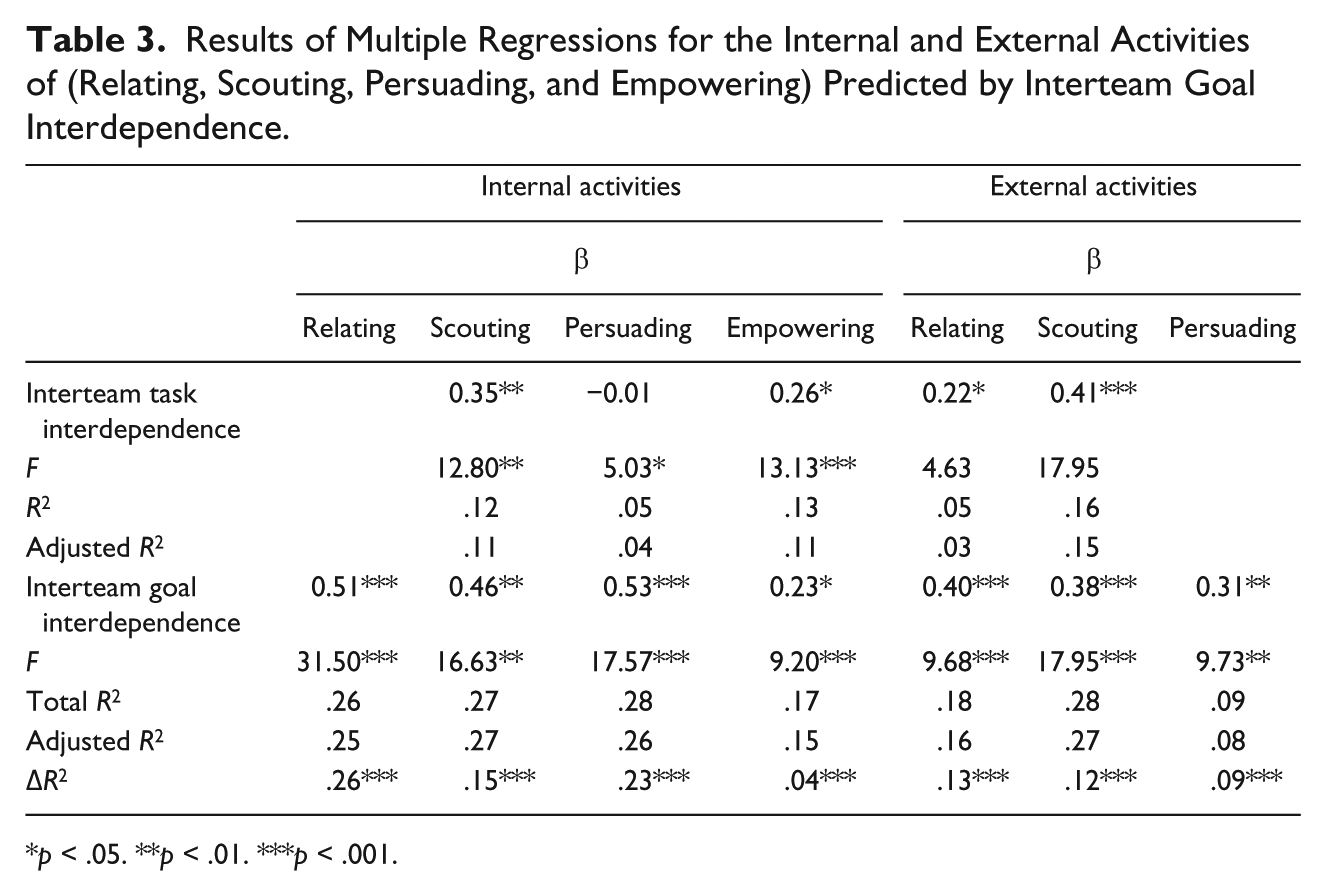
p < .05. **p < .01. ***p < .001.
Third, we aimed to identify which of the internal activity subdimensions were the best predictors of in-role performance and which of the external activity subdimensions were the best predictors of innovation. Two stepwise multiple regression analyses were conducted. In the first regression, in-role performance was used as the dependent variable. The internal activity variables of relating, scouting, persuading, and empowering were used as predictors. In the second regression, innovation was used as the dependent variable. The external activity variables of relating, scouting, and persuading were used as predictors. Regression analysis (Table 4) shows that the internal activity of relating significantly predicted the outcome of in-role performance, β = .30, p < .01, explaining 9% of variance. Regression analysis (Table 5) shows that the external activity of relating significantly predicted the outcome of innovation, β = .22, p < .05, explaining 5% of variance.
Regression Results of Internal Activities of Relating, Scouting, Persuading, and Empowering on Team In-Role Performance.

Note. F = 8.98, p < .01; R2 = .09.
Regression Results of External Activities of Relating, Scouting, and Persuading on Team Innovation.

Note. F = 4.57, p < .05; R2 = .05.
Discussion
Research indicates that interdisciplinary teams possess the potential for effectiveness (Bronstein et al., 2010; Yong et al., 2014). However, research has shown that such teams do not always achieve their potential. The present study proposes a functional leadership approach to enhance interdisciplinary team effectiveness. Both internal and external activities have been shown to serve as key mechanisms to translate the benefit of contextual factor and a team composition into improved team effectiveness. The results can be seen to imply that leaders who perform both internal and external activities may promote the effectiveness of interdisciplinary teams. Accordingly, within that context, it seems that interdisciplinary teams may need close and constant management to ensure that they become neither too sharply delineated nor too permeable. On one hand, the leader may promote team identity through internal activities. This can help team members from different functions and disciplines to have a better awareness of the other team members and their responsibilities. As part of this effort, the team leader may wish to keep a tight boundary around the team. On the other hand, through external activities, the leader can seek to avoid team isolation and help the team to maintain an ongoing information exchange with the environment in which it operates. As such, the leader can maintain a loose, flexible, and permeable team boundary (Druskat & Wheeler, 2003; Zaccaro & Horn, 2003).
The results of the subdimension analyses indicate that although interteam goal interdependence seems to contribute equally to the team leader’s internal and external activities (i.e., relating, scouting, persuading, and empowering), functional heterogeneity seems to be differentially related to the leader’s internal activities. Specifically, our analysis shows that team functional heterogeneity was positively associated with leaders’ internal activities of relating. Research has supported the premise that a given leadership function may satisfy multiple team needs and that the same team need would be satisfied by different leadership functions (Morgeson et al., 2010). Members of highly heterogeneous teams often need to learn how to share and develop cognitive, emotional, and instrumental resources so that they can properly utilize their team’s functional heterogeneity (West, 2002). As their functions and fields of expertise are subgroups of a larger academic culture, each field is likely to maintain its own specific values, processes, worldviews, and methods of communication. Research has identified discipline-specific patterns of communication and work practices as well as functional differences that can lead to conflict within interdisciplinary teams (Benner, 2001; Hall, Stevens, & Torralba, 2002). Perhaps leaders’ internal activities of relating aimed at building team trust and caring for team members’ needs are especially important because these activities encourage the formation of team norms. This may, in turn, result in a common team identity that promotes effective cooperation among the members of interdisciplinary teams. These results are in line with previous findings suggesting that one important role for the leader in heterogeneous teams is to clear up misunderstandings, improve cooperation, and mediate conflict through relationship building (Gantert & McWilliam, 2004; Kearney & Gebert, 2009; Somech, 2006).
Results show that interteam goal interdependence was positively associated with all the subdimensions of the leaders’ internal activities. It seems that to achieve highly interdependent goals, teams must first develop a shared understanding of how best to coordinate their own actions and to work together. Accordingly, with an internal focus, leaders may enable team members to work together more effectively, enhancing the team’s commitment to goal accomplishment. These results are in line with previous findings indicating that mental models that are shared with fellow team members within interdisciplinary teams are critical for team members’ ability to approach a shared problem from complementary perspectives (DuRussel & Derry, 2005).
However, and not consistent with our proposition, the findings also indicate that interteam goal interdependence is positively associated with the leader’s external activities. This may be because of a need for good communication and cooperation between teams as teams depend on each other to accomplish their goals (Barrick, Bradley, Kristof-Brown, & Colbert, 2007). Research has shown that information sharing is thought to be especially important for teams performing cognitive and complex tasks that require a high degree of interdependence (Alge et al., 2003). Kane (2010) found that when different subgroups shared a superordinate identity, the knowledge from one was more likely to be considered and used by the other. Through external activities, the leader may be able to bring the set of diverse visions into a shared understanding that speaks to all, building a consensual understanding of the organizational goals. Therefore, it seems plausible to argue that leaders of interdisciplinary teams balance the need for interteam differentiation and the maintenance of team identity by preserving a diversity of values and priorities while also promoting a common mission. As such, by facilitating the development of a common purpose (Mickan & Rodger, 2005), the leader may serve the role of coordinator between team members and constituencies external to the team (Hogg, Van Knippenberg, & Rast, 2012).
Regarding the link between leader boundary activities and team outcomes, the results show that external activities of relating were positively related to team innovation whereas internal activities of relating were positively related to team in-role performance. An emphasis on forming trusting and cooperative relationships both within the team but also between the team and external constituencies seems to promote the effectiveness of interdisciplinary teams. Through the internal activity of relating, the leader may facilitate the development of a common team identity. This may in turn enable team members to work and solve problems together more effectively and to achieve superior team performance (Goh, 2002; Kane, Argote, & Levine, 2005). Through the external activities of relating, leaders can enhance interactions with external agents, possessing a broad array of skills. Therefore, leaders can create opportunities for team members to obtain new knowledge, and debate new perspectives crucial to team innovation. This is consistent with previous studies emphasizing the importance of trust building as a prerequisite for effective communication and the commitment of members toward team goal accomplishment within interdisciplinary teams (Eigel & Kuhnert, 1996; Orchard, Curran, & Kabene, 2005). Also, these results are in line with previous findings indicating a relationship between information acquired through external activities and team innovation (Howell & Shea, 2006; Hülsheger et al., 2009).
These results may be particularly important because it can help members of interdisciplinary teams to communicate their diverse perspectives more effectively. It may also help team members to better understand and utilize these differences in a productive way. Research has shown that when team members with different values and priorities interact, they may experience greater conflict (Dougherty, 1992; Jakobsen, Hels, & McLaughlin, 2004). It may be possible then, that through the internal and external activities of relating, leaders can help reduce bias and conflict. This may be critical to interdisciplinary teams given the importance of convergent thinking to the implementation of innovative solutions (Skilton & Dooley, 2010). This, in turn, transforms the team members’ self-perceptions from us versus them to the more inclusive we, both within the team and between teams.
However, the fact that only relating activity was significantly related to the proposed outcomes may be due to some possible trade-off relationships among the subdimensions. Are leaders of interdisciplinary teams able to engage simultaneously in all four internal boundary activities? Research on teams suggests, for example, that engagement in scouting boundary activities may interfere with other boundary activities, and vice versa (Ancona & Caldwell, 1992b; Choi, 2002). Further studies may investigate the possible trade-off relationships among the subdimensions and thus provide a deeper understanding of the relationship between each activity and specific outcomes.
Finally, the results show that internal activities fully mediate the relationships of team functional heterogeneity and interteam goal interdependence to team performance. However, internal activities were not found to mediate the relationship of the proposed factors to team innovation. This finding is surprising because an examination of the correlation analysis indicates significant positive correlations between internal activities and team innovation. Similarly, the present results show that external activities aimed at building relationships with external constituencies, gathering resources, and protecting the team fully mediated the relationships of interteam goal interdependence to team innovation. However, and inconsistent with our expectations, leaders’ external activities were not found to mediate the relationship of interteam goal interdependence to team performance. This effect may be due perhaps to the mediation tests that were based on a SEM. The SEM examined pathways between contextual variables and team variables, leaders’ internal and external activity variables, and the two outcomes of interest simultaneously. We may be able to attribute this to the fact that the predictive abilities of the leader’s internal activities and external activities overshadowed and suppressed each other (Preacher & Hayes, 2008). Therefore, these findings may show two different pathways through which leaders’ boundary activities affect their teams’ effectiveness outcomes. Indeed, a model involving multiple mediators does not compare two mediators in their ability to mediate, but rather, compares their unique abilities to mediate, above and beyond any other mediators in the model (Preacher & Hayes, 2008). This is not to say that leaders’ internal activities are not important to innovation or that leaders’ external activities are not important to in-role performance. However, leaders’ external activities seem more critical when it comes to innovation, just as leaders’ internal activities seem more critical when it comes to in-role performance.
Overall, these results seem to highlight the fact that the distinctive linking role of internal and external activities between a contextual factor and a team composition to effectiveness is a more complex matter than is generally perceived. It seems that each activity promotes a distinct but potentially complementary approach to managing the interdisciplinary team, depending on the desired outcome. By examining internal and external activities as distinct activities, the study seeks to clarify the unique contribution that each type of activity can make toward improving the effectiveness of interdisciplinary teams. In line with the paradoxical approach to management, this study seeks to offer a basis for ongoing conceptual development, to move from either/or toward both/and approaches to thinking and working (Lewis, Welsh, Dehler, & Green, 2002).
Limitations and Future Research
The major strength of the present study is that the likelihood of common method variance was low because data were collected from two sources: team effectiveness (the manager) and the leader internal and external activities (team members; Podsakoff & Organ, 1986). However, several limitations in the study warrant further attention in future research. Therefore, we counsel caution in drawing generalized conclusions.
First, the data were largely self-reported and retrospective, and therefore, subject to bias. However, recent research suggests that self-reported data are not as limited as previously believed, and people often accurately appraise their social environment (Alper, Tjosvold, & Law, 1998). Second, the information on external activities relies entirely on team member ratings. These represent the team members’ perceptions of the leader’s functioning. Although these types of ratings are commonly used in leadership research, there are some potential problems with this measure. These methodological limits may call for caution in generalizing conclusions. Future studies should try to compare team members’ perceptions of the leader’s external activities with the perceptions of team leaders themselves, or external stakeholders. Doing so would help to validate the scores. Third, the uniqueness of the sampled population, as the research was conducted in an educational context in which the majority of leaders are female, restricts the ability to generalize the results to other occupations. The literature shows the impact of gender on leadership style and tendencies, with women attributing more importance to human relationships and human resources (Carless, 1998). It is critical to assess the generalizability of the present findings to male participants, as well as to larger and more heterogeneous samples (Tierney, Farmer, & Graen, 1999). Future research may investigate the differential impact of gender on the preferred focus behavior and the specific activities being studied. Furthermore, management scholars have recognized the socio-cultural environment as one of the most influential factors explaining leaders’ activities and behaviors in organizations (Dimmock & Walker, 1998; Hallinger & Leithwood, 1996; Sagie & Aycan, 2003). As the unique characteristics of the Israeli work culture are typified by low individualism, small power distance, and strong traditions of democratic and cooperative ideologies, future research may investigate leaders’ internal and external activity tendencies from a cross-cultural perspective. Future research should seek to determine whether internal and external activity profiles can be identified according to the leader’s gender and culture, and to further relate these profiles to team and organizational effectiveness.
Fourth, the cross-sectional design of the present study raises the issue of causality. The data cannot provide direct evidence of causal links between internal and external activities and team effectiveness. Conceivably, the causal order could be reversed. Nor can reciprocal causality be ruled out. Future research needs to use longitudinal designs to further validate the causal inferences suggested in the current study.
Finally, future research may investigate the interactive impact of functional heterogeneity and interteam goal interdependence on the leader boundary activities. Previous research has acknowledged that these team characteristics may have an interactive impact on leadership activities and behaviors (Drach-Zahavy & Somech, 2010). Furthermore, future research should extend the inquiry to other antecedent variables. For example, research suggests that personality traits are associated with leaders’ attitudes and behaviors; future studies may therefore investigate how the big five personality traits will influence the tendency of leaders toward internal or/and external activities (Barrick & Mount, 2005). Also, studies have examined how team members’ personality from the big five typology congruence might explain how differences among them are associated with employee outcomes and behaviors (Day & Bedeian, 1995; Neuman, Wagner, & Christiansen, 1999). Therefore, a team’s personality composition and even the fit between the team’s personality composition and the leader’s personality, applying the leader–member exchange (LMX) approach, may be related to the leader’s internal and/or external activities (DeChurch, Hiller, Toshio, Doty, & Salas, 2010). Such an investigation may extend the research into the links between team and leader characteristics and leader activities focus behavior and effectiveness.
Conclusion
Overall, the results provide important evidence that boundary leadership focus matters to interdisciplinary teams. The results further underline the importance of both types of activities and the need for carefully choosing the preferred focus boundary activity, depending on context and team composition. The proper choice can affect team effectiveness. For example, by fostering and enhancing relationship building among members of interdisciplinary teams, leaders can contribute to the development of a common team identity and improve cooperation within the team. An improved sense of team identity can, in turn, lead to a higher level of team effectiveness. Similarly, by fostering and maintaining an ongoing information exchange with the environment in which the team resides, leaders may ensure that with increased intergoal interdependence, the team will not be isolated from other teams in the organization. Therefore, investigating leader boundary management techniques designed to develop constructive teamwork processes may help in promoting the exchange of resources and information among team members and between teams, promoting better team effectiveness (DeChurch & Marks, 2006; Edmondson, 2003).
In conclusion, this study highlights the importance of more fully understanding the role of leaders’ internal and external activities in promoting interdisciplinary team effectiveness. The study proposes that leaders focus on both internal and external activities, and that they move back and forth across the team boundary to enhance overall effectiveness (both/and approach to management; Lewis et al., 2002). Our results are important for leaders seeking to enhance the effectiveness of interdisciplinary teams. On the basis of our findings, leaders’ internal and external activities may be seen as a means to unlock the effectiveness potential inherent in interdisciplinary teams. These activities can help organizations to tap the benefits of interdisciplinary teams while mitigating or preventing the possible side effects sometimes associated with interdisciplinary teams. This can help the interdisciplinary team achieve better cooperation with its counterparts, improving the use of the variety of assets and perceptions. These are important functions of modern team-based organizational frameworks because they can enable team members to identify not only with their team but also with their organization as a whole.
Footnotes
Declaration of Conflicting Interests
The author(s) declared no potential conflicts of interest with respect to the research, authorship, and/or publication of this article.
Funding
The author(s) received no financial support for the research, authorship, and/or publication of this article.