



Abstract
We assess the relative value of participative and directive leadership for improving the accuracy and speed of decision-making in crisis management teams, contingent on whether teams face an emergency that is familiar or unfamiliar to them. Testing our theory, using randomized experiments, with 72 teams tasked with managing simulated crises, we found that participative leadership improves decision accuracy in unfamiliar emergencies, whereas directive leadership improves accuracy in familiar crises; directive leadership produces speedier decisions than participative leadership when the team is familiar with the crisis. We discuss implications of our findings for leaders and crisis management experts.
Keywords
Teams today operate in multidisciplinary, dynamic, and complex environments that require speedy decisions based on incomplete information (Riolli-Saltzman & Luthans, 2001). This is especially true for crisis management teams in businesses, healthcare, and military organizations, for which theory and practical leadership guidance are sparse (Dinh et al., 2014; Hadley et al., 2011). On such teams, decision-making speed is critical (Cosgrave, 1996), because delays cause emergency situations to dangerously deteriorate. Decisions must also be accurate, requiring crisis management team members and their leaders to effectively integrate disparate knowledge and expertise (Hollenbeck et al., 1998; Humphrey et al., 2002). Yet, achieving both speed and accuracy at the same time is difficult for teams (Beersma et al., 2003). Therefore, understanding how leadership influences the accuracy and speed of decisions in crisis management teams holds practical significance as organizations increasingly invest in specialized crisis management teams (James & Wooten, 2010). We conceive of crisis management teams as a set of multidisciplinary experts brought together to coordinate their functional expertise with the purpose of determining how best to direct resources and activities in response to complex and dynamic situations that involve high time pressure and have high-stake consequences but may present incomplete information (Jobidon et al., 2017; van der Haar et al., 2017).
Leadership has a critical influence on teams (Kozlowski et al., 2016), accounting for large variance in team performance (e.g., Lorinkova et al., 2013; Martin et al., 2013). We expect leadership to also explain variance in the accuracy and speed of emergency team decisions for two reasons. First, team decisions are more proximal outcomes of team leadership than team performance (Sohrab et al., 2015) and, thus, likely more responsive to leadership behaviors. Second, teams make decisions in response to specific tasks or events whereas team performance often pertains to the aggregate outcome of multiple tasks over time.
While researchers acknowledge that leadership influences team decision accuracy (Sohrab et al., 2015) and speed (Vroom, 2003), there is surprisingly little theorizing or empirical evidence about the relative benefits of participative and directive leadership for team outcomes (Cheong et al., 2016; Pearce & Sims, 2002; Sharma & Kirkman, 2015). Even fewer empirical studies have mapped the features that mitigate or enhance the effects of different leadership behaviors on the decision-making accuracy and speed of multidisciplinary teams (Schulz-Hardt & Mojzisch, 2012). This is especially true for crisis management teams, where the extent to which a decision task is unfamiliar (vs. familiar) requires team members to interact and think in novel ways in order to arrive at accurate and speedy decisions (e.g., James, 2011).
Our study theorizes what forms of leadership are most effective in crisis management teams, an emerging area of leadership studies (Dinh et al., 2014), where findings about the influence of leadership in emergencies are mixed (Hannah et al., 2009). We posit that such effects may depend on a key feature of emergency decision problems: the extent to which they are familiar to the crisis management team and associated with pre-specified courses of action.
Adopting a contingency theory of leadership as our theoretical framework, we theorize the relative influence of participative and directive leadership behaviors on the accuracy and speed of decisions that teams make in both familiar and unfamiliar emergency decision situations. We chose to compare participative and directive leadership because we seek to contribute and extend the ongoing conversation about the relative benefits of these two leadership behaviors on newly formed teams (Lorinkova et al., 2013; Martin et al., 2013). Participative leadership refers to the subset of empowering leadership behaviors that encourage members to voice their opinions and share information to foster collective information processing and teamwork (Pearce et al., 2003; Spreitzer et al., 1999). Directive leadership, which is conceptually distinct from participative leadership (Yun et al., 2005), consists of behaviors that show team members the way, provide structure to the team, establish clear channels of communication, and seek to consolidate information (Pearce et al., 2003).
Our study makes several contributions to team leadership and team decision-making research on crisis management teams. First, by theorizing that directive and participative leadership behaviors improve distinct crisis management team decision-making outcomes (i.e., accuracy and speed), we contribute to the growing literature comparing the relative value of participative and directive leadership (Lorinkova et al., 2013; Martin et al., 2013). By explaining how the familiarity of a crisis management team’s decision task moderates the influence of leadership on crisis management team decision-making, our study further clarifies the relative advantage of unique leadership behaviors for team decision accuracy and speed. Second, our findings contribute urgently needed practical guidance to crisis management experts and trainers on the most effective behaviors for optimizing crisis management team decisions (Dinh et al., 2014; Hadley et al., 2011). Third, our empirical approach—an experimental crisis management simulation—contributes to team leadership theory by isolating the causal effect of leadership from other potentially confounding factors (Antonakis et al., 2014).
Leadership, Decision Accuracy, and Speed
Our study compares the influence of participative and directive leadership on the accuracy and speed of crisis management team decisions, which, we were surprised to find, is only sparingly documented in published studies despite the longevity of the speed-accuracy distinction in psychology research on decision-making (Humphrey et al., 2002; Woodworth, 1899). We conceive of participative and directive leadership as team-level constructs inasmuch as team leaders predominantly exhibit these leadership behaviors in leading the team. We conceive of the leader as an integral part of the team (Morgeson et al., 2010) rather than an independent decision maker. Thus, our approach agrees with both the conceptualization of team leadership and the emerging scholarship theorizing team leadership’s effects on team outcomes (e.g., Lorinkova et al., 2013; Martin et al., 2013).
Participative and directive leadership both shape team decision-making (Brodbeck et al., 2007). Some evidence shows empowering leadership, of which participative leadership is a critical component, enhances team performance (Kirkman & Rosen, 1999; Lee et al., 2018), while directive leadership behaviors hinders it (Moorhead & Montanari, 1986; Tetlock et al., 1992). Meyer et al. (2016), for example, found that when leaders empower their teams by asking questions (i.e., a participative leadership behavior), the quality of team decisions improves. Directive leadership, in contrast, is associated with groupthink (Janis, 1982). Yet, other studies show that participative leadership may backfire, for example, by burdening followers (Cheong et al., 2016), and that directive leadership sometimes enhances group decision-making processes (Kahai et al., 2004; Yun et al., 2005). Such mixed evidence suggests that contextual factors moderate the influence of leadership on team decision-making (Martin et al., 2013) and that this may also be the case in crisis management teams. Because accuracy and speed both characterize decisions but are not necessarily correlated, in a first step we isolate the influence of leadership on these distinct outcomes of decision-making. We also consider the nature of the decision task because the effectiveness of leadership may further depend on it (Durham et al., 1997).
Leadership and Decision-Making Accuracy in Crisis Management Teams
We propose that crisis management teams led with participative behaviors make decisions more accurately than crisis management teams led with directive behaviors because, compared to directive leadership, participative leadership allows more information to surface and to be more effectively integrated into a team decision. Our reasoning rests on prior evidence that participative leadership promotes information sharing (Kirkman & Rosen, 1999; Srivastava et al., 2006) and discourages premature closure in decision-making (Larson, Christensen, et al., 1998), thereby enabling synergistic thinking (DeChurch & Mesmer-Magnus, 2010), all of which should optimize decision-making accuracy. Because multidisciplinary teams require information sharing and collective thinking to make accurate decisions under high time pressures (Boone & Hendriks, 2009), participative leadership is likely to be especially beneficial for crisis management teams (James & Wooten, 2010). This may be why participative leadership is correlated with better patient outcomes on multi-specialty trauma teams whose specialized knowledge needs to be rapidly integrated, yet are expected to quickly arrive at a comprehensive assessment of the patient’s injuries (Ford et al., 2016). Managing a crisis also requires improvisation, at which participative leadership may be more effective, to simultaneously create and implement plans (James & Wooten, 2010). Directive leadership, in contrast, seeks compliance (Sims et al., 2009), punishes deviates (Emans et al., 2003), and formalizes decision-making rules (De Hoogh et al., 2015), which restricts synergistic thinking (DeChurch & Mesmer-Magnus, 2010). Hence:
Leadership and Decision-Making Speed in Crisis Management Teams
We propose that crisis management teams led by leaders using directive leadership make speedier decisions than those led by leaders using participative leadership because directive leadership provides more structure and alleviates member cognitive overload more so than participative leadership. Directive leadership keeps members on track (Kahai et al., 2004), facilitates coordination, reduces task ambiguity (Pearce et al., 2003), and gets teams to more speedily synchronize their thinking and behaviors than does participative leadership (Harrison et al., 2003). The rapid and proactive coordination provided by directive leadership may be critical to ensure speedy decisions in crisis management teams, because a crisis situation initially requires very concrete steps and basic coordination of activities (Tschan et al., 2006). In contrast, on teams with participative leaders, members may talk with each other more frequently and longer (Larson, Foster-Fishman, et al., 1998) and experience more cognitive overload (Magni & Maruping, 2013) than on teams with directive leaders. For example, participative medical leaders tend to approach cardiac arrest situations by assessing the incident with input from team members, asking questions about the patient and ensuring that relevant expertise is shared on the team (Tschan et al., 2006). Production blocking may further delay decisions in teams with participative leaders because when one person speaks, other members may be blocked from contributing or may forget their own ideas (Diehl & Stroebe, 1987) and, therefore, the team may need more time for each member to express their views before the team can come to a decision. When leaders encourage team members to speak their minds—which participative (more so than directive) leaders tend to do—the team needs more time to retrieve members’ input. Hence:
Emergency Familiarity as Moderator of Leadership Behaviors’ Relative Effects
Crisis management teams’ familiarity with an emergency is likely to moderate the relative benefits of participative and directive leadership for decision accuracy and speed. Crisis management teams are trained to expect and handle many sorts of crises but cannot be prepared for every contingency (Kaplan et al., 2013). Thus, depending on their training and experience, crisis management teams will be more familiar with some types of crises than with others. Familiar emergencies have a low variability, are known to the crisis management team, recur with some predictability, and contain pre-specified courses of action so that team members can draw upon their knowledge and experience to rapidly identify solutions (Lei et al., 2016). Unfamiliar decision-making problems, in contrast, do not conform to known situations and require improvisation and a complex, collective problem-solving approach (Fox & Ochoa, 1997; Kaplan et al., 2013; Waller, 1999; Wang et al., 2014). For example, a utility company’s crisis management teams would be more familiar with gas leaks than with large-scale infrastructure failures.
To ensure high quality decisions, crisis management teams, because of their multidisciplinarity, require members not just to share information, but also to help each other interpret and apply it (Rentsch et al., 2010). This sense-making capability is crucial when crisis management teams face unfamiliar situations, which require co-creating an understanding of the situation (van der Haar et al., 2015) by combining each member’s unique knowledge with that of others to develop an integrated action plan and anticipate joint outcomes (Endsley, 1995). It follows that leaders’ sense-giving role (Smircich & Morgan, 1982) is vital when decision-making problems are unfamiliar (Weick et al., 2005), but sense-making may look different based on leaders’ behaviors, with consequences for crisis management teams.
In unfamiliar emergencies, participative leadership further improves team decision accuracy (relative to directive leadership)
We theorize that the difference in decision accuracy between teams led with participative versus led with directive leadership is wider for crisis management teams dealing with unfamiliar (vs. familiar) task decisions, because when tasks are unfamiliar, achieving accuracy requires identifying who has the relevant knowledge as well as sharing, making sense of, and recombining dispersed, unique knowledge, which are more likely to exist when leaders employ participative behaviors.
First, leaders who use participative behaviors can more easily locate and integrate hitherto unknown expertise among members of crisis management teams, which represent multiple disciplines, than leaders with directive behaviors. Crisis management teams facing unfamiliar decision-making problems may lack cues to trigger knowledge stored among members (Schraagen & van de Ven, 2008). Unfamiliar situations also constrict team information flows (Gladstein & Reilly, 1985), leading unshared information to be suppressed or overlooked (Schulz-Hardt & Mojzisch, 2012). Consequently, leaders need to retrieve information from teams members by encouraging them to speak up and share unique insights, consulting with members, and valuing their opinions (Wang et al., 2014), all of which are participative behaviors.
Second, participative leadership is more likely than directive leadership to create team processes for information sharing and the recombination of knowledge (Harrison et al., 2003; Kirkman & Rosen, 1999; Srivastava et al., 2006). When an emergency decision does not fit a pre-existing pattern, there is no executable script to rely on and, thus, no known or identifiable response (Sommer & Pearson, 2007). Accordingly, achieving accuracy requires not just that team members participate in the decision-making process and share unique information they may possess (De Dreu et al., 2008; Waller, 1999; Wang et al., 2014) due to the multidisciplinary nature of the team, but also that they engage in collective information processing (Waller, 1999; Wang et al., 2014), reconfiguring new and unexpected information to generate an optimal decision (Jehn, 1995). In contrast, teams led with directive behaviors tend to have established norms of structured decision-making, communication, and information consolidation but not team skills, capabilities, and cognitions for collaborative learning, collective information processing, and adapting to unfamiliar situations (e.g., Burke et al., 2006).
Third, leaders facilitate inter-subjective sense-making when they empower (Patriotta & Spedale, 2009) rather than direct others. To solve unfamiliar emergencies, crisis management teams, because they are multidisciplinary, depend on collective, inter-subjective sense-making (Uitdewilligen & Waller, 2018; Weick, 1993). Communication among team members, encouraged by participative leadership, helps teams develop shared, interpretive schemes and prepares them to handle uncertainty (Weick, 1993). In contrast, directive leaders may “narrow perception and heighten habitual response” (Weick, 1995, p. 86), as they tend to “construct reality through authoritative acts” (Weick, 1995, p. 31), interpreting the situation for their team members (e.g., Morgeson et al., 2010). Hence:
In familiar emergencies, directive leadership further increases team decision speed (relative to participative leadership)
Because familiar emergency decision-making requires less information processing than unfamiliar decision-making and can rely on pre-specified courses of action (Leonard & Howitt, 2012), we theorize that the quicker decision-making predicted for directive (over participative) leadership is even quicker for crisis management teams dealing with familiar task decisions than for those in unfamiliar ones.
Directive leadership keeps members on track (Kahai et al., 2004), facilitates coordination (Pearce et al., 2003; van der Haar et al., 2017), and gets team members to synchronize their thinking and behaviors more speedily (Harrison et al., 2003). Further, in familiar emergency situations, substantial debate before coming to a decision is not just unnecessary (Gladstein, 1984; Magni & Maruping, 2013), but may also interfere with existing procedures (De Dreu & Weingart, 2003; Jehn, 1995). Familiar situations require only the sharing of information but not necessarily collaborative information processing (De Dreu et al., 2008). Rather, team members can draw upon their knowledge and experience to rapidly identify solutions (Lei et al., 2016). Sommer and Pearson (2007) have shown that, when decision makers develop habits through practice and experience, they can more speedily find a satisfying solution to problems than if they had not developed habits. Therefore, directive leaders, who act with minimal consultation (Yun et al., 2005), can speed up team decision-making considerably when decision-tasks are familiar. In contrast, in unfamiliar emergencies, teams led by directive leaders find their established decision-making rhythm disrupted (Harrison et al., 2003) by the search for novel solutions and are unable to speedily adapt to the discontinuity in their established processes. Hence:
Method
Sample
A total of 216 undergraduate students from a Belgian military academy (n = 144) and a medium-sized Dutch university (n = 72) participated in our study. Participants in both samples were intrinsically motivated to participate in a crisis management simulation: the Belgian Military Academy participants anticipate crisis management to be one of their central responsibilities, since the military is often a first responder when a natural or man-made disaster occurs. Incidentally, role-playing is a central training pedagogy in military academies such as the one we sampled from. In our university sample, participants were enrolled in an elective course on crisis management. Hence, the task was highly relevant for all participants, who consistently indicated perceiving it as a highly engaging task. Video-recordings further show that all teams took the task very seriously and did their best to optimally perform.
Participant age ranged from 18 to 29 years (M = 22.08, SD = 1.84) and 73% were male (military academy sample 81% and university sample 54%). We divided participants into 72 three-person teams and had each team participate in four scenarios (k = 288). We tested the teams in separate experimental sessions, which lasted 2 hours on average, and were incorporated into existing courses. Participants received neither course credit nor payment for participation.
Task Overview
The crisis management simulation exposed participants to an emergency decision task that required the integration of commonly and uniquely held information to make an accurate decision about how to respond to the emergency. First, we randomly assigned all participants to teams. Next, we organized each team into a two-level hierarchy comprising a formal team leader (fire brigade commander) and two subordinate staff members (police officer and chemical specialist). To do so, we followed Lorinkova et al. (2013) and, within each team, allocated the formal team leader role based on our assessment of each team member’s preferred leadership behavior as described below in the leadership manipulation section. This method ensures that the treatment conditions best reflected leaders’ predispositions for participative or directive leadership, while also maintaining all participants’ (including the leader’s) random assignments to teams and experimental conditions. Finally, once the team leader role was allocated, all other participants were randomly assigned to the two staff member roles within teams.
All teams responded to four experimental emergency scenarios (within-team factor), two of which were “familiar” conditions and two of which were “unfamiliar” conditions. All scenarios required the functional knowledge of each of the three roles to come to an accurate decision. In addition, each team member possessed the same amount of expertise as the other team members, and the expertise they possessed had equal importance for coming to a collective decision. For instance, each team needed the functional expertise of the chemical advisor (to determine the chance that an adjacent building would catch fire), of the police officer (to determine whether buildings would need to be evacuated), and of the firefighter (to determine the assignment of firefighting units to extinguish fires or evacuate buildings). To ensure consistency in how the information was distributed, the firefighting expertise was always located with the team leader. Before each experiment began, teams were explicitly reminded that they had to collectively make speedy but accurate decisions.
Procedure
The experimental procedure followed four distinct sequential steps: leadership manipulation, individual instructions and practice, team training, and the four experimental emergency scenarios. Each step is described in more detail below.
Leadership manipulation
Consistent with Lorinkova et al. (2013) and because preferences for directive or participative leadership have a dispositional source (Li et al., 2018), we manipulated leadership after all participants were randomly assigned to teams, using a two-step approach consisting of a selection and a training step, to maximize the effectiveness of the manipulation. First, we randomly assigned each team to either the participative leadership condition (N = 36) or the directive leadership condition (N = 36). Then, within each team, we assigned the team member with the highest score on the respective leadership style to become the leader. A week before each experimental session, participants took a 20-item online questionnaire (Lorinkova et al., 2013), which was used to determine their preferred leadership behavior. Participants indicated whether, and the extent to which, they felt more comfortable performing participative leader behaviors or directive leader behaviors. We selected the participants with the highest participative scores within their team to serve as team leaders in the participative leadership condition (N = 36), and participants with the highest directive scores within their team to serve as team leaders in the directive leadership condition (N = 36).
The second step of the manipulation was a short leadership training. Prior to commencing the experiments, the experimenter provided the leaders with instructions regarding their specific leader role. The instructions contained information about the behaviors that we expected the leaders to exhibit during each of the scenarios, as well as a suggested list of verbal prompts for them to use in interaction with team members. Next, the experimenter showed the leaders a 5-minute movie scene illustrating the desired leadership behaviors. The scenes were from “Cube” (participative leadership manipulation) and “Apollo 13” (directive leadership manipulation). To ensure that the leaders understood their roles, the experimenter pointed out specific leadership behaviors in the movie scenes that exemplified the leadership that the leaders would assume.
Individual instruction and practice
The experimenters also trained each team member on their role prior to the beginning of the simulation. Specifically, each member was trained in their specific role and functional expertise within the simulation (e.g., chemical advisor, police officer, and firefighter). Team members received information and formulas related to their specific role and questions to guide them through their training and assess their role understanding. For instance, chemical advisors had information about the different chemicals that could be involved in the scenarios and decision rules about when and how the presence of the chemicals could increase fire hazards. Fire commanders learned how to calculate the required extinguishing capacity, to calculate the damage costs to the buildings, and to determine whether they should go inside a building. Police officer learned rules for deciding which routes should be closed, for calculating the chance that a building would collapse, and for deciding what buildings should be evacuated. Participants read their respective instruction sheets, reviewed a map to help them visualize the disaster zones pertaining to their emergency scenarios, and completed individual training tasks, which included answering guided questions intended to clarify what kind of judgments they should make. When needed, the experimenter assisted participants with correctly answering the practice questions.
Team training
In the team training session, we gave teams two tasks, both under the condition of a “familiar” situation. The teams had 15 minutes to complete the first task and 10 minutes to complete the second one. After each task, members briefly reflected on how they performed as a team. The experimenter did not intervene. Working on the training scenarios and evaluating their performance allowed team members and, in particular, team leaders to discover the specific goals, tasks, and responsibilities of each member and how the team should respond to emergency situations under the condition of a “familiar” situation. Upon completion of the two training scenarios, the teams were considered prepared to deal with familiar situations.
Experimental scenarios
All teams completed four experimental emergency scenarios, two familiar ones and two unfamiliar ones. In each scenario team members received information regarding the time of the incident, the location and intensity of the fires, wind direction and strength, the different chemicals involved, structural characteristics of the buildings, and the number of people per building. The last three information aspects were distributed across the team members. In order to come to an optimal solution, the expertise of each member would need to be combined with scenario-specific information and integrated with the knowledge of other team members. For most judgments, a suboptimal response from one team member could create a negative cascading effect on others’ judgments, causing a team to perform sub-optimally because the decisions often required trade-offs. For instance, applying units to evacuate buildings entailed that these units could not be used to help extinguish fires in other buildings. Familiar scenarios had conditions very similar to those in the training scenarios, enabling teams to rely on pre-specified decision routines (e.g., first determining which buildings should be evacuated, second deciding how many units were needed for extinguishing and evacuation, and then closing roads to make the units available). Unfamiliar scenarios involved conditions that the team had not previously experienced or developed a decision-making protocol (e.g., much larger than usual quantities of chemicals involved; absence of one of the resources they had come to count on during practice; unexpected impossibility to extinguish all fires, requiring the need to prioritize). To prevent order effects, we presented the familiar and unfamiliar scenarios in random order, resulting in a counterbalanced experimental design. Mirroring the amount of time that nuclear power plant control teams (Stachowski et al., 2009), medical trauma teams (Härgestam et al., 2016), and emergency management command-and-control teams (van der Haar et al., 2015) need to come to a shared understanding and initial plan of action, the teams in our study had a maximum of 10 minutes to work on each scenario, after which the team leader recorded the team decision. When teams in our study faced the familiar condition, only 4.2% used the full 10 minutes to decide; in contrast, when teams faced an unfamiliar scenario, 30.6% used up the allocated time.
Measures
Perceived leadership behavior
Team members filled out surveys assessing their perceptions of their leaders’ behavior after each experimental emergency scenario. Using six items adapted from Lorinkova et al. (2013), team members evaluated the extent to which their team leader behaved in a participative or directive way (from 1 = Strongly disagree to 5 = Strongly agree). Cronbach’s alphas were .89 for participative leadership and .92 for directive leadership. We assessed within-team agreement by calculating rwg, using the expected variance of a 5-point scale with a uniform null distribution
Perceived emergency familiarity
We developed a five-item questionnaire to measure team members’ perceptions of the degree of scenario familiarity. Team members indicated to what extent the experimental scenario differed from scenarios performed during their training sessions on a scale from 0 (no difference) to 100 (very different). A sample item is, “How different from the training sessions did you consider this scenario to be?” The Cronbach’s alpha was .74. We assessed within-team agreement with the rwg-index (James et al., 1984), using an expected random variance and the formula
Decision accuracy and speed
The team decisions included the type and number of emergency units to dispatch to which specific building, which roads to close leading to the emergency zone, whether to evacuate people from buildings, etc. We computed Decision accuracy with an algorithm specifically designed for each scenario as the costs a team incurred relative to the minimal amount of costs they would have incurred if they had made the optimal combination of decisions. In both familiar scenarios, four teams reached the optimal solution and the average costs were 1.60 and 1.40 times higher than the minimal possible amount of costs. In the unfamiliar scenarios, respectively, five and two teams reached the optimal solution, and the average costs were 1.92 and 1.61 times higher than the minimal possible amount of costs. We converted the costs for each scenario to a score between 0 and 100 and then inverted the scores to facilitate interpretation (i.e., higher scores = higher accuracy). We operationalized Decision speed as the time needed to make a decision from the moment the teams were told to start reading the instructions until the moment the team leader finished entering the team decision. Team decision speed ranged from 111 to 600 seconds (i.e., the maximum time available to complete each scenario). To facilitate interpretation, we inverted the scores so that higher scores represent speedier decisions.
Analytical Strategy
We used a repeated measures design setup with four emergency scenarios nested within each team. Given the nested data structure, we used a two-level hierarchical linear modeling approach to test our hypotheses. The dependent (decision accuracy and decision speed) and moderating (emergency familiarity) variables were scenario (level 1) variables, whereas the independent variable (leadership behavior) was a team (level 2) variable. Thus, our hypothesis that emergency familiarity and leadership behavior interact in predicting decision accuracy and speed is a cross-level interaction hypothesis (Klein et al., 1994). To estimate our models, we used the nlme package in R (version 3.0.3) (Bliese, 2016). We first built an intercept-only model (Null model) for the level-1 outcome variables (decision accuracy and speed) as a baseline model for subsequent analyses, indicating how much variance in accuracy and speed exists within and between teams. Next, we entered test location (Belgium = 0; Netherlands = 1) and leader gender (female = 1) into the equation as control variables. Then, we added leadership behavior (directive = −1; participative = 1) and emergency familiarity (unfamiliar = −1; familiar = 1), allowing the slope of familiarity to vary across teams in a random-intercept, random-slope model (LaHuis & Ferguson, 2009). After that, we entered the cross-level interaction of emergency familiarity and leadership behavior into the equation. Finally, we estimated the models using the full maximum likelihood estimation method to compare model fit. Since some teams completed their tasks very quickly, one concern may be that these teams did not take the task seriously. Therefore, we ran all our analysis both with and without the teams (n = 46) that completed the task in under 5 minutes. The pattern of results was consistent for the two samples: all effects remained significant and in the same direction; thus, our results are robust to how quickly teams completed their tasks.
Results
Manipulation Checks
Leadership behavior
To assess whether leadership manipulations were successful, we trained two coders, who were blind to the experimental conditions, to independently judge the leadership behaviors in the videotaped experimental sessions (n = 45). The coders assessed the leadership behaviors with Lorinkova et al. (2013) leadership scale. When independent coders agreed that the leader “took charge of the team,” “gave instructions to the team members,” and “required team members to follow instructions,” we classified the leader as directive. When they concurred that the leader encouraged team members “to express ideas/suggestions,” “to assume responsibilities on their own,” and “to search for solutions to problems on their own initiative,” we classified the leader as participative. Cronbach’s alphas were .78 for directive and .72 for participative leadership. The mean interrater agreement index rwg (James et al., 1984), calculated using a uniform null distribution
We also considered whether team members perceived leadership behaviors differently and whether their perceptions of the leader’s behaviors were consistent over the course of the experiment (i.e., across familiar and unfamiliar scenarios). Because we measured members’ leadership perceptions four times at the completion of each experimental scenario, we conducted validity assessment using multilevel analysis, with scenarios embedded in teams. The results showed that participants in the directive leadership condition (M = 3.97, SD = 0.42) always perceived the team leader to be significantly more directive than participants in the participative condition did (M = 3.55, SD = 0.59), (γ = −.20, t = −3.37, p = .001), whereas there was neither a main effect of situation familiarity (γ = .02, t = 0.72, p = .472) nor an interaction effect between situation familiarity and leadership style in predicting perceived directive leadership (γ = −.00, t = −0.01, p > .990). Teams in the participative (M = 3.80, SD = 0.43) and directive conditions (M = 3.77, SD = 0.42) did not significantly differ in the extent to which they perceived their leader to use participative behaviors (γ = .16, t = 0.32, p > .753), and there was neither a main effect of situation familiarity (γ = .05, t = 1.81, p = .071) nor an interaction effect between situation familiarity and leadership style in predicting perceived directive leadership (γ = .01, t = 0.22, p = .827).
Our independent coders were trained to recognize the two types of leadership behaviors and observed all teams through videos, paying close, “real time” attention to leader behaviors, whereas participants evaluated leader behaviors in retrospect in survey responses. Thus, we consider that coders provided more objective and consistent determination of leaders’ behaviors than participants (Waller & Kaplan, 2018), indicating leadership manipulations were successful.
Emergency familiarity
Results of the t-test indicate that participants perceived the unfamiliar scenarios (M = 62.33, SD = 10.94) to be significantly more different from the training scenarios, in comparison to familiar emergency scenarios (M = 28.76, SD = 9.08), (t(142) = 20.29, d = 3.38, p < .001), indicating that the emergency familiarity manipulation was effective.
Preliminary Results
Table 1 presents descriptive statistics and inter-correlations among the variables in the study. The correlation between leadership behaviors and decision speed (but not accuracy) is statistically significant, suggesting that directive leadership behaviors, on average, bring about speedier decisions. A lack of statistical correlation between participative leadership and our outcomes of interest could indicate no effect—or that any effect is contingent on other factors. Decision accuracy and decision speed are both positively correlated with familiarity, meaning that when dealing with familiar decision-making tasks, team members make speedier and more accurate decisions than when dealing with unfamiliar decision-making tasks. Finally, decision accuracy and decision speed correlate positively. As this seemed contrary to what we know about decision-making (Nutt, 1976; Perlow et al., 2002), we conducted further analyses, revealing that the correlation is only statistically significant in familiar but not unfamiliar situations; both decision accuracy and speed were higher in the familiar scenarios. When testing a partial correlation, controlling for scenario familiarity, the effect is significantly reduced (r = .124, p = .036). Details of the analyses are available upon request.
Descriptive Statistics and Correlations.
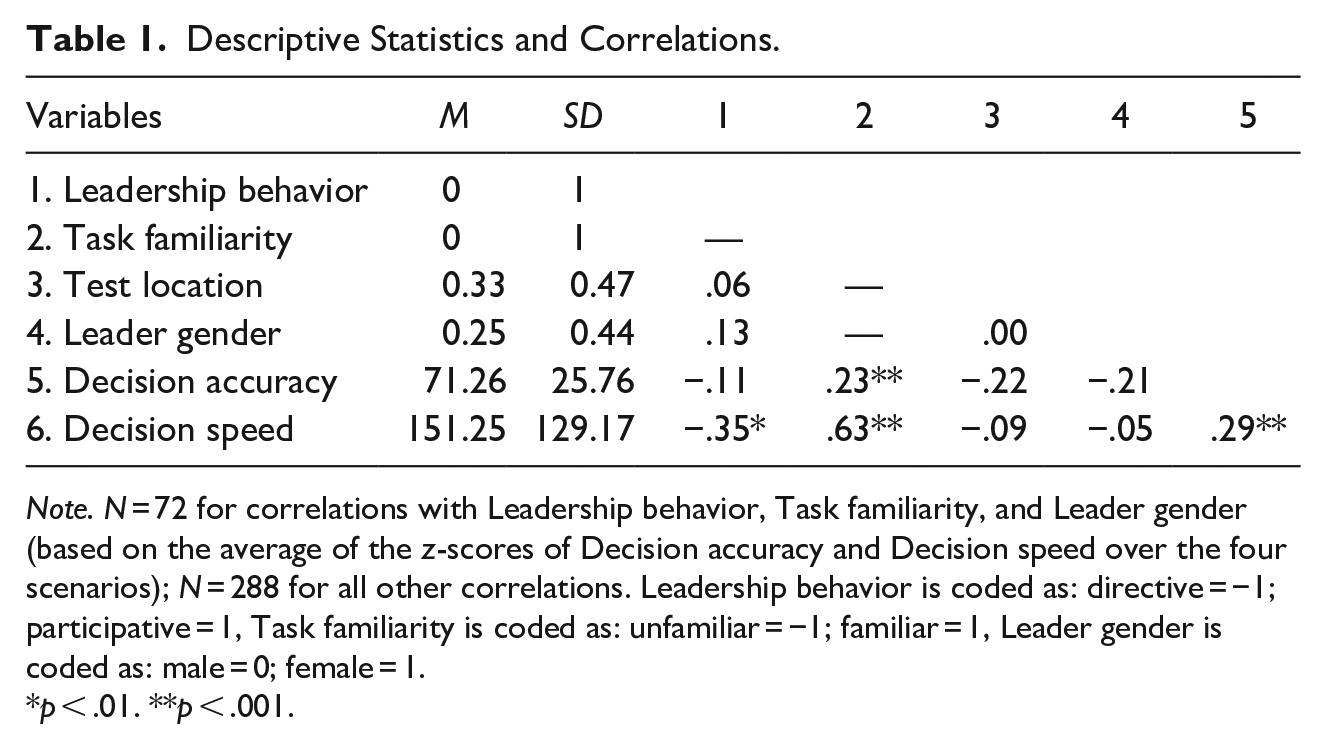
Note. N = 72 for correlations with Leadership behavior, Task familiarity, and Leader gender (based on the average of the z-scores of Decision accuracy and Decision speed over the four scenarios); N = 288 for all other correlations. Leadership behavior is coded as: directive = −1; participative = 1, Task familiarity is coded as: unfamiliar = −1; familiar = 1, Leader gender is coded as: male = 0; female = 1.
p < .01. **p < .001.
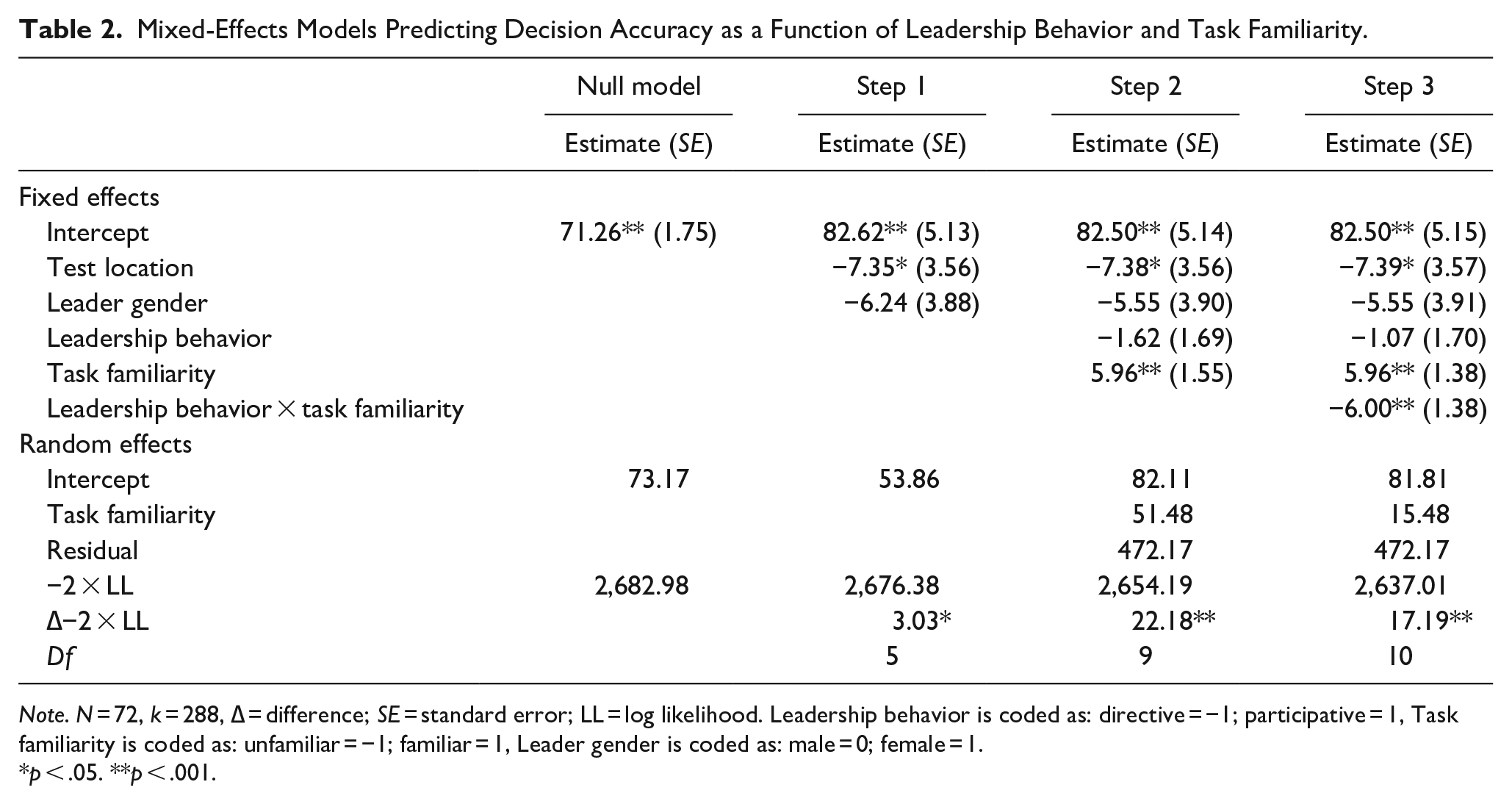
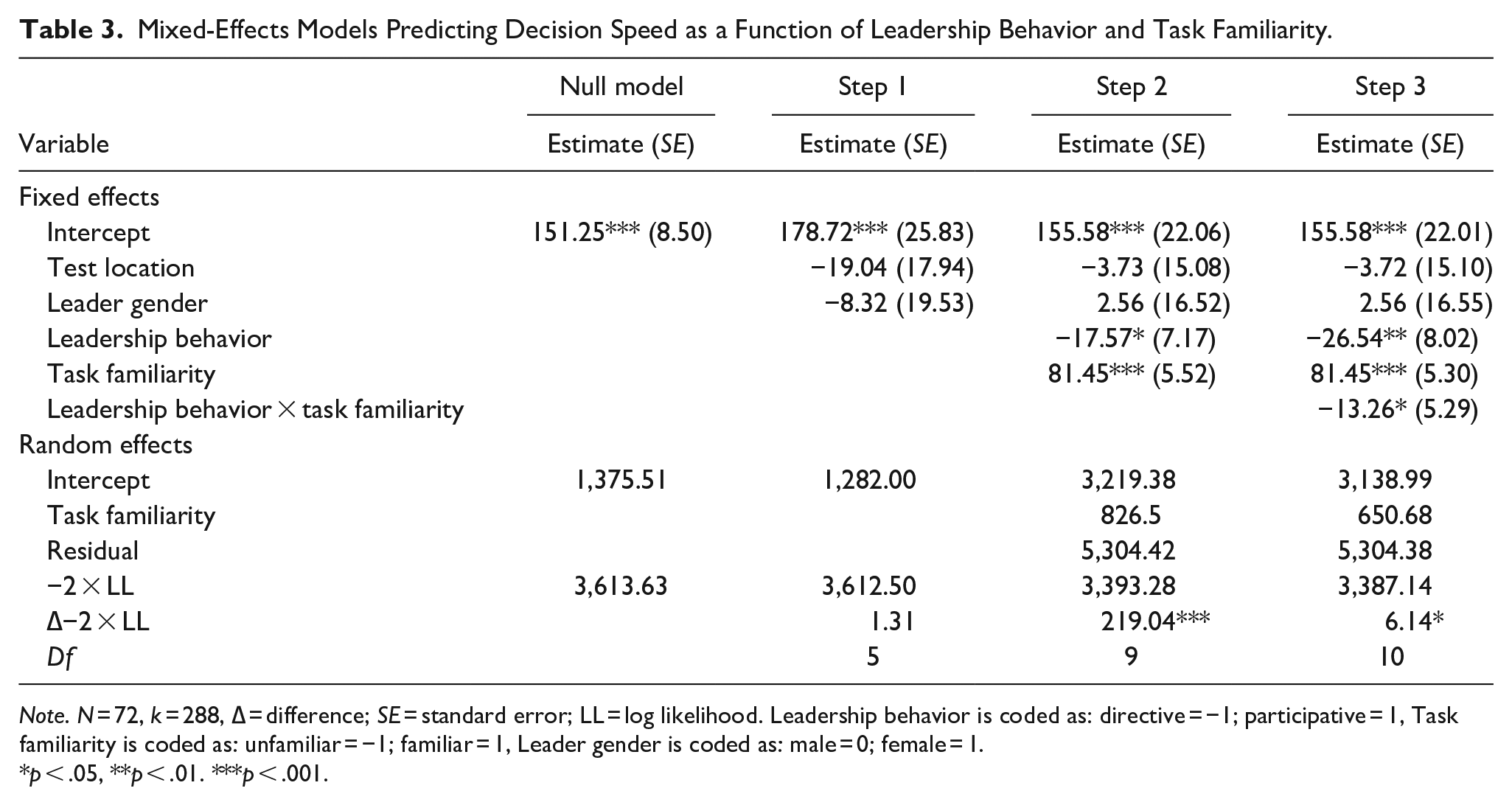
Before testing the hypotheses, we ran intercept-only models to examine whether there was systematic between-team variance in the dependent variables. We used ICC(1) as an index of non-independence for the dependent variables (Bliese, 2016). For decision accuracy, ICC(1) was .11, F(71, 216) = 1.52, p = .012; for decision speed, it was .09, F(71, 216) = 1.38, p = .041. These values indicate that there is a substantial amount of between-team variance in the dependent variables (LeBreton & Senter, 2008). The results are shown in Tables 2 and 3.
Mixed-Effects Models Predicting Decision Accuracy as a Function of Leadership Behavior and Task Familiarity.
Note. N = 72, k = 288, ∆ = difference; SE = standard error; LL = log likelihood. Leadership behavior is coded as: directive = −1; participative = 1, Task familiarity is coded as: unfamiliar = −1; familiar = 1, Leader gender is coded as: male = 0; female = 1.
p < .05. **p < .001.
Mixed-Effects Models Predicting Decision Speed as a Function of Leadership Behavior and Task Familiarity.
Note. N = 72, k = 288, ∆ = difference; SE = standard error; LL = log likelihood. Leadership behavior is coded as: directive = −1; participative = 1, Task familiarity is coded as: unfamiliar = −1; familiar = 1, Leader gender is coded as: male = 0; female = 1.
p < .05, **p < .01. ***p < .001.
Test of Hypotheses
First, we examined the main effects of leadership behaviors on decision accuracy (H1) and speed (H2). Step 2 in Table 2 shows that leadership behaviors did not have a significant main effect on decision accuracy, failing to support H1. Step 2 in Table 3 shows that leadership behaviors have a significant main effect on decision speed: teams where leaders used directive behaviors made their decision more speedily than teams where leaders used participative behaviors, supporting H2.
Next, we examined the interaction effects between leadership behavior and task familiarity on the two outcome variables. We predicted that the greater accuracy associated with participative leadership (over directive leadership) in crisis management teams is even more pronounced when task decisions are unfamiliar than when familiar (H3). Supporting H3, leadership and emergency familiarity interacted in predicting decision accuracy (γ = −6.00, p < .001; Table 2, step 3). To clarify our results, we also conducted simple t-tests comparing the teams’ average accuracy between teams with a directive and participative leader. Results showed that in unfamiliar situations, teams with participative leaders made more accurate decisions than teams with directive leaders (t = −2.091, df = 70, p = .040), whereas in familiar situations, teams with directive leaders made more accurate decisions than teams with participative leaders (t = 3.492, df = 70, p < .001). Figure 1a illustrates the interaction effect. By adding the cross-level interaction of emergency familiarity and leadership style, the model improved significantly (Δ−2x log = 19.69, ∆df = 1, p < .001).

Interaction of leadership behavior and decision task familiarity (vs. unfamiliarity) predicting team decision accuracy (a) and speed (b).
H4 predicted an interaction effect between leadership style and emergency familiarity on decision speed, such that teams with directive leadership would make speedier decisions than teams with participative leadership, and more so in familiar decision-making tasks. Supporting H4 (Table 3, step 3), leadership behaviors and emergency familiarity interacted in predicting decision speed (γ = −13.26, p < .013). Further, the model fit improved significantly when adding the cross-level interaction of emergency familiarity and leadership style (Δ−2x log = 6.14, ∆df = 1, p < .013). Results of simple t-tests showed that, in familiar situations, teams with directive leaders made their decisions faster than teams with participative leaders (t = 3.475, df = 70, p < .001); whereas speed of decision-making in unfamiliar situations did not differ significantly (t = 1.805, df = 70, p = .075). We graph the effect in Figure 1b.
Discussion
Our study addresses the theoretical challenge of determining what forms of leadership are most effective in crisis management teams. We resolve ambiguities about the relative effects of participative and directive leadership with two central features of our theory: we examine effects of leadership style on teams’ decision-making accuracy and speed simultaneously; and we introduce as contingency the team’s familiarity with the emergency decision task. Our study is one of a small but growing number (Cheong et al., 2016; Pearce & Sims, 2002; Sharma & Kirkman, 2015) identifying the conditions that mitigate or enhance the effects of different leadership behaviors on decision-making accuracy and speed of multidisciplinary teams, particularly crisis management teams. We used randomized experiments, an ideal research design in leadership studies (Antonakis et al., 2014), and a realistic crisis management simulation, with a sample of 216 undergraduate student teams, of which 144 teams are training in a Belgian Military Academy in preparation for roles that include crisis management.
Theoretical Implications
Our findings extend previous research in several ways. First, while evidence suggests that participative leadership is not advantageous in all contexts and to all followers (Cheong et al., 2016; Lee et al., 2018; Sharma & Kirkman, 2015), we add to the small number of studies that directly compare the effectiveness of participative and directive leadership on team outcomes (Lorinkova et al., 2013; Martin et al., 2013; Yun et al., 2005), focusing on crisis management teams. Findings from our laboratory experiment of a simulated crisis context showed that neither leadership style is a priori better than the other. Participative leadership helps crisis management teams make more accurate decisions in unfamiliar emergency situations, presumably by identifying who has the relevant knowledge, promoting the sharing of information, and helping the team make sense of and recombine dispersed, unique knowledge. However, these leadership behaviors also appear to inhibit accuracy in familiar emergency decisions and slow teams down in both familiar and unfamiliar emergency situations. In contrast, directive leadership helps teams to rapidly identify solutions, but in the process of doing so, may hamper decision quality, particularly when the decision tasks are unfamiliar. By offering fresh evidence of the relative benefits and drawbacks of participative and directive behaviors for teams dealing with emergency decision tasks, we encourage future research to explore how different leadership behaviors affect team outcomes in emergency, crisis, and dangerous situations. We note that our study focuses on what leaders actually do while interacting with their followers and not so much on what they should do or typically do. As such, our study evaluates the effect of leaders’ behaviors while interacting with their followers (Hannah et al., 2014). A focus on leader behaviors is helpful because it “creates a better understanding of how leaders can draw from a host of potential behaviors from multiple models of leadership, and how these models are more or less effective across time and context” (Hannah et al., 2014, p. 602).
Second, our study advances contingency leadership theory by identifying teams’ familiarity with an emergency decision as a key condition that moderates the effects of participative and directive leadership on crisis management decision-making, in a simulation setting. Our findings may also apply more broadly to teams not specifically trained to tackle, but nevertheless likely to face, emergencies (e.g., top management teams, board of directors). For example, pharmaceutical and medical devices firms regularly face product recalls, which are emergency situations. Recalls may be familiar (e.g., in the extent of their negative impact and the scope of products affects) or unfamiliar (e.g., resulting in fatalities or very large in scope). On top management teams facing such recalls, the CEO’s leadership behaviors may affect the correctness of the recall decision and the speed at which it is initiated.
Third, we advance research on the relevance of two team decision outcome characteristics, accuracy and speed. Studies examining the effects of participative and/or directive leadership tend to focus on overall team performance as an outcome, with mixed results (Cheong et al., 2016; Kahai et al., 2004; Yun et al., 2005). Our findings suggest that a single leadership behavior may have opposite effects on the distinct performance outcomes of accuracy or speed, thereby highlighting the importance of distinguishing between various decision-making performance indicators in evaluating the effectiveness of different leadership behaviors.
Fourth, our empirical approach—an experimental emergency management simulation—contributes to the contingency approach to leadership theory by isolating the effect of leadership from other, potentially confounding factors. As such, it contrasts with leadership studies that do not correct for endogeneity issues. Our study, therefore, helps advance leadership research by ruling out endogeneity as an alternate explanation for leadership effects (Antonakis et al., 2014).
Practical Implications
Our findings suggest at least three strategies for organizations seeking more accurate and speedier decisions from their crisis management teams. First, teams may be staffed with predominantly participative or directive leaders, depending on the characteristics of the situations they face (i.e., directive for teams facing more familiar situations and participative for teams facing more unfamiliar situations). This approach has the benefit of stability: team members will know what to expect from their leaders; however, it may lead to suboptimal functioning in situations that require leadership behaviors that are contrary to the team leader’s preferred behavioral approach. This may occasionally lead to high costs; for instance, a directive leader on a team that is unexpectedly faced with a complex crisis may lead to low-quality decision outcomes.
Second, since crisis management teams face a variety of situations, team leaders should be trained to adaptively switch between leadership behaviors (Klein et al., 2006; Yukl & Mahsud, 2010). Several scholars have pointed out the pivotal role of leadership in teams adapting to different situations (e.g., Burke et al., 2006). While teams, when led with participative behaviors, may be capable of adapting their processes (e.g., communication, coordination, and cognition) during unfamiliar events, the same may not be true for teams led with directive behaviors. Therefore, if team leaders can adjust their behavior to situational demands, teams should benefit.
Third, for leaders to adjust their behavior to best fit the situational demands, they first need to be able to correctly assess the situation. People have the tendency to search for and interpret information in a way that supports one’s existing beliefs (Nickerson, 1998). Therefore, one could expect many crisis teams to exacerbate crisis situations by combatting the crisis with the mistaken belief that it is a familiar situation and can be managed with rote directive leadership, only to realize too late that the situation is fundamentally different and should be approached with a more empowering/participative leadership strategy. (We are indebted to one of our anonymous reviewers for this insight.) Weick’s (1993) account of the Mann Gulch disaster is a telling example of erroneous group decision-making due to inaccurate situational awareness. Given the biases that lead people to believe a situation is more familiar than it actually is, our results should at a minimum stimulate emergency management crisis trainers—but potentially also encourage firms that rely on such teams—to help teams recognize situations with more unfamiliar patterns of parameters. Crisis management teams operating in complex and dynamic environments are advised to enhance their situational awareness to help leaders adopt leadership behaviors that best fit the team’s emergency decision task.
Limitations and Suggestions for Future Research
Like any research, our study has limitations that also present opportunities for future research. First, our sample comprises only undergraduate students and mostly men. While student subjects are not inherently problematic in experimental research (Druckman & Kam, 2011), future studies may seek to replicate our work with a gender-balanced sample of working adults in crisis management teams. Also, while in this study, the focus was on emergency decision-making in crisis management teams, future research may want to investigate whether similar results occur with other types of multidisciplinary teams (e.g., top management teams) facing emergencies. Such research could clarify how our findings about the effects of participative and directive leadership may differ across team characteristics (e.g., distributed vs. shared knowledge) and context (e.g., loss of lives vs. loss of capital).
Second, while our independent coders, blinded to our experimental conditions, reported differences in the behaviors of leaders in the directive and participative conditions, team members themselves did not significantly differ in the extent to which they rated their leader as using participative leadership behaviors. This inconsistency could stem from response biases, which are more likely to cloud participants’ than independent coders’ ratings of leader behaviors (Gioia & Sims, 1985; Podsakoff et al., 2003). According to implicit leadership research, individuals’ idiosyncratic beliefs about leadership color how they respond to surveys retrospectively asking about their leaders’ behaviors (Feldman, 1981). The discrepancies between recollected and actual leader behaviors are not trivial and increase with individuals’ knowledge about the leaders’ prior performance (Martinko et al., 2018). While we are confident in our decision to rely on independent coders’ objective judgments of each leader’s behaviors (Waller & Kaplan, 2018), team members’ leadership behavior perceptions could affect their attitudes toward the team’s decision and success and, ultimately toward their leader, suggesting new avenues of research.
Third, while our experimental design, which relied on a sample of teams performing realistic crisis management exercises, helped us reduce endogeneity, this comes at the expense of capturing the complexity of real-world decision-making problems. One inherent drawback of an experimental design with dichotomous variables (i.e., leadership style and emergency familiarity in this study) is that it does not allow us to draw conclusions on the exact minimum and maximum level of the variables at which our effects will occur. Moreover, while we draw on parameters from real crisis management teams to construct the simulation, our experiment may not entirely capture the experience of real-world crisis management teams (Kleinmuntz & Thomas, 1987) that confront dynamic problems and must continuously adapt to ever-changing circumstances. In addition, real-world emergency decision tasks likely sit somewhere along a continuum from high to low familiarity, rather than squarely qualify as familiar or not. Also, research has revealed that effective leaders are not limited to one leadership style but use several types of leadership behaviors (Yukl & Mahsud, 2010). That is, leaders may switch back and forth between directive and participative leadership. Future research may, thus, benefit from longitudinal designs wherein real crisis management teams confront emergencies that evolve over time from familiar to unfamiliar decision-making problems (or vice versa) and wherein leaders are not constrained to use only one set of leadership behaviors.
Fourth, we did not consider leadership experience as a decisive variable in our study. However, experience is an important prerequisite for accurate decision-making in familiar situations since leaders must be able to use previously compiled knowledge to determine how useful a solution to the problem might be (Fox & Ochoa, 1997). In our study, all teams and team members received the same training for dealing with routine emergency situations. Future research could examine whether our findings hold when team leaders and members vary in level of experience. Moreover, although in our sample, teams were randomly assigned to conditions, within the teams the leaders were not randomly selected but assigned based on their scores of the leadership preference scale in the pre-questionnaire. While this does not change the randomness of the composition between groups, it could potentially change the distribution of disposition variables within the group, between the members and the leader.
Conclusion
This study reveals the effects of participative and directive leadership on team decision-making when performing a realistic crisis management exercise, extending previous research on the relative advantages and disadvantages of different leadership behaviors. It was shown that leadership style has different effects on teams’ decision-making in terms of accuracy and speed, and that these effects depend on the team’s familiarity with the emergency decision task. Future studies that evaluate the mechanisms through which these leadership behaviors influence distinct performance outcomes of crisis management teams and of teams more generally would further contribute to contingency theories of leadership.
Footnotes
Declaration of Conflicting Interests
The author(s) declared no potential conflicts of interest with respect to the research, authorship, and/or publication of this article.
Funding
The author(s) received no financial support for the research, authorship, and/or publication of this article.
