




Abstract
Within scientific teams, a culture of community (the facilitation of shared values, goals, and an environment where individuals feel valued and want to engage in a team’s work) has implications for members’ learning and participation, and the team’s functioning, cohesion, and productivity. Drawing on 12 focus group interviews conducted over four years with 23 participants, we used an autoethnographic approach to examine how a research team developed a positive culture of community that influences its cohesion and productivity. We present six interconnected cultural practices that can foster a culture of community in settings where team-based learning and collaborations are required.
In a global context where complex issues require critical and immediate solutions, scientific teams have proven to be essential. Through the inclusion of individuals with diverse backgrounds, experiences, and knowledge, scientific teams facilitate innovation beyond that which individuals alone can generate (DeHart, 2017; Fiore, 2008; Horowitz et al., 2017). A growing constellation of research offers recommendations for the design and leadership of teams and communication within them, all with the aim of creating communities of practice (CoPs) that are cohesive and productive (Carter et al., 2019; Schwarz & Bennett, 2021; Wildman & Bedwell, 2013). As CoPs, scientific teams share knowledge, resources, and practices to meet their goals. Yet, such a collection of individuals, designated a “community,” may need more to facilitate their team’s cohesion and productivity.
Based on existing team science scholarship, we argue that a culture of community is necessary for sustaining team cohesion and productivity. While a culture of community facilitates sharing values and goals to guide how individuals engage and work together, it also helps create and maintain an environment in which individuals feel valued and want to engage in the team’s work (McMillan & Chavis, 1986). Despite its importance, knowledge is scant regarding the practices that influence a culture of community. More information about developing a culture of community within scientific teams is necessary for understanding and implementing practices to enhance team cohesion and productivity.
Establishing a scientific team that fosters a culture of community is neither easy nor automatic, and exactly how a culture of community influences a team’s cohesion and productivity remains unclear. This longitudinal, autoethnographic qualitative study of one scientific team comprised of students (undergraduate, master’s, and doctoral) in the field of education provides insights into our team’s culture of community. These insights, drawn from student team members’ voices, coalesce into six cultural practices of team science that have facilitated the development and sustainment of cohesion and productivity within our team. The findings inform a new theoretical model (the Team Culture of Community Model), and offer implications for future studies of team design and learning and for developing a culture of community in other settings where team-based collaborations are required.
Literature on Scientific Teams
Teams of all kinds can be considered CoPs in which newer members aspire to become full participants and enact behaviors associated with the community (Langevin Harnois et al., 2018; Phillips & Russell, 1994). Newer members learn to navigate the community’s norms, language, and practices by observing and socially interacting with more advanced members (Feldon et al., 2015; Lave & Wenger, 1991; Rogoff, 1990). In addition, they may feel a sense of belonging to the community and develop a sense of responsibility and commitment to the betterment of the team (McMillan & Chavis, 1986; Strayhorn, 2012). Most germane to this study are CoPs that are scientific teams.
In an array of fields (e.g., architecture, psychology, and science, technology, engineering, mathematics [STEM]), scientific teams may also be known as research groups, research labs, or research teams. These scientific teams are formal structures where teaching and learning take place, much like the classroom is the primary social location for learning in other fields of study (Burt, 2017, 2019; Crede & Borrego, 2012; Wofford & Blaney, 2021). Metrics for scientific teams’ productivity may vary, but are likely to include research grants, patents, publications, and other forms of external dissemination of research findings (Abramo et al., 2009; Brahm et al., 2011; Griffin, 2012; Lee & Bozeman, 2005). Because the nature of research deliverables tends to differ, usually around disciplinary expectations of merit, so too do the nuanced practices implemented to meet teams’ goals. How a scientific team is designed, the practices implemented to meet its objectives, and how members’ learning is facilitated by the team all provide insights into some characteristics that foster a team’s cohesion, productivity, and community.
Team Design That Facilitates Productivity and Cohesion
A team’s design includes its composition, formation, leadership, and the decision-making processes that went into determining how it would be structured and function (Bresman & Zellmer-Bruhn, 2013; Carter et al., 2019). A team’s design is crucial to its cohesion and productivity (Fiore, 2008; Schwarz & Bennett, 2021). For instance, how a team functions relates in part to how it is formed (Feldman et al., 2013; López-Yáñez & Altopiedi, 2015; Nersessian et al., 2003). Crede and Borrego’s (2012) mixed methods study of engineering graduate students showed that team size and composition (e.g., postdoctoral, doctoral, master’s, undergraduate students) influenced how members learned to do the work necessary to meet the team’s goals. They found that the size of the group had implications for how members performed their work and interacted with each other, and for the space required to accommodate members’ work and interactions. In another ethnographic mixed methods study of students within scientific teams from a variety of disciplines (i.e., archeology, ecology, rheology, health psychology), López-Yáñez and Altopiedi (2015) reported that teams that were formed with a plan for cohesion, rather than as a collection of individuals, fostered greater collaboration within the team. According to the authors, because the cohesive teams were established with a plan for who members would be, they were better able to intentionally structure research tasks around the members. In this example, how the team functioned vis-à-vis its practices and learning behaviors (explained more below) was in part based upon the team’s design and what its goals were.
One aspect of team design that receives mixed findings is how team composition—specifically related to individuals’ educational backgrounds, race/ethnicity, and gender, etc.—influences teams’ effectiveness and productivity. While scholars agree that teams are more beneficial to innovation than individuals (DeHart, 2017; Fiore, 2008), there is no definitive clarity regarding how a team’s diverse composition contributes to its innovation. McLeod et al.’s (1996) study of students placed in groups (some racially/ethnically homogeneous and others heterogeneous) showed that racially/ethnically heterogeneously composed groups produced ideas of higher quality than homogeneously composed groups. However, the study also found that members in homogeneously composed groups expressed greater affinity for their groups than those in heterogeneously composed groups, which might explain the prevalence of group conflicts in diverse groups. These patterns, along with other inconsistent findings on team science (see additional examples in Carter et al., 2019; Salazar et al., 2012), complicate understandings of and justifications for diversely comprised teams.
Learning Behaviors and Team Participation
Scientific teams incorporate learning behaviors (i.e., activities and processes) into regular practices that facilitate team members’ participation and development (Bresman & Zellmer-Bruhn, 2013). Scholarship on learning behaviors illustrates that learning occurs through interacting with members in a community, leading an individual to fully participate in the practices of the team (Lave & Wenger, 1991). Team members learn how to navigate the organizational culture, use the laboratory’s equipment and research procedures, and participate in other team practices (e.g., write proposals, disseminate research) necessary for engaging in the team’s work (Burt, 2017, 2019; Crede & Borrego, 2012). These learning behaviors are often characterized by the intergenerational sharing of knowledge (e.g., faculty supervisor to students; advanced student peer to novice peer) (Burt et al., 2017; DeHart, 2017; López-Yáñez & Altopiedi, 2015). For example, Crede and Borrego (2012) found that more advanced graduate students introduced newer members to existing members, demonstrated how to use lab equipment, and offered strategies for navigating their shared lab space. Their findings highlighted that shared knowledge gets transmitted through learning behaviors and simultaneously promotes positive collaborations (i.e., cohesion).
Team Practices and Their Effects on Productivity and Cohesion
A team’s practices also influence cohesion and productivity (Brahm et al., 2011; Langevin Harnois et al., 2018). Extant research offers a wide range of practices that have been hypothesized, tested, and implemented to improve team effectiveness (see e.g., Wildman & Bedwell, 2013). This research on team practices provides information on team member tasks, leadership, accountability structures, ways of communicating, etc. to detail the expectations of team members’ contributions to achieving a group’s goals (Wildman & Bedwell, 2013). As an example, Feldman et al.’s (2013) study of four science and engineering teams comprised of undergraduate and graduate students described a typology of team practices. They found that tightly organized teams tended to more regularly meet, exchange knowledge and use members’ existing skills, include formal and informal discussions, share space, and share research tasks. They also found that teams that modeled these behaviors tended to have community-building social practices (e.g., cookouts, special gatherings for team celebrations), which increased team cohesion by bringing team members together informally, outside of formal research. These social practices provided additional opportunities for team members to interact with each other, albeit in informal, lower-stakes settings. In contrast, more loosely organized teams tended to promote independent work; despite sharing a common space, members’ research might be independently, rather than collaboratively, completed. Feldman et al. (2013) argued that in loosely organized teams, members felt more isolated. Their findings show that team practices vary, in part based on the team’s design and its goals. Additionally, their findings highlight the interplay between how a team is designed (e.g., tightly vs. loosely coupled), its practices, and students’ connection to and satisfaction with the team.
One aspect shaping the practices of a team relates to its leadership structure (e.g., hierarchical, horizontal; Carter et al., 2019; Guerin et al., 2013). Guerin et al.’s (2013) study of doctoral student team members (i.e., seven women and one man from different public health disciplines) reported that members felt isolated until they formed a writing team with shared leadership, a practice that distributes a team’s leadership across its members. The team, agentically formed based on each member’s need, generated a shared sense of purpose, allowing members to focus on agreed-upon writing goals and see connections between their work despite their varied fields of study. In this example, the shared leadership model encouraged team members to equally invest in the team, which enhanced their team experience and learning.
In the literature reviewed, team cohesion and productivity appear to be outcomes of a team’s design and learning behaviors, and its members’ participation and practices. Although there is a wide range of organizational and team science scholarship hypothesizing and quantifying how teams are designed and how newer members become socialized into teams (Burt, 2019; Hollingsworth & Fassinger, 2002; Stewart, 2006; Wildman & Bedwell, 2013), it remains less clear how cultures of community themselves (i.e., teams about which members have positive feelings and to which they want to belong) relate to a team’s cohesion and productivity. Scholarship that can establish the connections between cultures of community, cohesion, and productivity, and teams’ design, learning behaviors, and practices can offer valuable insights for teams’ development and sustainability. In addition, because scientific teams are not all the same, discipline-based investigations may identify new cultural practices related to specific scientific goals and disciplinary contexts. Thus, this study addresses the following research questions: How do team design, learning behaviors, and participation relate to a scientific team’s—in the field of education—culture of community? And, how does a team’s culture of community assist in its development and sustainment of cohesion and productivity?
Methods
To gain a better understanding of a team’s culture of community, this autoethnographic study included 12 focus group interviews with 23 members of an education research team conducted between Fall 2015 and Spring 2019 (including seven cohorts). The team was located at a university of very high research activity in the United States (Carnegie Classifications of Institutions of Higher Education, 2020). Similar to ethnography, autoethnography is the “analytic demonstration of how we come to know, name, and interpret personal and cultural experience” (Adams et al., 2015, p. 1). The authors of this article include a faculty member (principal investigator), one doctoral student, and four staff members at different universities (all of whom were master’s students in this study’s research team at the time of data collection and initial data analysis; more information about the data analysis process is provided below). The autoethnographic methodological research design was chosen because of the desire to both capture and make sense of the team’s cultural norms and practices. Further, autoethnography offered techniques to examine the team’s culture from both the emic (insider–team member) and etic (outsider–researcher) perspectives (Merriam & Tisdell, 2016). Thus, this research design offered the opportunity to explore and identify nuanced practices that contribute to the team’s culture of community.
Data Collection
Upon gaining institutional review board (IRB) approval, focus group interviews were conducted for data collection. Guided by a social constructivist paradigm (Bhattacharya, 2017; Creswell & Poth, 2018), which suggests that individuals co-construct meaning and that multiple meanings (or truths) can exist, focus group interviewing encourages generative conversations between individuals with multiple perspectives and experiences, resulting in rich data (Creswell & Poth, 2018; Merriam & Tisdell, 2016). The focus group interview design also provided an opportunity for ethnographic observation of the communicative ways members worked together to make meaning (i.e., answering complex questions together in interviews). Thus, this data collection strategy was intentionally chosen to capture how members describe their individual team experiences, and to observe how members of this highly participatory and collaborative team build on the ideas expressed by others.
Interviews took place at the end of each semester. Members were invited to voluntarily participate and were told that continued membership did not depend on focus group participation. To implement this convenience sampling strategy (Merriam & Tisdell, 2016), interviews were generally scheduled during reserved team meeting times to make it easier for members to participate if they wanted. Twenty-three members volunteered to participate over the duration of data collection. Each focus group consisted of different members, and 12 members participated in more than one interview, resulting in a total of 41 participant voices over the four-year study (See Table 1). Based on their self-identifications, of the 23 participants, 12 were female and 11 were male; one was an undergraduate, 20 were master’s students, and two were doctoral students; eight were Black, four were Latinx, nine were White, and two were multi-racial; none had prior research team experience before joining this team. See Table 1 for each interview’s composition.
Interview Attendance and Demographics.
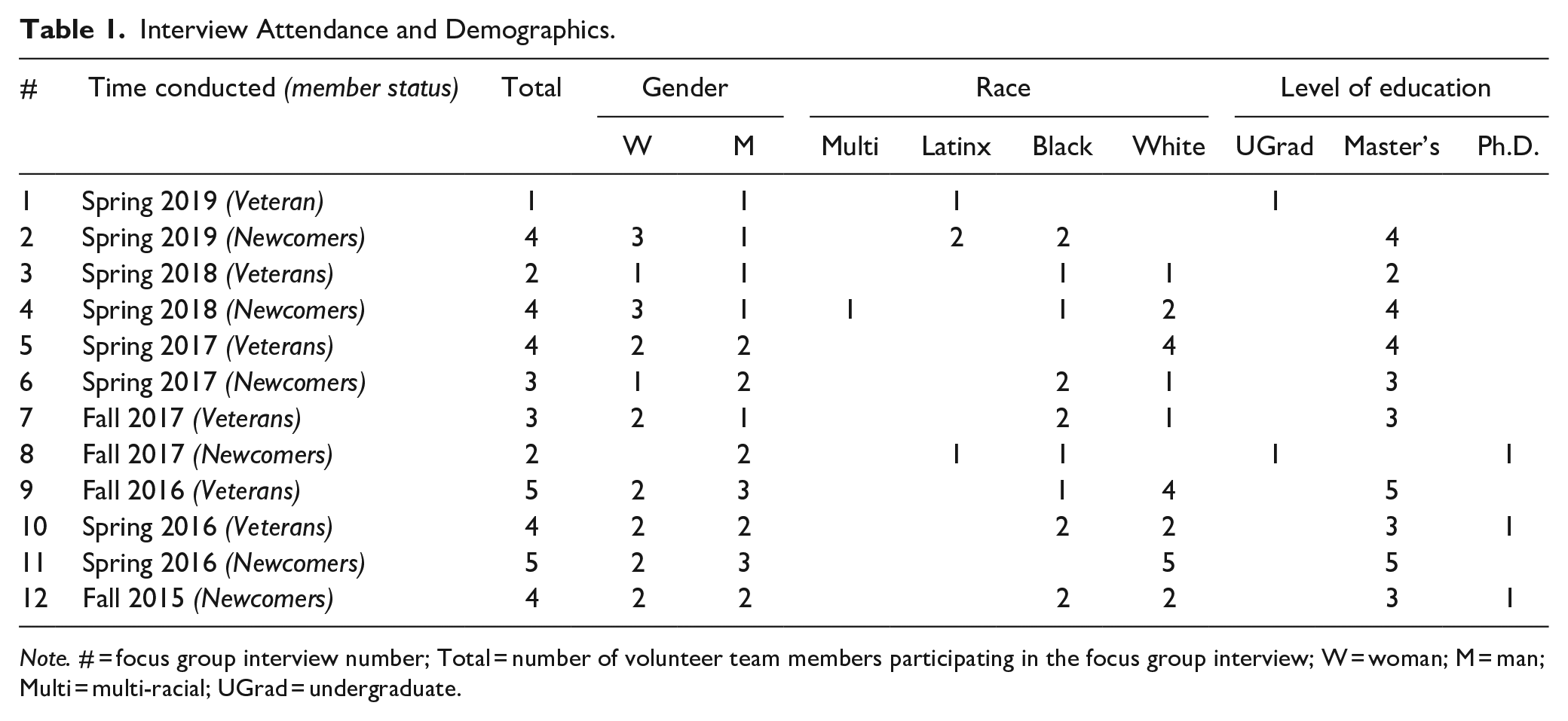
Note. # = focus group interview number; Total = number of volunteer team members participating in the focus group interview; W = woman; M = man; Multi = multi-racial; UGrad = undergraduate.
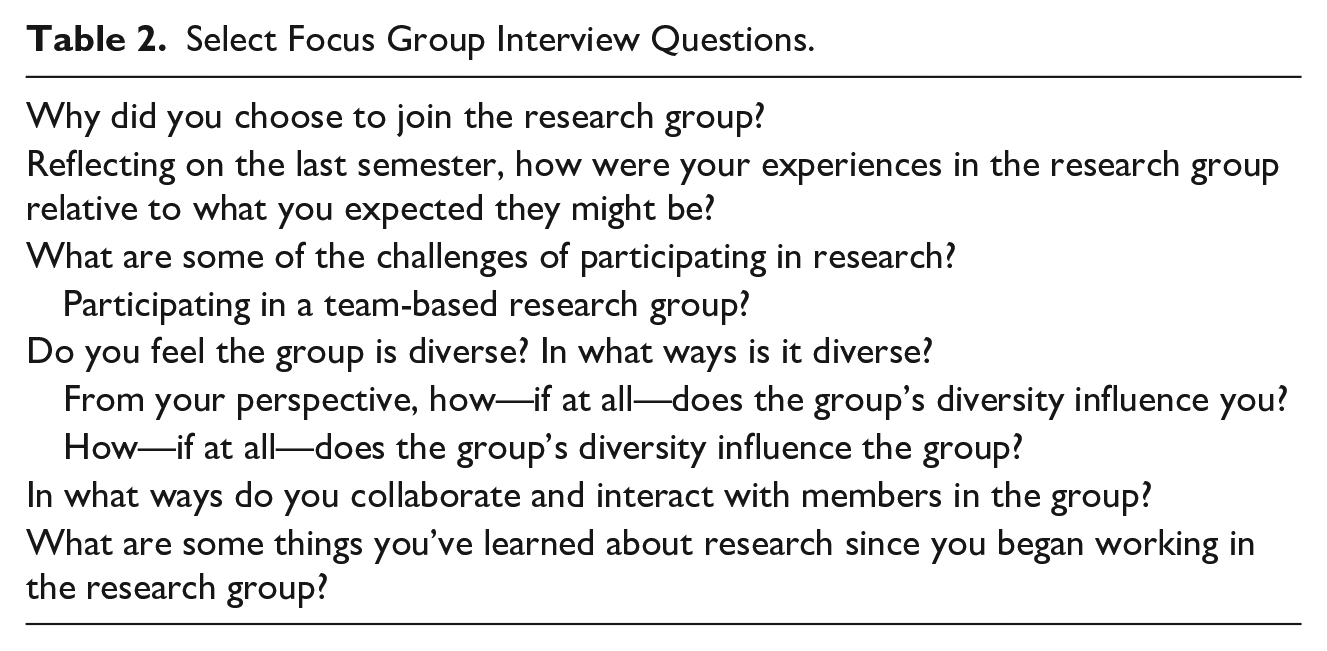
Because participants interacted with and learned from each other through their research tasks, the interview protocol was designed to explore how team design, learning behaviors, and members’ participation influenced their research culture of community, cohesion, and productivity. For instance, the question “In what ways is it [the research group] diverse?” was intended to elicit information about the team’s design, specifically as it relates to the diversity of its members. And the question “In what ways do you collaborate and interact with members of the group?” was used to probe for information related to the team’s learning behaviors and members’ participation. See Table 2 for sample questions from the protocol. Trained qualitative researchers not associated with the team’s work facilitated each focus group interview. Facilitators read a script at the beginning of each interview that reminded participants to converse with each other, share the space (i.e., not dominate the conversation), and keep conversations discussed during the interview confidential only to those in that particular focus group. Facilitators encouraged conversational interactions and probed for clarification and details regarding members’ experiences. Focus groups lasted approximately 45 minutes and were transcribed verbatim by a professional transcription company. The authors then checked accuracy by comparing the transcripts to the audio recordings.
Select Focus Group Interview Questions.
Data Analysis
The prolonged period of autoethnographic data collection resulted in approximately 180-transcribed pages of text. Basic qualitative analysis techniques were used to analyze the data (Merriam & Tisdell, 2016). We started by independently reading one transcript, and specifically open coding for single events, common behaviors, and shared activities and language to identify cultural patterns within the team (Creswell & Poth, 2018). It is important to note that none of the authors participated in the focus group this transcript came from, and that none of the authors ever read transcripts from focus groups they had participated in. Then, the authors gathered to discuss what stood out as potential answers to this study’s research questions. During our first conversation, we discussed which codes we independently identified that supported our own explanations. Next, we began collectively labeling, defining, and deciding on the inclusion and exclusion criteria for each code based on one transcript. Where we differed regarding the labeling or defining of codes, we took time to discuss why our codes differed. This process of creating labels and definitions for each code continued until consensus was reached. We then compiled our codes and definitions into a shared codebook. After creating our codebook, we independently read the remaining transcripts using the developed codes, but we remained open to new codes and revision of coding definitions. We continued to have generative discussions related to coding across the remaining transcripts and patterns we were beginning to see. To assist in determining patterns, each researcher wrote memos about their initial interpretations (Merriam & Tisdell, 2016). This practice helped us to first independently, then collectively, think about connections that we were seeing within and across transcripts, and their potential linkages to existing scholarship related to team science.
To ensure that we were not overlooking possible explanations regarding the culture of community phenomenon, a peer reviewer (Merriam & Tisdell, 2016) who was qualitatively trained and external to the research team reviewed our codes and codebook. He then reviewed the raw data to compile his own coding and codebook to see how our analysis aligned or differed. The team’s codes and definitions were similar to those of the external reviewer.
Once coding was finalized, we discussed how the codes could be grouped into categories, and how the categories logically addressed our research questions about culture of community. As an example, participants across focus groups talked about how they felt that their differences (e.g., career goals/trajectories, gender identity, racial identities, student major/field of study, student status/classification) were honored and were assets to the team’s culture. Thus, we labeled this set of codes “team design that intentionally includes diverse identities and perspectives.”
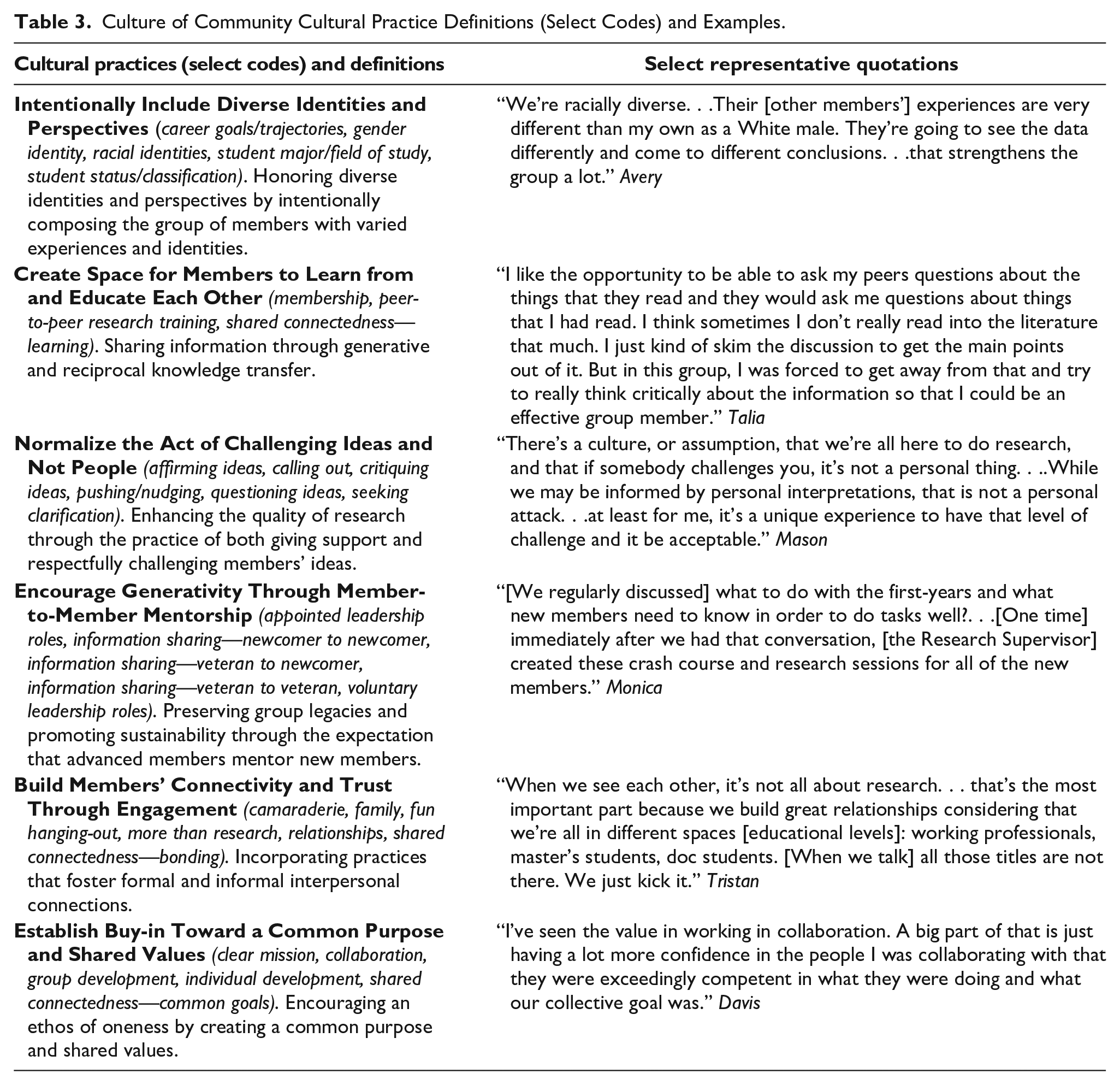
Through iterative discussions on how to best describe the portrait (i.e., story) of the data (Merriam & Tisdell, 2016), we determined the most salient themes to reflect six cultural practices that promote our team’s cohesion and productivity: (1) intentionally include diverse identities and perspectives; (2) create space for members to learn from and educate each other; (3) normalize the act of challenging ideas and not people; (4) encourage generativity through member-to-member mentorship; (5) build members’ connectivity and trust through engagement; and (6) establish buy-in toward a common purpose and shared values. Taken together in the aggregate, these six practices constitute our team’s culture of community. See Table 3 for culture of community cultural practice definitions and example quotations.
Culture of Community Cultural Practice Definitions (Select Codes) and Examples.
Finally, after agreeing on themes, we turned to an existing conceptual framework, sense of community (McMillan & Chavis, 1986), for additional interpretation. According to McMillan and Chavis (1986), cohesive communities are those where “members have belonging, a feeling that members matter to one another and to the team, and a shared faith that members’ needs will be met through their commitment to be together” (p. 9). They assert that a sense of community includes membership (the right to belong), influence (mattering to the community, and the community mattering to members), integration and fulfillment of needs (participation meets needs and offers rewards), and shared emotional connections (interactions through shared events, histories, and traditions). With this framework, we revisited our themes one last time, and none were changed, but the framework offered greater nuance to understand our findings.
Positionality Statement
In analyzing the data, our perspectives differed because of our diverse identities (e.g., education levels, race, gender, research experiences). However, as people committed to equity-focused research, we engaged in an ongoing practice of researcher reflexivity (Peshkin, 1988). At all stages, we discussed how our positionalities shaped our assumptions (Bhattacharya, 2017; Cooper et al., 1998). For example, in early iterations of data analysis, there were disagreements about who was responsible for creating the team’s culture of community. It appeared at times that some wanted to solely attribute the responsibility to the PI, perhaps for approval or appeasement. However, counterexamples in the data were identified, revealing how team members agentically helped to co-construct the team’s culture of community. This example highlights one way in which ongoing discussions allowed for a more accurate portrayal of the data. We also discussed how the intersections of our identities shaped our interpretations, were cautious not to conflate our experiences with those of other members, and treated the data carefully within its context. This ongoing internal peer review (Merriam & Tisdell, 2016) helped ensure that we considered multiple perspectives on the data.
Limitations and Trustworthiness Strategies
A hallmark of autoethnography is a commitment to transparency for readers (Adams et al., 2015). Drawing from our audit trail (i.e., documentation of the nuanced methodological decisions made throughout this study; Merriam & Tisdell, 2016), we openly acknowledge limitations and detail several mitigation strategies implemented to enhance the validity of our findings (Creswell & Poth, 2018). First, the team engaged in equity-focused work where conversations about diversity, inclusion, and justice were frequent. We acknowledge that this may have influenced how focus group participants thought about their experiences in the team and primed their assumptions about what they should mention during interviews.
Next, the analysis included data from across four years and 12 focus groups. We recognize that research teams vary based on a host of factors, including member composition, which may change year-by-year (Burt, 2014, 2017, 2019; Crede & Borrego, 2012; National Research Council, 2015). To accommodate team variation, the interview protocol was designed to be broad in nature and to provide continuity across interviews and increase depth in our findings. Although a standardized interview protocol was used across the four years of data collection, interview facilitators asked follow-up questions where necessary to probe more deeply. The strategy of using the same interview protocol over the data collection period appeared beneficial as patterns and themes related to how and why building a culture of community influenced the team’s cohesion and productivity emerged, despite different team composition over time.
While this study’s autoethnographic nature offers a unique contribution to the knowledge base regarding team science, there are also limitations due to the nature of team power dynamics. Specifically, although the team’s PI did not conduct any of the interviews (they were facilitated by qualitatively trained external researchers), knowing that the PI would at some point read the transcripts could have led to participation bias, where those with more positive experiences may have agreed to participate in the interviews. To intentionally mitigate this concern, the PI informed team members that he would not read any transcripts until data collection had concluded. The intention behind this procedure was to prevent perceptions that any critiques offered by participants might not be kept confidential, or worse, might be used against them professionally or personally. Participants were likely able to feel more confident and candid in their interviews, knowing that the PI would not read the transcripts immediately. Reading the transcripts prior to conclusion of data collection might have informed adjustments to team practices and thus influenced the team’s culture of community. Yet, waiting until the data were fully collected allowed the PI to honor his commitment to the study’s analytical integrity, and increased the validity of our findings.
Relatedly, autoethnographic studies often receive critiques because the authors are the subjects of the research and are also responsible for conducting analysis and interpreting findings, which means they might only present favorable results (Adams et al., 2015). However, there are benefits to balancing both emic and etic perspectives. For example, being both the research subject and the researcher analyzing the group enables unique insights into the team’s culture (Merriam & Tisdell, 2016). To reduce concerns that we may favor positive findings, we actively sought out evidence in the data that indicates unfavorable results, such as instances where members thought that the culture of community was weak, causes of friction between team members, and power conflicts between the team’s supervisor and its members.
Similarly, we acknowledge concerns about the power dynamic between the PI and the graduate students who served on the scientific team being studied and helped analyze the data. Several strategies were implemented to address this concern. For instance, no authors of this study analyzed transcripts from focus groups in which they participated. This choice was made to reduce the possibility of favorable bias in the analysis. In addition, the peer-review process where an outside, qualitatively trained scholar was involved in data analysis (Merriam & Tisdell, 2016) helped ensure that our findings were not skewed.
By being transparent about our approach and the intentional strategies implemented to mitigate biases, we addressed concerns surrounding the validity and credibility of our findings and thus argue that our methods are trustworthy. Findings from our autoethnographic study offer nuanced insights into the science of team science that might be otherwise missed if data were interpreted by outsiders.
Findings
Overview of the Team Culture of Community Model (TCCM)
The data from this study led to the generation of a new substantive theory (a practice-informing theory based on a limited number of observations) (Merriam & Tisdell, 2016): the Team Culture of Community Model (TCCM) (see Figure 1). The TCCM illustrates how a team’s cohesion and productivity are influenced by a host of factors. Specifically, the model acknowledges that an institution’s contexts and research expectations (e.g., Carnegie Classifications) serve as a backdrop to a team’s construction (design, learning behaviors, practices), performance (participation), and outcomes (cohesion and productivity). One layer inside of the model illustrates that a team’s design, its learning behaviors, and team [members’] participation are linked. These three elements alone may have some influence on a team’s cohesion and productivity. Additionally, the bidirectional arrows between a team’s design, its learning behaviors, and team [members’] participation, and cohesion and productivity denote a relationship where the team’s outcomes (cohesion and productivity) could also influence the team’s construction (design and learning behaviors) and performance (participation), and vice versa.
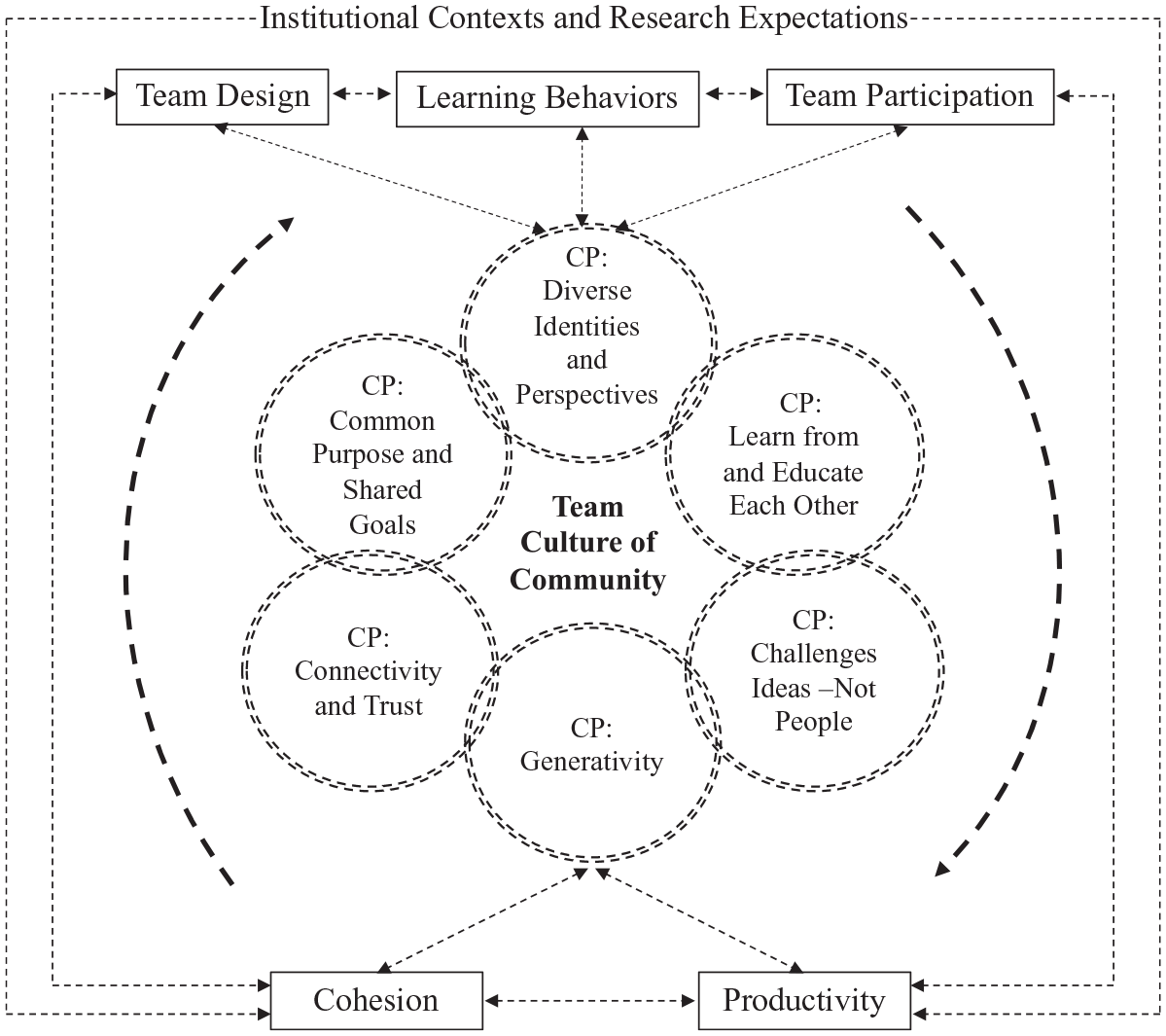
Team culture of community model.
Most germane to this study’s findings are the team’s six interconnected cultural practices. The cultural practices are the result of institutional contexts and research expectations, a team’s design, its learning behaviors, and team [members’] participation. To be clear, each practice can be considered its own cultural practice (labeled “CP” in the model). However, in the aggregate, the individual cultural practices form a culture of community, where team members feel valued and want to engage in the work of the team. In the model, there are bidirectional arrows going from the cultural practices to team design, learning behaviors, and team [members’] participation to indicate that a team’s culture of community could also influence how a team is constructed and operates. Similarly, there are bidirectional arrows from the cultural practices to cohesion and productivity to denote that a team’s cohesion and productivity may inform a team’s culture of community, and as a result, its cultural practices. The bidirectional connections throughout the model—with the exception of institutional contexts and research expectations, which are likely to be fixed—highlight the non-linear nature of how a team is constructed, how it performs, and its outcomes. Finally, the dotted arches on the left and right side of the cultural practices denote the evolving nature of the team’s practices (likely as a result of its evolving design, learning behaviors, participation, and attempts to be cohesive and productive).
Our Team’s Culture of Community, and Its Cultural Practices
To establish what we considered research productivity for the purposes of this study, in part based on our institution’s metrics, the team’s publication records were considered. Between 2015 and 2019, there were seven peer-reviewed publications, seven peer-reviewed conference papers, three manuscripts in revision or under review, and four manuscripts in progress. In addition, of the 23 participants, to date, 16 earned their degrees while being on the team, and another six earned their degrees shortly after data collection concluded.
The team’s six interconnected cultural practices—implemented and supported by the team’s research supervisor and student members—were essential to developing and sustaining a culture of community within the team, and enhanced the team’s cohesion and productivity: (1) intentionally include diverse identities and perspectives; (2) create space for members to learn from and educate each other; (3) normalize the act of challenging ideas and not people; (4) encourage generativity through member-to-member mentorship; (5) build members’ connectivity and trust through engagement; and (6) establish buy-in toward a common purpose and shared values. Because of the design of this study, confidentiality is necessary. We use pseudonyms and provide some but not all team member demographic information to maintain confidentiality when quoting from their transcripts; demographic information is not included when—combined with a quotation—it could reveal a participant’s identity.
Cultural Practice 1: Intentionally Include Diverse Identities and Perspectives
A team that honors diverse identities and perspectives is critical for any knowledge-creating community (Järvelä & Järvenoja, 2011; McLeod et al., 1996). According to the participants, their research team was intentionally composed of members with varied experiences and identities, a design implemented by the supervisor and supported by team members. After two semesters in the team, Aubry, a female master’s student, explained: “Different levels of research experience. . .allow [for greater] collaboration and assistance. . .also the positionalities of members brings a strength as well, whether that’s racial and ethnic makeup or experiences.” Aubry described a range of ways in which members were diverse (e.g., race; ethnicity; levels of research experience—which might also refer to educational levels or time of service in the team). The word “positionalities” suggests that Aubry was aware of other forms of identities and experiences, in addition to research experience, which she mentioned, but she did not offer an exhaustive list. Another participant, Avery, a White male master’s student, noted how members’ racial differences contributed to the team’s culture and performance: “We’re racially diverse. . .Their [other members’] experiences are very different than my own as a White male. They’re going to see the data differently and come to different conclusions. . .that strengthens the team a lot.” Having been in the team for a year and half, Avery explicitly described the team’s racial diversity as an asset. Similar to Aubry’s recognition of members’ different positionalities, Avery described how members’ differences contributed complementary strengths.
Chuck, a male of color and newcomer to the team, reflected that strong research “requires multiple eyes, multiple perspectives, and that. . .provides checks and balances. . .it allows for people to share ideas in [more] ways than if I was just working on something by myself.” From his point of view, the team’s diversity provided necessary checks to members’ subjectivities (Peshkin, 1988), which strengthened the quality of the work. Dean, a White male who had been in the team for a year, also said members’ diverse experiences were a strength: “[This] has definitely been a very formative experience. Just seeing how [a research team] can work, and bring. . .different strengths to the table to produce an end product that is greater than the sum of its parts.” Dean, like others participating in research for the first time, reflected on how the “different strengths” each member brought were beneficial to producing collaborative research. These representative examples show that intentionally including diverse identities and perspectives in the team’s design influenced how members participated in research with each other and contributed to a culture of support and the production of quality work.
Cultural Practice 2: Create Space for Members to Learn From and Educate Each Other
Participants regularly said that the research team’s culture encouraged members to learn from and educate each other. Chuck shared, “If I need to go to Armad to understand something, I do that, because it’s not about me feeling like I need to know X, Y, and Z because I’m [an advanced graduate student].” Chuck described how members’ skills transcended their educational levels (i.e., undergraduate, master’s, doctoral), referring to Armad, the team’s least senior member, who had his own set of research responsibilities for which he became an expert. A key to developing this practice of learning from and educating each other appeared to be acknowledging that everyone “brings different skills,” as referenced by Julian, a male of color who had completed his first semester in the team. When members recognized that others had skills, they were also aware that these skills could be shared and leveraged across projects.
Mason provided a similar example when describing his perceived role: “Being in this team enables me to try to understand, and then to create knowledge for others to utilize, talk about, and understand.” Mason described his role in scholarly creation as linked to understanding others’ viewpoints. Similarly, Tristan, a male of color and one of the most senior members, explained how the team’s collaborative nature facilitated learning: I learned to be patient with myself and my colleagues because we have certain processes that we work through, and we. . .depend on each other for certain pieces. . .I’ve had to understand that I’m learning in this [research and team] process. . .That’s a large piece of this team, that we process what’s happening together. . .
Tristan described how making sense of research together is a necessary part of the process in team-based research. Tristan mentioned that different members were responsible for completing their “piece” before a project was fully complete. This finding about creating space for members to learn from and educate each other relates to the generative nature of knowledge transfer, highlighting that learning does not happen in isolation, but within a community of learners who share ideas (Carter et al., 2019; Lave & Wenger, 1991). This team’s culture of community, rooted in part in the practice of sharing knowledge, appeared to suggest that no member was more significant than the others. Rather, each was encouraged to lend their unique perspective. This cultural practice seemed to enhance the group’s capacity to work cohesively.
Cultural Practice 3: Normalize the Act of Challenging Ideas and Not People
Several participants described the team as a space in which it was normal to practice both giving support and respectfully challenging each other’s ideas. Krystal, a White female newcomer to the team, mentioned that each cohort of new members became indoctrinated to “always. . .challenge and support.” Chuck, too, explained that new members were expected to “be curious. Be ready to push back. Be ready to affirm.” Other members provided further details. For instance, Julian and Mason, who joined the team at the same time, reflected on their parallel learning. Julian shared, “Mason has been very consistent in calling me out. . .like ‘Julian you need to talk more. . .I know you know what this is so why don’t you just say it?’” Mason attempted to explain his perspective on how this culture was shared across cohorts of new members: There’s a culture, or assumption, that we’re all here to do research, and that if somebody challenges you, it’s not a personal thing. . ..While we may be informed by personal interpretations, that is not a personal attack. . .at least for me, it’s a unique experience to have that level of challenge and it be acceptable.
Mason recognized the need to challenge ideas to produce high-quality work and also the unique acceptability of challenging ideas within the team. Mason’s comment appeared to contrast the culture of the team to other settings where challenging peers and supervisors would be considered contentious. The research team provided a “unique experience” where he could challenge others and have his own ideas challenged without feeling guilty about his desire for clarity. Mason appeared to suggest that, for this practice to work, it should be established that challenging each other is the team’s norm. Providing additional context, Aubry stated, “I feel like. . .when we challenge each other, it’s for the greater good to serve the research. It benefits the team, meeting our goal.” Like Mason, Aubry agreed that challenging each other is beneficial to the quality of research and helps the team meet its collective, equity-focused research goals.
Such examples reveal that normalizing the act of challenging ideas and not people contribute to team cohesion and productivity. Support may be more intuitively seen as valuable, but challenge and support are a necessary pairing for healthy team-based learning behaviors (Bielaczyc & Collins, 2006; Burt, 2017, 2019; Hare, 1994; Wildman & Bedwell, 2013). If only one of the pair were present, an aspect of the team’s culture would not be whole. That is, if there were only support, there might not be the “checks and balances” that members previously mentioned. If there were only challenge, team cohesion and trust (described more fully in a later theme) might be more difficult to accomplish.
Cultural Practice 4: Encourage Generativity Through Member-to-Member Mentorship
The ideology and practice of generativity played an important role in promoting the team’s culture of community. We borrow from the concept of generativity (Erikson, 1963), a psychosocial phenomenon of maturity where an individual aims to provide for a future generation as a form of self-legacy (McAdams et al., 1993). Participants described appreciating more advanced members mentoring them, resulting in a desire to help newer members when they gained seniority. Chuck explained the culture of generativity: “The. . .ethos of the team, it’s like. . .if you need information, come to me, and I’ll share.” Chuck’s example illustrated a practice of being open to new members, or any member who needed help, making them feel comfortable asking. This practice, or “ethos,” as Chuck called it, helped foster a culture where asking for help was not a deficit but an expectation that encouraged growth in one’s research competencies and benefited the team’s overall work. Julian described how generativity helped with his transition into the team: Me and Dean worked great. Always. . .“What are we gonna do? How are we gonna do this? What are you thinking? How are you thinking about this?” So getting through those challenges [of not knowing how to do research and imposter syndrome] [was] kind of easy because he was. . .supportive or—collaborative.
During Julian’s transition, the team was testing out a new onboarding technique. To promote peer mentorship, advanced members were charged with regular check-ins with new members, and new members were assigned to projects with advanced members. New members were expected to go to advanced members not only when they needed help; frequent check-ins and formal collaborations were also embedded practices of generativity.
Participants also described other ways that members practiced generativity. Monica, a White female master’s student who was completing her third semester in the team, explained the role of advanced members in developing new members’ research skills: [We regularly discussed] what to do with the first-years and what new members need to know in order to do tasks well. . .[One time] immediately after we had that conversation, [the Research Supervisor] created these crash course and research sessions for all of the new members.
Monica revealed the role that preparation and mentorship played in the continuity and sustainability of the team. Because of conversations advanced members and the research supervisor engaged in regarding team transitions, the team was able to create learning modules for new members. Monica’s observations showed that the team proactively created tools and provided resources to help onboard new members.
Another aspect of the team’s generative culture was assuming leadership roles. Tristan remarked, “The nature of this research team is not specifically giving out roles or responsibilities to the team. It’s about. . .rising to the occasion, or situating yourself in particular roles and taking on certain responsibilities.” Tristan’s quotation illuminated the ownership that members took in seeking out leadership and mentorship roles. According to the participants, the supervisor did not force members to assume leadership roles but instead encouraged them to leverage their skills and interests to benefit the team’s work. This practice appeared to encourage members to honor and promote their existing talents. Thus, the team’s design and its learning behaviors, where more senior leaders are connected with newer members to assist with their transitions, encourage generativity through member-to-member mentorship and assist in sustaining the group’s culture of community.
Cultural Practice 5: Build Members’ Connectivity and Trust Through Engagement
Participants explained that incorporating collaborative learning behaviors was integral to fostering interpersonal connections and trust within the team. Specifically, they described different formalized activities the team used to help cultivate community while also aiding research efficiency. Kenya explained that members of her subgroup reserved a conference room weekly, which made research “a lot more enjoyable and more motivating [because] we were together as a group.” The subgroup design appeared to lend itself to completing tasks for members who regularly worked together. For Kenya, regularly meeting in a shared physical space helped build camaraderie.
In addition to formal, research-focused learning behaviors, participants described informal interpersonal connections that generated camaraderie. For some, this meant spending time together celebrating the achievement of goals, bonding over challenges, or getting to know each other as people. Evan, a White male master’s student with two semesters of team participation, said, “The work spills over into real life, personal lives, which is nice.” Tristan shared a similar perspective: When we see each other, it’s not all about research. . . that’s the most important part because we build great relationships considering that we’re all in different spaces [educational levels]: working professionals, master’s students, doc students. [When we talk] all those titles are not there. We just kick it.
Tristan’s quotation highlighted elements that could prevent people from bonding (i.e., educational levels, professionals vs. students). However, despite status differences, he mentioned that members built camaraderie by not talking about research. By “just kick[ing] it,” he referred to informal interactions where there were no pretenses based on titles and statuses, but just individuals having a good conversation.
Armad also offered his perspective on the informal nature of the team: “[The Research Team] was. . .a family environment. . .It wasn’t somebody reporting straight to the boss. [The PI] is someone I can go into, and talk about my day, or what I’m planning on doing, or this test I just took.” Like Tristan, Armad described the culture of the team as not exclusively work-focused. Armad departed from others in mentioning the research supervisor. Armad appeared to describe the supervisor in ways similar to how other team members described each other. This suggested that informal connectivity took place at and between both the peer and the supervisory levels. As expressed by Armad, these humanizing effects made the research team feel like a “family,” and not just a research team. Examples in this section show that learning behaviors that build members’ connectivity and trust encourage participation in the team’s work and increase the team’s cohesion. In addition, participants described how the team’s learning behaviors recognized their need to be connected in physical spaces and encouraged interactions not focused entirely on research. This cultural practice related to connectivity and trust created for members a culture of community where they felt like they belonged and wanted to engage in the team’s work.
Cultural Practice 6: Establish Buy-in Toward a Common Purpose and Shared Values
Creating a common purpose and shared values was a core practice in the team. This was done by encouraging an ethos of oneness, or as Chuck stated, “We’re on the same team, we have the same mission.” Some participants mentioned the connections between understanding the team’s work, its vision, and the production of research. Monica shared, “I love knowing the big picture and then seeing my piece in it.” Gaining a better sense of the scope of the research helped Monica understand how her piece contributed. Similarly, Aubry spoke about the team’s goals to disseminate their research: “[Our work] is more out there in the open, and we share that [as a] common purpose of the research and the scholarship that we hope to produce.” To Aubry, clear team goals were to publish, present at conferences, and influence educational policy and practice (goals influenced by the institutional context and the institution’s research expectations for the team’s PI).
While some participants noted that the team had shared goals, others provided hints as to how it created those goals. Davis, a White male master’s student who had been in the team for two semesters, explained how intentional collaboration contributed to goal setting: I’ve seen the value in working in collaboration. A big part of that is just having a lot more confidence in the people I was collaborating with that they were exceedingly competent in what they were doing and what our collective goal was.
Perhaps most insightful in Davis’s quotation were the connections he made between collaborating, building trust, or, as he said, “having a lot of confidence in people,” and working toward a common goal. His statement shows that, when there is trust, collaboration can flourish. Tristan, similarly, described collaborative learning behaviors and their role in creating trust and shared team goals: We started these working meetings, and working collaboratively as a larger team, specifically with particular goals. Some of [us] are. . .seeing what our goals are, and. . .if we can work collaboratively based on our goals. If we have similar interests. . .we can actually break off in subgroups based on interests and work on those particular projects.
Tristan’s comments described various types of collaboration (i.e., large group, subgroup), and it was suggested that projects were not all determined by the research supervisor. He explained that members could propose new projects related to their shared interests. In Tristan’s example, developing shared goals required agreement among members on a common purpose and the shared value in dissemination work. This finding about a team’s common purpose and shared values illustrates how they facilitate a team’s cohesion and productivity. This finding also illuminates how a team’s design and its collaborative learning behaviors help promote the development of a team’s culture of community, namely through the development of its common purpose and shared values.
Discussion
This autoethnographic, longitudinal study of one research team in the field of education offered insights into our team’s culture of community. To help illustrate how our team’s culture of community facilitated the development and sustainment of cohesion and productivity, the Team Culture of Community Model (TCCM) was generated. The TCCM shows how the team’s cultural practices were developed in part based on the team’s institutional contexts and the institution’s research expectations, the team’s design, its learning behaviors, and team member participation. The richness of the data illuminated how the team (i.e., its construction, its practices, and its members) created an environment (i.e., culture of community) that members valued and sustained for future members.
Because of the social nature of team interactions and participation in research, the conceptual framework of sense of community (McMillan & Chavis, 1986) was consulted to interpret the findings. This framework offered clarity as to how community is formed and operates within a wide range of settings (e.g., professional, spiritual, neighborhoods, towns, cities, schools). Similar to research findings on team science (Hare, 1994; Schwarz & Bennett, 2021), McMillan and Chavis (1986) provide insights that, when considering the role of community in scientific teams, it is necessary to explore the interactions between individuals, the formal and informal practices that contribute to the team, and the explicit and implicit goals of the team and its members. While the sense of community framework was conceptually useful, it was not designed for scientific teams in academe, nor was it initially empirically tested (see examples for later empirical investigations: French et al., 2014; Garrett et al., 2017). Our findings, based on empirical evidence, expand and deepen understandings of team science practices that build and maintain a culture of community, specifically in a scientific team in education. Our findings suggest that the six practices required for a culture of community within a scientific team are interconnected and not as discrete as previously conceptualized.
One way that the team in this study attempted to build a culture of community was to honor diverse identities and perspectives by intentionally recruiting diverse individuals. This finding is important, as previous scholarship suggested weak and/or mixed results regarding the influence of diversity on team performance (Carter et al., 2019). Our findings suggest that the recognition of and intentionality around incorporating team members’ varied social identities and backgrounds into the team’s work contributed to members’ sense of belonging and desire to be a part of the team and do the work of the team. Our findings showed that the intentionality of recruiting members with diverse social identities, different academic backgrounds, and varying levels of research experience is beneficial. When doing so, teams can create a space where everyone’s knowledge is valued (Bielaczyc & Collins, 2006; Carter et al., 2019; DeHart, 2017; Fiore, 2008; McLeod et al., 1996) and ensure that all voices and opinions are acknowledged.
The team also built a culture of community by encouraging members to apply existing interests and skills to their operations. Leadership was demonstrated when members took initiative to lead studies or activities or when transitioning new members into the team. This finding offers a slight departure from Wildman and Bedwell’s (2013) conceptualization of team leadership as being either supervisory or followership. Rather, by agentically serving as informal or emergent influencers of the team (Carter et al., 2019; Stewart, 2006), members helped advance the team’s goals and contributed to its culture of community. Members cultivated the community by agentically creating opportunities to advance the team’s operations. It also suggests that the supervisors of the team must allow space for members to innovate and apply their talents. Based on our findings, when team members contributed their existing strengths, it signaled to newer members that valuable contributions to the team enhanced both research productivity and team sustainability, illustrating the ideology and practice of generativity.
Implications for Future Research and Theory on Community Within Team-Based Contexts
We offer recommendations for future research on collaborative team contexts and explain implications for building and maintaining cultures of community in team-based contexts. Important to note, these data were collected and analyzed prior to the global pandemic. The pandemic created a context in which team-based collaborations were—and in some cases, continue to be—disrupted and reimagined around the parameters of maintaining healthy distance. However, because of the abrupt changes made to scientific teams since this study’s data were analyzed, we feel an obligation to also remind readers to think about how our recommendations can be applied to present-day realities of their scientific team contexts. For a summary of implications for research and theory and practice, see Table 4.
Implications for Future Research and Theory and Practice.

To start, in this study, six practices were identified that help to build and maintain a culture of community in one scientific team in the field of education. Yet, as existing research suggests, teams vary for many reasons (e.g., design, structure, learning behaviors; Bresman & Zellmer-Bruhn, 2013; Carter et al., 2019; Schwarz & Bennett, 2021). Therefore, more research on different types of teams could help identify how team practices enhance team cohesion, productivity, and culture of community. Future research could also examine scientific teams within the same field of study but located at different institutions. This might further test the roles that disciplinary boundaries (DeHart, 2017) and institutions—as organizational structures (Bresman & Zellmer-Bruhn, 2013)—play in enhancing the culture of community, team cohesion, and productivity. For instance, investigating another scientific team in education from a comparable research-intensive institution might provide insights into organizational influences on teams. Or, examining scientific teams within the same discipline, yet housed at different institutional types (e.g., research-focused vs. teaching-focused institutions) might help determine how institutional resources and priorities shape team outcomes. New research focused on disciplinary influences will expand understandings of scientific teams’ designs and learning behaviors necessary for teams to meet their objectives.
Contrary to the mixed findings in existing literature on the influence of team members’ social identities and backgrounds (Bresman & Zellmer-Bruhn, 2013; Carter et al., 2019; McLeod et al., 1996; Salazar et al., 2012), the present study’s participants described team diversity as playing an important role in how they made sense of their learning, experiences, and the team’s culture of community. While this study adds to the collection of contradictory research findings on diversity in teams, we argue that more equity-focused research should explore how social identities and other forms of team member differences influence team outcomes, such as the culture of community. Future research could also explore other aspects of team diversity or the lack thereof. For example, in addition to considering how diversely comprised teams influence their members, scholars could also investigate the mechanisms that maintain homogeneous group compositions. In addition to wondering how diversity impacts team satisfaction, scholars could also more deeply explore how diversity transforms and enhances team innovations. Asking new questions about diversity in team science should help extend the literature.
This study illuminated team members’ agency in co-building and co-maintaining a team’s culture of community. Participants primarily offered insights into the nature of their peer interactions; limited information was offered about their interactions with and the influences of the team’s supervisor. Missing from the picture is the role that PIs play in supervising scientific teams, such as the PI’s intentional efforts to establish supportive and sustainable practices or the unintended outcomes of the PI’s decisions. While existing team science scholarship offers information on how a variety of teams are led (Carter et al., 2019; Stewart, 2006; Wildman & Bedwell, 2013), the strategies for team leadership should depend on a team’s contexts and goals. How organizational leadership strategies specifically translate to scientific teams, guided by nuanced academic and institutional norms and expectations, is not always entirely clear. Future research should continue to explore the leadership of scientific teams, especially new leadership methods of younger generations and the ways supervisors lead in more contemporary and unique contexts (e.g., COVID-19). Scholarship exploring the roles of team supervisors could help identify new practices that foster more interaction between team members, positive working environments, and enhanced learning experiences.
The Team Culture of Community Model offers a number of valuable contributions to the existing knowledge base on scientific teams. Specifically, the TCCM provides insights into one team’s cultural practices, what informs the team’s cultural practices, and the relationships between these cultural practices and cohesion and productivity. Yet, future research could continue to refine the model. For instance, scholars could more intentionally test the various direct, indirect, bidirectional, and cyclical effects found within the model. In addition, expanded understandings for institutional contexts and research expectations are needed. That is, future research should identify more about how these contexts (institutions and their often fixed research expectations) might prove to be useful for some teams but barriers to cohesion and productivity for others.
Finally, this study’s autoethnographic research design adds to the small but growing amount of team science scholarship utilizing qualitative methods (DeHart, 2017). Specifically, by focusing on the lived experiences and voices of participants, this type of research can further humanize research results and provide insights that may be lost in statistical interpretation (Creswell & Poth, 2018; Merriam & Tisdell, 2016). Although this study extends the research around the construct of community, and in so doing identifies cultural practices that contribute to a scientific team’s community, more qualitative research could help expand evolving understandings of what constitutes a team and its culture of community. For instance, what cultural practices have teams created to build and maintain cultures of community during times of change (e.g., the global pandemic)? And, how do a team’s cultural practices help to sustain a team’s cohesion and productivity? While we encourage more research from a wide range of methodological approaches to study the impacts the pandemic has had on teams, more research utilizing qualitative methods will provide additional nuanced information on team cultures of community in ways that may not easily get teased out with quantitative methods. Further, more qualitative research may offer information that extends and deepens knowledge of the cultural practices that enhance team cohesion and productivity.
Implications for Building and Maintaining a Culture of Community in Team-Based Contexts
While this study centers on a scientific team in the field of education, its findings may apply to other team-based contexts. In our study, participants referenced diversity as a characteristic that contributed to their learning and to the team’s culture. Thus, teams’ leaders (e.g., PIs) should intentionally bring individuals with diverse backgrounds and perspectives into their teams. However, for a team to benefit from diversity, it requires cultivating open-mindedness among members. Participants described demonstrating vulnerability and openness to diverse ideas, which helped create connections that allowed them to work comfortably together. Further, in our study, diverse perspectives came from team members’ different backgrounds. In settings where it is difficult to recruit individuals of varying backgrounds, creative ways to diversify a team may be required. For example, team leaders could consider identifying talented and inquisitive students within classes, recruiting professional staff members interested in gaining research skills but not enrolled in coursework, establishing exchange partnerships with institutions with more diverse student bodies (i.e., minority-serving institutions), or serving as a mentor for an undergraduate research program to increase opportunities to recruit individuals of different backgrounds (e.g., Louis Stokes Alliance for Minority Participation, McNair Scholars Program, Summer Research Opportunities Program). The key is acknowledging and believing that a diversely comprised team can enhance the culture of community, team cohesion, and productivity. To achieve this practice, the team leader must intentionally recruit a diverse team rather than leave it up to chance.
The team in the present study was not always cohesive; there were occasional peer-level personality incongruences and subgroup pairing mismatches. Planning for teams with diverse individuals and perspectives should come with recognition that conflicts may arise. While conflict is not intrinsically negative (e.g., a positive resetting of the team’s focus and goals could result from conflict resolution), ongoing conflicts could temporarily thwart members’ learning, research, and building a culture of community. To be clear, conflict and disagreement are not synonymous. Our data related to disagreements suggests that knowing that ideas can be challenged was vital to the team’s research productivity and culture of community, consistent with previous team science research (Bresman & Zellmer-Bruhn, 2013; Hare, 1994; Wildman & Bedwell, 2013). Bielaczyc and Collins (2006) describe argumentation as a process of conflict, where disagreements can lead to the discovery of alternative possibilities. To achieve a culture where disagreements result in positive outcomes, teams should consider normalizing asking questions, offering suggestions, challenging ideas to improve research, and synthesizing similarities and differences within arguments (Bielaczyc & Collins, 2006). This formative skill of argumentation can allow members to learn from being challenged for the betterment of the team’s work (Burt, 2017, 2019). When disagreements lead to conflicts, team members should consider revisiting the team’s purpose and goals. The team may also want to determine where the conflict lies (e.g., disagreement about ideas, disrespectful behavior, a misunderstanding). Determining the root of the conflict may assist in addressing the issue and getting back on course to (re)build a culture of community.
In the current study, team members developed a bond based on common goals of learning about equity-based research and maintaining a community-centered culture. Members agreed that they wanted to become better researchers and assist in maintaining the team, which was often demonstrated in their willingness to take on leadership and mentorship roles. However, building a common purpose or shared understanding may be difficult, especially in teams comprised of members who have never engaged in research. It may also be difficult for new members transitioning into established settings (DeHart, 2017). To help build a common purpose, advanced members should be encouraged to assist new members through formal or informal mentoring (onboarding) leadership roles (Carter et al., 2019; Stewart, 2006). Advanced members could be tasked with regularly checking in with new members, or research tasks could be distributed so that new members learn from and with more advanced members. In addition, holding learning sessions with the supervisor might allow new members to understand the supervisor’s expectations. These strategies can help smooth transitions and enhance team sustainability.
According to our findings, working and gathering together is necessary to build a team’s culture of community. Creating time and space for members to get to know each other through casual activities (e.g., dinner, potluck, team outing) allowed them to engage with each other outside of research. Engagement outside of research helped to humanize team members and led them to value their relationships for more than research purposes. These practices aided in connecting members interpersonally and supported their enjoyment of the team’s work. Physically coming together may pose a challenge if space is limited or requires funding, or if there are policies against physical gathering (e.g., during COVID-19), in which case teams should consider creating formal and informal opportunities virtually to develop a culture of community through connectivity. This might be done with regular virtual team work meetings, subgroup meetings, and recurring virtual gatherings that do not include a work-related agenda.
Concluding Thoughts
Teams that are only sporadically productive limit their full capacity for innovation and impact. Thoughtfulness and intentionality around a team’s culture of community have implications for team cohesion and productivity. A team’s culture of community can influence how members identify and engage with the team, particularly in fields where intensive time is spent on the team. Fostering practices that create and maintain a team’s culture of community may make members feel respected, that their contributions matter, and that they belong.
Creating a culture of community in scientific teams, where individuals learn and feel that they belong, does not occur through happenstance. A team that prioritizes community may make the research experience more enjoyable and productive. If a team is enjoyable but not productive, maximum impact may not be reached. Alternatively, if a team is productive but does not include practices that bring cohesion and joy, members may become resentful, and consider leaving the team, graduate school, and/or the field of study altogether. Incorporating team cultural practices that make members feel valued and that foster learning opportunities can help develop and sustain both team cohesion and productivity. To assist in these efforts, we encourage more future research on building and maintaining cultures of community.
Footnotes
Acknowledgements
We wish to thank Dr. Xueli Wang and Dr. Rich Halverson for their invaluable feedback and support. We also thank members from the Burt Research Group for participating in interviews and allowing us to Learn From Within.
Declaration of Conflicting Interests
The author(s) declared no potential conflicts of interest with respect to the research, authorship, and/or publication of this article.
Funding
The author(s) received no financial support for the research, authorship, and/or publication of this article.
