



Abstract
Turn-taking is the most basic sequential process in group interactions. However, few studies have analyzed how turn-taking patterns impact group dynamics and outcomes. Research has shown that turn-taking in group interactions usually takes the form of a dyadic ABA pattern, in which two speakers talk interchangeably. In this paper, we propose that in groups discussing a controversial topic (abortion rights), ABA patterns transmit conflict. It was found that ABA patterns correlate with reciprocal exchanges of contradictory arguments, which, when prolonged, escalate into conflicts marked by heightened negativity, dominance, disagreement, and opinion strength. Content in ABA patterns conveyed later in the conversation becomes more conflictive, compared to non-dyadic ordering. The interacting group members in the ABA pattern were less satisfied with the group, as manifested by a lower level of perceived quality of the discussion, and they gave mutual assessments of influence, dissimilarity, and disagreement.
Turn-taking is one of the most fundamental features of group discussion. The fact that speakers take turns to speak makes a conversation an exchange of thoughts, feelings, and judgments. Without turn-taking, and indicator of expressing mutual interest and curiosity, there would be no flux of information between group members and no ability to cooperate and share ideas. In this sense, turn-taking is a core manifestation of the group interaction process.
Existing quantitative research on communication dynamics in groups meeting in physical space (Parker, 1988; Stasser & Taylor, 1991) shows that turn-taking tends to proceed as a series of mini-dialogues with a cyclic change of speakers—so called ABA floor (i.e., speaker A, speaker B, speaker A; Parker, 1988), in which two persons interchangeably take turns to speak while the rest of the group remains a silent audience. A number of studies has consistently shown that dyadic ABA exchanges prevail in small group interaction (Dabbs & Ruback, 1987; Fay et al., 2000; Parker, 1988; Stasser & Taylor, 1991). Concomitantly, studies of online group interaction show that reciprocal patterns of turn-taking that involve intensive exchanges of messages between few contributors are typical for conversations on social media (e.g., Aragón, Gómez, García, 2017; Backstrom et al., 2013; Gómez et al., 2013).
Research on structural features of turn-taking has suggested conflicting meanings that ABA exchanges connote in group communication dynamics. Several studies exploring the structure of discussion trees on social media point to the higher controversy of the content transmitted in reciprocal turn-taking (Black et al., 2011; Laniado et al., 2011; Ziembowicz et al., 2021). Similarly, in offline groups, exchanges within two group members have been found to be more conflictive and intimate than exchanges between many group members (Pincus et al., 2008; Pincus, 2014). However, other research accounts have shown that reciprocity of communication is a sign of trust, social solidarity, and effective information exchange among interaction participants (Aragón, Gómez, & Kaltenbrunner, 2017; Poquet & Dawson, 2018).
The reason why there is an unambiguous relationship between turn-taking patterns and their communicative function might be that group coordination patterns likely depend on the context of a particular interaction. In the present study, we focus strictly on consensus-making groups whose task is to come up with a decision that would reflect the views of the group’s majority. In these groups, the conversation topic activates relevant attitudes of group members, which may differ in direction and extremity (Howe & Krosnick, 2017). Such a setting invites conflict, typically manifested by a high level of directness and oppositional intensity of communication (Weingart et al., 2015) and recurring episodes of serial arguments between speakers attacking or defending a given solution (Brett et al., 1998).
In this paper, first, we posit that in interactions of consensus-making groups discussing a controversial topic, dyadic turn-taking is the structure indicating direct, one-to-one communication through which group members exchange opposing views and communicate disagreement. Second, we propose to link the dyadic turn-taking to reciprocity of contentious communication often observed in groups and dyads processing conflict (Putnam, 2013), which tends to escalate into conflict spirals (Brett et al., 1998; Weingart et al., 2015). To support our claims, we present a study of groups discussing a controversial topic (i.e., abortion) face-to-face, with results showing that dyadic communication takes the form of prolonged exchanges of contradictory arguments.
This paper offers the following key contributions: we link research on sequential dynamics of turn-taking to research on group communication by tracking how group members communicatively co-create conflict in group interaction. In our study, we demonstrate that content of turns within the ABA context is more negative, dominant, and contains stronger opinions and more disagreement than content transmitted in different communication patterns. Dyadic exchanges with these features tend to escalate proportionally in terms of length of conversation. Finally, the number and length of the ABA patterns predict the formation of inter-member disagreement, dissimilarity, and influence during discussion, as well as dissatisfaction after the interaction. In sum, our results lead to the conclusion that dyadic turn-taking in consensus-making groups is a symptom of negative reciprocity leading to escalated dissention, which is well-documented in conflict and communication research (see Putnam, 2013; Brett et al., 1998).
Turn-Taking and Group Conflict
One of the common patterns of how group members take turns to speak during a group interaction is dyadic exchange. Two-person interactions (e.g., ABA patterns) constitute approximately 60% of turns in four-person groups (Parker, 1988) and 50% of turns in six-person groups (Stasser & Taylor, 1991). Similar findings were reported in research on online interaction. Reciprocity, the tendency of participants to reply to users who had previously replied to their messages, has been related to a property very common for online fora: skinny threads, in which every successive post is a response to a previous message in a thread, as opposed to star threads, in which each post is a response to the root (Aragón, Gómez, & Kaltenbrunner, 2017; Gómez et al., 2008; Kumar et al., 2010; Poquet & Dawson, 2018). Skinny threading has been linked to the ubiquity of chains of messages developing between two users (Aragón, Gómez, García, 2017; Laniado et al., 2011). However, the role turn-taking structures play in group dynamics and communication is still understudied in the field of small group psychology. For example, in the popular, repeatedly reissued textbook on group dynamics by Forsyth (2019), turn-taking does not appear even once.
Reciprocal exchanges between interacting communicators have been studied in the context of group conflict processes, such as research examining ways in which teams interact regarding their differences (DeChurch et al., 2013). Conflict processes have been distinguished from conflict states, commonly divided into task- and relationship-related, representing themes around which a conflict revolves and the source of perceived incompatibility in the group (see Behfar et al., 2011). Conflict processes, on the other hand, refer to sequences of interdependent acts of group members, both verbal and nonverbal, through which a conflict is played out in a group setting (DeChurch et al., 2013).
Research on conflict processes focuses on detection of typical patterns in the development of interrelated behaviors over time (Putnam, 2013). A pattern that has been found to be characteristic for conflict involves reciprocity of aggressive behaviors, such as polarized or negatively charged claims or tactics (Brett et al., 1998; Mortensen, 1974; Putnam, 2013). Muntigl and Turnbull (1998) define a speaker sequence that is necessary for a conflict to evolve, referred to as conflict nucleus, which consists of three successive statements: speaker A stating an argument, speaker B responding with a counterargument, and speaker A reacting with another counterargument. Such a three-statement sequence, also called conflict introductory sequence (Gruber, 1998) has been found in dyadic and group discussions (Antaki, 1994; Leung, 2002).
Such reciprocal, contentious communication that occurs during a conflict tends to evolve into repetitive, escalatory cycles, or conflict spirals (Brett et al., 1998; Burgoon et al., 1995; Rubin et al., 1994), referring to the repeated series of counter-argumentation conflicted parties get stuck in. Brett et al. (1998) make two important observations about conflict spirals: “they have a momentum that makes them difficult to end” and “their substance gets repeated or reciprocated” (p. 411). In effect, a conflict spiral proceeds in a form of reciprocal communication, exactly as the pattern of an ABA sequence: “When a negotiator initiates a contentious communication, the other negotiator responds with a contentious communication, and the first negotiator continues in a self-consistent manner with a contentious communication. Thus, within any conflict spiral, reciprocation occurs at least twice: between the first contentious communication and the second contentious communication and between the second contentious communication and the third contentious communication.” (Brett et al. 1998, p. 411)
Conflict spirals lead to escalation of the conflict, as each exchange in the interaction becomes more severe than the previous one (Rubin et al., 1994). They usually result in one-sided agreements, when one side has stronger arguments or is more aggressive and persistent in its argumentation, resulting in the other party backing down (Brett et al., 1998). The conversation may also end without group members reaching a consensus.
Pincus (2001, 2014), Pincus et al. (2008), and Pincus and Guastello (2005) studied frequencies of different turn-taking patterns in face-to-face group discussions and found that, the more frequent the patterns in which the same two interlocutors took part together were, the more conflictive and intimate the relationship between them was (Pincus et al., 2008). They also found that inducing conflict in a group resulted in a rapid change in the structure of turn-taking, which became more organized and reciprocal, as more repetitions of the same turn-taking sequences were found after the conflict initiation (Pincus, 2014; Pincus et al., 2008).
In online communication, the skinny patterning of discussion trees has been found to be associated with high communicator engagement in a conversation (Aragón, Gómez, & Kaltenbrunner, 2017), controversiality (Borra et al., 2014; Gómez et al., 2008), and virality of a thread (Choi et al., 2015). The reciprocity feature has been associated with controversy-evoking discussion topics on Wikipedia (Borra et al., 2014) and highly emotional content of posts within a thread on BBC forums (Chmiel et al., 2011). For example, Laniado et al. (2011) and Ziembowicz et al. (2021) used the number of chains developed only by two editors engaging in a discussion as an indicator of controversiality of a Wikipedia article.
Based on the literature reviewed in the present study, we can formulate the following conclusions. First, an important structural feature of group turn-taking is the dialogical ABA communication pattern, in which statements of two persons follow each other in alternating fashion. Second, both in offline (e.g., Pincus, 2014) and online group discussions (e.g., Chmiel, 2011; Ziembowicz, 2021), prolonged dyadic communication is related to controversiality and conflictive nature of the discussed topic. Third, there is strong evidence that conflicts typically unfold in the form of reciprocal exchanges of negative emotions, contradictory views, or hostile communicative tactics. This evidence points to the possible link between dyadic turn-taking patterns in group interaction and group conflict, in that dyadic ABA exchanges might be a symptom of ongoing disagreements and may also contribute to the escalation of conflict due to conflict spirals. However, research has not found this link consistently across studies, possibly due to group or task differences in extant research. Our study fills this gap, by examining whether dyadic exchanges within group discussions aimed at reaching a group consensus are a symptom of conflictive interactions. In the next section, we describe our approach to extracting and analyzing turn-taking patterns and we unpack the general proposition into specific, testable hypotheses.
Theoretical Approach and Hypotheses
The order in which group members take the floor during a group discussion is a proxy for how the information is disseminated within the group. During a group interaction, ideas, opinions, or emotions are shared by group members. The contextual constraints of a group task determine what information is going to be shared, by whom, and in what manner (Hinsz et al., 1997). The pattern of turn-taking indicates who is the current source of information and whom the information is directed to. By tracing turn-taking patterns, we can observe how relevant information travels within a group.
We propose that the ABA pattern is a marker of reciprocal, person-to-person communication in group interaction. If we split the turn-taking sequence into consecutive sets of three turns, each progressing the conversation, the three element sequences would include either two or three speakers and take two forms: either the floor returns to the first speaker in the third turn (A-B-A), or it is transmitted further to a third person (A-B-C). As in the original work of Parker (1988), ABA patterns are extracted without the actual identity of the speakers (i.e., in each consecutive, three-element sequence of turns, a different person may take the role of “A,” which is simply an indicator of a first speaker, “B” is the second speaker, and “C” is the last); the only criterion is the repetition of the same speaker in lag +2 (i.e, two events—here, turns—after the initiation of a sequence). The ABA communication follows the structure of conflict nucleus (Muntigl & Turnbull, 1998) as the floor is reciprocally shared by two group members whose utterances interchange at least once.
In the present study, we divided group discussions into either three-element sequences of turns that followed the conflict nucleus dynamics (i.e., ABA) or three-element sequences that did not take the form of conflict nucleus dynamics (i.e., ABC). We extracted periods of conversation in which the floor was shared by pairs of group members speaking in alternating fashion. We coded each turn as ABA if it was followed by a turn with the same speaker in lag +2. If the turn was followed by two consecutive turns uttered by two different speakers, we coded it as ABC, which represented non-reciprocal segments of communication within a group. In the next step, we combined all turns into strings of ABA and ABC exchanges based on the number of consecutive turns that belonged to the same speakers. Thus, each group interaction was divided into intertwined strings of reciprocal and non-reciprocal ABA and ABC exchanges of various lengths (Figure 1).
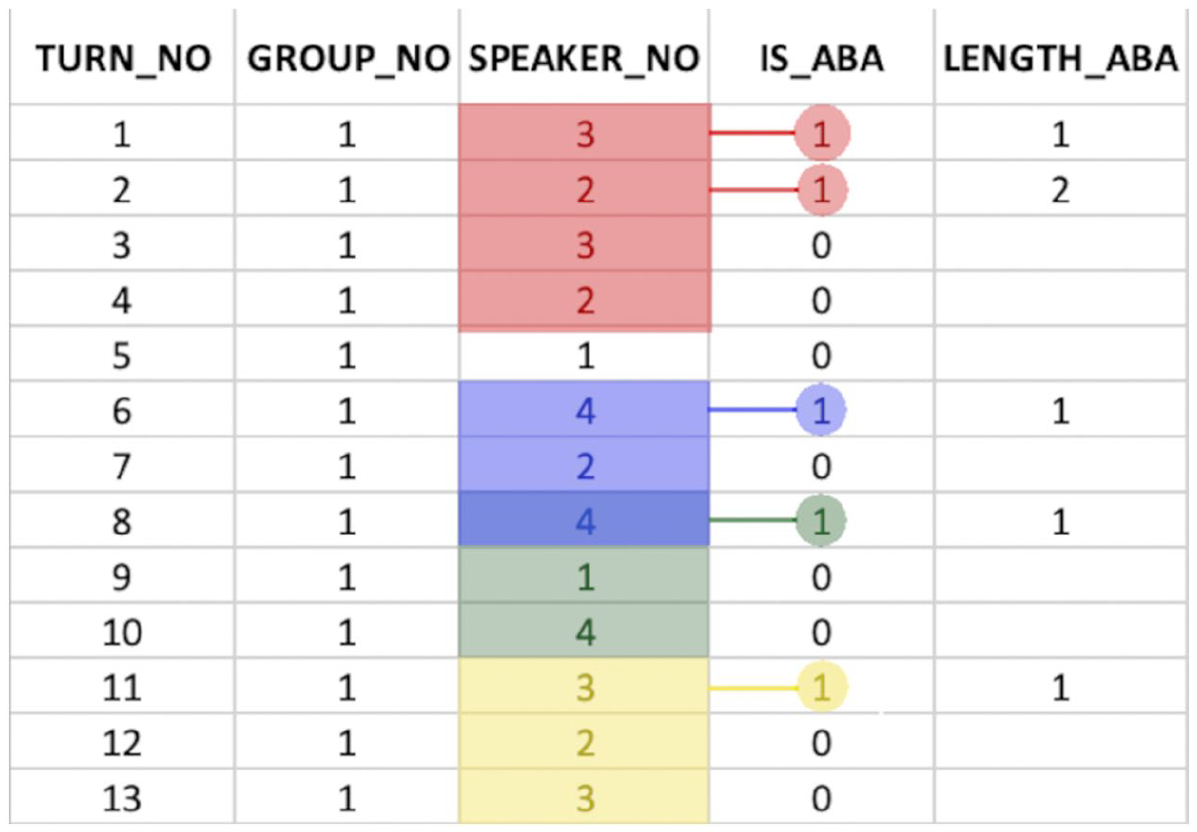
The coding of ABA and ABC patterns in the group interactions.
Reciprocal ABA and non-reciprocal ABC reflects the difference between direct, personal communication between two individuals and group level communication. In the ABA sequence, especially a prolonged one, only two people speak to one another; in continuous ABC exchange on the other hand, if the floor is sequentially passed on to different speakers, it is more likely that people speak on the group forum, without any particular addressee. This approach (i.e., comparing ABA and ABC), however, is an oversimplified view on the dynamics of turn-taking. For example, reciprocal interactions can be interspersed by off-topic intrusions from other group members; conflict may develop when two group members join forces to attack a third one; finally, the reciprocal third turn may be completely unrelated to the topic of the preceding turns in a sequence. However, comparing ABA with ABC sequences allows us to quantitatively inspect the differences between structurally reciprocal and non-reciprocal patterns in turn-taking in a maximally effective and unequivocal manner to determine if the dyadic structure of turn-taking mediates contentious communication in group discussions over controversial topics.
The goal of the present study was to test the following hypotheses regarding the role the ABA turn-taking patterns play in transmitting discrepancy of opinions and conflict in consensus-making groups.
When group members’ task is to arrive at a consensus, their communication is centered around negotiating a decision that would reflect the views of the whole or majority of the group (Price & Cybulski, 2005). A conversation topic triggers corresponding attitudes varying in direction and intensity (Howe & Krosnick, 2017). A controversial, conflict-prone topic (e.g., abortion, death penalty, etc.) is likely to activate strong, opposing attitudes (e.g., pro-life or pro-choice, abolitionist or retentionist views) that can trigger a heated discussion where group members argue to defend or attack their points of view (Coulter, 1991; Weingart et al., 2015).
Researchers generally agree that conflict, by definition, involves some level of incompatibility of opinions, goals, needs, or values of the group members (see Putnam, 2013, for a discussion). Typical interaction patterns in which conflict process is enacted are cycles of reciprocal exchanges of comparative evaluations, accusatory statements, and polarized opinions (Brett et al., 1998; Mortensen, 1974). A controversial statement designates a starting point for a conflict nucleus sequence of argumentation between disagreeing parties (Muntigl & Turnbull, 1998). A controversial topic is likely to evoke high directedness and oppositional intensity in conflict expression, which manifest in the clear articulation of a controversial position, direct expression to an antagonist, and entrenched defense of a position, such as “defending (. . .) [one’s] own opinions and rebutting others’ beliefs or perspectives” (Weingart et al., 2015; p. 241). We expect these exchanges to be conveyed through direct ABA turn-taking between advocates of the opposing views, engaged in reciprocal counter-argumentation.
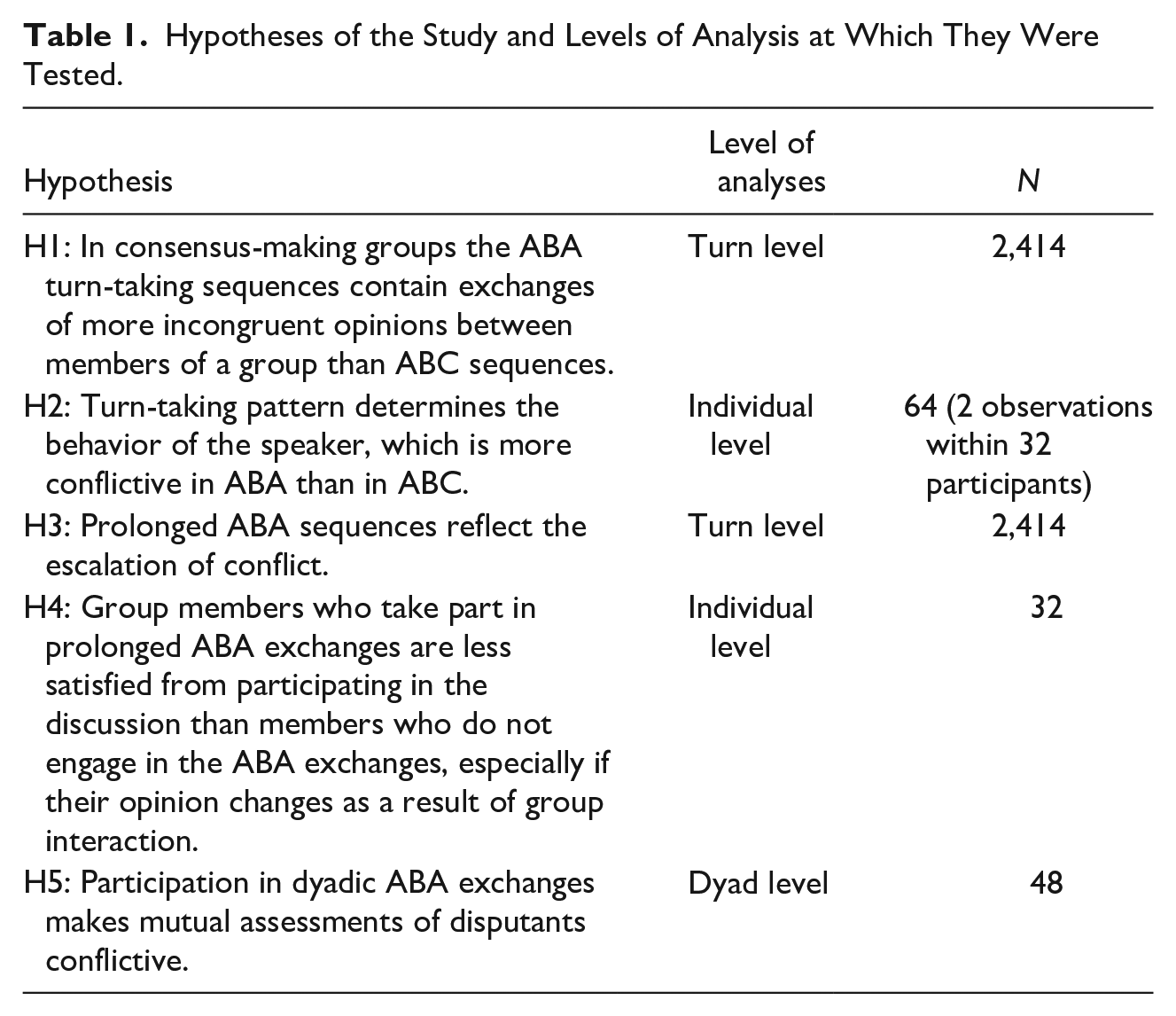
H1: In consensus-making groups the ABA turn-taking sequences contain exchanges of more incongruent opinions between members of a group than ABC sequences.
A conflict is likely to emerge when arguments are expressed directly and with a sufficient oppositional intensity between two people (Weingart et al., 2015). Directing a controversial opinion at an adversary in a discussion is like throwing down the gauntlet (Eisenberg & Garvey, 1981; Kotthoff, 1993; Leung, 2002). During a conflict, the goal of reaching an agreement is likely suspended (Kotthoff, 1993) and the controversial assertion is often responded to with an assertive (or aggravated) disagreement (Garcia, 1991). Incompatibility between opinions, goals, or interests is likely perceived by the group members who engage in the processes of opposition (Nair, 2008), which involves competition, power plays, or rivalry to enforce a particular solution or strategy on the opponent. Disagreement about how the task should be performed gives way for negative emotionality. Overt expression of conflict may encompass emotional frustration, such as anxiety, tension, anger, and hostility (Nair, 2008, Ting-Toomey & Oetzel, 2001). Team members communicatively cocreate conflict by exchanging negatively valenced, dominant, and disagreeing statements focused on exchanging contradictory opinions (Nair, 2008) and emotional communication evokes complementary and reciprocal emotions in others (Keltner & Heidt, 1999).
It is important to determine to what extent the behavior of interacting participants is a result of their individual predispositions and personal traits, and to what extent it is conditional upon (or emergent from) interaction itself. According to Gibson (2008), people’s social behavior has two main sources of variation. The first one is predetermined by individual characteristics of a person, such as personality traits, opinions on the topic of discussion, social roles, and the status a person enters a social interaction with. The other one is related to a particular sequential scaffolding imposed by the interaction itself. A behavior is a reaction to what has been said or done and restricted by social conventions of a given interaction pattern. Thus, we predict that group member’s behavior will differ depending on the turn-taking context (i.e., ABA or ABC). In reciprocal turn-taking patterns (i.e., ABA), group member’s behavior will be more conflictive than in non-reciprocal ones (i.e., ABC).
We thus expect that dyadic reciprocal ABA communication involves more conflictive behaviors than the non-dyadic ABC communication. Based on the literature reviewed in this section, we operationalize conflictive behavior as being emotionally negative, dominant, and conveying more disagreement and stronger opinions.
H2: Turn taking pattern determines the behavior of the speaker, which is more conflictive in ABA than in ABC.
Research across a wide array of contexts shows that reciprocity in contentious or competitive communication escalates conflict (Brett et al., 1998; Olekalns & Smith, 2000; Weingart et al., 1999). Adjacent, opposing arguments strengthen people’s motivation to counter, prolonging the tit-for-tat sequence, which makes the conversation more engaging for the disagreeing communicators. In result, interactions between opposing parties may grow in intensity and lead to escalation of conflict, which has been described incisively by the conflict spiral model (Rubin et al., 1994). According to Folger et al. (1997), participants of conflict become “trapped in their own interaction patterns” (p. 73). These interaction patters, or reciprocal patterns, often “stem from matching the other person’s tactics, potentially leading to a lengthy cycle” (Putnam, 2013, p. 17). The spiral pattern imposes order on the succession of events in an interaction; in conflict, disagreement tends to escalate, often even when the communicators wish to bring it to an end (Brett et al.,1998).
Thus, we expect that, in a conflict process, contentious communication mediated by dyadic turn-taking is going to escalate with each step of the reciprocal cycle of behavior. In situations where there is a substantial disagreement between two group members, the dyadic exchange will prolong and turn into conflict. We expect to observe a growing intensity of dominance, animosity, and disagreement with each step of the ABA sequences.
H3: Prolonged ABA sequences reflect the escalation of conflict.
When group members feel pressure to conform, which may take the form of the ABA reciprocal counter-argumentation sequences, some members may agree to the group’s decision for the sake of group consensus. Disagreements within a group can lead to cognitive dissonance, which is a psychological discomfort or an aversive drive state that people are motivated to reduce (Festinger, 1957). Since open expressions of disagreement in a group produces tension, team members may be motivated to reduce cognitive dissonance by subsequently converging on a group consensus (Matz & Wood, 2005). Since cognitive dissonance is associated with emotional discomfort (Matz & Wood, 2005), it will likely lead to a negative assessment of the interaction and the members whom a group member disagreed with (Pruitt et al., 1997). Participants who engaged in ABA patterns may perceive the interaction as less satisfactory than those who engaged in ABC patterns. Moreover, this negative assessment would be moderated by the extent to which a group member changed their initial attitude toward the group consensus. Conforming group members should perceive conversation as less satisfactory, as they were subjected to social pressure, marked by increasingly aggressive and dominant reciprocal communication which they had to be involved in. Contrarily, people who were able to withstand the group pressure to conform or were even able to impose their own opinions were more likely to remain satisfied throughout the group interaction even when engaged in prolonged back-and-forth exchanges.
We also seek to understand which aspect of a group interaction would be perceived as dissatisfactory by reciprocally communicating group members. Group member satisfaction has been defined as “an affective response that members have to some element pertaining to a small group” (Wiiteman, 1991, p. 31). Traditionally, in task groups, two basic facets of group interaction were distinguished (Bales, 1950)—the socio-emotional aspect, which relates to interpersonal relationships among group members, and the task-related aspect, which concerns how well members manage to perform the job. Further, fluency of coordination is a determinant of group satisfaction, as it stimulates the feeling of connectedness and rapport (e.g., Dijksterhuis, 2005; Kulesza et al., 2013; Lakin & Chartrand, 2003).
Similar to categorization of group interactions, distinctions have been proposed with reference to intragroup conflict—task, relationship, and finally process conflict (Behfar et al., 2011), the last reflecting how well group members are able to coordinate their activities while working on the task (e.g., Behfar et al., 2011; Jehn, 1997). Thus, in our study, satisfaction was operationalized as perceived quality of the conversation (task-related satisfaction), positive emotions toward other group members (socio-emotional satisfaction), and experienced fluency and mutual adjustment of the speakers (process-related satisfaction). By differentiating between these three aspects of interaction-related satisfaction, we could determine which one was affected by the dyadic contentious communication in the form of ABA sequences. We expected each of these aspects to be potentially influenced by escalatory ABA exchanges.
H4: Group members who take part in prolonged ABA exchanges are less satisfied from participating in the discussion than members who do not engage in ABA exchanges, especially if their opinion changes as a result of the group interaction.
Finally, we posit that repetitive patterns of coordination may lead to the emergence of similar behaviors between group members (Nowak et al., 2017). If two group members participate in the same coordination pattern that mutually determines their behavior, its characteristics will influence the way they remember and perceive each other (Fiske, 2000). By the same token, team members’ conflictive interactions (i.e., conflict process) will determine their perceptions of the differences between them (DeChurch et al., 2013). When exposed to the adverse behavior of their interaction partner, the group members may mutually acquire a more negative view of each other (Friedman & Currall, 2003; Keltner & Haidt, 1999; Pruitt et al., 1997). Based on this, we assume that the social bond established during the group interaction will be tinged with the negative emotions and/or disagreements group members were involved in while talking to each other (Friedman & Currall, 2003). If two people have participated in frequent conflictual dyadic exchanges (i.e., ABA), their mutual assessments measured after the interaction will be conflictual or at least influential (i.e. having an influence on own opinions regarding the topic of the conversation), as a result of frequent direct communication.
H5: Frequent co-participation in dyadic ABA exchanges makes the mutual assessments of disputants conflictive.
To test our hypotheses, we designed a study involving discussions of groups interacting in physical space with the goal of reaching consensus. The topic chosen for the discussions was women’s right to abort pregnancy, which is often referred to as a topic that evokes controversy (e.g., Chen & Berger, 2013). Operationalizations of the above hypotheses are listed in Table 1.
Hypotheses of the Study and Levels of Analysis at Which They Were Tested.
Materials and Methods
Participants
The participants of the study were students at the University of Warsaw recruited randomly on campus. They were appointed to a specific place and time where they would join a group discussion with students whom they had not met before. Participants were not offered compensation; however, snacks and drinks were served throughout the study procedure.
A total number of 41 students participated, with 8 groups of 4 members and 3 groups of 3 members. Only groups of four members were included in the sample of the present study; thus the final sample consisted of 32 people organized in eight 4-person groups, with 21 women and 11 men aged 19 to 28 (M = 22.9).
Ethics Statement
All procedures were approved by the Research Ethics Committee of the institution where the research was carried out. All participants were informed about the aim, duration, and outline of the procedure, including the topic of the discussion. They were notified that the conversation was going to be recorded and analyzed by competent raters and all data were going to be anonymized and used only for purposes related to the study. All participants understood the consent information and gave oral consent.
Procedure
The whole procedure was conducted in Polish. After arriving at the lab, participants were given an ID-tag with numbers 1 to 4. Then, they completed a survey composed of items from the Attitudes toward Abortion Scale (see measures). After completion, they were seated at a table and given written instructions for the group task. The experimenter made sure that the instructions were clear, turned the camera on, left the room. The experimenter returned after 30 minutes and asked whether the group needed additional 5 minutes to complete the discussion. Most groups used the extra time. Some groups did not finish their discussion even after the extra time because the conversation was so heated, in which case the experimenter once again encouraged the group to finish and waited in the laboratory until they did. The final recordings lasted from 30 minutes 15 seconds to 45 minutes 46 seconds (M = 39 minutes 26 seconds).
After the group task, participants were seated separately but able to see each other’s IDs. They completed another survey composed of items from the Attitudes toward Abortion Scale, the Group Interaction Satisfaction Scale, and the Sociogram. When the study was over, participants were thanked and carefully debriefed. The procedure took around 1.5 hours. Anonymized data files used for the analyses are available from the OSF database (access link: https://osf.io/wbzus/?view_only=a4f75ded290e4cce811f34b2663240ce).
Materials
Attitudes toward Abortion Scale
The Attitudes toward Abortion Scale was used to measure participants’ attitudes toward abortion. The scale consisted of 12 statements, 6 of which expressing pro-choice (e.g., “Anti-abortion law in Poland should be liberalized”) and 6 pro-life (e.g., “Polish law should not allow to induce abortion”) views. Participants rated to what extent they agreed with each statement on a Likert-type scale from 1 (“strongly disagree”) to 9 (“strongly agree”). Attitude toward abortion was calculated by deducting the average score of the pro-choice statement from that of the pro-life statements. Reliability of the questionnaire measured with Cronbach’s alpha statistic reached .91 the first time the attitude was measured (i.e., before group interaction), and .93 after the interaction.
Group task instructions
Before starting the discussion, participants were informed that the purpose of the study was to develop solutions to the dilemmas of abortion, which could be included in an Act prepared by the Ministry of Health to regulate abortion rights in Poland. The law would be the result of a social compromise on the controversial issue; therefore, different groups were invited to consult on the matter. To facilitate the discussion, the instructions provided seven controversial topics (e.g., “When does the embryo become a human being?” or “How should medical decisions about conducting an abortion be regulated?”), and the group could choose which topics to discuss. Group members were instructed that their task was to share their personal opinions related to these issues during the group discussion and to develop a common group-level position—a consensus. In cases where consensus was impossible to achieve, instructions advised the group to discuss differences in opinions.
Group Interaction Satisfaction Scale
Satisfaction was assessed through a 15-item scale, specially developed by the authors for the purpose of this study, that consisted of statements on three aspects of group interaction (five items for each aspect): positive emotions (e.g., “I liked the people in my group”), quality of the discussion (e.g., “I am satisfied with the effects of the group work”), and coordination (e.g., “I have the impression that the knowledge and skills of participants complemented each other”). Participants assessed to what extent they agreed with each statement on a Likert-type scale ranging from 1 (strongly disagree) to 9 (strongly agree). Cronbach’s alpha for the total scale amounted to .91, and for the individual subscales was slightly lower: .79 for positive emotions, .71 for coordination, and .80 for discussion quality. The aspects of satisfaction were used as outcome variables at the person-level analysis.
Sociogram measures
Sociogram measures (see, e.g., Hale, 2009, for the explanation of the sociogram analysis) were used to assess participant’s perceptions of their fellow group members. Participants answered eight open-ended questions using each group member’s assigned ID number. The questions are:
(1) “Which participant do you know?” (to ensure group members were strangers),
(2) “With whom in the group did you like to cooperate?”,
(3) “Whom do you consider similar to yourself?”,
(4) “Whom do you consider to be a pro-choice proponent?”
(5) “Whom do you consider to be a pro-life proponent?”,
(6) “With whose views do you disagree the most?”,
(7) “With whose views do you agree the most?” and
(8) “Who in the group did influence your opinion on abortion?”.
The sociogram measures were used at the dyadic level of analysis.
Coding of the interaction
Coding of turn-taking sequences
First, transcripts of video recordings were divided into turns, with each turn denoting a speaker. Strict rules were employed to obtain unambiguous sequences of consecutive turns. A turn was categorized as preceding if it started before a concomitant turn. If two turns began exactly at the same time, the one that finished earlier was categorized as preceding. Interjections (e.g., by changing the topic of their turn, answering a question, etc.) and short side comments during longer turns were counted as separate turns only if the speaker of the longer turns reacted to the interjection or side comment. Otherwise, it was not counted as a turn. By abiding by these rules, we obtained divided group discussions into consecutive turns.
Subsequently, each turn was automatically classified as either belonging to the ABA or ABC sequence. The reciprocal communication was coded without reference to the participants’ identity (i.e., using letters A, B, and C). The turn was classified as ABA if the speaker of a given turn was also speaking in lag +2 (i.e., two events—here turns—after the initiation of the sequence), and as ABC, if the speaker of a given turn was different from those in lag +1 and +2 (i.e., one and two turns after the initiation of the sequence).
To ensure reliability, a second rater, a non-academic who was blinded to the hypotheses of the study, was trained to code the sequence of two randomly selected group interactions (one in which group members held divergent views on abortion and one in which they were uniformly pro-life) using the same coding instructions. Results of the second round of coding differed only slightly from the original coding (i.e., 5.8% difference in the uniform group and 2.0% in the divergent group). The main source of disagreement was the categorization of interjections. The second rater was less likely to count interjections as turns, which resulted in slightly shorter speaker sequences. We also examined whether the turn-taking patterns differed significantly between coders. The percentages of ABA and ABC sequences obtained by the two raters were similar (54.0% vs. 55.0% in the divergent group; 46.0% vs. 49.0% in the uniform group). Based on the comparison between the raters, we decided that the original coding of the turn-taking sequences was sufficiently reliable for data analyses.
Content coding scheme
Coders rated the level of intensity of participants’ verbal and nonverbal behavior using the following coding scales. All coding scales, except for the last one (i.e., opinion strength) consisted of seven levels, from −3 to 3, with 0 in the middle. The numbers from 3 to 1 indicated the intensity of a given behavioral attempt (e.g., 3 to 1 meant from “very dominant” to “somewhat dominant”; −3 to −1 meant “very submissive” to “somewhat submissive”). The value of “0” meant that the person’s behavior could not be meaningfully described by a given scale (e.g., “it was neither dominant, nor submissive”).
Domination–submission
A turn was coded as dominant when a person tried to take control over the discussion and dominate others (e.g., participant was active, talkative, or dogmatic). A turn was coded as submissive when a statement was the expression of concession or withdrawal from previously presented opinion (e.g., participant was weak or passive). The codes were adapted from the upward-downward dimension, SYMLOG - a System for the Multiple Level Observation of Groups, proposed by Bales et al. (1979).
Positive–negative emotion
A turn was coded as connoting positive emotions when it conveyed a friendly attitude, humor, or enthusiasm in relation to other individuals, the group as a whole, or the discussed issue. A turn was coded as showing negative emotions when it showed personal attack, negligence, or resentment toward another person’s opinion, the group, or the discussed issue. The codes were adapted from the friendly-unfriendly dimension of SYMLOG (Bales et al., 1979).
Inquiry–advocacy
A statement was coded as inquiry when it included questions aimed at exploring the position of another person or proposing issues for the group’s consideration. It was coded as advocacy when the participant argued in favor of their own opinion. The codes were adapted from the dimension proposed by Losada (1999).
Agreement–disagreement
The scale was used to code to what extent a statement expressed agreement or disagreement with a statement made by a previous speaker. The coding was developed to assess conflictive argumentation.
Prolife–prochoice argumentation
The scale was used to assess whether the participant expressed support or opposition to abortion in their argument.
Opinion strength
A scale with a range of 0 (“no opinion regarding abortion was stated”) to 3 (“strong opinion either supporting or opposing abortion”) was used to assess how strongly the participant expressed their opinions to support or oppose abortion.
Rating procedure
The total number of turns coded was 2,414. The shortest conversation took 165 turns while the longest was 469 turns.
The content was analyzed by two competent raters who are graduate students in psychology. To ensure reliability, the coding procedure had two stages. First, the raters coded the material individually using a provided coding guideline. Then, when there was high discrepancy, the raters compared differences. Initial differences between raters’ assessments pertained to 5.8% to 10.0% of turns in the first four encoded discussions, but declined to 1.2% to 4.0% in the last four discussions. After each group was coded, an interclass correlation (two-factor mixed model) was run to verify the agreement between the assessments of the raters, for each scale separately. Agreement between the raters was considered satisfactory when intraclass correlation coefficient exceeded the value of .7. The mean of the two raters scores was used for data analysis.
Results
Testing Hypothesis 1
The goal of the first analysis was to inspect whether ABA turn-taking sequences contain exchanges of more incongruent opinions than ABC sequences. If ABA sequences contained exchanges of incongruent opinions, the autocorrelations between the different argumentation about abortion expressed in the turns should be low (and presumably negative) only for ABA sequences. We computed autocorrelations on prochoice versus prolife argumentation dimension in turns: each turn’s score was compared to the score of the next turn. If the autocorrelation between the turn at lag 0 and a turn at lag 1 was negative, it indicated that arguments used in these turns were opposite—prochoice argumentation was followed by pro-life argumentation or vice versa. On the other hand, if the autocorrelation was positive, it implied that subsequent argumentation was compatible. Using Spearman’s rank correlation analysis, we examined the autocorrelation in all interactions in all groups taken together, and separately for ABA and ABC. The variables included empty rows in the data: 8 for the prolife-prochoice coding and 16 for the ABA versus ABC coding. In the case of prolife-prochoice coding, the last turn in each group could not be calculated because there was no response at the end of a conversation in a two-element pattern, whereas in the case of the three-element turn-taking pattern, it was the last two turns that could not be included in the analysis. Thus, N = 1,053 for ABA, N = 1,345 for ABC, and total N = 2,398. Spearman correlation was used to calculate the autocorrelations, as the distribution of prolife-prochoice argumentation scale was leptokurtic.
For the whole sample, correlations between arguments were slightly positive, r = .048, p = .02. For the ABC patterns, it was also positive, r = .123, p < .001, while for ABA it was slightly negative, r = -.04, p = .22. The difference between ABA and ABC in correlations was significant (Fisher’s Z = 3.97, p < .001); however, unlike our prediction, the opinions in ABA were not significantly contradictive but were unrelated to each other.
After inspection of the autocorrelations in all eight groups under study, we noticed that argumentation was contradictory in some groups, while for some it was not (see Figure 2). We conducted further exploratory analysis to understand where these differences arise from. The idea behind this exploration was that contradictory counter-argumentation would occur only if members of a discussing group hold contradictory attitudes toward abortion. If the whole group is in agreement as to whether abortion is right or wrong, it is highly unlikely that any of the disputants would engage in rebutting each other’s opinions. This is in fact a prerequisite for conflict: discrepancy of attitudes or opinions are necessary for conflict nucleus to form (Muntigl & Turnbull, 1998). Therefore, we investigated whether the contradictory argumentation in ABA would show up more in groups where attitude discrepancy was high versus low.

Autocorrelations of the prolife-prochoice argumentation in subsequent turns of the eight studied group interactions.
For each group, we calculated the sum of points on the first administration (before the group task) of Attitudes Toward Abortion Scale, on prolife and prochoice subscales separately. Given that attitude toward abortion was ranged from a scale of 1 to 9, if the group members expressed views in the same direction, the total scores would be close to either 4 or 36 because there are four group members. Groups with a similar attitude toward abortion were coded 1 for uniform. If group members expressed views in different directions, the group was coded 0 for divergent. We also assessed the proportions and mean length of ABA and ABC sequences in each group’s discussion (see Table 2). The differences in ABA proportions and mean length between divergent and uniform groups were not significant.
Allotment of Groups into Uniform and Divergent Based on the Initial Incongruence of Opinions.
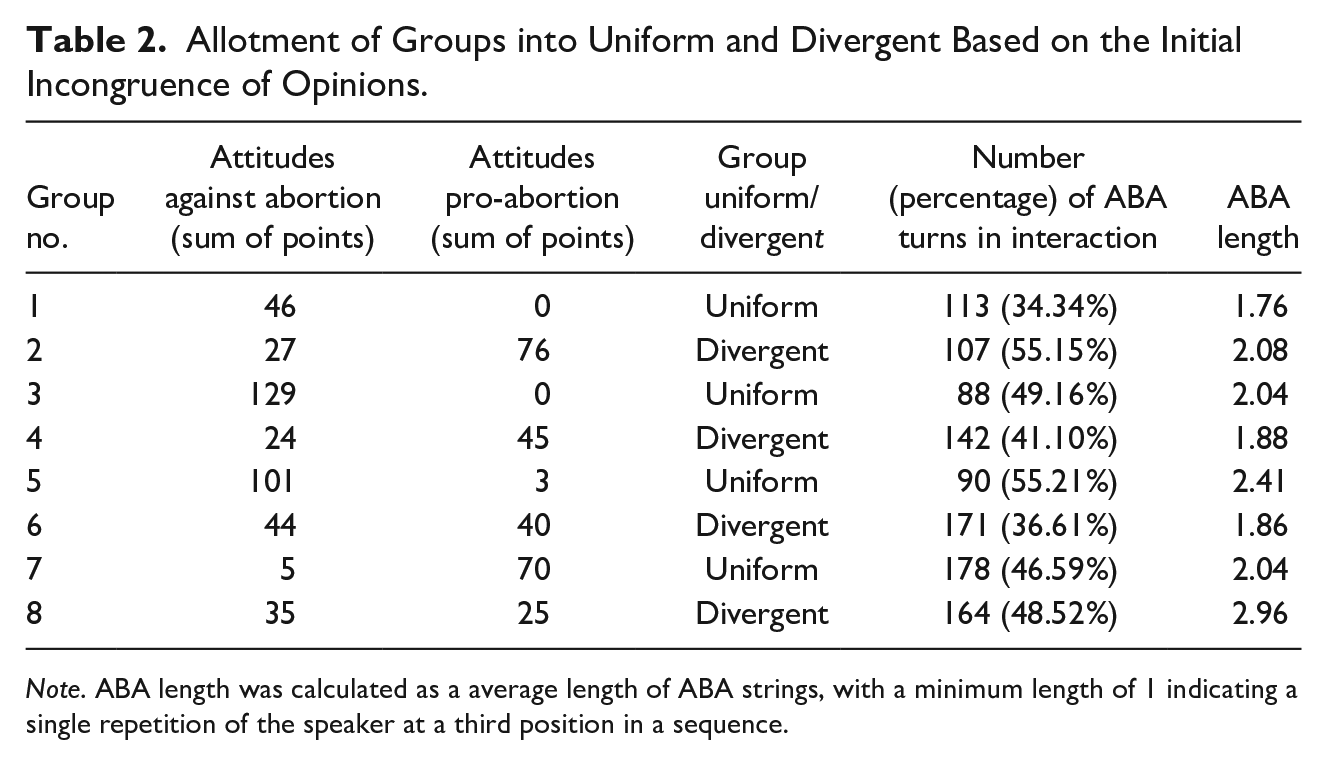
Note. ABA length was calculated as a average length of ABA strings, with a minimum length of 1 indicating a single repetition of the speaker at a third position in a sequence.
Then, we calculated the autocorrelations between attitudes toward abortion in ABA and ABC separately for divergent and uniform groups. The results are visualized in Figure 3. In divergent groups, the autocorrelations in ABC and ABA differed significantly (.06 for ABC vs. −.20 for ABA; Z = 4.77. p < .001). In uniform groups, on the other hand, autocorrelations between the attitudes were positive regardless of the sequence type (.20 for ABC and .11 for ABA, the difference between correlation coefficients not significant, p = .11). Thus, the only negative correlation between the attitudes was observed in divergent groups within ABA patterns.
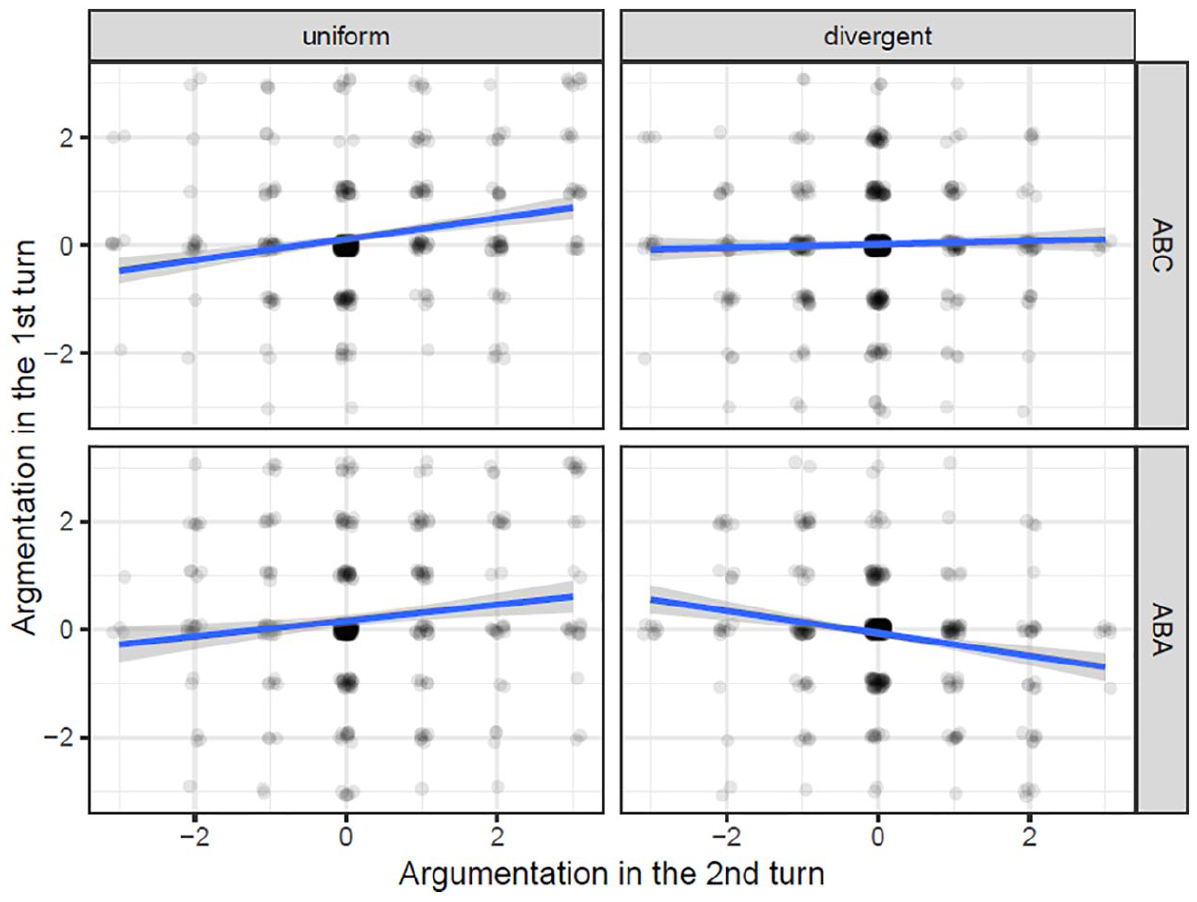
Autocorrelations of prolife-prochoice argumentation in two subsequent turns.
Testing Hypothesis 2
To examine how participants’ behavior, specifically, the manifestations of conflict in their communication (i.e., disagreement, negative emotions, dominance, and strong opinions) changed depending on the structure of turn-taking, we conducted a within-person analysis comparing the content of group members’ communication while they engaged in ABA versus ABC patterns (total N = 64, with two observations for each of 32 participants). For each person mean values on the content coding scales were averaged, separately for the ABC and ABA sequences. Because both the climate of discussion in different groups as well as individual differences can introduce variance into the behavior of speakers, we used linear mixed models to account for the variances. The type of sequence (ABA vs. ABC) was the fixed within-subject factor, and the model also accounted for the overall intercept, the variance within the group, and between the persons. The analysis showed that the pattern of turn-taking significantly predicted the levels of dominance (M = .94 for ABA; M = .78 for ABC), emotion (less positive in ABA, M = .07 than in ABC, M = .16), agreement (lower in ABA, M = −.06 than in ABC, M = .12) and opinion strength (higher in ABA, M = .58 than in ABC, M = .49). Results are summarized in Table 3.
The Effect of the ABA versus ABC Turn-Taking Context on the Content of Communication.
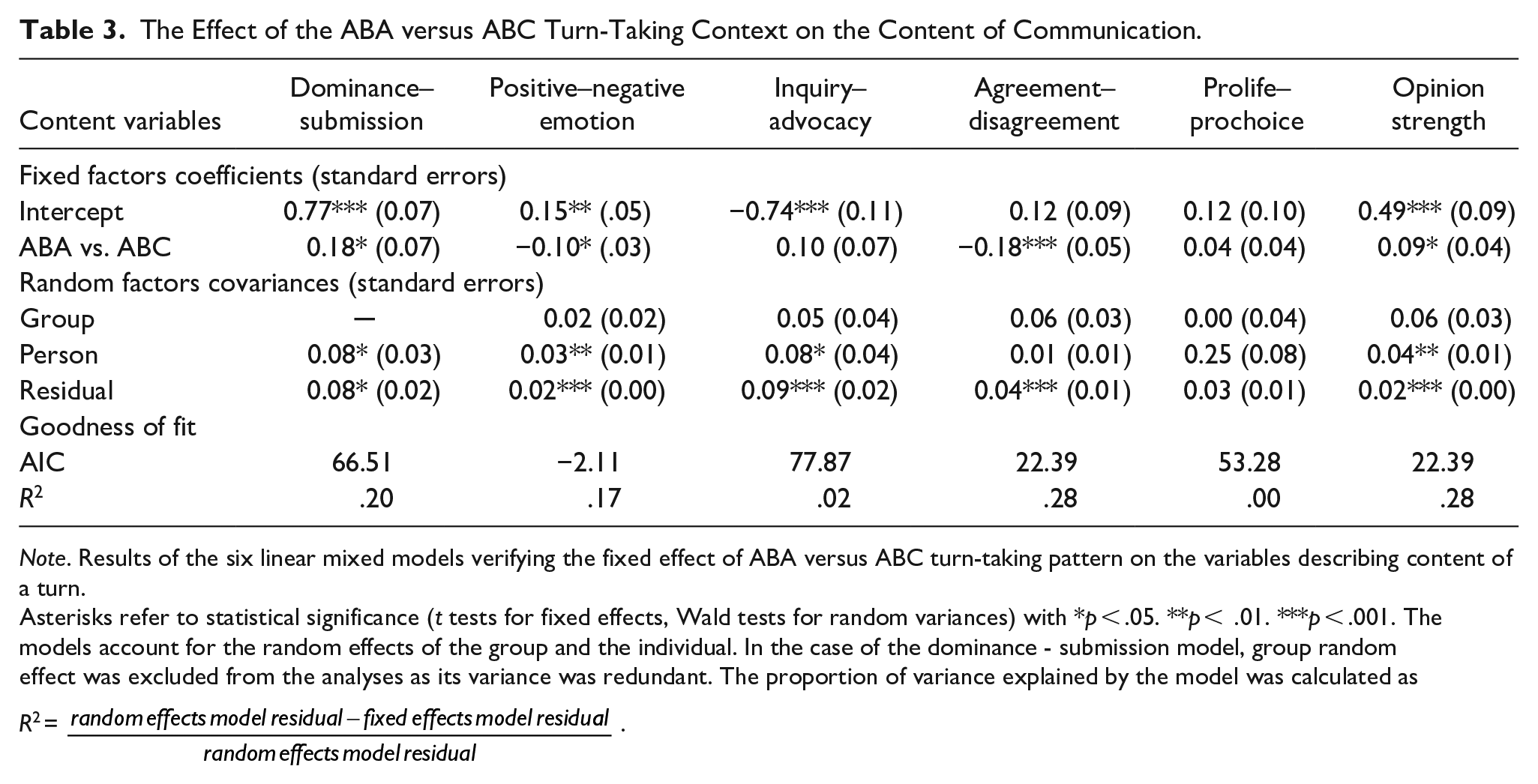
Note. Results of the six linear mixed models verifying the fixed effect of ABA versus ABC turn-taking pattern on the variables describing content of a turn.
Asterisks refer to statistical significance (t tests for fixed effects, Wald tests for random variances) with *p < .05. **p < .01. ***p < .001. The models account for the random effects of the group and the individual. In the case of the dominance - submission model, group random effect was excluded from the analyses as its variance was redundant. The proportion of variance explained by the model was calculated as R2 =
Testing Hypothesis 3
To investigate the effects of the prolongation of ABA sequences on escalation of conflict, we examined whether the content changed with the ordinal position of a turn in the turn-taking sequence, that is, where the turn occurs in the communication thread. Using Spearman’s rank correlation analysis, we examined the relationship between the position of a turn in both types of sequences and its content.
Table 4 shows the results of the analyses. The relationship between the position in the ABA sequence and content coding scales was significant for three content variables: dominance-submission, positive-negative emotions, and agreement-disagreement. The later in an ABA sequence the participant spoke, the higher the dominance, negativity, and disagreement in the content. In the case of ABC sequences, dominance and argumentation strength diminished when the participant spoke at a later turn in the sequence. Significant differences between the correlations in ABA and ABC sequences were observed on dominance (Fisher’s Z = 3.6, p < .001), positive-negative emotions (Z = 3.9, p < .001), and agreement-disagreement (Z = 2.92, p < .01). The differences were not significant in the case of opinion strength.
Spearman Correlations Between the Position of a Turn in a Sequence and Its Content in All Groups, Uniform, and Divergent Groups.
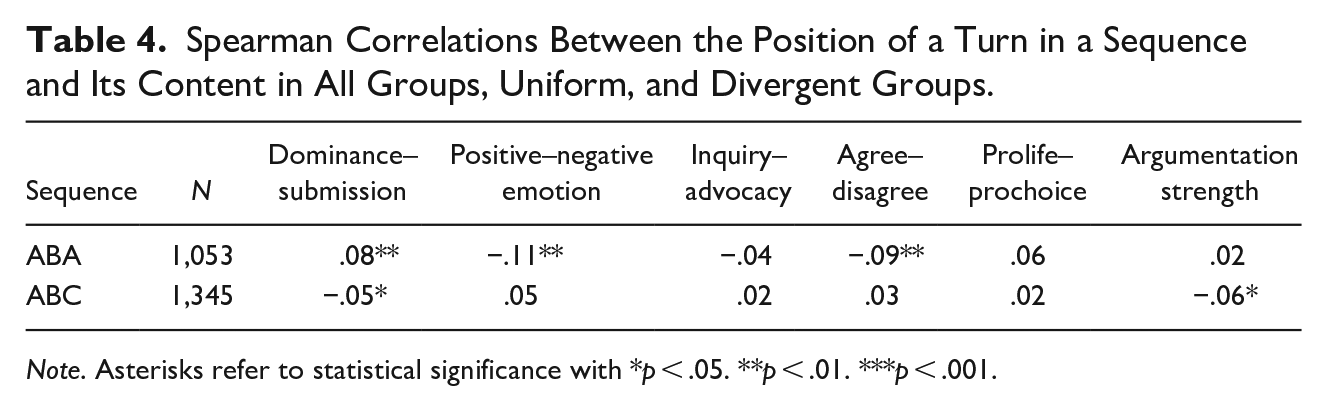
Note. Asterisks refer to statistical significance with *p < .05. **p < .01. ***p < .001.
Testing Hypothesis 4
The following analysis was conducted at the level of individuals (N = 32). As shown by the previous analysis, conflict grew in intensity with length of the ABA exchanges (H3). Therefore, we assumed that participation in prolonged ABA exchanges would predict negative assessments of the group interaction. We operationalized ABA length as the average length of uninterrupted ABA sequences in which a person participated, with a minimum length of 1 indicating a single repetition of the speaker in lag +2. Results of a linear mixed model showed that the length of ABA exchanges significantly predicted only one aspect of satisfaction: participants’ perceived quality of the discussion. The model explained 31 % of variance (see Table 5). A similar model with the length of the ABC exchanges as the covariate predictor was not significant.
The Effect of the ABA Length on the Quality of Discussion Rankings.
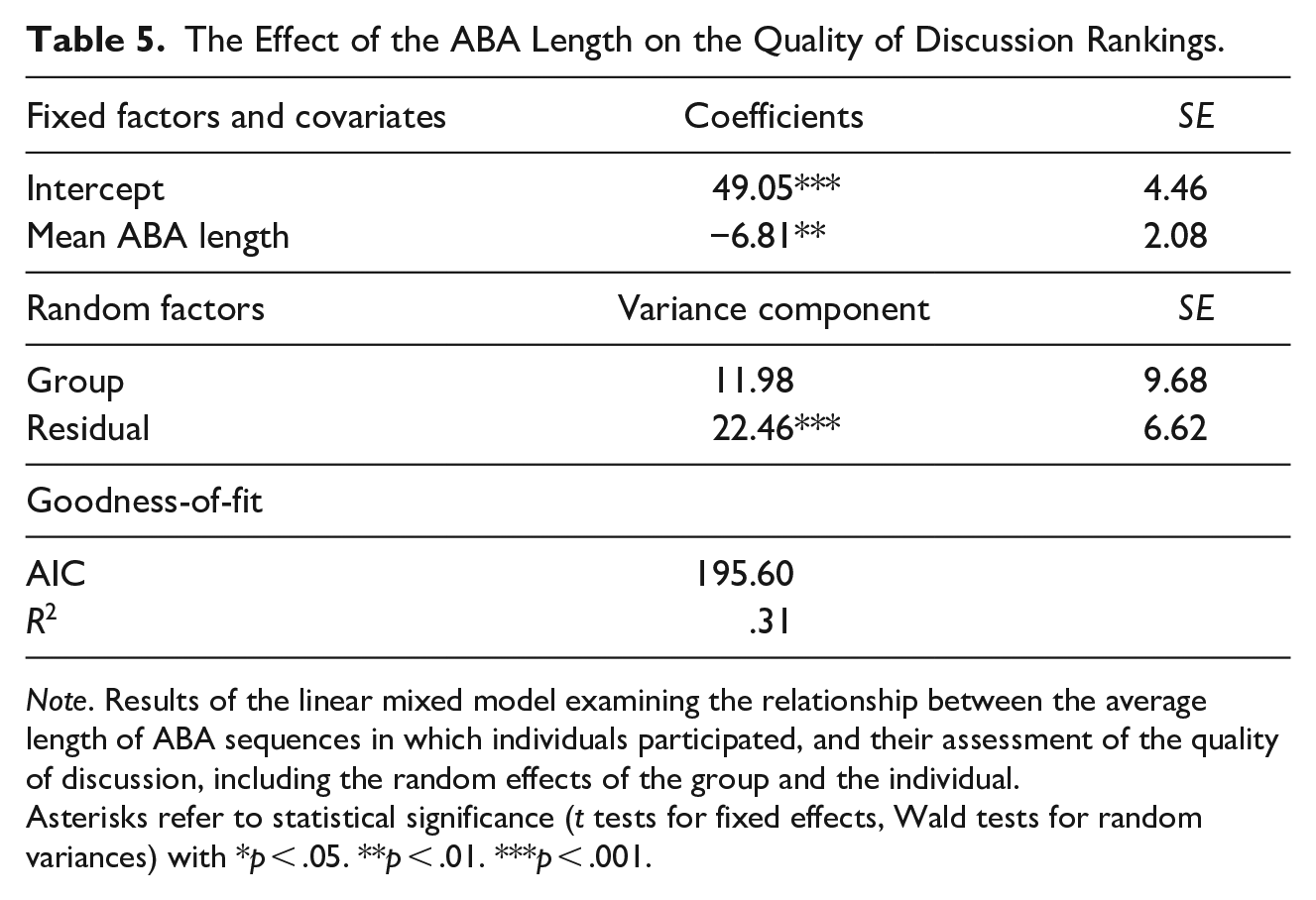
Note. Results of the linear mixed model examining the relationship between the average length of ABA sequences in which individuals participated, and their assessment of the quality of discussion, including the random effects of the group and the individual.
Asterisks refer to statistical significance (t tests for fixed effects, Wald tests for random variances) with *p < .05. **p < .01. ***p < .001.
Then, we conducted an analysis to check whether the effect of ABA length on satisfaction was different if a person conformed to the group’s attitude toward abortion or not. To measure a person’s level of conformism, we created a nominal variable, where 1 indicated that the person’s views on abortion became more similar to the group’s (i.e., mean value of the scores of the four participants’ attitude toward abortion) in result of the interaction, while value 0 indicated that the difference between the person’s views and that of the group further polarized from the group mean or remained the same. This variable was used as a factor in the mixed model, with ABA length as covariate and satisfaction measure as dependent. Results are presented in Table 6. The model explained 42.0 % of variance in quality of discussion estimations. A similar analysis with the length of ABC exchanges as the covariate predictor showed no significant results.
The Effect of ABA Length, Personal Level of Conformism and Their Interaction on Quality of Discussion Rankings.
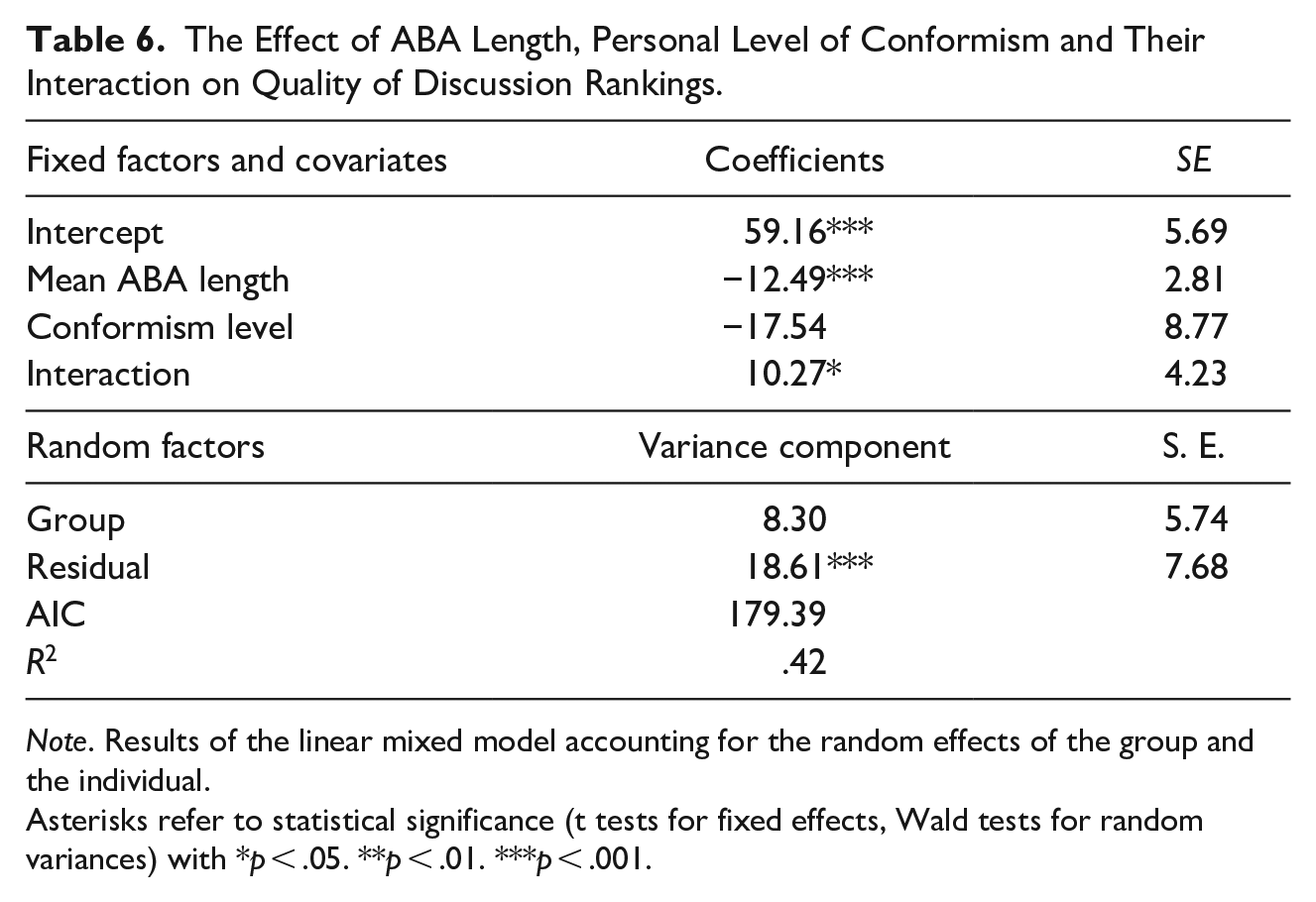
Note. Results of the linear mixed model accounting for the random effects of the group and the individual.
Asterisks refer to statistical significance (t tests for fixed effects, Wald tests for random variances) with *p < .05. **p < .01. ***p < .001.
The analysis of the interaction effect showed that for participants who changed their attitude in the direction of matching the group’s mean, participation in longer ABA exchanges had a negative effect on their satisfaction with the quality of interaction. Conversely, satisfaction of those participants whose attitude further polarized from the group mean or remained the same was unaffected by the length of turn-taking (see Figure 4). Conformism did not predict satisfaction, however, when ABA length was removed from the model (B = −1.75, p = .45). Also, ABA length was not related to the likelihood of moving closer toward the group mean (B = 1.52, p = .15).
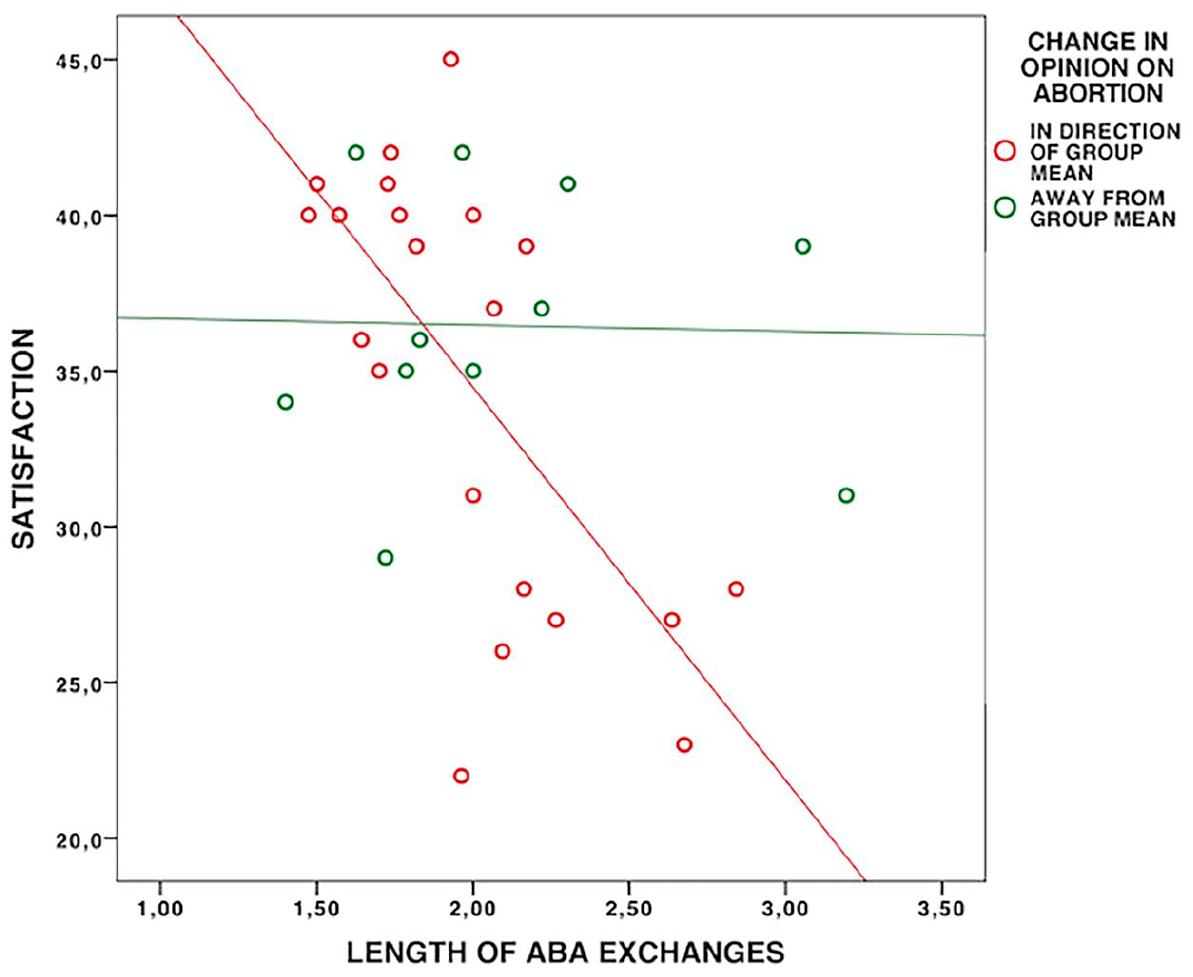
Interaction effect of mean ABA length and conformism on satisfaction ratings.
Testing Hypothesis 5
The following analysis was conducted at the level of a dyad (N = 48). We first examined whether joint participation in ABA was related to the extent to which the two individuals differed in their views on abortion as measured before and after the interaction. The co-participation in ABA was operationalized as a proportion of turns in which a given pair of group members co-participated in the ABA exchanges. To obtain the measure, we assigned each turn to a particular dyad if the turn was uttered by one of the dyad members and followed by a turn uttered by another dyad member. We then calculated how many of these turns were part of the ABA context, which allowed us to calculate the resulting percentage of ABA turns for each dyad.
Two linear mixed models were computed to explore the relationship between co-participation in ABA (covariate predictor) and attitude differences between the two speakers—prior and after the interaction (dependent variables). Each model accounted for the random effect of the group and the pair of participants.
For both models, distributions of residuals significantly deviated from normal. Subjecting the dependent variables to a linear transformation (square root) solved the problem of the non-linear relationship. Table 7 shows results of the analysis. Both models showed a significant relationship between co-participation in ABA and attitude differences; however, co-participation in ABA explained more variance in attitude differences after the interaction (R2 = .31), even though the sole difference between group member’s attitudes diminished after the interaction (MD = 2.56, t = 2.39, p = .02). The analysis confirmed that dissimilarity of opinions was related to frequency of ABA communication within a dyad.
The Effect of Co-Participation in ABA on the Difference of Views Between Individuals Before and After The Interaction.
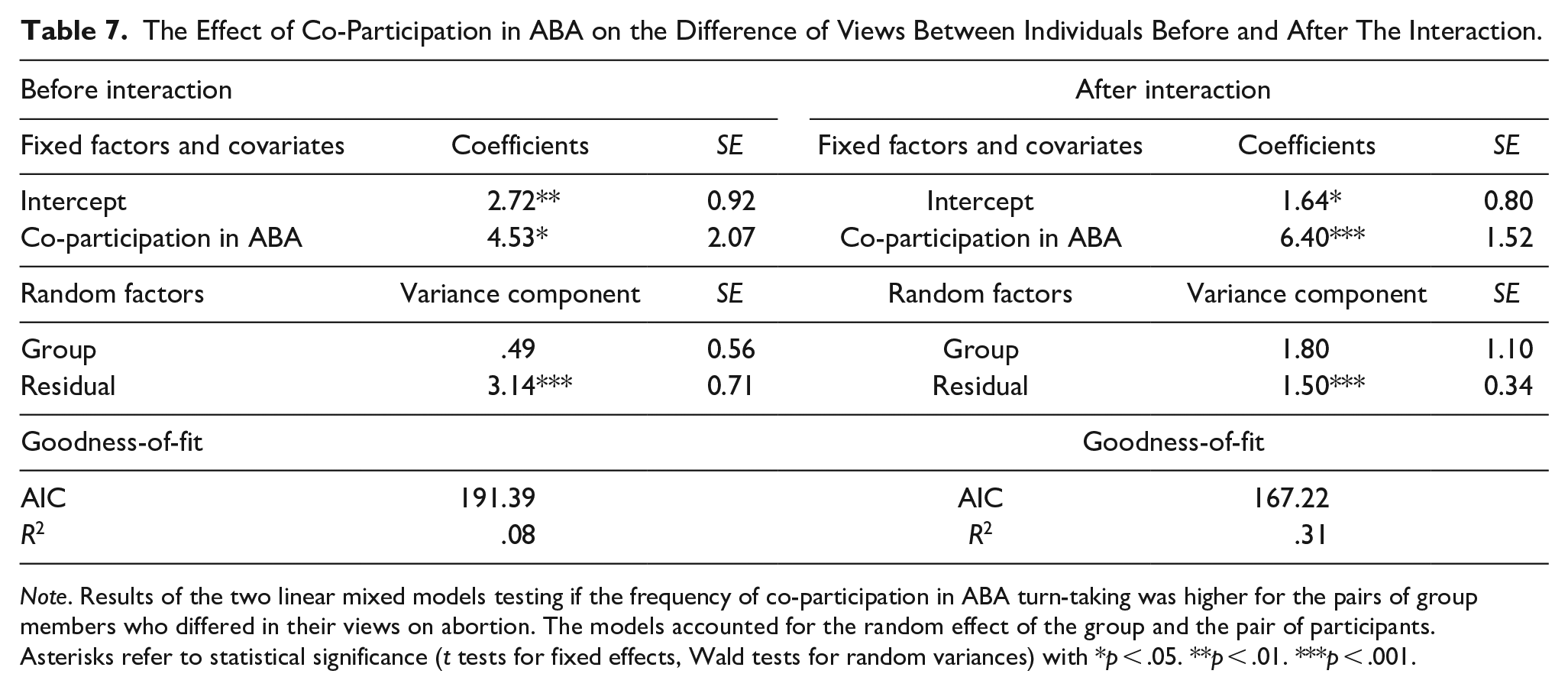
Note. Results of the two linear mixed models testing if the frequency of co-participation in ABA turn-taking was higher for the pairs of group members who differed in their views on abortion. The models accounted for the random effect of the group and the pair of participants.
Asterisks refer to statistical significance (t tests for fixed effects, Wald tests for random variances) with *p < .05. **p < .01. ***p < .001.
To examine the effects of ABA patterns on mutual assessments of the disputants we used a binary variable to transform sociogram ratings, with 1 indicating that at least one person in the pair rated their dyadic partner as influential, similar, disagreeing, etc., and 0 indicating neither person mentioned their dyadic partner in their answers to the sociogram questions. We tested logistic regression models with the binary variable as the dependent variable. To eliminate the random effect of group membership and ensure independence of observations, we centered co-participation in ABA around the group mean.
Results of the analyses are shown in Table 8. Co-participation in ABA significantly predicted whether members of the dyad perceived each other as disagreeing, χ2 = 5.08. p = .04, Nagelkerke pseudo R2 = .13 and influential χ2 = 6.37, p = .02, R2 = .17. The more frequent their co-participation in ABA, the more likely the two group members rated each other as disagreeing and influential. The model with similarity ratings as the dependent variable was significant with χ2 = 4.86, p = .04, R2 = .13. The more frequent the common participation in ABA, the less likely the similarity ratings were. Models for predicting the influence of participation in ABA on cooperation, agreement, and perception of the partner’s attitude toward abortion were not significant.
The Effect Co-Participation in ABA on Mutual Sociogram Assessments.
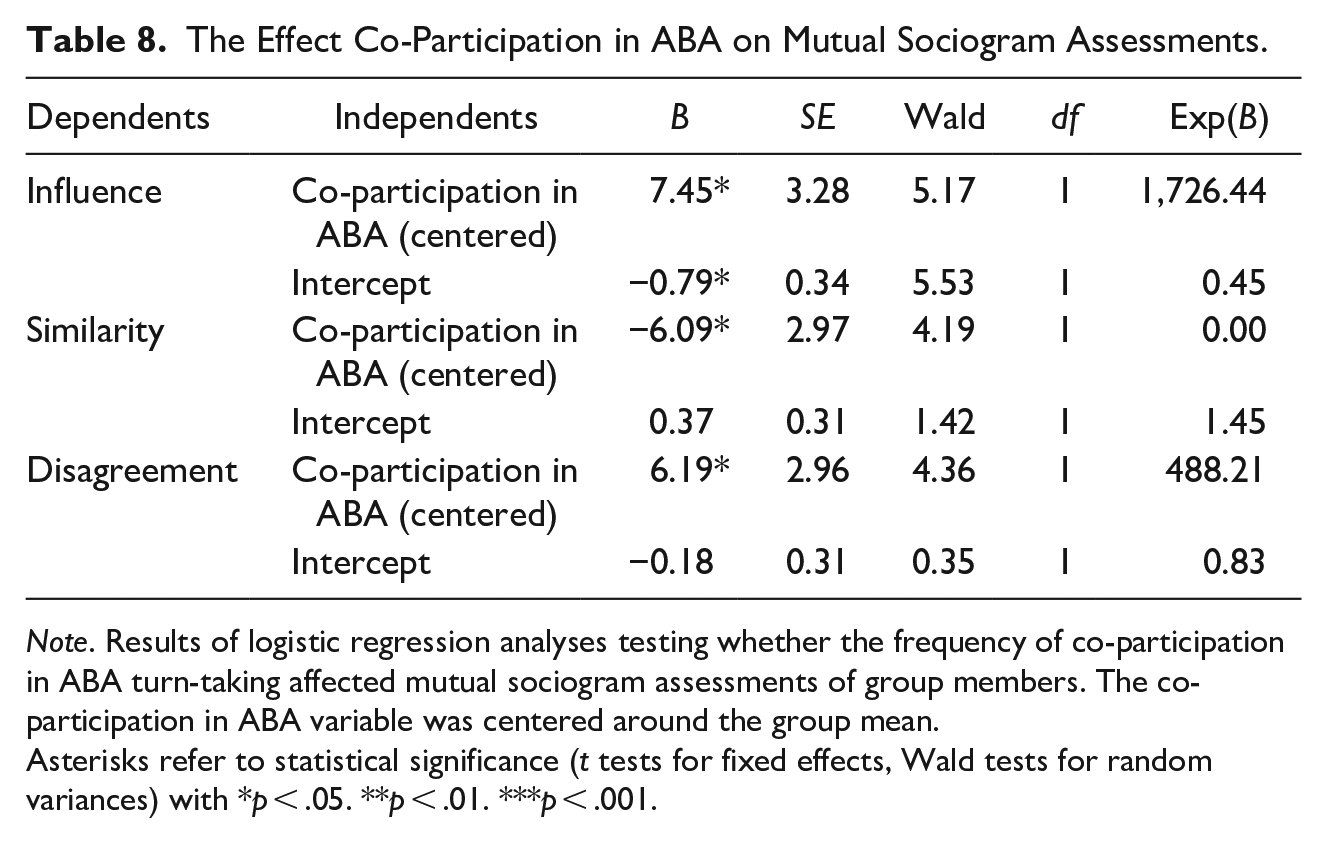
Note. Results of logistic regression analyses testing whether the frequency of co-participation in ABA turn-taking affected mutual sociogram assessments of group members. The co-participation in ABA variable was centered around the group mean.
Asterisks refer to statistical significance (t tests for fixed effects, Wald tests for random variances) with *p < .05. **p < .01. ***p < .001.
Discussion
The purpose of this study was to investigate whether reciprocal, dyadic communication patterns - ABA sequences - transmit disagreement between participants in group discussions on a controversial topic, and if so, how they affect the participants’ mutual assessments and satisfaction after the interaction. It was hypothesized that the dyadic turn-taking is a structure that transmits reciprocity in contentious communication leading to escalation of conflict in disagreeing groups, as widely observed in conflict and communication research (see Brett et al., 1998; Putnam, 2013).
Our analysis showed that, when turn-taking patterns are not considered, opinions expressed by discussion participants in were positively related to each other. However, comparison between turn-taking patterns revealed that, although there was a positive correlation between opinions expressed by different participants in ABC exchanges, this relation diminished in the ABA patterns. Subsequent exploratory analysis showed that ABA communication was associated with exchanges of contradictory opinions only in groups with different opinions. In groups where members had a similar attitude on abortion, the relationship between their expressed opinions was positive both for ABA and ABC patterns, and the difference between dyadic and non-dyadic communication was not significant.
Results also showed that ABA sequences conveyed more conflict than ABC sequences. Participants’ behavior differed significantly depending on the communication pattern. When speaking in an ABA pattern, participants tended to produce more dominant, negative, and disagreeing statements and express stronger opinions than when speaking in an ABC pattern. What is more, intensity of conflict increased proportionally when the ABA sequences were longer, showing that direct one-on-one exchanges, especially those that were prolonged, tended to facilitate conflict expression, escalating with each step of the sequence. Finally, the analyses showed that the ordinal position of the turn in the ABA pattern influenced the participant’s perception of the interaction. Participation in ABA predicted perceived quality of the interaction. Those who changed their attitude to match that of the group were significantly less satisfied with the discussion only when they participated later in long ABA sequences. Participants whose attitude remained the same or further deviated from the group consensus enjoyed the group interaction, even if they participated later in a long ABA sequence. We also found that joint participation of dyads in the ABA exchanges predicted the participant’s mutual assessment of their communication partner’s influence and the level of conflict in the interaction. Pairs who interacted reciprocally were more likely to rate each other as influential, dissimilar, and disagreeing. Co-participation in ABA was also related to the extent to which the two speakers’ attitudes toward abortion differed both prior to and after the interaction. The effect was much higher for the attitudes expressed after the interaction, which indicates that the dyadic communication during the interaction has amplified the pre-existing discrepancy between the two participants, instead of creating it.
Theoretical Implications
Psychological research on groups usually focuses on the individual group member’s motivations, behavior, and influence on group processes. However, the behavior of group members is highly determined by interpersonal processes that cannot be viewed solely from the perspective of an individual acting alone. For example, communication processes that involve the influence of a previous speaker’s statements, interaction goals, and comprehension of the ongoing interaction floor are all important determinants of group processes. Our study takes the approach of examining the influence of communication process to acknowledge the importance of considering groups as complex, adaptive, and dynamical systems (see Arrow et al., 2000; McGrath, 1997).
Our approach is focused not on identifying the type and intensity of conflict experienced by group members but on how group members communicatively co-create conflict in group interaction. It agrees with the process-state model of conflict proposed by DeChurch et al. (2013) which distinguishes “what teams disagree about from how they go about interacting to resolve their differences” (p. 565). Conflict processes ultimately give rise to conflict emergent states, that is, group members’ perceptions of conflict, which are usually categorized as task or relationship-related. Our study captures precisely this process of emergence—negative inter-member perceptions and dissatisfaction that result from transitory patterns of communication. The emergent aspect of interaction grasps the causal relationship between dynamic coordination patterns and stable group-level qualities, such as social structure (relations between group members) or norms (Di Paolo & De Jaegher, 2012; Seyfarth, 2000). In the case of the current study, the mutual assessments of group members can be considered a symptom of the formation of group protostructure, which could solidify if the groups met more than once.
Our work reveals the association between phenomena well known in conflict research, including reciprocal patterns of disagreement, conflict cycles, and turn-taking dynamics. Reciprocity of contentious communication has been primarily studied in the context of dyads, for example, marital interaction (e.g., Gottman et al., 2002), two-party negotiation (Pruitt et al., 1997; see also Brett et al., 1998), and even bilateral patterns of cooperation and conflict between nations (Goldstein & Pevehouse, 1997). Turn-taking has rarely been the focus of group research on conflict. A notable exception is the work done by Pincus et al. (Pincus, 2001; Pincus & Guastello, 2005; Pincus et al., 2008; Pincus, 2014), who adopt the perspective of nonlinear and dynamical systems on researching groups. According to these authors, the basic parameter of a system’s dynamics is the complexity–rigidity dimension. The more complex the system’s dynamics, the more adaptable and flexible the system’s response is to changes in external conditions. In a moment of crisis, such as group conflict, the system becomes more rigid, and therefore resilient to potential threats. According Pincus and collaborators, rigidity is observed in turn-taking dynamics, that is, longer and more frequent repetitions of patterns in the sequence of turn-taking, which becomes more structured and predictable. However, the most frequent patterns observed by the authors after inducing conflict were prolonged dyadic ABA structures, which relates not to an abstract term of rigidity, but to a more concrete collective struggle of the group to resolve a controversial issue dividing its participants.
Reciprocity of communication in group interaction has caught research attention in the context of online communication on social media. Reciprocity, the proportion of mutual links within the total number of links between posts in a discussion tree (Aragón, Gómez, García 2017; Backstrom et al., 2013), has been found to be related to controversiality of a topic. For example, Bagavathi et al. (2019) found that controversial discussions on the Gab platform were characterized by more instances of two users responding reciprocally to each other. Laniado et al. (2011) found chains of direct replies between pairs of users as an indicator of contentious topics on Wikipedia. Poquet and Dawson (2018) analyzed the network structure of turn-taking sequences to capture altruistic behavior on Massive Open Online Courses and argued that direct dyadic communication “impedes group formation” (p.62). Ziembowicz et al. (2021) showed that on Wikipedia, dyadic turn-taking patterns tended to convey more negative emotions such as anger, less positive emotions, as well as more negations and references to Wikipedia NPOV (neutral point of view) standard. Using the fraction of two-person patterns as a predictor, they distinguished conflict-prone discussions from discussions of featured articles with 80% accuracy.
The present study not only confirms the relationship between reciprocity and conflict in group interaction, but it also adds one more piece to the puzzle. It suggests that, in conflictful group interaction, dyadic turn-taking and negative reciprocity might function the same as the process of coupling, which ultimately leads to the escalation of conflict. When two people initiate a dialog, a feedback loop emerges between their consecutive behaviors in such a way that they may start to predict one another’s behavior. A communicative behavior at the beginning of a conversation may become a catalyst for a behavior that occurs later. The patterned sequence of behaviors becomes autonomous in the sense that it reorients individual behaviors in a top-down manner (De Jaegher et al., 2010). The behavior of a group member tends to be influenced not only by what they bring into the group interaction, such as their opinions or an individual tendency to defend their point of view, but also by what happens in the interaction process itself and whom communication is directed to at a given moment (Gibson, 2008). The coordination pattern imposes order on the succession of events in the interaction, and in conflict, disagreement tends to escalate, often even if the communicators wish to resolve the conflict (Brett et al., 1998).
In sum, our work contributes to the quantitative research on group turn-taking that points to the ABA floor as the most frequently found pattern in group interactions (Parker, 1988; Stasser & Talor, 1991) by examining the social process the ABA pattern may transmit. This opens up a new research avenue in which determinants of the relationship between turn-taking dynamics and factors of group communication can be studied. Further investigations are needed to examine the impact of emergent coordination patterns on individual members and group process outcomes. It would enhance our understanding of what makes some groups effective and well-functioning, and what is more, allow researchers and practitioners to directly target the dysfunctional structures of interaction and substitute them with effective ones.
Practical Implications
There are some important implications arising from the presented study that may be important for practitioners and group leaders interested in maintaining high productivity of interacting groups. The study confirms that, in the case of consensus seeking groups, prolonged, dyadic turn-taking that is not interrupted by other members might be a clear sign of conflict emerging within the group. Brett et al. (1998) have formulated propositions on how to break the bonds of negative reciprocity in dyadic interaction, such as non-reciprocating the contentious communication, responding to it with a non-contentious statement, or labeling it as ineffective. Our study adds another important proposition to this list. Changing the communication pattern by simply interrupting an ongoing dyadic exchange and replacing it with a non-dyadic exchange of opinions (e.g., by encouraging group members to make a stand one by one without interrupting each other) might be sufficient for stopping conflict from escalating.
The fact that conflicts take the form of prolonged dyadic communication can be of help to curators of mass online communication, both on social media and on work coordination platforms often utilized in large organizations. It might be possible to detect a fomenting conflict simply by analyzing turn-taking patterns online, without the need to engage in a content analysis that is more resource consuming (Ziembowicz et al., 2021). This approach to online conflict detection has the advantage of being applicable to many different interfaces and thus many different platforms: whenever textual communication is used, it can be reasonably well-decomposed into a sequence of turns, independent of particular platform affordances.
Limitations and Future Directions
Our study focused on groups tasked with developing group-wide solutions to a conflicting issue. Therefore, our results cannot be readily generalized to other types of group discussions. The nature of dyadic exchanges in different types of groups pursuing different goals should be the subject of further research. For example, in groups where members get to know each other, frequent dyadic turn-taking might predict the development of a friendly relationship, whereas in task-oriented teams it might simply indicate close collaborations among the interacting individuals. The role of topic controversiality in consensus-making groups should also be further explored. We predict that interactions about noncontroversial topics will be associated with a smaller amount or shorter ABA patterns than discussions about highly controversial topics. Future studies could investigate whether the ABA patterns also have negative effects on group processes in groups with different types of goals and how dysfunctional coordination can be efficiently interrupted. Future research should also include person-level variables that may influence turn-taking, such as political views, religious beliefs, or gender (Note. The effects of gender status were examined, but did not yield any significant results as for the variables controlled in our study, therefore we resigned from describing them in the results section.), especially when a group is discussing a controversial topic. Further, future research should examine real work groups instead of artificial laboratory groups composed of students.
Another limitation of the present study is that categorizing turn-taking into ABA and ABC patterns may not be nuanced enough. A more fine-grained approach, such as differentiating more complicated sequences of speakers, tracing their identities, and including turn-taking timing cues in the analysis would be beneficial for understanding the relationship between the structuring of interaction and communication qualities.
Finally, we analyzed group dynamics at multiple levels: individual, dyadic, and group, each with a different number of turn-taking patterns. While our analyses at each level was conducted with a satisfactory sample size, the small sample size at the group level is a limitation, especially for quantitative analysis. Given the low representativeness of the sample, our results should be treated with caution and best treated as preliminary results that need to be confirmed in further studies with larger samples.
Conclusions
Results of the present study enhance our understanding of how particular contexts and group tasks (e.g., consensus-making) affect coordination between disputants and how this coordination, in turn, impacts individual and group-level properties of the social system: satisfaction, attitude change, and mutual assessments of group members. Acknowledging that specific modes of coordination impact group properties related to conflict is extremely relevant in times when much public debate surrounding various social and political issues is sharply polarized.
Footnotes
Declaration of Conflicting Interests
The author(s) declared no potential conflicts of interest with respect to the research, authorship, and/or publication of this article.
Funding
The author(s) disclosed receipt of the following financial support for the research, authorship, and/or publication of this article: This work was supported by the Polish National Science Center, under Grant 2018/31/D/HS6/00573 received by KZ.
Author Biographies
 ).
).
).
).