



Abstract
Psychophysiological methodology has been successfully applied to investigate media responses, including the experience of playing digital games. The approach has many benefits for a player experience assessment—it can provide detailed, unbiased, and time-accurate data without interrupting the gameplay. However, gaming can be a highly social activity. This article extends the methodological focus from single player to include multiple simultaneous players. A physiological metric for investigating social experience within a shared gaming context is introduced: Physiological linkage is measured by gathering simultaneous psychophysiological measurements from several players. The authors review how physiological linkage may be associated with social presence among participants in various gaming situations or social contexts. These metrics provide such information about the interaction among participants that is not currently available by any other method. The authors discuss various measures used to calculate linkage, the related social processes, and how to use physiological linkage in game experience research.
Keywords
The body plays a fundamental role in how emotional experiences develop, and reciprocally, emotional state is reflected by changes in physiological state. Although bodily changes do not form or define an individual’s experience, they are nevertheless a crucial part of how the body and mind work together to form subjective experiences. As a methodology for experience research, psychophysiology does not reveal the subjective experience, but measurements of body activities are used to infer the processes that underlie subjective experience: emotions, attention, motivations and desires, attitudes, and conscious and unconscious cognitive processes. When used as a part of the methodological toolbox of experience research, psychophysiology is commonly combined with other methods, such as observations, interviews, and self-report.
Psychophysiology has been applied to digital game research, in which it has provided new insight into the individual experiences and reactions during gameplay (see, for a review, Kivikangas et al., 2010). Considering the potential of psychophysiological methodology and the benefits it has brought to examine single-player experiences, it is motivated to seek ways to extend the methods for social gaming as well. Despite the widespread agreement on viewing play as a social activity, few attempts have been made at including the social aspect in psychophysiological game research.
This article takes a step in that direction by proposing a way to use physiological measures for examining social gaming. Specifically, we suggest using a measure of physiological linkage, which quantifies the extent of synchronization between several participants’ physiological responses, and explicate how it relates to social presence within the gaming context. We approach the issue through two sequential questions: What processes and elements contribute to and shape the experience of social presence in gaming? and How is social presence linked to psychophysiology and physiological linkage? We start out by presenting a brief overview of psychophysiological methodology and by introducing the most common metrics for calculating physiological linkage. We then discuss what these measures reveal on social interaction and finally how to apply them to game research.
Psychophysiological Measures and Experience
Psychophysiological investigations usually focus on (the physiological concomitants of) the player’s emotional experience, with regard to a particular game, a game characteristic, or a gaming style. How then, do measures of bodily activation reflect a person’s inner world? The dimensional emotion theory (see, for example, Russell, 1980; Posner, Russell, & Peterson, 2005) provides a particularly suitable framework for interpreting measured signals and linking them to psychological processes. Most theorists agree that emotions consist of experiential, expressive, and physical and behavioral components. According to the dimensional model of emotions, all emotions can be located within a few basic dimensions. Typical dimensions are valence (how positive or negative the emotion is) and arousal (bodily activation; see Lang, 1995); however, alternate models abound—specifically relevant for games (see Kivikangas & Ravaja, 2010) are the ones that include simultaneous positive and negative activation (see, for example, Larsen, McGraw, Mellers, & Cacioppo, 2004; Tellegen, Watson, & Clark, 1999).
The physiological component has a fundamental role in how experiences develop, as the emotional state is reflected by changes in physiological state (see Cacioppo, Tassinary, & Berntson, 2000). This might seem straightforward; however, in practice, the inferences that can be made from any one physiological measure are limited. Physiological signals are typically not related to psychological phenomena with a one-to-one relationship; instead, a single physiological process is linked to several psychological processes and vice versa (Cacioppo et al., 2000). Moreover, digital games are a particularly challenging stimulus in form and function. Games provide a sensory output in several modalities and sometimes use complicated physical input devices, and playing involves complex mental processing on different interpretative levels, incorporating different time scales from fractions of a second to (potentially) several hours (Klimmt, 2003). Consequently, to ensure correct interpretation of psychophysiological measurements, the phenomenon under focus must be strong or the sample size large, otherwise the reactions of interest will be confounded among noise and background activity. Nevertheless, with proper experiment design, measurements can give accurate information that cannot be attained by other measures. Using several signals simultaneously, and using psychophysiology in conjunction with self-reports and observational data, enables accurate and powerful assessment of game experience.
Common Psychophysiological Measures Suitable for Physiological Linkage Experiments
The psychophysiological methodology in general has been previously covered comprehensively in the Handbook of Psychophysiology (Cacioppo, Tassinary, & Berntson, 2007). A more focused look at the measures suitable for game research was done by Mandryk (2008), and Kivikangas et al. (2010) provide a review of how psychophysiology has been used in game research. The following brief introduction presents measures that are commonly used in game research and suitable for investigations of physiological linkage. We have intentionally left out equipment that is either too costly or demanding to operate to be used with several simultaneous participants and concentrated on only the measures most feasible for synchrony experiments.
Facial electromyography (EMG)
This measures the electrical activity of facial muscles and can be analyzed for individual gestures or accumulated over longer timespans to assess emotional valence (Tassinary & Cacioppo, 2000), also in digital games (Hazlett, 2006; Mandryk & Atkins, 2007; L. Nacke & Lindley, 2009). Its measurements are temporally accurate, and it is possible to distinguish very small activations, but measurements are also sensitive to activity from surrounding muscles considered as artifacts (e.g., from speaking).
Electrodermal activity (EDA)
Measuring EDA, or skin conductance (SC), is one of the easiest and therefore most often used method in psychophysiology. EDA measures perspiration of skin and is associated with emotional arousal (Dawson, Schell, & Filion, 2000; Lang, Greenwald, Bradley, & Hamm, 1993). Although other indices are measured on a millisecond basis, electrodermal responses have a delay of 1 to 3 seconds. Nevertheless, EDA is a robust measure to assess arousal, but as it is easily confounded by physical activity, it may mix with the physical effort of play. In game research, EDA has been correlated with self-reported negative affect or frustration during first-person shooter gameplay (Drachen, Nacke, Yannakakis, & Pedersen, 2010) and was also discussed by Mandryk and Atkins (2007) to be indicative of high in-game challenges and excitement.
Cardiac activity
This (e.g., heart rate [HR]) is typically measured with electrocardiograph (ECG) or with a simple peripheral pulse oximeter and is widely used in physiological research (used to study attention, cognitive effort, stress, arousal, valence, and orientation reflex during media viewing; see Ravaja, 2004), but it is problematic in the context of complex stimuli such as digital games. Due to the central role of blood circulation in the human body, the heart is regulated by many processes and systems, which complicates the interpretation of this measure. It has been suggested that an index of HR variability called respiratory sinus arrhythmia (RSA) would be a more reliable measure when studying complex media stimuli (Ravaja, 2004), but this is still largely untested.
Electroencephalography (EEG)
This measures brain activity by surface electrodes. Compared with other brain research methods, EEG offers one of the best time resolutions and a moderate spatial resolution. The relatively lightweight measurement devices of EEG enable more ecologically valid experimental settings (and multiple participants) compared with other brain imaging methods that require unwieldy equipment. Typically, EEG can discern between activation in various parts of the brain. In practice, two main lines of research exist for quantifying EEG: studying event-related potentials (ERP) and studying power changes in different frequency bands. In game research, the latter method is very popular and has been used to investigate impact of different level design methods (L. E. Nacke, Stellmach, & Lindley, 2010), to evaluate wounding and killing events (Salminen & Ravaja, 2008), to show alpha differences in competitive and cooperative games (Salminen, Kivikangas, Ravaja, & Kallinen, 2009), and to investigate band power differences when using different game controller devices (L. E. Nacke, 2010). Similar to EMG, EEG is sensitive to noise, for example, from body movement and eye blinks.
In addition to these measures, some researchers have used respiration, pupil size and eye gaze, bodily movement, upper body position (measured by acceleration sensors and camera systems), and exerted pressure on physical interface in the study of attention, arousal, interest, and emotions.
Physiological Linkage
Current measurement devices support monitoring several individuals simultaneously, enabling psychophysiological measurements in multiplayer settings. The psychophysiological methodology also introduces new viewpoints to research regarding the influence of social context. Physiological linkage refers to joint changes in the physiological activity of two or more people (Henning, Boucsein, & Gil, 2001; Levenson & Gottman, 1983). Therefore, physiological linkage (also called compliance or synchrony) can be used as a measure of the intensity of the interaction between participants (Hatfield, Cacioppo, & Rapson, 1994).
Physiological linkage emerges when people are intensively interacting with each other (Hatfield et al., 1994). Levenson and Gottman (1983) observe a higher level of physiological linkage between spouses during conflicting interaction than compared with nonconflicting interaction using signals such as HR and skin conductivity level. In Levenson and Ruef (1992), the same measures were correlated with the accuracy to perceive others’ emotions, suggesting that physiological linkage is related to complex social processes such as empathy. Compliance can emerge during highly conflicting situations and is not limited to positive social experiences as is demonstrated in Kimura and Daibo (2006).
This is in line with theories of emotional contagion (see Hatfield et al., 1994), which propose that emotions are communicated from a person to another by unconscious imitation of the emotional behavior that in turn elicits the same emotional state. Emotional contagion is assumed to play an important role in emotional perception and in the regulation of social interactions. The emotional contagion theory is also supported by social neuroscience and theory of mind, which states that our understanding of the others is done by simulation and evaluation processes (Adolphs, 2003). Uddin, Iacoboni, Lange, and Keenan (2007) propose that the simulation of others’ behavior (imitation) would be operated by the mirror neuron system, while the cortical middle structures would be responsible for the evaluation of the behavior with regard to the self (appraisal, possibly leading to emotion).
Physiological linkage is especially suitable to varying requirements of social interaction research, as it is not confined to any particular media. All of media use is expected to induce physiological reactions and synchrony (Hansson, Nir, Levy, Fuhrmann, & Malach, 2004; Henning et al., 2001). Furthermore, psychological linkage is not refined to any particular social interaction as it occurs during a wide range of social interactions ranging from collaboration to more hostile interactions (Elkins et al., 2009, Henning, Armstead, & Ferris, 2009; Levenson & Gottman, 1983).
Calculating Physiological Linkage
Joint changes in physiological signals can be detected and quantified by several approaches. While the precise metrics are beyond the scope of this article, the following approximate descriptions illustrate the most prominent approaches.
Correlation measures can be used to quantify and characterize linear coupling in a physiological activity. However, as the correlation assumption of linear relationships between signals might be violated in the case of physiological signals, an alternative is to use nonlinear dependence measurements such as mutual information. By computing cross-correlation or cross-mutual information functions, it is possible to determine the temporal difference between the signals and, thus, by assuming temporal causality, to infer which player is the physiological driver (i.e., which player is affecting the physiological activity of the other players more than is affected by himself or herself).
Alternatively, coherence measures switch from the temporal domain to the frequency domain, which allows determining whether two signals oscillate at the same frequency. This could be particularly useful to better interpret the results obtained from signals such as HR, which is known to have energy in several frequency bands related to different physiological processes. Methods from stochastic modeling have also been proposed to account for the potential bias of autocorrelation in the signals and the fact that the samples of a physiological signal are rarely independent (see, for example, Allison & Liker, 1982; Gottman & Ringland, 1981). Among measures issued from stochastic modeling, the Granger causality criterion has been used to investigate the interaction between brain regions (Bressler, Tang, Sylvester, Shulman, & Corbetta, 2008).
Furthermore, it has been suggested (Stam, 2005) that many psychological processes are nonlinear dynamical systems. In this case, the (linear) methods described previously are not usable. However, a viable approach is to measure if several nonlinear systems are synchronized, that is, the extent to which two signals oscillate together. The following are two main approaches to investigate this (see Figure 1):
In phase synchronization (Lachaux, Rodriguez, Martinerie, & Varela, 1999), signals will be considered as synchronized when their phase difference remains constant.
In generalized synchronization (Stam, 2005), the method searches for co-occurrence of generalized states, instead of operating directly on the signals.
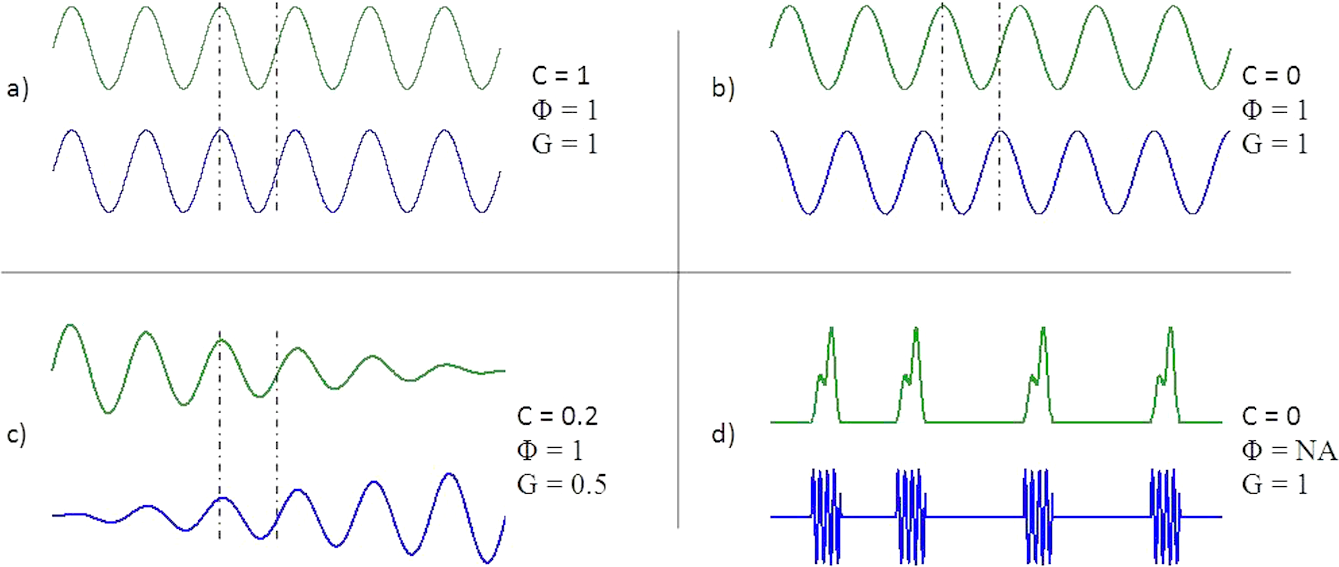
Examples of physiological linkage measures
Phase synchronization has been frequently used to study brain signals (Lachaux et al., 1999; Linderberger, Li, Gruber, & Muller, 2009; Stam, 2005). Compared with the other methods, it does not take into account the amplitude of the signals to measure the degree of dependence, but specifically the phase information. A consequence is that it does not require stationary signals, an important property when dealing with physiological signals. It can operate on different types of signals (for instance, EEG and EMG), but it requires that signals are relatively periodic. This is not a limit for generalized synchronization, which in general operates on a wider range of signals, and even allows measuring synchronization between different types of signals. Furthermore, several of the methods assessing generalized synchronization (Stam, 2005) can be used to detect asymmetric interactions (driver and response individuals). Unfortunately, the expected distributions of both synchronization measures are unknown, and thus, it is not possible to assess the level of significance using standard statistical tests. One solution to this problem is to use surrogate data testing to determine significance (Lachaux et al., 1999; Stam, 2005) at the cost of computational complexity.
Social Gaming
Contemporary gaming is often a highly social activity. For over a decade, most new games have included a multiplayer mode or other forms of shared play. At the same time, we have seen an explosive increase in games designed as solely multiplayer experiences. It is now widely accepted in the academic world (e.g., Raney, Smith, & Baker, 2006) and in the industry (Klug & Schell, 2006; Lazzaro, 2008) that social aspects of play constitute a fundamental motivator for playing. In fact, studies on people’s gaming motivations indicate “that the most prominent of the motivations for game use are more social in nature” (Sherry, Lucas, Greenberg, & Lachlan, 2006, p. 221).
Many studies have shown that the presence of others influences the quality and nature of the emotions elicited during play (Gajadhar, de Kort, & IJsselsteijn, 2008). The impact of the social gaming context has been observed also with physiological measurements: For instance, playing with a friend elicits stronger and more positive emotional responses than playing either against a stranger or alone (Ravaja et al., 2006). Furthermore, several studies report physiological changes in response to different social playing contexts (Kivikangas & Ravaja, 2010; Lim & Lee, 2009; Lim & Reeves, 2010; Ravaja, 2009). These findings indicate that psychophysiological methods are sensitive to the social experiences during playing.
The idea of using simultaneous measurements from multiple participants is not novel. However, game experience studies using psychophysiology have investigated the experience of single players, even when the focus of interest has been social interaction. As interaction is a two-way process, relying on subjective evaluations (or measurements) from only one participant captures only one view of the story or, even at best, two separate views of the same story. The data can only ever reflect a single individual’s interpretations of the interaction and not a measure of the interaction per se. In contrast, whenever psychophysiological measurements can be made concurrently for multiple participants during a social gaming situation, physiological linkage provides the unique possibility to examine interaction from a viewpoint that is not based on individual’s views on the interaction.
Several studies support the idea that physiological linkage will occur during social interaction. However, many factors exist that contribute to linkage. Therefore, the meaning derived from observed linkage has to be considered contextually in reference to the game as stimulus, the (cognitive and emotional) judgments made by the player, gaming as action, and the interaction possibilities between players (face to face or other). The following sections will address these factors and how they relate to physiological linkage on three levels (see Figure 2). The game session defines the premises of the social interaction in terms of game structure and the participants’ socioemotional context. Social presence (Biocca, Harms, & Burgoon, 2003) offers a theoretical framework for interpreting the shared experiences. Finally, physiological linkage provides a metric of the commonality between several participants’ individual experiences.
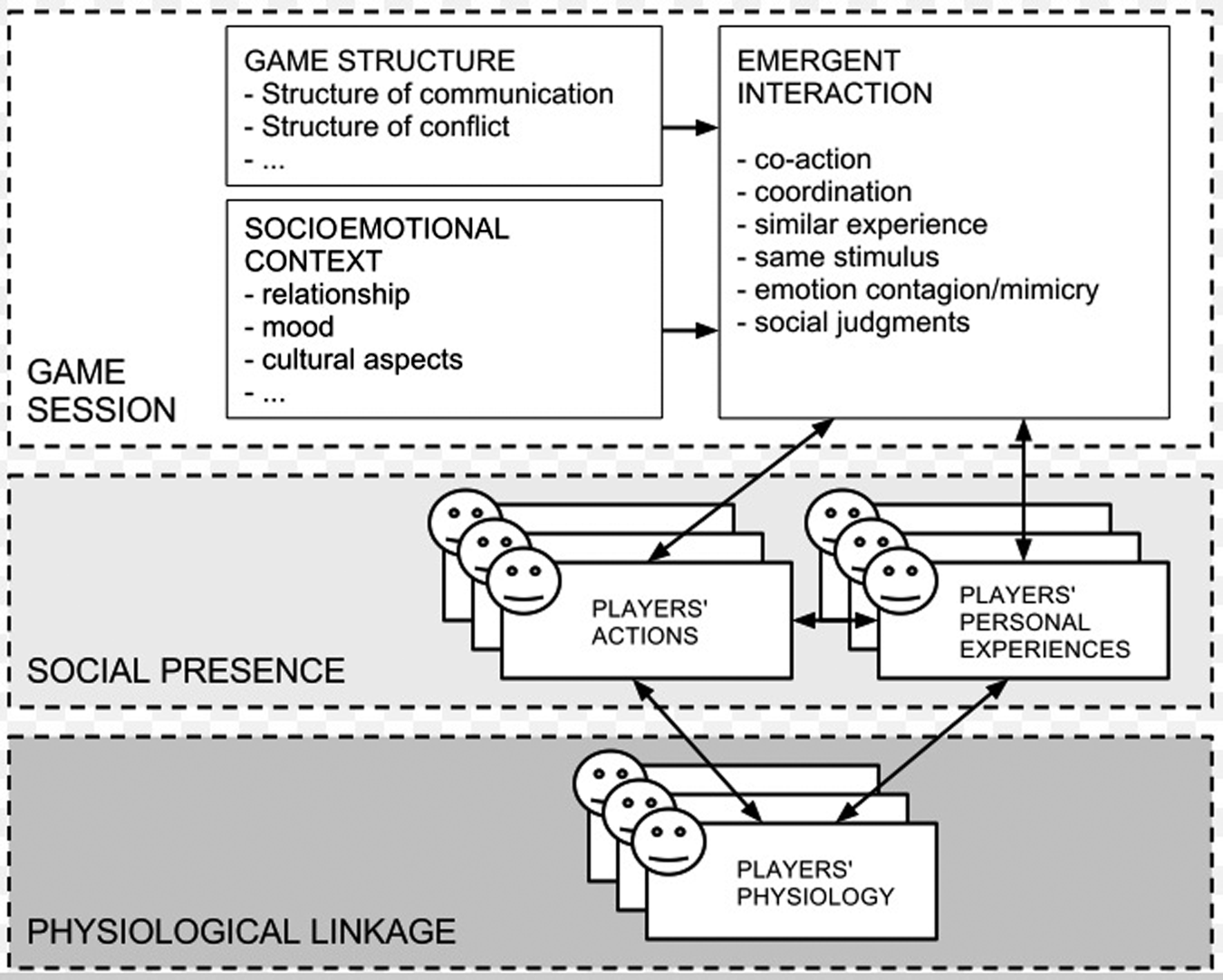
The relationship between play, presence and physiological linkage
The Game Session
The game session is the situation that players and spectators share and, each from their own point of view, personally experience. At a structural level, the game facilitates and imposes limitations on the interaction. Moreover, the players themselves, as well as possible spectators, shape the game session by bringing it to their personal social backgrounds.
The game rules define the
In addition to the conflict structure, the game and the environment provide a
On a third level, we can identify that players bring a broader
In practice, we find that the structure of conflict, the structure of interaction, and the socioemotional context contribute to the
Social Presence and Physiological Linkage
Biocca et al. (2003) propose that social presence is composed of three dimensions. Copresence is the sense of being in touch with another person. The feeling can be based on a sensory representation (“I can see the other person”), but it might also be the result of a strong mental representation of the other (“I can imagine the other person”). Psychological involvement refers to the level of personal understanding, perceived emotional engagement, and attention between participants. It relates to the level of emotional and mental connectedness between people, but is also influenced by the participants’ subjective evaluations of the situation (“I can understand your feelings” or “I respond to how you feel”). Notice that psychological involvement is not only limited to positive interactions, but can also emerge during conflicts where the participants interact on a mental or emotional level. Behavioral involvement refers to the amount (number and extent) of dependency between people’s actions. Behavioral involvement can arise as people perform similar actions or if a person coordinates his or her behavior in response to the other persons’ actions (e.g., dancing together, taking turns in a conversation).
As physiological linkage taps into all the components of social presence theory, it can be used to assess social presence. Extending from the interpretation of Biocca and colleagues (2003), we view copresence as facilitating the psychological and behavioral involvement of participants.
Psychological involvement addresses the game as stimulus and includes emotional contagion that operates mainly by theory of mind principles and relies on social judgments. Synchrony is also naturally influenced by the extent to which these persons are subject to the same type of stimuli. For example, visualization of identical media material has been shown to induce synchronized cortical activity among several persons at cortical regions involved in selective attention and social cognition (Hansson et al., 2004). People can also react or respond similarly, feeling in unison.
Behavioral involvement, on the other hand, corresponds to game-related coordinated action and coaction. As gaming consists of actions driven or motivated by the game, it is possible that the level of similar actions between two people playing the same game will be high. If several persons are performing the same physical actions, for example, performing identical moves on a dance mat, their physiological profiles will show similarities. Furthermore, players who strive to coordinate their actions to other players’ actions (e.g., in player-player combat or playing musical games) will have increased levels of behavioral involvement. Similarly, coordinated action is associated with synchrony. For instance, Linderberger et al. (2009) demonstrate the occurrence of EEG signals synchronization before and during coordinated guitar playing.
Using Physiological Linkage for Game Research
Physiological linkage provides an association with social presence that can be used for different types of media (including different types of games) and in several ways to address questions of social interaction within game research. It can be used to compare playing contexts and determine the level of social presence in different forms of social play. As it can also be assumed that player types respond diversely to different social contexts, psychological linkage provides tools for exploring how and why different players prefer different types of social play.
The amount of physiological linkage is not the only information of interest. Sequences of physiological reactions should also be studied. According to emotional contagion theory, the sequences could help to identify who is the player who originates an emotion and who is contaminated by it later. More generally, it can give insights into the bidirectionality of interaction and reveal, for example, whether all players are equal or whether the interaction is being steered by dominant individuals.
Applying linkage to games research requires validating a few central assumptions. First, as much research on linkage has been conducted in face-to-face situations, it is still unclear to which extent linkage operates in mediated environments. Our own recent experiments support the notion that physiological linkage is associated with at least some (sub)components of mediated social presence. In a recent study (Järvelä, Chanel, Kuikkaniemi, & Ravaja, 2011), participants were watching short film clips together while their cardiac and EDAs were recorded. The study showed that HR cross-correlation was positively associated with average self-reported understanding of the other group members, and EDA synchronization was associated with perceived emotional contagion. It also seems that structural changes to the available interaction channels during computer-mediated communication influence measures of synchrony.
Furthermore, it is unclear to which extent measures of synchrony can be used predictively, which is particularly important if physiological linkage is to be used for validating game design choices. Such studies should examine not only short-term links between physiological linkage and gameplay, but also how linkage predicts the duration and frequency of playing the particular game in real life during a longer follow-up period. We have previously found that psychophysiological measures outperform self-report as predictors of long-term gameplaying for single-player games, which supports the predictive validity of psychophysiological measures in general (The Fun of Gaming: Measuring the Human Experience of Media Enjoyment [FUGA], 2009).
Physiological linkage, on the other hand, has been used by others to estimate team performance on strongly collaborative tasks (Elkins et al., 2009; Henning et al., 2001, 2009). Previous results within this domain demonstrate that peripheral and central physiological linkage are indicators of interaction and cooperation in a group and can be used to infer the potential outcomes of a group, which often relate to group dynamics. Importantly, the results described by Henning et al. (2001) were obtained using a collaborative game. Furthermore, in a study of our own examining mobile gaming (Chanel, Kivikangas, & Ravaja, 2011), we found a predictive relationship between linkage and the Social Presence in Gaming Questionnaire (de Kort, IJsselsteijn, & Poels, 2007), including a predictive relationship between social empathy and smiling (orbicularis oculi activation). Importantly, the results were not limited to positive social interactions as the participants were found to report higher social negative feelings when frowning asynchronously (corrugator supercilii activation).
Practical Considerations With Linkage in Game Context
The choice of method is to some extent guided by the signal type. For example, using a traditional correlation measure for EMGs is a possibility, but would not make sense for EEGs due to their frequency properties and their nonlinearity. Similarly, to compute linkage in respiration, it is possible to use the correlation value and the coherence. In the first case, linkage will be high when the people are respiring together, while with coherence, the linkage will be high when they are respiring at the same rate. In those two cases, linkage has a complete different meaning. Therefore, it is not possible to define any single measure of linkage that performs better in the detection of physiological linkage. Currently we do not have enough data to conclusively outline the interpretation of various linkage measures. Particularly, more studies are needed to better understand the link between a particular form of physiological linkage and the subcomponents of social presence. Therefore, linkage should be complemented by other methods, such as self-report, as is common practice within psychophysiological methodology in general. In cases where previous studies are unavailable or inconclusive, we recommend to compute linkage with several methods and interpret the results carefully, taking into account the properties of each individual measure.
The use of linkage also depends on the game structure. The interaction structure will, for instance, determine whether communication behaviors can be periodic or not, that is, whether recorded behavior will exhibit a pattern of repetition. Furthermore, as physiological activity from two people sharing the same stimuli will often be significantly correlated, it is important to separate this effect from the assumed effect of social interaction under investigation. Significant correlation in the signals of two people watching the same game may not be a sign of interaction between those participants, but of a common activity in which they both participate. For these reasons, the choice of a method should be done for each specific case, according to the knowledge of the game or the application. For example, a formal analysis of game conflict and communication structures may be useful as part of the experiment setup.
Finally, while social presence provides a useful conceptualization of the involvement between players in a social gaming situation, it does not sufficiently cover all aspects of social interaction in the game experience (see de Kort, IJsselsteijn, & Gajadhar, 2007). It is clear that social aspects are not a factor that can be separated from the individual experiences, but need to be considered in joint relationship to them. On the other hand, the social relationships that players bring to the situation may interact with some, but not all of the underlying functions of linkage. For example, emotional contagion is not influenced by, for example, friendship, whereas social judgment certainly is.
Summary
Psychophysiological measurements provide quantitative data that can be used to infer a person’s cognitive and emotional responses. Psychophysiology complements information gathered by other methods in social interaction research. The psychophysiological method has been applied to games research with promising results for assessing individual experiences. The success encourages further development of the methodology that would extend its applicability to more fully cover gaming as an activity. Particularly, social interaction is a changing, fluid process, which benefits from the properties offered by the psychophysiological methodology: access to real-time and online monitoring of all interacting parties, without interruptions and disturbing secondary tasks. Optimally, a metric capable of indicating the strength of interpersonal interaction within a shared gaming context would greatly extend the use of the psychophysiological methodology for games research, as it would allow performing experiments in more diverse and realistic social settings instead of tightly controlled conditions necessary today.
Current measurement devices support monitoring several individuals simultaneously, enabling psychophysiological measurements in multiplayer settings. We suggest the use of physiological linkage, a measure derived from comparisons between the signals of different participants producing quantitative data on social interaction. Importantly, physiological linkage potentially provides insight into not only individual experiences of the social interaction, but also the interaction as a process (e.g., how mutually intense the interaction is). This information is not accessible via other methods. As an assessment of social presence, physiological linkage could provide a valuable metric for research of social interaction in gaming.
Physiological linkage has been established as a metric for examining social interaction. However, setting down the standard of using these methods in the field of games research calls for rigorous method development. In addition to confirming the predictive validity and reliability of physiological linkage within a gaming context, several open practical questions remain that need to be addressed. While we see several different methods to analyze physiological linkage, yet little knowledge exists on which measures best correspond to the various subcomponents of social presence. Moreover, as psychophysiological research has only begun to consider the social aspect in gaming, we see a general a lack of knowledge on how structural elements of the social situation are reflected in psychophysiology. Consequently, studies using physiological linkage should pay extra care when planning and preparing experiments, controlling for contextual factors, and interpreting linkage results. Particularly, it is necessary to combine measures of physiological linkage with other sources of data such as self-report and observation and recordings of game logs, and extensively consider various different possible sources of linkage.
Footnotes
Declaration of Conflicting Interests
The authors declared no potential conflicts of interest with respect to the research, authorship, and/or publication of this article.
Funding
The authors disclosed receipt of the following financial support for the research, authorship, and/or publication of this article: This work is supported by the Finnish Funding Agency for Technology and Innovation (TEKES), research project Emokeitai (Diary number: 417/31/09; Decision number: 40157/09), and the Finnish graduate school on User Centered Information Technology (UCIT).
Bios
Contact:
Contact:
Contact:
Contact:
Contact:
Contact: