




Abstract
Leadership development poses great challenges to modern organizations. One possible method to develop leaders is the use of experiential techniques based on business games. The objective of this article was to identify, based on literature, business games used in leadership development and to examine how they contribute to the qualification of the leaders. In particular, the article analyzes business games in which elements of leadership development were present as part of the computer model (simulator). The article describes the goals of the games, their pedagogical and technical features, their relation to leadership theories, and their effectiveness in leadership development. The methodology used was systematic review conducted in SCOPUS, ISI, and BKL (Bernie Keys Library) databases. The review identified five games that met the criteria and objectives of this research. This study shows that using business games for leadership development is still a hard task. It points up some problems and difficulties in this task and suggests ways to develop more effective methods for leadership development with business games.
Keywords
Early theories on leadership argued that leaders were born with characteristics and behaviors that made them special people able to guide and influence others. One of these theories was called great men and remained popular until the 19th century (Bass, 2008; Yukl, 2008). Traits theory replaced it at the beginning of the 20th century. Traits theory was concerned about identifying leaders’ individual abilities.
Traits theory began to be contested in the mid-20th century (Northouse, 2007). In 1948, Stogdill suggested that no consistent differences in traits existed between leaders and nonleaders. Subsequent research evidenced that other elements such as organizational and situational context, readiness of the followers, and interpersonal relationships, among others, are also key factors for good leadership (Bass, 2008; Northouse, 2007).
Complexity of knowledge society presents even more challenges to the task of developing leaders (Avolio, Walumbwa, & Weber, 2009). One major difficulty is to define leadership. The concept of “what leadership is” has evolved and adapted to the dynamics of new social demands (Day, 2001; McCrimmon, 2005; Uhl-Bien, Marion, & McKelvey, 2007). Another difficulty is related to issues such as global and open markets, technological and cultural elements, and different models of organizations and systems of production and marketing (Yukl, 1998).
In this new context, many researchers propose and develop models, techniques, and tools for leadership development in organizations. One of the major controversies related to leadership development concerns what can actually be taught and how much is actually learned, from both the theoretical and experiential points of view (Allio, 2005). This issue is related to two other important themes that are not the focus of this article: how to assess learning and how to evaluate the effectiveness of leadership processes.
Experiential models offer techniques for the development of leadership. Computational and noncomputational models have been proposed based on the idea that participants must experience situations involving the abilities or skills required for the exercise of leadership. These models are used in teaching and learning environments and have as their main feature the presentation of real-world situations that enable the participant to intervene, plan, make decisions, and evaluate the results of their actions (Faria, Hutchinson, Wellington, & Gold, 2009).
The models can be very simple, describing a small number of variables and relationships, or very complex, simulating different elements and interrelated variables (Ben-Zvi & Carton, 2007; Klabbers, 2003; Maier & Grosler, 2000). In this article, we analyze only computer-based models addressed as business games. The word simulation has been used occasionally throughout the article because terminology is not clearly defined in the literature (Klabbers, 2009; Maier & Grosler, 2000).
Early discussions relating games and leadership emerged in the late 50th century, through the American Management Association (AMA; Ricciardi et al., 1957). However, both in the AMA approach as well as in the methods adopted in the vast majority of games, the issue of leadership is discussed as a subject that is not part of the computational model of the game. Leadership is treated at the level of relations between participants and is often presented also as synonymous with managerial practice. Leadership is not part of the mathematical model of the games.
In this article, we identify business games in which leadership development elements are included in the computational model and are the main focus of discussion. The article examines the following issues:
How do business games model the theoretical elements of leadership?
How do business games focused on leadership development address the complexity of leadership training?
What kinds of goals, pedagogical and technical features, and theoretical bases have been used?
How has the effectiveness of the games been evaluated?
To answer these questions, we identify business games that are applied to leadership development and examine how the games contribute to the process of training leaders. The business games analyzed are computerized, thus limiting the scope of the research. Methodology used to identify business games consisted of searching scientific publication databases using a set of criteria that are explicitly and systematically defined (Castro, 2001).
Next sections of this article are organized as follows. First, we present a brief literature review on leadership development and experiential learning. Then we describe systematic review method used in the research. The survey results and the analysis of the business games identified are then presented. Last section presents limitations and final considerations of the study.
Leadership Development and Experiential Learning
One approach to leadership development focuses on developing skills that enable the leader to understand, amplify, and anticipate contexts, situations or reactions, expanding his or her capacity for action and adaptation in the various roles he or she takes on (Avolio et al., 2009; Gardner, Avolio, Luthans, May, & Walumbwa, 2005; McCauley, 2004; Mintzberg, 2004; Northouse, 2009; Parks, 2005). Another approach emphasizes that leadership development is broader than the formation of a leader (Day, 2001). Both approaches, however, deal with the development of skills required at different stages of the career of a leader (Mumford, Marks, Connely, Zaccaro, & Reiter-Palmon, 2000).
Developing personal or interpersonal skills is a task connected to learning. Ibarra, Snook, and Ramo (2010) point out that researchers recognize that leadership skills are learned through practice and observation, that is, through methods able to provide experience and expertise, which are known as learning by doing. Several authors present approaches of leadership development based on experiential learning processes (Day, 2001; Dentico, 1999; Hirst, Mann, Bain, Pirola-Merlo, & Richver, 2004; Kets de Vries & Korotov, 2007; Reeves, Malone, & O’Driscoll, 2008).
Learning based on experience is treated in several learning theories. Bandura (1980), Revans (1980), Kolb and Kolb (2008), and Argyris (1982) are some authors of the learning theories referred in articles on leadership development. Bandura, in his social learning theory, emphasizes that human behavior is learned by observation. The observation of others and, therefore, their experience will guide subsequent behavior. Revans proposes Action Learning and emphasizes that people learn more effectively when working on real problems of the organization. Kolb and Kolb propose the experiential learning cycle that is related to different learning styles, from some concrete experience to reflection, thought, and action. Argyris emphasizes that learning occurs in what he called a “double-loop mode” as opposed to the single-loop. The learning in a single-loop involves only some corrective or incremental adjustment, not resulting in changing beliefs or paradigms. Double-loop learning is transformational because it implies the revision of values and behavior change. Common to all these authors is the fact that learning occurs effectively when a situation is experienced.
A technique used in learning based on experience is the games. In this context, games consists of exercises based on real situations, with one key factor: The participant is able to interact with the simulator, making decisions or performing actions that lead to different situations or contexts (Gredler, 1992). This process encourages the participants to reflect about their behavior, improving their skills of communication, decision making, strategic planning, among others (Hunsaker, 2007).
Dentico (1999) believes that games are more efficient than case studies, once they make possible the double-loop learning of Argyris (1982). Hunsaker (2007) emphasizes that participants experience high levels of realism and involvement in games. Dealing specifically about leadership skills, Carucci (2009) points out that games accelerates leadership learning and are more effective and creative, preparing leaders to take on new challenges.
Games created with the purpose of learning can be performed in computing environments or otherwise. Some authors, like Carucci (2009), Dentico (1999), and Gosling and Mintzberg (2004), criticize games based on virtual environments. For them, the game must include the context in which the participants live daily and must be built with elements taken from their own work. Although their criticism present consistent arguments, these authors seem to ignore the current capabilities offered by new technologies and the fact that a new generation of young people, candidates to be leaders, is strongly connected to these technologies and is entering the labor market.
Reeves et al. (2008) present several opportunities for observing and developing leaders through virtual environments. A survey conducted by them among people who play video games showed a strong relationship between the game environment and professional activities. Business games analyzed in the present article also show positive evidence that the use of such techniques may have good results.
Research Method
Studies based on systematic reviews are widely used in health care and have been introduced with some adjustments in other sciences, taking into account the particularities of each area (Pittaway, Robertson, Munir, Denyer, & Neely, 2004; Tranfield, Denyer, & Smart, 2003). The purpose of a systematic review is to answer a specific research question through explicit and systematic methods used to identify, select, and critically evaluate the studies included in the review. The method exploits field of study in the databases of scientific publications, using criteria defined accurately and objectively (Becheikh, Landry, & Amara, 2006).
This study used systematic review method proposed by Tranfield et al. (2003). In this approach, systematic review is conducted in three stages:
planning, which defines the purpose and criteria directing the review;
execution, which means to search for related articles and summarize the information found;
reporting and dissemination, which means to proceed the presentation and analysis of the results.
In the planning stage, general and specific objectives of the research are defined, along with the terms used in the research, the criteria used for inclusion or exclusion of the studies, and the scientific databases to be used. In the execution stage, the steps followed are adapting the terms to the syntax of each database, doing the search in the databases, and selecting the articles to be analyzed, filtered by inclusion and exclusion criteria. In the reporting and dissemination stage, the synthesis and analysis of the results according to the established objectives is done.
Objectives and Criteria
The main objective of this article is to identify, through literature review, business games used in leadership development. Some specific items examined are as follows:
objectives of the authors in the design and use of games
theoretical bases of leadership that supported the games
methods or techniques of teaching and learning used in the games
methods used for evaluation and feedback
effectiveness of the games in leadership development
elements of media and interactivity that characterize the simulators of the games
This article also intends to point out gaps in research studies about the subject under discussion that may become themes for future research.
Definition of the Terms
In a systematic review, it is essential to define terms that distinguish adequately the objectives of the research. Based on the terms, the articles are retrieved from the scientific databases. For this research, we used the terms Leadership, and Game and Simulation.
We decided to make the research as general as possible. We choose not to use the term Development along with Leadership to broaden the range of possible outcomes. The use of the terms Games and Simulation together is justified because they are often treated interchangeably in business games literature.
Selection Criteria
The next step was the definition of the inclusion or exclusion criteria for selecting the studies to be evaluated in the review. The criteria were as follows:
In case of articles, review articles, or short articles published in journals or conferences, the text should be fully available in the scientific database, accessed through the portal Capes (www.periodicos.capes.gov.br), Brazil. Book reviews, editor letters, notes, or releases were ignored.
The text should not present problems about references (no publisher, author, summary, etc.).
Only articles published in English were considered.
The studies may follow any kind of method: empirical (quantitative or qualitative), case studies, or conceptual work.
The article should focus on leadership development based on computer games. Other kinds of games or simulations were not considered.
The article should include games that model some leadership aspects. For example, a game in the marketing area in which the author mentions that we can exercise leadership principles without specifying it in the computational model was put away.
We imposed no restriction about the year of publication of the articles, although the year when the related terms first appeared was identified. We also did not include any criteria regarding the number of citations of works by other authors, because the citation in a previous work probably had a different motivation compared with that in the present research.
Selection of Databases and Search Terms
The survey was conducted in two general databases and in a specific database for games and simulations. The general databases used were Elsevier SCOPUS (www.scopus.com) and ISI Web of Knowledge from Thomson Reuters (www.isiknowledge.com). SCOPUS indexes approximately 18,000 titles from 5,000 publishers (SCOPUS, 2008), and the ISI about 10,000 titles (ISI, 2009). The specific database used was the Bernie Keys Library (BKL; Bernie Keys Library, 2009). This database, published by the Association for Business Simulation and Experiential Learning (ABSEL), includes all papers published in conferences organized by the association since 1974.
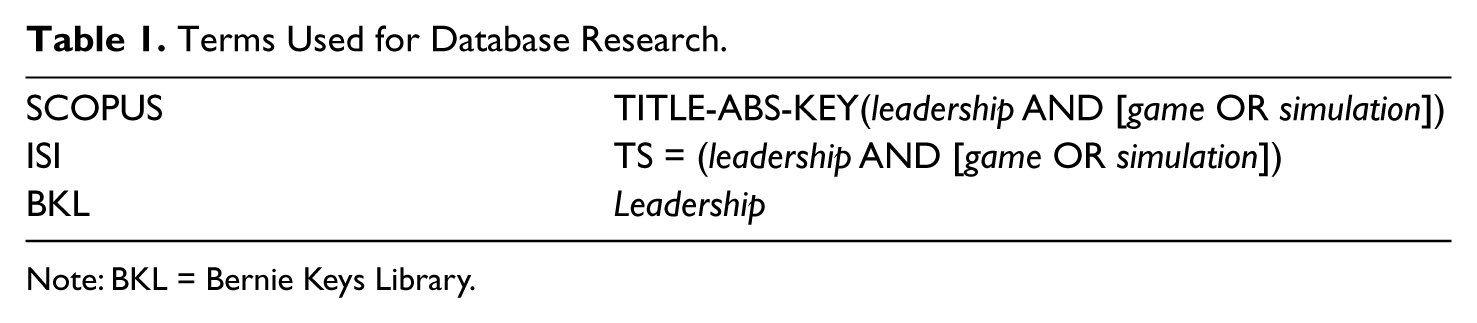
Table 1 shows the mode that the terms were used in the databases.
Terms Used for Database Research.
Note: BKL = Bernie Keys Library.
The survey was conducted using the fields title, summary (abstract), and keyword both in ISI and SCOPUS. In BKL, we do not have the possibility of a more specific research in these fields, because the files were in PDF format. Because it is a specific database for simulation and experiential learning, we adopted the exclusive use of the term leadership, applying additional filter elements later.
Selection of the Games
The next step was the selection of articles to identify and analyze the games that met the criteria and goals of the research. The survey was conducted in October 2009. We obtained 823 articles on SCOPUS, 336 on ISI, and 449 on the BKL database, totaling 1,608 articles. Of these, 223 were eliminated because they were repeated in the databases. In total, we retrieved 1,385 articles.
Figure 1 shows the distribution of the articles organized by year.
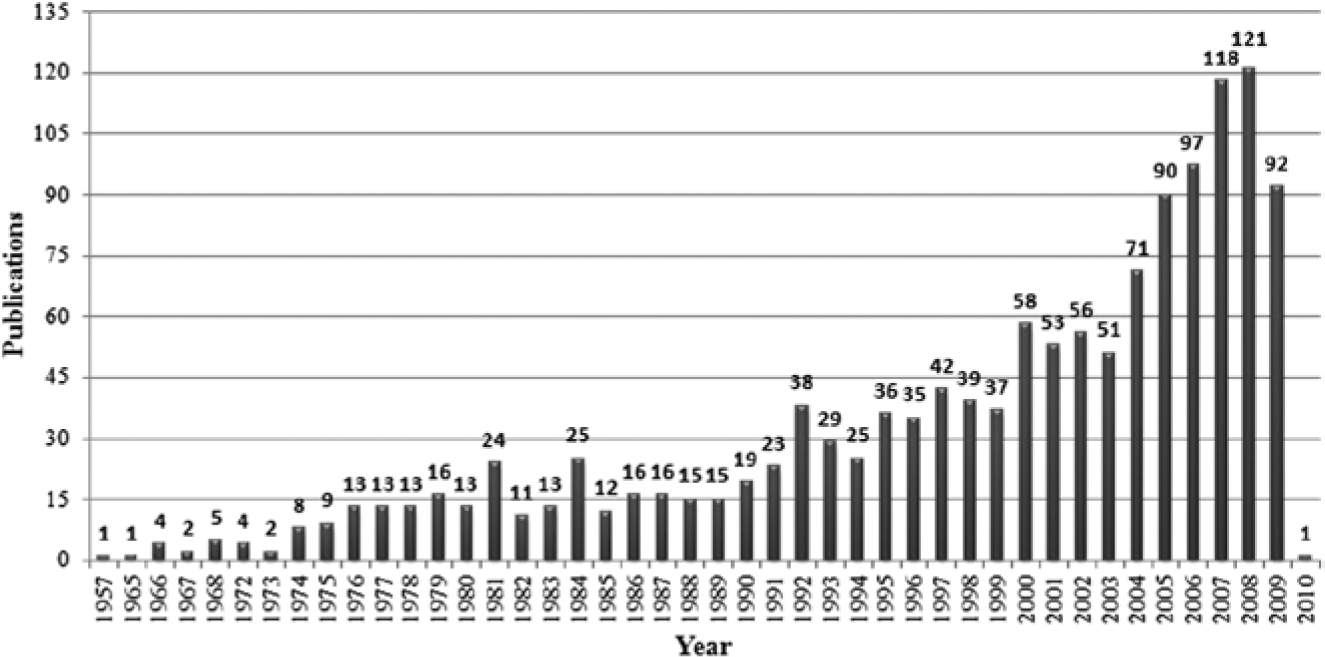
Articles recovered in the researched databases by year of publication.
Figure 1 shows that the first reference retrieved relating leadership, and games or simulations dates back to 1957, the same year in which the first practical business game was introduced by the AMA (Ricciardi et al., 1957). However, in fact, this first reference related to AMA business game (Executives Play Games, 1957). The second article did not appear until 8 years later, but was in another context than the one addressed here (Johnson, 1965). Over time, the number of articles increased achieving its max value in 2008. The year 2009 data are partial, as the survey was conducted in October 2009. Using these studies, we started the filtering process considering our research objectives. This process occurred in three steps as described below.
In the first stage, all duplicated articles and those that did not meet criteria (a) and (b) on the selection criteria above were eliminated. Articles from BKL database, where the term leadership did not appear in the text, but only in some bibliographical references were eliminated too. The end of this stage resulted in 917 articles, as shown in Table 2. The letters within parentheses define the item applied according to the section on the selection criteria.
Articles Eliminated in the First Stage.

Next stage was the evaluation of the theme of the texts. This analysis came from reading the abstracts of the articles trying to answer items (e) and (f) of the selection criteria. Table 3 shows in more detail the reasons for the exclusion of works, resulting in 25 selected articles.
Articles Eliminated in the Second Stage.
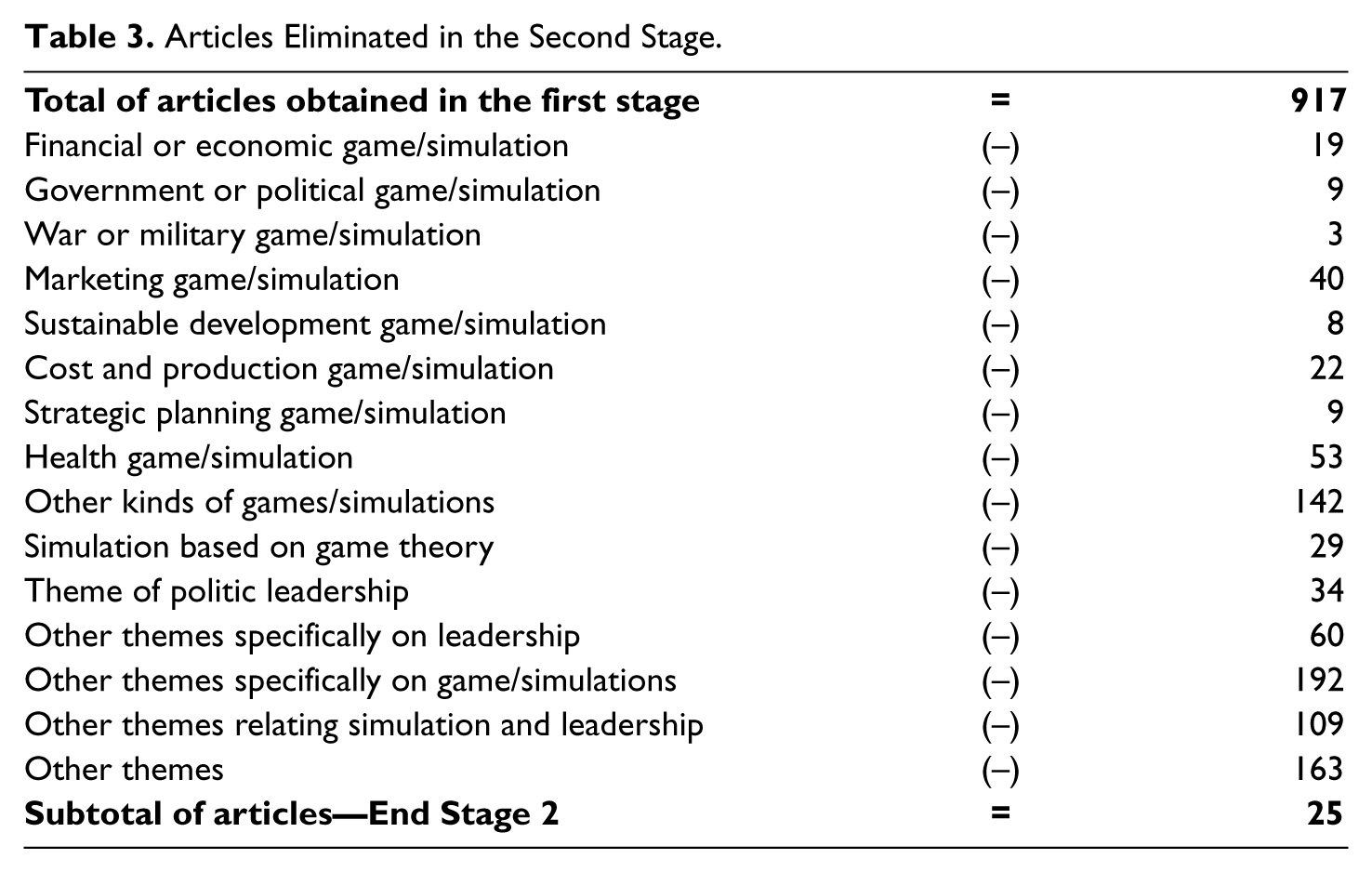
Many eliminated articles related leadership with some other type of game. For example, some studies dealt with marketing leadership, others included leadership as just one of the key factors for success in a specific area, and so on. Other articles were specifically about leadership without involving games, but had, in some context, the word game or simulation. Reciprocal situations occurred where the word leadership appeared inside some specific articles on games or simulations. Other articles associated games or simulations and leadership, but in the context of numerical or noncomputational approaches. We proceeded through this stage with great caution, keeping records for further queries in case of doubts.
Next stage entailed a full reading of the 25 articles. In this stage, only 3 articles met all the specified criteria. However, 6 other articles had citations of business games used to develop leadership, but they were not specific about business games for leadership development. The games were used in the article for some other kind of approach or research. Thus, to broaden the research sample, we decided to work on two groups of articles:
Group 1: composed of three articles that met the research criteria
Group 2: composed of six articles mentioning business games that could potentially meet the search criteria
Table 4 presents the criteria for the items included and excluded.
Articles Eliminated in the Third Stage and Final Set of Articles Selected.

Selected works, classified by group, year, and the database from which they came, are listed in Table 5. Complete information about each work, such as the title and the journal where it was published, including volume, issue, and page numbers, can be found in the references.
Selected Works by Group, Year of Publication, and Database Source.

Note: BKL = Bernie Keys Library.
Due to the bias caused by the insertion of Group 2 articles, a new stage was added: the search for information about the games mentioned in those articles.
This stage started with the analysis of Hunsaker (1977, 2007) articles, which mention four software used in creating an environment for military leadership development: TACTICAL PACIFICATION GAME, LUNA I MOON COLONY, LATS (LEADERSHIP ASSESSMENT AND TRAINING SIMULATION), and LEDS (LEADERSHIP EFFECTIVENESS DEVELOPMENT SIMULATION). According to the author, the first two grounded the third, which grounded the last. Author notes that the development of these systems has been aided by the U.S. Army Research Institute for the Behavioral and Social Sciences (ARI). When searched on the Internet, however, none of these systems was located.
A more accurate search on the ARI website showed a document (Hill et al., 2008) that details the development of leadership using TLAC-XL (THINK LIKE A COMMANDER EXCELLENCE IN LEADERSHIP), also cited by Gordon, Van Lent, Van Velsen, Carpenter, and Jhala (2004), whose article was among those selected in Group 2. TLAC-XL is a game developed by the Institute for Creative Technologies (ICT) at the University of Southern California (USC) that aims to offer scenarios for leadership challenge creation related to military training. The work of Hill et al. (2008) points to an evolution of TLAC-XL: the AXL (ARMY EXCELLENCE IN LEADERSHIP). This game is shown on the USC website (AXL, 2010). Being an evolution of the games cited by Hunsaker (1977, 2007) and Gordon et al. (2004), it was selected for analysis in this article.
Aldrich (2003) cites the game VIRTUAL LEADER developed by SimuLearn Inc. The analysis of the site where the software is hosted (SimuLearn, 2010) indicated that the game met the requirements of this research; thus it was included in the analysis.
The works of Page and Roberts (1996) and Page, Roberts, and Baugh (1995) mention THE LOOKING GLASS INC. produced by the Center for Creative Leadership (CCL). Through the site (The Looking Glass Experience, 2010), we found details about it, but it was not a digital game.
Games Selected
Analyzing the articles presented above and considering the works of both groups, we selected five games to be evaluated in this study. Table 6 presents their identification, the references used as sources for the research, and the institution to which they are linked. Of the five games identified, three are linked to universities and two to consulting organizations.
Games Evaluated in the Research.
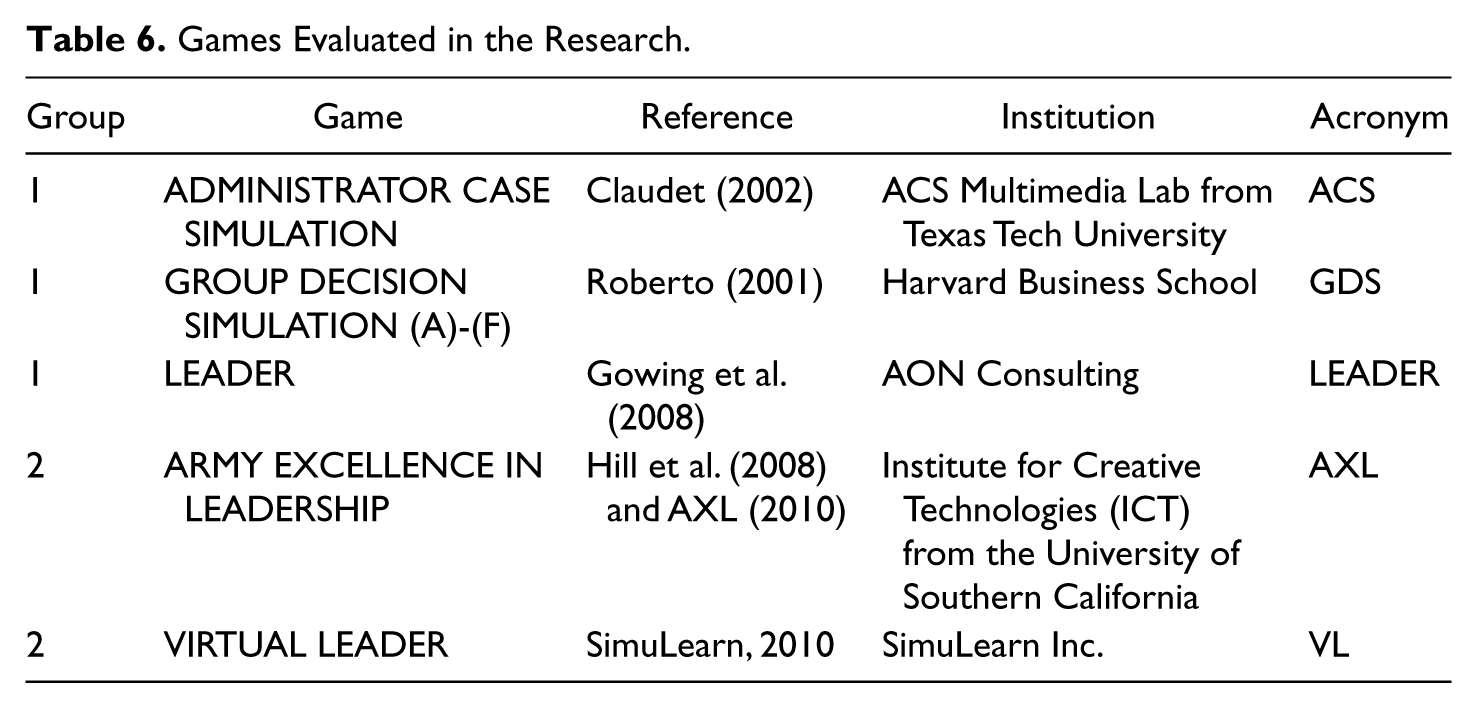
All the institutions identified in this research have their headquarters inside the United States. To facilitate the individual identification of each one, we adopted an acronym. Games of the first group were analyzed from the articles retrieved in the search, while those in the second group were analyzed from the information available on their respective websites.
Analysis of the Games
The games were analyzed considering the following:
the goals addressed by the authors regarding the design and use of the game for leadership development
the pedagogical and technical features of the game regarding the pedagogical methods used, the interactive media, and elements of evaluation and feedback
the theoretical bases on leadership that supports the conceptual model of the game
the effectiveness of the game in meeting the goal of developing leaders
These elements will be systematized through comparative tables and critical analysis of each item.
Goals of the Games
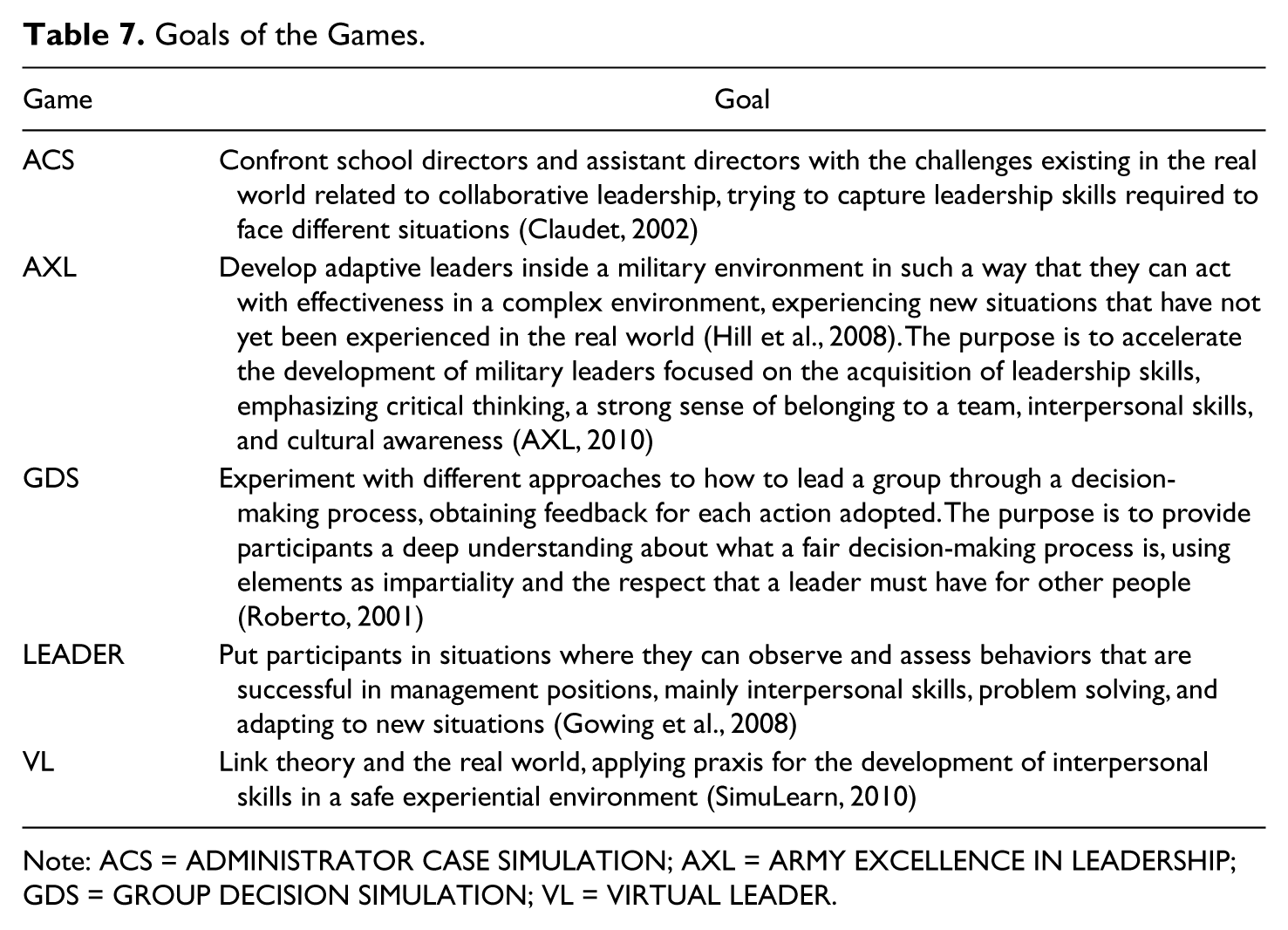
First topic under examination was to identify the goals of the games in relation to leadership development. Table 7 presents a summary of these goals.
Goals of the Games.
Note: ACS = ADMINISTRATOR CASE SIMULATION; AXL = ARMY EXCELLENCE IN LEADERSHIP; GDS = GROUP DECISION SIMULATION; VL = VIRTUAL LEADER.
Some of the games evaluated were developed for a specific knowledge context. This is the case of ACS, which focuses on leadership in schools, and AXL, which is directed toward military education. Often, this customization is required to bring the game closer to the reality of the target audience.
Table 7 shows a desire to offer challenging environments that are able to prepare leaders to serve in difficult and complex situations. This is an issue that turns the design of the games more challenging. Games evaluated try to develop individual abilities and styles, focusing on the relationship between cause and effect in a decision-making process involving the leader and the followers. Another concern is establishing the link between the game and the real world. This closeness to reality is a strategic objective of the games analyzed that could make the learning tools more effective.
They can be improved if they consider that leadership development depends not only on individual skills, but also on a complex and dynamic context of social and interpersonal relationships (Day, 2001).
Technical and Pedagogical Features of the Games
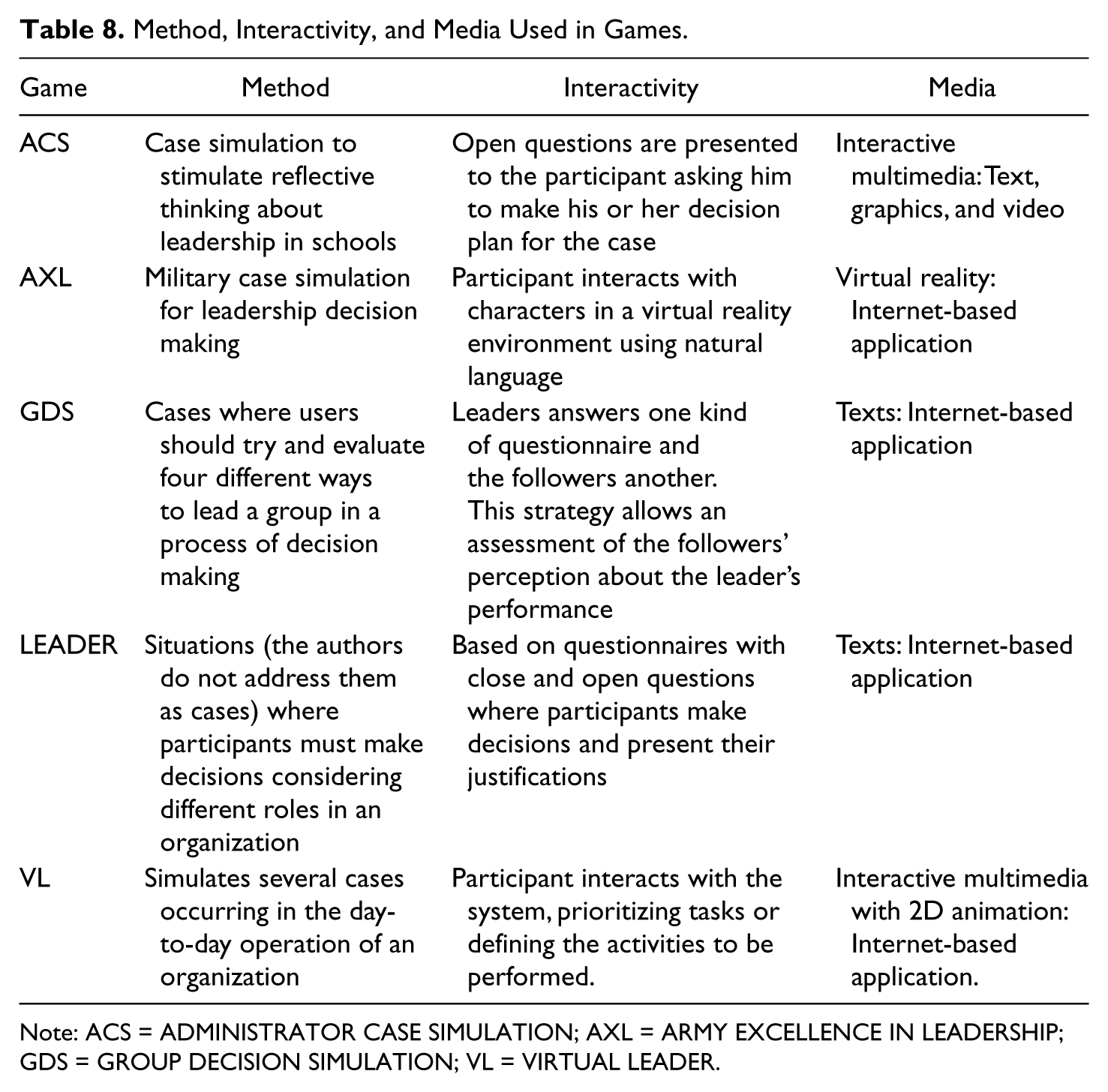
The second topic under review examines the technical and pedagogical features of the games. Table 8 presents the type of teaching-learning method on which the games are based, how the participant interacts with the simulator, and the media resources used.
Method, Interactivity, and Media Used in Games.
Note: ACS = ADMINISTRATOR CASE SIMULATION; AXL = ARMY EXCELLENCE IN LEADERSHIP; GDS = GROUP DECISION SIMULATION; VL = VIRTUAL LEADER.
Table 8 presents the main technical and pedagogical features of the games. First highlight is the fact that all games are based on cases that represent situations that occur in the daily operation of an organization. Case-based simulation is an interesting feature when the simulated elements are not fully quantifiable. This is the case with leadership development, which involves aspects of interpretation and subjectivity. Another feature provided by some games is the personalization of the cases according to the needs of the group or individuals who use them. In ACS and LEADER, the cases are predesigned in accordance with the priorities of the target audience. However, games based only on cases can become subjective, when considering evaluation and feedback elements.
Both the participants’ interactivity with the cases and the media resources are used in different ways in the simulators. Most are designed to be used on the Internet. In three situations (ACS, GDS, and LEADER), the interaction takes place through textual questionnaires. GDS and LEADER are based only on text. ACS uses graphics and videos. In AXL and VL, it is possible to interact with the characters using graphic resources. AXL, for example, uses advanced features such as natural language processing and virtual reality. This makes the environment more immersive and engages the participant closer to the real world. Questionnaire-based interactions are usually very limited, tend to be more distracting and less attractive to the participants of the game, and can be developed through manual resources. ACS uses video capabilities, but only for the presentation of the cases.
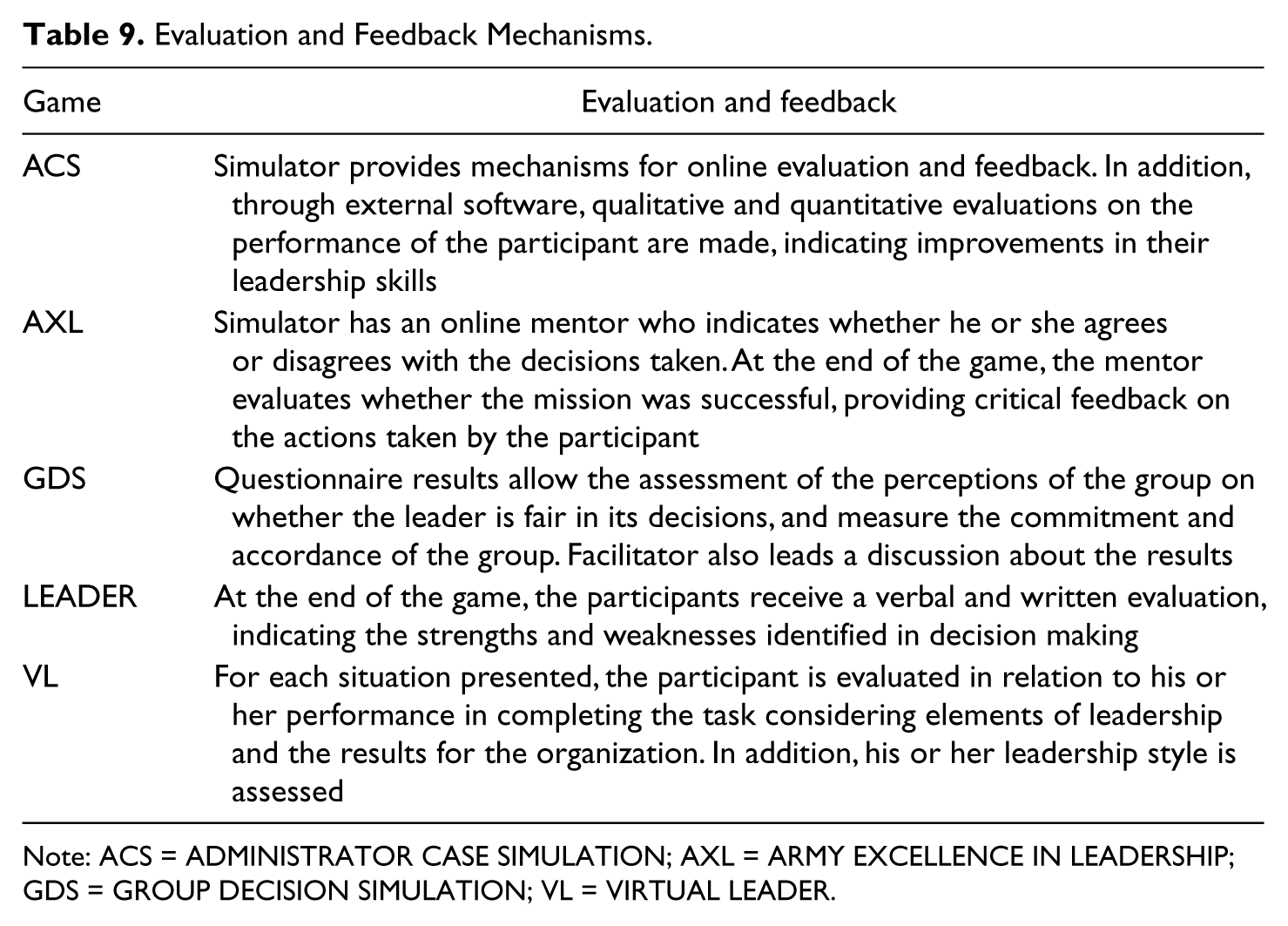
Another point of pedagogical analysis are the mechanisms of evaluation and feedback used in the games. Table 9 shows them.
Evaluation and Feedback Mechanisms.
Note: ACS = ADMINISTRATOR CASE SIMULATION; AXL = ARMY EXCELLENCE IN LEADERSHIP; GDS = GROUP DECISION SIMULATION; VL = VIRTUAL LEADER.
Table 9 shows that all the games have resources for the participant to evaluate his or her performance. Some games, like ACS, AXL, and VL, have computational resources that allow participants to receive feedback during and after the game process. This feature is important because it allows the participants to take steps to correct their ways and reflect on their learning as they make their decisions. AXL, for example, has a digital mentor who accompanies the participants in every action they take, helping them to reflect on the best way to act in every situation. These technological features were not observed in GDS and LEADER. Efficient mechanisms for assessment and feedback are important for games that are used not only for leisure activities, but also to involve participants in deep reflection and behavior change.
The analysis of the technical and pedagogical features of the games allowed to verify many different resources used by them—from simple and specific games like GDS and LEADER to sophisticated one like AXL. AXL is a game developed with modern computing resources, with the aim of using these resources to improve learning, which has been a trend in recent years in virtual environments focused on education. The use of these techniques has the potential to overcome the criticisms made by various authors (Carucci, 2009; Dentico, 1999; Gosling & Mintzberg, 2004) regarding the effectiveness of computer games for leadership development.
Theoretical Bases of the Games
An expectation we had in the research was to find games based on the theories of leadership so that these could be used to test and exercise leadership approaches. The analysis of this topic revealed that no such connection is explicitly addressed in the games.
Claudet (2002) binds the ACS proposal to collaborative leadership. However, the text presented shows no review on the subject and has no consistent links between the game and any theoretical bases on collaborative leadership. The work of Roberto (2001) emphasizes that the purpose of GDS is to exercise the components of decision making based on fair processes, including elements that could be related to authentic leadership theory, but in fact, his proposal does not bind to any theory.
Gowing, Adler, Gold, and Morris (2008) present a very simplified review on traits, situational, and contingency theories, but LEADER is not clearly connected to any of these theories. Only a subtle reference is done to the fact that the game can capture aspects of these theories, without presenting explicitly how and when this occurs. The game AXL states, among its goals, the development of adaptive leaders, which is one aspect that underlies Heifeitz (1994) theory, but no aspect of the theory is discussed. VL also does not present references to any kind of theory that could ground the implementation of the processes simulated.
The lack of theoretical bases on leadership can be considered a weakness of all the evaluated games. Experiential learning is meant to confront the participants with theory and practice so that they can look, act, reflect, and change their beliefs, attitudes, and behaviors. Without an appropriate and explicit theoretical foundation, training, evaluation, and feedback become compromised.
Effectiveness of the Games
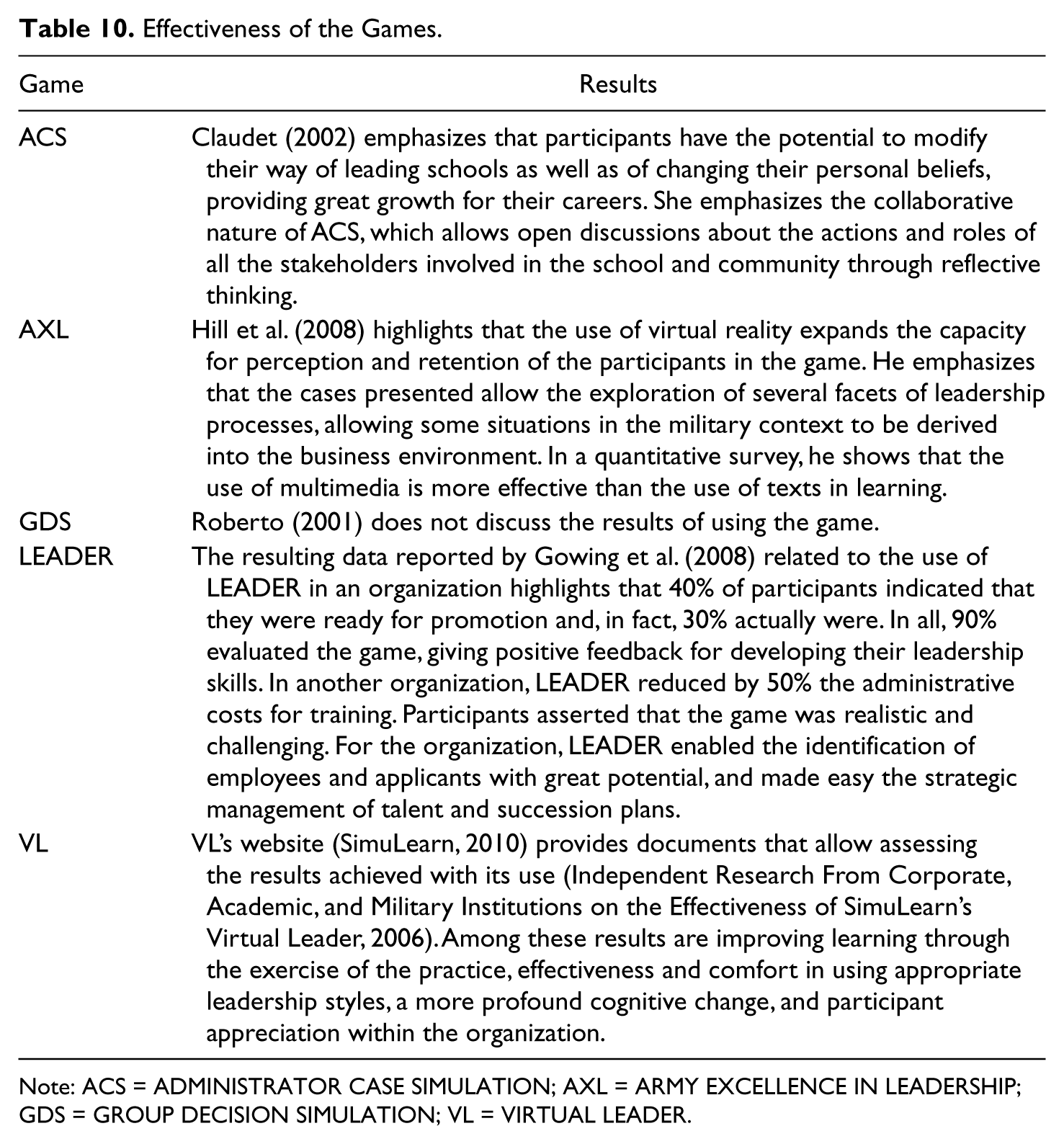
The last topic under analysis in this research was the set of results presented by the authors in relation to the effectiveness of games in leadership development. Table 10 presents a summary of the authors’ considerations.
Effectiveness of the Games.
Note: ACS = ADMINISTRATOR CASE SIMULATION; AXL = ARMY EXCELLENCE IN LEADERSHIP; GDS = GROUP DECISION SIMULATION; VL = VIRTUAL LEADER.
Table 10 shows that few works actually measure the results achieved by the participants through pre- and postgame evaluation and are based on measurable data. AXL and VL are the only ones that allowed to extract data for evaluating the results in some depth. LEADER presents some data on participants’ assessment, but does not show the instruments, criteria, or methods of research. Regarding the other games, we could not identify measurable data showing the actual results of their use.
Overall, we recognize the concern of the authors with demonstrating their results, relating them to real situations occurring daily inside organizations. However, effectively structured tools, methods, and criteria that would allow a more specific and real analysis about the role of these programs in leadership training were not shown, which can be indicated as a weak point of the games analyzed.
Final Considerations
Leadership development is essential for organizations that need to create and innovate. Experiential activities can accelerate this process due to the fact that they enable individuals to practice, evaluate, reflect, and act in a safe environment and close to reality game.
Systematic review presented in this article described some criticisms and opportunities to improve leadership development using business games. First, the number of studies that rely on technological resources to develop leadership is still insignificant. Technology offers more advanced features, such as computers with larger processing capability, virtual reality, and artificial intelligence, among others, which allow the creation of virtual worlds closer to the reality of organizations. Development of systems of high complexity involves higher costs and risks; on the other hand, it may be an alternative to a public increasingly immersed in the facilities provided by technological resources.
Second, a lack of relationship between leadership theoretical approaches and business games was noted. As discussed previously, this issue could have implications for game participants in their learning process. Business games should make explicit their set of theoretical bases to facilitate the relationship with the practice and feedback activity. Researchers could also use the games to assist the tasks of building, verification, and validation of their models in an attempt to evidence their ideas and theoretical propositions.
Third, findings reported by the authors highlight that experiential activity using business games for leadership development does not guarantee effective results for learning. Evidence that the participants of the games changed their behaviors or skills was very limited. This implies investing in consistent assessment and feedback methods because business game must not be an end in itself, but has to be used as a tool. This becomes even more important in complex and subjective training as is the case with leadership development.
Leadership development supported by business games remains an open field with many possibilities of evolution. Benefits generated by its use in organizational environments may in fact improve the development of the leaders who can be better prepared to deal with the complexity of knowledge society. Next step is to work on building higher quality and more effective models.
Systematic review used in this article has proved useful. Nevertheless it imposes some limitations due to the own method nature. In future articles, we intend to extend the research on other media such as books and academic papers like theses and dissertations.
Footnotes
Declaration of Conflicting Interests
The authors declared no potential conflicts of interest with respect to the research, authorship, and/or publication of this article.
Funding
The authors received no financial support for the research, authorship, and/or publication of this article.
Author Biographies
Contact:
Contact:
Contact:
Contact: