



Abstract
Background.
Escape rooms have been adapted from a range of educational purposes across disciplines, including healthcare simulation. The use of this technique has become increasingly popular among industry and faculty members. We sought to clarify the characteristics of
Methods.
A scoping review of the literature with an environmental scan of websites and other public information was performed to identify concepts which describe educational and healthcare simulation escape rooms to differentiate between and determine key features and scope of this clinical education tool to provide an interprofessional definition. Twenty-three references were used.
Results.
Healthcare simulation escape rooms share many of the characteristics of those being used for education and may be utilized for teaching a variety of skills. These may be conducted either within a simulation scenario, within the simulation/simulated environment, and/or with associated equipment. It is essential that the development and implementation of these escape rooms follow design standards of best practice for healthcare simulation for optimal learning. Only one definition of simulation escape rooms was found.
Discussion.
While similar to escape rooms utilized in other forms of education, there are principal differences between those escape rooms and ones used in healthcare simulation. Key features include utilization of core healthcare simulation principles, including providing a safe and realistic learning environment.
Conclusion.
Escape rooms may be used to engage learners in a simulation experience. It is important to differentiate between true simulation escape rooms and escape rooms that do not reflect healthcare simulation-based learning experiences. An expanded definition is provided, as reflected by the literature review, to provide a clearer understanding of the term as applied to healthcare simulation and enhance repeatable studies to advance the science of healthcare simulation.
Background
The trend to use escape rooms as a form of entertainment has increased (Kutzin, 2019; Mallenbaum, 2018; Nicholson, 2018). In the wake of COVID-19 and alternative clinical/educational experiences for healthcare professions (National Council of State Boards of Nursing, 2020), escape rooms in educational and clinical use have flourished (Kinio et al., 2019; Kutzin, 2019; Laerdal, n.d.a), including those in virtual form (Booker & Nestor, 2020). Vendors, such as Laerdal (n.d.a, n.d.b), and educators, for example Baily (2020), have offered free escape room content and resources to educators. Journals have seen increased manuscripts related to escape rooms; Simulation & Gaming even put out a special call. As a result, this term has been seen more in healthcare, simulation education, associated media and publications. However, there is no clarity around what qualifies as a healthcare simulation escape room and whether there is a difference between general escape rooms and those used in simulation.
As representative members of an editorial group for the Society for Simulation in Healthcare Simulation Dictionary (second edition) published by the Agency for Healthcare Research and Quality (Lioce et al., 2020), our recent task was to clarify and add additional terms seen as a result of COVID-19 (Society for Simulation in Healthcare, n.d.). Escape rooms, as related to healthcare simulation, was one such term that was deliberated, although it was decided not to add to the dictionary at this time. As a group, there was some confusion as to how escape rooms, often used in educational environments outside of healthcare (Dietrich, 2018; Nicholson, 2018; Reade, 2017), related to simulation. In order for simulationists to share ideas and publish research outcomes, they must speak the same language, therefore, clear descriptions and language are essential (Lioce et al., 2020). Thus, the manuscript aims to clarify and define escape room related to healthcare simulation.
Methods
Due to the rapid emergence of this type of simulation-based education (SBE) and to clarify terms, a scoping review of the literature with an environmental scan of websites and other public information (Porterfield et al., 2012) was performed. Specific databases searched included CINAHL, Medline, Google, and Google Scholar. The terms healthcare, escape room, simulation + escape room and simulation escape room were utilized. A total of twenty-three entries were found in the literature including: abstracts, letters to the editor, as well as, websites. Literature included some key educational sources as well, particularly those cited within healthcare and simulation literature. Literature was searched for characteristics, usage, examples, and definitions, if used. Only English citations were included.
Results
Results were grouped by descriptions/characteristics of escape rooms across educational and simulation literature, use in healthcare and training, and then further narrowed to healthcare simulation and the simulation environment.
Escape Room Descriptions/Characteristics
General Description (Common Characteristics Across Literature - Education and Simulation)
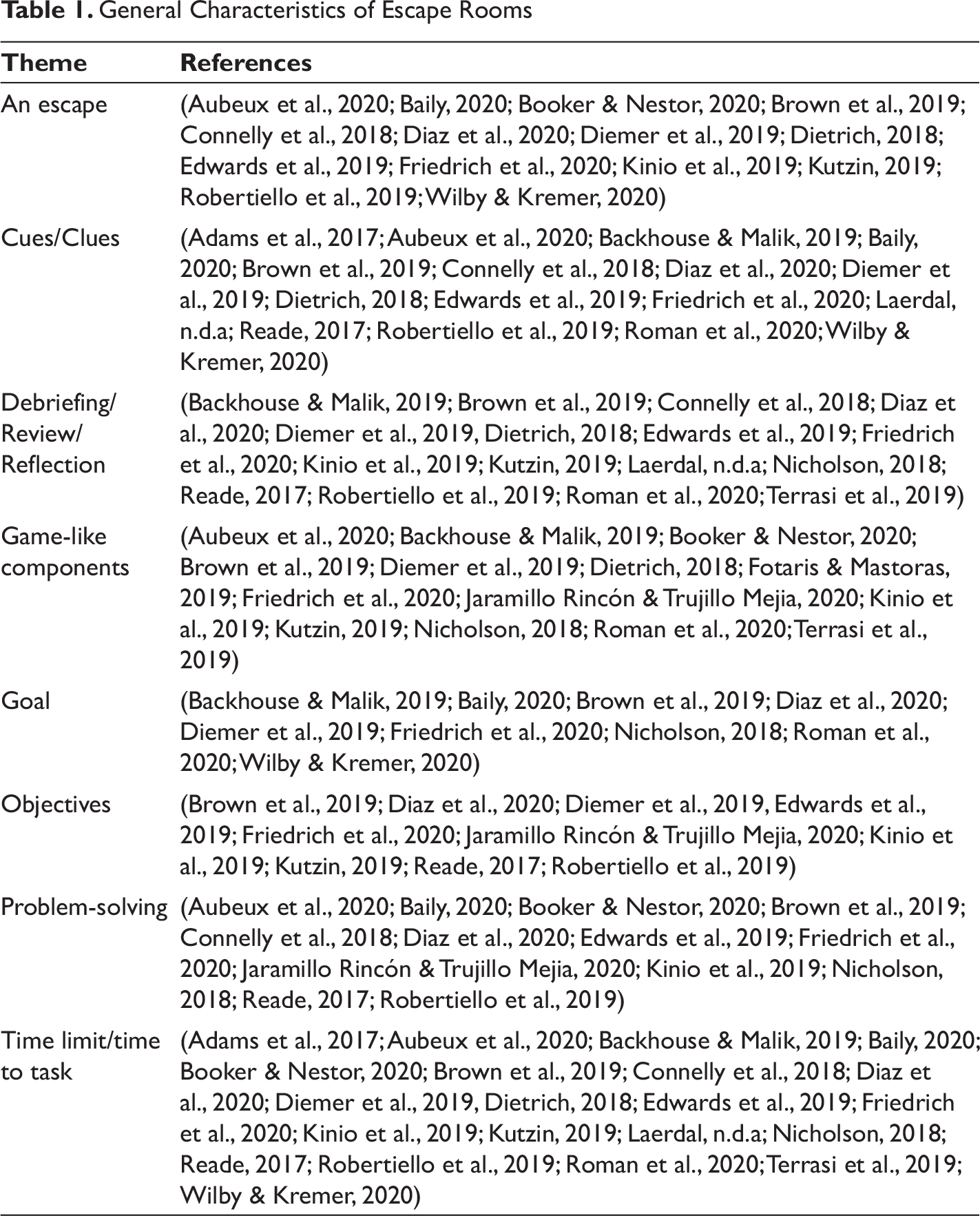
In general, for education, an escape room is a teaching tool or activity wherein puzzle rooms are utilized for learning and/or engagement (Aubeux et al., 2020; Backhouse & Malik, 2019; Baily, 2020; Booker & Nestor, 2020; Brown et al., 2019; Connelly et al., 2018; Diaz et al., 2020; Diemer et al., 2019; Dietrich, 2018; Edwards et al., 2019; Fotaris & Mastoras, 2019; Friedrich et al., 2020; Jaramillo Rincón & Trujillo Mejia, 2020; Kinio et al., 2019; Kutzin, 2019; Laerdal, n.d.a; Nicholson, 2018; Reade, 2017; Robertiello et al., 2019; Roman et al., 2020; Terrasi et al., 2019; Wilby & Kremer, 2020). A theme may be incorporated or described (Aubeux et al., 2020; Brown et al., 2019; Connelly et al., 2018; Diaz et al., 2020; Dietrich, 2018; Kinio et al., 2018; Reade, 2017; Wilby & Kremer, 2020). Escape rooms may enhance teamwork and collaboration (Aubeux et al., 2020; Backhouse & Malik, 2019; Baily, 2020; Booker & Nestor, 2020, Brown et al., 2019; Connelly et al., 2018; Diaz et al., 2020; Diemer et al., 2019, Dietrich, 2018; Edwards et al., 2019; Fotaris & Mastoras, 2019; Friedrich et al., 2020; Kinio et al., 2019; Kutzin, 2019; Laerdal, n.d.a; Nicholson, 2018; Reade, 2017; Robertiello et al., 2019; Roman et al., 2020; Terrasi et al., 2019; Wilby & Kremer, 2020). Additional characteristics of escape rooms that cross educational and simulation literature can be found in Table 1.
General Characteristics of Escape Rooms
Healthcare Education and Training
In the education of healthcare students or practicing professionals, escape rooms may be used for multiple reasons. Table 2 contains ways escape rooms have been utilized for healthcare education and training, along with specific examples and associated references.
Healthcare Education and Training Escape Room Uses and Examples

Healthcare Simulation and Simulation Environment
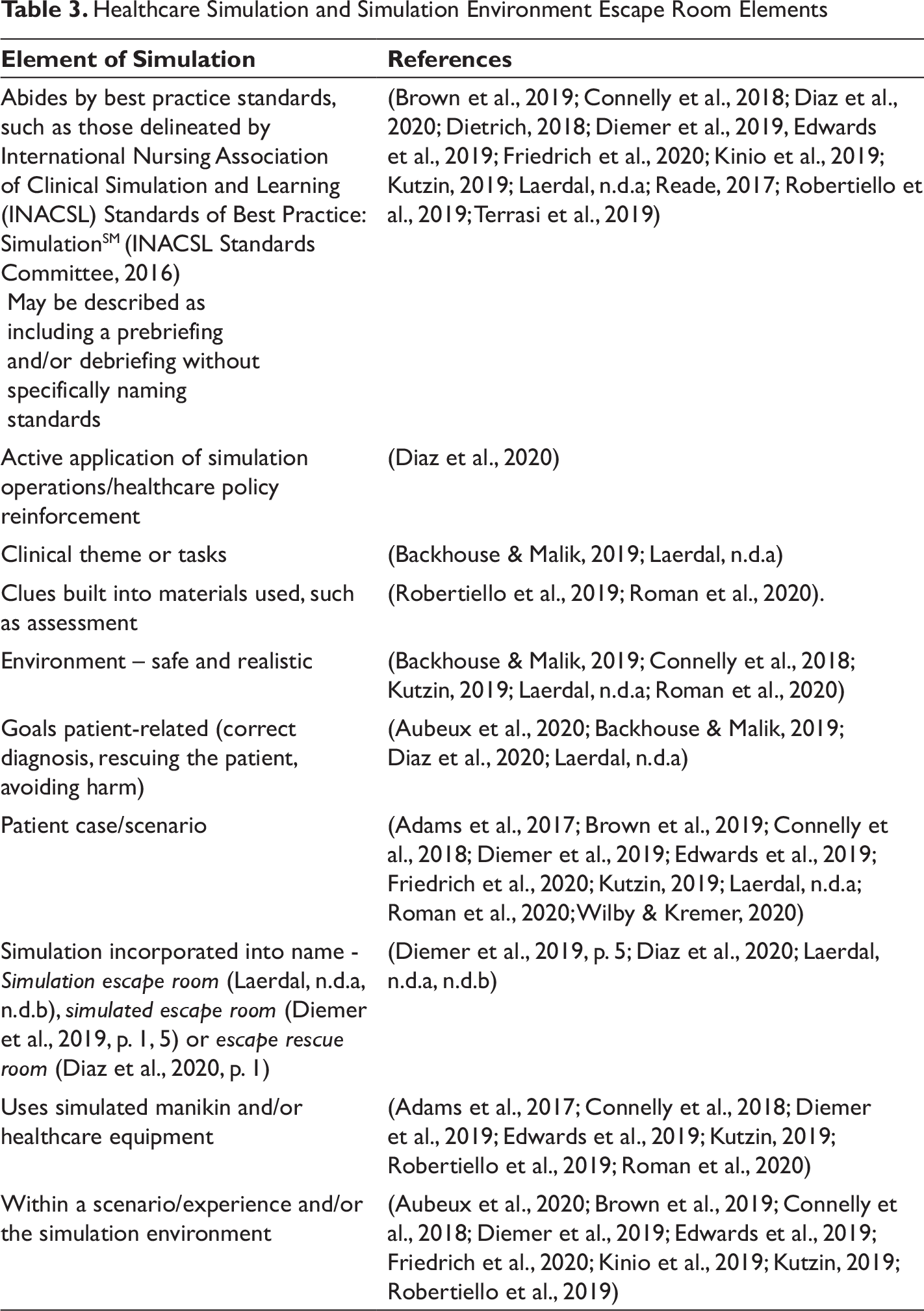
More explicitly related to healthcare simulation, different elements of simulation are included. Table 3 contains these elements of healthcare simulation escape rooms, along with references. Only one definition of simulation escape room was found (Laerdal, n.d.a) broadened from a definition of escape room (University of Minnesota, 2019).
Healthcare Simulation and Simulation Environment Escape Room Elements
Discussion
While simulation escape rooms share many of the same characteristics of escape rooms used by other educational entities, there are clearly some differences. The word simulation is a key component, either with the scenario itself or occurring within the simulation/simulated environment (Aubeux et al., 2020; Brown et al., 2019; Connelly et al., 2018; Diemer et al., 2019; Edwards et al., 2019; Friedrich et al., 2020; Kinio et al., 2019; Kutzin, 2019; Robertiello et al., 2019). Although, often, it is difficult to determine based on descriptions, or lack thereof, provided in current literature.
The use of simulation equipment (simulator, etc.) is not a qualifier alone to label an activity as a simulation escape room; the design must also follow healthcare simulation best practices, most importantly, have clear objectives and expected performance measures as well as being centered around patient outcomes. In a realistic clinical experience, there is a patient outcome you are trying to achieve, or there are interventions to be completed or patient management to occur (Aubeux et al., 2020; Brown et al., 2019; Connelly et al., 2018; Edwards et al., 2019; Robertiello et al., 2019).
As discussed in healthcare simulation best practices, simulation activities should include a custom prebriefing and debriefing/feedback for improvement of learning, as well as, the other elements of simulation design, based on the objectives (Diaz et al., 2020; INACSL Standards Committee, 2016; Robertiello et al., 2019). A healthcare simulation escape room should include these components and be clinically focused (Backhouse & Malik, 2019; Friedrich et al., 2020; Laerdal, n.d.a; Roman et al., 2020), such as, utilizing a high-fidelity patient simulator with content and/or skills. The ultimate goal of all healthcare simulation escape rooms should center around patient safety through improved participant, team, and/or patient outcomes, with a pressured timed response (Baily, 2020; Jaramillo Rincón & Trujillo Mejia, 2020; Laerdal, n.d.a).
The premise of the Healthcare Simulation Dictionary is to use consistent terminology (Lioce et al., 2020). Using consistent terminology, such as escape room, simulation escape room (Laerdal, n.d.a), simulated escape room (Diemer et al., 2019, p. 1, 5), ‘escape’ rescue room (Diaz et al., 2020, p. 1) or other coined term is important for simulationists in order to promote and strengthen communication (Lioce et al., 2020).
The specific setting in which an escape room exists serves as the prefix to the room. An example of this is a simulated escape room (Diemer et al., 2019, p. 1, 5); one which mimics reality or a virtual escape room (Booker & Nestor, 2020); one which is conducted virtually. The descriptive terms assist in understanding the application of the modern-day puzzle room.
When writing manuscripts, published terms should be used and definitions should accompany. Authors should discuss how the published escape room meets simulation best practices and core healthcare simulation principles. These definitions and descriptions will enhance repeatability of studies with a clear understanding of the researchers’ application of the term to advance the science of healthcare simulation escape room best practices.
Limitations
A scoping review with an environmental scan was completed to provide a timely synopsis for the Society of Simulation in Healthcare’s Simulation Dictionary Addendum (SSH, n.d.) in response to the current pandemic. While we sought to search literature and websites which used simulation and escape room, key articles could have been missed. This analysis will serve as a starting point for building a comprehensive interprofessional definition and discussion as reflected in the literature.
Conclusion
While escape rooms are widely purposed, social, educational and some are simulation-based, i.e. healthcare simulation escape rooms or simulated escape rooms, they may also be incorrectly termed. Incorporating an escape room as an educational teaching method does not automatically justify the use of the term simulation or healthcare simulation escape room. A simulated healthcare setting is an example of an environment the escape room is being conducted in, but the actions do not represent real-life patient scenarios nor include all of the components of healthcare simulation design (INACSL Standards Committee, 2016). This is a different concept than a simulation escape room. Creating a clear definition of what entails a healthcare simulation escape room is necessary.
Expanding on the current broadened definition (Laerdal, n.d.a), the authors offer the following expanded definition to enhance the reporting and dissemination of healthcare simulation escape rooms, based on this review. A healthcare simulation escape room is an interactive activity that incorporates traditional elements of escape rooms with healthcare-related themes or content for the purpose of education, engagement and/or evaluation; the setting is within a simulation experience, simulated environment, and/or incorporates simulation equipment, and simulation best practices and core healthcare simulation principles are utilized with the overall goal of safe patient care.
Footnotes
Declaration of Conflicting Interests
Funding
The author(s) received no financial support for the research, authorship, and/or publication of this article.
Acknowledgments
The authors thank Todd P. Chang, MD, MAcM and Andrew E. Spain, MA, EMT-P for their input on the initial discussions of the definition of escape room. The opinions and assertions expressed herein are those of Dr. Lopreiato and do not necessarily reflect the official policy or position of the Uniformed Services University or the Department of Defense.

Author Biographies
Contact:
Contact:
Contact:
Contact:
Desiree A. Díaz, PhD, RN-BC, CNE, CHSE-A, ANEF, FAAN, is an associate professor of Nursing at UCF. She was recently inducted as a fellow into the American Academy of Nursing.
Contact: