




Abstract
Background
Nurses are often the first health professional who identify cardiopulmonary arrests in hospital settings; therefore, they require proficient cardiopulmonary resuscitation skills.
Aim
The purpose of this study was to evaluate game-based cardiopulmonary resuscitation training for first-year nursing students in terms of students’ knowledge levels, performance, satisfaction, and confidence.
Methods
This study was conducted following a quasi-experimental design. A total of 104 students were randomly assigned to two study groups. A Serious Game & Integrated Real-Time Audiovisual Feedback Simulator was utilized in the cardiopulmonary resuscitation training of the intervention group. For the control group, only a real-time audiovisual feedback simulator was used.
Results
There was an increase of approximately 30 points between the pre-test and post-test scores for knowledge in both groups. In regard to performance scores, there were no statistically significant differences between the groups in regard to overall scores, compression depth, and compression frequency were similar at post-test and re-test (p>0.05). The difference between groups was not statistically significant for satisfaction and self-confidence statistically (p>0.05).
Conclusion
The integration of a serious game into a real-time audiovisual feedback simulator does not provide significant advantages over the use of only a real-time audiovisual feedback simulator in terms of cardiopulmonary resuscitation knowledge and performance.
Keywords
Introduction
Cardiopulmonary resuscitation (CPR) is a procedure by which respiratory support and blood flow to the brain and other vital organs is provided by chest compressions. When CPR procedures are performed correctly and in a timely manner by a trained health professional, mortality associated with cardiac conditions decreases (Rajeswaran et al., 2018).
Nurses are generally the first health professional who identify cardiopulmonary arrest as they check on patients frequently in hospital settings (Park et al., 2016; Partiprajak and Thongpo, 2016). However, despite their role in identifying and administering CPR, it has been shown that nurses and nursing students do not have sufficient knowledge regarding CPR (Kim et al., 2020; Roh et al., 2013). As such, high-quality training practices and strategies must be adopted to increase their CPR knowledge and experience (Rajeswaran et al, 2018; Roh et al, 2013; Cortegiani et al., 2018).
One key strategy to increase CPR training quality is undoubtedly providing good-quality feedback to trainees from the instructors (Cortegiani et al., 2018). In order to achieve beneficial feedback, there is a requirement for accurate assessment of standard CPR skills. Cortegiani et al. (2018) report that instructors do not consistently evaluate the skills and capabilities of trainees in a strictly objective manner. With technological advances, various real-time audiovisual feedback simulators have been designed for the objective assessment of CPR quality and to increase the skills of trainees in terms of CPR application. These devices range from those that provide simple audio cues to help with the frequency of compressions to very complex devices that assess and record results (Wee et al., 2014). The literature shows some evidence that these devices may increase CPR effectiveness in clinical settings (Yeung et al., 2009; Lukas et al., 2011; Song et al., 2015). Recently, real-time audiovisual feedback has advanced CPR training. Since 2015, American Heart Association (AHA) has recommended the use of real-time feedback simulators for CPR training. The objective measurements provide accurate assessment and acceptable perception of CPR quality (Lin et al.,2018). Many studies in the literature have shown that these devices increase the quality of chest compressions (Wee et al, 2014; Kirkbright et al., 2014; Skorning et al., 2010; Pozner et al., 2011; Song et al, 2015a; Yeung et al., 2014). Compression depth and frequency are key features of high-quality CPR and have been associated with increased survival rates after cardiac arrest. The real-time feedback simulators are considered an effective tool for improving the quality of CPR (Gugelmin-Almeida et al., 2021).
With increasing gaming technology for learning and training, serious games have been used in several areas of nursing education including CPR. Games, in addition to being interactive computer simulations, can be adapted to real-life scenarios (Johnsen et al., 2018). Games can promote experience-based learning through interactive 3D environments; thus motivating individuals, and providing an easy and fun way of learning (Bauman, 2012; Kang and Suh, 2018; Drummond et al., 2017). Using games students can enhance their skills before encountering patients (McEnroe-Petitte and Farris, 2020; Chen et al., 2015). However, little research has been done on the use of game-based learning, and more research is recommended to better understand how educational games can be best used in nursing education (Gallegos et al., 2017).
Currently, when face-to-face education is not possible due to the COVID-19 pandemic, digital technologies provide realistic, interactive online learning experiences on screen-based platforms, including mobile devices (Jimenez-Rodrigez et al., 2020; Kharisat et al., 2020). To maximize the success of distance simulation learning, simulators are designed as plug-and-play technology in the form of serious games (Vazquez et al., 2020).
The increase in the number of devices and software that provide CPR education makes selecting an appropriate one challenging. Nurse educators need knowledge regarding both CPR itself and evidenced-based information related to devices and software in order to select an appropriate device.
Study Question
The question being studied is as follows: • Are there significant differences in the CPR knowledge, performance, self-confidence, and satisfaction scores in students receiving training with a serious game and integrated real-time audiovisual feedback simulator and those receiving training with only a real-time audiovisual feedback simulator?
Methods
Study Aim and Design
The purpose of this study was to evaluate game-based CPR training for first-year nursing students in terms of students’ knowledge levels, performance, satisfaction, and confidence. This study had a pre-post intervention design in which data were collected before and after the CPR training program.
Theoretical Framework: Kolb Experiential Learning Theory
The theoretical framework of the research is based on Kolb Experiential Learning Theory (Kolb, 2015). All simulation experiences were carried out following INACSL Standards of Best Practice: Simulation as well as the theoretical background, including prebriefing, simulation design, and debriefing (INACSL, 2021).
In Kolb's experiential learning theory, learning takes place in four steps: Concrete experience, reflective observation, conceptualization, and active experimentation. It is emphasized that these steps are a cyclical process, not unidirectional (Kolb, 2015).
Theoretical Training Phase: At the stage where CPR indications and related complications are learned, the students conceptualized the learning goal with theoretical knowledge on abstract concepts by making reflective observations (Reflective observation-Conceptualization).
Simulation Phase: In the prebriefing session, an abstract framework was created by giving information about the scenario to the students. The abstract concepts obtained in theoretical training and Serious Game Application have been concretized by applying on the mannequin. In the CPR experience, the students were able to display data as pass or fail such as compression depth, compression frequency, ventilation volume, and number. Thus, students were encouraged to reflect on the skills practiced. Besides, with the opportunity to practice more than once, students with different abilities were provided with the opportunity to practice until the learning goal was achieved (Conceptualizm-Active experimentation).
Debriefing Phase: It was aimed to identify and resolve gaps in the students' knowledge, skills, and attitudes about CPR in the debriefing sessions. At this process, reflective thinking was encouraged by maintaining the students' psychological safety and confidentiality. (INACSL, 2021a) Concepts, which are based on a concrete framework with active experience, were adapted to real-life experiences through reflective observation. (Reflective observation- Concrete experience).
Participants
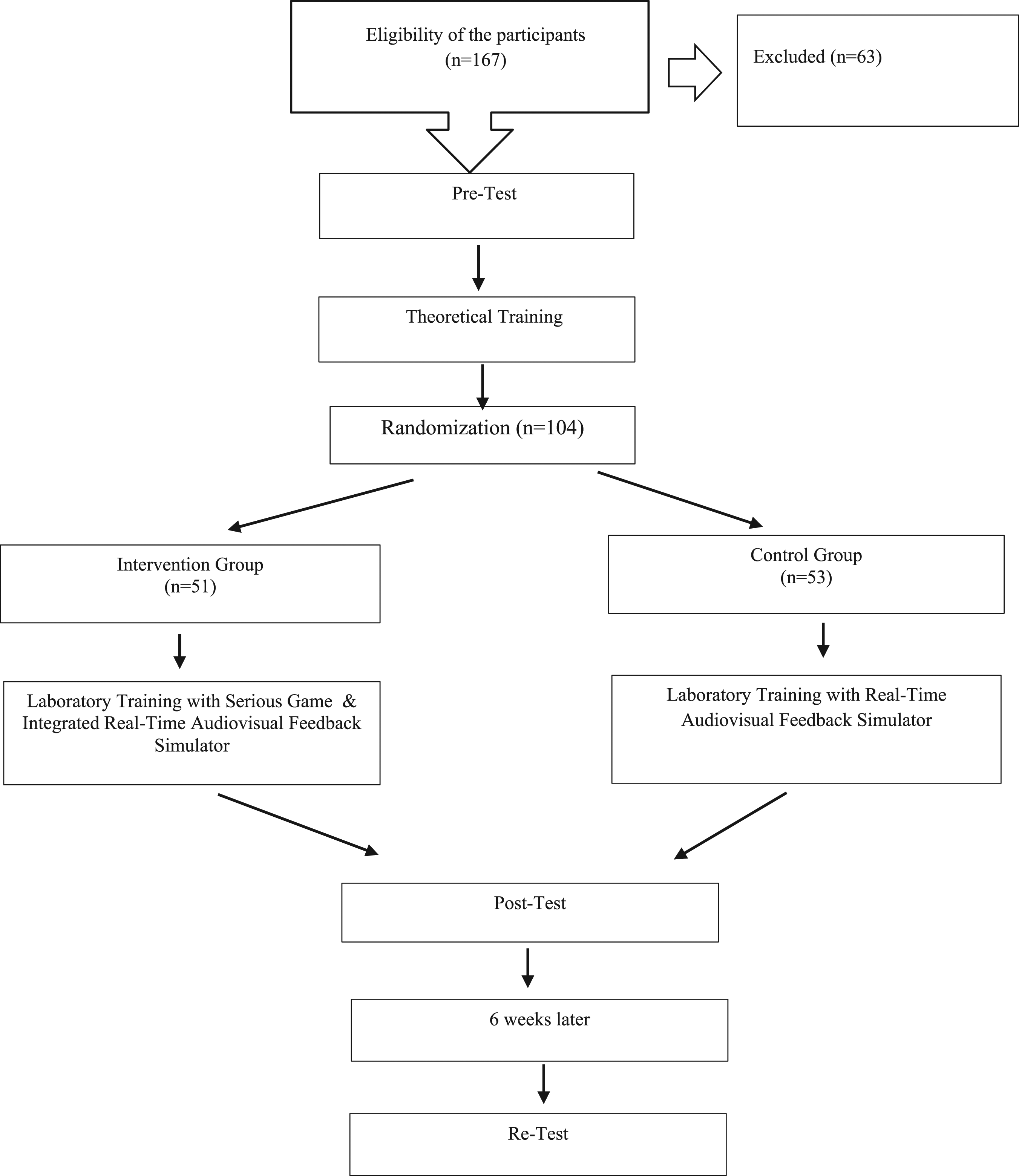
This study was conducted with 164 first-year students during the 2018-2019 academic year. Additional inclusion criteria were: not having undergone CPR training and being a volunteer to participate in the study. A total of 104 students who fulfilled these criteria were included in the study and randomly assigned to two study groups (intervention and control groups) via e-Picos computer software.
Data Collection Tools
Procedure
The study procedure was conducted in four steps. Pre-test: The students in both groups completed a questionnaire comprised of demographic details and a 20-item assessment test of CPR knowledge. The test took approximately 10-15 minutes to complete (Figure 1). Theoretical training: The students attended 3-hour CPR training in class, received theoretical explanations regarding the CPR procedure, and viewed a video tutorial of CPR that was followed by a live demonstration. After randomization to intervention and control groups, the students participated in laboratory training. Laboratory training: Both groups attended a class for procedural practice. The students in the intervention group were included in the laboratory training after completing the serious game. The students had two days to complete the serious game. During this period, it has been determined from the records that the students played the serious game many times (at least half an hour, at most 3 hours). In laboratory training, all students in both groups were provided with feedback regarding their technique during the practice. The students were allotted time for practice. After laboratory training, all students completed a ‘Student satisfaction and self-confidence in learning’ instrument. The instrument was completed in about 10 minutes. Post-Test: In the post-test, students' CPR knowledge level and CPR performance were evaluated. The knowledge levels of students were assessed after laboratory training by the ‘CPR knowledge assessment test. The test was used both as the pre-test and the post-test phase. The CPR performance scores of all students were evaluated by ‘SmartMan Basic Life Support Megacode Pro’. During this assessment, students were asked to perform CPR for the duration of 2 cycles on the simulator. The simulator screen was turned off and all students did not receive any form of feedback during the test. Each student’s compression depth, compression frequency (per minute) and total score were saved by the device and immediately recorded by researchers. Re-Test: Six weeks after the post-test, the students’ CPR performances were re-evaluated by the same procedure with the same device. The flow diagrams of the study.
Data Analysis
All data were assessed via the IBM SPSS version 21.0. Demographic data were expressed with frequency and percentages. The comparison of knowledge levels and performance scores were performed via paired t-test and the independent samples t-test (between group comparisons). The significance level was <0.05.
Ethics Considerations
The study was approved by the Ethics Commission of Gulhane Training and Research Hospital (September 2018, number 18/216). The study was conducted in accordance with the Declaration of Helsinki.
Results
Pre-test and post-test scores for knowledge.

aThe maximum possible score was 100.
Post-test and Re-test scores for CPR performance.

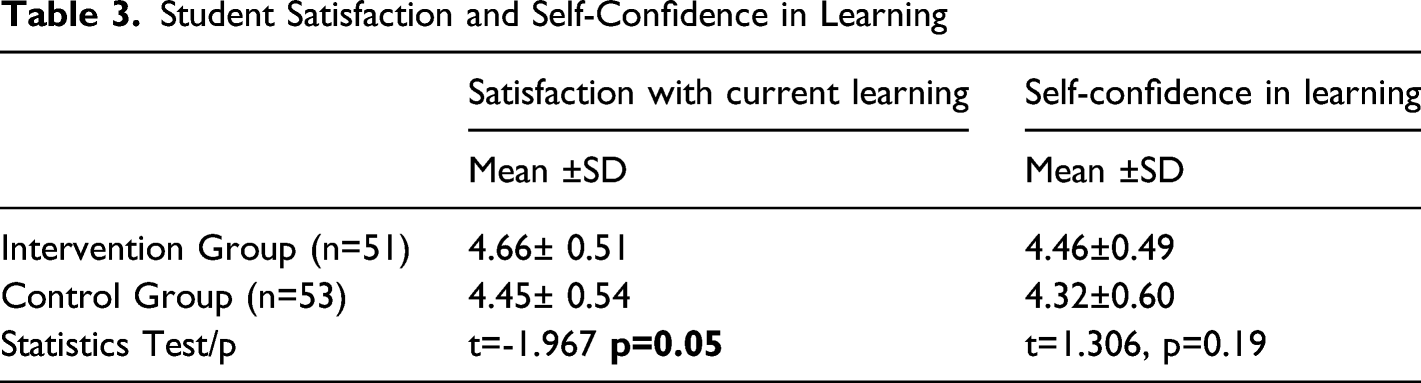
Student Satisfaction and Self-Confidence in Learning
Discussion
In this study, we aimed to determine the effectiveness of game-based CPR training on students’ knowledge levels, performance, satisfaction, and self-confidence scores. The fact that post-test scores were significantly increased after training is an important finding showing that training was indeed effective in improving the knowledge. Partiprajak and Thongpo (2016) and Tawalbeh and Ahmad (2014) single-group study evaluating cardiovascular life support with a one-day program with modified basic life support course, have also reported similar results demonstrating increased knowledge levels after training. In our study, there were no significant differences between the groups about knowledge, but knowledge scores increased in both groups. There are various studies in the literature that have assessed game-based CPR training and results vary. Drummond et al. (2017) compared game-based training with online course training for CPR. Both groups showed an increase in scores at post-test; however, there were no significant differences between game-based and online course training. Boada et al. (2015) found students who played CPR serious games before and after theoretical training performed CPR better on a mannequin. Nishiyama et al. (2019) first applied animated video-based CPR training, and then included the students in the CPR practice with a manikin. The study has reported that current educational methods are insufficient to train students effectively and to increase experience. De Sena et al. (2019) applied CPR self-training with video-based presentation and serious game 3D learning environment to medical students. The study results showed that self-regulated video-based CPR training had higher scores compared to self-regulated serious game-based CPR training, both for knowledge levels and performance. However, students reported higher satisfaction with game-based training (De Sena et al., 2019). Our results show that both simulators were beneficial in training and there were no significant differences between the two training methods. We found that the students who underwent training with the serious game and integrated real-time audiovisual feedback simulator reported higher satisfaction. However, the groups were similar about self-confidence scores.
CPR knowledge and skills deteriorate in 3 to 6 months after training (Kovacs et al., 2019). Partiprajak and Thlongpo (2016) reported a decrease in the CPR knowledge levels of nurses 3 months after training; however, compression depth was maintained. In a systematic review study by Riggs et al. (2019), it was recommended to undertake refresher training every 3-6 months to ensure the retention of CPR skills. In Oerman et al. (2011), which examined the effects of monthly practice on nursing students' CPR skills at 3, 6, 9, and 12 months, they determined that only 6 minutes of training for each month improved nursing students' CPR skills over baseline. In the current study, we found that both groups maintained their competence in CPR performance after 6 weeks. Serious games may be an effective tool for refresher training. Since the results of this study indicate a high satisfaction rate there could be an increased adherence to playing the game every month or two so that CPR skills may be maintained. Therefore, it is apparent that the effects of game-based CPR learning should also be assessed at longer intervals to determine whether this method contributes to retention of knowledge and skills.
Limitation
This study was conducted in a single center, the CPR performances of nursing students were assessed with only 2 cycles of CPR, and re-test was performed only after 6 weeks (long term evaluation was not performed). It was stated that during the two days given to the students to play, they could play as much as they wanted until they felt competent. Therefore, the students did not play the serious game in equal time. Also, the cost-effectiveness of simulators was not evaluated in the study.
Conclusion
In this study, it was concluded that there was an increase in knowledge scores in both groups whether the serious game was integrated into the real-time audio-visual feedback simulator or not. Both simulators seem to be effective in providing appropriate training to nursing students. Serious games have the potential to provide refresher training to maintain CPR skills. It is also recommended that studies be conducted over different periods between training refresher interventions.
Footnotes
Declaration of Conflicting Interests
The author(s) declared no potential conflicts of interest with respect to the research, authorship, and/or publication of this article.
Funding
The author(s) received no financial support for the research, authorship, and/or publication of this article.
