




Abstract
Nursery rhymes have been a part of childhood for centuries. Spanning the generations, children and adults continue to delight in their poetry and melodies. Educators consider these rhymes traditional literature for music and language instruction. Within this article, the author includes a brief historical discussion of nursery rhymes and writes contemporary music lessons for young children using traditional English verse.
For centuries, people have delighted in nursery rhymes. Today, we consider Mother Goose Melodies as mainstays of children’s literature. Rhymes—once exclusively transmitted orally—have been collected, illustrated, published, and sold as compilations for children. The first English publication is attributed to John Newbery in London ca. 1760 (Opie & Opie, 1951/1997; Whitmore, 1892). During the Victorian era, English collections made their way “across the pond,” and publishers made them available to American readers.
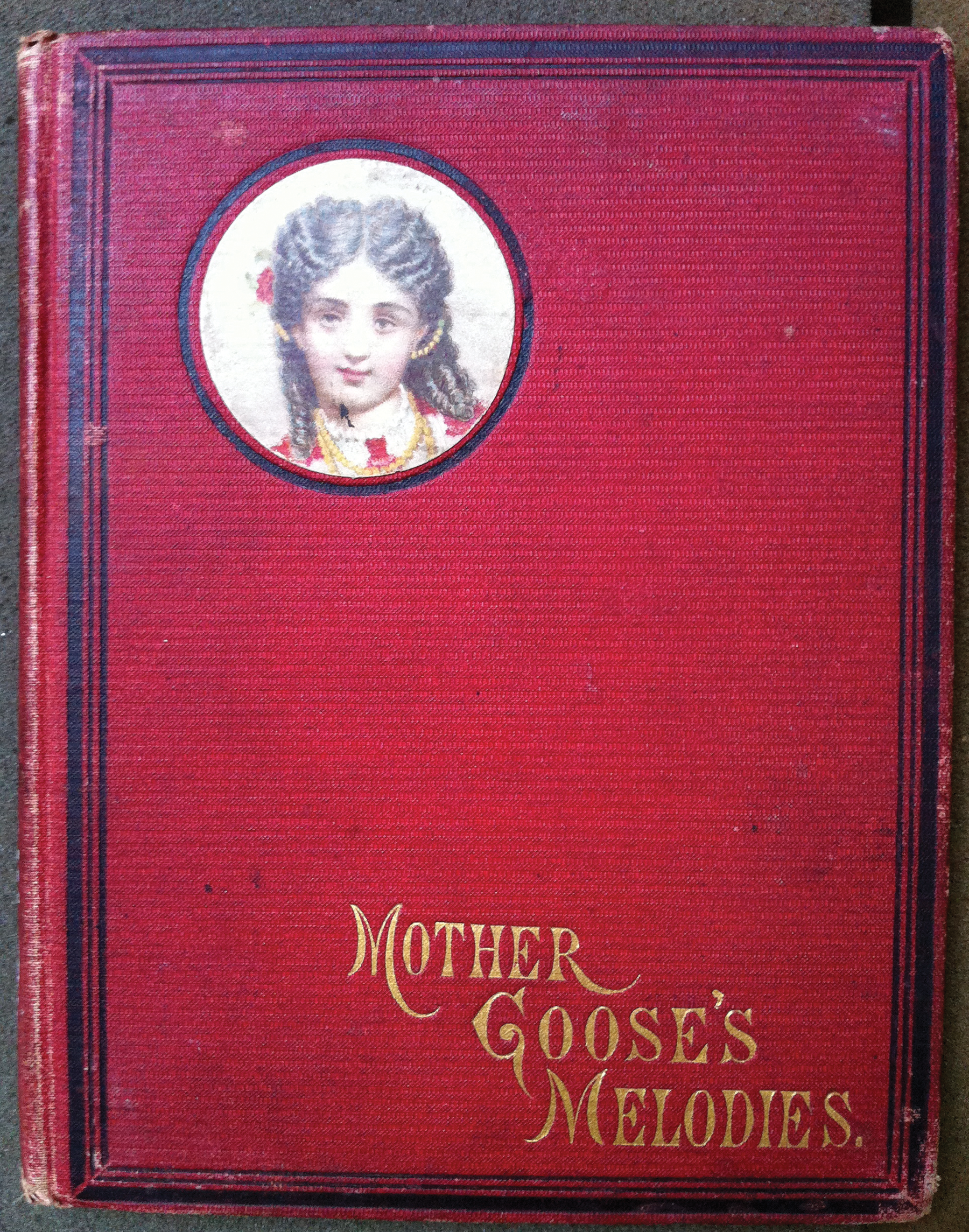
Published in 1860, John Miller’s Mother Goose’s Melodies included the subtitle, “Containing All That Have Ever Come to Light of Her Memorable Writings.”

Sidebar 1: Riddle
The Mist
A hill full, a hole full,
Yet you cannot catch a bowl full.
Two early sources of traditional rhymes published in the United States include John Miller’s (1860) New York publication, and an 1892 facsimile of an 1825 publication by Monroe & Frances of Boston, which was, in turn, a reprint of John Newbery’s 1760 Mother Goose’s Melodies. These examples and contemporary collections include verse specifically created for children, such as lullabies, rhyming alphabets, poems, and “infant amusements” with games such as Pat-a-cake and This Little Piggy Went to Market (Sendak, 1984). However, much of what we identify today as nursery rhymes was not originally composed for children. Collections, past and present, include vendors’ street cries—such as Hot Cross Buns and Lambs to Sell—as well as riddles that likely entertained adults and children alike (Opie & Opie, 1951/1997).
Nursery rhymes are found in all cultures and languages. Whitmore (1892) traced the name “Mother Goose” to published 17th-century French tales or stories that include Sleeping Beauty and Little Red Riding Hood. The English translations of these French tales retained the use of the name for the rhymes. Publishers distinguished the tales from the rhymes with the label melodies, which indicates that many were sung. Scholars have traced English-language rhymes from as early as medieval times in England and Scotland. Variants of some verses, however, such as “Ladybird” and “Jack Sprat” have been found across Europe in German, French, and Dutch (Opie & Opie, 1951/1997), making origins difficult to pinpoint. A few rhymes have American associations such as “Yankee Doodle” and “Rock-a-Bye Baby” (Roberts, 2005), and contemporary poetry over time will likely come to be known as a nursery rhymes (Opie & Opie, 1951/1997; Sendak, 1984). In fact, though rare, not all rhymes found in early collections had unknown authors. For example, the 19th-century Scots poet, William Miller, wrote “Wee Willie Winkie,” and Sara Catherine Martin wrote “Old Mother Hubbard” in 1805, under the title The Comic Adventures of Old Mother Hubbard and Her Dog (Opie & Opie, 1951/1997). Jerrold (1903/2012) noted that “tradition in the nursery has acted as a severe editor” (p. 8), as many of these rhymes with numerous verses become truncated with recitations of one verse or a few lines.
Historians and other individuals have linked some rhymes to specific social and political events in English history (Chisholm, 1984; Elwes, 1930; Opie & Opie, 1951/1997; Roberts, 2007). For example, “Ring Around the Rosie” may describe the symptoms of the Great Plague, and “Mary, Mary Quite Contrary” likely references Mary, Queen of Scots (Chisholm, 1984). Although individuals have attempted to link verses with real persons and events, much of the evidence is anecdotal or speculative, and sometimes contradictory (Jerrold, 1903/2012; Opie & Opie, 1951/1997; Roberts, 2005). Some of the rhymes are merely nonsensical strings of pleasing sounds, while others acquire new meanings over time. “The difficulty is, once you start seeing meaning you can find it anywhere, and people have been looking for a long time,” quipped author and librarian, Chris Roberts (2005, p. xvii). One comprehensive source for discovering the references, meanings, and origins of the rhymes is Peter Opie and Iona Archibald Opie’s (1951/1997) The Oxford Dictionary of Nursery Rhymes first published in 1951 by Oxford at the Clarendon Press. Another source—though the author admits a less scholarly source—is Heavy Words Lightly Thrown: The Reason Behind the Rhyme (Roberts, 2005).
Rhymes found inappropriate for children in their original wording are omitted from contemporary collections for children. However, with references to death, sex, and violence either lost or ignored—purposefully or due to ignorance—many of the rhymes with adult meanings remain in use at home and in schools. The tradition of “sanitizing” the rhymes began with the first collections. Roberts (2005) noted that the Victorians were “keen on deliberately rewriting them” in an effort to “tidy the rhymes and give moral instruction” (p. xviii). Taking verse from the streets to Victorian parlors, Roberts suggested, made them more accessible as well as less potent. Adults, particularly those involved in school systems, continue the tradition of tidying the verse by altering or censoring references to smoking and drinking. Yet, despite time and censorship, Mother Goose survives, and her rhymes continue to live in homes and schools. Lynn (1985) suggested that rhymes survive because they are genuine poetry that serves a dual audience of adults and children who find them amusing. “And that double nature of the audience has dictated the survival of a particular literary form” (p. 4). Children enjoy the wordplay and fanciful images conjured in their imaginations. Adults and teens, also amused by the rhymes, may find renewed interest in the Mother Goose Melodies on discovering the origins and meanings behind the rhymes.
Sidebar 2: Alphabet Rhyme
A as an apple-pie
B bit it,
C cut it,
D dealt it,
E eat it,
F fought for it,
G got it,
H had it,
I inspected it,
J jumped for it,
K kept it,
L longed for it,
M mourned for it,
N nodded at it,
O opened it,
P peeped in it,
R ran for it,
S stole it,
T took it,
U upset it,
V viewed it,
W wanted it,
X, Y, Z, and ampersand
All wished for a piece in the hand.
Nursery Rhymes in the Classroom
Educators consider nursery rhymes traditional literature for music and language subjects. Early knowledge of nursery rhymes predicts later success in reading for young children (Bryant, Bradley, Maclean, & Crossland, 1989). Classroom teachers of preschool and primary school-age children use nursery rhymes to teach reading content such as alphabetic knowledge, vocabulary building, and phonemic awareness through rhyme and alliteration (O’Herron & Siebenaler, 2007).
For example reciting Vinegar, veal, and venison, are very good victuals, I vow provide children practice with alliteration using the voiced /v/ sound. In addition to recognizing the similar beginning phoneme /v/, the sentence uses archaic language that would likely be new to many of today’s children. Additionally, children gain cultural understanding through knowledge of nursery rhymes. Children’s knowledge of these melodies, poems, finger plays, street cries, riddles, and stories provides them with a foundation for later modern references in literature (Cullinan & Galda, 1998).
Nursery rhymes serve as traditional early song repertoire for children in music learning. Music teachers use nursery rhymes and their traditional melodies in general music instruction to aid children in acquiring knowledge of music concepts. Beginning instrumental students play many of these melodies during their first years of study. Throughout history, composers have used folk melodies of traditional nursery rhymes in orchestral repertoire. For example, Wolfgang Mozart’s “Twelve Variations in C” explores the French nursery melody Ah, vous dirai-je Maman, which American children recognize as “Twinkle, Twinkle, Little Star” or the “ABC Song.” Also, French composer Lucien Calliet used the “Pop, Goes the Weasel” melody in his 1938 composition, “Variations on Pop Goes the Weasel.”
Lessons for the Music Classroom
Music teachers continue to use nursery rhymes in lessons that support young children’s music learning. Opie and Opie (1951/1997) asserted that adults do not “employ a jingle because it is a nursery rhyme per se, but because in [sic] the pleasantness (or desperation) of the moment” (p. 5). In that spirit of delight (and perhaps necessity), this author created new music activities based on old rhymes for preschool and kindergarten children. The activities are also suitable for children in primary grades. Each included lesson engages children in singing or chanting and invites children to demonstrate music understanding of pitch, beat, and rhythm through movement.
Old Mother Hubbard
Begin by sharing the rhyme with children in a traditional manner—orally/aurally from memory and with vocal inflections that excite the listener. Provide several hearings before asking young children to chant with you. Ask questions about the rhyme, such as “Who is the rhyme about?” and “What happened in the story?” Invite the children to move to help tell the story as you chant the rhyme. This type of kinesthetic activity aids in children’s language comprehension of the rhyme as well as provides concrete experience of music concepts. Suggested movements are below:
Have children stand in free formation about the room and add locomotor movements as you chant the rhyme. Invite children to chant with you, while walking the beat to another place in the room, and to stop on the word when (fourth line of text) and pantomime the suggested movements. Eventually, children will be able to recite the rhyme from memory.
On another day, add a pitch element through isolation and recognition of high and low sounds. Invite the children to describe the cupboards in their homes and note that some cupboards are placed high while others are low. Have them enact opening a cupboard placed high and opening a cupboard placed low. Explain that when they hear a high voice, they will open the cupboard placed high and when they hear a low voice, they will open the cupboard placed low. Recite the rhyme expressively, and pitch the phrase “the cupboard was bare” either higher or lower than normal speaking voice, while children respond by “opening” the appropriate cupboard door.
To further extend the use of the rhyme, provide children with improvisational opportunities. Have the children chant the rhyme, and then invite them to think about what the dog could do next. Then chant, or use pitches so, mi, and la to sing the following question, “Poor, poor, poor little doggie, now what is the doggie to do?” (See Figure 1 for sample melody.) Use a toy microphone to make the activity playful and to help individual children to feel comfortable singing or speaking alone. Model a few answers before inviting children to improvise a sung or chanted response.

Sample melody for prompting dialogue songs with children
This activity lends itself to engaging children in an extended dialogue song. Ask another question using a singing voice based on children’s initial responses. For example, if a child sings, “He can sit on the rug and sleep,” respond with “But what if the rug is wet?” Improvised dialogue songs provide children with playful opportunities to apply and demonstrate their music knowledge.
Tommy Snooks and Betsey Brooks
Typically, music teachers include opportunities for children to echo melodic patterns or “chunks” to improve pitch matching. In this lesson (see Figure 2 for melody), sing the rhyme for the children. Isolate the descending major-third interval by inviting children to sing “Monday” with you. Sing again using a ritard during the second phrase, and stopping prior to the last measure. This purposeful pause encourages the children to “fill in the blank” by responding and completing the melody. Sing the last phrase back to them with the correct interval to remediate and facilitate success. To provide additional practice with this “melodic chunk,” have the children listen for how you change the song and explain that their challenge will be to sing the correct day of the week at the end. Sing the melody for each day of the week in sequence, replacing “Sunday” with “Monday,” and so on.

Melody for “Tommy Snooks and Betsey Brooks”
On another day, help children identify the high and low sounds of the mi to do interval. Sing the days of the week sequence as learned in the previous lesson. Then say, “listen to these two sounds,” and sing the interval for the word “Monday.” Ask them if the sounds are the same or different, and then have them describe how they are different. Sing the interval on a neutral syllable, such as “loo,” to further focus their attention on pitch (e.g., “Monday, loo, loo”). Then sing the song using the days of week sequence, and invite them to show the high and low sounds through movement each time they sing and hear the pattern.
Horse, Horsey
Horse, horsey, don’t you stop Just let your feet go clippetty clop The tail goes swish and the wheels go round Let’s giddy up, we’re homeward bound.
Chant the “Horse, Horsey” nursery rhyme for the children several times. After each recitation ask them questions or provide statements to further prompt their listening. For example, “What is the rhyme about?” “What sounds does the rider hear?” “Listen for words that rhyme.” Invite the children to play a game. Establish that the horse is standing still during the rhyme and the rider complains by saying “don’t you stop” and tells the horse to move with “giddy up.” In free formation in the room, have children stand still during the rhyme, and move when you play “horse sounds” on a tone block or temple blocks. Explain that sometimes horses walk slowly, and sometimes they move fast with a gallop. Play a steady beat for walking and a rhythm pattern for galloping (see Figure 3). Tell the children to match their movements to the walking or galloping sounds they hear.
Walking and galloping rhythms for “Horse, Horsey” activity
Jack Sprat
Jack Sprat could eat no fat His wife could eat no lean; And so betwixt the two of them, They licked their platters clean.
“Boys and Girls Come Out to Play” engraving from Mother Goose’s Melodies (Miller, 1860)

Music teachers commonly include activities that aid children’s beat competency at every group session. “Jack Sprat” offers pleasing rhymes, and its archaic language provides a few “odd” words for interest. Recite the rhyme for children and engage their critical thinking with open-ended questions such as “What is this rhyme about?” and “What did you hear?” Collect a few answers, then recite again, and ask more direct questions that lead to identifying rhyming words and understanding word meaning. Betwixt, lean, and platters will likely be unknown vocabulary for young children. Pat the steady beat during the next recitation, and explain how the movements relate to the rhyme (e.g., “Since betwixt means to switch places, we’ll cross our hands back and forth.”) See movements below:
To provide meaningful repetition, invite children to pat other places, such as shoulders, knees, or the side of the head. Children in primary grades can play a singing game similar to one associated with the song “Bow, Wow, Wow” (Choksy & Brummitt, 1987, p. 49). Have children stand in circle formation facing a partner and perform the following movements:
With each repetition, have children turn to face a new partner when stomping at the beginning of the rhyme, and continue the game until children meet their original partner.
Summary
“The powerful rhythms of the verses combined with their great strength and resonance account largely for their appeal to the child’s inborn musical fancy” (Sendak, 1984, p. 64). Today’s parents and teachers seek fresh ways to delight their children and teach their students. Yet traditional verses and melodies continue to “free the fancy, charm the tongue and ear, and delight the inward eye” (de la Mare, 1923, as cited in Sendak, 1984, p. 64) of children and adults well into the 21st century. The traditional rhymes are like water from another time running through the present and into the future. The accompanying lessons presented here merely suggest a few new ways to keep Mother Goose’s melodies flowing through the musical lives of young children.
Footnotes
Declaration of Conflicting Interests
The author(s) declared no potential conflicts of interest with respect to the research, authorship, and/or publication of this article.
Funding
The author(s) received no financial support for the research, authorship, and/or publication of this article.