



Abstract
This column offers the personal reflections of the author on being a member of the band Touch, an iPad performing ensemble composed of music education faculty members and doctoral students at the University of South Florida. The ensemble primarily performed its own arrangements of popular music selections from a number of genres including, but not limited to, rock, hip-hop, and classical. The group began when the iPad was created by Apple in 2010 and had been performing all over the Tampa Bay (Florida) region, Texas, and Georgia, at the time of this publication. In this article, the reflections of the author are presented to inform the profession on how tablet technology can be used in the music performance arena and on how these devices can function as musical instruments in the general music classroom.
The iPad is not LIKE a musical instrument, the iPad IS a musical instrument.
A packed house of enthusiastic onlookers gathers in the School of Music Concert Hall. It is 7:25 p.m., 5 minutes before Touch—the University of South Florida’s (USF) iPad ensemble—takes the stage. On a screen stretching from floor to ceiling, a countdown begins. “Seven, six, five, four . . .” the crowd chants as the fog machine shoots out a mysterious shroud (Figure 1). Five band members enter the stage area, emerging from darkness and haze, disguised by the overwhelming size of the projection screen. Anticipation has been building. What does a group of people playing iPads sound like? Will the performance be musical? What will the evening bring?
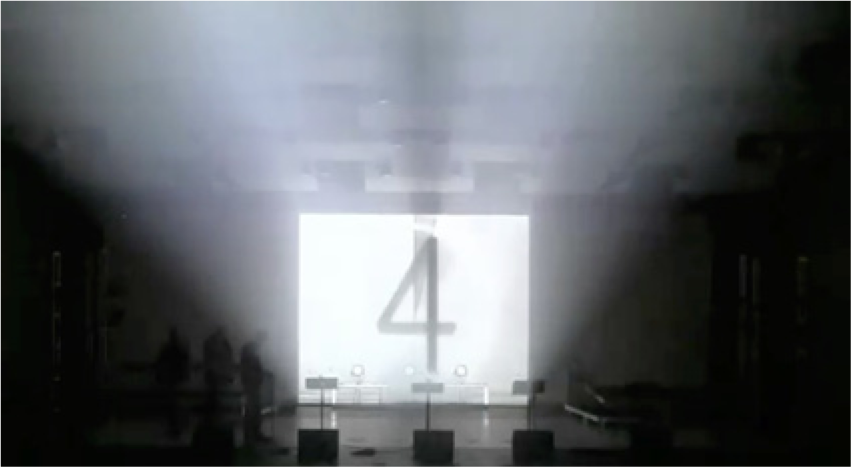
Beginning of a concert by the band Touch, April 2011.
The Story
Without many prior examples of tablet ensembles, David Williams (my colleague in music education at USF) and I, in Fall 2010, started the USF iPad ensemble Touch. Initially, the group included five members—two USF faculty composers, a USF faculty music theorist, and us. For 2 years, this version of the group performed at various campus functions and in the Tampa Bay region of Florida. There always seemed to be an undercurrent among the nonmusic education members that being a part of an iPad ensemble was not worth their time, or a “serious enough” musical pursuit to be included within a university school of music. As an assistant professor, new to the collegiate music education ranks, I began to doubt whether my involvement in the group was worth the time I invested each week. Thankfully, David had the vision and perseverance to realize that the group needed new membership to move forward. When the composers and theorist took a temporary leave of absence, three music education doctoral students joined the group. With this move, the ensemble began to gain momentum. The tone grew positive and generated more excitement. We “came together.”
From the beginning, I was prepared to play any role needed by the group. I had taught general music and band in the public schools of Michigan for 9 years prior to coming to USF. A guitarist most of my life, I also played keyboard in a Tampa Bay area praise band. So, I found the keyboard-like or guitar-like interface in the GarageBand iPad app familiar. As a public school teacher, I used to play the drum set at the end of the school day as a way of “winding down.” I have been musical all my life, so being musical with an iPad was not a stretch for me.
I had to adjust to the touch screen interface as far as response in musical time was concerned, and each app felt a little different. We worked on these and other issues within our practices. We shared apps. We experimented with the many different options of musical sounds as organized and actualized within the iPad’s virtually unlimited variety of interfaces. ThumbJam and GarageBand emerged as our preferred apps, facilitating the sounds needed for a variety of performances.
I remember thinking at that time about my stage image. What were iPadists supposed to look like? As no examples existed, I felt free to nurture my own vision of a tablet-based performing musician. Pictures of me from our first major performance at the USF School of Music shed light on what all of this looked like (see Figure 2). The picture, with the hot colors in the background, make what I am doing seem epic—more a product of the photographer’s work than my playing. You will notice that I am holding the device/instrument in my hand as I wanted to be mobile and able to move freely (Figure 3). I thought of my favorite guitarists over the past 50 years. Jimmy Paige of Led Zeppelin let his guitar hang low, as did Slash from Guns N’ Roses. Johnny Cash preferred his guitar to be located closer to his chest, as did John Lennon and Paul Simon. Buddy Holly and Chuck Berry could be classified somewhere in between these two groups. Sometimes during my iPad performances, I liked to turn my iPad so that the audience could see what the screen looked like, while I played it. I liked to think that people would recognize this as an element of my personal style.

The author in performance, April 2011.

The band Touch during a live performance.
Our performances received many positive reactions, but USF School of Music faculty members were quick to offer criticisms, an interesting fact considering many had never bothered to see a performance. People told us quite often that the iPad “cannot be just like a ______” In response, we simply said, “Yes, you are right. The iPad is not supposed to be a _______. It is something altogether different. And, that’s okay.” Negative perspectives seemed to center on the notion that traditional instruments had respectable, established literatures, and since the iPad lacked that, it had no place in a school of music. A university school of music, in their minds, was a place where the greatest artifacts of human musical achievement were to be performed—as if there was clear criterion for determining which achievements to include and which to leave out.
This argument seemed crazy, as I could imagine Bach and Mozart exploring what an iPad could do, musically, if they were alive in 2013. And, like the clarinet, trombone, and pipe organ, the iPad was a technology, invented to do a particular musical thing, at a particular point in time. It just so happened that the particular piece of technology I was using as an instrument could also send and receive e-mails, access my bank account, and check the score of the Tampa Bay Rays baseball game from the night before. Of course, there is legitimate room for caution and concern in embracing new technologies, and not everything new deserves a place in the curriculum. I was okay with what we were doing. I thought to myself, “The world is changing all of the time. Something else, something bigger and better will be created, and at that time I will be thinking of ways to use THAT in music teaching and learning settings.” The key was to be open to possibility.
Despite the reservations of nonmusic education colleagues in the School of Music, our group’s fame spread. Soon, we were playing for district music teacher start-of-the-year kick-offs. We were offered gigs at the Texas Music Educators Association state conference and the Technology in Music Education (TI:ME) national conference. A local Tampa Bay news anchorman presented a special segment on the group and joined us for a jam session. He was a guitarist, so he played a guitar-like interface within GarageBand (http://www.myfoxtampabay.com/video?clipId=8619068&autostart=true). He soloed over a harmonic progression that we provided. It was great! His enthusiasm was readily visible when the station aired the segment during a Saturday night news broadcast. I was stunned the following Tuesday, while working in a local Starbucks coffee shop, when a complete stranger came up and asked me if I was one of the members of the iPad band that was on the news on Saturday night. I was floored—what celebrities we had become!
Opportunity
At the end of a technology session during a Florida state conference, a middle school music teacher raised her hand. She then shared that her school district was purchasing iPads for all the district’s middle school students. This did not seem too out of the ordinary, as my previous school district had purchased mini-computers for all students Grades 6 through 8. Because the State of Florida would be paying for every student to have an iPad at this school district, my imagination soared at that the thought of every student being able to play music in an iPad ensemble. At that point, I realized my involvement with Touch could resonate widely within the profession.
As a music teacher in Michigan, I had the opportunity to teach preK–6 general music and 5–12 band. I noticed that not all of my “stars” in general music went on to be members of the school band. Some chose not to participate because their families were not supportive of band participation—it was not something that they did when they were a student (in 1970, 1980, or whenever). To some, membership in the band meant playing a lot of music that was not appealing. To others, playing in the band meant their parents would have to either rent-to-own or purchase an expensive instrument they could not financially afford. As the Florida music teacher shared—EVERY student in her school district would receive an iPad—that meant that EVERY student could participate in a band in a school music program. And, unlike the clarinet and the trombone—or even the guitar—the iPad could make many OTHER types of musical sounds rather than just one. Worlds collided—my previous world of being a music teacher and seeing what kept students from participating in school music and my current world as an iPadist. I caught a glimpse of available possibilities if music teachers were to remain open to new options.
Being an iPadist has given me the experience of learning to be musical in a way different from the ways of others in the world—to be a pioneer. When we started Touch, I was not aware of any other iPad bands. There were no “great master iPadists” currently in the world. Yes, Stanford had its iPhone orchestra and laptop ensembles existed to some extent, but I viewed these groups as cousins of what we were doing. We embraced freedom in our thinking. The iPad’s touch interface allowed for the manipulation of melodic and rhythmic materials in musical performance, just like the keys on a saxophone and the slide on a trombone. We recognized the iPad would not be “the big thing” forever. New technologies will be invented and will create musical performance and creativity possibilities not yet been imagined, but like other technologies these can build on the wants and needs of those currently involved in demonstrating the possibilities and desiring more. The process of doing something that few other people had done yet, was empowering for me. I found the process of engaging in a novel art empowering, and felt certain that similar experiences would also be empowering for music students in K–12 schools.
School music should be available for all rather than only those who can afford instruments, enjoy a specific music style, or want to identify themselves with a particular form of school music participation. Music should be available for all (Kratus, 2007; Thibeault, 2012; Williams, 2007), which is, of course, the spirit of general music. Results of a research study of students in grades four through twelve, suggest that students associate being a good musician with playing an instrument (Randles, 2011). It is possible that music teachers have yet to realize the types of instrumental music performance possibilities available, outside the current traditional “large instrumental-performance-from-notation-only” ensembles. Although iPads are expensive, they are essentially free for students when the school purchases them. Administrators, students, and parents often view technology use as positive. Secondary general music teachers would be keen to recognize the possibilities that new technologies might provide in music performance. Being an iPadist showed me new possibilities. When the imaginations of music teachers are sensitive to the possibilities that life serendipitously provides, anything is possible.
Footnotes
Declaration of Conflicting Interests
The author(s) declared no potential conflicts of interest with respect to the research, authorship, and/or publication of this article.
Funding
The author(s) received no financial support for the research, authorship, and/or publication of this article.