



Abstract
Folkloric music and dance in Bulgaria are performed as has been for generations, but also present are innovative hybrids in text, form, and instrumentation. Historically, traditional musical activities were divided by gender with singing a priority for women and playing instruments for men. This has been rapidly changing as in so many countries, and gender is no longer a hard and fast rule regarding specific means of music participation. This article will offer a brief description of particular musical traits from the different regions of the country, and it will then feature the score and teaching suggestions for a popular folk song and dance “Trâgnala Rumjana” that can be implemented in elementary and secondary general music classes.
Bulgaria (Figure 1) is a country with a rich and long musical history. Regional folk music is treasured throughout Bulgaria, as are the traditional dances that accompany many of the genres. Much of the folk canon is related to the work and life rituals of agrarian society. This article will offer a brief description of particular musical traits from the different areas of the country, and it will then feature the score and teaching suggestions for a popular folk song and dance “Trâgnala Rumjana” (TRUG-nah-lah Room-YAH-nah) that can be implemented in elementary and secondary general music classes.
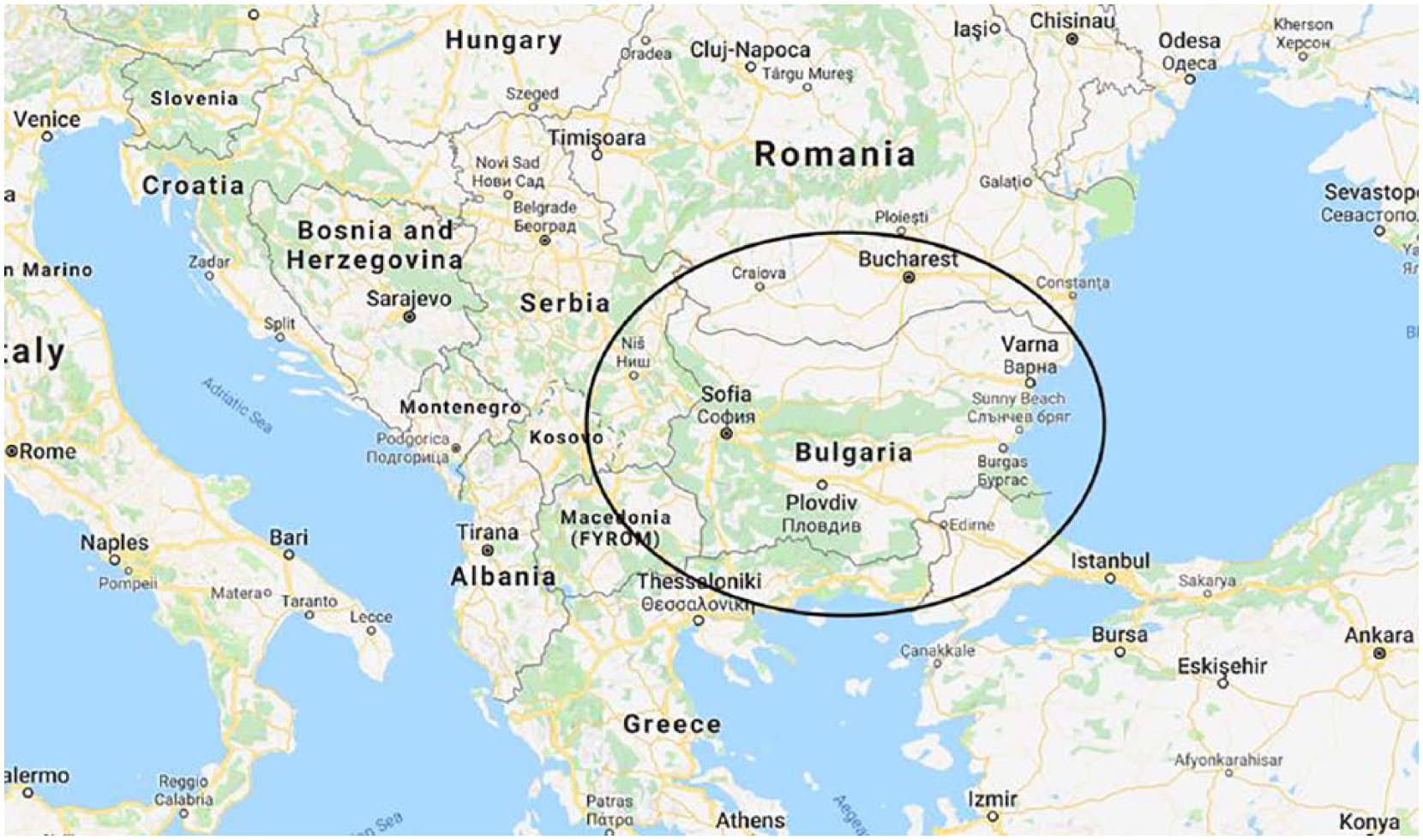
Map of Bulgaria.
Traditional Bulgarian Music
Folkloric music and dance are performed as has been for generations, but also present are innovative hybrids in text, form, and instrumentation. Kaufman and Peycheva (2004) described music making in Bulgaria as not only playing and singing but also “a manifestation of a worldview, of values, of social roles” (p. 38). Historically, traditional musical activities were divided by gender with singing a priority for women and playing instruments for men. This has been rapidly changing as in so many countries, and gender is no longer a hard and fast rule regarding specific means of music participation.
Common characteristics in traditional singing include the following:
Asymmetric rhythms (7/8, 9/8, 11/8, etc.)
Antiphonic performance—a sequence in which one singer or group sings a verse, and then another repeats it
A vocal drone supporting a melody
Vocal ornamentations particular to each region
These songs are typically organized by their association with rituals, work, or celebrations. Ritual songs are connected to religious holidays or seasonal celebrations related to certain times of year, and the milestones of life: birth, marriage, death. Work songs are connected to the many tasks related to harvest, and then the tasks of the home and community. The lyrics tell stories of history, battles, love, betrayal, and spiritual magic. Celebration songs are entwined with the arrival of a baby, the rites leading up to and including a wedding, and honoring one who died.
There are a variety of traditional instruments used throughout the country, and some singing traditions include accompaniment. These can include (Figure 2) the gajda (bagpipe), kaval (end-blown flute), and tambura (plucked or strummed string instrument) as well as gajdulka (string instrument played with a bow), accordion, and tupan (double-sided drum).
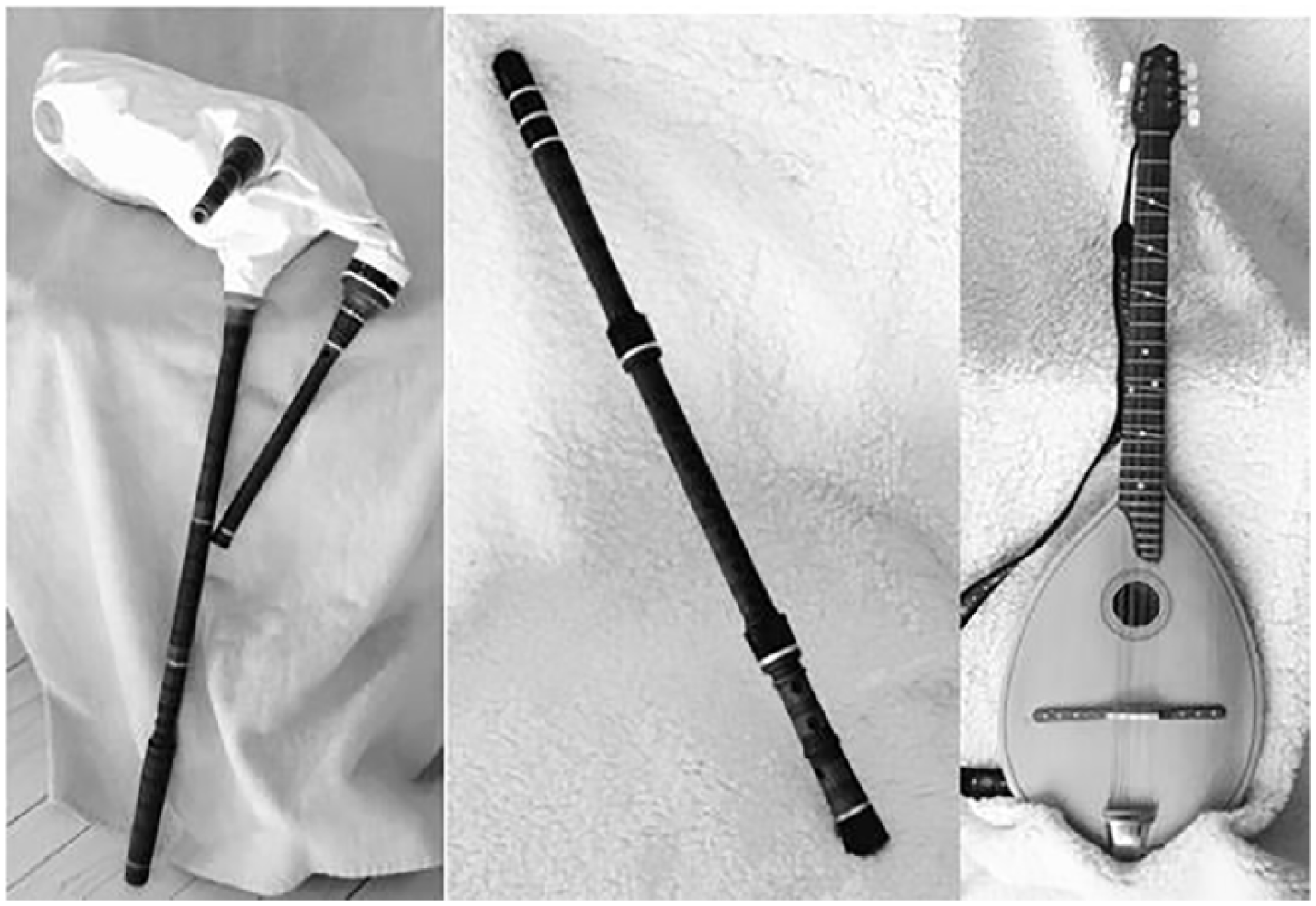
Traditional Bulgarian instruments: gajda (bagpipe), kaval (end-blown flute), and tambura (strummed or plucked string instrument).
Folkloric Regions
When studying the folkloric traditions of the country, there are six distinct regions each with its own unique flavor: Sofia (the capitol city area), the Northern area, Dobrudja, Thrace, Pirin, and the Rhodopes. Each of these has subregions with their own specific musical traits. At the same time, there is much influence present from the traditions of Turks, Greeks, Hungarians, Romanians, Moldavians, Ukrainians, and Serbs. Additionally, the presence of technology has opened possibilities for performance as it has everywhere with the Internet. Music educators value the access and variety that come with mass media, while simultaneously working to preserve older traditions.
The songs from the Sofia region are recognized for their bold personality and dissonant harmonies. Sofia has maintained the historical form of its traditional music, unlike other regions that were heavily influenced by Turkish and other cultures. The dissonance in the songs presents via a drone close to one or two other melodies. The drone may move back and forth between the two melodies leading to sustained seconds and other tense intervals that then resolve beautifully. The voices are intended to sound as if one person is on each part. If it is a unison melody, the singers aim to blend to sound as one voice rather than a blended choir.
The Northern region includes songs and instrumental music with special emphasis on brass bands. Dobrudja is located in the northeast and features songs shared between men and women showing strong influence from Greek and Turkish traditions. Songs from Thrace, the largest region, are considered to be the pearl of Bulgarian singing tradition including highly ornamented slow songs for celebrations and banquets. Thracian songs are soloistic with popular dance traditions to accompany including the pravo (Ilieva, 1977). Another popular dance genre from this region is Kopanitsa, featuring traditional instruments such as the kaval and gajda.
The region of Pirin includes more percussion than others. Tamburas are also commonly played. In the Rhodopes, there are Christian and Muslim musical traditions apparent in costuming and musical forms. A Muslim song would be in two parts while a Christian song would likely be in unison and feature the gajda. Also unique to each region are the costumes and embroidery patterns shown in traditional performances such as by members of the Ethnic Dance Theater of Minneapolis, Minnesota (Figure 3).
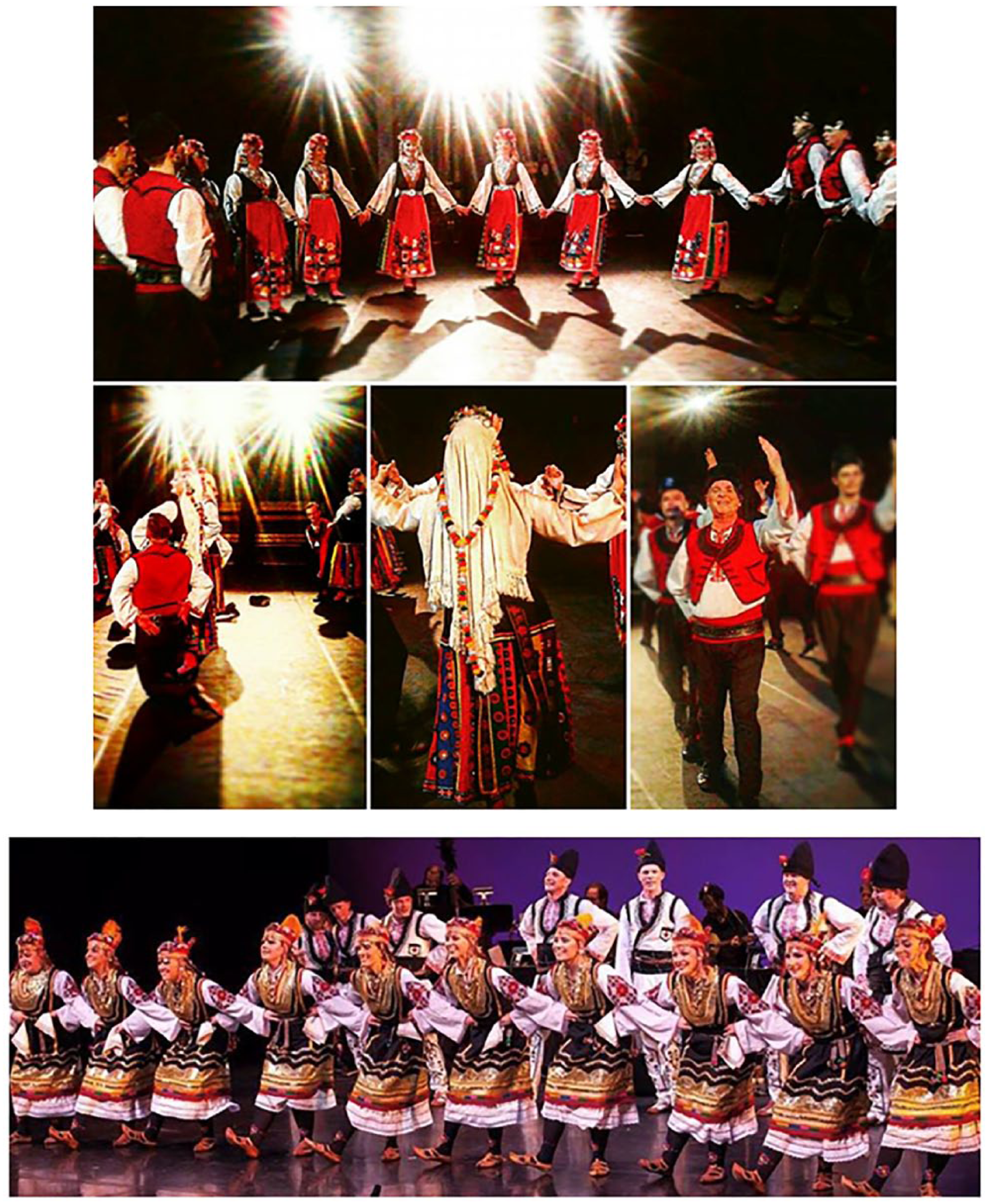
The Ethnic Dance Theater of Minneapolis, Minnesota, performing traditional Bulgarian dances.

“Trâgnala Rumjana.”
“Trâgnala Rumjana”
“Trâgnala Rumjana” is a Bulgarian folk dance and song in 7/8 known in many variants and also found in neighboring Macedonia and Serbia. The version of the dance included here is commonly found in the Rhodopes and Dobrudja regions, even appearing in the physical education curricula in Bulgarian elementary schools. This version was taught widely outside of Bulgaria by folk dance teacher Dick Crum after he learned it from a member of the Koutev Bulgarian State Folk Ensemble.
There are many available options for learning the pronunciation rules for Bulgarian (as well as other languages). Bulgarian is in the Cyrillic alphabet, but it is regularly transliterated using the Roman alphabet. A reliable option for working on the pronunciation can be found here: www.omniglot.com/writing/bulgarian.htm
Measure 1: Facing slightly right, step on the R foot to the R Continuing to the R, step on L foot crossing in front of R foot
Measure 2: Facing center, step R foot sideways to R Step on L foot crossing behind R foot
Measure 3: Still facing center, step on R foot sideways to R Touch L foot in front of R foot. A more traditional style is to slightly lift the foot off the ground in front of the other foot.
Measure 4: Repeat measure 3 on the L foot to the L side.
Possible Uses
Elementary General Music
Elementary general music teachers may consider
that the melody lends itself to solfège work. Use one of the melodies to start. Students can sing from hand signs, letter notation, staff notation, or a combination. Then move to the second melody. If you are able, lead two groups with just hand signs. This takes practice but is a great aural skill builder for teachers, and then students.
that elementary students might or might not read in 7/8, but there are no advanced rhythms in “Trâgnala Rumjana.” Most of the groupings are likely familiar to a fourth- or fifth-grade student. Work with the different rhythm combinations in 3 + 2 + 2, or 2 + 2 + 3. Emphasize the dotted quarter, quarter, quarter that underlies the tune.
creating an arrangement of the tune using classroom instruments (recorders, xylophones)
learning the dance. It is possible for children to learn this dance with minimal or even no teacher talk. Children and adults often perceive this piece in 4 when dancing. It is a great discovery to unpack the meter after and in fact discover that they were dancing in an uneven meter.
performing the original dance and then creating new choreography.
Secondary General Music
In addition to any of the steps included in the elementary general music list, secondary general music students in different types of music classes might
perform the instrumental section on guitars, ukuleles, or in a jazz combo adding harmonies if able.
explore further the possibilities of 7/8 in a percussion unit.
compose variations on the instrumental melody.
perform the piece in a completely different style (e.g., reggae, rock, hip-hop)
Suggested Resources for Bulgarian Vocal Music
The Bulgarian State Women’s Choir (also known as Le Mystère des Voix Bulgares) performs contemporary arrangements of Bulgarian folk genres from across the regions. A recent example: https://youtu.be/AFgzzWT3zX4
Kitka. www.kitka.org
Cradle songs: www.kitka.org/shop/cradle-songs-songbook
Wintersongs: www.kitka.org/shop/wintersongs-cd-songbook-bundle
Koutev Bulgarian National Ensemble recordings
Patty Cuyler & Mollie Stone (Eds.). Raising the bar: Bulgarian folk songs. The Choral Imperative. www.thechoralimperative.com/products/raising-the-bar-bulgarian-folk-songs
Footnotes
Declaration of Conflicting Interests
The authors declared no potential conflicts of interest with respect to the research, authorship, and/or publication of this article.
Funding
The author(s) received no financial support for the research, authorship, and/or publication of this article.