



Abstract
In this second of three in the series, we explore methods for incorporating instrumental ensembles into your music classroom. Experiences such as performing on ukulele, bucket drums, and in modern popular music ensembles are excellent ways to provide meaningful, relevant music education to students of all ages. Using both research-based information and practical experience, we will discuss ideas for three common instrumental ensembles. The techniques and resources provided in this article are starting points, appropriate for various levels and configurations of music classes: upper elementary music classes, secondary general music classes, afterschool or extracurricular music groups, or for teachers seeking to start an alternative ensemble or rebrand an existing nonperformance music class.
Historically, music education in the United States has centered on a traditional curriculum focused on music literacy and performance (Moore, 2017). From the singing schools of 18th-century America to the jazz ensembles that proliferated in public school music from the 1950s (Humphreys, 1995), music education has attempted to react (albeit slowly) to the changing landscape of music practice. Now, in the 21st century, teachers are seeking ways to transcend a somnambulant reliance on the standard curriculum to include meaningful, culturally relevant music making into their classrooms. Music styles and practice continue to evolve, and teachers who wish to teach “music for every child” (Gehrkens, 1933, p. 31) must evolve with them, reaching across the ever-troubling chasm between school music and the music kids hear every day (Kratus, 2007). Experiences such as playing bucket drums, ukulele, and in popular music (“modern band”) ensembles are excellent ways to provide students with satisfying music-making opportunities that approximate the vernacular music styles students enjoy. This article provides an overview and some basic starting points for teachers interested in introducing these ensembles to their students.
Bucket Drumming
The act of drumming—simple, elemental, powerful—can be a way to meaningful music making for humans of all ages and levels of expertise. Just as movement activities can help students refine their music skills, group drumming has been shown to reduce anxiety and depression (Fancourt et al., 2016). For many music teachers, bucket drumming is an exciting way to facilitate this enjoyable music-making experience. Buckets are inexpensive (and sometimes freely donated), durable, and can be used to make a variety of pleasing sounds. Stack them up at the end of the day and they are easily organized and stored (try drilling a small hole in the head of each to avoid the dreaded suctioning together of stacked buckets). Teachers may also want to remove the bucket handles. To prevent breakage, duct tape can be applied to the bucket heads and wrapped around sticks.
Traditionally played using a street style or rote-teaching approach in homage to its original roots, the basic equipment is a five-gallon bucket and a pair of drumsticks for each student. However, the instrumentarium can be expanded to include other items such as empty water cooler jugs, large plastic trash cans, and attachable drumheads (see Rhythm Pal Drumheads and Rhythm Lid Snare Clip by Remo®). Some teachers have found that chopsticks or light dowel rods make an acceptable substitute for drumsticks, though they lack the satisfying weight of real drumsticks (we suggest at least playing with the backs of the sticks). Chopsticks can be found inexpensively online, such as one seller on Amazon offering 200 chopsticks for $7. One suggestion would be for students to “earn” their real drumsticks through behavioral and/or music goals as appropriate for the situation. Kids tempted to bang indiscriminately instead of playing music may begin to respond to directions when real sticks are up for grabs! Teachers may want to start each new piece using the chopsticks so that everyone can hear the music and rhythms, then transition to sticks as the students settle in. Chopsticks are also a good option for teachers with noise-sensitive neighboring classrooms or on quieter testing days. Other ideas for quieting the buckets include covering the heads with a towel, sprayable foam, gluing on mouse pads, or attaching shelf-liner material. Beach balls can be inserted inside the buckets and drummed on for nearly silent practice.
Players can access three basic sound locations on most buckets: the head (bottom of the bucket), side, and rim, in addition to the sound of the sticks clicking together. Demonstrate the basic sounds and practice moving around the locations, as with these exercises (Figure 1).
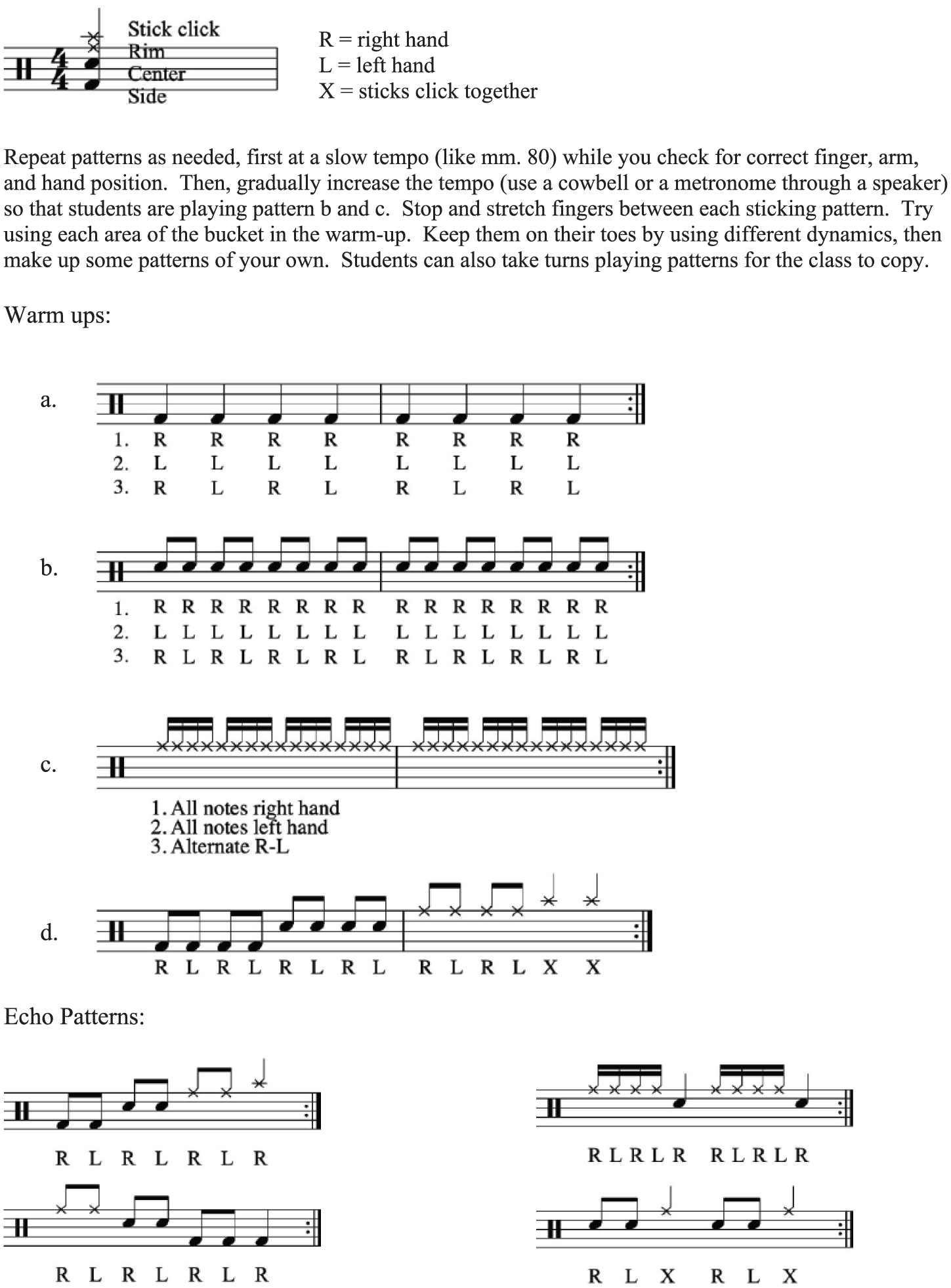
Bucket drumming warm-ups.
Once students are comfortable with how to play the buckets, numerous play-along videos are available on YouTube, provided you have a sound system capable of being heard over the instruments. Many of the best come from Sammy Foster’s BucketDrumming.net site, such as this great introductory video, “5 Basic Rhythms EVERYONE Should Know,” easily searchable on YouTube, with sheet music available on his site. Other fun play-alongs (links can be found in Table 1):
“Cha Cha Slide Bucket Drum with Music Notation” from santaritagym on YouTube
Uptown Funk Elementary Bucket Drum Follow Along by santaritagym on YouTube
Internet Links for Bucket Drumming Resources.
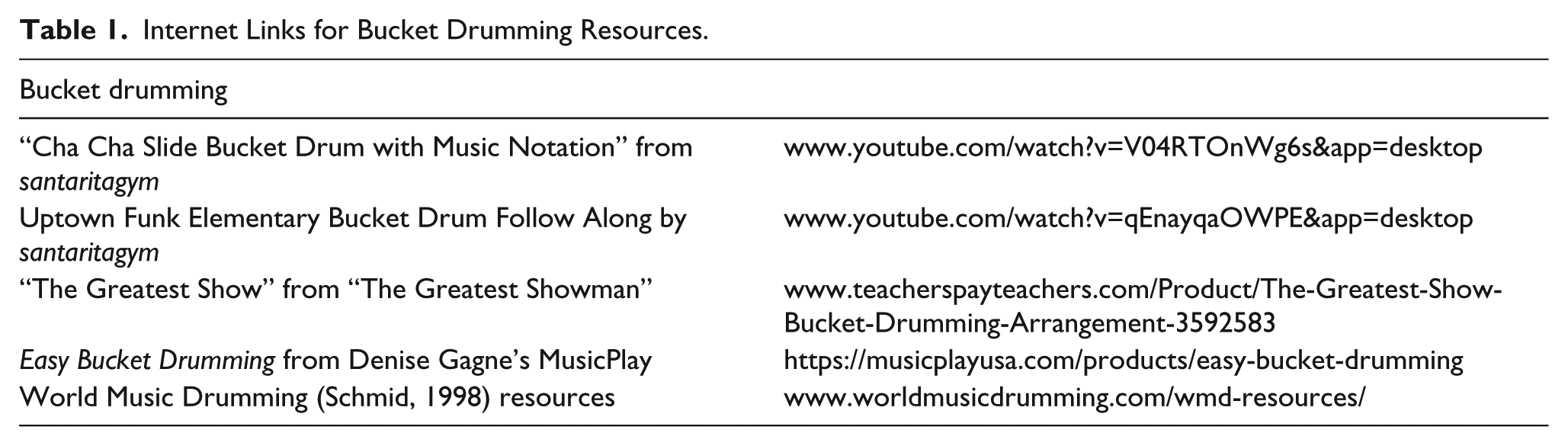
Drumming resources abound; once students are comfortable with playing the buckets, the sky is the limit! Bucket drumming can offer a fun alternative to clapping rhythm patterns from notation, motivating students to progress through more complex rhythms. “Bucket Drumming with Coach K” has playing and teaching demonstration videos on YouTube, with repertoire and curriculum materials available for purchase through www.bucketdrumming101.com. Other resources are available commercially through TeachersPayTeachers such as a bucket arrangement of “The Greatest Show” from “The Greatest Showman,” or through traditional publishers, such as Artie Almeida’s Kidstix: Rockin’ Repertoire for Rhythm Readiness, Give Me a Bucket, Grades 4-8: A Rockin’ Collection for Bucket Ensemble by Mark Shelton, and Easy Bucket Drumming from Denise Gagne’s MusicPlay resources. Some teachers enjoy using the World Music Drumming (Schmid, 1998) resources with the buckets or teaching basic drum set patterns to play along with current hits. Bucket drums can also peacefully coexist with others in the classroom, used to accompany singing or rapping activities or combine with other classroom percussion and Orff instruments.
To acquire buckets without a huge financial investment, we suggest seeking donations from local stores such as Lowe’s or Home Depot. Although some teachers have had success with merely walking in and asking a cashier for buckets, others suggest writing a letter on school letterhead and approaching the store manager. If stores do donate, thank them publicly on social media, school websites and newsletters, and through announcements to parents and the community. If donations are not available, try asking in the school cafeteria kitchen: much institutionally provided food comes in plastic buckets!
Ukulele
Another instrument that is currently popular in the general music classroom is the ukulele. The ukulele is a fun, easy-to-play instrument which can help motivate and excite students of all ages. Unlike other instruments you may use in your classroom, ukuleles are seen and heard in music outside of school. Students may be familiar with players such as Jake Shimabukuro and Israel Kamakawiwoʻole or their music or have heard the ukulele in songs such as “I’m Yours” by Jason Mraz and “Riptide” by Vance Joy. The ukulele adapts well to many styles of music (Fox, 2014) and these connections to music outside of school help the ukulele’s reputation with today’s students. In addition, the uke is perfect for kids due to its size and finger-friendly nylon strings, and is a fantastic gateway to learning the guitar.
For general music teachers, the ukulele is a natural fit. Though it can be played as a melodic instrument, it is also well-suited for playing chords and singing simultaneously. The open strings are pitched in an appropriate range for children’s voices and the fingerings for playing commonly used chords (I, ii, IV, V, vi) in the keys of C, F, and G major are uncomplicated. Best of all, ukuleles can be played almost immediately with no prior experience. Even young students can quickly play an initial chord, learn to strum, and accompany themselves when singing, all with a minimum of teacher instruction. Ukuleles are lightweight, portable, travel easily, and generate a quieter volume of sound than many other classroom instruments (making them a good choice in densely populated classroom areas). Perhaps most importantly, the ukulele is affordable (Greenberg, 1992). Available for as little as $30, starter ukuleles can be purchased by families and kept at home for more consistent practice. For schools, sturdy instruments can still be purchased at a reasonable price; even enough for half of a class can be a good start. A good-quality instrument (coming in at a higher price point) can withstand years of use. Many teachers suggest labeling the ukes, such as with numbers, letters, or even names (such as famous musicians). Each student can be assigned a specific ukulele to use each time, helping you track the wear and tear on the instrument and other issues.
Soprano ukuleles are recommended for younger children, while teachers who work in middle school may want to purchase the larger concert ukes. For mixed age groups, soprano ukuleles are a fine choice—though small, they are frequently played by adults as well as children. Some teachers prefer to use a concert-sized uke for themselves so that they can project better in front of the class. Though it is possible to play the ukulele left-handed, by reversing the order of the strings, it may be easier with shared classroom instruments when all students play the instrument in the conventional way. We merely remind the left-handed students how good they will be at fingering chords with their agile left hands! Students should play in a seated position for greater security, though teachers may want to use a neck strap for mobility around the room. Though frowned upon by some ukulele experts, a peg can be added at the bottom of the instrument to allow for a more secure neck strap than the clip-on variety. We also suggest that the ukuleles be tuned by the teacher, particularly at the elementary school level, though we acknowledge that this can be tedious and time consuming. Eventually, some older students can be taught to help you tune the instruments in the mornings or at lunch. Middle and high school students may feel comfortable learning to tune after a few months of playing. Clip-on vibration tuners like SNARK tuners can make quick tuning in a noisy room easier.
To begin, prepare students by setting up some prestrumming activities common to many general music lessons: patsching with hands together and hands alternating, patsching with only the right hand while holding the left hand still, or perhaps even trying some “air strumming.” Strumming can also be practiced by holding the strings mute with the left hand and strumming with the right. Though the ukulele is traditionally strummed with first finger or thumb, others prefer a felt pick to avoid wear on students’ skin. Felt picks can be washed and reused as needed. If you do choose to have students use picks, be prepared to replace lost picks frequently or extricate them from inside the instrument. We suggest asking students to strum with fingers until the end of class, when you can assist them in retrieving dropped picks.
Early ukulele activities usually start with the “C” chord, played by fingering the A string in the third fret. We like to mark a few basic chords (such as C, F, and G or G7) using a dot sticker or paint pen—colors can be chosen to correspond with Boomwhackers™ or other systems of your choice. Other chords can be easily located from these landmarks. (Just make sure students understand that they do not need to put their fingers exactly on the dots, but merely in the marked box between the fret bars.) This can greatly increase learning speed, and we find that students eventually stop looking for the dots as they grow more comfortable (Figure 2).
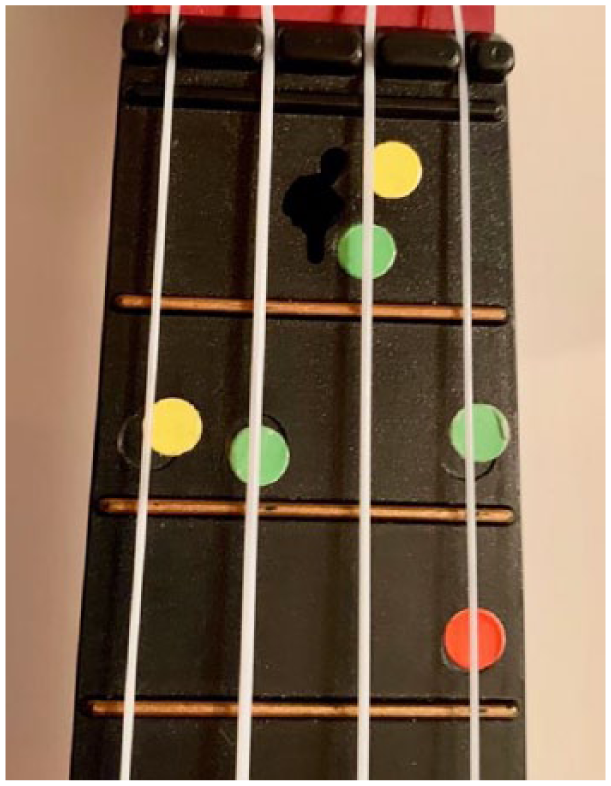
Ukulele with dots indicating the chords C (in red), F (in yellow) and G7 (in green).
Students can practice strumming their first chord with echo activities and call-and-response with the teacher using improvised patterns, before proceeding to one-chord songs. Children’s songs such as “Where is Thumbkin?” “Are You Sleeping?” “The Farmer in the Dell,” and “Fire’s Burning” can be used to practice both strumming and singing. Try dividing the class into players and singers before inviting students to try doing both. YouTube play-along videos are available for these initial songs as well, adding some harmonic and rhythmic accompaniment. When you are ready for a fun jam, try “Lime in the Coconut,” by Harry Nilsson, with or without a play-along video: it is usually played with the C7 chord but sounds fine with the C chord as well.
Students will need frequent breaks, particularly in initial classes, to relax wrists, hands, and fingers. Have students shake their hands out periodically and massage their fingers. If you have students working in pairs (which many teachers do if they have more students than instruments), students can trade instruments and take a rest while helping their partner when needed. We also encourage teachers to determine a “rest position,” such as holding the ukes in a strings-down position on laps, for when quiet listening is needed.
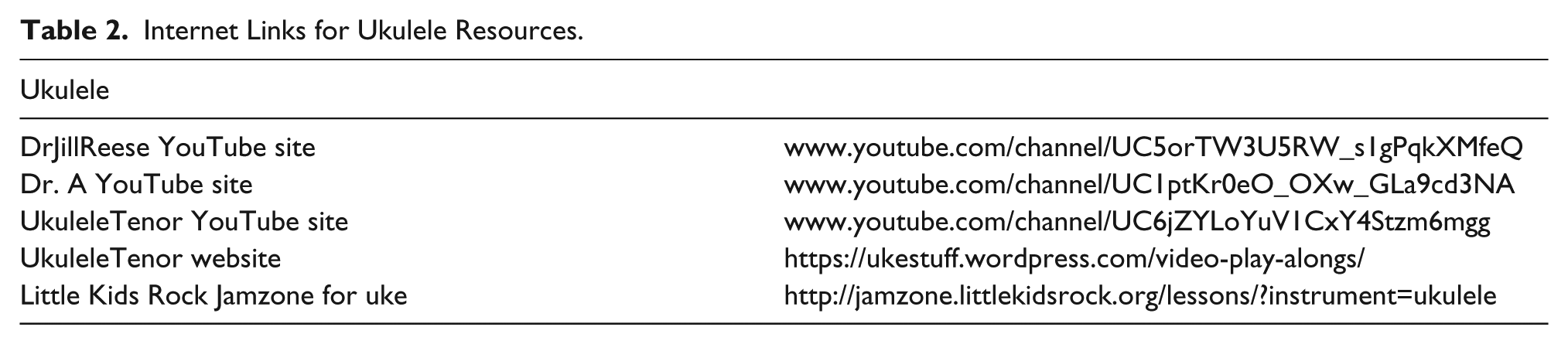
As the students progress, additional chords can be introduced. After the C and C7 chord, the F chord is typically next, followed by D minor, G, A minor, and E minor. G can be difficult for beginners, using three fingers, as can E minor. Luckily, several songs can be played with primarily C and F chords, while students refine their skills on the more difficult chords. Using the excellent play-along videos on YouTube by DrJillReese, Dr. A, UkuleleTenor, and others, students can jam along using chords they know. Best Day of My Life, Don’t Worry, Be Happy, and Dance the Night Away can all be played using C, F, and D minor (see Table 2). Once students have acquired the G chord and can play C, G, Am, F they can play a staggering number of “four-chord songs” (I, V, vi, IV) in a wide variety of popular genres. Try using UkuleleTenor’s website to look up songs by chords or key or view lessons and charts from Little Kids Rock.
Internet Links for Ukulele Resources.
Many students do struggle to switch chords, of course, even basic chords like C to F. To help students tackle initial chord changing struggles, try these ideas: make a game of lifting the fingers slightly off the strings, quickly stretching the fingers, and placing them back on the same chord to solidify the muscle memory needed to learn a new chord shape. Try practicing chord changes without any strumming; students can sing the chord roots and letter names. Giebelhausen (2016) suggests trying “air-strumming” while practicing chord changes; you can help by playing the chords so the students can hear them. Then, use drills with an easy strum, maybe just downstrokes on the beat, while counting down to a chord change. Try using four measures at a moderately slow tempo and count students into a chord change: “F chord, one, two, ready, go.” Then decrease the time to eight beats between chords, four beats, two beats, until students can switch quickly. Encourage them to place all needed fingers at the same time if possible, rather than placing fingers one at a time. When students first attempt changing chords within a song, many are more successful playing the chord only on the first beat of the measure and taking the other beats to change. More complex strumming can be added as students feel ready: strumming on all downbeats, strumming down-up on eighth notes, and using strumming patterns appropriate to the song. Differentiate by allowing students to select the strum difficulty level that feels right for them and allow plenty of time for self-correction of mistakes without interference. To keep making music while students are still practicing chord changing, try splitting the class into groups and having each play a chord. Students who feel ready to play more chords can do so, while others play only the designated chord.
However you address changing chords, it is important to keep activities as low stress as possible. We suggest a participatory approach, in which students are allowed to make mistakes in the pursuit of learning without being singled out or micromanaged. Devote class time to playing together in a group setting, allowing students to develop their skills naturally by listening, watching, and practicing. A rehearsal-type approach, with attention to small details, is usually not necessary and can affect many students’ joy of playing. You will find that many issues will correct themselves over time and that others can be addressed through careful selection of materials and group activities.
Numerous materials are available for classroom ukulele. Besides the fun and motivating play-along videos, methods like Uke Can Do It!: Developing Your School Ukulele Program, Vol. 1 and 2 (Tamberino, 2014) are an excellent resource, as is the free e-book Ukulele for Music Teachers by Robin Giebelhausen on Apple Books in iTunes, and Rainbow Ukulele, available on TeachersPayTeachers.com. These are only a few of the available resources for ukulele available on the Internet:
ukutabs.com/ and ukulele-tabs.com/ offer chord charts for songs and allow users to change the key for playability;
www.nafme.org/ukulele-todays-music-classroom/ and www.nafme.org/all-uke-can-do-enhancing-general-music-through-the-ukulele/ are excellent articles on using ukulele in the classroom;
www.hooktheory.com/trends# can help you find songs that share certain chord progressions;
www.ukefarm.com/chordette is an paid app which supplies ukulele chord fonts which you can copy into documents; and
Backing tracks such as www.youtube.com/watch?v=O4L8kjE2SSc allow students to practice improvising.
Modern Band
Particularly for older students, there may be no ensemble more meaningful and motivating than the modern popular music ensemble. Young people connect to popular music as a means of expressing their identities and shaping their social experience (Hebert & Campbell, 2000). “Popular music” can be difficult to define but can be understood to include a variety of contemporary genres with mass appeal (Humphreys, 2004). To circumvent the differing shades of interpretation surrounding the word “popular,” the term “modern band,” was designed to transcend genre and includes groupings of instruments such as electric guitar, electric bass, keyboard, drum set, computer and other technology, and vocals (Randles, 2018; Smith, Gramm, & Wagner, 2018). By providing opportunities for students to learn these contemporary instruments, modern band allows students to participate authentically in the kind of music they hear in their daily lives (Byo, 2017). In one community, a modern band ensemble might look like students forming small pop bands coached by their teacher; in other areas, modern band might look more like rap groups, cumbia music, or country bands. Although popular music has been a recommended facet of music education since the Tanglewood Declaration of 1968 (Choate, 1968), participatory modern band ensembles are not yet the norm in most school districts in the United States, though popular music is quite prominent in school music education internationally (Lee, 2004). Still, K–12 popular music education is a growing movement in the United States, due in part to efforts of nonprofit organizations like Little Kids Rock, a charity that helps school establish modern band programs through training workshops and instrument grants (Powell, Krikun, & Pignato, 2015). For the first time in 2019, the National Association for Music Education (NAfME) will feature a Modern Band ensemble as part of its All-National Honor Ensembles (NAfME, 2019), and professional organizations and journals such as the Association for Popular Music Education, the Journal of Popular Music Education, and NAfME’s Popular Music Education Special Interest Research Group are available to provide support and resources for teachers of modern band (Weiss, Abeles, & Powell, 2017).
Acquiring instruments for use in the modern band ensemble is one of the greatest challenges to initiating popular music education programs. Grants for teachers and school districts can be requested from sources such as Little Kids Rock, The Traveling Guitar Foundation (2018), and regional organizations like Nashville’s Music Makes Us (“Music Makes Us,” 2018), as well as educational grants like DonorsChoose.org. Enterprising teachers might also request instrument donations from parents, local music stores, parent-teacher organizations, or seek inexpensive used instruments on Craigslist.org or other resale and swap sources. Even a few instruments can be enough to begin, and ensembles can be filled out using bucket drums, ukuleles, Orff percussion, and other classroom instruments. Also consider activities such as karaoke, songwriting units, rap writing and freestyle, body drum set, and using printed (and perhaps laminated) fretboards and keyboards to begin hand and finger positioning as well as finding notes and chord shapes.
Initial experiences in modern band should be participatory, low stress, and above all, fun! Engage students with initial experiences on as many instruments as possible: in many successful classrooms that means rotating units on guitar, electric bass, drums, and vocals, as well as technology such as iPads. After these starter units, students can select their favorite instruments to play in full-class sessions with teachers guiding students in breaking down popular songs into different instrument parts. When students feel ready, try having them begin forming bands in small groups with classmates. Students can work their way through different challenges such as selecting and “covering” (copying) a familiar song using aural means and/or charts provided by teachers and creating original songs with the support of songwriting units, culminating in school and community performances.
We recommend using resources and curricula such as those from Little Kids Rock to create meaningful music-making experiences from day 1. Basic skills should be scaffolded for initial success. On guitar, one of the most challenging modern band instruments, this means showing beginners one-finger options for standard chords: the G chord can be simplified by playing only the 6th string on the 3rd box (between the 2nd and 3rd fret bar) and strumming only the top three strings. Similarly, the C chord can be simplified by playing the 5th string in the first box and strumming the top three strings. E minor can be played with the top three smallest, highest open strings. (We recommend using a sponge or paper towel under the lower strings to mute them during this stage, particularly for younger students.) Students who already have experienced playing ukulele will notice similar shapes on the guitar, sounding a perfect 4th lower. Encourage students who may already know the full chord shapes to play them, each student working at their own pace (Figure 3).

Beginner guitar chords.
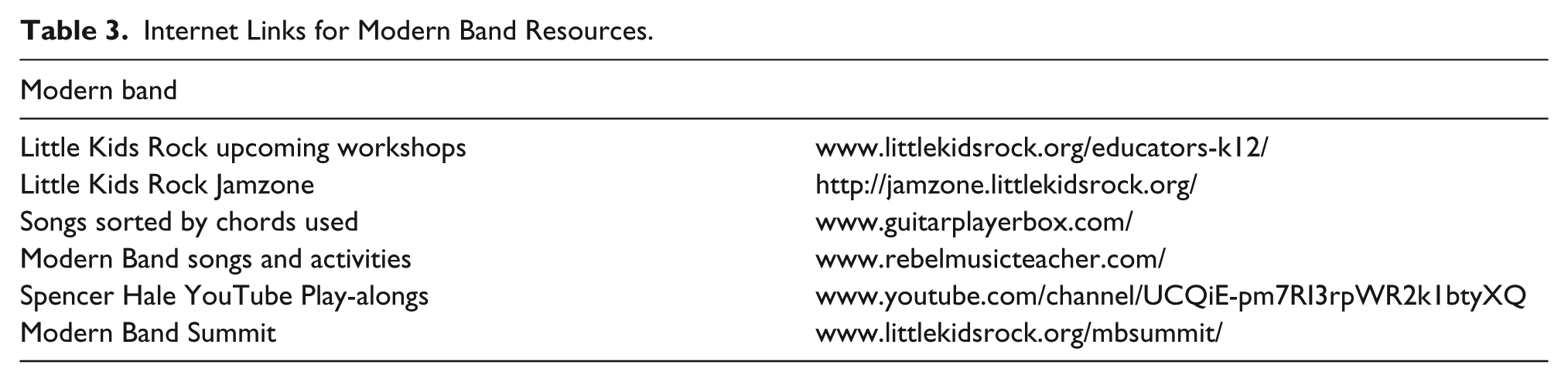
In addition to guitars, expose students to other modern band instruments such as electric bass, keyboards, and drum set. Do not have enough bass guitars? Students can practice bass using the bottom four strings of a guitar. Drum set can be practiced using the body for initial experiences in two- and three-way coordination. Try tapping your left shoulder for hi-hat quarter notes, your right knee on Beats 2 and 4, and tapping your right foot on Beats 1 and 3. That is a basic backbeat! If students struggle with coordinating all the limbs necessary for playing drum set parts, try splitting the part between several students. One student could play the hi-hat, for example, while another could keep a steady beat on the bass drum and a third could play the snare drum on Beats 2 and 4. Keyboard and bass players can begin by locating the root notes of chords on their instruments (it is okay to use note-name stickers here too, just like on ukulele and guitar), and students can progress from playing only on the first beat of measures to more complex rhythm patterns as they feel comfortable. The Little Kids Rock Jamzone (see Table 3) features lessons and resources to help beginner and intermediate students (and teachers) gain skills on playing basslines, drumming the backbeat, and “comping” on all the instruments.
Internet Links for Modern Band Resources.
Just as with ukulele, try using one-chord songs to help students acclimate to the instruments and practice strumming and comping patterns. Songs like Baby Shark, Lime in the Coconut, Shake Your Body, We Will Rock You, Lowrider, and Land of 1000 Dances, as well as others that can pass as one-chord songs, like Electric Avenue, Budapest, and I Want Candy, can provide fun play-along opportunities for beginners on all instruments. As students add more chords, be creative with helping students find their just-right level of difficulty: perhaps singing and playing only one chord of a song when it comes around while using a play-along track, playing only root notes on instruments, and having several students playing drum set. Try splitting students into groups, each playing one chord of a three- or four-chord song—simply making music is the goal! We strongly recommend letting students have agency in choosing the instruments and repertoire they play: motivation is highest when students are playing music that is valuable and familiar to them.
Not sure how to start? Try allowing students to view the huge number of songs available on the Little Kids Rock Jamzone and write down the top three songs they are interested in learning. The class can help narrow down the list, or you can allow students to break into friendship groups to work independently on songs of their choice. Both full-class jam sessions and small group work are important aspects of successful modern band programs. To sort songs by the chords students know, visit www.guitarplayerbox.com/ and check out www.rebelmusicteacher.com/ for song and activity ideas.
We recommend using informal and nonformal learning practices to create an authentic popular music learning environment, favoring “facilitation over direct instruction” (Cremata, 2017; Smith et al., 2018, p. 12). This essentially means letting students acquire music knowledge by using hands-on, trial-and-error means, emphasizing aural learning and discovery, approximating the music they hear rather than insisting on a strict adherence to detail, and allowing for ambiguity and mistake making (for a more in-depth discussion of using informal learning in the music classroom, see Green, 2008 and Hewitt, 2018 among others). Consider rethinking what is meant by music literacy: chord symbols, tablature, charts, and lead sheets are not crutches, but legitimate notation used by multitudes of musicians in music genres worldwide. These forms of symbolizing music can exist side-by-side with more traditional staff notation when the goal is a meaningful music experience for students.
Resources for modern band ensembles are plentiful. The Little Kids Rock Jamzone contains song charts, breakdowns of current songs, play-along videos, instrumental lessons, and a Teacher Zone full of lesson plans and other resources. Guitar, bass, and ukulele tabs can be found on ultimateguitar.com, and tutorial and play-along videos abound on YouTube, like the excellent guitar videos from Spencer Hale. Although older students can benefit greatly from watching tutorial videos and play-along videos on their own, in independent learning centers or at home for a flipped classroom model, younger children do better with a live teacher. For best results, consider watching and playing through the tutorials yourself, particularly for instruments more out of your comfort zone, and then presenting the lessons to the students.
Other helpful resources include software for slowing down the tempo of songs and changing the key to improve playability of chords or to better suit children’s vocal ranges, such as SeeSaw®, or AnyTune®. YouTube allows you to slow down tempo and keep original pitches for easier play-alongs. Many teachers swear by The Amazing Slow Downer® ($10) app, which allows you to slow down, loop, and change keys of songs, including those on streaming services like Spotify, as well as the app Audacity®. For professional development instruction, look for workshops at the NAfME national conferences, your state music educators’ associations, Little Kids Rock workshops in your area, or attend the Modern Band Summit, held every summer in Fort Collins, Colorado. These hands-on opportunities to learn and network with other teachers can be invaluable to the continued success of your program.
Coda
This power trio of ensemble types can be effective ways to increase student motivation and make music class a meaningful, participatory experience. To expand outward from lessons during the school day, we recommend trying before- or after-school clubs or open jam times to further accommodate interested students. Musicians are motivated by having a performance goal to work toward, so look for ways to showcase your students’ accomplishments, like PTO events, assemblies, pep rallies, or ask a local coffee shop or other hangout to allow students to play. Reach out to parents, classroom teachers, and school administrators for maximum buy-in; invite them to sit in with your group, attend beginner classes, or have informance-type concerts in which students teach their parents a few notes or chords and play together. Find out your principal’s favorite song or band and surprise them on their birthday or other special day. Collaborate with other music teachers in your district by seeking ways to combine your ensembles with the bands, choirs, and orchestras for concerts and other special community events. By showing our students how music can be a regular part of their lives, both in and out of school, we can continue to work toward the original goal of music education in the United States: “Music for every child; every child for music” (Gehrkens, 1933, p. 31).
Footnotes
Declaration of Conflicting Interests
The author(s) declared no potential conflicts of interest with respect to the research, authorship, and/or publication of this article.
Funding
The author(s) received no financial support for the research, authorship, and/or publication of this article.