




Abstract
For the greater part of the past 50 years, music educators have advocated for contemporary approaches to music education that reflect the interests of students. This has recently manifested in an approach to music education that scholars call Modern Band. Though the term lacks any one definition, Modern Band classes typically involve popular music making with guitars, drum set, electric bass, and keyboard. Among the features of this approach is a student-centered orientation that is focused on the individual learner. Additionally, Modern Band is rooted in informal music-learning theory, which easily lends itself to the inclusive principles of universal design for learning and differentiated instruction. Because of this, Modern Band may be a perfect fit for inclusive music classrooms.
Modern Band is an approach for popular music education that has recently gained prominence. Though the term lacks a specifically articulated definition, the approach is best described by its instrumentation and repertoire. Like other popular music education approaches, its instrumentation reflects contemporary means of creating music, namely guitar, bass, drums, keyboard, vocals, and technology. Also like other popular music education approaches, its repertoire is drawn from the wide range of music that students prefer, whether that be pop, rock, hip-hop, or their myriad-related subgenres, such as indie pop, post-rock, reggaetón, and bounce. This student-centered orientation is intended to overcome a central issue in music education—the gap between music making in and out of school—by creating music-making experiences in school that reflect the kinds of vernacular music activities that students do out of school.
Beyond instrumentation and repertoire, Modern Band is student-centered in ways that are inclusive of many different learners. Among its core principles are attributes that make it ideal for special learners, especially with regard to building classrooms around universal design for learning (UDL) and differentiated instruction (DI). For music educators wanting to implement popular music education in an inclusive classroom, Modern Band could be the right fit. 1
Popular Music and Informal Learning Theory
For at least the last half-century music educators have worked to incorporate popular music in the classroom. Perhaps most notable among these earlier efforts was the 1967 Tanglewood Symposium when music educators from across the United States imagined ways to incorporate folk and popular music into the music curriculum. Heading into the 21st century, courses like guitar and music technology were increasingly offered in secondary schools as an option beyond traditional large ensembles (Abril & Gault, 2008).
A key figure in popular music education is Lucy Green, a British scholar who has reframed how the music education field views the gap between music making in and out of school. In her book Music, Informal Learning, and the School (Green, 2008), Green described the benefits of school music practices based on the ways that many popular musicians learn. By creating informal learning models in schools, Green argues, students are freed from the one-size-fits-all large ensemble model. Without the strictures inherent to this model, students may enjoy a wider range of creative and interpersonal music endeavors while working in small groups to successively approximate their preferred music.
Equity, Access, and Modern Band
Recent research from Elpus and Abril (2019) indicated that approximately 24% of high school students enroll in at least 1 year of music. For a profession that values its mission of “music education for all,” this excludes approximately three quarters of American high school students (National Association for Music Education, 2019). More problematic in these data is that non-White and economically marginalized students were significantly underrepresented in music classes, especially in band and orchestra.
The Modern Band approach stems in part from the efforts of Little Kids Rock (LKR), a nonprofit organization that seeks to broaden access to music education (Powell, 2020). Through philanthropy and inservice training, LKR works to expand music education by advocating for the Modern Band approach (Wish, 2020). As of 2019, LKR has provided teacher training and instruments that facilitate Modern Band courses to 850,000 K–12 students across the United States (LKR, personal communication, November 2, 2019). Though LKR’s efforts have had a substantial national impact on music education (Randles, 2018), it is worth noting that there are many music educators using popular music in their classrooms that are unaffiliated with LKR. Even if these programs were not inspired by LKR, their focus on popular music pedagogy may be considered de facto examples of modern band.
One conclusion from Elpus and Abril (2011) and their earlier demographic survey is that the cost of music education for traditional instrumental ensembles economically precludes some students. From the price of instruments to the cost of private instruction, lower socioeconomic status students are unable to afford the cost of participation; however, they argue, choir is more representative of the overall student population because it is less expensive and because it is a more malleable ensemble and therefore able to respond more adeptly to students’ cultures than instrumental ensembles. Similarly, other scholars have argued that popular music classes, like Modern Band, are more accessible than traditional instrumental ensembles because they are less expensive and more culturally responsive (Clauhs et al., 2017).
Inclusive Principles of Modern Band
Because the Modern Band approach is based on informal learning theory, it is free from the predetermined curricular constraints that limit typical music education models like band, chorus, and orchestra. Teachers are able to design and adjust their lessons based on the needs of their classroom and the interests of students. Williams (2011) discussed the benefits of popular music education models, arguing they are better able to engage individual students in developing their musicianship due to the models’:
Student-centered classes that allow for greater student engagement by developing self- and peer-directed learning experiences.
Shared music decision making, allowing for individual students to participate in music thinking.
Devalued summative formal concerts that remove the focus on large-group success, and place a greater emphasis on individual learning.
Eschewing of traditional notation, freeing students from a mode of music transmission that does not necessarily correlate with success in music making.
Continuous points of entry that allow for students of all ability levels to participate in music classes.
Williams’ recommendations are all prominent features of the Modern Band approach. By establishing a music-learning environment premised on the music abilities and interests of individual students, these features allow Modern Band classrooms to better attend to the learning of all students.
Universal Design for Learning in Modern Band
Taken as a whole, Williams’ recommendations demonstrate a perspective of music education rooted in UDL, a prominent learning theory for inclusive education. Darrow and Adamek (2018) discussed the value of UDL in music education, and the ability of lessons designed with UDL to attend to learner differences without excluding students and without sacrificing academic rigor. First, teachers should provide for multiple means of representation when delivering lesson content. This may involve multiple modes of transmission, including visual and aural. Students in Modern Band classrooms may learn by listening to an audio recording, mimicking the teacher as a model, or by reading nonstandard notation. This style of teaching engages different learning modalities for different learners in the classroom. UDL also asks students to demonstrate their knowledge through multiple means of expression. Students in a Modern Band classroom have the opportunity to make music in different ways, like singing or playing a variety of instruments including drums, guitar, bass, and keyboard. Additionally, because Modern Band classes are not driven by summative performances, students are also able to express their musicianship through composition and improvisation. Finally, students should be provided multiple means of engagement with a variety of activities that interest them. Along with traditional ways of engaging through music performance, students in a Modern Band class will likely be asked to analyze and respond to music videos, or create using music technology through synthesizers and Digital Audio Workstations.
Differentiated Instruction in Modern Band
Darrow and Adamek (2018) also discussed the importance of DI in creating inclusive classrooms. Similar to UDL, DI is intended to provide instruction that responds to the learning needs of individual students. Unlike UDL, which is considered during the lesson-planning phase, DI provides for adjustments during the lesson based on formative assessments. The authors explained the following: DI operates under the assumption that not all accommodations for learner differences can be planned proactively. Instruction should be fluid and variable, depending on the changing needs of the learners. Instructional fluidity may indicate having a layered curriculum in which the focus of the subject matter—the essential concepts—is the same for all students, though individual students are learning the curriculum content at different levels of complexity and are expressing what they know at different levels of sophistication. (Darrow & Adamek, p. 63)
Lessons may be differentiated in their content, process, or products. Owing to the features of Modern Band classrooms discussed by Williams (2011), lesson content and products are easily differentiated for individual learners. But perhaps the most inclusive aspect of the Modern Band approach comes from its ability to differentiate during the learning process.
Powell and Burstein (2017) discussed the core values of Modern Band, which, in addition to a student-centered classroom, composition, and improvisation, included scaffolding and approximation. Together, scaffolding and approximation allow Modern Band teachers to differentiate instruction based on continuous formative assessments and individual learners’ abilities. For example, beginning guitar students, or students with limited fine-motor skills, could be given simplified forms of chords to play. These less complex chords allow students to participate fully in classroom activities, even if they are unable to play more complex chord forms. For some students, this may be their final chord form. For others, this may be an approximated form as they develop the skills needed for more complex versions. For advanced students, teachers could choose to add complexity by teaching barre chords. Because Modern Band is able to differentiate instruction to individual students, students of all ability levels are able to participate equally in the same classroom (Figure 1.)
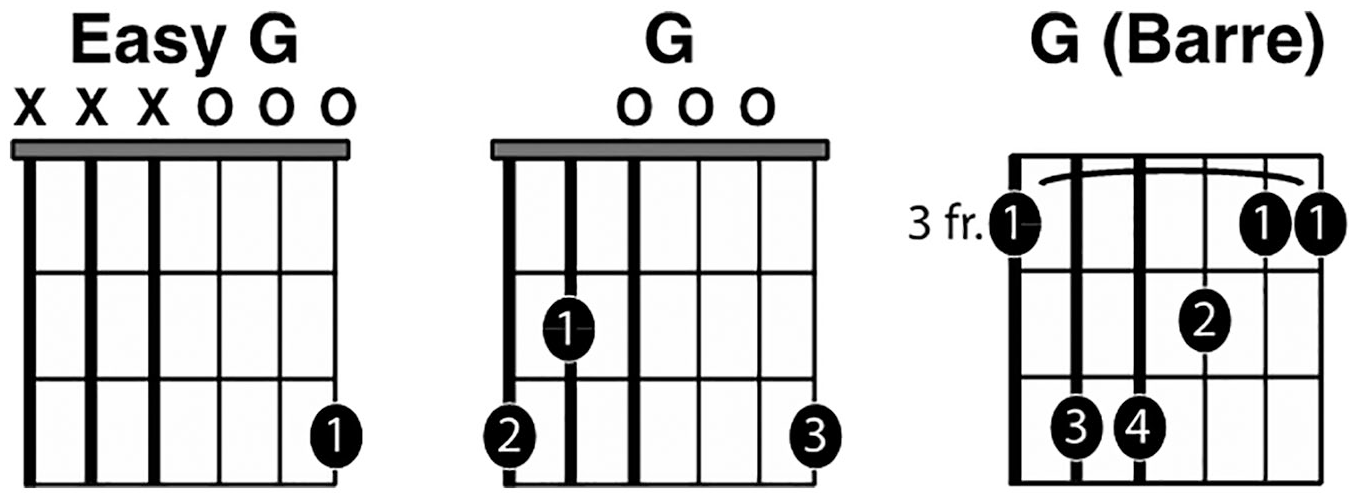
Example of differentiated instruction in Modern Band.
This same process of adaptation can be used for any instrument in a Modern Band. Some bass players may choose to play only chord roots on the downbeat, while others play a more complex bass line. Each component of the drum set—the bass drum, hi-hat, and snare—can be differentiated for individual learners. Even more, the drum set could be divided so students play only one component each. For students with physical limitations, mallet cuffs could also be used to adapt the drum set.
Conclusion
Modern Band has become a prominent approach for broadening access to music education through popular music. Its culturally responsive orientation centers student experiences and is able to expand equity and access to music education beyond traditional large ensembles. Additionally, Modern Band is an educational approach that is particularly well suited for inclusive music classrooms with special learners. Because it is premised on informal music learning theory, teachers are able to design classrooms with universal principles, attending to the education needs of individual students. Finally, its core values of scaffolding and approximation make it an ideal choice for classrooms needing differentiated instruction.
Footnotes
Declaration of Conflicting Interests
The author declared no potential conflicts of interest with respect to the research, authorship, and/or publication of this article.
Funding
The author received no financial support for the research, authorship, and/or publication of this article.