



Abstract
Scott Joplin was an African American composer and pianist of singular merit and influence. This article is the final entry in a three-part series considering the biographical, artistic, and cultural contexts of Joplin’s life and work and their use in K–12 general music education. “Ragtime Spaces” focuses on cultural globalization and the modernist entertainment aesthetic which supported Joplin’s work. Scott Joplin’s creative and entrepreneurial activities embodied humanism, racial uplift, and craftsmanship at a time when society became increasingly racially segregated and dehumanized. The discussion is followed by suggested student activities written in accordance with National Association for Music Education’s 2014 National Music Standards.
Keywords
The first two parts of Scott Joplin: A Guide for Music Educators introduced music teachers to a contemporary Scott Joplin biography, analyses of Joplin’s compositions, and classroom activities for exploring Joplin’s life and work. Joplin’s chosen genre—ragtime music—was overlooked in the 20th century as a vehicle for studying music theory, music history, and skill development. Joplin, the historical figure, was also overlooked in music education literature, historical records, and collective memory until the popularity of “The Entertainer” reawakened scholarly interest in ragtime. A survey of modern writings by Berlin (2016), Hill (2020), Karp (2016), Piras (2013), Melton (2018), and others, however, paint a compelling portrait of Joplin as an intentional artistic and cultural touchstone whose unique contributions to vernacular and art music require inclusion in modern music education curricula. If teachers are to move beyond the popular but one-dimensional presentation of Joplin as the composer of “The Entertainer,” they must have access to a holistic representation of Joplin’s artistic output as well as the context of his struggles, triumphs, and aspirations.
“Ragtime Spaces,” the final article in this three-part series, connects the modernist culture of Scott Joplin’s era with societal forces that remain active in the digital age. Public demand for ragtime music in the late 1890s led to the development of a new, nationalized popular culture unrelated to geographical locale. The strictures of Gilded Age social dance were put aside in favor of freely improvised ragtime one-step dances of the early 1900s. Beginning in 1913, White social dance superstars, Irene and Vernon Castle, and Black ragtime bandleader, James Reese Europe, took advantage of America’s growing fascination with “new syncopated music styles” of working-class African Americans, immigrants, and American youth, in general, to craft new cultural products and marketing strategies, “ . . . opening up unprecedented avenues for [Europe’s] Society Orchestra dance bands and drawing the acclaim of New York and New England elites” (Gilbert, 2015, p. 194). According to Jorgensen (1997), “The music industrialization of the nineteenth century ushered in an era of global expansion of Western music [which] . . . culminated during the latter part of the twentieth century” (p. 61). From the 1890s until World War I, ragtime culture shaped the public’s music tastes, fashion choices, and use of leisure time, foreshadowing the cultural effects that swing music, rock ‘n roll, and grunge rock would exert on future generations. Over time, technological advances allowed this phenomenon to affect a worldwide audience. In the 1990s, MTV founder, Tom Freston, cited globalization as a driving force behind the establishment of international MTV channels, confident that his 1980s creation for American youth (the “MTV generation”) would be welcomed into “every home in the world” (Banks, 1997). Freston observed, “ . . . young people from disparate countries are part of an emerging international youth culture that transcends any national cultural identity” (Banks, 1997, p. 50).
After music television became an established media format, technology once again expanded the possibilities for global enculturation, this time allowing for greater personalization of music experiences within a mass media context. Online platforms such as Banjo Hangout, The Mudcat Café, and Songtree eliminated geographical and social barriers to participation and allowed users to form virtual, highly participatory communities which transcended personal disabilities, travel limitations, and the requirement of an expert guide in acquiring music skill and knowledge (Calefato et al., 2018; J. Waldron, 2013; J. L. Waldron, 2018). Although modern music educators may feel they are waging a new battle against social media influencers, the conflicting forces of corporate dominance, personal preference, and cultural democratization can be traced to the unprecedented international commercial and artistic success of Scott Joplin’s 1899 publication, “Maple Leaf Rag.”
As contemporary research demonstrates, “Ragtime Spaces” and the musicians who filled them with their unique offerings represent the first rung of a long climb toward today’s mass media culture. How did Scott Joplin’s meticulously crafted rags become the inspiration for a nation? What societal forces did Joplin use to his advantage as he built his career? Who encouraged Joplin’s professional advancement in a society that supported sundown towns and segregation? Educators in search of the forces guiding their students’ music choices and preferences benefit from understanding cultural shifts that took place because of the work of ragtime musicians, their publishers, and the modernist audiences that flocked to hear their music.
Modernism and Ragtime
According to Merriam-Webster Dictionary, modernism is defined as “modern artistic or literary philosophy and practice, especially a self-conscious break with the past and a search for new forms of expression” (“Modernism,” n.d.). Whereas 18th-century European composers depended on a small group of elite patrons to sponsor and vouch for their superior talents, modernist American composers of the 1890s worked to gain acceptance and accolades from a vast public audience craving escapist entertainment. The market rewarded participatory performance experiences, class-less and racially integrated gatherings, and entertainers that projected wit, charm, and individual style. Entertainers were expected to possess enough virtuosity, charisma, and showmanship to win over highly diverse crowds, dictating every aspect of an evening’s entertainment and maintaining a convivial atmosphere conducive to parlaying a good time into lucrative tips (Gilbert, 2015, p. 119). Joplin’s calling card, in fact, read, “Scott Joplin, The Entertainer.” James Weldon Johnson described a modernist’s reaction to a New York ragtime space in his 1912 semiautobiographical novel, The Autobiography of an Ex-Colored Man.
I was little prepared for what I saw. The brilliancy of the place, the display of diamond rings, scarf-pins, earrings and breastpins, the big rolls of money that were brought into evidence when drinks were paid for, and the air of gayety that pervaded, all completely dazzled and dazed me. I felt positively giddy, and it was several minutes before I was able to make any clear and definite observations. . . . there was a young fellow singing a song, accompanied on the piano by a short, thick-set, dark man. Between each verse he did some dance steps, which brought forth great applause and a shower of small coins at his feet. After the singer had responded to a rousing encore, the stout man at the piano began to run his fingers up and down the keyboard. This he did in a manner which indicated that he was master of a good deal of technic. Then he began to play, and such playing! I stopped talking to listen. (Johnson, 1912)
A relatively small crowd of adventurous fair-goers famously fell in love with African American ragtime music played at off-site bars during Chicago’s 1893 World’s Columbian Exposition (Carter, 2008, p. 27). Following the 1899 release of Scott Joplin’s “Maple Leaf Rag,” however, the country as a whole adopted ragtime as its collective musical voice, illustrating the modernist concept of cultural identify based on mass consumerism (Gilbert, 2015). Joplin, a precursor to Lady Gaga, Harry Styles, and Beyonce, cultivated a refined and eye-catching image, wearing fine suits accented with diamond-studded lapel pins, and was often sought out and followed by crowds of teenage African American admirers as he strolled the streets of Sedalia and St. Louis (Berlin, 2016; Hill, 2020).
Joplin’s life coincided with America’s ultimate sign of modernism: a move toward industrialization and corporate oversight of labor, particularly in the development of America’s railroad system (Glick, 2019). Joplin, the son of a railroad laborer, grew up in the shadow of the Texas and Pacific Railway, and gladly joined the millions of Americans traveling faster and farther than had been imagined in previous generations. Joplin, always on the move, never owned a home and lived in rented spaces his entire life. In his earliest years of professional activity, Joplin and his Texas Medley Quartette depended on rail transportation to complete a successful concert tour extending from Iowa to New York from 1893 to 1894. On arrival in a new town, Joplin sought positive press coverage to establish legitimacy and to improve the odds of finding employment as quickly as possible. The Quartette’s ad in a Buffalo, New York, paper declared that the group had received “ . . . hundreds of newspaper testimonials and personal letters of praise from musicians and lovers of music. . . . They sing for parties, excursions, and gatherings of all kinds, including church societies” (“The Texas Medley Quartette,” 1894). Recent evidence suggests this tour prevented Joplin from serving as a long-term band leader in music halls outside Chicago’s Columbian Exposition—an oft-shared report made by his widow, Lottie Stokes (Berlin, 2016).
Joplin thrived professionally because 20th century Americans demanded new forms of entertainment, and publishing houses possessed the technology to mass produce sheet music at a blistering pace. Individual pieces of music cost between 25 and 60 cents, or between $6 and $10 in today’s currency (Tarby, 2017). Joplin benefited from his long-time collaboration with John Stillwell Stark, a 58-year-old White publisher and ardent supporter of the artistic merits of Joplin’s chosen genre. In an era of racial division, Stark offered fair compensation to Joplin and other Black composers for their work and publicly attributed his own success to the talents of African American composers (Tichenor, 1989). Stark repeatedly equated Joplin’s talents to European masters in trade publications and newspaper advertisements, an opinion supported by his daughter, Eleanor, a concert pianist and former student of Moritz Moszkowski.
Ragtime music became popular among America’s youth because it was spontaneous, immediately satisfying, and highly social—the opposite of their industrial working conditions (Kraft, 1995; Robinson, 2009). As ragtime’s popularity grew, Black intellectuals in New York City gathered at Harlem’s Marshall Hotel in the late 1890s to debate and discuss ideals for modernist African American life and culture. These contemporaries of Joplin, including Rosamund Johnson, Will Marion Cook, W. E. B. Du Bois, and Paul Laurence Dunbar, collaborated on musicals and other entertainment forms intended to replace the racially derogatory minstrelsy tradition. Dunbar’s 1897 poem, “The Sparrow,” artfully expressed dueling realities of modernism: nature is waiting, but life demands attention to work to the exclusion of all else (Dunbar, 1897).
“The Sparrow” A little bird, with plumage brown, Beside my window flutters down, A moment chirps its little strain, Ten taps upon my window-pane, And chirps again, and hops along, To call my notice to its song; But I work on, nor heed its lay, Till, in neglect, it flies away. So birds of peace and hope and love Come fluttering earthward from above, To settle on life’s window-sills, And ease our load of earthly ills; But we, in traffic’s rush and din Too deep engaged to let them in, With deadened heart and sense plod on, Nor know our loss till they are gone.
Denied access to concert stages because of their race, ragtime artists like Joplin found an enthusiastic welcome among entrepreneurs inventing the first generation of night clubs and mixed-use venues with decidedly democratized, mixed-class clienteles (Still, 1970; Wiltse, 2013). Whereas society-at-large became more segregated during the ragtime era, ragtime spaces became increasingly desegregated, establishing expectations inherited by the Savoy Ballroom and other nondiscriminatory dance halls of the Harlem Renaissance. A single ragtime space also provided a wide variety of entertainment options—a departure from Victorian saloons targeting male patrons seeking a place to consume alcoholic beverages.
[The Bank Exchange Saloon] occupied part of a fine building, and its interiors had been described as opulent. A man could come alone and drink at the bar with his comrades, or he could bring his wife or girlfriend to enjoy a comfy evening of good food and drink, separated from any boisterous . . . behavior in the bar section. . . . [It] was run in a very orderly fashion, and drunks were not welcome. (Karp, 2016, p. 42)
Ragtime spaces catered to newly mobile masses of business owners, European immigrants, and fortune seekers, a suspicious mix of clientele that (1) challenged Victorian-era social norms and (2) diversified local economies (Baumann et al., 2011; Carney, 2003). Traditional society depended on an ability to ignore the personal demoralization that existed among persons denied economic and political power. Joplin’s haunts in modernist Midwestern towns and big city Tenderloin districts were teeming with savory and unsavory characters thrown together due to social policies considered unacceptable and illegal today. For example, Sedalia, home to 15,000 residents during Joplin’s tenancy (1894–1904) proudly publicized its middle-class, “cosmopolitan” quality of life complete with paved streets, public utilities, and an upscale train depot, yet the town simultaneously supported a notorious sporting district, “Battle Row,” containing 29 saloons and a notable collection of brothels and gambling halls which employed dozens of ragtime pianists (Knopick, 2008; Maserang, 1985). Chalfant (2005) pointed out that Sedalia’s leaders allowed red-light districts and their ragtime-fueled partying to operate from the 1870s onward due to building owners’ needs to collect rent and the city’s need to maintain tax revenue. Ragtime spaces, though publicly decried, were tacitly agreed to be too valuable to shut down.
Burgeoning Northern and Midwestern railroad towns also provided hope to African American workers and their families in search of freedoms promised by the Reconstruction Amendments. Orators such as Booker T. Washington and W. E. B. Du Bois synthesized the concerns of their communities and presented philosophical guidelines for achieving economic equality. Having inherited the value of action-based community-building from their parents’ generation, Joplin and his peers pursued education, discourse via African American newspapers, and civic engagement. Joplin may have moved to Sedalia to attend the newly built George R. Smith College for Negroes, created by the daughters of Sedalia’s founder in response to the observed growth of African American communities in the center of the country (Stowell, 1922). Joplin, an avid reader of The Indianapolis Freeman, America’s first illustrated newspaper for African Americans, impressed others as a “gentleman” singularly focused on music and civic pursuits. Joplin served as one of the 25 founding members of Sedalia’s African American political interest group, the P. D. Hastain Republican Club, established in 1900 (Berlin, 2016), and Joplin also generously used his status as “The King of Ragtime Composers” to secure publishing deals for younger composers such as Joseph Lamb, Arthur Marshall, and James Scott. Eubie Blake, ragtime pianist and 1981 Presidential Medal of Freedom recipient, told the story of an the ailing Joplin seeking him out in Washington, D.C., in 1910 to tell him, “keep up the good work” (West, 1978).
During his tenure in New York City, Joplin’s social circle included members of the Clef Club Orchestra, the first African American ensemble to perform at Carnegie Hall; and fellow members of the Colored Vaudeville Benevolent Association, a prominent social club and philanthropy. Joplin and his peers, members of America’s first postslavery generation, shared a keen interest in proving that Black Americans were ready to fulfill the responsibilities required of citizenship (Gilbert, 2015). Joplin believed in his individual power to enact change despite the barriers to success he faced in his own career. Well-versed in uplift philosophy, Joplin “ . . . saw himself as bringing light into a world where he found so much ignorance and brutality” (Papanikolas, 2015, p. 65).
Community Values and Ragtime
Given Joplin’s observable talent and keen mind, why did he expend so much effort perfecting ragtime compositions when the genre was viewed as morally deficient, trivial, and downright evil? Why should students in the 21st century bother studying a man who built his career in the red-light districts of modernist American cities? Joplin’s successes and failures personalize the nation’s struggle to acknowledge that African American music, culture, and community values would be dominant forces in American life (Gilbert, 2015). Antonin Dvořák, director of New York’s National Conservatory of Music from 1891 to 1895, publicized his conclusion that the logical basis for a uniquely “American” school of classical composition was the African American folk repertoire preserved in aural tradition. According to Dvořák’s student, Will Marion Cook, the professor . . . spent many hours listening to [Harry T. Burleigh] sing the folk songs of his people. This repertoire apparently inspired the writing of Dvořák’s celebrated symphony From the New World (No. 5 in E Minor) . . . (Carter, 2008, p. 31)
Representation of Blackness in the 20th century and beyond would, indeed, transcend its original racial identity and would come from culture bearers like Joplin, James Reese Europe, Sissieretta Jones, and Bob Cole in place of minstrel tropes.
William Grant Still (1970), observed that African American instrumentalists of Joplin’s generation . . . studied, practiced, looked for openings, and finally came to grips with the fact that they had to earn a living and that there was no possibility of a colored musician doing that in the concert field. (p. 158)
Still testified that he first worked as a jazz musician because, as a young Black man, he knew he could earn a living in that field. Like Still, Joplin discovered at the start of his career that the popular music industry afforded him the realistic hope of receiving compensation for his brand of skilled labor. One of Joplin’s greatest triumphs, “The Ragtime Dance,” achieved success by playing up the public’s familiarity with ragtime dance fads, including the one-step, the cakewalk, the slow drag, and the stop-time. Various iterations of the 1899 show and its all-Black cast, including Joplin’s brother, Will, were a local hit, but the score did not sell well when offered to a broader audience. The contrasting responses to the same piece of music suggested that the communal experience of witnessing the show held greater value than the solo experience of playing the piece at home (Edwards, 2017).
Dr. Ollie Watts Davis, voice professor, performer, and director of The University of Illinois’ Black Chorus, is a recognized authority on culturally responsive teaching. According to Davis (2020), “Black people’s music” is a functional form of expression that (1) equally strengthens creators while it inspires listeners and (2) accurately reflects the experience of a community—the final authority on success and failure. Joplin’s opera, Treemonisha, for example, concludes with a Black community’s election of an educated woman as their leader, though voting rights were not guaranteed for Black men and illegal for Black women at the time of composition. Davis’s educational philosophy is channeled into pedagogical practices deeply rooted in community values that would have been familiar to Joplin and his circle of ragtime innovators.
[Davis] wants the chorus to be a celebration of African American music and culture, where students’ cultural capital is recognized, honoured and encouraged. Through musical participation, Davis creates and sustains a vibrant, joyful, committed community, highly valued by its membership. Community is built through musical and non-musical practices that combine to inspire the singers to do better, live better and sing better while embracing their cultural heritage and celebrating their identity. (Chadwick, 2011, pp. 148–149)
Joplin engaged in activities that lifted up others and demonstrated his pride in his African American heritage—a relationship and people-based use of time that is highly valued by some communities (Payne, 2013). Joplin could have stayed a solo act following the publication of “Maple Leaf Rag,” yet he shared authorship credit with younger composers such as Arthur Marshall and Scott Hayden. He could have followed the crowd in attaching racialized terms to his titles, yet a majority of piano rag titles tended toward elegant, evocative language (e.g., “A Picture of Her Face,” “The Nonpareil [None to Equal],” “Pleasant Moments,” “Magnetic Rag”) regardless of the cover art slapped on the final product by White publishers. Since Joplin produced scant documentation of his guiding philosophy, Joplin’s choices in behavior and the outside support he received all his working life must, instead, testify to his success at embodying the values of his community while still engaging in modernist business pursuits.
Appreciation for Joplin’s art leads a new generation of writers and performers to program Joplin’s music on a regular basis. Joplin’s surviving opera, Treemonisha, once a dormant remnant of history, is now hailed as a landmark achievement of artistic and ethnographic endeavor as well as repertoire worth performing (Cerchiari, 2018; Joplin, 2011; Lumsden, 2015; Sears, 2012). Edward Berlin’s solitary visit to Joplin’s grave in St. Michael’s Cemetery, unmarked until 1974, led to the 2005 establishment of an annual Scott Joplin Memorial Concert at Joplin’s final resting place (Berlin, 2019). On April 1, 2017, the centennial anniversary of the composer’s death, Carnegie Hall hosted a two-part recital of Joplin’s 53 piano pieces performed by Steinway artist, Richard Dowling. Following a 7-month hiatus due to COVID restrictions, The Royal Ballet’s October 9, 2020, livestreamed gala concert, The Royal Ballet: Back On Stage, concluded with Kenneth MacMillan’s 1974 ballet, Elite Syncopations, a fanciful showcase of Joplin’s music (“Elite Syncopations,” 2020). Whether presented as improvised interpretation or faithful reproduction of the score, Joplin’s music commands respect as a valuable and exuberant gateway into modernist music thought and cross-cultural expression (Table 1).
Content Standards and Essential Questions for Student Explorations (Shuler et al., 2014).

Ragtime Lessons for Today
Classroom Experiences for Grades K–12
Student Exploration: Group and Individual Reflection
Ragtime values include an appreciation of community. Introduce students to modernist African American communities by examining W. E. B. DuBois’ collection of photos exhibited at the Paris Exposition of 1900. Visit the Library of Congress’ digitized version of the collection here: http://www.loc.gov/pictures/search/?st=grid&co=anedub.
Encourage students to reflect on the images portrayed in the collection. W. E. D. DuBois intended to use these photos to communicate the richness and variety of African American culture at the dawn of the 20th century. Imagine that each one of them knew Joplin’s. What activities are depicted in these photos? What similarities and differences exist in the lifestyles depicted in the photos? Choose one photograph and create its backstory.
Classroom Experiences for Grades K–3
Student Exploration: Partner and Individual Movement
Invite students to play “Mirrors” (partners face each other and take turns leading then mirroring a series of movements).
The ragtime era saw the creation of the “One-Step,” a dance with no predetermined series of steps. The dancers simply move one foot at a time to the beat of the music (R L R L, etc.). Invite students to create their own one-step dances to Joplin’s “Maple Leaf Rag,” “The Easy Winners,” or “The Entertainer.”
Discuss the creative process involved in playing “Mirrors” versus creating a ragtime dance. Help students recognize moments when they had choices (when they were the leaders) and when they had no choices (when they were the mirror images). Point out that ragtime music and dance were valued because they encouraged personal choice and expression.
Classroom Experiences for Grades 4 to 8
Student Exploration: Group Reflection and Composition
Invite students to read and reflect on the poem, “The Sparrow,” by Paul Laurence Dunbar (1897). The poem is reproduced in two parts in Figure 1 to facilitate classroom discussion.
Identify words in the poem that could be represented as sound rather than language (e.g., flutters, chirps, taps). Using available sound sources—including body percussion or vocalizations—create a performance of the poem that uses both spoken word and sounds. Perform words and sounds together or replace words with sounds alone.
Perform “The Sparrow” for an audience, or have groups of students perform for one another, showing that one assignment can have multiple music outcomes.
Read and discuss other modernist poems by Paul Laurence Dunbar (Table 2).
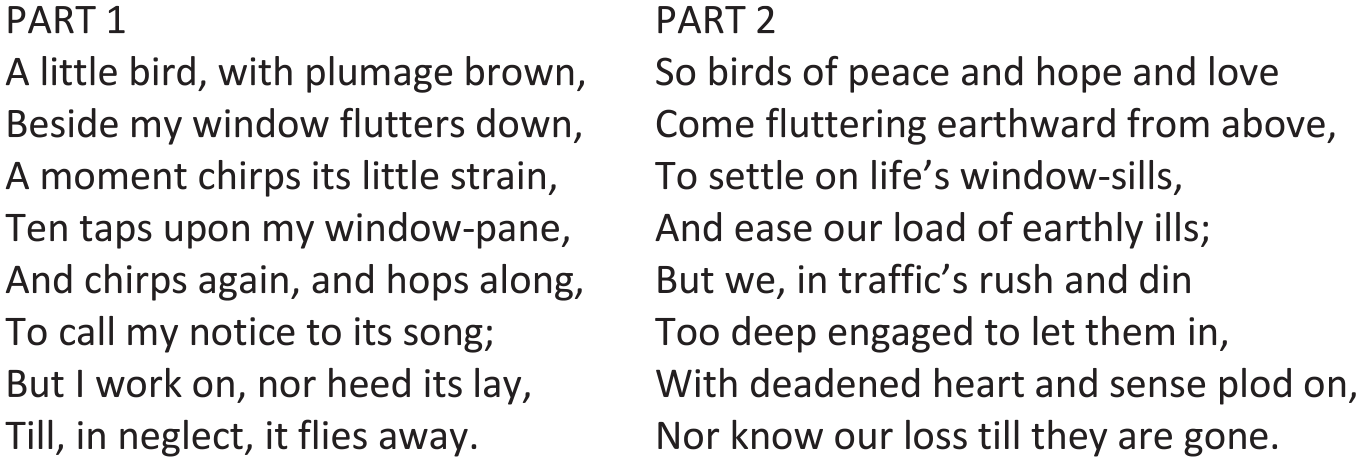
“The Sparrow” by Paul Laurence Dunbar, Lyrics of Lowly Life (1897).
Additional Poems by Paul Laurence Dunbar.

Classroom Experiences for Grades 6 to 12
Student Exploration: Group Reflection and Individual Creation
Background: Ragtime music existed in context of the modernist era, a time in American history when industrialized labor was normalized across society. “Going to the factory” or “working the line” were new realities of daily life. In the 1890s, ragtime music and ragtime spaces provided relief from the daily grind for America’s working population. From 1894 to 1918, ragtime was embraced as America’s universal leisure time soundtrack, and Scott Joplin was celebrated as “The King of Ragtime Composers.”
Define context as “the interrelated conditions in which something exists or occurs: environment, setting” (www.Merriam-Webster.com).
Invite students to share their experiences with Labor and Leisure. Describing personal experiences contributes to students’ development of self. Listening to others’ experiences allows them to practice empathy for others. What activities are associated with work? With free time? What behavior expectations exist during work, school, and free time? What music do you associate with work? With free time? What music do you enjoy alone? With friends?
Invite students to watch and discuss videos depicting Labor and Leisure during the modernist era (see Table 3). Individuals merge into corporate forces in the LABOR videos; conversely, individual actions and choices stand out in the Leisure videos.
Using personal and classroom resources, including the internet, invite students to create personalized music compilations for these contexts: Labor or Leisure time. First, define a circumstance (e.g., working at a fast-food restaurant, attending a late-night party, celebrating a birthday or a wedding). Second, define the music traits that would be valued in the setting (e.g., lively and rhythmic, soothing and in the background). Third, choose 10 to 12 songs that would fit into the chosen environment.
Allow students to share and reflect on their choices when the project is complete. Encourage students to notice and comment on the similarities and differences in one another’s compilations. Recognize that the process of curating music to suit an occasion is a creative act of personal expression that serves the community, an endeavor highly valued by ragtime musicians and their audiences.
Online Videos Depicting Modernist Labor and Leisure.

Conclusion
Scott Joplin earned the devotion of close friends who made extraordinary efforts to venerate his legacy in the waning years of their lives. Tom Ireland (1866–1963), a ragtime musician turned newspaperman, routinely shared stories about his great friend. William Hill, city editor for the Sedalia Democrat in the 1960s, noted that the 93-year-old Ireland spoke of Joplin with “ . . . a strain in every sentence. The presence of a compelling nostalgia and the friendship that existed between the two was evident with every syllable” (Hill, 2020, p. 104). Brun Campbell, the White teenager who ran away from home to study with Joplin, later called his mentor the “perfector” of ragtime among a company of innovative, talented Sedalia pianists (Karp, 2016, p. 156). Ireland and Campbell were so captivated by the memory of Joplin that they made extraordinary efforts to venerate his legacy in the last decades of their lives. A contemporary chorus of researchers agree that Joplin cast a large shadow over the development of a uniquely American music style that embodied humanism, racial uplift, and craftsmanship for people living in a dehumanized, modernist society.
If Scott Joplin is to be understood and acknowledged by the public in the 21st century, he needs to be represented with greater intention in music education curricula. Although a current generation of Americans name Joplin as the composer of a single rag, “The Entertainer,” a future generation is waiting to learn about his extraordinary life story, the full range of his creative output, and his unimpeachable work ethic. Children understand many of the circumstances behind Joplin’s struggles. They know adults who value tight-knit social groups, who live in rental housing, who strive to better the lives of others, and who change jobs in search of greater economic and personal fulfillment. As stated in the first article of this three-part series, Scott Joplin was an African American composer of singular merit and influence. Increased study of the biographical, artistic, and cultural contexts of his life will allow more children to see themselves in Joplin’s image: creators, performers, and participants in America’s ever-changing music life.
Footnotes
Declaration of Conflicting Interests
The author(s) declared no potential conflicts of interest with respect to the research, authorship, and/or publication of this article.
Funding
The author(s) received no financial support for the research, authorship, and/or publication of this article.
