



Abstract
Objectives: Accreditation standards and challenges in group work education require competency-based approaches in teaching social work with groups. The Association for the Advancement of Social Work with Groups developed Standards for Social Work Practice with Groups, which serve as foundation competencies for professional practice. However, there has been no empirical publication about using them in teaching. This pilot study tested a microskills teaching approach to improve competency in the Standards. Methods: The mixed-methods study used a preexperimental, pretest–posttest design involving 123 diverse baccalaureate and master’s students in introductory group work courses. Student responses about the experience were also collected. Results: There were significant, substantial increases in students’ perceived importance of and confidence in using the Standards. Confidence gain scores were significantly associated with performance in role-plays. Comments about the assignments were highly favorable and identified role-plays as contributing most to learning. Conclusions: The teaching approach advanced Standards-based group work education.
A convergence of factors has created the need for competency-based group work education. One has been the requirement by the Council on Social Work Education’s (CSWE, 2008) Educational Policy and Accreditation Standards (EPAS), which requires all social work programs to ensure that students develop mastery of core competencies. CSWE defined competencies as “measurable practice behaviors that are comprised of knowledge, values, and skills” (CSWE, 2008, p. 3). In accordance with the EPAS, competency-based education is grounded in a curriculum with measurable learning outcomes. The demonstration and documented assessment of core competencies are part of the new accreditation requirements.
A second factor is the finding from studies suggesting that many students and faculty have limited grasp of group work concepts and skills. A national survey of MSW students examined the degree to which they learned group theory and practice in foundation group work courses (Sweifach & LaPorte, 2009). The study of 1,360 students reported that almost half of the sample (47%) reported that “little to no time at all” (p. 307) was spent on group work during the foundation year. When asked a series of questions about particular group work skills, almost two thirds of the respondents reported that they did not think that they “possessed basic group work skills, such as understanding how to select members, how to identify tasks and goals for the group to accomplish, and how to assist group members in problem solving” (p. 307). In addition, only 16% of the students reported that they were able to use mutual aid in groups. The authors concluded that “students are graduating without basic skills for facilitating groups” (p. 311).
In another study, researchers surveyed 212 social work faculty about their level of knowledge and competence in teaching group work courses (Birnbaum & Wayne, 2000). Almost all respondents (96%) reported that they were “knowledgeable” or “very knowledgeable” about teaching group work. However, more than a third of respondents did not identify which group concepts were covered in the foundation curriculum. Of those who did respond, many briefly listed one or a few concepts, with little detail. When asked for suggestions to improve group work education, the most common suggestion was for more developed teaching materials.
A recent study of first-year MSW students’ perceptions of their field practicum experience suggested that many field instructors have also not been well prepared to teach group work (LaPorte & Sweifach, 2011). As the profession’s signature pedagogy, the field experience is the “central form of instruction and learning” (CSWE, 2008, p. 8), where students apply the concepts and skills learned in the classroom. The survey of 1,360 MSW students reported that, More than half of the respondents indicated that field instructors provided very little or no measurable information at all about group work theory and practice. Furthermore, slightly less than half of the respondents indicated that they were not satisfied with what they learned in the field about groups, and slightly more than half indicated that field instructors simply did not help to prepare them for work with groups. (LaPorte & Sweifach, 2011, p. 246)
The study also reported that students thought their field experience was significantly better at helping them learn to work with individuals than with groups, on many indicators. For example, students reported that their field instructors were significantly better in helping them develop individual rather than group work practice skills. The researchers noted that 73% of the students were satisfied with what they learned from their field instructors about working with individuals, but only 45% were satisfied about what they learned from their instructors about group work (LaPorte & Sweifach, 2011).
Collectively, these empirical findings reveal the “price of neglect” in group work education, which has generally declined over the years (Birnbaum & Auerbach, 1994; Simon & Kilbane, 2011). Both students and faculty are in dire need of new and effective approaches for learning, teaching, and assessing group work competencies.
There are two essential ingredients needed to advance competency-based group work education. The first is a set of core group work competencies. There is a consensus-based document that outlines foundation values, knowledge, and skills for group work. The Association for the Advancement of Social Work with Groups (AASWG)—social work’s only organization dedicated to group work—developed Standards for Social Work Practice with Groups (AASWG, 2006). The Standards were developed by experts in group work education, practice, and research and “represent the perspectives of the [AASWG], on the value and knowledge and skill base essential for professionally sound and effective social work practice with groups and are intended to serve as a guide to social work practice with groups” (AASWG, 2006, p. 1). However, the Standards have not been widely used (Cohen & Olshever, 2010) and nothing has been written on how they can be utilized in teaching about social work with groups.
The second essential ingredient is a measure to assess the attainment of competencies. Until recently, there has been no reliable and valid assessment instrument to measure competencies in social work with groups. Such an instrument could be used as a benchmark in teaching group work and in evaluating whether particular teaching strategies have contributed to changes in learning relevant knowledge and skills. An inventory based on the Standards for Social Work Practice with Groups has recently been developed and empirically tested (Macgowan, 2012), which is suitable for measuring changes in learning about the Standards.
Using these two essential ingredients, this article describes and tests a teaching approach to improve perceived importance and confidence in the AASWG Standards. This article details how the inventory based on the Standards has been used in a measurement-based approach to increase the amount of importance students attribute to the Standards and their confidence about using them in practice. Details about the teaching approach and assignments are presented. In addition to quantitative data, qualitative comments from students about the learning are provided, and suggestions for improving the experience are offered.
Methods
Sample
The sample consisted of 123 full-time students enrolled in six BSW and MSW group work courses from fall 2009 until summer 2011. Table 1 describes the demographics of the sample. Most of the sample was female and racially and ethnically diverse, reflecting the large metropolitan area of the Southeastern United States in which the school of social work was located. The study had Institutional Review Board approval.
Participant Demographics

Note. Not all individuals completed demographic variables.
Measures
The primary instrument used in this study is a newly tested inventory of perceived importance of and confidence in using the AASWG Standards for Social Work Practice with Groups (Macgowan, 2012). The 70-item inventory was developed exclusively from the Standards. Example of items include: “Knows how to select members for the group in relationship to principles of group composition;” “Invites full participation of all members;” and “Seeks to cultivate mutual aid” (cf. Macgowan, 2012 for complete inventory, or contact the first author). Respondents rated each item in two domains; namely, how important the item was for successful group work and how confident the respondent thinks she or he could successfully demonstrate the skill. Responses are scaled from 1 to 4, very unimportant to very important and very unconfident to very confident, in the respective domain. For each domain, items were totaled and a mean scale score was derived. The inventory, consisting of both domains, required approximately 15 min to complete.
Preliminary reliability and validity testing has been reported on the instrument, which included the sample reported in this study (Macgowan, 2012). As summarized in Table 2, the inventory has excellent internal consistency and a low standard error of measurement. Based strictly on the Standards, the inventory had prima facie content validity. The inventory was empirically tested for concurrent and construct–convergent validity, and two forms of criterion validity, known groups and predictive. Overall, the inventory has good validity (Table 2; see Macgowan, 2012). Further testing of the inventory with the sample involved in this study is reported in the findings section below.
Summary of Reliability, Standard Error of Measurement, and Validity of the Inventory (Macgowan, 2012).

Note. CGWSI-IC = Core Group Work Skills Inventory–Importance and Confidence (Wilson & Newmeyer, 2008). Adapted from “A standards-based inventory of foundation competencies in social work with groups,” by Macgowan (2012), Research on Social Work Practice.
In the preliminary psychometric study (Macgowan, 2012), inventory items were linked logically to the 10 core competencies of Educational Policy 2.1 of the EPAS “Explicit Curriculum” (CSWE, 2008). Inventory items were linked to all but one area of the EPAS (not policy practice 2.1.8). According to the EPAS, data from ongoing assessment are required to determine whether competencies have been met. When used to measure confidence and performance in role-plays, the inventory can assess not only how well students know and perform the AASWG Standards but also how well the group work course meets Educational Policy 2.1.
In addition to the inventory, a 6-item measure was administered at the end of the semester to elicit student feedback on the various teaching methods used during the course. The first four questions were closed-ended and asked students to rate the four course assignments (i.e., leading the role-plays, participating in role-plays, observing role-plays, and completing the paper) with respect to how much each contributed to their knowledge and skills in group work, using the following scale: 1 = very little; 2 = little; 3 = much; 4 = very much. The final two questions were open-ended and asked “What did you like about the assignments?” and “How would you improve the assignments?”
Design and Teaching Approach
This pilot study used a mixed-methods approach to examine a teaching method to improve student ratings of importance of and confidence in using the AASWG group work Standards. Both quantitative and qualitative methods were used, which include self-ratings and observer ratings of performance in role-plays. To determine the effects of the teaching approach on outcomes, this study used a preexperimental, single-group, pretest–posttest design. The pretest occurred at the beginning of the semester and the posttest was administered at the last class. Students completed the newly-tested inventory of the AASWG Standards at the beginning and end of the semester and completed the 6-item measure at the end of the semester to rate which assignments and activities they thought most contributed to their learning. Instructor ratings of student performances in role-plays were also used as a measure of learning. For the qualitative portion of the study, students offered comments about the assignments and experience.
The teaching approach was delivered in single-semester, three-credit, introductory group work courses offered at the baccalaureate and masters levels. Students enrolled in the courses after completing foundation courses in introductory social work, social work practice, interviewing skills, social policy, and human behavior and the social environment. The primary text was a popular introductory group work text (Toseland & Rivas, 2009). Assessment of learning was done in three ways: weekly quizzes based on the text, a writing assignment, and in-class role-plays. The instructor who taught the course is a White, Anglo/Latino male, tenured, with almost 20 years of teaching experience across BSW, MSW, and doctoral courses.
An intensive teaching approach was developed to help students learn the Standards. The approach was based on a microskills model (also called microtraining and microcounseling, Evans, Hearn, Uhlemann, & Ivey, 2004; Ivey, Ivey, & Zalaquett, 2010; Ivey, Normington, Miller, Morrill, & Haase, 1968; Poorman, 2003), which was first developed for teaching interviewing skills. Microskills have been defined as “the basic skill components that together form the common communication behaviors critical to professional helping and to building an effective helping relationship” (Poorman, 2003, p. 7). To master the complexity of the skills, microportions of the interview are identified, which are specific behaviors that the learner is to demonstrate (Evans, et al., 2004; Poorman, 2003). In the application described in this article, single skills based on the Standards using the inventory were learned by students and then demonstrated through role-plays. Although there is a record of empirical studies of skills-based, microcounseling approaches in teaching group work in other disciplines (Smaby, Maddux, Torres-Rivera, & Zimmick, 1999; Toth & Stockton, 1996), there is little empirical research in social work of teaching methods to build foundation skills in group work.
The purpose of the assignment was to increase students’ perceived knowledge and confidence in doing the AASWG Practice Standards. The assignment involved two main phases: (a) assessment and (b) knowledge and skills building. In the first phase, students undertook a self-assessment during the first class of the semester using the inventory. Items rated lowest on the importance and confidence scales (i.e., very unimportant or unimportant and very unconfident or unconfident) were identified and targeted for building knowledge and skills during the semester.
Knowledge and skills building was the focus for the remainder of the semester, during which the students completed the writing assignment and engaged in role-plays. The writing assignment was intended to assist with knowledge development and demonstration, while the role-plays were intended to facilitate skills development and demonstration.
For knowledge development, students selected two items from the Standards that they rated low in “importance.” The aim of this assignment was to increase the students’ understanding and appreciation of the significance of those items in the Standards. For each item, students completed a paper that consisted of two parts. For the first part, students sought the group work literature and described why the item was indeed important for effective group work. The second part required that students describe how the item would be applied in practice with a real group. The following is an example of a student’s assignment related to knowledge development (Hones, 2009) which is based on item number 3 of the inventory, “Creates a group environment that offers an opportunity to live and practice the democratic principles of equality and autonomy. This value is presented to the group whenever appropriate and reinforced when members articulate it.”
“Importance of this item. A core value of the AASWG’s Standards for Social Work Practice with Groups is to respect people and their autonomy. Equality and autonomy are demonstrated by treating people with respect and dignity and valuing their diversity. Group members are diverse based on their culture, ethnicity, gender, sexual orientation, physical and mental abilities, and age. Neither the member, nor the worker, nor the agency has more privileges than the other. Group workers help the group “appreciate the contributions of the other members so that everyone's ideas are heard and considered” (Toseland & Rivas, 2009, pp. 459–460). Another core value of the Standards is to create a socially just society. As a democratic society has to ensure its members’ basic human needs are met, group workers are required to do the same. A group is the opportunity for members to live and practice autonomy and equality (Toseland & Rivas, 2009, p. 460).
“Equality example in practice. I facilitate a group for adolescents from ages 13 to 17 who have parents who are incarcerated. The purpose of the group is to help them achieve coping skills to deal with being a teen of an incarcerated parent. The group consists of youth with different culture backgrounds and ages. I facilitated the treasure hunt activity with the teens. Treasure hunt requires members to find out facts about each other (Toseland & Rivas, 2009, p. 191). I did a variation of the game in which one teen interviewed another in the presence of the other group members. Specific interview questions included age, ethnicity, race, school, and a responsibility they had within their family. The members were to remember the answers. After everyone took turns, each member identified one thing they had learned about a particular member. Then I had the group members identify similarities and differences. They were able to identify on their own that they were of different races, ages, or ethnicities but their similarities were that they were children of inmates and helped in the caregiving activities of their younger siblings.
“Autonomy example in practice. In the same group, I helped members develop group rules. I asked the members to define the term ‘rules.’ I explained the reason for group rules. Then I had the members decide if they felt they needed group rules. The group decided they needed rules. I let them make the rules. The teens came together to decide who would write the rules and determined that a vote would be made on each rule to ensure everyone was in agreement.”
For skills building and to develop confidence in carrying out the items in the Standards, students performed three role-plays in class using other students as group members. During the semester, students worked in groups and consulted with the instructor to help build various skills in the role-plays. Each student was assigned a date in the semester to demonstrate the skills in a role-play before the class, and the student’s performance was evaluated. The instructor rated how clearly each item was demonstrated using the following scale: 1 = very unclearly, 2 = unclearly; 3 = clearly; and 4 = very clearly (contact the first author for a copy of the rating sheet). Students were required to receive a minimum rating of “3” (demonstrated clearly) to pass the assignment.
This intensive teaching approach was intended to foster gains in learning about the Standards during the semester. The study sought to test two main hypotheses. First, regardless of level (BSW or MSW), students were expected to demonstrate significant gains in their self-ratings of importance of, and confidence in doing, the AASWG Standards from pretest to posttest. Second, it was expected that student ratings of confidence would correlate with actual performance on the role-plays; that is, students with the highest gains in confidence from pretest to posttest would also have the highest observer performance ratings on their role-plays on those items. This second analysis involved a subsample of students in the study whose performance in the role-plays were rated, further described below. At the end of semester, students completed the 6-item instrument to record feedback about the assignments and what they thought best contributed to their learning about group work.
Data Analysis
For the first main hypothesis, statistically significant differences between pretest and posttest Importance and Confidence scores were determined using paired t tests. There were six tests, which involved the entire sample and by student status (BSW and MSW). The probability value was set at p < .05. Statistical power, the probability that the statistical test will identify the teaching’s effect if it really existed, was examined for the t tests. Power for a dependent t test was calculated based on the set alpha level, the smallest sample size in the analyses (BSW students, n = 45), and a medium effect size. The test indicated a power level of .91, exceeding the convention of .80 (Cohen, 1998). Thus, the planned analyses seemed adequately powered.
To test the second main hypothesis, bivariate correlations (Pearson) were used. Although all classes included role-plays, not all had ratings recorded that were available for this study. Thus, a subsample (n = 66) was included in analyses. It was expected that instructor ratings of role-plays would be significantly related to mean pretest to posttest confidence gain scores. To obtain mean change scores, pretest scores were subtracted from posttest ratings. The instructor was not aware of student ratings of confidence when rating the role-plays.
For significant differences, estimates of effect sizes were determined by calculating Cohen’s (1988) d statistic using the pooled mean divided by the standard deviation for pared t tests, or using r 2 divided by 1 minus r 2 for bivariate correlations (Lipsey & Wilson, 2001). Statistical data analysis was done using Statistical Package for the Social Sciences (SPSS) version 19.
Findings
Pretest and Posttest Ratings of Importance of and Confidence in the AASWG Standards
Mean pretest and posttest scores on the 70-item inventory are reported in Table 3. Overall, students rated the importance of the items higher (M = 3.72) than their confidence in demonstrating those items (M = 2.90). In all cases, there were statistically significant improvements in pretest and posttest scores on students’ ratings of perceived importance of the standards and, particularly, in their confidence in knowing how to carry them out in practice. The Cohen’s d effect sizes (Table 3) indicate approximately medium effects for Importance (≈.50) and large effects for Confidence (>.80).
Pretest and Posttest Results on Importance of and Confidence in the Standards
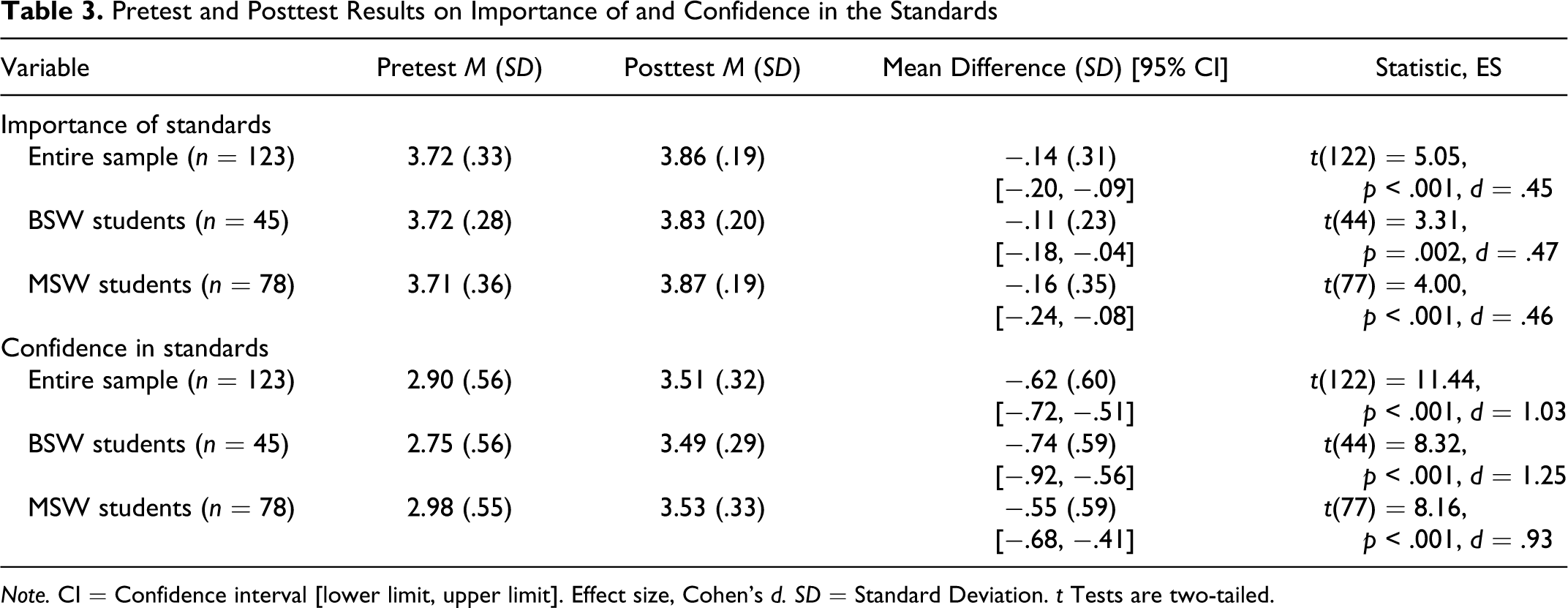
Note. CI = Confidence interval [lower limit, upper limit]. Effect size, Cohen’s d. SD = Standard Deviation. t Tests are two-tailed.
Changes in Self-Ratings of Confidence and Performance on Role-Plays
It was expected that observer ratings of role-plays would be significantly and positively related to mean pretest to posttest confidence gain scores. There was a significant relationship between instructor ratings of student performance and student mean gain scores in confidence, r(66) = .33, p = .003, d = .71.
Student Perceptions of the Learning Experience
Two sources provided data concerning the learning experience for students. First, students were asked to anonymously provide feedback about which assignment or class activity most contributed to their knowledge of and skills in group work. Table 4 identifies which assignment or activity they thought most contributed to learning. Clearly, students reported that leading the role-plays most contributed to building both their knowledge and skills in group work, followed by observing and participating in the role-plays. Participants thought that completing the paper contributed the least to learning about the Standards.
Student Responses About What Contributed Most to Their Learning and How Much of the Learning Was Incorporated in Their Field Practicum

Note. SD = Standard deviation. Responses were recorded using the following scale: 1 = very little; 2 = little; 3 = much; 4 = very much.
Two qualitative questions asked students to comment about the assignments. When asked what they liked most about the assignments, students offered only positive comments. The majority of MSW students said they found the role-playing to be the most helpful activity in the class. Many commented that the interactive experience of participating in the role-plays was a highly effective way to learn various clinical skills and to understand aspects of group development: “Role plays were great! I had lots of fun while learning, practicing, and getting feedback;” “Acting out actual skills helped with understanding them better as opposed to observing them or writing them out;” “I enjoyed the role plays as it allowed me to grasp the theory and practice skills associated with group work.”
MSW students appreciated the multiple perspectives of being a group leader, group member as well as an observer of other students’ role-plays. Students noted, “The assignment provided an opportunity for me to experience both sides of the group experience—the leader as well as the group member;” “I liked the role plays I conducted and I enjoyed other classmates role plays as well. Overall, an excellent learning experience.”
Some students acknowledged that they were initially anxious or unsure about participating in the scenarios in front of the class, but that they ultimately found it to be a beneficial exercise: “I liked the role plays—helped me to get more comfortable with public speaking skills and group work skills;” “As much as I thought I would not have liked doing the role plays, I learned more from doing and researching for the role plays than writing the papers.”
The research and preparation required for the role-plays was also a positive learning experience. Masters students noted, “I liked that we were exposed to new material and had to apply theory to the skills. It was nice to make the connections from identifying a theory, applying it in the role play and utilize developing skills;” “I found LEADING the role plays to be very helpful, especially doing the research for them and receiving your feedback.”
Students also found the diversity of instructional methods and assignments helpful in conveying the subject matter: “I am a learner that likes doing things in order to gain a better understanding. I liked the role plays a lot. I think they really helped me in learning how to run a group. The paper helped me to become a critical thinker.”
For some MSW students, the role-play assignment helped them learn and practice new skills that could be immediately applied into their field placements: “It was helpful to me and I believe my skills in group work have improved greatly. The role plays were especially helpful and gave me ideas for running my own groups in my practicum.” For a few others, the classroom role-play was the only opportunity to practice group skills because there was no opportunity in their field placements: “I really enjoyed the role plays especially since I didn’t have a group during practicum to practice and implement the skills I have learned.” “I feel that conducting the role plays contributed my group work skills; however I was disappointed as I did not have the opportunity to use them in my placement.”
The BSW students shared similar comments. Students shared that participating in role-plays made them feel more skilled, despite their initial reluctance to participate: “The role plays made me think a lot about how to effectively practice group work skills. In addition, while I was nervous before I presented, I think that having to practice in front of others has made me more confident in the long run;” “I was able to build on my confidence as a group leader and overcome to some degree the fear and pressure that comes with it. Learning from my mistakes and the mistake of my classmates was helpful.”
Baccalaureate students shared that the role-plays were a fun and different way to learn: “It made the words come alive and an image that will stick like glue. I may not remember what I read in the class but I’ll remember the role plays;” “I had never role played in a group setting, so it was interesting to me and fun. The role plays were very creative way in getting us to think about how to perform in a group setting.”
In answer to the second question, “How would you improve the assignments?” both groups almost unanimously stated that more role-play opportunities could have been beneficial and helpful.
Discussion and Applications for Social Work Practice
This article described the application of a teaching method to increase student knowledge and perceived confidence in the AASWG Standards for Social Work with Groups using a measurement-based approach. It is the first article to report both the application of the Standards in teaching about group work and the use of an inventory as a foundational tool for teaching about social work with groups.
There were significant and substantial improvements over time in students’ appreciation of, and confidence in using, the Standards. The effect sizes showed substantial changes in learning, with higher effects on confidence. Changes in confidence among the full sample were large (d = 1.03), particularly among baccalaureate students (d = 1.25), and are within the range of those reported in studies measuring self-efficacy in social work education (Holden, Barker, Rosenberg, & Onghena, 2008). More importantly, students with the highest growth in their confidence about performing the Standards had correspondingly high observed ratings on the role-plays. The improvements in confidence corresponded with actual practice behaviors.
Changes in student ratings of importance of the Standards, although significant and moderate in effect sizes, were of marginal substantive significance. At the pretest, students rated each item, on average, high in “importance” (e.g., 3.72 of 4.00; Table 3). The significant positive changes to a higher level of “importance” (e.g., 3.86 of 4.00), although desirable, may not be worth the respondent burden in completing items in that domain. The psychometric study of the inventory, which involved a larger sample (N = 426), reported similar high ratings of importance (mean of 3.68; Macgowan, 2012). Thus, subsequent studies may exclude the importance domain. On the other hand, pretest scores in confidence were below “confident” and the resulting substantial increases brought scores higher into the “confident” range, which is a meaningful difference over time.
Given the inventory has been logically linked to the core competencies of educational policy 2.1 of the EPAS (Macgowan, 2012), gains in group work competencies were also likely accompanied by improvements in the EPAS competencies. For accreditation purposes, these data can help determine whether the group work course helped students demonstrate competency in the core areas of the EPAS.
Students reported that all assignments were beneficial in contributing to their learning about group work but that the role-plays had the largest impact. Specifically, they reported that being a group worker contributed most to learning, followed by being a group member and, finally, being an observer. These participatory and interactive learning experiences were perceived as more valuable than completing the paper. Some students reported that they should be given the opportunity to demonstrate all competencies as role-plays only, rather than role-plays combined with a written assignment. Students highly valued the role-play experiences. Giving students the option of participating in role-plays may yield greater learning gains than written assignments alone.
The inventory utilized in the study can be used to advance practice in group work settings. Supervisors can use the inventory to measure staff confidence in leading groups and their knowledge of group skills. Inventory responses can assist supervisors to pinpoint staff training needs and to set goals for the staff’s professional development. Identifying staff members who need additional support can help supervisors to provide more focused clinical supervision to enhance skills. Increased confidence and awareness of standards-based group work skills increases the potential that social workers are engaged in ethical and evidence-based group work (Macgowan, 2008).
Although there was no further data in this study about performance in the field practicum, students reported that they used the skills “much” in their placements (Table 4). The inventory has great potential for linking group work courses with the field practicum experience. Inventory responses can be relayed to field instructors who can provide students with additional opportunities to build and enhance group work skills in parallel to the classroom. This linkage would help ensure that students are receiving adequate opportunities to learn and develop skills both inside and outside of the classroom. This partnership can help strengthen group work education in the field practicum, which has had some notable deficiencies (LaPorte & Sweifach, 2011).
Although this pilot study has substantial strengths, there are methodological and conceptual limitations, and recommendations for strengthening, testing, and extending the measurement and teaching approaches. The study documented positive changes in perceived confidence about the Standards, with demonstrations of competence in role-plays. A limitation is that the data were based on the ratings of a single observer in the classroom. It would be beneficial to use the ratings of multiple observers and in other settings, such as in the field placement and beyond graduation.
Although the preexperimental design was suitable for this stage of research, the next study should use a stronger design. No causal inferences can be made about what contributed to improvements in learning, as there were many uncontrolled elements including history, maturation, and testing which may have contributed to the significant changes from pretest to posttest (Shadish, Cook, & Campbell, 2002). A stronger grouped design in which students are randomly assigned to comparison or control groups, or a single-subject design that includes a withdrawal period are needed to determine if the teaching approach described in this article significantly contributes to improvements over others. In designing more rigorous grouped studies, future studies could test different teaching approaches to determine if more generalized approaches to teaching about the Standards are also associated with improved learning. A comparative effectiveness research design would include randomly assigning learners into two sections of the same course and offer different teaching methods. It would also be instructive to learn if students who have been taught directly about the Standards are regarded as more competent by their field supervisors than their counterparts who have not.
This article presented a novel approach to developing knowledge and confidence about the AASWG Standards for Social Work Practice with Groups. Using a promising new instrument to measure performance on the Standards, both quantitative results and qualitative reports from students clearly indicated students benefited from the teaching approach. Importantly, student improvement in confidence was correlated with practice behaviors observed in role-plays. The inventory’s items have been linked to the EPAS Standards and thus may be used as markers of student development of not only social work competencies but also competencies in social work with groups. Although there were limitations to the approach and with the preexperimental research design used in the study, this article described a teaching method and instrument that may be readily implemented and useful for competency-based learning.
Footnotes
The authors declared no potential conflicts of interest with respect to the research, authorship, and/or publication of this article.
The authors received no financial support for the research, authorship, and/or publication of this article.