



Abstract
Objective:
This is a replication of a study that examined the effects of teaching foundation competencies in group work to social work students and assessed their self-confidence in applying these skills. This study improves on the first by utilizing a controlled design.
Method:
Twenty-six master of social work students were taught group work competencies derived from the International Association for the Advancement of Social Work with Groups’ (IASWG) Standards for Social Work Practice with Groups using didactic activities and micro-skill exercises. Students were assessed 4 times on their confidence in group work competencies using a validated 70-item inventory. Group work skills were divided into three blocks and taught successively in an abbreviated multiple-baseline design.
Results:
The t-tests indicated significant increases in confidence ratings after training on the respective skills but not before skills training.
Conclusion:
The results provide additional support for the effectiveness of the teaching approach in building student confidence in using IASWG Standards.
Empirical studies over the past 40 years have pointed out how poorly prepared students are for group work and how ill equipped faculty are who teach social work with groups (Bakalinsky, 1982; Birnbaum & Auerbach, 1994; Birnbaum & Wayne, 2000; Goodman, Knight, & Khudododov, 2014; LaPorte & Sweifach, 2011; Simon & Kilbane, 2014; Sweifach & LaPorte, 2009). For example, a national survey of 1,360 master of social work (MSW) students examined the degree to which they learned group theory and practice in foundation group work courses (Sweifach & LaPorte, 2009). Almost two thirds of respondents reported that they did not think that they “possessed basic group work skills, such as understanding how to select members, how to identify tasks and goals for the group to accomplish, and how to assist group members in problem solving” (p. 307). Only 16% of the students reported that they were able to use mutual aid in groups. The authors of the study concluded that “students are graduating without basic skills for facilitating groups” (p. 311).
Recently, Goodman, Knight, and Khudododov (2014) completed a study of students in the group work concentration (N = 294) in a large MSW program to determine how prepared students were for group work in the field practicum. Among participants who had group work as a part of their field training, just over a quarter (26.5%) reported that their courses provided adequate preparation for group work. Fewer than half (45.6%) of group work majors were satisfied that their courses prepared them adequately for their field placements.
Collectively, these and other studies reveal the “price of neglect” (Birnbaum & Auerbach, 1994, p. 325) in group work education. Council on Social Work Education (CSWE) accrediting standards require a group work experience, but there is a lack of adequate course work on the modality, which leaves graduates unprepared for the routine assignment of leading a treatment or task group. As has been noted, “It is one thing to require group work experience in a field placement, but quite another to make it a true learning experience” (Simon & Kilbane, 2014, p. 252). In addition to the lack of exposure to dedicated group work courses, the empirical evidence reveals that students and faculty need effective approaches for learning and teaching foundation group work competencies.
Practice standards are essential for advancing appropriate and effective group work. One of the functions of group work standards is to encourage evolving aspirations or “continual quality advancement” (Wilson, Rapin, & Haley-Banez, 2004, p. 22). The International Association for the Advancement of Social Work with Groups (IASWG)—social work’s only organization dedicated to group work—developed Standards for Social Work Practice with Groups (IASWG, 2006). The Standards represent the perspective of IASWG “on the value and knowledge and skill base essential for professionally sound and effective social work practice with groups and are intended to serve as a guide to social work practice with groups” (IASWG, 2006, p. 1). The Standards have been used in multinational contexts and examined specifically for their relevance across cultures, with evidence of their applicability among English-speaking participants in the United States, Canada, and Great Britain (Cohen & Olshever, 2013; Kirwan, 2013; Macgowan, 2012, in press).
The Standards have potential to advance practice and teaching about social work with groups by outlining the core elements of what group workers should know and practice. An important tool to evaluate learning about the Standards is a measure of their attainment. Such an instrument could be used as a benchmark in teaching group work. The CSWE latest Educational Policy and Accreditation Standards (EPAS) called for the teaching of competencies in social work practice (CSWE, 2008). A standards-based inventory could provide a tool for academics to monitor whether practice competencies are being met, as the items in the inventory have been linked to the 10 core competencies of the EPAS “Explicit Curriculum” (CSWE, 2008; Macgowan, 2012). Thus, if used to evaluate student performance, the inventory could be used to determine which accreditation standards are being met in group work courses.
Another hurdle to effective teaching of group work practices is finding practical research designs with acceptable internal validity to evaluate those teaching practices, which would allow investigators to conclude that their intervention caused observed improvements in students’ attitudes, knowledge, or performance. In an extensive review of social work education and interprofessional education involving social workers and social work students published from 1997 to 2010, Carpenter (2011) found that three quarters of these studies used uncontrolled, one-group pre–post designs, which could not logically permit such causal inferences. Carpenter’s review was also unable to identify even a single example of a randomized controlled trial or a controlled single-case or single-system design evaluating an intervention in social work education. Thus, widespread and persistent methodological shortcomings limit the findings of previous studies evaluating both social work education in general and group work instructional practices in particular.
This study improves on previous studies that assessed learning outcomes related to the Standards (Macgowan & Vakharia, 2012; Shera, Muskat, Delay, Quinn, & Tufford, 2013). Specifically, this study builds on a previous study by Macgowan and Vakharia (2012) by using the educational model but with a stronger research design. This study uses an abbreviated, multiple-baseline design (MBD), which allows one to assess whether changes over time can be attributed to the sequence of instruction rather than other extraneous factors, such as history, maturation, testing, instrumentation, regression, selection, and mortality (Campbell & Stanley, 1966). This study evaluates a teaching approach that has the potential to advance student understanding of foundation group work competencies as outlined in the IASWG Standards. Specifically, this study tests a single hypothesis that there would be significant positive changes in ratings of confidence for performing the Standards after training occurred and that no such changes occurred prior to training.
Method
Participants
This study included 26 students enrolled in a one-semester, introductory MSW group work course. The sample demographics are given in Table 1. Most were female and Hispanic/Latina/o and about 30 years of age. A few students were not available to complete the measure at all four assessment points due to absences. Specifically, two students were absent at the second administration, two at the third, and one at the final. There were no other missing data. The research was approved by Florida International University’s institutional review board.
Participant Demographics.

Note. N = 26. Not all individuals completed demographic variables.
Measure
The measure used in this study was the 70-item Inventory of Foundation Competencies in Social Work with Groups (ICSWG), which is based exclusively on the IASWG Standards for Social Work Practice with Groups (Cohen, Macgowan, Garvin, & Muskat, 2013; IASWG, 2006; Macgowan, 2012). The inventory measures two domains for each item, namely, how important the respondent thinks the item is for successful group work and how confident the respondent thinks she or he could successfully demonstrate the skill. Perceived importance and confidence are crucial elements in acquiring group work expertise (Wilson & Newmeyer, 2008) and based on concepts from theories of change and motivation (e.g., Prochaska, Redding, & Evers, 2002; Rollnick, 2004). Additionally, there is a large literature on the importance and validity of measuring self-efficacy in both learning and practice, and there are many measures of self-efficacy (Anastas, 2010; Holden, Barker, Rosenberg, & Onghena, 2007, 2008; Holden, Cuzzi, Rutter, Rosenberg, & Chernack, 1996; Kranz & O’Hare, 2006; Larson & Daniels, 1998; Murdock, Wendler, & Nilsson, 2005; Rishel & Majewski, 2009; Stevens, 2006). Reviews and empirical studies have indicated that performance on reliable and valid self-efficacy instruments correlates with actual performance (Holden, 1991; Holden, Anastas, & Meenaghan, 2003; Holden, Barker, Meenaghan, & Rosenberg, 1999; Holden, Meenaghan, Anastas, & Metrey, 2002; Macgowan, 2012).
The measure has been tested in four studies involving participants from three countries (United States, Canada, and Great Britain; Macgowan, 2012, in press; Macgowan & Vakharia, 2012; Shera et al., 2013). The reliability for both subscales was excellent (mean coefficient αs of .97 on the two domains) and the standard errors of measurement were desirably low (mean of 3.76 and 4.73 for importance and confidence domains, respectively). Validity analyses were completed in two of the studies, consisting of content, concurrent, construct-convergent, and criterion (known groups and predictive), all producing good results (Macgowan, 2012, in press). Collectively, the multinational research provides empirical evidence of the cross-national reliability and validity of the inventory (and the Standards represented in the inventory).
The previous study suggested that future studies could exclude the importance of subscale altogether, as respondents tended to rate all items highly on that domain even before instruction (Macgowan & Vakharia, 2012). Therefore, in this study, only the confidence domain of the ICSWG was used. Respondents rated each item with respect to how confident she or he was in the ability to successfully demonstrate the skill in practice. The response scale ranged from 1 to 4, very unconfident to very confident. An assessment of the inventory’s reliability (confidence subscale) was completed for this study, which yielded a mean coefficient α of .97 across the repeated administrations.
Design
This study used an abbreviated MBD. The MBD is the most frequently used single-case design in group work (Macgowan & Wong, 2014), but it has not been used in the evaluation of teaching about social work with groups. The MBD is a controlled single-case design that evaluates an intervention by successively applying it across two or more independent baselines or clinical measures. If improvements occur when, and only when, the intervention is applied to those baselines or measures, we can infer that the intervention caused those improvements (Wong, 2010, 2014).
The inventory was administered 4 times throughout the semester, that is, at the first class and then after each phase of instruction. The inventory, representing the Standards, was divided into approximate thirds and students were taught one of those thirds during the three instructional phases. The first block of 24 items (Items 1–24) relating to core values and the planning phase was taught after the first assessment. The second block of 24 items (Items 25–48) relating to the beginning phase and the early part of the middle phase was taught after the second assessment. The last block of 22 items (Items 49–70) relating to the last part of the middle phase and the ending phase was taught after the third assessment. It was expected that statistically significant changes would occur in blocks of items only after instruction on those particular items.
Teaching Method
The teaching approach was delivered in a single-semester, three-credit, introductory group work course for MSW students. Students enrolled after completing courses in introductory social work, social work practice, interviewing skills, social policy, and human behavior and the social environment. The primary text was a popular introductory group work text (Toseland & Rivas, 2009), supplemented by materials related to the Standards, described below. The instructor was a White, Anglo/Latino male, with over 20 years of teaching experience in accredited social work programs.
Brown (2010) has identified a number of group work teaching models, which include didactic (e.g., lectures, readings, and discussion), simulation (e.g., role plays), process and therapy groups, observation, and skills-based focusing on specific leader behaviors. This study incorporated some didactic methods but relied primarily on skill-based exercises and simulations, similar to the original study (Macgowan & Vakharia, 2012). IASWG Standards were taught using a micro-skills model (Evans, Hearn, Uhlemann, & Ivey, 2004; Ivey, Ivey, & Zalaquett, 2010; Ivey, Normington, Miller, Morrill, & Haase, 1968; Poorman, 2003) during one semester (12 weekly meetings). IASWG Standards were broken down into micro-skills or specific behaviors that the learner was asked to demonstrate in simulated group interactions (Evans et al., 2004; Poorman, 2003). What is distinct in this micro-skills approach is the emphasis on measuring learning of each item of the Standards. Other approaches to teaching about the Standards are less direct (e.g., Shera et al., 2013). However, the process of instruction did not merely focus on worker skills, which may make students less client aware (Barber, 1988) but also directed students to see how each skill made the group experience for each member productive and helpful. For example, in planning for a group, one of the IASWG Standards says, “The worker should know how to select members for the group in relationship to principles of group composition” (appearing as Item 13 in the inventory). The instructor directed the students to think about how this principle would relate to a prospective member’s involvement in the group experience. Would the member feel welcomed? Would it promote more active participation in groups?
The main objective was to increase students’ confidence in carrying out the Standards. As in the first study (Macgowan & Vakharia, 2012), the assignment involved assessment and skills building phases. In the first instructional phase, during the first class of the semester, students began self-assessment using the inventory. Items rated lowest on the confidence scales (i.e., very unconfident or unconfident) were targeted for skills building during the semester. Raising confidence and building skills were the focus for the remainder of the semester, during which the students completed writing assignments and engaged in role plays (more fully described in Macgowan & Vakharia, 2012). The writing assignment was intended to assist with knowledge development and application, while the role plays were intended to hone skills and to build confidence in implementing the Standards. This intensive teaching approach was intended to promote significant gains in both knowledge and interactive performance related to the Standards.
Data Analysis
To test the hypothesis, paired t-tests were used. It was expected that statistically significant increases would occur in ICSWG items corresponding to Standards that had been taught, while no significant changes would occur in ICSWG items corresponding to Standards that had not been taught. There were nine hypothesized paired t-tests. To decrease the risk of either a Type I or Type II error, the per-comparison α was adjusted using a modified Bonferroni correction of p < .10, which would set the experiment-wise α at .01 (.10/9) as the criterion for statistical significance for each of the t-tests (Kazdin, 2003; Warner, 2013). SPSS (version 19) was used for the analyses. Estimates of effect sizes were determined by calculating Cohen’s (1988) d statistic by subtracting the mean confidence score at Time 1 from the score at Time 2 divided by the pooled standard deviation for paired t-tests (Lipsey & Wilson, 2001). The magnitude of the d statistic was interpreted based on Cohen’s (1988) designation of .20 (small), .50 (medium), and .80 (large).
Results
At the initial baseline assessment at the beginning of the class, the mean score of students was below “confident” on the entire measure (M = 2.83; Table 2), and there was a statistically significant gain from the first baseline assessment to the last. The resulting Cohen’s d indicated a large effect of 1.84.
Baseline to Teaching Phase Changes in Confidence in the Standards.

Note. T-tests are two tailed; CI = confidence interval [lower limit, upper limit]; Effect size, Cohen’s d; SD = standard deviation.
Following each instructional phase, there were statistically significant improvements in students’ confidence in knowing how to perform the instructed items, as hypothesized. The Cohen’s d effect sizes (Table 2) indicated medium and large effects. In contrast, repeated baseline assessments showed no significant gains in content areas before they were taught.
Confidence ratings are graphed in Figure 1, which reveals the pattern of changes over time and shows the statistically significant increases in confidence appearing after, but not before, the instructional periods. Although not hypothesized, gains continued to accumulate subsequent to training and were significant with strong effects. For example, the gains in confidence related to values, planning, and beginnings continued to be strong from Assessment 2 to Assessment 3, t(23) = −3.74, p < .005, d = .77, and from Assessment 3 to Assessment 4, t(23) = −2.46, p < .05, d = .50. The gains in confidence related to beginnings and middles continued to increase from Assessment 3 to Assessment 4, t(23) = −4.33, p < .001, d = .88.
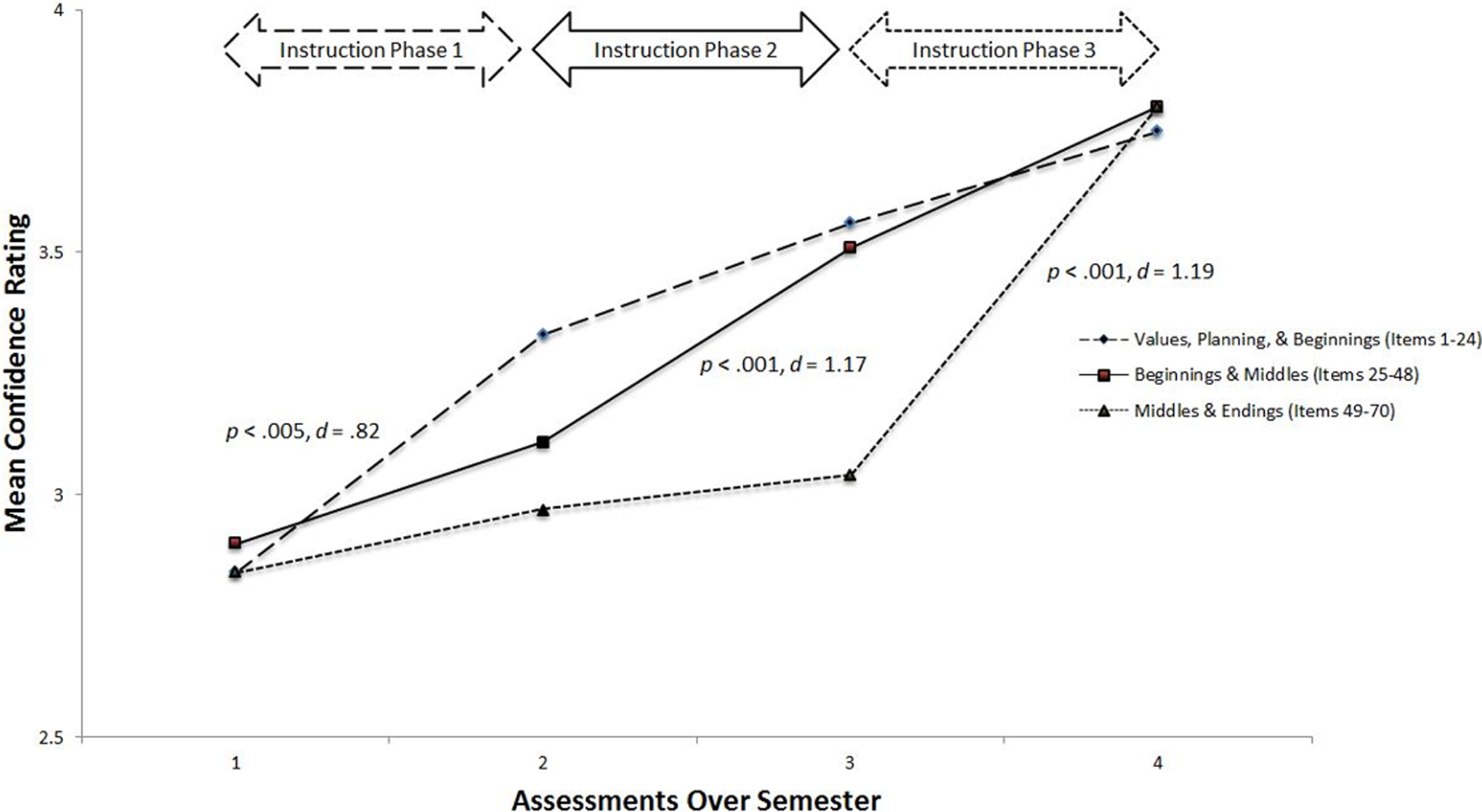
Effects of classroom instruction on confidence over phases of instruction.
Discussion and Applications for Teaching and Practice
This study is a response to the need for controlled outcome studies about effective standards-based teaching about social work with groups. The study addresses shortcomings of previous research (Macgowan & Vakharia, 2012; Shera et al., 2013) by using a controlled single-case design that permits inferences about whether changes over time can be attributed to the teaching approach rather than extraneous factors. There were significant, strong gains over time in trained portions of the Standards, with nonsignificant increases in untrained portions of the Standards. The findings supported the single hypothesis posed in this study that there would be significant positive changes in ratings of confidence for performing the Standards after training occurred and no significant changes in ratings of confidence before training occurred. As found in a previous study (Macgowan & Vakharia, 2012), there were both significant and substantial improvements over time in students’ confidence in using the Standards, within the range of those reported in studies measuring self-efficacy in social work education (Holden et al., 2008). In addition, gains were sustained beyond the dedicated instruction periods. These gains may have been due to continued discussion in class about those items or from students successfully applying the learned material in their concurrent field placements. The findings from this study have applications for advancing standards-based teaching about group work practice and for empirical research about group work education approaches.
First, the teaching method may be used to increase student confidence in their ability to perform the Standards in practice. The essentials of the teaching approach consisted of initial assessment using the reliable and valid ICSWG to identify areas of low confidence in the Standards and then have students gain knowledge and skills through specific readings and role plays to build proficiency in those areas of the Standards. The findings from this and the earlier study (Macgowan & Vakharia, 2012) indicate that this focused teaching approach appears to help building knowledge and confidence in the IASWG Standards for Practice of Social Work with Groups. The assignments, role plays, and discussions in class focused on the Standards, which contributed to gains in students’ confidence in performing the Standards in practice. Although not examined in this study, previous research on self-efficacy and actual performance suggests that student confidence ratings should relate to their ability to perform them in practice (Anastas, 2010; Holden, Anastas, et al., 2003; Holden et al., 2007, 2008; Holden, Meenaghan, et al., 2002; Kranz & O’Hare, 2006; Larson & Daniels, 1998; Macgowan & Vakharia, 2012; Murdock et al., 2005; Rishel & Majewski, 2009; Stevens, 2006). This study adds to the few studies of Standards-based education on social work with groups and provides a model of teaching for replication. The teaching approach equips students with foundation group work competencies that have been linked with the CSWE core competencies (CSWE, 2008; Macgowan, 2012) and may be used in introductory bachelor of social work (BSW) and MSW group work courses. A condensed version of the educational approach may be used in continuing education with practitioners who have not had formal exposure to the group work Standards.
An important part of the teaching is using the ICSWG to assess initial confidence in the Standards. Students then select items they think they are “unconfident” in doing and build knowledge and skills through readings and role plays. The ICSWG does not need to be readministered but, if so, what level of “confidence” should be expected after instruction? Based on the results of this study and data from the first study where the mean confidence rating at posttest was 3.51 (SD = 0.32) for 123 BSW and MSW students (Macgowan & Vakharia, 2012), it is suggested that ratings after instruction should at least reach the second tertile within confidence (i.e., 3.33 on a 4.00 scale) and preferably the second half (i.e., 3.50).
Although there are many writings about social work education and methods for teaching about social work with groups (e.g., Anastas, 2010; Kurland & Salmon, 1998; Wayne & Cohen, 2001), there is little discussion about rigorous quantitative designs for evaluating the effectiveness of teaching approaches and learning outcomes. Carpenter’s review (2011) of designs used in social work education reported no utilization of rigorous controlled studies in learning outcomes, but noted that time-series designs were promising. This is the first application of such a design to assess outcomes of teaching group work methods to social workers. For research on group work education, the controlled single-case design used in this study is a practical alternative to controlled studies involving multiple classrooms, requiring fewer participants and only one classroom. Another abbreviated MBD with somewhat weaker internal validity involving only three assessments and two content areas, which was applied to evaluate a continuing education workshop (Schinke, Smith, Gilchrist, & Wong, 1981), is a simpler alternative to the present design.
A limitation to this study was the use of a self-report measure that was completed in class. Future research should use an objective measure to test the effects of confidence on changes in skill level in natural settings. Ultimately, however, increases in confidence should be validated by corresponding gains in student performance and subsequent improvements in group processes and outcomes for group members. Promoting social workers’ adherence to the Standards is important and worthwhile, but it is not a substitute for demonstrating how these changes actually benefit group members. This study is an important, early step in the evaluation of teaching group skills to social workers. Finally, this study utilized one method of teaching, which is effective. No single strategy adequately assesses all group work competencies for all students and teaching styles. Each approach has its own strengths and challenges. There are now three studies representing two different approaches to teaching about the Standards (Macgowan & Vakharia, 2012; Shera et al., 2013) but more are needed to test different teaching methods.
Summary and Conclusions
This study successfully replicated a method for developing knowledge and confidence about the IASWG Standards for Social Work Practice with Groups. Replications of effective instructional programs are rarely seen in the literature, and this one was carried out with a novel, abbreviated, MBD. This study improved on previous studies to determine whether the teaching approach increased student confidence in doing the Standards. There were significant and substantial gains in student confidence that can be attributed to the teaching method. This study offers a validated instructional approach that may be used by group work educators to build student confidence in important foundation group work competencies.
Footnotes
Declaration of Conflicting Interests
The authors declared no potential conflicts of interest with respect to the research, authorship, and/or publication of this article.
Funding
The authors received no financial support for the research, authorship, and/or publication of this article.