



Abstract
Objective:
The objective was to examine reference errors in research articles published in Research on Social Work Practice. High rates of reference errors in other top social work journals have been noted in previous studies.
Methods:
Via a sampling frame of 22,177 total references among 464 research articles published in the previous decade, a sample of 500 references were randomly selected and verified against the original work for accuracy in the following fields: author name(s), publication year, article title, journal title, volume, and page number(s).
Results:
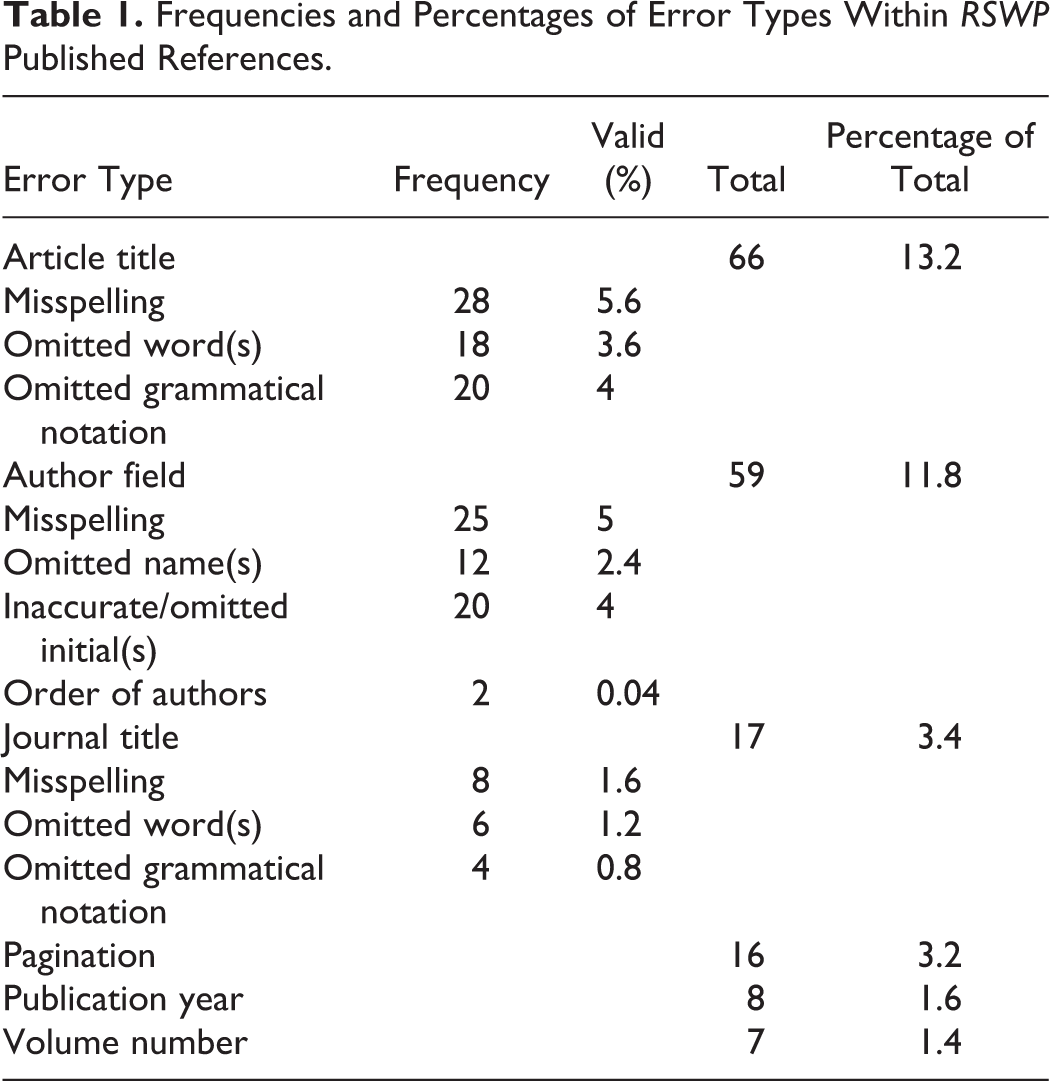
Almost 27% of references contained at least 1 error (0.35 errors per reference); 173 errors in total. The plurality of errors occurred in article titles (13.2%). Two factors significantly related to the likelihood of error: reference age and number of authors.
Conclusion:
Comparison to reference error rates in other social work journals is discussed, as are suggestions to authors, editors, and educators regarding error reduction.
Keywords
Background
According to the Publication Manual of the American Psychological Association (APA; 2009, p. 9), “Authors of scientific articles contribute most to the literature when they communicate clearly and concisely.” This clarity includes correctness of content in the reference list. The significance of reference accuracy in published work is reflected in a number of conditions. It reveals the rigor of quality writing, at least in the editing phase, in a profession’s scholarly output (e.g., journal publications and public reports). It allows the author to acknowledge another’s work in a professional and ethical manner. In turn, it allows the reader to search for sources embedded in an article without confusion or delay. Conversely, the lack of accuracy in reference reporting potentially undermines all of the aforementioned respects.
In the first study of its kind among social work journals, 1 Spivey and Wilks (2004, p. 281) assessed reference accuracy and highlighted a number of studies from other disciplines to emphasize the following point: “[I]mplications of citation errors are serious.” They examined the top five circulated journals (at that time) in social work and noted a substantial amount of errors among a random sample of published references; the number of errors paralleled results previously reported in other fields. Approximately a decade later, a follow-up study was conducted with similar methodology, noting similar rates of errors among the previously examined social work journals (Mitchell-Williams, Skipper, Alexander, & Wilks, 2015). Research on social work practice (RSWP) was a journal omitted from these two studies because, at the time of Spivey and Wilks’ (2004) work, RSWP was not among the top five circulated journals in social work. The current study examined RSWP articles primarily for two reasons. First, RSWP exhibits a strong 5-year impact factor compared to its peers of social work and related journals (many of which have no impact factors)—1.580 as noted in a 2014 comparative list of said journals (Leung & Cheung, 2014). Second, RSWP has promoted the importance of reference accuracy in social work, evidenced by two publications related to such (Mitchell-Williams et al., 2015; Spivey & Wilks, 2004).
Purpose and Hypotheses
The purpose of this study was to assess reference accuracy in research articles specifically housed in RSWP. Following the template set forth by Spivey and Wilks (2004), two of their three hypotheses were adopted for this study:
Unlike the Spivey and Wilks’ study, the current study was unable to include a third hypothesis because the single journal sampling (see Method section) disallowed multiple journal analyses.
Method
Design and Sampling
The methodology entails an updated, single journal follow-up to the original Spivey and Wilks (2004) study of reference list errors. For a recent follow-up study reflecting Spivey and Wilks’ sampling of five journals, see Mitchell-Williams, Skipper, Alexander, and Wilks (2015). The current study selected references from RSWP published articles in the previous decade, from January 2005 through March 2015. Book reviews, editorials, and other articles considered nonresearch in the original study also were excluded from the sampling frame in the current study. The sampling frame consisted of 22,177 total references among 464 research articles. Similar to Spivey and Wilks (2004), the current study’s sample consisted of 500 total references selected via computer generated random selection from the sampling frame. Each reference’s author name(s), publication year, article title, journal title, volume number, and page number(s) were compared against the original work for accuracy by three raters. Within three of the reference fields, the specificity of each error was recorded. Author name errors included misspellings, omitted names, inaccurate or omitted initials, and inaccurate author order. Article title and journal title errors included misspellings, omitted words, and omitted grammatical notation. Because the sample spanned two editions of the APA manual, other errors such as improper capitalization were not recorded.
Interrater Agreement
The current study utilized raw, absolute agreement as the measure of interrater agreement: the number of times of rater agreement on a rating divided by the total number of ratings (see Graham, Milanowski, & Miller, 2012, p. 7). We compared findings among three raters, with a randomly selected 15% (n = 75) of the sample in the following stratified manner. We divided the entire sample (N = 500) into three groups: Group 1—references from the 21 issues between January 2005 and May 2008, Group 2—references from the 21 issues between July 2008 and November 2011, and Group 3—references from the 20 issues between January 2012 and March 2015.
The interrater agreement samples contained the first 25 references from each group, 75 in total. Agreement was observed at 94%.
Results
Descriptive Statistics
Among the entirety of the sample (N = 500 references in RSWP), approximately 27% (n = 134) contained errors, totaling 173 errors within the entire sample. Looking deeper, almost 21% of references (n = 104) contained one error, and 6% of references (n = 30) contained two or more errors. Within the total sample, the mean number of errors per reference was 0.35.
The most common errors were identified in the article title field (13.2%), followed by author field (11.8%), journal title field (3.4%), pagination (3.2%), publication year (1.6%), and the volume number (1.4%). More specifically, the most commonly made error was article title misspellings (5.6%). Frequencies and valid percentages of error types within the references containing one or more errors are illustrated in Table 1.
Frequencies and Percentages of Error Types Within RSWP Published References.
Hypothesis 1
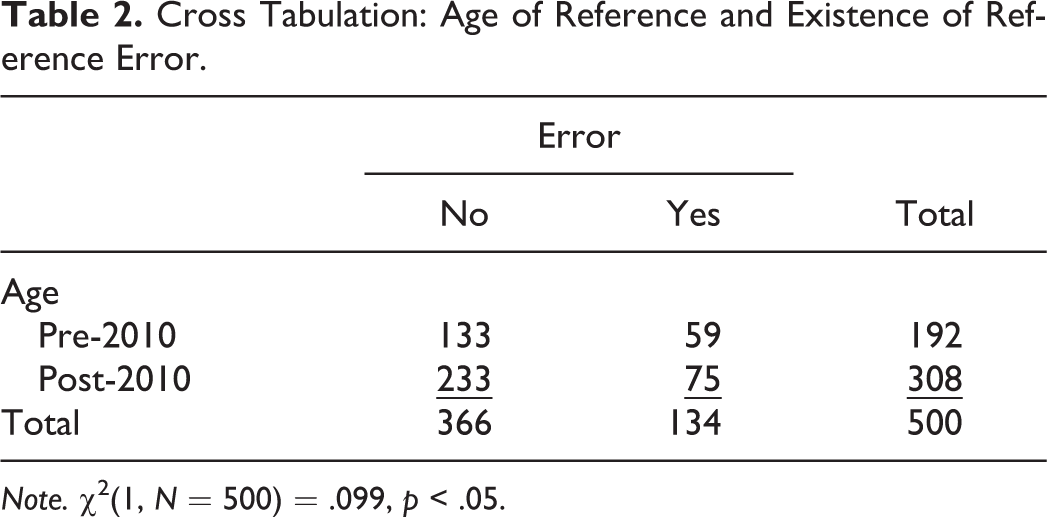
Following the original hypotheses established by Spivey and Wilks (2004), a Pearson’s χ2 test was conducted to evaluate the relationship, if any, between the age of the reference and the existence of reference errors. The results of this test were significant, χ2(1, N = 500) = .099, p < .05. Details from the two-way contingency table analysis of this test are displayed in Table 2.
Cross Tabulation: Age of Reference and Existence of Reference Error.
Note. χ2(1, N = 500) = .099, p < .05.
Hypothesis 2
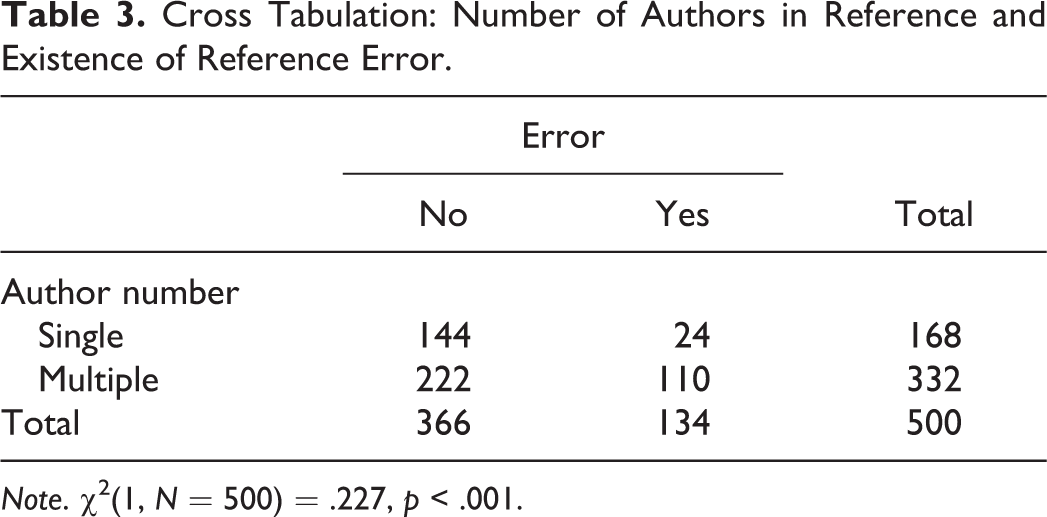
To evaluate the relationship, if any, between the number of authors in a given article (single vs. multiple) and the existence of errors, a Pearson χ2 test was conducted. Results of the test were significant, χ2(1, N = 500) = .227, p < .001. Details from the two-way contingency table analysis data of this test are displayed in Table 3.
Cross Tabulation: Number of Authors in Reference and Existence of Reference Error.
Note. χ2(1, N = 500) = .227, p < .001.
Summary of Results
To iterate, the total percentage of references containing at least one error was about 27% (n = 134). This number appears consistent with the findings of reference lists from journals in other professions, as stated in the literature review. It is also lower than the results from the original assessment, where Spivey and Wilks (2004) found at least one error in 41% of references across their sample. Descriptive statistics indicated that the most commonly made errors were contained in the article title field; specifically, the misspelling of the article title. We observed author order (0.04%) as the least common error. A Pearson χ2 test shows empirical support for Hypothesis 1, χ2(1, N = 500) = .099, p < .05, as a relationship existed between the age of the reference within the journal and the existence of an error. Another χ2 test supported Hypothesis 2, χ2(1, N = 500) = .227, p < .001: Error rates of references with multiple authors were significantly different than error rates of references with single authors. Results from both hypotheses contrasted results from similar hypotheses in the original work (Spivey & Wilks, 2004), which reported no significance in either χ2 tests. Two assumptions were derived from results in the current study regarding RSWP references. One, references of more recent age yielded a greater likelihood of error(s) in said references. Two, references with multiple authors (compared to single author) yielded a greater likelihood of error(s) in said reference. Borrowing a phrase from the Spivey and Wilks study, too many cooks (authors) did indeed spoil the broth (reference accuracy).
Discussion
APA (2009, p. 180) affirmed the notion that the accuracy of references is linked with the “credibility as a careful researcher.” In order to improve reference accuracy, thereby enhancing the credibility of scholarly inquiry, researchers have offered solutions to the problem of reference list inaccuracy. In medical literature, Fenton, Brazier, De Souza, Hughes, and McShane (2000) suggested that the understanding of shared responsibility among authors and editors may lead to increased accuracy within reference content. APA (2009) appeared to concur with Fenton and his colleagues with the following account: “The author, editor, and publisher share responsibility for the ethical and efficient handling of a manuscript. This responsibility begins when the editor receives the manuscript and extends through the life of the published article” (p. 225).
Spivey and Wilks’ (2004) original work cited two sources that continue to hold poignancy decades later regarding the responsibilities of reference list accuracy among authors and journal editors:
Foreman and Kirchoff (1987) suggested that authors verify references against the original source and that authors check with each amended draft to address errors that may be embedded within the article.
Goldberg et al. (1993) suggested that journal editors offer clear expectations of reference accuracy before manuscript submissions and that journal editors mandate a signed declaration of such by authors during the submission process.
Another suggestion is for authors to abide by, and for editors to promote vigorously, a fewer number of references unless a larger number is unequivocally warranted. Literature (e.g., Adair & Vohra, 2003; Safer & Tang, 2009.) in this area supports the notion that manuscripts contain a plethora of preventable citations/references because of the specious assumption of a more scientific appearance, thereby making it appear more presentable to journal reviewers. Safer and Tang (2009, p. 52) highlighted this point, stating that authors are encouraged “to include more references, particularly in the introduction, for the sake of credibility and appearance, rather than for specific substance.”
In addition to the above implications for editors and authors, implications exist within the educational setting. A 1991 study by Peden (as cited by Spivey & Wilks, 2004) attested that precision in reference preparation should fall on the shoulders of instructors and students. As authors of the current study, we suggest that social work educators adequately prepare students for scholarly writing (and by extension, scholarly publication) by holding students accountable. We recommend more emphatic instruction in the editing phase of scholarly writing, which would allow justly for more rigorous grading penalties for reference and other grammatical/structural errors. Accordingly, we assert that the APA Publication Manual (APA, 2009) should be a required text, rather than recommended, in every social work class. To ease the problem of reference inaccuracy, Greasley (2011) offered a solution that may be helpful for students—the utilization of bibliographic software. For example, Word software (Microsoft, 2015) enables one to create a database of references, which can subsequently be inserted as a bibliography or reference list.
Keeping these educational sentiments in mind, increased errors among published references in the past few years may reflect technological advancements. For example, writers can search peer-reviewed articles from Internet research databases (e.g., ESBSCOhost, Google Scholar, and ScienceDirect). Such easily accessible and user-friendly search conduits provide often APA formatted versions of references, allowing authors to copy or import these citations directly into their reference lists or into citation managers such as EndNote. While allowing authors to quickly identify relevant research, research databases oftentimes have incorrect formatting or citation elements which may not be corrected, even when imported into a citation manager, if left unchecked by authors. If researchers transcribe references by hand, they may be more likely to check citations for accuracy rather than import them without checking for editing errors. The relatively high rate of reference list errors in the current study indicates that many researchers may not be checking or transcribing citations by hand. At worst, the results perhaps point to an even deeper problem of authors citing without reading or possessing the cited article. Indeed, this problem has been studied in the past, with estimates that less than 25% of authors actually read the original source when citing a study (Simkin & Roychowdhury, 2006). Ease of access through these technological advances may further exacerbate the problem of authors copying references without consulting the original study by allowing authors to easily copy and paste the improper citations of other authors, thereby hindering other scholars from finding the original source. Recognizing that technology influences the efficiency of information gathered, we assert the importance for educators and journal editors to encourage scholars to take caution when utilizing these online reference importation methods.
Future Research
We recognized future areas of research from this study. One is to conduct a cross-discipline analysis of reference errors between top journals (ranked by impact factor) in social work and allied health-related disciplines, utilizing analysis of covariance to control for confounding influence potentially from age of reference and author number per reference. Another line of future inquiry is to delve deeper into the error numbers and assess the importance of, and responsibility for, reference accuracy from current editors and recently published authors, that is, a follow-up to a similar study conducted a decade ago (Wilks & Spivey, 2004) with comparative findings. Finally, future research should perhaps survey a sample of social work scholars themselves to further understand the contributing factors in committing reference list errors. As previously discussed, we suspect that the overreliance on technology, such as automatically generated citations from databases, online citation generators (e.g., Citation Machine), and reference managers, has worsened the amount of errors committed over time, as found by the current results. In addition, the relatively high incidence of reference list errors indicates, perhaps, a lack of overall attention and care in preparing manuscripts. If nearly 30% of scholars are committing simple reference errors, how might social work scholars be cutting corners in other aspects of manuscript writing? For example, does this lack of care in reference list preparation also translate to more egregious lack of care in properly obtaining and interpreting original sources? Future research, therefore, ought to tap into these questions surrounding the role of technology in reference list errors in addition to authors’ process in selecting and interpreting the scholarly works they cite.
Conclusion
APA (2009, p. 180) informs us that reference accuracy helps establish one’s “credibility as a careful researcher.” To some, this credibility of research carefulness among all disciplines has markedly declined. In reviewing literature for this study, we found at least one journal editor who intimated critical mass level in the carefulness of scholarly writing (Heatwole, 2008, p. 159): “The standard of writing in current scientific journals has reached an all-time low, in terms of both poor grammar and imprecise communication.” The current study examined and revealed the carefulness, or lack thereof, among published research articles—specifically among reference content—in RSWP. We appreciate the commitment from RSWP over the past decade in disclosing reference error rates among top social work journals, including itself. The risk in doing such is exposure of writing carelessness embedded within the profession’s scholarly work. Conversely, the potential reward of exposing reference errors in social work research, we feel, is greater: increased awareness of the problem that leads to genuine self-reflection and corresponding enhanced editing skills from social work scholars.
Footnotes
Declaration of Conflicting Interests
The authors declared no potential conflicts of interest with respect to the research, authorship, and/or publication of this article.
Funding
The authors received no financial support for the research, authorship, and/or publication of this article.