




Abstract
Keywords
Preparing for an ageing population is integral to the achievement of the 2030 Agenda for Sustainable Development (United Nations Development Programme, 2017). In 2020, the number of people aged 60 or older increased to 1 billion, almost 15% of the world's population (United Nations, 2015). Between 2020 and 2050, the number of older persons is forecasted to be more than double, with 1 in 6 people in the world being an older person (United Nations, 2019). As unprecedented global ageing continues, these older adults face specific challenges. Older people are often seen as an economic burden because they increase the size of the “dependent” population, including those in need of government aid programs like medical care, which are associated with higher taxes for younger demographic groups (Chen, 2021; Garstka et al., 2005). Young people are often viewed as reckless and unappreciative of sacrifices, diminishing their access to equal standing in society.
Ageism, both implicit (subconscious) and explicit (conscious), is experienced by both older and younger people (Sun et al., 2019). Ageism could produce substantial negative influences on older adults’ physical and mental health (Horton et al., 2008; Meisner, 2012). Similarly, young people with negative attitudes toward ageing live 7.5 years less than those with a more positive attitude toward ageing (Levy & Bavishi, 2018). In addition to age stereotypes that might affect their wellbeing, the prevalence of sedentary or unhealthy lifestyles is high among youth generation (Hoffman et al., 2006; Houldcroft et al., 2014). The habits they create during this period of emerging adulthood shape their future lifestyle patterns and affect long-term health outcomes. It is important to help young people make healthy choices as early as possible in higher education settings (Gropper et al., 2012). However, the current curriculum at universities falls behind in educating college students by addressing ageism and promoting health awareness concurrently.
Taiwan, along with many other countries in Southeast Asia, is experiencing rapid population growth as life expectancy increases for individuals aged 65 or older, along with the second lowest fertility rate in the world. By 2025, Taiwan is expected to become a “super-aged” nation, with more than 20% of the population aged 65 or older (Lin & Huang, 2015). Taiwan features a culture of traditional and modern Confucianism. Cultural values instill filial obligation and respect for older adults, a primary influence on the policies and practices of gerontology. However, the accelerated rate of ageing has heightened ageist misconceptions between generations, including stereotypes that harm people of all ages. The lack of understanding between generations can result in an ageist society, a major challenge in the current practice of gerontology in Taiwan (Chien & Tann, 2017).
Increasing understanding of younger and older people's experiences requires more synergy, which can be addressed through the provision of intergenerational programs. Intergenerational activities or programs that increase cooperation, interaction, or exchange between two generations provide the opportunity for meaningful exchanges (Canedo-Garcia et al., 2017). The literature shows that intergenerational programs can reduce ageism among younger generations in ageing societies (Gualano et al., 2018). Recently, the US Centers for Disease Control and Prevention has promoted the concept of ageing in place, referring to older adults living in their own home and community (Rural Health Information Hub, 2022). However, the extant literature indicates that most intergenerational programs have been conducted in convalescent homes, assisted-living facilities, or hospitals (Garbarino, 2019; Hsiao et al., 2020), rather than community-based settings.
In addition, most university courses engaging older adults in intergenerational activities use traditional didactic teaching methods focused on an instructor-centered approach (Chen, 2021) or lack structured ageing-related trainings that impart empathy to empower college students to develop intergenerational programs (Chien & Tann, 2017; Kalisch et al., 2013). To address the gap in the current practice of gerontology in higher education settings, our research team developed the design-thinking intergenerational service-learning model (DTISLM) in 2021, using a design-thinking approach characterized structured ageing-related trainings for empathy improvement and community service opportunities focused on older adults in community-based settings. The model empowers university students to develop intergenerational programs that address local older adults’ needs, thus promoting positive relationships and wellbeing between younger and older generations in ageing societies.
Using a purposive sampling method and mixed-methods data (pre–post surveys and after-class reflection notes) collected from 142 college students in Taiwan, this pilot study was the first to examine the effects of DTISLM on improving (a) empathy toward older adults; (b) ageism and age-related stereotypes among young people; (c) intergenerational relationships between college students and older adults; and (d) wellbeing and health awareness. This study shows the significant impacts of DTISLM on improving college students’ attitudes toward older adults and intergenerational relationships. In addition, DTISLM might promote wellbeing (i.e., life satisfaction) and healthy lifestyle such as exercise among college students. In terms of sustainability, DTISLM features a weekly syllabus and handbook to guide faculty members as they build partnerships with community centers for older adults, making it easy to replicate or promote in long-term care institutions with intergenerational service needs or universities in different regions of Taiwan or other countries. This mixed-methods pilot study was the first, to the best of our knowledge, to test the DTISLM intervention empirically among college students in Taiwan. Findings of the present study provide important implications for social work practice and research on intergenerational programs that help build positive social relationships with older adults and promote health to create age-friendly societies.
Theoretical Background and Literature Review
Ageism and Stereotypes
Older adults are often perceived to have the lowest social status of all age groups due to their perceived lack of contributions to society, which often results in ageism (Kite & Johnson, 1988). Pre-existing negative attitudes about ageing tend to manifest in various ways during the daily life of an older adult. The institutionalization of ageism in the United States is strongly associated with younger people's negative views of older adults (Nelson, 2002). Ayalon (2013) concluded that ageism is the most prevalent category of discrimination, finding approximately 35% of individuals aged 18 or older possessed ageist stereotypes. Adopting negative attitudes toward ageing or the future self at an early age is a growing concern because studies have identified an associated risk to health and well-being (Lamont et al., 2015; Wurm et al., 2017).
Health implications such as mortality risk, poor functional health, slower recovery from illnesses, and worsened mental health are all related to the internalization of negative attitudes toward ageing (Bryant et al., 2012; Meisner, 2012). On average, individuals with negative attitudes toward ageing live 7.5 years fewer than those with a more positive attitude toward ageing (Levy & Bavishi, 2018). The complexity of ageism has led to the institutionalization, marginalization, and discrimination of responsibility, social status, and dignity of older adults, forecasting a pattern of perceived ill health for future generations (Nelson, 2002). The demographic shift of the ageing population is accelerating and exacerbating ageist stereotypes in society (Nelson, 2002; Palmore, 2001). Developing effective interventions to reduce ageism is a priority in all age groups.
Ageism and Intergroup Contact Theory
The contact hypothesis proposed by Allport (1954) argues that bringing two parties together under the condition of equal status, intergroup cooperation, shared goals, and support by social and institutional authorities can result in the reduction of bias between groups (Allport, 1954; Stephan & Stephan, 1985). The most significant aspect of intergroup contact is to allow self-disclosure during contact, because voluntarily providing information to another person is an intimate and personal act (Jourard, 1971; Omarzu, 2000; Pettigrew, 1998). Moreover, self-disclosure allows the other person to gain knowledge and insight into their situation, reducing uncertainty about the subject and allowing dissonance to occur (Rothbart & John, 1985). This helps break down the negative stereotypes that participants previously held (Brewer & Brown, 1998; Leippe & Eisenstadt, 1994). Past studies have shown that younger and older adults who have regular high-quality interactions created norms of acceptance, filling in incomplete information that may have formed stereotypes, which reduced their negative attitudes toward older adults (Pettigrew & Tropp, 2006).
Intergenerational Educational Intervention
Intergroup contact theory is often used as the basis for intergenerational contact interventions, in which intergenerational educational interventions about ageing are the most common method to reduce negative ageist stereotypes (Wurtele & Maruyama, 2013). Intergenerational educational programs targeting young adults are frequently conducted in partnership with academic institutions to be implemented in classes or community service-learning programs (Christian et al., 2014). Core concepts of these programs include educating professionals and the general public and reinforcing the intergroup contact of younger and older adults to reduce intergroup biases and enhance intergenerational relationships (Celdrán et al., 2009; Fujiwara, 2016; Galbraith et al., 2015; Sakurai et al., 2016).
Previous studies have used various topics for intergenerational educational interventions, such as ageism awareness (Agmon et al., 2018; Sun et al., 2019), general knowledge of ageing (Garbarino, 2019), or even physical education for older adults (Ruiz-Montero et al., 2020). For example, the Meaningful Connections intervention provided by Arizona State University–Salvation Army Program involved weekly meetings with students using discussion prompts (e.g., hobbies, travel, career, etc.) at both senior centers and assisted-living facilities (Penick et al., 2014). The course curriculum focused on letting older adults reminisce to support ego integrity and younger adults to explore their identity and relationship, and participants showed significant ageism reduction. Studies have assessed the effectiveness of intergenerational interventions by examining changes in the participants’ attitudes (e.g., ageist stereotypes), empathy, and closeness toward specific target groups after going through the intervention (Ames & Youatt, 1994; Christian et al., 2014; Dovidio & Gaertner, 1999; Gamliel & Gabay, 2014; Sun et al., 2019). Scholars found that traditional didactic teaching methods that involve a teacher-centered approach have limited benefits (Young et al., 2016). Moreover, student participants of intergenerational educational programs typically come from one department such as psychology or clinical-related fields (e.g., Garbarino, 2019; Heuer et al., 2020; Miller et al., 2017; Penick et al., 2014) rather than across departments with a diversity of majors.
Health Belief Model
In addition to traditional objectives of intergenerational educational interventions, scholars started to explore whether interacting with older adults is also related to significant elements of health promotion among participants. Theoretically, the health belief model (HBM) proposed that individuals will be motivated to act in healthy ways if they believe they are susceptible to a particular negative health outcome (Carpenter, 2010; Rosenstock, 1974). Thus, understanding the physiological experiences of older adults may mitigate the negative influences of a sedentary lifestyle and motivate younger adults to modify their unhealthy behaviors.
Several studies used the HBM to examine college students’ diabetes self-management and weight management (Deshpande et al., 2009; McArthur et al., 2017). An example of such an intergenerational program is the Intergenerational Mobile Technology Opportunities Program, which focused on health promotion behaviors and ageism. The intervention allowed college students to interact with older participants with diabetes by tutoring them regarding self-care knowledge and skills for diabetes symptom management using mobile devices such as tablets (Hsiao et al., 2020; Tseng et al., in press). The study showed that interaction with older adults can not only reduce younger adults’ ageist stereotypes but also promote healthy behaviors (Hsiao et al., 2020). However, due to the program being designed solely for older adults with chronic diseases, the intergenerational course materials did not focus on younger adults who served as tutors rather than taking a leading role in developing the intergenerational activities.
Design-Thinking Intergenerational Service-Learning Model
In the extant literature in Western societies, most intergenerational educational programs were conducted at assisted-living or geriatric facilities and nursing homes (Garbarino, 2019; Miller et al., 2017; Ruiz-Montero et al., 2020). Recently, ageing in place—the ability to live in one's own home and community safely, independently, and comfortably—has been promoted by the US Centers for Disease Control and Prevention (Rural Health Information Hub, 2022). In the context of Taiwan's culture, most of the older adults prefer living at home or in community as they age, rather than relocating or moving into long-term care institutions.
Although university courses have used various formats (e.g., seminar on healthy ageing, social gerontology, service learning, workshops) to involve older adults in intergenerational activities, most activities were led or planned mainly by instructors rather than college students (Chen, 2021; Hsiao et al., 2020; Sun et al., 2019). Moreover, these courses or extracurricular activities lacked structured trainings using a design-thinking approach characterized by strategies that improve program developers’ empathy toward service recipients, helping them identify recipients’ social problems and provide relevant solutions.
Hence, our cross-university research team developed DTISLM for community-based settings in 2021. A university curriculum with an 18-week module across 36 h (i.e., 2 h per week), DTISLM integrates a design-thinking approach (i.e., empathy, define, ideate, prototype, and test) and service-learning framework to improve ageing stereotypes, intergenerational relationships, and health awareness among college students. College students receive structured ageing-related trainings (i.e., ageing experience, communication, and observation skills) for needs assessments among older adults and lectures about how to apply design-thinking skills to develop and implement intergenerational activities (e.g., physical exercise and language exchange) that address older adults’ needs in community-based settings.
To create intergenerational service programs in local communities, the research team established a university–community collaboration platform in long-term care with 13 daycare or activity centers for older adults in the neighborhoods surrounding the participating universities. To improve college students’ geriatric competencies and empower them to take leading roles in intergenerational program development focused on older adults in community-based settings, three faculty members of the research team and professional lecturers in gerontology or geriatrics, physical therapy, public health, and social work provided cross-university trainings for students. These trainings involved: (a) an introduction to the United Nations sustainable development goal of promoting good health and wellbeing in the context of an age-friendly society; (b) ageing simulation activities to improve their level of empathy for older adults; (c) observation and interview skills from a design-thinking perspective to learn about older adults’ health status, chronic disease history, and needs; (d) communication skills with older adults; (e) ageing lifestyle redesign; (f) introduction of community partners in the context of long-term care; and (g) problem-solving skills for program implementation.
To address the literature gap in international intergenerational programs in gerontology, this pilot study of DTISLM used mixed methods to explore the effects of the model on: (a) level of empathy toward older adults; (b) ageism and stereotypes among young people; (c) intergenerational relationships between college students and older adults; and (d) wellbeing and health awareness using data (pre–post questionnaires and after-class reflection notes) collected from 142 college students in Taiwan. Qualitative methods were used to obtain an in-depth understanding of changes in attitude and behavior before and after the intervention and the characteristics of intergenerational interactions and relationships and health awareness among college students in the context of Taiwan.
Method
Samples and Data Collection Procedures
Using a purposive sampling approach, college students were recruited by three investigators and their research assistants at universities where they work in Taichung, Pingtung, and Hualien (i.e., western, southern, and eastern regions) in Taiwan. At start of the spring and fall semesters in 2021, between March and December, research assistants at the three universities went to classes to introduce the project, DTISLM, and recruit participants. Inclusion criteria for participation included the following: (a) aged 18–30 and (b) committed to attending the trainings and volunteering at daycare centers for 36 h. Enrollment packages included a participant consent form and survey and were distributed at the classes. The principal investigator of the study received funding from the Ministry of Health and Welfare's Health Promotion Administration in Taiwan in January 2021. This study was approved (IRB110-045-B) by the institutional review board at a university-affiliated hospital, Hualien Tzu Chi Hospital, Taiwan, in February 2021.
One hundred fifty-four college students participated in the project and completed pretest questionnaires online. Participating students received structured ageing-related trainings and lectures for 14 h (i.e., 2 h per week for 7 weeks) to improve their knowledge relevant to the ageing population, empathy, and communication skills with older adults. In a group format with four to six members per group, students were assigned to one of 13 older adult daycare centers in the neighborhood. They spent 6 h observing older adults’ on-site activities and behaviors and interviewing them to understand their chronic disease history, health status, and needs.
Following three steps of design thinking—problem definition, ideate, and prototype—students identified health issues or social problems faced by older adults based on results from interviews with them and on-site observation. Working in groups, they focused on one issue in each group. Then students designed sustainable age-friendly solutions in the context of intergenerational programs (e.g., group-based aerobic exercise to improve older adults’ physical function, medication management at home, and painting books together) to address the identified problems in group work. Afterward, they implemented the intergenerational programs at daycare centers 2 h a week on four occasions. After each visit, each student provided a reflection on their intergenerational interaction experience. All participated students completed post-test questionnaires online after they completed all trainings and intergenerational activities at the centers required by DTISLM, totaling 36 h at the end of the semester in 2021. Twelve students could not complete the post-test questionnaires due to a COVID-19 pandemic shutdown in 2021 because they were unable to implement intergenerational activities with older adults at the center prior to the shutdown.
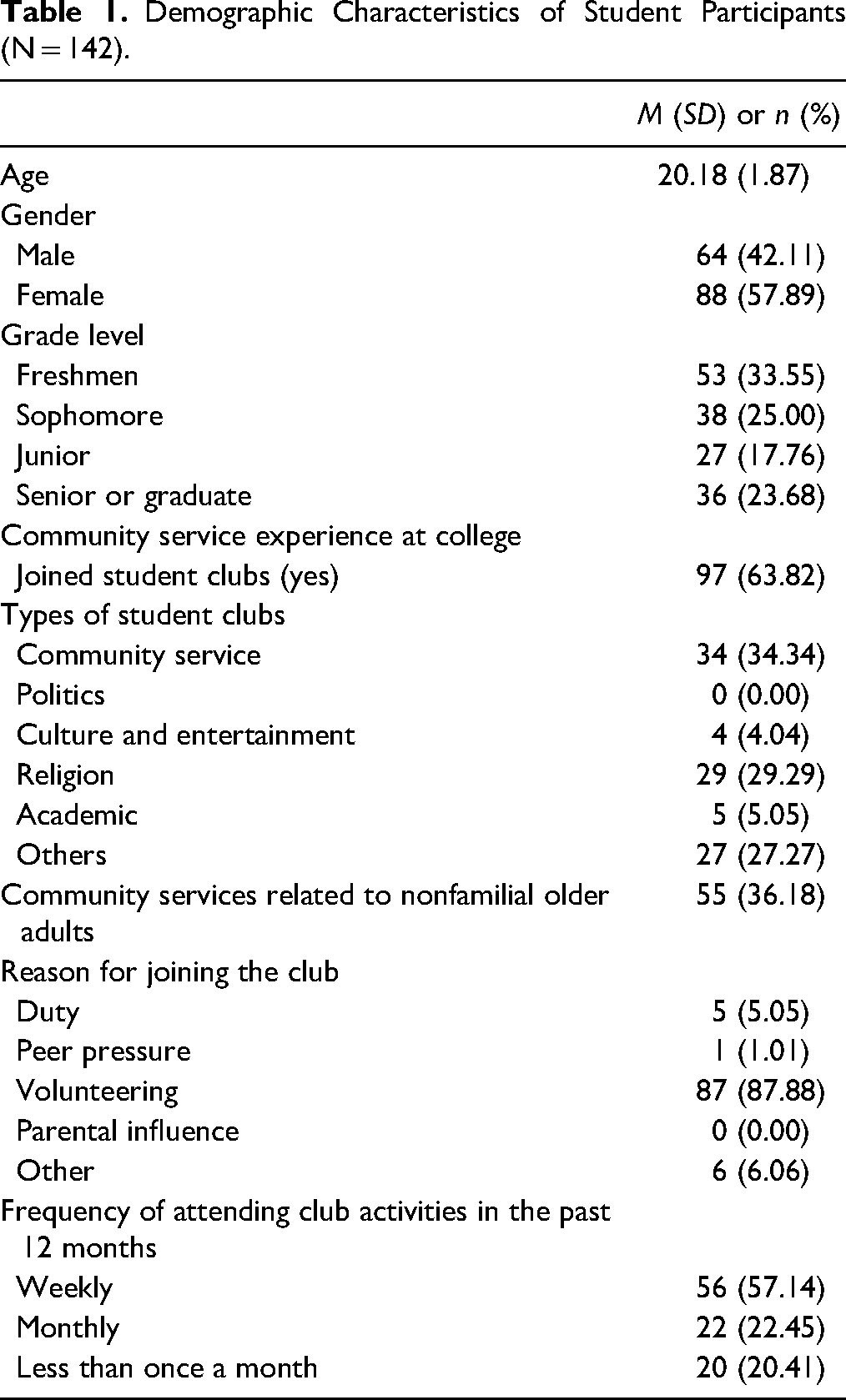
Table 1 shows the sociodemographic information of student participants from three universities. Among 142 student participants, 58% were female and the mean age was 20.18 years (SD = 1.87). Most participants were either freshmen (34%) or sophomores (25%). Students majored in interdisciplinary fields such as social work, medicine, laboratory medicine and biotechnology, nursing, physical therapy, child development and family studies, and human development and psychology. More than 63% participants joined student clubs relevant to community service (34%), religion (29%), and others (27%). They primarily joined clubs to volunteer (88%), and only 5% reporting joining out of a sense of duty. Most student participants were active in their clubs; 57% attended club activities weekly. More than 36% of participants had previously provided social services to nonfamilial older adults.
Demographic Characteristics of Student Participants (N = 142).
Measures
Questionnaires included demographic information (gender, age, educational attainment, and years of providing services for older adults) and validated scales such as attitude toward older adults, intergenerational relationship, empathy, altruistic value, satisfaction with life, and health promotion behavior. All pre–post questionnaires were administered online and filled out by college students at participating universities.
Attitude Toward Older Adults
The Kogan Attitudes Toward Old People Scale (Kogan, 1961) was used to measure the participants’ attitudes toward older adults. The measure consists of 34 items with a six-point Likert scale (1 = strongly disagree to 6 = strongly agree), with 17 items worded positively and 17 items worded negatively. The overall purpose of the scale is to measure attitude toward older adults, which is an unobservable variable (Yen et al., 2009). The survey includes items like “Most older adults get set in their ways and are unable to change,” “Most older adults are irritable, grouchy, and unpleasant,” and “People grow wiser with the coming of old age.” The scale had high internal consistency in this sample (Cronbach's α = .82). After reverse coding of negatively worded items, higher scores indicated lower negative attitudes toward older adults.
Intergenerational Relationship
A scale measuring parent–child relations was adopted from Lo (1997) and adapted to measure intergenerational relationships between younger and older generations. Items include “When talking to older adults, I feel that they understand me” and “In general, I don’t think I get along well with older adults.” Items were rated on a five-point Likert scale (1 = strongly disagree to 5 = strongly agree). The measurement showed high internal consistency in the sample (Cronbach's α = .82). After reverse coding, higher scores indicated more positive relationships between younger and older generations.
Empathy
The Interpersonal Reactivity Index (Davis, 1980) was used to measure the empathy of the participants. The measure has 28 items and a five-point Likert scale that ranges from 1 (does not describe me well) to 5 (describes me very well). The index has four subscales, each consisting of seven items: perspective-taking (e.g., “I try to look at everybody's side of a disagreement before I make a decision”; Cronbach's α = .82); fantasy (e.g., “I really get involved with the feelings of the characters in a novel”; Cronbach's α = .82); empathic concern (e.g., “When I see someone being taken advantage of, I feel kind of protective towards them”; Cronbach's α = .84); and personal distress (e.g., “Being in a tense emotional situation scares me”; Cronbach's α = 80). The measure showed high internal consistency in the sample (Cronbach's α = .81). Higher scores indicated a higher level of empathy.
Altruistic Value
The Self-Report Altruism assesses the altruistic values of the participants. The measure consists of 20 items on a five-point Likert scale (1 = never, 2 = once, 3 = more than once, 4 = often, and 5 = very often). It includes statements such as “I have helped an acquaintance to move households” and “I have done volunteer work for a charity.” The measure showed high internal consistency in the sample (Cronbach's α = .82). Higher scores indicated higher level of altruism.
Satisfaction With Life
The Satisfaction with Life Scale (Diener et al., 1985) was used to measure the subjective wellbeing of the participants. The measure has five items with a six-point Likert scale (1 = strongly disagree to 6 = strongly agree), in which the participants indicate their agreement with each statement (e.g., “In most ways, my life is close to my ideal”). The scale had high internal consistency in our sample (Cronbach's α = .82). Higher scores indicated a higher level of life satisfaction.
Adolescent Health Promotion Behavior
The Adolescent Health Promotion Scale (Chen et al., 2014) was used to measure the participants’ health-promoting behaviors. The measurement has six subscales: nutrition (e.g., “Eat breakfast daily”; Cronbach's α = .89); social support (e.g., “I speak up and share my feelings with others”; Cronbach's α = .88); health responsibility (e.g., “I watch my weight”; Cronbach's α = .88); life appreciation (e.g., “Make an effort to like myself”; Cronbach's α = .88); exercise (e.g., “Exercise rigorously 30 min at least 3 times per week”; Cronbach's α = .88); and stress management (e.g., “Make an effort to spend time daily for relaxation”; Cronbach's α = .88). Overall, the measure consists of 21 items using a five-point Likert scale from 1 (never) to 5 (always). The scale had high internal consistency with this sample (Cronbach's α = .87). Higher scores indicated better health promotion behaviors.
Data Analysis Procedures
Questionnaires
Quantitative data collected from pre–post questionnaires completed by 154 participating students were analyzed using paired-sample t-tests and Kruskal–Wallis tests to assess pretest and post-test differences and whether the differences followed a normal distribution. The statistical analysis utilized SAS software version 9.4. Research hypotheses for this pilot study were: (H1) level of empathy toward older adults—(a) perspective-taking, (b) fantasy, (c) empathic concern, and (d) personal distress—would increase; (H2) attitude toward older adults would improve; (H3) intergenerational relationships between college students and older adults would improve; (H4) level of altruism would increase; (H5) level of satisfaction with life would increase; and (H6) health promotion behavior—(a) nutrition, (b) social support, (c) health responsibility, (d) life appreciation, (e) exercise, and (f) stress management—would improve after students participated in and completed the DTISLM intervention.
Reflection Notes
All participating students were asked to complete after-class self-reflection notes. The following open-ended questions were guidelines:
Have you developed or improved any skills from DTISLM? What do you think about older adults and the ageing process after participating in DTISLM? Do intergenerational interactions influence your attitude and thoughts toward older adults? If so, what are those impacts? Do intergenerational interactions influence your attitude and behaviors about health? If so, what are those impacts? What are the important takeaways that you learned from DTISLM?
Qualitative data of all self-reflection notes written by student participants were coded by four members of the research team through a process of selective open coding. For the first stage of the process, each coder worked independently to read and code several randomly assigned notes. Then, the coders and principal investigators met regularly to discuss the responses and identify emergent patterns (Patton, 2005). The coders and principal investigators reviewed the open-coded data to enhance intercoder agreement; that process helped ensure that the codebook reflected a high degree of intercoder agreement. The codebook was imported into Dedoose, a web-based, cross-platform application used to analyze qualitative research (Niedzielski et al., 2016; Unertl et al., 2015). Prior to data analysis, the coders used Dedoose to test interrater reliability to ensure a high level of consistency. The coders received Cohen's kappa scores >.80, indicating high reliability (Landis & Koch, 1977). After the qualitative analysis was complete, a research assistant proficient in English translated a selection of self-reflection notes related to key themes for use in English language journal articles.
Results
Quantitative Results
Table 2 shows the pre–post results regarding changes in various outcomes among participating students. H1 proposed that level of empathy toward older adults would increase after the intervention. Results of paired-sample t-tests analysis showed that participants’ level of empathy in the pretest (M = 46.37, SD = 6.53) significantly increased after completing the DTISLM program (M = 49.52, SD = 6.62), which supported H1 (p = .001, d = −.455, 95% confidence interval [CI] [−.746, −.220]). The effect size (Cohen's d) value of .455 suggests modest improvement of empathy after the intervention. Three indicators of empathy—perspective-taking (p = .027, d = −.222, 95% CI [−.476, −.022]), fantasy (p = .001, d = −.457, 95% CI [−.745, −.224]), and empathic concern (p = .001, d = −.457, 95% CI [−.745, −.224])—significantly improved after students completed the intervention, partially supporting H1a-1c. However, the fourth indicator of empathy, personal distress (p = .195), was not statistically significant, which failed to support H1d. Through interacting with older adults, participants’ attitudes toward older adults before (M = 55.08, SD = 5.88) and after (M = 56.32, SD = 6.81) the DTISLM intervention significantly improved (p = .005, d = −.238, 95% CI [−.451, −.064]), which supported H2. There was a modest improvement of participants’ positive attitude toward older adults. Similarly, as H3 posited, intergenerational relationships with older adults (p < .001, d = −.370, 95% CI [−.599, −.180]) significantly improved after participants interacted with older adults through intergenerational activities they developed.
Pre–Post Changes in Attitude Toward Older Adults, Intergenerational Relationship, Empathy, Altruism, and Health Promotion Behavior Among College Students (N = 142).
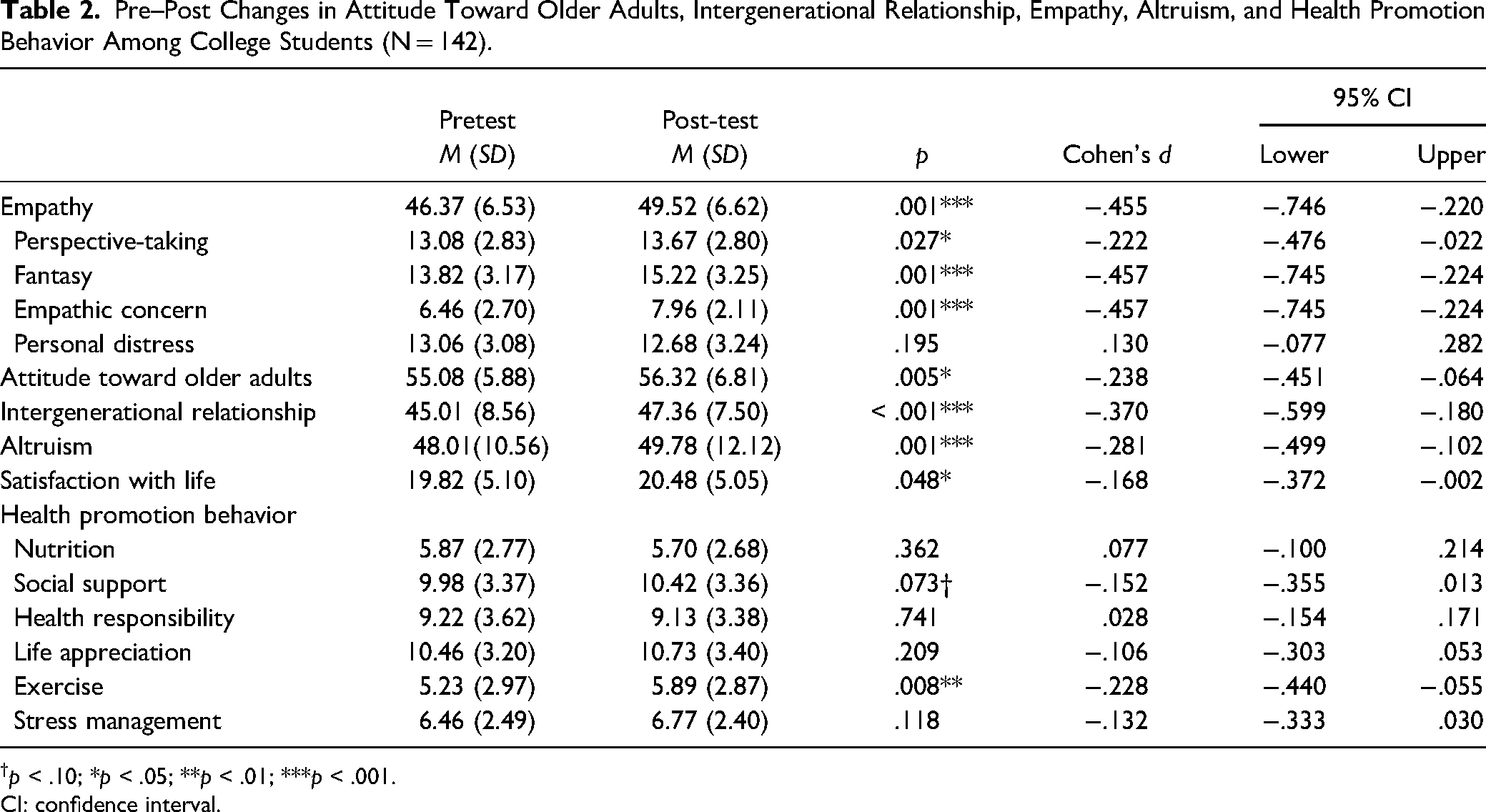
†p < .10; *p < .05; **p < .01; ***p < .001.
CI: confidence interval.
Moreover, H4 was supported by results showing that participants’ level of altruism significantly increased after the intervention (p = .001, d = −.281, 95% CI [−.499, −.102]). Similarly, level of satisfaction with life among participants (p = .048, d = −.168, 95% CI [−.372, −.002]) increased significantly after they interacted with older adults through various intergenerational activities (M = 20.48, SD = 5.05), which supported H5. However, the effect size value of .168 indicated a small improvement between pretest and post-test. Among six indicators of health promotion behavior, only the amount of exercise significantly increased among participants after the intervention (p = .008, d = −.228, 95% CI [−.440, −.055]), with modest improvement, supporting H6e. In addition, after completing the DTISLM program, participants’ level of social support in the post-test increased with marginal significance (p = .073, d = −.152, 95% CI [−.355, −.013]), partially supporting H6b. Although in the post-test, the level of life appreciation (p = .209) and stress management (p = .118) increased, the pre–post changes were not significant statistically. In addition, changes in nutrition (p = .362) and health responsibility (p = .741) were not statistically significant. Hence, H6c, d, e, and f were not supported by the pre–post results.
Qualitative Results
Six themes emerged from participating students’ reflection notes that indicated ageing-related trainings provided by the DTISLM program with intergenerational activities developed by student participants improved their level of empathy toward older adults, age stereotypes, social relationships with older adults, self-examination of intergenerational relationships with family members, life satisfaction, and healthy lifestyle habits.
Increased Level of Empathy Toward Older Adults
Age-related simulation trainings and on-site observation of older adults’ behaviors enhanced participating students’ knowledge of older adults’ ageing process, deterioration of physical functions, mental health, and lives. Wearing the age simulation suit in class, I realized why older adults walk so slowly! Their physical deterioration causes inconvenience in their daily life. Sometimes as young adults, we feel impatient at those with slow walking speed, so after this simulation activity, I really sympathized with how they feel and had a better understanding of them. (Female participant, 23 years old)
Older adults usually don’t share with others about how they feel when there are language or cultural barriers between two generations. Hence, we should put ourselves in their shoes for interaction or program development since they are in wheelchairs or have dementia that prevents them from normal communication with others. (Male participant, 21 years old)
Changes in Age Stereotypes
The DTISLM program helped young participants change their negative beliefs regarding older adults. Not only did they gain a new perspective and awareness toward older adults, but many of the previous negative stereotypes they held against older adults were replaced by positive perceptions. Originally, I thought older adults were difficult to talk to. However, after participating in this program, I found they were very lovely, friendly, and willing to share. They all have unique life stories. Over the past 3 weeks, I really enjoyed interacting with them, and I look forward to coming back in my own time! (Female participant, 18 years old)
The older adults are very warm and friendly. One lady told me, “You are so far away from home. If you need anything, let me know. I am always here.” I realized that older adults aren’t resistant to the new generation, but they simply don’t know how to communicate with us. (Female participant, 19 years old)
Building Social Relationships With Older Adults
The majority of the young students reported that the skills they learned from the program helped them communicate with older adults with care and build relationships with them. I think this program made me realize that the point is not understanding the same language, but it's about opening our hearts for communication. Once I understood this, I realized it wasn’t about having the right “dialect” for Taiwanese, but about my attitude, which increased my confidence to connect with older adults. (Female participant, 19 years old)
The older adults are very different from what I imagined. They are lively, creative—perhaps even more than we are! It may be due to their life experience. The feeling of embarrassment is very unlikely, and I feel very comfortable chatting with them. I’m not afraid that there aren’t any topics to talk about because they have so much to share. (Male participant, 21 years old)
Self-Examination of Intergenerational Relationship With Family Members
Attending the DTISLM program helped young participants realize that due to the ageing process, older adults experience many physical and psychological challenges, which in turn improved their ability to sympathize with the care needs of their own family members. This newfound understanding strengthened the relationship between the young participants and their family members. The older adults I interacted with told me why older adults’ reaction is slow. It's not about cognitive degradation but deterioration of physical functions such as eyesight and hearing. The conversation with him reminded me of my grandma. My father told me once that my grandma is a wise lady who kindly responds to my neglecting her. Now I realize that she might feel lonely all the time. (Male participant, 19 years old)
I felt that these Aboriginal older adults at the community centers in rural areas are different from those in urban cities. They are talkative and like to talk about their own grandchildren. I found they are easy to get along with. The experience of interacting with older adults broadened my horizons! I examined my communication skills with others and believe that intergenerational interaction will be better with my own family members in the future. (Male participant, 23 years old)
Improved Life Satisfaction Among Students
Though interactions with older adults, many young students said they were amazed by the older adults’ life stories and contributions they made to society. These intergenerational interactions increased students’ confidence and satisfaction with their lives. They don’t give up on life because they are getting old! Instead, their lifestyles are very colorful! As a matter of fact, through interviewing with them, I felt that I am very lucky because I learned the meaning of my life from our conversation. (Female participant, 20 years old)
Although the intergenerational activities we developed were easy and simple to follow, I felt very happy through interacting with them. Their big smiles made me feel being proud of myself. (Male participant, 21 years old)
Modification of Current Habits for Healthy Lifestyle
Through ageing simulation activities, on-site observation of older adults’ behaviors, and interviewing older adults about their disease history, many students reported reflecting on their sedentary lifestyle and attempting to practice self-care skills in their daily lives. Some mentioned that they seldom exercised prior to participating in the program, but they learned that an unhealthy lifestyle can lead to health consequences. For example, physical inactivity is a major risk factor for developing sarcopenia and other chronic diseases (i.e., diabetes and hypertension). Students planned to modify their health behaviors by doing more exercise. The design-thinking class educated us to understand what older adults value so we could develop intergenerational activities to better fit their needs. Hence, I interviewed two older adults and observed their lifestyles. Two older adults had completely different lifestyles. One had an unhealthy lifestyle such as eating greasy food and visiting doctors only when he felt sick, while the other had a healthy life with light diet and did regular health examinations. I realized that each older adult has habits and food preferences that led to their current health condition. (Female participant, 23 years old)
I learned they are very aware of their health—being able to walk, cook, clean—breaking the stereotype that when I get old, my health will deteriorate. In fact, physical condition isn’t related to age but our lifestyle. Habits do matter! Therefore, I want to follow their healthy lifestyle and change some of my bad behaviors so I can be like them—a vibrant, healthy old person in the future! (Female participant, 18 years old)
Discussion
Combining a design-thinking approach and service-learning framework, our research team developed DTISLM to provide a learning environment in higher education aiming to improve age stereotypes, build intergenerational relationships between college students and older adults in the community, and improve their sedentary or unhealthy lifestyles. Using mixed methods, this pilot study examined the effects of the DTISLM program on improving age stereotypes, intergenerational relationships, and health lifestyle among college students in Taiwan. Results of quantitative and qualitative data collected from pre–post questionnaires and after-class reflection notes show significant improvements among young participants in various aspects. Our qualitative results provided explanations for significant changes in attitude and behavior among participating students and some insights into nonsignificant results from the surveys.
First, quantitative results show that after participating in the DTISLM program, the level of empathy among young participants significantly increased. Reflection notes explain their changed attitudes after the intervention. Prior to the study, young participants lacked an understanding of the ageing process and had difficulty empathizing with older adults. However, the program's ageing-related simulation activities and training on observing older adults’ behaviors enhanced their understanding of the deterioration of physical functions and mental health challenges among older adults due to ageing. Hence, these young participants developed a greater sense of empathy, such as perspective-taking and empathic concern.
Second, young participants’ intergenerational relationships with older adults significantly improved after participating in the program, which is supported by pre–post results. This was echoed by the qualitative data, which indicate that before the program, many students were concerned about interacting with older adults in the community due to preconceived ageist stereotypes. However, the program brought positive experiences for the young participants through planned intergenerational activities. Most participants found that older adults at community-based centers were friendly, warm, and easy to get along with, which diminished or eliminated their age stereotypes. These findings are consistent with previous studies based on intergroup contact theory, which posits that positive contact with older adults is related to a reduction in ageism (Abrams et al., 2006; Bousfield & Hutchison, 2010; Kalisch et al., 2013; Lytle & Levy, 2017; McCleary, 2014; Penick et al., 2014). Our qualitative findings also show that most participants reflected on their familial relationships after interacting with older adults in the community, which helped them relate to their older family members.
Third, pre–post results indicate the young participants’ altruistic values significantly increased. Their reflection notes show that with better understanding of the ageing process and awareness of the needs of older adults, more students were willing to assist and care for the ageing population. Fourth, in terms of life satisfaction as an indicator of youth's wellbeing, analysis of pre–post surveys indicated that after interacting with older adults, the young participants were more satisfied with their life at college. Their reflection notes show that life stories shared by older adults and positive encounters with them helped the young participants find self-confidence and meaning in life. Finally, among six indicators of health promotion behaviors, the young participants’ level of social support increased with marginal statistical significance. Participating students’ reflection notes show that with empathetic attitudes and communication skills learned from the class, these students became more willing to build relationships with and support older adults and others. Moreover, their level of exercise significantly increased, as supported by pre–post survey results. The young participants did more exercise after participating in the program. Most participants mentioned that they rarely understood the association between their current lifestyle and future health consequences. However, after interviewing older adults who shared stories about their lifestyles and chronic disease history, these students reflected on their unhealthy lifestyles and realized the association between adolescent lifestyle and health outcomes in late adulthood. Through designing intergenerational activities focusing on physical activities promoting physical function for older adults, students spent more time exercising.
These results align with the literature relevant to perceived susceptibility to and severity of poor health outcomes based on the HBM (Carpenter, 2010; Rosenstock, 1974). With perceived susceptibility to developing chronic disease and an improved understanding of the potential for severe health consequences (e.g., dietary restrictions) after listening to older adults, these young participants showed stronger intentions to make lifestyle modifications to reduce their risk of developing chronic diseases. These findings support the HBM's assumption that nonfamilial interaction with patients with chronic diseases would lead college students to recognize their vulnerability to negative health outcomes (Cao et al., 2014; Conner & Norman, 2005; Davis et al., 2014; Rosenstock, 1974).
In contrast, although scores of pre–post surveys regarding stress management and life appreciation increased after students participating in the DTISLM program, the program had no statistical effect on improving their knowledge of nutrition, level of health responsibility, stress management, and life appreciation. Nonsignificant findings might be explained by the training course content, which placed less emphasis on knowledge of nutrition and skills for health management among college students. In addition, most intergenerational programs developed by student participants focused more on physical exercise and psychosocial activities (e.g., illustrating books) to improve older adults’ social engagement and psychological wellbeing (e.g., loneliness). Similarly, the literature on intergenerational programs has traditionally focused on social aspects (e.g., reducing intergroup prejudice; Chua et al., 2013; Park, 2015) rather than physical or cardiovascular activities which could be improved by including health professionals for training workshops for next phase implementation.
This study suggests that DTISLM can help young college students by significantly reducing their ageist stereotypes and enhancing their intergenerational relationships, wellbeing, and lifestyle. However, the present study had certain limitations. First, via a purposive sampling method, college students were recruited by research team at three universities affiliated with investigators’ workplace located in three cities and most participants were female (approximately 60%). More than 34% of students joined student clubs as community service volunteers. The possibility of self-selection bias (e.g., gender and high motivation for volunteering) limits the transferability of findings to students in other cities in Taiwan. The results lack of generalization. Second, demographic data collected among college students were for readers’ reference as background information which deserves future studies’ further analysis.
Third, using a design-thinking approach and social service-learning framework, DTISLM was developed by our research team in 2021 to train students regarding the ageing process, observation, interview and communication skills, and program development for older adults. Topics for intergenerational activities were completely chosen by students, and many student groups decided on a psychosocial theme for program implementation. Third, during post-test questionnaire collection in 2021 after intergenerational activities at the centers finished, the COVID-19 pandemic was so severe that all university courses were delivered online and campuses were closed. All college students were forced to stay in their dormitory or at home during the period of shutdown. They were unable to go out to purchase or cook healthy food. The COVID-19 shutdown might have affected the post-test survey results among these college students.
Implication for Research and Practice
Despite these limitations, findings of this pilot study using mixed methods provide several implications for practice and future research on intergenerational interventions. Different than traditional didactic teaching methods with an instructor-centered approach, DTISLM empowered students to develop intergenerational activities with the knowledge and skills they learned from the program. It fostered positive intergenerational relationships between younger and older adults, reduced ageist stereotypes, and enhanced the quality of interactions not only for interfamilial interactions but also for young participants’ intrafamilial interactions. DTISLM also improved their wellbeing through increasing their satisfaction with life and level of exercise. Moreover, this study was implemented from March to December 2021 during the COVID-19 pandemic that greatly affected college students’ and older adults’ lives. The implementation of intergenerational activities was delayed several times due to national shutdown policy. In addition, due to older adults’ vulnerability to COVID-19 complications, they stayed at home to avoid social contact (Galea et al., 2020), which limited their opportunities to connect with family members and maintain intergenerational relationships. Developing intergenerational programs using mobile technology to help older adults connect with their family members might reduce social isolation and improve mental health among older adults. Future research could examine the effectiveness of intergenerational programs using mobile technology with a design-thinking approach to improve intergenerational relationships and age stereotypes via virtual platforms. The efficacy of long-distance intergenerational programs on improving relationships between generations needs to be examined to see whether such programs could produce similar effects (e.g., improving young students’ age stereotypes, health awareness) as face-to-face interactions. Second, this study was implemented as a pilot study with a small sample. Given this study using small size and purposive sampling future studies could use large samples across universities to test hypothetical relationships among theoretical constructs using structural equation modeling. Last, trainings offered through the DTISLM program could focus more on disease-specific health promotion topics that involve older patients and also target young adults at colleges to examine the outcomes of such programs between two generations.
Conclusion
Taiwan's hyper-ageing society suggests the strong need for younger generations to gain much-needed knowledge and provide support for ageing populations. In addition, Taiwan has a fast-growing adolescent population with prediabetes (Menke et al., 2016; World Health Organization, 2016). Current university curricula and learning environments fall behind in preparing students for building social relationships with older adults and promoting a healthy lifestyle. Findings derived from DTISLM shed new light on the application of intergenerational programs led by college students to reduce age stereotypes and promote positive intergenerational relationships and healthy habits among young people. Such intergenerational programs may increase desirability and acceptability among young adults related to working in ageing-related fields due to their positive attitudes toward older adults. With a structured weekly curriculum and guidebook for faculty members to build partnership with community centers for older adults, DTISLM can be easily promoted at community-based canters and long-term care institutions with intergenerational service needs to create age-friendly societies.
Footnotes
Acknowledgments
We wish to acknowledge Ministry of Health and Welfare's Health Promotion Administration in Taiwan as the funder for the DTISLM study and the invaluable contribution of research team members Ms. Chun-Yu Hsieh and Mr. Pao-Sheng Chang at Tzu Chi University, Ms. Yi-Hsiu Lin at Chung Shan Medical University, Dr. Ling-Yu Chang at Meiho University, and staffs at community-based centers for data collection and program implementation.
Declaration of Conflicting Interests
The authors declared no potential conflicts of interest with respect to the research, authorship, and/or publication of this article.
Funding
The authors disclosed receipt of the following financial support for the research, authorship, and/or publication of this article: This work was supported by the Health Promotion Administration, Ministry of Health and Welfare (grant number B1091236).
