



Abstract
Purpose
This study explores the feasibility, acceptability, and treatment outcomes of Empower@Home, a digital cognitive behavioral therapy intervention for geriatric depression.
Method
Participants with depressive symptoms (PHQ-9 ≥ 5) underwent a nine-session remote intervention supported by a lay coach (N = 103).
Results
Most participants (91%) completed all nine sessions (mean = 8.5). According to the Treatment Evaluation Inventory, participant attitudes toward the program were largely positive. A medium effect in depression reduction was observed following the intervention (Cohen's d = 0.75) and at a 10-week follow-up (Cohen's d = 0.60). This reduction was large (Cohen's d = 1.31 at posttest and Cohen's d = 1.18 at 10-week follow-up) among those who presented with moderate depression at baseline (PHQ-9 ≥ 10). Significant improvements were also reported in anxiety, social isolation, loneliness, and behavioral activation.
Discussion
Empower@Home is a promising, acceptable digital mental health intervention for treating depression in older adults.
Depression, a leading cause of disability globally, negatively affects older adults’ health and quality of life. The global burden of depression has been exacerbated by the COVID-19 pandemic, which has exposed the gaps in mental health systems in most countries (Santomauro et al., 2021). Digital mental health interventions (DMHIs), behavioral and psychological intervention strategies using technology such as websites and mobile apps, are a potentially cost-effective and scalable option for addressing the growing unmet mental health needs among older adults. Many DMHIs can be used repeatedly with different patients without losing their therapeutic power at reduced marginal cost, making them especially helpful in under-resourced settings (Muñoz, 2010). One of the most studied DMHIs is internet-based cognitive-behavioral therapy (iCBT), which imparts core CBT techniques through automated lessons delivered via dedicated websites or apps. A meta-analysis showed that iCBT has benefits comparable to face-to-face CBT in mixed-age samples (Andrews et al., 2018). Emerging evidence supports its acceptability and benefits among older adults, including high-risk subgroups (Cremers et al., 2022; Read et al., 2020; Tomasino et al., 2017).
Despite the increasing popularity of iCBT, very few programs have been intentionally designed for older adults (Dear et al., 2013; Tomasino et al., 2017). Systematic reviews showed that older adults were underrepresented in iCBT trials, many of which excluded participants of advanced age (Crabb et al., 2012; Xiang et al., 2020). Tailoring treatment to specific populations, contexts, and settings increases uptake, acceptability, and sustainability (Barrera et al., 2013; Krebs et al., 2010). The lack of tailored solutions may explain why some studies testing generic iCBT programs reported limited effects, unsatisfied participants, and usability problems (Xiang et al., 2020). These challenges are more likely to affect older adult subgroups who experience mental health disparities—individuals who tend to be older, less technologically adept, and have more functional impairments (Cremers et al., 2022).
Our team developed Empower@Home to address the shortage of DMHIs tailored for older adults. Like many iCBT programs, Empower@Home can be entirely self-guided and completed without external human support, defined as contact with a human to increase users’ ability to use the DMHI to obtain the intended treatment outcome (Schueller et al., 2017). However, supported-iCBT is generally more efficacious and associated with better adherence than un-supported interventions (Andersson et al., 2009; Baumeister et al., 2014). External support may be particularly beneficial for populations with lower educational attainment and technology literacy. In this pilot study, we tested the intervention supported by laypersons without specialized mental health training or licensure. We focused on using laypersons as supporters to address the shortage of mental health professionals and to improve the prospects that the intervention will be implemented and sustained in real-world settings. The findings from this innovative intervention are presented for the first time in this manuscript.
This study aimed to examine the feasibility, acceptability, and preliminary effects of Empower@Home supported by lay persons. The following hypotheses were tested:
Hypothesis 1: The layperson-supported Empower@Home is feasible among older adults with depressive symptoms, as indicated by its retention and completion rates comparable to or exceeding those reported in published studies of similar interventions. Hypothesis 2: The layperson-supported Empower@Home is acceptable to older adults with depressive symptoms, as indicated by scores exceeding the benchmark on validated measures of treatment acceptability. Hypothesis 3: Empower@Home participants have reduced depressive symptoms after the intervention and at the 10-week follow-up, compared to their baseline symptoms scores. Hypothesis 4: Empower@Home participants have reduced anxiety symptoms, social isolation, and loneliness after the intervention, compared to their baseline symptoms scores.
In addition to these hypotheses, we also have exploratory aims to examine potential mechanisms and moderators.
Method
Participants
Participants were recruited into the study on a rolling basis from multiple community social service agencies in Michigan and research volunteer registries (UMHealthResearch and Participant Resource Pool at the Healthier Black Elders Center). All participants entered the study between May and September 2022. Participants needed to (a) read and speak English, (b) be at least 50 years old, (c) have at least mild depressive symptoms at screening (≥5 on the Patient Health Questionnaire-9 [PHQ-9]) (Santomauro et al., 2021), and (d) reside in the state of Michigan. Individuals were ineligible if they had (a) probable dementia based on the Blessed Orientation, Memory, and Concentration test (score >9) (Katzman et al., 1983), (b) elevated suicide risk, defined as having a moderate or high risk based on the 6-item Columbia-Suicide Severity Rating Scale (C-SSRS) (Posner et al., 2011), (c) a terminal illness with less than 6 months to live or unstable physical health conditions based on self-report, (d) severe vision impairment based on self-report (i.e., legally blind), or (e) possible recent or current substance use disorders based on the CAGE screener (Brown et al., 1998). Device ownership, prior computer use, or internet access were not required.
Procedures
This study was approved by the University of Michigan institutional review board and registered prospectively on ClinicalTrials.gov as NCT05384704. A single-group uncontrolled open trial design was employed, comparing pre- and posttreatment outcomes. Figure 1 shows participant flow and allocation. Potential participants on research volunteer registries were directed to a website to complete a prescreening survey. Those meeting preliminary screening criteria were contacted for a phone screening. Referrals from community agencies received the phone screening without completing the online prescreening survey due to concerns about limited technology access. Participants meeting eligibility criteria after phone screening were invited to complete informed consent and a baseline assessment over the phone.

Participant flow chart. Note. BOMC = blessed orientation, memory, and concentration test; PHQ-9 = patient health questionnaire-9.
At the end of the baseline, each participant was assigned an “empower coach” and scheduled for their first telephone coaching meeting within 2 weeks. All participants received program access for up to 10 weeks. Participants who lacked device access or preferred a study device received a Samsung Galaxy Tab S4 10.5-inch tablet with 4G cellular data and a stylus pen. All study devices had restricted functionality (e.g., Users cannot view web content unrelated to the study). Each participant also received a printed workbook. Program materials were sent via UPS at no cost to the participants, including free return shipping of study devices. At the end of 10 weeks, participants were invited to complete a posttest and a final follow-up 10 weeks after the posttest, both conducted over the phone. All study data were entered and managed using REDCap electronic data capture tools hosted at the University of Michigan (Harris et al., 2009; Harris et al., 2019). Participants could earn up to $100 USD for completing research assessments. Compensation was based on the completion of assessments and not dependent on participation in the intervention or coach meetings.
Intervention
Empower@Home is a web-based intervention for depression based on CBT principles developed for older adults. It was built on a custom learning management system and is accessible via computers, tablets, and mobile phones. It consists of 9 online lessons, including didactic content, interactive exercises, inspirational quotes, and an animated character-driven story to enhance engagement. The lessons are sequenced, and the completion of the first lesson unlocks the next, and so on. Each lesson ends with directions to do home practices, where users practice skills using program tools. Tools focus on core CBT skills, including behavioral activation and problem-solving (Doing Tools), cognitive restructuring (Thinking Tools), relaxation, mindfulness, mood monitoring (Feeling Tools), and effective communication (Communication Tools). Participants received a large print workbook containing session summaries, interactive exercises, wellness resources, and materials related to home practice exercises.
Coaching
Each participant received support from a coach for up to 10 weeks. Coaches were instructed to call each participant weekly for up to 1 hour per call. Coaches’ roles are based on the efficiency model of support, a model for understanding the provision of human support in DMHIs (Schueller et al., 2017). It discusses how failure points under five categories, usability (ease of use), engagement (motivation), fit (meeting user's needs), knowledge (how to use a tool), and implementation (how to apply the tool to the user's life) can prevent users from benefiting from DMHIs. Human support can address these failure points, and the amount of support should be efficient to optimize the ratio of benefit to resources devoted to it. Applying these principles, Empower coaches are trained to tailor their approach to meet client needs. For example, coaches can offer to go through online sessions with the participant if they have low motivation or frequently experience technical challenges. For highly motivated clients who experience little technical issues, coaches will encourage them to complete online sessions on their own and invite them to discuss the session during the weekly coaching calls and provide guidance on homework assignments. This tailored approach is rooted in self-determination and optimizes staff time.
Coach Qualification and Training
In the pilot study, seven research assistants acted as coaches, including two undergraduate students majoring in Biopsychology, Cognition, and Neuroscience, three master's students in social work, one person with a Bachelor of Social Work degree, and one person with a Master of Social Work degree. The master-prepared coach had 1 year of case management experience; the rest had little training or experience in psychotherapy with actual patients. Hence, they were all considered lay coaches without specialized mental health training or independent clinical licensure. The PI (Xiang) and a licensed clinical social worker (Kayser) supervised the coaches and conducted weekly group supervision meetings.
Coach training involves a hybrid curriculum, including self-paced online learning (∼5 h) and a live Zoom training session (90 min) with the PI (Xiang). A training handout accompanies the online training, which includes psychoeducation on geriatric depression, light CBT training, and an introduction to the program and the study. The live Zoom training covers technical support, frequently asked questions, study procedures, and logistics. The minimum training requirement for coaches was intended to mimic real-world implementation settings. Coaches tracked time spent meeting with clients and self-reported the type of assistance provided during each meeting from a pre-determined checklist (e.g., simple feedback, homework review, technical assistance). Coaches also documented whether participants completed the online lessons on their own.
A structured coaching guide is provided to each coach. This guide includes a program introduction, conceptualization of the coach roles, technical tutorial, and a session-by-session coaching guide. The technical tutorial covers the tablet (if applicable) and online program login (which was identified as a top challenge for technology novices with dexterity issues based on our prior work). The session-by-session guide is further broken down into web pages or program components, marked with the % corresponding to the progress within a session displayed at the bottom of each web page. For example, at 33%, the participants watch a 2-min psychoeducational video on the symptoms of depression. The coaching guide includes a “coaching point” after this video, prompting the coach to invite the participant to share what they have learned from this video. Some coaching points are marked as “required”—coaches must cover the required discussion points—and some are optional and provided as suggestions. For example, a required coaching point occurs after the biweekly PHQ-9 “mood self-check” as this pertains to symptom self-monitoring, an important CBT technique. The coach is directed to help the participant understand the purpose of symptom self-monitoring and interpretation of their scores. In summary, the coaching guide is structured to make it easy for novice coaches, which is important given that they are laypersons without specialized mental health training. It also provides ample space to allow tailoring to clients’ particular needs and preferences.
Measures
Empower@Home feasibility was measured via the number of online lessons completed over the 10 weeks. Acceptability was assessed posttest using the modified version of the Treatment Evaluation Inventory (TEI) developed explicitly for evaluating geriatric depression treatment (Schueller et al., 2017). The TEI has 11 items, including 8 positively worded items and 3 negatively worded items. The TEI score ranges from 11 to 77, and a score of ≥44 indicates favorable attitudes toward the treatment (Landreville & Guérette, 1998). We modified the TEI by rephrasing the original TEI items from questions to statements and reducing the responses from a 7-point Likert scale to a 5-point Likert scale to ease respondents’ burden. As used in the present study, the modified TEI had a total score ranging from 11 to 55, and a score of ≥ 32 indicates favorable attitudes toward the treatment. The TEI had acceptable reliability among Empower@Home participants (Cronbach's alpha = .77).
The primary clinical outcome is depressive symptoms, measured using the PHQ-9. While the PHQ-9 was not specifically designed for older adults, it is one of the most commonly used screening tools in primary care. According to a systematic review, most iCBT studies with older adults use the PHQ-9 as their primary outcome measure (Xiang et al., 2020). We opted for PHQ-9 given its strong psychometric properties (Santomauro et al., 2021) and to allow for comparison with similar interventions. Scores 5, 10, 15, and 20 on the PHQ-9 represent thresholds of mild, moderate, moderately severe, and severe depressive symptoms, respectively. A 5-point change is clinically significant. A score of less than 10 suggests a partial response, and a score of less than 5 represents remission (Santomauro et al., 2021). PHQ-9 was administered over the phone by research staff at screening, posttreatment, and 10-week follow-up. In addition, participants completed up to five self-administered PHQ-9 surveys built into the online program, occurring in sessions 1, 3, 5, 7, and 9.
Secondary outcomes include anxiety symptoms, social isolation, and loneliness, all measured at the baseline and the posttreatment. Generalized Anxiety Disorder 7-item (GAD-7) is a validated population-based survey instrument measuring anxiety symptoms (Spitzer et al., 2006). The Duke Social Support Index (DSSI) 10-item measures social support in older adults, including social interaction and satisfaction with social support (Koenig et al., 1993). The Patient Reported Outcome Measurement Information System-Social Isolation (PROMIS-Social Isolation) contains eight items and evaluates feelings of being avoided, excluded, detached, or disconnected (Carlozzi et al., 2019; Cella et al., 2010). In addition, behavioral activation was measured using the 9-item Behavioral Activation for Depression Scale-Short Form (BADS-SF), which includes subscales for activation and avoidance to explore treatment mechanisms (Manos et al., 2011).
Statistical Analysis
Descriptive statistics were computed for pretreatment socio-demographic and psychosocial outcomes. Within-group differences in psychosocial outcomes were evaluated using paired t-tests. Linear mixed modeling was used to test within-group changes in PHQ-9 scores over time, involving up to 5 in-session assessments occurring every other week. In addition, we examined clinical significance metrics, including (a) the proportion of participants who scored < 5 at posttreatment, (b) the proportion of participants who scored ≥ 10 on the PHQ-9 at pretreatment and subsequently < 10 at posttreatment, and (c) the proportion of participants with ≥ 5 points reduction on the PHQ-9 at posttreatment (Santomauro et al., 2021). Two-tailed tests at α = .05 were used to determine statistical significance. Analyses of the primary clinical outcome were intention-to-treat using the last observation carried forward. Analyses of secondary clinical outcomes involved pairwise deletion. All analyses were conducted using Stata 15 SE (StataCorp, College Station, TX).
Results
Descriptive Statistics of the Study Participants
Figure 1 illustrates that our study sample consisted of 103 participants who commenced the intervention program. All of these individuals were incorporated into the intention-to-treat analysis. Participants averaged 63.7 years of age (SD = 8.59), ranging from 50 to 95. Most were female (78.6%), non-Hispanic White (78.6%), and college-educated (56.2%). Just below a quarter had less than $20,000 in annual household income (23.6%), and less than half lived alone (43.7%). Over half of the participants had at least two chronic health conditions (53.4%) and reported no difficulties with activities of daily living or instrumental activities of daily living (58.3%). Most had mild depressive symptoms at pretreatment (62.1%), followed by moderate (30.1%), moderately severe (4.9%), and severe symptoms (2.9%) (Table 1).
Descriptive Statistics of the Study Sample (n = 103).
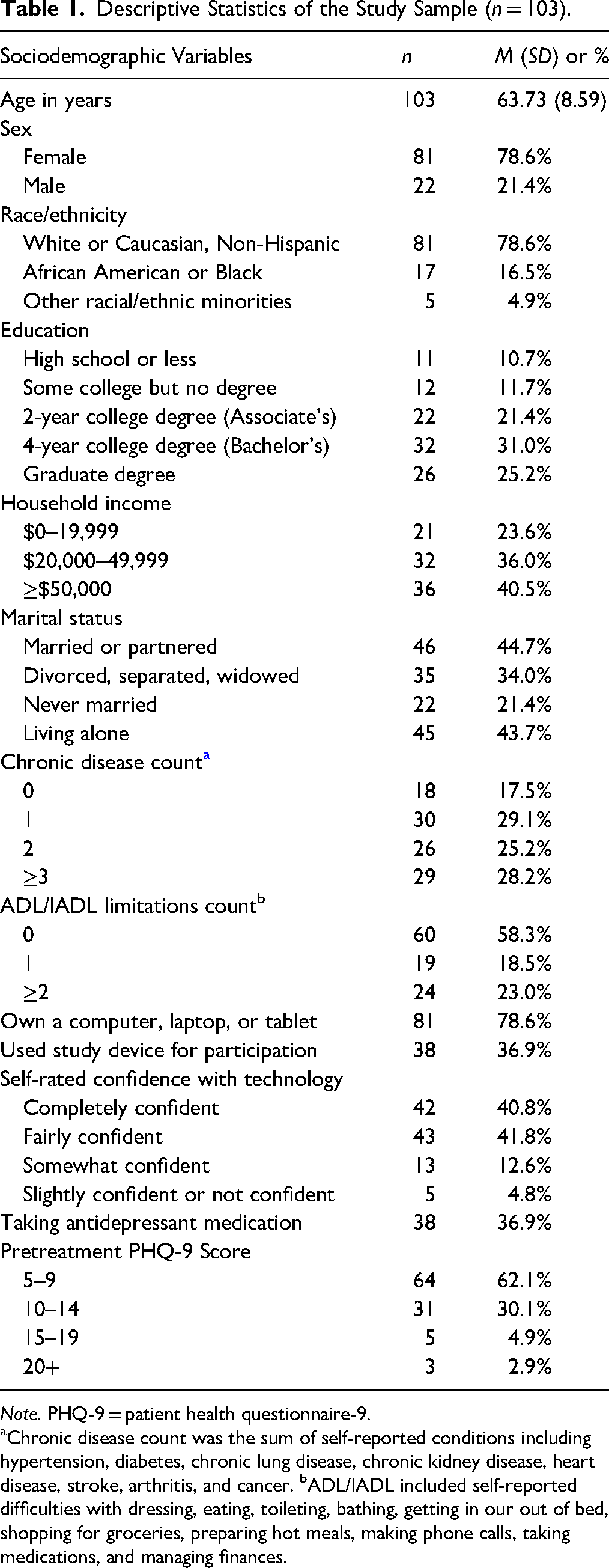
Note. PHQ-9 = patient health questionnaire-9.
Chronic disease count was the sum of self-reported conditions including hypertension, diabetes, chronic lung disease, chronic kidney disease, heart disease, stroke, arthritis, and cancer. bADL/IADL included self-reported difficulties with dressing, eating, toileting, bathing, getting in our out of bed, shopping for groceries, preparing hot meals, making phone calls, taking medications, and managing finances.
Coaching
The mean number of coaching meetings was 8.4 per participant, averaging 34.5 min (SD = 20) per meeting. According to coach self-reports, the top assistance provided by coaches was simple feedback (79% of the coaching calls), followed by facilitating understanding of lesson content (77.7%), reviewing or assisting with home practice (74.4%), technical assistance (19.2%), and assisting with the implementation of tools (15.5%). Coaches reported going through at least a portion of the online lessons with the participants during slightly over half of the coach meetings (51.7%).
Hypothesis 1
Hypothesis 1: The layperson-supported Empower@Home is feasible among older adults with depressive symptoms, as indicated by its retention and completion rates comparable to or exceeding those reported in published studies of similar interventions.
The results supported hypothesis 1. Out of the 103 participants, 96 completed posttests and 10-week follow-ups. This resulted in a 93% retention rate at the posttest stage and a 100% retention rate at the 10-week follow-up among those who completed the posttest. These rates surpass the typical benchmark of an 80% retention rate. On average, participants completed 8.5 out of 9 online sessions. Notably, 91.3% of the participants finished all nine sessions (n = 103). Among the 96 who completed the posttest, 94 finished all nine sessions. These completion rates surpass those found in most studies of similar interventions included in a systematic review (Xiang et al., 2020), a point elaborated further in the discussion section.
Hypothesis 2
Hypothesis 2: The layperson-supported Empower@Home is acceptable to older adults with depressive symptoms, as indicated by scores exceeding the benchmark on validated measures of treatment acceptability.
The results supported hypothesis 2. The range for the modified TEI scores was from 37 to 55 among study participants, with an average score of 46. This average equals 64 on the original TEI scale and exceeds the benchmark score 32. In addition, Table 2 shows that the overwhelming majority of posttest completers (n = 96) agreed or strongly agreed that this program was an acceptable way of dealing with depressed moods (94.8%), that they would recommend this program to others who experience depressed moods (95.8%), and that they believed this program was likely to be effective (92.7%). Most participants (92.7%) reported being satisfied or very satisfied with the program. Conversely, slightly over a third agreed or strongly agreed that the program required much effort (36.5%), and below a fifth reported discomfort during the treatment (17.7%). Four participants (4.2%) reported undesirable side effects from the program. Overall, these results suggest favorable attitudes toward the treatment among the participants.
Treatment Acceptability Measured by the Treatment Evaluation Inventory (N = 96).

Note. aStatistics presented here represented the number and percentage of people who reported “Satisfied” or “Very Satisfied” when asked, “How would you rate your overall satisfaction with the program?”
Hypothesis 3
Hypothesis 3: Empower@Home participants have reduced depressive symptoms after the intervention and at the 10-week follow-up, compared to their baseline symptoms scores.
The results supported hypothesis 3. As shown in Table 3, paired t-tests revealed a significant reduction in depressive symptoms from pretreatment to posttest (t = 7.64, p < .001) and from pretreatment to follow-up (t = 6.09, p < .001) in the entire sample (n = 103). Within-group effect size Cohen's d = 0.75 at posttest and .60 at 10-week follow-up, indicating medium effects. The effect sizes were large among those with moderate depression (PHQ-9 ≥ 10) at pretreatment (Cohen's d = 1.31 at posttest and Cohen's d = 1.18 at follow-up).
Means, Standard Deviations, and Effect Size for Primary Clinical Outcome PHQ-9.

Note. PHQ-9 = patient health questionnaire-9; CI = confidence interval. All analyses were intention-to-treat using the last available observation carried forward. Effect sizes were calculated using pretest scores to subtract posttest scores so that a positive effect size indicates a reduction or improvement in depressive symptoms as measured by PHQ-9. Paired t-test statistics for PHQ-9 score changes from pre to post and from pre to follow-up were all significant at p < .001.
Moreover, linear mixed modeling with random intercept and slope involving up to 5 in-session assessments showed a significant linear time effect over 10 weeks of active intervention (b = −1.13 [95% CI, −1.3 to −.96], p < .001). The predicted PHQ-9 score decreased by over one point every 2 weeks while the participants were engaged with the online program.
In addition to statistically significant results, metrics of clinical significance were also in the expected direction. Table 4 shows that at the posttest, half of the participants achieved remission (PHQ-9 < 5), and 43.7% had a clinically significant improvement (≥5-point reduction on the PHQ-9). Among those with moderate depression (PHQ-9 ≥ 10) at pretreatment, 82.1% had a partial response (PHQ-9 < 10), 41% achieved remission, and 66.7% had a clinically significant improvement at the posttest.
Clinically Significant Improvements in Depressive Symptoms Metrics.

Note. PHQ-9 = patient health questionnaire-9.
Hypothesis 4
Hypothesis 4: Empower@Home participants have reduced anxiety symptoms, social isolation, and loneliness after the intervention, compared to their baseline symptoms scores.
The results supported hypothesis 4. As shown in Table 5, paired t-tests revealed significant improvement in secondary outcomes from pretreatment and posttest among posttest completers (n = 96). The within-group effect size was large for anxiety symptoms as measured with the GAD-9 (Cohen's d = 0.80) and small for DSSI-10 for social support (Cohen's d = 0.36) and the PROMIS 8a for loneliness (Cohen's d = 0.30).
Means, Standard Deviations, and Effect Sizes for Secondary Clinical Outcomes.

Note. GAD-7 = Generalized Anxiety Disorder-7 items; DSSI-10 = Duke Social Support Index; PROMIS-8a = Patient Reported Outcomes Measurement Information System-Social Isolation 8a; BADS-SF = Behavioral Activation for Depression Scale-Short Form. All analyses were conducted with participants who completed the posttest, excluding those with occasional missing data on some items. To facilitate the interpretation of results, t-test statistics and effect sizes were calculated such that a positive statistic indicated improved outcomes (i.e., decreased scores on the GAD-7 and PROMIS-8a and increased scores on the DSSI-10 and BADS-SF).
Exploratory Analysis
We explored correlates of treatment effects, defined as the change in PHQ-9 scores from pre- to posttreatment (i.e., a positive change score suggests symptom reduction). The more severe the pretreatment symptoms were, the larger the PHQ-9 change score at posttreatment (b = .79, p < .001). In addition, BADS-SF scores for behavioral activation increased significantly at the posttest with a moderate effect size (Cohen's d = 0.52). BADS-SF change scores were positively associated with PHQ-9 change scores in multiple regression adjusting for pretreatment PHQ-9 scores (b = .12, p = .006).
Discussion
This pilot study evaluated the acceptability and treatment outcomes of a DMHI called Empower@Home, a web-delivered CBT program for treating the core symptoms of depression among older adults. Although Empower@Home can be entirely self-guided, the study tested a layperson-supported format, where participants received support from a lay coach. Study findings demonstrate the feasibility and preliminary effects of the treatment modality and suggest that older adults will utilize and benefit from DMHIs for depression facilitated by lay coaches.
Retention and treatment adherence of Empower@Home were excellent, comparable or higher than most iCBT trials. According to a systematic review of iCBT trials with older adults (Xiang et al., 2020), treatment completion rates ranged from 55% to 92%, with all except one study reporting an 80% or lower adherence rate. In our previous study of Beating the BluesTM, a commercially available iCBT program not specifically designed for older adults, only a quarter of participants completed the program, even with intense in-home support (Xiang et al., 2020). In contrast, over 90% of Empower@Home participants completed the program, including 98% of posttest completers. Low user engagement with DMHIs is a known issue and a barrier to realizing the benefits of these interventions in real-world settings (Gan et al., 2021).
There are several possible explanations for the superior adherence rate of Empower@Home. Supported DMHIs have better adherence rates than self-guided programs (Cuijpers et al., 2019; Karyotaki et al., 2021). Support from coaches may have boosted accountability, made the program more interactive, and facilitated the routinization of session engagement. Another possible reason is the increased global demand for mental health treatments since the COVID-19 pandemic (World Health Organization, 2022). Reports from our community partners serving older adults in Michigan echoed these global trends. Participants may be motivated to finish the program due to a desire to feel better and barriers to accessing alternative treatment options.
Overall acceptability and satisfaction ratings of Empower@Home are similar to reports from a behavioral activation program delivered via video conference by bachelor's level lay counselors (Choi et al., 2021) and higher than those of Beating the BluesTM in our previous study (Xiang et al., 2020). For example, 94.8% of Empower@Home participants found the program acceptable for dealing with depressed moods compared to 71.4% of Beating the BluesTM users in our previous study. On the other hand, one-third of Empower@Home users reported that the program required much effort (36.5%), compared to over half of Beating the BluesTM users (52.4%) in our previous study. Moreover, fewer Empower@Home users (17.7%) experienced discomfort than Beating the BluesTM users (28.6%) in our previous study.
The preliminary effects of Empower@home are in line with those from previous studies. A meta-analysis of iCBT trials involving older adults showed a pooled within-group Cohen’s d = 1.27 with an average pretreatment PHQ-9 score of 12.6 (Xiang et al., 2020). The effect size of .75 in our sample may appear smaller than the pooled average, but that is mainly due to a lower pretreatment PHQ-9 score (M = 9.2). Most studies used the PHQ-9 ≥ 10 threshold, while we used a lower threshold of ≥ 5, which is more prone to floor effects. Our exploratory analysis showed that pretreatment symptom severity was significantly associated with treatment effects. We found a Cohen’s d = 1.31 among those with PHQ-9 ≥ 10 at pretreatment, slightly larger than the pooled average from previous trials. The clinically meaningful improvement metrics of Empower@Home were slightly better than those from iCBT programs supported by clinical psychologists (Dear et al., 2013; Titov et al., 2015). However, therapist involvement in these programs was less intense and required less time commitment than “empower coaches”.
These treatment benefits were sustained at the 10-week follow-up, although a significant albeit slight drop from the posttest occurred. Decaying of treatment effects over time is not uncommon (Palacios et al., 2022). Due to our uncontrolled design, it was unclear whether the leveling off in treatment effects at the follow-up indicated a lack of sustained impact of the program itself or due to other external reasons. Of note, baselines in this study occurred between May and September, posttests occurred between August and December 2022, and the 10-week follow-up occurred between October 2022 and February 2023. Michigan is known for its long and cold winters with grey skies, so the occasional “winter blues” and the more serious seasonal depression may explain the slight drop in treatment effects at follow-up.
Limitations
The study's primary limitation is the uncontrolled design, which limits its ability to determine treatment effectiveness. A small randomized controlled trial of Empower@Home is underway and will provide more rigorous findings regarding treatment effects (Kayser al., 2023). Another limitation is its generalizability. Although participants came from all parts of Michigan, including its metropolitan and rural areas, their education levels and technology device ownership exceeded the national and state averages among older adults (U.S. Census Bureau, 2022). The overrepresentation of highly educated and tech-savvy participants was not unexpected, given the majority came from a research volunteer registry that required internet access to sign up. Additional exploratory analysis showed that study device usage did not predict PHQ-9 change scores in multiple regression adjusting for pretreatment PHQ-9 scores, age, education, and income. However, how well iCBT will work among socioeconomically disadvantaged older adults remains unclear. In addition, it is unclear how coaches enhance treatment outcomes and whether the program will be similarly beneficial with less intense or no support. Analyses of qualitative data collected from the pilot study are underway, which will shed light on these unanswered questions. Finally, the follow-up period is relatively short, and secondary clinical outcomes were not re-assessed at the 10-week follow-up to reduce participant burden. Studies with extended follow-up periods are needed to determine if the intervention has sustained effects.
Implications for Social Work Practice
The adaptable nature of the coach-client relationship in Empower@Home, ranging from guided completion to more autonomous use based on clients’ needs and preferences, aligns well with social work's emphasis on self-determination. The program's self-guided structure respects and encourages the autonomy of older adults, while the coach's role in providing feedback, technical assistance, and guidance mirrors the supportive function of social workers.
DMHIs like Empower@Home serve as a valuable resource for social work practitioners working with older adults, such as case managers and care coordinators, especially those facing persistent treatment barriers such as transportation issues and financial constraints. While potential challenges like access to technology and hesitance to use digital platforms exist, we have found that most older adults are open to learning and utilizing DMHIs, especially with demonstrations and sustained support. Social work practitioners are uniquely positioned to introduce evidence-supported DMHIs to older adults who are not yet familiar with the technology. Macro social work practitioners should also be aware of DMHIs such as Empower@Home and consider this a method to democratize access to mental health care, particularly for marginalized or underserved communities.
It is important to emphasize that while DMHIs like Empower@Home can effectively treat depression, they are not intended to replace the crucial role of mental health professionals, such as Licensed Clinical Social Workers (LCSWs). Instead, they should be considered supplementary tools that mental health professionals can use in their practice. These digital interventions can be used alongside traditional one-on-one therapy provided by LCSWs by providing additional, easily accessible resources that clients can utilize outside therapy sessions. They can also serve as intermediate support between therapy sessions or as a resource for clients waiting for traditional treatments.
Conclusion
This uncontrolled study found that iCBT supported by lay coaches is a feasible and acceptable treatment modality for reducing depression and improving psychosocial outcomes among older adults. If confirmed effective in future controlled trials, this treatment modality can be scaled up and implemented in community settings to substantially improve treatment access and outcomes among underserved older adults with mental health needs.
Footnotes
Acknowledgments
We thank the following social service agencies for sending referrals: A&D Home Health Care, Inc., Northern Lakes Community Mental Health Authority/Northern Health Care Management, Region 2 Area Agency on Aging, Region VII Area Agency on Aging, Senior Resources, Grand Traverse Commisson on Aging, EightCAP, Inc., Ypsilanti Meals on Wheels, and Catholic Human Services. Special thanks to the study participants who volunteered their time.
Declaration of Conflicting Interests
The author(s) declared no potential conflicts of interest with respect to the research, authorship, and/or publication of this article.
Funding
The author(s) disclosed receipt of the following financial support for the research, authorship, and/or publication of this article: This work was supported by the Michigan Health Endowment Fund, Center of Medicare and Medicaid Services through the Michigan Department of Health and Human Services, National Center for Advancing Translational Sciences (grant number R-2107-149026, E20225002-00, E20233264-00, UL1TR002240).
