




Abstract
As increasing value is placed on community engagement, co-creation, and transdisciplinarity as essential ingredients to improve policies; participatory health research has gained popularity as a promising avenue for stakeholders to collaborate and solve problems in innovative ways. Participatory research has a history of success but important caveats caution against romanticizing the approach. The assumption that participation will empower participants overlooks potential feelings of disappointment or exploitation amid power imbalances, vested interest, and representativeness issues. This article outlines a multilevel conceptual framework that explicitly situates power dynamics within a wider system of bidirectional interconnections operating at the individual, interpersonal, and structural levels. It then provides a practical tool to examine and address these dynamics in a comprehensive and systematic way. This can be helpful for researchers and community practitioners working in contexts where democratic principles are not broadly endorsed and where power dynamics operate in subtle ways.
Keywords
The last few years have seen an increasing interest in transdisciplinary research (Klein et al., 2001), patient and public involvement (Brett et al., 2014), community engagement (Cacari-Stone et al., 2014), co-creation (European Commission, 2015), and citizen science (Bonney et al., 2014), as key drivers of innovation and essential ingredients to improve health policies. As a result, participatory health research approaches have gained popularity as a promising avenue to enable individuals, groups, and organizations to connect, collaborate, and solve problems in creative ways (Canadian Institutes of Health Research, 2014; Department of Health, 2004; Health Canada, 2000; Health Service Executive, 2008; INVOLVE, 2018; NICE, 2013; Ocloo & Matthews, 2016; Wait & Nolte, 2006).
This family of approaches—which englobes Participatory Learning and Action research (PLA), Community-Based Health Research (CBHR), and collaborative inquiry among other—draws from the work of Paulo Freire, a Brazilian pedagogist who sustained that the education system was helping the dominant groups to keep their authoritative position over the oppressed (Freire, 1972). Freire’s work encouraged deprived communities to analyze the structural reasons for their oppression, and aimed at radical change in societal power structures. Building on his critique on the use of knowledge as an instrument to (re)produce social injustice, participatory health research situates the day-to-day experiential knowledge of all those who have a stake in the matter at hand (Stakeholders) at the same level as the academic knowledge (Brunger & Wall, 2016; Minkler, 2010; Wallerstein et al., 2017). This is reflected in a number of fundamental values including reciprocal learning, participatory decision-making, two-way open communication, building mutual trusts, critical reflexivity, and addressing inequalities (ICPHR, 2017; Wallerstein & Duran, 2010; Wright et al., 2018).
Two intrinsically related ambitions underpin participatory research. On the one hand, it aims at achieving fairness of the processes by which decisions are made (procedural justice) through a transparent involvement of different stakeholders. This is often facilitated by the use of qualitative approaches which—underpinned by the relativist epistemological assumption that the “truth” is based on socially constructed ways of knowing (Foucault, 1998)—challenge the conventional idea of objectivity in favor of knowledge democracy and deliberative approaches (Cho & Trent, 2006). On the other hand, it intends to catalyze broader societal transformation outcomes, enhancing the distributive justice of society beyond the life course of specific projects, contributing to a fairer allocation of rights and resources in favor of the most disadvantaged (Freire, 1972; Minkler, 2010).
The underlying assumption and core justification of participatory approaches is that a more equitable share of power will foster stakeholders’ “empowerment” (Greene, 1988; Ocloo & Matthews, 2016), defined as enhancing an individual’s or group’s capacity to make purposive choice and transform that choice into desired outcomes (Alsop, 2013). “Empowerment” is then expected to leverage social mobilization for greater distributive justice and lead to better health outcomes (Cacari-Stone et al., 2014; Chambers, 1997; Chambers, 2008; Haines et al., 2004). Recognizing the interdependence and mutual influence of individuals and their broader social contexts, empowerment theory situates human problems in a person-in-environment perspective, and proposes that successful interventions need to address the individual, interpersonal, and community levels simultaneously (East, 2016). Along these lines, funding institutions increasingly require greater engagement with “the public” and/or “communities,” and stakeholder involvement claims have become common. While this can produce many benefits—such as improved service delivery, awareness of a previously neglected problem, or effective advocacy for a more equitable access to prevention, screening, and treatment (Brett et al., 2014; Frerichs et al., 2016; Hallgren et al., 2015; Northway et al., 2015; Roura et al., 2015; Wallerstein, 2006)—there are concerns that its underpinning participatory requirements are often applied as a tick-box exercise. Participation—it is argued—is an abused term, and it can remain at a superficial level that does not truly account for different perspectives nor leads to any societal change (Ocloo & Matthews, 2016; Wilson et al., 2014). This is the case when the involvement of stakeholders—and specially the most disadvantaged—is tokenistic and instrumental, and without any meaningful impact in higher level decision-making processes (Ocloo & Matthews, 2016; University of Oxford, 2014).
Efforts to unpack participation have highlighted that meaningful stakeholder engagement in health research is ultimately about sharing the decision-making power (Cornwall, 2008). The critical social theory literature in turn has extensively described how power dynamics shape decision-making processes in participatory research. The complex relationships between academics and community partners is a particularly salient issue in this body of research (Lingard et al., 2007; Minkler, 2004). Discrepancies and tensions—it is argued—are naturally likely emerge from the interaction of dissimilar class and ideological formations whose interests do not necessarily converge (Rahman, 1993). When these are resolved through power dynamics that are not acknowledged nor adequately managed (Flinders et al., 2016; Freedman, 2016; Horowitz et al., 2009; Oliver et al., 2019), participation fails to contribute to neither procedural nor distributive justice, depriving this promising research approach of its original intended purpose. At its worst, it becomes a means of ensuring local consent to interventionist and sometimes exploitative projects that favor the interests of the most powerful stakeholders (Rahnema, 1990). There are concerns that it can even entail important costs for some of the actors involved, because it can be extremely time-consuming, ethically complex, and subject to competing demands and expectations (Flinders et al., 2016; Oliver et al., 2019). The so-called “tyranny” and “dark side” of participation speaks of the risk of reinforcing inequalities through participatory research, when the most disadvantaged bear the greatest share of these costs (Bouchard, 2016; Cooke & Kothari, 2001).
In this article, power is understood as “dispersed throughout the complex networks of discourse, practices, and relationships that position subjects as powerful and that justify and facilitate their authority” (Clegg, 1989). This is in line with Foucault’s view of power as “an ubiquitous force acting everywhere, because it comes from everywhere” (Foucault, 1975/1977; Kesby, 2005). This systemic understanding of power resonates with socioecological approaches, which situate individual behaviors within broader interpersonal dynamics and societal structures. Inspired by natural ecosystems, these frameworks focus on the network of interactions among organisms and between organisms and their environment, with particular attention to how the component parts interact, affect, and change each other (Frerichs et al., 2016; McLaren & Hawe, 2005). This explicit attention to the interdependence across different domains can be particularly useful to examine how power dynamics operate within and across the individual (micro), interpersonal (meso), and structural level (macro) in participatory research.
A number of conceptual models have enriched our understanding of the domains that influence participatory research processes and outcomes, including contextual factors, partnership processes, and individual characteristics (Jagosh et al., 2015; Khodyakov et al., 2013; Oetzel et al., 2018). Frameworks validated in the United States situate power dynamics at the level of partnership processes, reflecting a historic research focus on the programmatic level (Belone et al., 2016). While these frameworks provide a solid basis to examine the effectiveness of participatory partnerships, they do not fully capture the permeability of power dynamics across the different domains.
This article first describes how disruptive power dynamics can operate synergistically at the micro, meso, and macro level in participatory research, and the potential costs derived from failing to identify and address these. It then outlines a multilevel conceptual framework that explicitly situates power inequities within a wider system of bidirectional interconnections operating at different levels. Finally, it provides a list of monitoring questions to guide the assessment of power dynamics in multistakeholder partnerships from a systemic perspective.
The added value of the conceptual framework presented in this article is that it explicitly accounts for the way in which power dynamics filter throughout the social ecology. It extends previous work by providing a framework to think about how power inequities cut across the macro, meso, and micro level. It also presents a practical tool to examine systematically the specific pathways through which power dynamics permeate across the different domains, which can prompt researchers and community practitioners to reflect on areas of improvement and potential strategies to address these. This is important to inform the design and implementation of participatory projects in contexts where democratic principles are not broadly endorsed or where disruptive power dynamics operate in subtle ways (Lukes, 2004).
The Establishment Blues of Participatory Health Research
Successful participatory research relies on deliberation and bidirectional interactions to resolve discrepancies and generate hybrid forms of understanding (Jagosh et al., 2015). However, we cannot assume that the values that underpin participatory approaches are always ascribed across a plurality of stakeholders.
At the micro level of individual values and attitudes, contributors accustomed to privilege may not be willing to relinquish decision-making power (Tucker et al., 2017) and fail to acknowledge how this may affect the research process (Muhammad et al., 2015). Behind the equality rhetoric, academics may regulate research for their own purposes (Rahnema, 1990) and focus on getting results for publications and conferences (Tucker et al., 2017), which is a more pragmatic way of obtaining research funds than “achieving social change” (Baum, 2016). In some instances, “participation” can mask manipulation and be deliberatively employed to legitimize already-taken decisions, merely instrumentalized to gain moral authority. Even the best-intentioned attempts to give a voice to the less advantaged may fall short in their participatory intent when divergences between lay people and academic experts are—perhaps unconsciously but still patronizingly—framed as wrong beliefs, lack of awareness, or poor literacy of the former (Rawson et al., 2017). Considering the academic knowledge as “the valid one” and persuading less powerful stakeholders’ to embrace “the right views,” is equally at odds with the fundamental values of participatory research because it leaves dominant assumptions and systems of beliefs unquestioned. Where this is the case, discrepancies may emerge between research leads caught in the “rhetoric-reality gap” and front-line researchers struggling to preserve their personal credibility as they directly interact with community stakeholders (Lingard et al., 2007; Ocloo & Matthews, 2016; Oliver et al., 2019). Navigating these tensions can be particularly costly when intricate power dynamics operate and jobs are at stake, because the decisions over who is compensated, for what work, in what amounts, and for how long do not occur in a vacuum and are generally not taken in transparent ways.
At the meso level of multistakeholder research teams, conflicting priorities and complex power relationships means that decisions about how results are interpreted and what is done with them can end up determined by a small elite group that decides how things should look (Flinders et al., 2016; Oliver et al., 2019). As noted by Oliver et al., one can imagine scenarios where participants were asked for input, which was then cherry-picked to suit personal or political agendas (Oliver et al., 2019). Visual tools specifically designed to foster deliberation with post-its and flipcharts can be helpful to facilitate the disclosure of preconceived assumptions and to build consensus over operational aspects of field work. However, the use of a particular technique does not warrant “per se” a meaningful stakeholder involvement. The frequent assumption that a set of techniques can create safe spaces for joint decision-making must be revisited. As has been long recognized by qualitative researchers, hierarchies, dependency, and vested interest usually operate during group dynamics and may heavily influence what can be said, irrespectively of the methods used (Durand & Chantler, 2014). Behind the curtains of post-its and flipcharts, contributions that do not fit into preconceived ideas of the “right” responses may be silenced through the often subtle ways in which power mechanisms operate in real-life settings (Greene, 1988). This happens for example where participatory tools specifically designed to foster dialogue are employed in lengthy consensus building processes over matters of little relevance, while higher level decisions related to what is “really at stake”(e.g., resource allocation, policy decisions) remain secluded in less participatory spaces. In worst case scenarios, informal opaque decision-making processes that operate in parallel to formal governance structures are used to reward or penalize participants (Jami & Walsh, 2016; Long et al., 2016). As noted by Lukes, where power dynamics are less visible, they are also likely to be more effective (Lukes, 2004).
Tensions related to differential rewards structures across stakeholder groups are also common, particularly when some contributors—but not others—are expected to engage in unpaid work to show commitment to the “common cause.” This is particularly disturbing because these extra costs are generally borne by contributors on short-term contracts, often female and/or of color (Díaz & Simmons, 1999; Oliver et al., 2019).
Beyond the internal dynamics of a particular project, disruptive power inequities can also emerge when “the community” or “the public” is divided over an issue. In contrast with the romanticized ideal of cohesive spaces, “communities” are not homogeneous places that researchers enter but rather “a set of negotiations that inherently entail multiple and often conflicting interests” (Minkler, 2005; Yoshihama & Carr, 2002). As noted by development scholars, it cannot be assumed that community leaders will always act in the interest of their people (Rifkin, 1986). In fact, an individual’s role as “representative” of patients, the public or the community, may confer them an increased control over how resources are used/distributed. This can reinforce the power of local elites, which are not always characterized by a democratic ethos, and may instead adhere to the doctrines of charismatic/powerful leaders (e.g., patriarchy). Certainly, “communities” can be authoritarian spaces governed by allegiances (Guta et al., 2014), traditions, and rules, and diverging views may be seen as a dissent and a threat to what is (presumed to be) “good for the community” (Belton, 2013).
Where the associational landscape from which community representatives can be identified is thin and fragmented, participatory research is less likely to succeed. This is often the case where governments prefer to fund organizations focused on the passive provision of charity services as opposed to strengthening community structures that could potentially challenge the establishment. Because contemporary socioeconomic inequities are deeply embedded in historical factors and economic models of production, attempts to redistribute power and resources are often resisted (Hicken et al., 2018; Oliver et al., 2019). In some contexts, nongovernmental organizations and activists are severely repressed (Butt et al., 2019). In San Francisco, for example, undocumented research contributors were arrested during a protest to revendicate their rights, and in the United Kingdom a number of environmental activists have been recently sentenced to jail (Butt et al., 2019; Lee et al., 2003). Worryingly, in some postcolonial settings where multinational companies have extracted natural resources for decades, an appalling increase of murders of environmental activist has been documented (Butt et al., 2019). In Brazil, where participatory approaches first developed, a record number of deaths of mostly indigenous activists has been recorded over the last few years. A relaxation of gun laws and branding social movements such as the Landless Workers’ Movement (MST) as “terrorists” adds further concern in this country (Butt et al., 2019). Similarly, in contexts where gender inequities are deeply entrenched, resistance to relinquish power may impact negatively on women’s well-being. In Bangladesh, for example, interventions aimed at empowering women could both reduce or exacerbate domestic violence (Bolis & Hughes, 2015). These examples illustrate that although a major aim of participatory approaches is to benefit the most disadvantaged partners, the potential for unintended negative consequences is profoundly contextual and may lead to the exclusion of key stakeholders whose voices will ultimately not be heard.
Challenging deeply rooted power structures through “empowered” action can lead to transformative action but can also entail dramatic costs for those involved. This is particularly concerning because maintaining confidentiality in participatory research presents specific challenges that are not always adequately addressed (Chabot et al., 2012; Cross et al., 2015; Petrova et al., 2016). Certainly, there are successful examples of grassroots efforts that have generated system-level changes (Jagosh, 2015). However, in many countries, it is ultimately up to the higher government levels to shape policies and decide how funds are allocated to competing priorities and organizations. In certain contexts, it is hard to imagine how even the most charismatic activist and best-intentioned government officials engaging in participatory processes can possibly incorporate the views of the most disadvantaged into the political decision-making process. This is often the case in countries with persistently high socioeconomic inequities, poor governance, and weak rule of law.
Behind the Curtains of “Meaningful” Involvement
Participatory approaches are ultimately about co-creating new forms of blended knowledge where the traditional hierarchies of knowledge dilute. This ambitious endeavor is not something that can be attained by a single individual, project, or team, because knowledge production takes place within complex social ecologies. Power mechanisms cut across multiple layers and operate in two directions, from the micro level of individual values and attitudes to the macro sociopolitical structures (Figure 1).
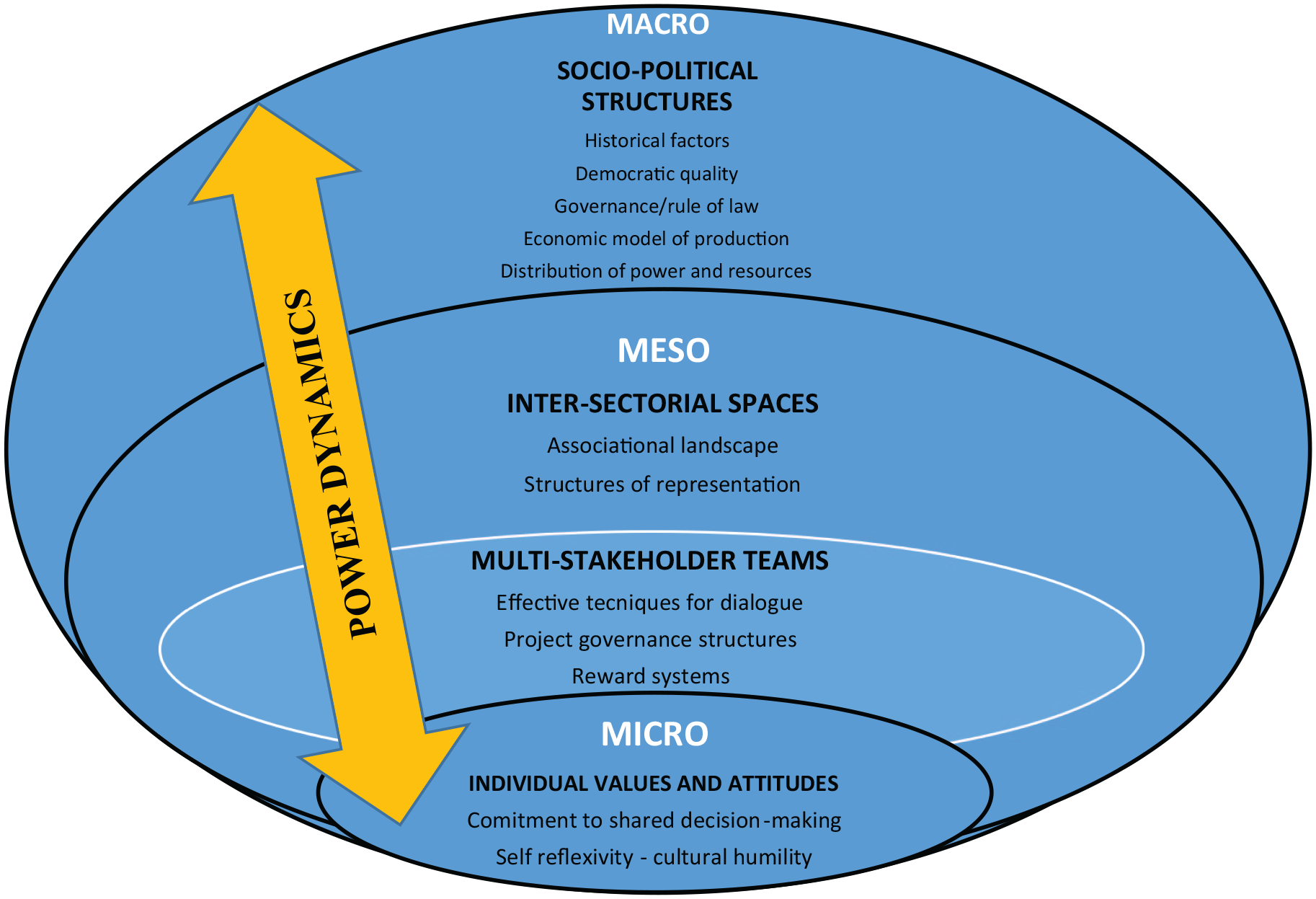
The social ecology of power in participatory research.
Disruptive power dynamics operating synergistically across the different levels can yield inequitable cost–benefit ratios among stakeholders in participatory research. Examining the specific pathways through which these dynamics cut across the different levels is thus essential to prevent the reproduction of inequities that the approach originally intended to address. At the project development stage, this can help to gauge what is the optimal level of participation for each particular context. At a later stage, it can prompt researchers and community practitioners to reflect on areas of improvement and potential strategies to address these. Table 1 provides a list of monitoring questions to guide the assessment of power dynamics at each of the socioecological levels (Table 1).
Monitoring Questions to Guide the Assessment of Power Dynamics in Participatory Health Research.

At the micro level of individual values and attitudes, research contributors should reflect over whether they belong to a dominant group (Oetzel, 2009) and acknowledge how power and privilege may ultimately hinder their capacity to genuinely (and effectively) engage in the participatory process. Self-reflexivity—defined as the practice of critically reflecting on how one’s own identity and experiences contribute to systems of power and oppression—can help stakeholders to articulate their own value systems and the ways in which identities of power and privilege influence research practices (Lake & Wendland, 2018). Understanding their own values shall enable them to explore the multiple dimensions of their work from new angles and reimagine more equitable and inclusive ways of being with others (Grant et al., 2013). A major degree of cultural humility and adherence to social justice values is required to constantly revisit preconceived views and interests and critically reflect about how being in a powerful position may influence subjective perceptions of what can be considered to be “valid knowledge.” Both academic and other stakeholders need to reflect on their own cultural assumptions, be open to question dominant systems of beliefs, and acknowledge underlying power dynamics.
At the meso level of multistakeholder research teams, the use of techniques for effective participatory dialogue and conflict resolution can be helpful to tackle hierarchies across and within stakeholders and address the naturally conflicting views that emerge across stakeholder groups. Documenting the participatory techniques employed for shared decision-making is a major step toward greater transparency in participatory research. However, it is insufficient to sustain claims of meaningful engagement, specially where these are employed to restrict the scope of joint decision-making to “safe” issues (Bachrach & Baratz, 1962). Participatory techniques can only be effectively employed where project governance structures are unambiguously and proactively committed to an equitable distribution of power and where participants feel genuinely free to express themselves without fear of reprisals nor any type of coercion.
To genuinely share decision-making about the points that really matter requires all stakeholders to jointly reflect on their subjective perspectives, interests, and assumptions. This entails questioning dominant systems of beliefs and balancing interests that may not be shared by all stakeholders. The reporting of participatory research must thus transcend the focus on specific techniques to fully account for the philosophical principles, values, and attitudes underpinning project governance structures. Transformational leadership approaches that highlight the autonomy of contributors, the flexibility of leaders, and the importance of values such as “justice in leadership” can be particularly valuable here (Bass, 1985; Burns, 1978).Throughout the entire project cycle, conflicts of interests need to be expected, disclosed, and monitored (Mandeville et al., 2019).
At the meso level of intersectorial spaces, the structures of representation of different stakeholders must be critically assessed. Formative research can be useful to gain insights into the alliances and tensions that exist within a particular research setting. Understanding the grassroots associational landscape, their roles, and functions and the linkages of the “representatives” with the broader communities becomes critical here. This can help to assess the existence of adequate representative structures and the likelihood that heterogeneous populations will cooperate successfully by putting aside their differences and work toward a shared objective.
The ultimate distinctiveness and added value of participatory research rests in its potential to catalyze transformative action for greater social justice. At the macro level, supportive sociopolitical environments are essential for this potential to be realized. In a global world where structural inequities are shaped by historical and economic factors, it is important to understand how power and resources are distributed across population groups and what are the root causes of this. In contexts where state institutions are equipped to support a meaningful participation of disadvantaged populations, and where successful examples of grassroots efforts have previously contributed to generate system level changes, participatory research will be more likely to succeed. On the contrary, power inequities will be perpetuated in contexts with poor governance and weak adherence to democratic values.
As pointed out by Long et al., the many poignant questions related to power dynamics in participatory research will never “go away” because they are inherent to the broader context in which research takes place. A respectful participatory practice—they argue—requires engaging in honest and difficult conversations that are essential to critically reflect upon the deeper question of how participatory endeavors can enable social justice rather than reinforce prevailing hegemonies (Long et al., 2016). The multilevel framework and monitoring questions presented in this article can be helpful to advance in this direction by prompting stakeholders to reflect on the optimal level of participation for each particular context, the areas that may require improvement, and suitable strategies to tackle these. For example, in contexts with poor adherence to right-based principles and weak rule of law, it is imperative to make sure that the groups affected by structural inequities (e.g., because of their sex, age, ethnic origin, religion) are aware of the potential unintended consequence derived from challenging existing structures of oppression. In countries with weak or deteriorating democratic structures with inequities deeply entrenched in historical and cultural factors, and weak associational landscapes, it could be useful to temper down expectations over improving distributive justice in the short/mid-term. In more favorable contexts where democratic values are effectively backed by good governance and solid civil society structures, a careful monitoring of disruptive power dynamics operating at the meso and micro level shall help to identify rhetoric–reality gaps and to develop strategies to address these in a timely manner.
The conceptual framework presented in this article situates power inequities within a wider system of bidirectional interconnections operating at different levels and explicitly accounts for the way in which power dynamics filter across and within the social ecology. This can help to broaden the assessment of power dynamics beyond the prevailing focus on the programmatic level. The list of monitoring questions addressing each of the levels (Table 1) can be applied to assess how power dynamics influence processes and outcomes in specific projects and inform the development of tailored strategies to deal with disruptive power dynamics. A limitation is that it draws from the peer reviewed literature and the experiential knowledge of the author. Future empirical qualitative research with contributors to participatory processes in different settings would be useful to validate and complete the framework and the monitoring questions posed.
Conclusion
Participatory health research is grounded on the idea that experiential and academic sources of knowledge should be equally weighted and combined (procedural justice) to contribute to a fairer allocation of resources (distributive justice). However, disruptive power dynamics operating across the individual, interpersonal, and structural levels may reproduce the inequities that the approach originally intended to address.
At the micro level of individual values and attitudes, contributors accustomed to privilege may not be willing to relinquish decision-making power and employ it to legitimize already-taken decisions. At the meso level of multistakeholder research teams, hierarchies and vested interest may operate during group dynamics and heavily influence what can be said. Contributions that do not fit into preconceived ideas of the “right” responses may be silenced and higher level decisions related to what is “really at stake” (e.g., resource allocation, policy decisions) secluded to less participatory informal spaces that operate in parallel to formal governance structures. Where associational landscapes are thin and fragmented, biased structures of representation may reinforce the power of local elites that govern through allegiances and traditions, perpetuating inequities (e.g., patriarchy). In worse case scenarios, attempts to redistribute power and resources can be resisted and activists repressed.
Despite enormous potential and a wealth of successful experiences, widespread advocacy of participatory approaches without due problematization of widely reported caveats is troubling. This article situates power inequities in participatory research within a wider system of bidirectional interconnections operating at different levels. It provides a framework to think about how power inequities cut across the social ecology, and a practical tool to systematically examine the specific pathways through which power dynamics permeate across the different domains. This is particularly important in contexts where democratic principles are not broadly endorsed or were disruptive power dynamics are particularly effective because they operate in subtle ways.
Footnotes
Author’s Note
Maria Roura is now affiliated with University College Cork Cork, Ireland.
Declaration of Conflicting Interests
The author declared no potential conflicts of interest with respect to the research, authorship, and/or publication of this article.
Funding
The author received no financial support for the research, authorship, and/or publication of this article.
