



Abstract
Persons with serious mental illness are often reluctant to disclose their disability to an employer because of the intense stigma associated with their illness. Yet, disclosure may be desirable to gain access to employer-provided job accommodations, or to achieve other goals. In this article, we aimed to (1) describe the contexts in which workers in regular employment disclose a mental illness to their employer and (2) describe employer responses to disclosure, as perceived by the workers themselves. Semi-structured interviews were conducted with 40 workers, who were currently or formerly employed in a mainstream, regular job, post-onset of mental illness. Workers were asked to describe the circumstances that led to disclosure, and to describe their employers’ responses to disclosure. Conventional content analysis was applied to identify common themes in the transcribed interviews. Analyses revealed five mutually exclusive disclosure contexts: seeking job accommodations, seeking protection, seeking understanding, responding to an employer’s symptom-based inquiries, or being exposed by a third party or event. Analyses also revealed a wider range of employer responses—positive, negative, and ambiguous—than has been suggested by studies in which employers described their reactions to worker disclosure. Some themes were more prevalent among current versus former workers. Overall, the disclosure process appeared to be more complex than has been described by extant frameworks to date, and the linkages between disclosure contexts and employer response themes suggested that many workers did not receive the responses they were seeking from their employers.
Introduction
In 2020, approximately 14.2 million U.S. adults had a serious mental illness (SMI) (SAMHSA, 2021), that is, a mental, behavioral, or emotional disorder associated with significant functional impairment which interferes with one or more activities of daily living (NIMH, 2022). Slightly less than 55% of adults with SMI were employed in 2010, and only 38% were working full-time, compared to 76% and 62% of adults with no mental illness (Luciano & Meara, 2014). Their poor employment outcomes are often attributed to the stereotypes that persons with SMI are unintelligent, unpredictable, unreliable, and thus incapable of regular employment (Russinova et al., 2011). A regular job (i.e., a job which pays at least minimum wage, is not set aside for persons with disabilities, and is not obtained with the help of mental health vocational services) is the pathway to financial security and independence for most adults. Recent research demonstrates that, contrary to the stereotypes, many persons with SMI are successfully employed in regular, well-paid jobs (Baldwin, 2021; Ellison et al., 2008; Joyce et al., 2009). Understanding challenges encountered by persons with SMI in regular employment is critical to reducing the burden of mental illness on individuals, families, and society. One of the most significant challenges is the decision whether or not to disclose mental illness to their employer.
Workers with SMI often have a choice regarding disclosure because their illness is concealable if its symptoms are well-controlled (Brohan et al., 2012). Some measure of disclosure is necessary if a worker needs employer-provided accommodations, and some workers prefer to be forthcoming about their illness (Brouwers et al., 2019). Many workers, however, are deterred from disclosing because they anticipate that it will subject them to employer and/or co-worker discrimination (i.e., differential negative treatment based solely on the diagnosis of mental illness; Pandya et al., 2011; Üçok et al., 2012). The anticipation of discrimination is grounded in the reality that stigma associated with mental illness is more intense than stigma associated with almost any other disabling health condition (Choe et al., 2020; Toth & Dewa, 2014; Yoshimura et al., 2018). Yet, little is known about how employers respond to workers’ disclosure in the context of regular employment.
Worker Disclosure of Mental Illness
A considerable body of research has explored how workers with mental illness perceive the decision to disclose their illness at work. On the negative side, many studies indicate that the majority of workers prefer not to disclose their illness at work because they anticipate that disclosure will result in discrimination (Brohan et al., 2014; Brouwers et al., 2019; Krupa et al., 2009; Peterson et al., 2011; Üçok et al., 2012). In a U.S. study of 45 working professionals diagnosed with bipolar disorder or major depression, for example, nearly half of workers said that they concealed their mental illness because they feared that disclosure would damage their reputation as a competent professional (Elliott & Reuter, 2021). Other reasons to prefer nondisclosure include workers’ preferences for privacy, or concerns that the individuals to whom they disclose will not respect their confidentiality (Donnelly, 2017; Henderson et al., 2012; Toth & Dewa, 2014).
On the positive side, disclosure is the means to access job accommodations. The Americans with Disabilities Act requires employers with 15 or more employees to provide reasonable accommodations to otherwise qualified workers with disabilities, including workers with mental disabilities (ADAAA, 2008). When requesting accommodations, a worker must inform their employer that the accommodations are needed for a medical condition. The employer may request information about the nature of the condition and associated functional limitations in order to identify effective accommodations (EEOC, 2002). Thus, a request for job accommodations is expected to be a frequent context for workers’ disclosure. One study of working professionals and managers with mental illness finds that disclosure included a discussion of job accommodations in 30% of cases (Ellison et al., 2003).
In addition to the practical advantage of gaining access to job accommodations, there are other positive aspects supporting disclosure. Some workers express the belief that concealing a diagnosis of mental illness is dishonest (Brohan et al., 2014; Donnelly, 2017); others say that concealment is stressful (Brohan et al., 2014; Yoshimura et al., 2018). An Israeli study indicates that some workers disclose their mental illness to gain emotional or social support from a trusted employer or co-worker (Bril-Barniv et al., 2017). Some workers even perceive a moral obligation to disclose to help combat the stigma associated with mental illness (Bril-Barniv et al., 2017; Peterson et al., 2011).
Three extant frameworks attempt to describe the contexts under which disclosure occurs. One characterizes disclosure decisions as a dichotomy of purposive, planned, or intentional disclosure (e.g., to request employer-provided job accommodations) versus unintentional or involuntary disclosure (e.g., to explain a recurrence of symptoms; Bril-Barniv et al., 2017; Brohan et al., 2012). The second describes the disclosure decision-making process as a risk–benefit analysis (Toth & Dewa, 2014). Accordingly, anticipated discrimination, reinforced by concerns for privacy and confidentiality, make nondisclosure (i.e., concealment), the default position. Workers remain in the default position unless a triggering incident (e.g., recurrence of symptoms, negative performance evaluation) causes them to reassess the risks and benefits of disclosure. The third framework views disclosure through dimensions of control, conditions, and costs (Baldwin, 2021). A worker has control over disclosure if their mental illness is concealable and if those who have been informed respect the worker’s privacy. The worker may impose conditions on disclosure that determine (to varying degrees) when, to whom, and how much they choose to reveal. In evaluating the disclosure decision, and the conditions under which it occurs, the worker considers anticipated costs (monetary, social, emotional). These frameworks offer different lenses for scholarly thinking about workplace disclosure of SMI, but it is unclear how well they describe workers’ lived experiences of disclosure in a diverse sample of regular jobs.
Responses to Disclosure
Workers who are reluctant to disclose because they anticipate a discriminatory response from their employer are behaving rationally, given the intense and pervasive stigma associated with mental illness (Pescosolido et al., 2010; Read, 2007; Westbrook et al., 1993). That stigma is evoked by negative stereotypes which devalue someone with mental illness “from a whole and usual person to a tainted and discounted one” (Goffman, 1963, p. 3). Among the negative stereotypes commonly associated with mental illness are beliefs that the prognosis is hopeless (i.e., a person will never recover), that mental illness is not real (i.e., the person is malingering), and that persons with mental illness are dangerous, incompetent, unpredictable, and unreliable (Corrigan, 2000; Corrigan et al., 2003; Toth & Dewa, 2014). Negative stereotypes such as these evoke feelings and emotions that elicit predictable behavioral responses (Corrigan, 2000; Corrigan et al., 2000, 2003). The stereotype of hopelessness, for example, evokes feelings of frustration and impotence; the behavioral response is to diminish helping behaviors, which are perceived to be a waste of time (Corrigan, 2000). In the workplace, employers who endorse this stereotype may seek to distance themselves from a worker who is struggling with symptoms of mental illness, rather than offer help or support which they perceive will be ineffectual. Discriminatory responses associated with other stereotypes of mental illness could include, for example, disbelief or dismissiveness (the worker is malingering); failure to promote or provide job training (the worker is incompetent, unreliable); and avoidance or isolation (the worker is dangerous, unpredictable.).
The literature on responses to disclosure of mental illness in the workplace focuses almost exclusively on the employer perspective. Most studies involve small samples of managers or supervisors in workplaces outside the U.S., and the majority of respondents describe having positive attitudes toward workers with SMI and positive responses to disclosure. For example, workers with mental illness are perceived—by employers—to be capable and productive employees who bring special skills and abilities to the workplace (e.g., insight, resilience, and lived experience; Tse, 2004; Peterson et al., 2017). Employers indicate that managing mental illness is a relevant part of their job which involves being attentive to behavioral changes that could indicate mental health issues; providing compassionate support; protecting the privacy and dignity of the worker; and supporting a return to work (Kirsh et al., 2018). These studies, however, are limited in perspective because their designs either did not ensure that participants had actually supervised workers with SMI (Kirsh et al., 2018; Tse, 2004); focused on supervisors who had permission from their current employee with SMI to participate (Peterson et al., 2017); or involved supervisors who were interviewed following a workplace anti-stigma campaign (Kirsh et al., 2018).
Some participants in employer studies describe responses to disclosure that reflect negative stereotypes of SMI. These responses include having lower performance expectations of a worker who discloses a mental illness; attributing all of the worker’s mistakes to their mental illness, believing the worker is “pulling the mental health card” (malingering); and/or trying to get rid of the worker (Brouwers et al., 2019; Kirsh et al., 2018). The results of a large UK study suggest that employers’ lack of knowledge of disability law may hamper their response to a worker’s disclosure of mental illness (Brohan et al., 2010). Among 502 employer respondents, 67% of those who had hired a worker with mental illness said they did not have sufficient knowledge of disability law, compared to only 34% of employers who had not hired a worker with mental illness. The difference suggests that many employers are unprepared to manage disclosure of mental illness and do not realize it until faced with the issue.
Workers’ voices have been largely unheard in the literature on employer responses to disclosure. An exception is Elliott and Reuter’s (2021) study of working professionals diagnosed with bipolar disorder or major depression. Nine workers expressed a need for job accommodations, some of whom disclosed and others who did not. According to the authors’ analysis, all of these workers experienced barriers to obtaining accommodations, either because of concerns about disclosure, or because they had actual experiences of being treated unfairly after making an accommodation request. Individual workers described their employers’ responses as unhelpful, unsupportive, and cold. This study is unique in providing workers’ perspectives of employers’ responses to disclosure for the purpose of requesting accommodations. There are, however, many other reasons for disclosure (see, e.g., Brohan et al., 2014; Yoshimura et al., 2018; Bril-Barniv et al., 2017; Peterson et al., 2011), which may be met with different employer responses. In fact, one study reported that less than one-third of workers disclosed in order to request accommodations (Ellison et al., 2003).
A few large survey studies of persons with SMI portray a fairly negative picture of workplace responses to disclosure. Pandya et al. (2011) report results of a U.S. survey of 258 individuals with schizophrenia spectrum disorders. When asked how they were treated after disclosure, 38% said their employer treated them worse; only 18% said their employer treated them better. Yoshimura et al. (2018) report results of a UK survey of nearly 6000 individuals with mental illness, asking about experiences of discrimination in various settings. Among those with a history of employment, 35% report that they were treated unfairly in trying to keep their job. Neither of these studies, however, are restricted to workplace relationships nor do they provide details on disclosure circumstances or responses.
Current Study
The extant literature both supports workers’ fears that disclosing SMI may subject them to discrimination and indicates that some employers respond to disclosure positively. This article extends the literature that gives voice to workers by focusing exclusively on employees with serious mental illness (bipolar disorder, major depression, schizophrenia spectrum disorders) who disclosed their illness to a supervisor or manager in the context of regular employment. We focus on regular, mainstream employment as opposed to workers receiving vocational services related to their mental illness (e.g., supported employment programs) because workers in regular jobs make independent decisions regarding employment and disclosure. Workers in supported employment or other vocational programs typically receive individualized services (e.g., job development, help with interviewing, assistance with disclosure, and counseling on maintaining disability benefits) that alter the nature of the disclosure process.
Workers in our study were employed in a wide range of occupations, including professional, nonprofessional white-collar, and blue-collar jobs. They were recruited from a national survey of U.S. workers with SMI, as opposed to a localized and/or workplace-specific convenience sample (e.g., Peterson et al., 2011; Toth & Dewa, 2014). The stratified sample includes workers employed at their firms at the time of the interviews and those who were no longer employed, avoiding the selection bias associated with sampling only currently employed workers (or supervisors of current workers; e.g., Kirsh et al., 2018; Peterson et al., 2017). Participants described both the circumstances surrounding their disclosure and their employers’ responses. We aim to 1) describe the contexts in which workers in regular jobs disclose mental illness to their employer and (2) describe employer responses to disclosure, as perceived by the worker.
Methods
A brief methodological and analytic description follows; for thick methodological and analytic details, including a full description of strategies used to advance trustworthiness, see Online Supplemental Materials. Participants in the current study are a subsample of participants from a larger, national survey investigating disclosure of SMI in the context of regular employment. Eligibility criteria for the larger survey were being of working-age (18–65); having been diagnosed with bipolar disorder, major depressive disorder, or a schizophrenia spectrum disorder; and either currently working in regular employment (hereafter “current workers”) or had worked in regular employment for 6 months or longer, post-onset of illness, and within the prior 5 years (hereafter “former workers”). A subset of these participants was invited to participate in a follow-up semi-structured interview which investigated the process of disclosure in depth. Contact information for those who were willing to participate was sent to a qualitative team, along with a limited subset of survey data to determine eligibility for the qualitative study.
Eligibility was based on a purposeful sampling frame (Figure 1) that stratified the sample by disclosure status, employment status, and accommodation status.
1
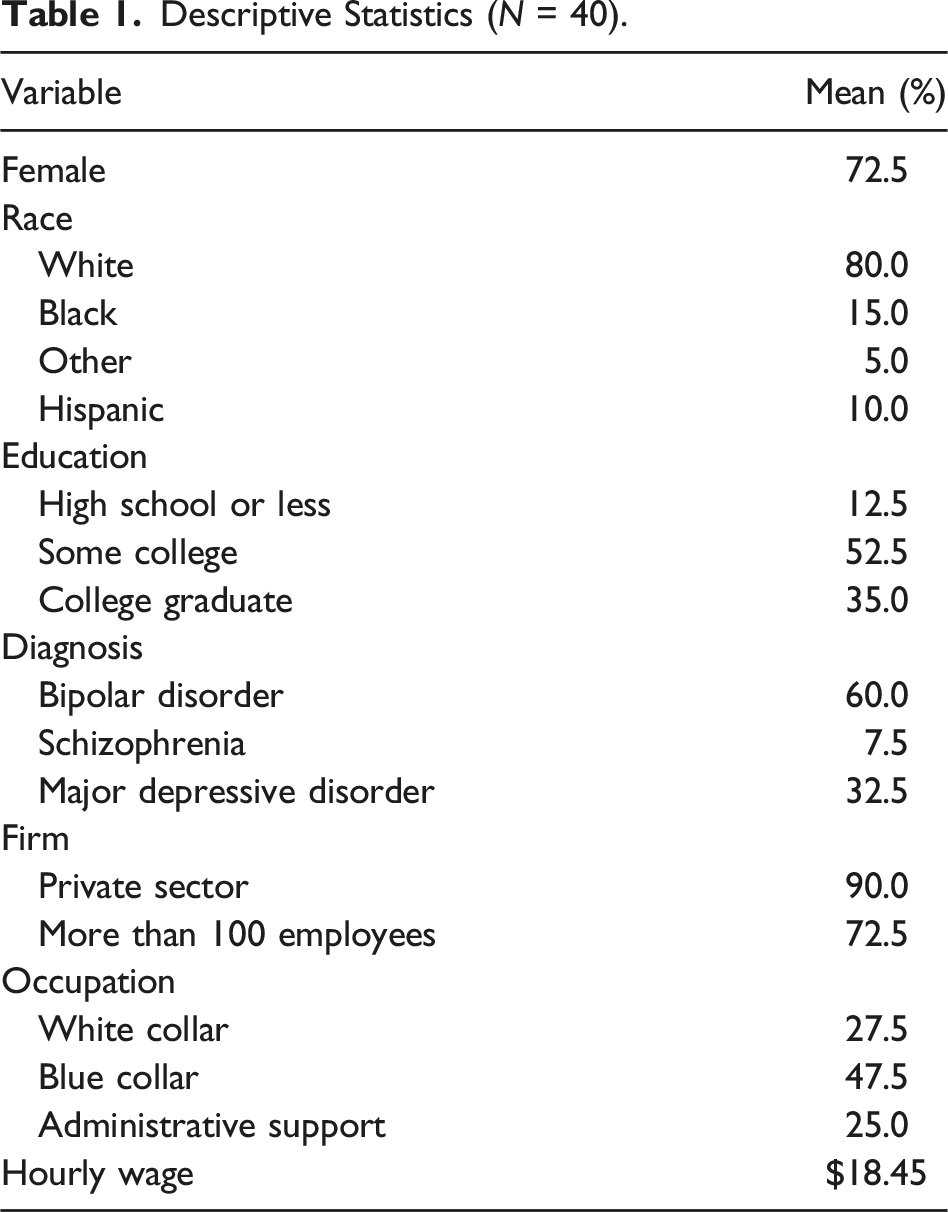
Purposeful sampling is a tool used to enhance the transferability dimension of trustworthiness (Anney, 2014). Follow-up interviews were conducted by telephone at a time convenient for the participant. A co-investigator (author 1) and a doctoral candidate in counseling psychology conducted all interviews. All participants provided verbal informed consent prior to enrollment and were paid $50 for participating. Study protocols were approved by the Arizona State University Social and Behavioral Institutional Review Board (#STUDY00006021). The current study focuses on 40 participants whose employers knew about their mental illness. Their demographic and work-related characteristics are described in Table 1. Stratification of sample. Descriptive Statistics (N = 40).
Analytic Plan
This research is situated within qualitative content analysis approaches that strive “to provide knowledge and understanding of the phenomenon under study” (Downe-Wamboldt, 1992, p. 314). Specifically, we used conventional content analysis, in which codes are derived from observation of text data inductively (Hsieh & Shannon, 2005), to describe the disclosure and response phenomena. Analysis proceeded in five steps: (1) discovering themes, (2) describing themes, (3) building theme codebooks, (4) applying themes, and (5) linking themes (Bernard et al., 2016). First, we followed steps 1–3 analyzing the disclosure narratives to develop a worker disclosure codebook (Aim 1). These analyses coded workers’ responses to the prompt, “Tell me the story about when your employer first found out about your mental illness.” Next, we followed steps 1–3 analyzing the response narratives to develop an employer response codebook (Aim 2). These analyses coded responses to the prompt, “How did your employer respond?” We then applied the codes (step 4) to all narratives using Dedoose. Finally, we produced a code co-occurrence matrix to examine how worker disclosure codes linked to employer response codes (step 5).
The three co-authors engaged in subjective interpretation of worker perspectives through systematic processes for coding and theme identification (Hsieh & Shannon, 2005), 2 using appropriate tools for establishing credibility in qualitative content analysis (Amin et al., 2020). Specifically, following principles of investigator triangulation, the authors approached the research from different disciplinary perspectives (e.g., public health, health economics and policy, and developmental psychology) which ensured that no one perspective drove the study design or implementation. Following principles of peer debriefing, we presented key themes and exemplars to a Community Advisory Board over multiple iterations, incorporating feedback as we refined codebooks. Authors 1 and 2 have multi-decade experiences with a family member (parent or adult child) diagnosed with schizophrenia who worked or had worked in regular jobs; they had a vested interest in centering on worker voices and identifying factors that affect regular employment for persons with SMI. Author 3 does not have personal experience with SMI and was on the team as an expert in qualitative methods.
Results
Context of Worker Disclosure of Mental Illness in the Workplace
Five Mutually Exclusive Disclosure Typologies (N = 40; n current worker = 20; nformer worker = 20).
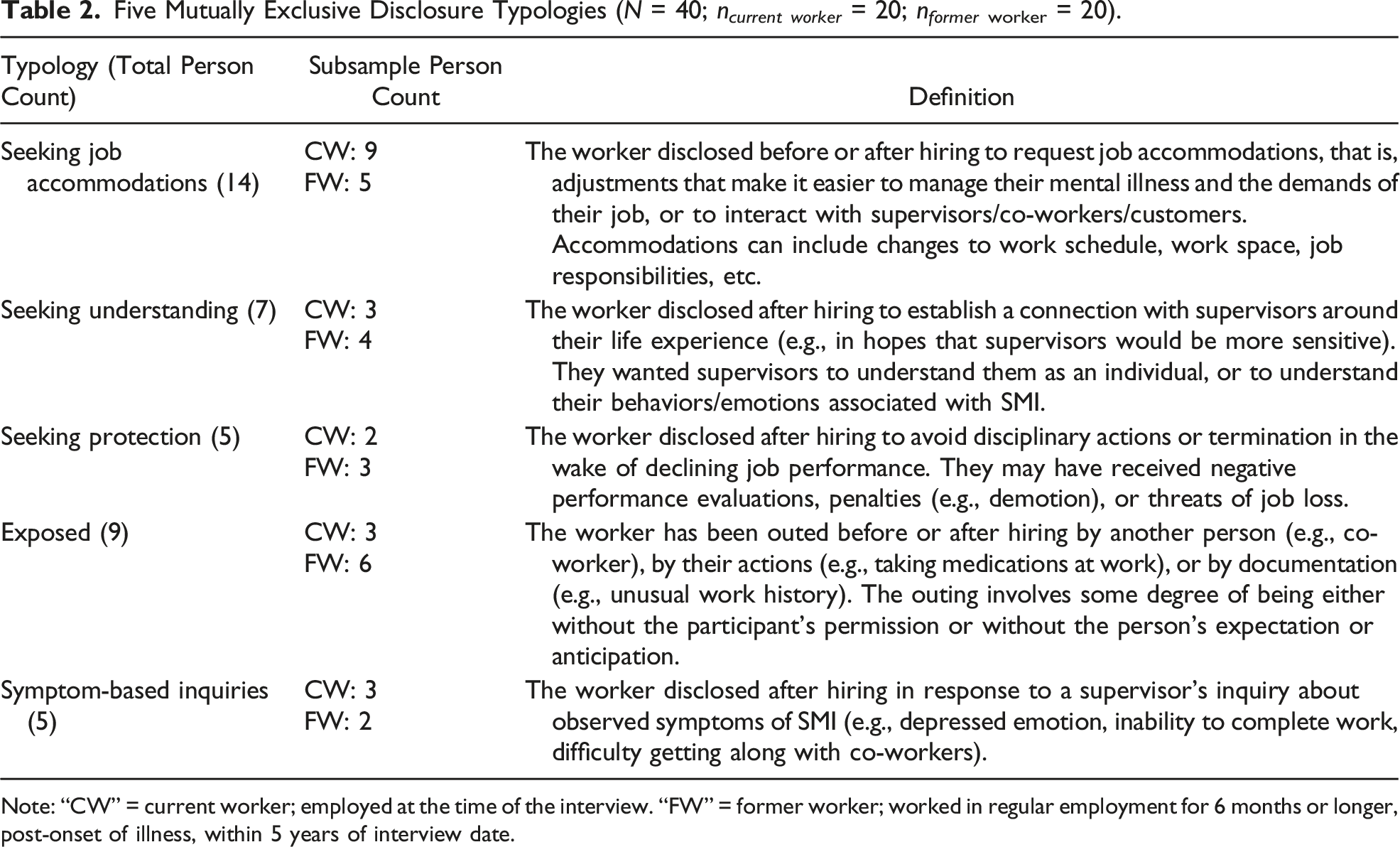
Note: “CW” = current worker; employed at the time of the interview. “FW” = former worker; worked in regular employment for 6 months or longer, post-onset of illness, within 5 years of interview date.
Seeking accommodations was a common context of disclosure, although this typology was more prevalent among current versus former workers. These narratives frequently referenced disclosing because a worker needed time off, a schedule change, or other changes to their job because of their mental illness. For example, William indicated during the hiring process that he would need time off for treatment: “I pretty much had to tell them, you know, why I needed the time off.” Often, the request for accommodations was initiated to help relieve job-related stress. Tina, for example, said she needed unscheduled breaks to “get off the phone occasionally.” Lisa disclosed more spontaneously while driving to work; she called her boss and said “I have bipolar and it’s just really affecting [me] ... I just can’t come in.”
Workers whose disclosure narratives centered on seeking understanding either wanted to establish a connection with their employer or wanted their employer to understand the worker’s behaviors/emotions associated with mental illness. This typology was approximately equally prevalent among current and former workers. Susan said, “I disclosed to [my supervisor] as a way of trying to explain myself. . . why I felt the way I did about things, you know, why my opinion was what it was, why I behaved in certain ways.” Paul said, “[Disclosure] gave me opportunity to allow somebody else to understand what I was going through. . . it’s always good for somebody to understand what’s happening. . . with you.”
Several workers disclosed in the context of deteriorating job performance or impending disciplinary actions, as a means of seeking protection. This typology was approximately equally prevalent among current and former workers. For example, Melissa said that she “had to say something” about her mental illness when her supervisor began making comments such as, “I’m gonna fire you because, you know, you’re not making your numbers, and I’ve talked to you over and over.” David was even more explicit about seeking protection in the wake of declining job performance, I was falling behind on some work metrics. And I thought it was worth telling them to let them know, look, this is, this is why, I might be slowing down… I wanted to lay the basis for uh, the protection that being a, a person with a medical condition might offer.
When a workers’ disclosure story referenced someone or something revealing their mental illness, we coded the exposed theme; this typology was more common among former workers. For example, Michael said that a former acquaintance (interviewing for a job with the same employer) told the interviewer that they had observed Michael engaged in unusual behaviors outside the work setting. When later questioned about the comments, Michael said, “you know, I’m mentally ill.” Wendy was exposed by a sporadic work history on her resume. When questioned about it during her interview, she explained, “I had went through a series of dark periods in my life where things progressively were getting worse and I was eventually diagnosed with bipolar disorder.” In other cases, workers were exposed in more subtle ways. For example, Dana’s employer required workers to carry transparent handbags that could be inspected when they entered or exited their retail store. One day, a supervisor asked Dana to explain why she had prescription medications in her purse. She spontaneously responded, “I’m bipolar.”
In a few cases, workers disclosed in response to their employer’s symptom-based inquiries. This typology was approximately equally prevalent among current and former workers. The inquiries usually occurred after a change in the worker’s behavior or emotions. Denise said, “he asked me if I was doing okay one day. I told him certain symptoms and things that have been showing up.” Linda said that, when her employer asked why she seemed down, “I just . . . gave her the explanation . . . [of what] my diagnosis was, and how long ago that diagnosis had occurred . . . that it was just, uh, kind of, natural for me” to be down.
Worker Perceptions of Employer Responses to Disclosure
Eight Employer Response Themes (N = 40; n current worker = 20; nformer worker = 20).

Note: “CW” = current worker; employed at the time of the interview. “FW” = former worker; worked in regular employment for 6 months or longer, post-onset of illness, within 5 years of interview date.
Some employers responded to disclosure with compassion, or with expressions of generic support. This theme was more prevalent among current workers. Sarah’s employers responded with encouragement, “We’re here for you. We will help you through whatever.” Paul, who disclosed to a supervisory team, told us “I got a hug from everybody.” The compassion theme also included references to an employer’s positive characteristics (e.g., Tracy described her supervisor as “very nice”) and references to feeling heard or understood versus being dismissed in response to disclosure.
Some workers described their employer responding to disclosure with experiential understanding of mental illness, and this theme was approximately equally prevalent among current and former workers. The understanding may have come from personal experience (e.g., Kelly’s supervisor “told me she understood. Like she had been through it before, her own self”); from a friend or relative (e.g., Linda’s supervisor “had family members that had dealt with the same issues. And so, she was familiar with that”) or from professional experience (e.g., Paul, who worked in a health-related occupation said that the management team “are trained to [be] dealing with people with bipolar or some kind of mental illness”).
Narratives involving instrumental help described an employer responding to disclosure in specific ways that supported the worker in their job, and this theme was also equally prevalent among current and former workers. Instrumental help included, for example, employers picking up some of a worker’s job responsibilities; helping a worker minimize work-related stress; or helping them manage workloads. Kelly said, “[my supervisor] helped me when I needed like help. She was able to calm me down if I was upset about something or anything like that. Or if I had a bad day, she always made me smile or laugh.” Diane described her employer providing instrumental help in time management, while taking care not to imply that Diane was incapable: “I know this [challenging project] is right up your alley, so if you want it, it’s yours, but don’t feel you have to. This is definitely one of those things that you can drop.” Instrumental help also included reminders to engage with treatment. For example, Melissa described her employer saying “If you have doctors’ appointments, make sure you go to those, just let your supervisor know.”
Workers’ response narratives sometimes referenced an employer’s emotions, and this theme was more common among current workers. Emotions ranged from being “shocked,” to feeling “relieved,” or “glad that I told her.” William observed, “I feel like it gave them comfort. … I felt like me being up front about it was what really, you know, put them at ease.”
Some workers described their employers responding to disclosure in mechanized ways, emphasizing rules, policies, or procedures for managing workers with disabilities. This theme was more prevalent among former workers. Mechanized responses often reflected an emotional disconnect. Timothy, for example, indicated that his manager was “just trained to go through the steps and- and- and to walk somebody through procedures very quickly.” Some workers perceived these procedural responses as protecting their rights. For example, Sherry told us The good thing about working for the department I do, is they, they are really, and working for government work in general, it’s very, I think it’s, it’s much harder to discriminate or, to, to, um, penalize something for having mental illness, because it is an illness.
Other workers, like Laura, described more negative aspects of a mechanized response, “[My employers] do what they need, had to legally, and nothing else.”
Several workers made direct references to their employers’ respect for confidentiality when describing their employers’ responses to disclosure (e.g., Diane’s employer “kept it in complete confidence”). These responses were coded as confidentiality-present and were more prevalent among current workers. On the other hand, two former workers, Tammy and Tracy, indicated that their employers shared their private health information with others in the workplace without their permission (coded as confidentiality-absent).
A number of workers included references to threatening behavior in their narratives of employer responses to disclosure. We coded threat-present if a worker described their employer’s response as characterized by harshness or hostility; threats of termination, demotion, or cuts to hours; or efforts to make the worker’s job more difficult. Workers described employers “cracking down” on them, or trying to get them fired. Tracy’s employer responded to disclosure by saying: “Look, you know, get it together or you know, you know whatever, or you’re done.” In contrast, we coded threat-absent when workers noted the lack of threat in their employer’s response to disclosure (e.g., Wendy’s employer said “you’re not gonna be in trouble…”), or noted that threatening behavior ceased after disclosure (e.g., Amy’s supervisor “didn’t send me any more nasty emails about getting fired.”) The threat-present theme was about equally prevalent among current and former workers, but the threat-absent theme was more prevalent among current workers.
We identified stigma in a narrative when the worker described their employer responding to disclosure in ways that specifically reflected one or more of the negative stereotypes associated with mental illness. This theme was about equally prevalent among current and former workers. Some participants described employers responding with skepticism (e.g., Steven’s employer “didn’t believe in my illnesses”; Tracy’s employer responded with “everybody’s got problems”) consistent with the stereotype that mental illness is not real. Other respondents described being kept away from co-workers or customers, a response consistent with stereotypes of persons with mental illness as dangerous or unpredictable.
Linking Disclosures and Responses
Co-Occurrence of Disclosure Typologies and Employer Response Themes (N = 40).
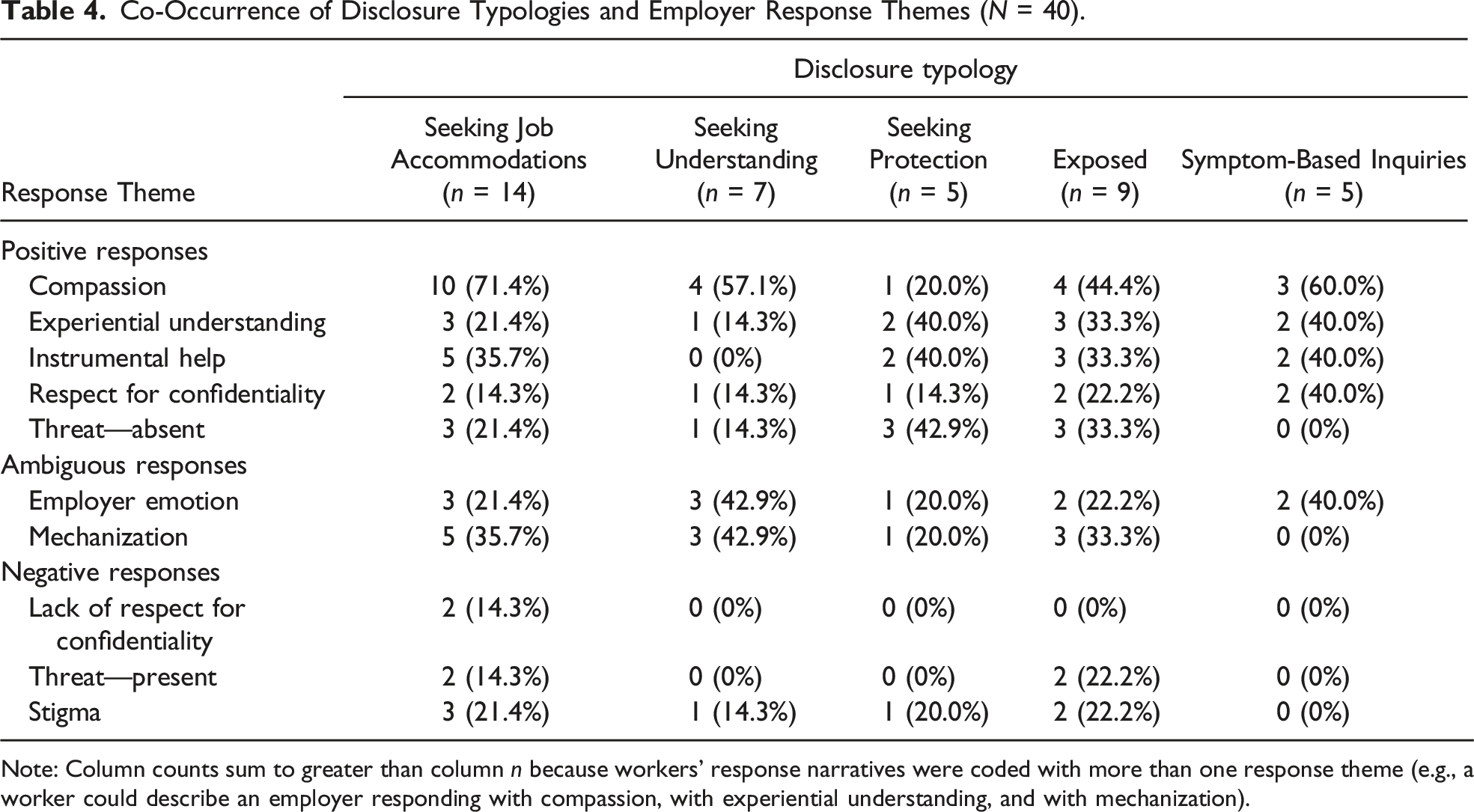
Note: Column counts sum to greater than column n because workers’ response narratives were coded with more than one response theme (e.g., a worker could describe an employer responding with compassion, with experiential understanding, and with mechanization).
First, we focus on the three disclosure typologies in which workers were seeking a specific outcome (Table 4, columns 1–3). Workers seeking accommodations most frequently noted employer responses of compassion, instrumental help, and mechanization. However, workers in this group also reported a number of negative responses, including stigma, threat-present, and two who indicated that their employer violated their confidentiality. The narratives of workers who were seeking understanding included about equal proportions of positive (especially compassion) and ambiguous (employer emotion and mechanization) responses. Only one worker in this group reported a negative employer response (stigma). The narratives of workers seeking protection also featured mostly positive employer responses (especially instrumental help and experiential understanding), including one worker who noted threat-absent. Only one worker seeking protection mentioned a negative response (stigma).
Next, we consider workers who disclosed in response to external circumstances (Table 4, columns 4–5). Within the narratives of exposed workers, descriptions of positive employer responses (especially compassion) occurred frequently, but descriptions of ambiguous and/or negative responses (mechanization, stigma, threat-present) were also common. The narratives of workers who disclosed in response to symptom-based inquiries focused almost exclusively on positive responses (including compassion, instrumental help, experiential understanding, confidentiality-present). None of these workers’ narratives mentioned a negative response.
Discussion
The current study addressed gaps in research on disclosure of SMI in employment contexts. Prior research on disclosure has sampled current workers from single sectors or workplaces (Joyce et al., 2009; Toth & Dewa, 2014), or from mental health services agencies, where it is likely that some participants were in non-regular jobs that were obtained and/or supported by vocational services (Brohan et al., 2014; Bril-Barniv et al., 2017; Henderson et al., 2012). Prior research on employer responses has centered employer/supervisor voices (Kirsh et al., 2018; Peterson et al., 2017; Tse, 2004), or only focused on worker perspectives in the context of working professionals needing accommodations (Elliott & Reuter, 2021). We addressed these limitations by examining worker perspectives on disclosure and on their employers’ responses to disclosure among a sample of current and former workers with SMI in a wide range of professional, nonprofessional white-collar, and blue-collar regular jobs.
Contexts of Disclosure
Some prior research has highlighted the dichotomous nature of the disclosure decision as planned/voluntary versus unplanned/involuntary (Bril-Barniv et al., 2017; Brohan et al., 2012). Our Aim 1 findings, focusing on the circumstances in which workers in regular jobs disclosed SMI to their employers, suggest that disclosure decisions are more nuanced. Workers in our sample never mentioned whether disclosure was voluntary or involuntary. Instead, their disclosure stories focused on what they were seeking (protection, job accommodations, understanding) or to what they were responding (symptom-based inquiries or exposure). Some of these contexts might appear to fit neatly into the planned/unplanned dichotomy, but the narratives did not support this characterization. Disclosure in the context of seeking accommodations, for example, might appear to be planned, but for some in this group, a recurrence of symptoms triggered more spontaneous disclosure. Disclosure in the context of symptom-based inquiries, which occurred with similar frequency among current and former workers, might seem to be involuntary, but even in this case, workers could be strategic in what they revealed. For example, one worker limited the amount of information disclosed by saying “certain symptoms and things have been showing up.”
Toth and Dewa (2014) model disclosure as a sequence of responses to a triggering incident which causes a worker to reconsider the default position of nondisclosure. A textbook example of their model is the “seeking protection” disclosure type. Workers seeking protection maintained the default position of nondisclosure until a triggering incident, the threat of disciplinary action or job loss, changed their calculation of risks and benefits in favor of disclosure. Workers who disclosed because they were seeking understanding, however, had no clear trigger. Moreover, the concept of nondisclosure as a default position is problematic, given our data, because four respondents disclosed prior to or during the hiring process. This finding suggests that, for some workers, concealment is not the default position. Such individuals may have no desire to hide their mental illness, may be afraid of being exposed, or may know, in advance, that they need accommodations to do the job (Donnelly, 2017; Peterson et al., 2011).
The Baldwin (2021) model, which characterizes disclosure in three dimensions (control, conditions, costs), is a better fit for some of the disclosure contexts in our data. Workers who disclosed in the context of symptom-based inquiries, or after being exposed, for example, had lost some measure of control over the disclosure decision because their mental illness had become visible. Still, these workers could impose conditions on how much they revealed about their illness based on their assessment of potential costs and benefits. Still, the exposed context was the most common among former workers, suggesting that it may be difficult for exposed workers to successfully navigate costs and benefits in this context. Workers who disclosed to seek understanding had considerable control over disclosure and chose conditions (time, place, person) consistent with a clearly defined objective (e.g., greater rapport with a supervisor) for which expected benefits presumably outweighed expected costs. Overall, our study identified a variety of contexts in which current and former workers disclose their SMI to their employers, above and beyond seeking job accommodations, and this finding corroborates prior work that found that 70% of disclosure scenarios were not about needing accommodations (Ellison et al., 2003).
Employer Responses to Disclosure
Prior research characterizing employer responses to supervising a worker with serious mental illness reveals mostly positive employer attitudes (Kirsh et al., 2018; Peterson et al., 2017; Tse, 2004). Much of this research references workplaces outside the U.S., often in disability-affirming contexts (e.g., after a workplace training, in the context of a being paired with a current employee) and centers on employer perspectives. Our study extends the literature by centering on worker perspectives, including workers and former workers, and sampling from a range of regular U.S. employment contexts. Consistent with some prior work in New Zealand and Canada (Kirsh et al., 2018; Peterson et al., 2017; Tse, 2004), we found that many workers highlighted positive employer responses to disclosure. However, many workers in our sample also highlighted employer responses that were ambiguous, and a sizeable minority described negative employer responses. Our findings also highlight the importance of considering current and former worker perspectives. Positive employer responses, like compassion, respect for confidentiality, and the absence of threat, were more prevalent among current workers. Negative employer responses, like lack of confidentiality and the presence of threats, were more prevalent among former workers.
Almost all of the positive employer responses described by our participants correspond to supervisor competencies identified in the Canadian study of supervisors who were managing a worker with mental illness in a large public service organization (Kirsh et al., 2018). The competencies include “responding to workers’ mental health concerns with compassion”; “implementing approaches to support both performance and well-being” (instrumental help); “respecting the privacy and dignity of the worker” (confidentiality); and “participating in mental health-related learning” (experiential understanding). Thus, supervisors in Canada and workers in the U.S. identify similar responses as positive practices in supervising workers with mental illness in regular jobs. Given that the samples come from two different countries, and different employment contexts, it is likely that these are critical features of positive employer responses to a worker’s disclosure of mental illness. Even the narratives of workers who described positive employer responses to disclosure, however, often included comments about threat (present or absent), suggesting that workers anticipated stigma and discrimination as likely responses to disclosure. These findings are consistent with prior research suggesting that, among workers with mental illness, anticipated discrimination is more prevalent than experienced discrimination (Yoshimura et al., 2018).
Interestingly, the experience of stigma did not strongly distinguish between current and former workers in our sample. This may reflect that SMI stigma is present at endemic levels, even when people are successfully employed in regular jobs. Such an interpretation is consistent with research on the intensity of stigma associated with SMI (Choe et al., 2020; Toth & Dewa, 2014; Yoshimura et al., 2018). Notably, stigma was also the least common employer response mentioned in our study, which is in contrast to prior work on workers’ anticipation of stigma and discrimination (Pandya et al., 2011, Ucok et al., 2012). We restricted our coding of stigma to cases where workers’ narratives explicitly identified one of the negative stereotypes of SMI (Russinova et al., 2011) in their employers’ responses to disclosure. However, other responses (e.g., threats, mechanization, and lack of confidentiality) may also reflect employers’ negative, but unspoken, stereotyping of workers with mental illness. More work is needed in this area.
Our results also extend the current literature by identifying some responses to disclosure, described by workers, that have not, to our knowledge, been identified in previous studies that focus on employers’ perspectives. These include the ambiguous responses of mechanization and employer emotion, and the negative responses of threat-present and breaches of confidentiality. Mechanization and breaches of confidentiality were more prevalent among former workers, suggesting that workers with SMI may benefit from more individualized responses to disclosure that comply with legal protections of workers’ privacy. It is not surprising that interviews with employers have not revealed some of the more negative or ambiguous responses to disclosure (Kirsh et al., 2018; Peterson et al., 2017; Tse, 2004), as employers may view their own actions positively. The identification of more negative and/or ambiguous employer responses in the current study highlights the importance of capturing current and former workers’ perspectives of their employers’ responses.
Linking Disclosure and Employer Responses
Three disclosure typologies describe workers disclosing their mental illness to achieve a specific goal: accommodations, protection, and understanding. Our results linking disclosure typologies to employer responses allow us to examine to what extent employers’ responses correspond to workers’ objectives. These analyses are a novel contribution to the literature.
One-third of workers who were seeking accommodations referred to instrumental help in their response narratives, suggesting that their employer/supervisor responded to disclosure by supporting the worker in their job, one of the key responsibilities associated with managing mental illness in the workplace (Kirsh et al., 2018). Mechanization was also a common response among workers in this group, which may reflect an employer or supervisor following established policies and procedures to negotiate formal accommodations. Several workers who requested accommodations also recounted negative responses to disclosure (stigma, threat-present, lack of respect for confidentiality). These results are not surprising, given that accommodations can impose burdens on supervisors/co-workers which may trigger resentment and negative, stigmatizing responses (MacDonald-Wilson et al., 2002; Elliott & Reuter, 2021; Peters & Brown, 2009).
Among the workers who were seeking protection from possible disciplinary action, only one mentioned absence of threat in their response narrative, but none described the threat as present or continuing after disclosure. These response narratives highlighted mostly positive employer responses (e.g., instrumental help and experiential understanding), an indication that disclosure not only removed the immediate threat for some workers but also provided supports for them to continue in their jobs. Indeed, several studies of the disclosure decision have highlighted “accessing workplace support” as one of the principle advantages of disclosure (Bril-Barniv et al., 2017; Brouwers et al., 2019; Ridge et al., 2019).
The most common response theme in the narratives of workers who were seeking understanding was compassion, followed by employer emotions, suggesting that these workers were successful in making an empathetic connection with their employer, possibly because the two had established a good relationship before the worker disclosed (Brouwers et al., 2019). However, several workers in this typology described mechanized or stigmatizing responses, suggesting that, for them, there was a disconnect between the worker’s motivation to disclose and the employer’s capacity to respond.
The other two typologies describe workers disclosing in response to a triggering incident (exposure or symptom-based inquiries), as suggested by the Toth and Dewa (2014) framework. Workers who were exposed might have expected the most negative responses to disclosure, given that they had lost considerable control over the disclosure decision (Baldwin, 2021; Bril-Barniv et al., 2017). Indeed, workers in this typology were more likely than most other groups to mention threat (present or absent) when describing their employers’ response to disclosure. They were also the most likely to be former workers, suggesting that exposure may be risky for workers with SMI.
Workers who disclosed in the context of employers’ symptom-based inquiries had some of the most unique experiences. They were the only group that, when describing their employers’ responses to disclosure, did not mention stigma, threat (present or absent), or mechanization. Additionally, they were more likely to mention experiential understanding and respect for confidentiality. This pattern of responses suggests that employers who inquire about workers’ changes in emotional, social, or behavioral well-being tend to have relevant personal, familial, or professional experience with mental illness, and that experience helps them relate to a worker with SMI (Kirsh et al., 2018; Tse, 2004). They might also have related knowledge or understanding about the importance of maintaining confidentiality. These results suggest that when employers with experiential understanding and low stigma reach out or check in with employees about their well-being, it creates a positive context for disclosure.
Implications for the Workplace
Our respondents identified three categories of negative employer responses to disclosure of mental illness, namely, stigma, threats initiated or continuing, and lack of respect for confidentiality. Some respondents also perceived mechanistic responses to be nonresponsive to their needs. These results suggest specific ways employers can work to create more inclusive workplaces, ensure compliance with disability statutes, and improve employment outcomes for workers with mental illness.
First, employers should strive to build a corporate culture that de-stigmatizes mental illness. Most of the negative responses our participants reported arose from stigmatizing attitudes that dehumanize workers with mental illness. Employers can avail themselves of anti-stigma programs designed specifically for the workplace, such as the ICU (“I See You”) program sponsored by the American Psychiatric Association (APA, 2022) or the Opening Minds program of the Mental Health Commission of Canada (Stuart et al., 2014). The objective is to establish a culture in which all employees recognize that mental illness is not a personal failing and that workers with mental illness can be responsible, reliable, and trustworthy (Joyce et al., 2009).
Second, employers should establish policies and procedures for responding to disclosure of SMI that include training in the mandates of the ADAAA (2008). The Job Accommodations Network (JAN, 2022) is an excellent resource for employers. Their consultants will work with an employer, at no cost, to develop written policies and procedures for responding to disclosure of SMI that comply with the ADAAA. JAN consultants will also assist in training managers and supervisors how to respond to a worker’s disclosure of mental illness and request for accommodations.
Finally, employers can work to sensitize all employees to respond to a worker with SMI with compassion. One of the best ways for individuals to develop compassion and understanding for persons with SMI is to interact with such a person, as we discovered among respondents who told us that their employers responded positively to disclosure because the employer had experiential understanding of mental illness. The “In Our Own Voice” program sponsored by the National Alliance on Mental Illness (NAMI, 2022) is a way for employers to bring the voices of persons with SMI into their workplace. The program, offered by NAMI local affiliates nationwide, provides a personal perspective on mental illness from individuals with lived experience of SMI.
Summary and Limitations
The current study addresses important gaps in research on workplace disclosure of SMI by sampling both currently and formerly employed workers, from previously unstudied geographic contexts and a wide range of employment settings, and collecting data about their experiences in regular jobs. This is also one of the earlier studies to examine worker perspectives of their employers’ responses to disclosure (see also Elliott & Reuter, 2021). Compared to much prior work that was limited to disability-affirming contexts and settings, and focused on the employer perspective, the study identified considerable nuances in the contexts of disclosure and a wider range of employer responses: positive, negative, and ambiguous.
Some limitations remain. Our focus on a stratified sample of workers means that the distribution of disclosure typologies and prevalence of response themes may not reflect their actual occurrence in the population. Many of the workers in our sample had considerable control over the disclosure decision, so they likely had reason to anticipate a positive response from their employer. A study of exposed workers, especially those exposed by a third party, might reveal a wider range of negative responses. Additionally, our small sample did not allow for disaggregation by diagnosis or occupation. Prior research recognizes that different diagnoses of mental illness elicit different intensities of stigma (Choe et al., 2020), and different occupations are more or less amenable to accommodating workers with mental illness, suggesting that some diagnostic/occupation groups may have more negative experiences than others. It is also important to consider that disability and discrimination policies vary across governments and may impact worker disclosure and employer responses. Finally, we centered on worker narratives because these are underrepresented in research on employer responses, but further research with employers and supervisors is also important.
These limitations do not mitigate the most important contribution of this work, which is to shed light on the process of disclosing a serious mental illness in regular, mainstream jobs. The results have important implications for the design of firm-level policies to promote inclusion of workers with mental illness in regular jobs. For example, the overwhelming positive outcomes described by workers whose supervisors made symptom-based inquiries suggest that efforts to train supervisors (to recognize the symptoms of mental illness, to inquire about a worker’s well-being in a non-threatening manner, and to provide appropriate supports) can improve employment outcomes for workers with mental illness. Other results suggest the need for workforce training to respect the confidentiality of workers’ personal health information and to debunk the negative stereotypes associated with mental illness. It is hoped that this study will lay the groundwork for future research and encourage workplace interventions that lead to successful and sustained employment for greater numbers of workers with mental illness.
Supplemental Material
Supplemental Material - Workers’ Perspectives on Workplace Disclosure of Serious Mental Illness and Their Employers’ Responses
Supplemental Material for Workers’ Perspectives on Workplace Disclosure of Serious Mental Illness and Their Employers’ Responses by Rebecca M. B. White, Marjorie L. Baldwin, and Xuesong Cang in Qualitative Health Research
Footnotes
Author Note
Worker surveys were conducted via telephone by West Group Research of Phoenix, AZ.  . Many follow-up interviews were conducted by Courtney Johnson, to whom the authors are deeply indebted. The datasets analyzed during the current study are not publicly available due to the fact that they constitute an excerpt of research in progress but are available from the corresponding author on reasonable request.
Declaration of Conflicting Interests
The author(s) declared no potential conflicts of interest with respect to the research, authorship, and/or publication of this article.
Funding
The author(s) disclosed receipt of the following financial support for the research, authorship, and/or publication of this article: This research was supported by a grant from the National Institute of Mental Health (R01 MH111650).
Supplemental Material
Supplemental material for this article is available online.
Notes
References
Supplementary Material
Please find the following supplemental material available below.
For Open Access articles published under a Creative Commons License, all supplemental material carries the same license as the article it is associated with.
For non-Open Access articles published, all supplemental material carries a non-exclusive license, and permission requests for re-use of supplemental material or any part of supplemental material shall be sent directly to the copyright owner as specified in the copyright notice associated with the article.
