




Abstract
This study explores the interactive relationship between apology, as a crisis-response strategy used in the current Toyota recall crisis, and product involvement in influencing the restoration of the organization’s reputation and customers’ future purchase intentions. The authors measured the impact of the interaction between participants’ perception of an apology and their product-involvement levels using a 2 (perception of apology: high sincerity vs. low sincerity) × 2 (product involvement: high vs. low) experiment design. The results showed that an apology was an effective strategy for repairing the organization’s reputation for those participants who were highly involved and perceived the strategy as highly sincere, but it did not increase their purchase intentions.
Public reaction in response to an organization’s crisis communication is of great concern to both public relations scholars and crisis managers. Crisis communication research has produced an abundant body of literature that helps communication managers to understand how to respond to a crisis. Situational crisis communication theory (SCCT) is one of the key theoretical approaches for guiding how a crisis situation influences response strategies and how the strategies eventually affect crisis outcomes, such as restoring an organization’s image (Benoit, 2004; Coombs & Holladay, 2002) and reputation (Claeys, Cauberghe, & Vyncke, 2010; Coombs, 2007b), decreasing negative word-of-mouth intentions (Coombs & Holladay, 2007), and improving customers’ purchase intentions (Coombs & Holladay, 2008; Laufer & Jung, 2010). A great deal of previous SCCT research has been devoted to how an organization should choose its response strategies, depending on the type of crisis (Coombs, 2007b).
On January 21, 2010, Toyota recalled 2.3 million vehicles because of a problem with the gas pedal. Five days later, Toyota announced it would stop the sale of all models affected by this recall (MacKenzie & Evans, 2010). While millions of Toyota vehicles were recalled and repaired, a company official announced to a U.S. House committee that “[t]he parts we are installing may not be fixing the acceleration problem [in our vehicles]” (Roemer, 2010). Furthermore, according to CBS News (2010), 52 deaths have been connected to Toyota vehicles since 2000, and between late 2009 and February 2010, 8.5 million Toyota vehicles were recalled.
The Toyota product recalls could be regarded as a crisis because they seriously damaged Toyota’s image, credibility, and reputation (Seeger, 2010). Specifically, according to SCCT, the recalls could represent a severe preventable crisis because the events involved numerous victims, and the organization was consequently held as fully responsible. To more effectively restore the organization’s reputation, SCCT suggests that Toyota should use the rebuild crisis-response strategy of an apology rather than deny or diminish strategies, such as a justification or an excuse (Coombs & Holladay, 2008).
But little attention has been given to the investigation of how people’s perception of a certain crisis-response strategy influences their reactions when combined with a level of product involvement (Coombs, 2007b). McDonald and Härtel (2000) suggested that product involvement may be a determinant of the outcome of a crisis because it can modify the effectiveness of crisis-communication. strategies. For example, people with high involvement are more likely to scrutinize a crisis strategy and have different perceptions of the strategy (Choi & Lin, 2009a; McDonald, Sparks, & Glendon, 2010). But little research has examined the interactive role of the two entities (product involvement and people’s perceptions of a communication strategy) in crisis communication. Most of the previous studies have tested the effectiveness of certain response strategies with crisis types based on hypothetical scenarios (Claeys et al., 2010; Coombs & Holladay, 2009; McDonald et al., 2010), not the response strategies actually used in a real crisis case. This gap in the research is our primary rationale for conducting this study. The Toyota recall crisis is a particularly useful research case because it affected various people around the world, not just in the United States.
Therefore, this research extends SCCT by testing the interaction between product involvement and apology as a crisis-response strategy in the Toyota recall crisis in order to better understand public responses to crisis communication. Specifically, this research focuses on whether people with different product involvement react differently to apology in terms of their perceptions of the organization’s reputation and their future purchase intentions. By exploring the concept of involvement in a real crisis case, this study contributes to the expansion of SCCT and serves as groundwork for future empirical studies that examine the effect of the interaction between involvement and any other crisis-response strategy on crisis communication.
We begin by providing an overview of the current Toyota recall crisis and then a review of existing work relevant to crisis management, including the consideration of apology as a crisis-response strategy and the interactive role of involvement in the public’s perception of the strategy. Next, we explain our methods for testing the interactive effects of apology and involvement and present the results of this experiment. Finally, we discuss several theoretical and practical implications of this study.
Background: The Toyota Recall Crisis
Toyota has maintained a long-standing reputation for creating high-quality vehicles. But recently, the company suffered a crisis involving the safety of its vehicles, which has damaged its widespread image of excellence. In late August 2009, four people riding in a Lexus ES350 were killed in an accident because the vehicle’s brakes did not seem to work, according to one of the passengers who called 911 (MacKenzie & Evans, 2010). In addition, CBS news media reported that the Department of Transportation had received complaints of 52 deaths connected to reports of sudden acceleration in Toyota vehicles since 2000 (CBS News, 2010).
The next month, Toyota recalled the floor mats of 4.2 million Toyota and Lexus vehicles, claiming that removing these mats would fix the problem of the stuck accelerator pedals. The Los Angeles Times then began featuring articles on incidents involving unintended acceleration in Toyota and Lexus vehicles (MacKenzie & Evans, 2010), including a story claiming that some Toyota drivers had accelerator pedal issues even after the floor mats had been removed. Following consumer complaints and media reports of alleged Toyota vehicle defects after the floor-mat recall, Toyota publicly denied all allegations (Seeger, 2010).
Due to this public denial, there has been much criticism concerning Toyota’s response to the crisis. Many civic activity groups, news media, and consumers complained that the auto giant did not take responsibility, leaving consumers in a potentially life-threatening situation. As criticism of its irresponsibility and slow response mounted, Toyota began voluntary safety recalls and recalled 8.5 million Toyota-brand vehicles from late 2009 to February 2010. But Toyota’s image, credibility, and reputation had already been seriously damaged (Seeger, 2010). As a result, the organization lost significant market shares (Seeger, 2010).
Literature Review of Strategic Crisis-Communication
Product recalls present a key crisis for companies that find that their products have certain technical or mechanical problems (Laufer & Jung, 2010). While a company’s initial motivation for a recall may be consumer safety, any negative media reports can damage the company’s reputation, lessen consumer trust (Birchall & Milne, 2009; Dawar & Pillutla, 2000), and have significant effects on consumers’ future purchases (Miller & Littlefield, 2010). But despite the potential for negative consequences, companies still make decisions to recall their products. Their major rationale behind this recall decision is the implicit threat of regulatory action, liability, and adverse publicity (Berman, 1999; Miller & Littlefield, 2010; Thomsen, Ollinger, Crandall, & O’Bryan, 2008).
An organizational crisis can be seen as an event that brings, or has the potential for bringing, an organization into disrepute, imperiling its future profitability, growth, and, possibly, its survival (Coombs, 2007b). Such events occur unexpectedly and are negative (Coombs, 2006). Although they have a low probability of occurrence, they are highly consequential and cause ambiguity and pressure for the organization, which must make timely decisions (McDonald et al., 2010). Typically, an organization tries to defend itself during and after a crisis while the media try to place blame for the crisis (Coombs & Holladay, 2002).
Coombs (2007a) added a crucial element of crisis in his definition: ‘‘The perception of an unpredictable event that threatens important expectancies of stakeholders and can seriously impact an organization’s performance and generate negative outcomes’’ (pp. 2–3). That is, a crisis is a perception, and ultimately, public perception is reality. Studying the role of perception, Penrose (2000) concluded that public perception of a crisis is a critical element in crisis responses and will affect crisis outcomes. According to Coombs (2007b), crisis communication is a process that takes place in four stages: prevention, preparation, response, and revision. Ulmer, Seeger, and Sellnow (2007) also described crisis communication as a four-step process: managing uncertainty, responding to a crisis, resolving a crisis, and learning from a crisis. Our study focuses on the crisis-response stage of crisis communication. Marsh (2006) noted that most research about crisis-response strategies stems from apologia theory, which was influenced by Ware and Linkugel’s (1973) work. Benoit (1995) built on apologia theory by developing image restoration theory. Finally, Coombs (2007b) developed SCCT, which provides the theoretical foundation of our study.
SCCT
SCCT provides a theoretical framework for explaining how crisis communication can repair reputational damage that may occur during a recall. According to SCCT, a crisis situation consists of four elements that can be used to assess its potential threat to the organization’s reputation: crisis type, damage severity, crisis history, and relationship history. To protect an organization’s reputation, crisis managers should select the most appropriate crisis-response strategy or strategies (Coombs, 2006, 2007b; Coombs & Holladay, 2002, 2007, 2008, 2009).
The SCCT divides crisis types into three clusters: victim crises, accidental crises, and preventable (or intentional) crises (Coombs, 2007b; Coombs & Holladay, 2002, 2009). The victim cluster includes crises in which a weak level of responsibility is attributed to the organization. The accidental cluster involves crises in which a certain, but low, level of responsibility is attributed to the organization. And the preventable cluster includes crises for which the full responsibility is attributed to the organization (Claeys et al., 2010).
The more responsibility that is attributed to the organization with respect to causing the crisis, the more negative the impact on the organization’s reputation (Coombs, 2006, 2007b). Therefore, different types of crises inflict different amounts of reputational damage. For example, a victim crisis may cause little damage to the organization’s reputation, an accidental crisis may cause a moderate amount of damage, and a preventable crisis may cause the most damage to the organization’s reputation (Coombs & Holladay, 2002, 2009).
SCCT also suggests three response strategies that can be used in postcrisis communication: deny, diminish, and rebuild. Deny strategies claim that no crisis exists or that the organization has no responsibility for it (Claeys et al., 2010; Coombs, 2007b). Diminish strategies argue that a crisis is not as serious as people think or minimize organizational responsibility. Rebuild crisis strategies offer compensation for the crisis or apologize. Consequently, research has found that crisis managers should select the most appropriate crisis-response strategy according to the crisis type (Coombs & Holladay, 2002, 2009). Previous studies have suggested that deny strategies would best match with victim crises and that diminish strategies would be most appropriate for accidental crises whereas rebuild strategies would be most effective for preventable crises (Claeys et al., 2010; Coombs, 2006, 2007b).
Apology as a Critical Crisis-Communication Strategy
Along with SCCT, attribution theory posits that when a crisis occurs, the public (consumers, opinion leaders, stakeholders, media, etc.) looks for explanations about the cause of the crisis; the public will assess who is responsible for the crisis and often attribute blame for the crisis (Wiener, 1985). If an organization is deemed responsible for a crisis, the attributions that the public makes about crisis responsibility have negative attitudinal and behavioral consequences for the organization (Coombs, 2007b). Researchers have emphasized the use of apology as the “best” crisis response when an organization faces attribution, specifically for preventable crises (Benoit, 1995; Benoit & Drew, 1997).
An apology is defined as a communicative expression of one’s regret, remorse, or sorrow for a wrongdoing (Benoit, 1995). In a crisis, an apology can be implemented by an organization accepting responsibility for the crisis and asking for forgiveness (Benoit & Drew, 1997; Fuchs-Burnett, 2002). For example, if a company faces a crisis that is the direct result of its actions, the company should apologize for it (Benoit, 1995). If the company does not fully apologize in a time of crisis, the public may express disappointment with the company and expect some explanation (Fearn-Banks, 2011). Therefore, in a time of crisis, the company must communicate to the public with an actual apology, such as “We made a mistake, we are sorry, please forgive us.” If the company expresses to the public its sincere apology and how it has taken steps to prevent the reoccurrence of the crisis, the public might forgive the company (Coombs & Holladay, 2008; Fearn-Banks, 2011). Thus, apology is a critical crisis communication strategy for a company to use in order to defend its reputation and protect its image.
A company can also use apology as a critical crisis communication strategy in order to separate itself from the negative impact of a crisis. While apologizing, the company may communicate to its public that it did not intend to make the mistake and that the crisis was unforeseen (Fearn-Banks, 2011). The public is more likely to forgive the company’s crisis because the apology and the claim that the happening was unforeseen influence the public to redefine the crisis as an unintentional mistake.
Toyota used an apology as a postcrisis response. In the congressional testimony on February 24, 2010, Toyota’s president, Akio Toyoda, publicly apologized for safety lapses that led to widespread recalls for accelerator and braking failures—and for a corporate culture that might have made things worse. The chief executive officer (CEO) told Congress that he was “deeply sorry” for accidents resulting from Toyota’s automobiles and that he would “take full responsibility” for the accidents. In his speech, Toyoda also emphasized that his company’s priority is safety and that the accidents were unintended mistakes. He stated that “we pursued growth over the speed at which we were able to develop our people and our organization, and we should sincerely be mindful of that” and that “I regret that this has resulted in the safety issues described in the recalls we face today” (Montopoli, 2010).
Overall, the accidents resulting in these Toyota product recalls have involved numerous victims who were killed or sustained property damage and serious injuries. Because of these factors, according to SCCT, the product recalls could be categorized as a severe preventable crisis. In addition, the public perceived the organization as being fully responsible. As a result, according to attribution theory, the organization apologized and admitted its responsibility. We could surmise that the use of an apology would be an effective strategy for restoring Toyota’s reputation and for increasing the intentions of the public to purchase its products in the future (Coombs & Holladay, 2008). Therefore, we proposed the following research hypothesis (RH):
RH1: The use of apology is effective for restoring Toyota’s reputation (RH1a) and for increasing consumers’ intentions to purchase its products in the future (RH1b).
In crisis communication, a crucial issue for an organization that is involved with a crisis is not changing the reality of the crisis but, rather, changing the public’s perception of the crisis (Benoit, 2004; Choi & Lin, 2009b). Within the context of product recalls, the public’s perception of a specific communication strategy (e.g., apology) used by the involved organization may play a crucial role in the effectiveness of that strategy. In other words, the public usually understands the crisis involved with product recalls through information from different sources and formats. Thus, an organization that is facing a product-recall crisis should make a diligent effort to provide information to the public and show its sincerity—a core element in the public’s perception of a crisis response—while doing so (Risen & Gilovich, 2007). Specifically, when apologizing for its wrongdoing to the public, an organization should show that it is fully sincere because the public rejects insincere apologies (Risen & Gilovich, 2007). While listening to an apology, the public usually evaluates its sincerity; the apology may pass the public’s judgment, then, depending on whether it seems sincere (Myers, 2000). If an organization’s apology passes the public’s evaluation of its sincerity, the organization can obtain the public’s forgiveness (Risen & Gilovich, 2007).
To pass the public’s judgment and obtain the public’s forgiveness, an organization needs to take responsibility for the crisis while it is experiencing and managing the situation. Taking such social responsibility is necessary in order for the public to perceive the organization as sincere (Hoeffler & Keller, 2002). In other words, to convince the public of its sincerity, an organization needs to emphasize its corporate social responsibility programs in its communication. Furthermore, as Hoeffler and Keller pointed out, an organization can convince the public of its sincerity through showing care and consideration. Therefore, when an organization faces a crisis, it should show how it sincerely cares for and considers the public. And one of the ways an organization can show its care and consideration for the public is by giving a sincere apology.
A sincere apology implies that the organization offering the apology sufficiently cares about people’s feelings and victims’ predicaments (Risen & Gilovich, 2007). The president of Toyota showed remorse for the family killed in the August 2009 accident due to his company’s automobile. In his apology, Toyoda stated, “I am deeply sorry for any accidents that Toyota drivers have experienced,” and he added, “especially, I would like to extend my condolences to the members of the Saylor family, for the accident in San Diego” (Montopoli, 2010). Thus, the president of Toyota used apology in his speech as a strategy for restoring his company’s reputation, which was damaged by the recall crisis. While giving his speech, Toyoda tried to show his sincerity. We wanted to measure how the public perceived his sincerity and how this perception influenced the company’s postcrisis reputation and consumers’ future purchase intentions; therefore, we proposed our second research hypothesis:
RH2: The use of apology is more effective in restoring Toyota’s reputation (RH2a) and increasing future purchase intentions (RH2b) with people who perceive the apology as sincere than it is with those who do not perceive it as sincere. Consequently, the perception of sincerity will have a main effect on the dependent variables.
Involvement
Finally, we wanted to study how people’s involvement with Toyota products influenced their perception of the apology and their future purchase intentions. One research aspect of communication has focused on how people receive information, evaluate it to form an opinion, and eventually reconcile it with their behavior. One explanation of this process features the concept of involvement, the extent to which personal interest serves as an incentive to receive new information and compare it to previously held information in order to form an opinion toward an object, situation, or issue (Petty & Cacioppo, 1981, 1986b). A central issue of involvement theory is that people desire to learn more about topics in which they are personally involved. This line of analysis argues that relevant thought about a topic increases as personal interest in that topic increases (Heath & Douglas, 1990, 1991; Petty & Cacioppo, 1981, 1986b). People respond to situational factors out of self-interest (Grunig, 1997), and they evaluate these factors using existing information that is advocated by a process of communication (Wright, 1974).
The concept of involvement has received considerable attention in many academic areas (Chaffee & Roser, 1986; Grunig, 1992, 1997; Heath & Douglas, 1990, 1991). In their elaboration likelihood model (ELM), Petty and Cacioppo (1986a) focused on involvement, or personal relevance, which they defined as “intrinsic importance, personal meaning, and consequences” (pp. 82–83). In a similar way, heuristic systematic model researchers have addressed response involvement and personal relevance, topic relevance (Chaiken, 1980, 1987), and task importance (Chaiken & Maheswaran, 1994). A marketing study (Droge, 1989) has shown that attitudes toward commercials positively affect attitudes toward the brands shown on the ads only in low-involvement situations. More relevant to our study, public relations research (Heath & Douglas, 1990, 1991) has emphasized the critical part that involvement plays in audience responsiveness to messages and issues. Similarly, involvement is a central construct in situational theory (Grunig, 1992, 1997), which focuses on the degree to which people feel “connected” to an issue as a predictor of the probability that they will become active members of a public concerned with such issues.
Further studies have applied the concept of product involvement to crisis communication (Choi & Lin, 2009b; McDonald et al., 2010; McDonald & Härtel, 2000). Product involvement relates to an individual’s overall perception of a product’s relevance and has motivational qualities that direct consumers’ cognition and overt behavior (Choi & Lin, 2009b; McQuarrie & Munson, 1992). According to the ELM, product involvement affects individuals’ motivation to attend to and comprehend incoming information; eventually, they attend to a crisis response that fits their needs (Celsi & Olson, 1988; Choi & Lin, 2009b; Petty & Cacioppo, 1981, 1986b; Salmon, 1986). In the case of the Toyota recalls, certain groups of people (e.g., current Toyota drivers and potential consumers who plan to purchase a Toyota vehicle in the near future) tend to perceive the recall issue as personally relevant to their safety. Thus, they are more likely to have a higher level of product involvement with the recalls than do those who are not driving a Toyota vehicle or do not plan to purchase one in the future. The ELM further suggests that message processing and attitude or behavior formation may take place differently, depending on the different level of involvement that is salient at the time of exposure to the postcrisis response. Thus, we proposed our third research hypothesis:
RH3: The use of apology is more effective in restoring Toyota’s reputation (RH3a) and increasing future purchase intentions (RH3b) with people who are highly involved than it is with those who are just minimally involved. Consequently, product involvement will have a main effect on the dependent variables.
Previous research has found that people’s involvement with a message potentially creates a positive attitude and behavior if the information or appeal is relevant to them (Batra & Ray, 1986). Based on this finding, Heath and Douglas (1990, 1991) suggested that a postcrisis response, such as an apology, is likely to have a greater effect on the attitude and behavior of people with high involvement than it is on those with low involvement. In other words, highly involved people, compared to people with little involvement, are more likely to pay attention to Toyota’s postcrisis responses, and these responses are also more likely to have a greater influence on their postcrisis attitudes toward the company and purchasing behavior. This overall logic implies an interaction between people’s level of product involvement and their perception of a crisis response strategy in that people who are highly involved in an organization’s product recalls and perceive the response from the organization as relevant and sincere are more likely to show a favorable attitude toward the organization and to purchase its products in the future compared to those with low involvement or those who perceive the response as irrelevant and insincere. Therefore, we proposed the following research hypothesis:
RH4: The use of apology is more effective in restoring Toyota’s reputation (RH4a) and increasing future purchase intentions (RH4b) with people who have high levels of involvement and perceive the apology as sincere than it is with those who have low levels of involvement and do not perceive the apology as sincere. The perception of sincerity and product involvement will have an interactive effect on the dependent variables.
Method
To investigate our hypotheses for this study, we used a 2 (perception of apology: high sincerity vs. low sincerity) × 2 (product involvement: high vs. low) factorial design. Identifying the Toyota recall as a preventive crisis, we investigate how participants’ perception of the Toyota CEO’s apology interacted with their level of product involvement, influenced the restoration of Toyota’s reputation, and increased their future purchase intentions.
Participants
We used a purposive sampling technique to obtain data for this study. After the Toyota CEO released his apology, we contacted 10 chambers of commerce at 10 cities in two large Southwestern states to see if we could collect data during their weekly business and town meetings. With permission from seven of the chambers of commerce, we visited nine meetings held at various times from March 2 to March 8, 2010 (about 2 weeks after the Toyota CEO apologized). A total of 293 participants initially participated in this study, but 41 were later excluded because they had already seen or read the full apology. Thus, 252 participants who had not seen or read the full apology or had minimum knowledge about the apology participated in this study. The ages of the participants varied, ranging from 22 to 65 (M = 39.3, SD = 8.9) years. The participants reflected the population of the seven cities in terms of gender proportion—118 males (46.8%) and 134 females (53.2%). We had approval from our institutions’ human-subjects research board.
Procedure
Immediately after each meeting ended, a trained experimenter explained the purpose of the research and the benefits of participating, and asked for volunteers. Those who volunteered to participate then completed a questionnaire, consisting of demographic questions and items concerning participants’ product involvement, opinion about Toyota’s reputation after the recalls (but before exposure to the apology), and current intention to purchase a Toyota vehicle. The participants then watched a 2-minute video of the apology speech delivered by the Toyota CEO ( Toyota CEO Apologizes for Recall, Accidents, 2010). After the participants watched this video, we asked them to fill out another questionnaire with a series of 5-point, Likert-type items in order to measure their perception of the sincerity of the apology, their opinion about Toyota’s reputation after the apology, and their future purchase intentions. Participants completed the entire survey in about 20 minutes.
Measurement
We measured all the variables in this study on a 5-point Likert-type scale, ranging from 1, strongly disagree, to 5, strongly agree. In detail, we measured participants’ opinion about Toyota’s reputation after the recall crisis using 5 items (high quality, good value, safety, comfort, and dependability) in combination with Fombrun, Gardberg, and Sever’s (2000) Reputation Quotient scale. The scale was reliable (Cronbach’s α = .92). We also used this scale to measure the organization’s reputation after the participants’ exposure to the CEO’s apology.
We measured purchase intentions using 3 items (It is very likely that I will buy a Toyota vehicle in the future, I will purchase a Toyota vehicle the next time I need one, and I now feel more confident to buy a Toyota vehicle) that we had modified from previous studies (Coombs & Holladay, 2007; Laufer & Jung, 2010). This scale was also reliable (Cronbach’s α = .89).
We measured the participants’ perception of the sincerity of the apology using 4 items (sincere, moving my heart, trustworthy, and candid) that we had modified from previous studies (Eisinger & Mills, 1968; Risen & Gilovich, 2007). This scale was reliable as well (Cronbach’s α = .86). We measured product involvement using 5 items (involved, important, matters, significant, and of interest) from McQuarrie and Munson’s (1992) commonly used involvement scale. This scale was also reliable (Cronbach’s α = .91).
Pretest
All the participants were somewhat involved with the Toyota recalls (M = 3.1, SD = 1.2). A total of 135 participants were categorized as having low involvement because their mean involvement score was less than 3.09; the other 117 participants were categorized as having high involvement because their mean involvement score was higher than the participants’ overall mean score of 3.1. None of the participants had the exact mean score of 3.1, which would indicate average involvement.
Before seeing the CEO’s apology speech, participants were moderately aware of the Toyota recalls (M = 3.5, SD = 1.2). The participants’ opinion about Toyota’s reputation was neutral (M = 3.2, SD = 1), and their purchase intentions were somewhat low (M = 2.7, SD = 1). We ran two independent t-tests to identify differences between highly involved and minimally involved participants on the levels of reputation and purchase intentions. The pretests showed that there were no significant differences between the two groups with regard to reputation [M high = 3.1, M low = 3.2, t(250) = −.4, ns] and purchase intentions [M high = 2.7, M low = 2.7 t(250) = −.5, ns], which indicated that before being exposed to the apology, the participants had similar views about Toyota’s reputation and similar intentions to purchase its products, regardless of their involvement level.
Posttest
Overall, the participants perceived the CEO’s apology as being moderately sincere (M = 3.1, SD = 1.1). A total of 133 participants perceived it as highly sincere because their averaged sincerity score was higher than the participants’ overall mean score of 3.1; the remaining 119 participants perceived the apology as having low sincerity because their averaged sincerity score was lower than 3.09. None of the participants had the exact mean score of 3.1. In addition, there was no difference between highly (M = 3.2, SD = 1.2) and minimally (M = 3.0, SD = 1) involved groups with regard to their perception of the apology’s sincerity [t(250) = 1.6, ns]. This finding indicates that the participants perceived the apology in a similar way, regardless of their involvement level.
Results
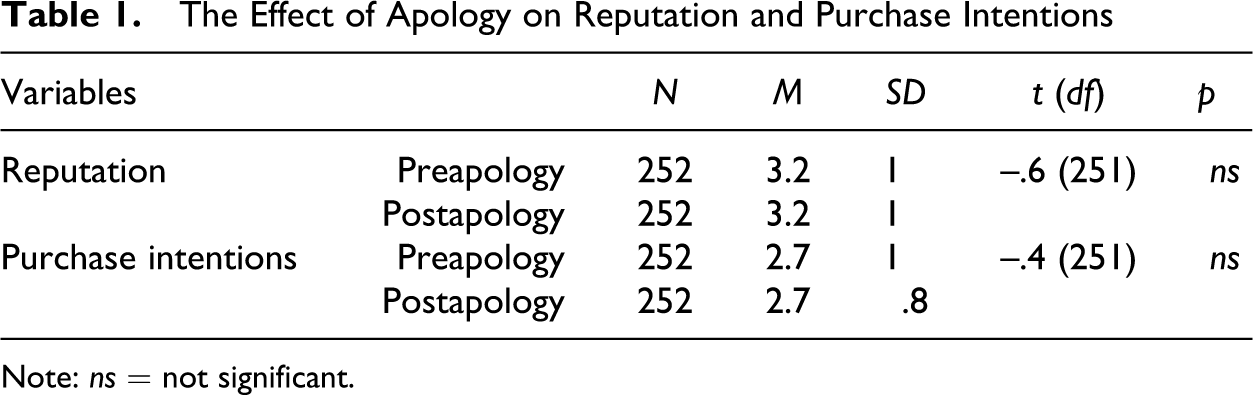
RH1 suggests that an apology has a general effect on restoring an organization’s reputation (RH1a) and on increasing consumers’ future purchase intentions (RH1b). To test RH1, we ran a series of paired t-tests to identify any effect of participants’ responses to the apology of Toyota’s CEO on the dependent variables. Table 1 shows the results of this analysis. We found that the use of apology was not effective in restoring Toyota’s reputation because the participants’ overall mean score on the reputation items of the questionnaire remained the same before and after they were exposed to the apology [M pre = 3.2, M post = 3.2, t(251) = −.6, ns]. Thus, the findings did not support RH1a. In addition, the use of apology was not effective in increasing the participants’ future purchase intentions because their overall mean score on the items about purchase intentions again remained the same after they were exposed to the apology [M pre = 2.7, M post = 2.7 t(251) = −.4, ns]. Thus, the findings did not support RH1b, either.
The Effect of Apology on Reputation and Purchase Intentions
Note: ns = not significant.
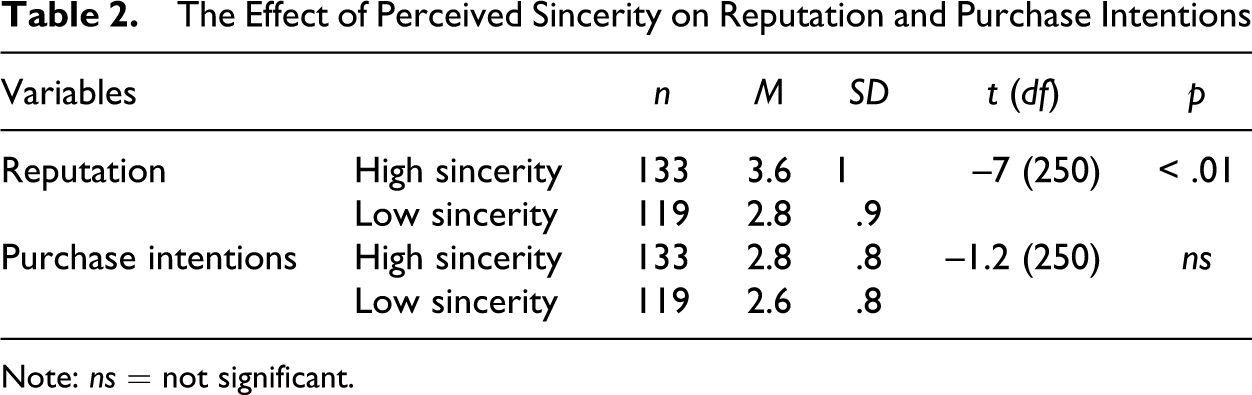
RH2 suggests that the perception of sincerity will have a main effect on restoring an organization’s reputation (RH2a) and on increasing future purchase intentions (RH2b); that is, RH2 suggests that the use of apology will be more effective in restoring Toyota’s damaged reputation and increasing future purchase intentions with participants who perceive the strategy as sincere as opposed to with those who do not. To test RH2, we used a series of independent t-tests to compare the two groups on the dependent variables. Table 2 shows the results of this analysis. We found that the use of apology was more effective at restoring Toyota’s postcrisis reputation with participants who perceived the strategy as highly sincere than it was with those who did not find the apology to be as sincere. That is, the mean score on the reputation items for participants who perceived the apology as highly sincere was significantly higher than that of participants who perceived the apology as having little sincerity [M high sincerity = 3.6, M low sincerity = 2.8, t(250) = −7, p < .01]. Thus, the findings supported RH2a. But the use of apology did not influence participants’ intentions to purchase regardless of their perception of the apology’s sincerity [M high sincerity = 2.8, M low sincerity = 2.6, t(250) = −1.2, ns]. Thus, our findings did not support RH2b.
The Effect of Perceived Sincerity on Reputation and Purchase Intentions
Note: ns = not significant.
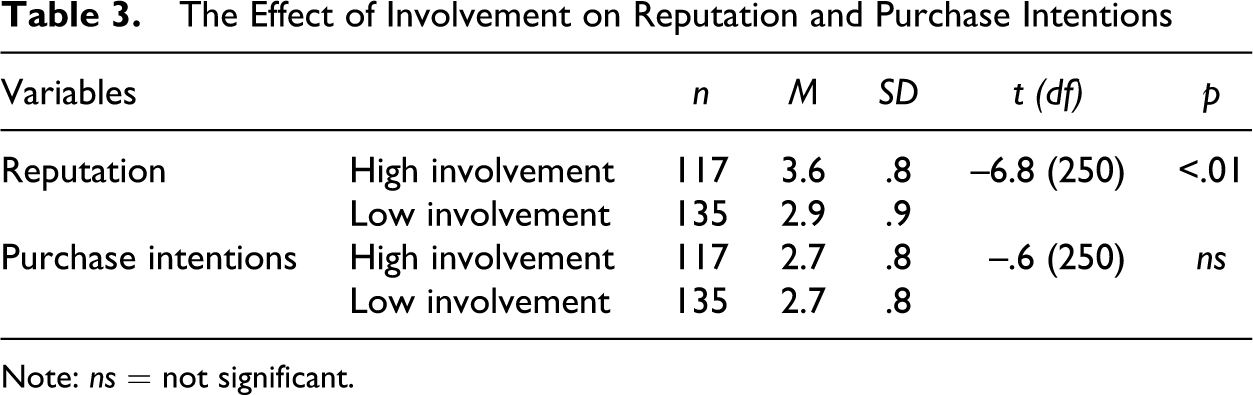
RH3 suggests that product involvement will have a main effect on restoring an organization’s damaged reputation (RH3a) and on increasing consumers’ future purchase intentions (RH3b); that is, RH3 suggests that the use of apology will be more effective in restoring Toyota’s reputation and increasing future purchase intentions with participants who are highly involved as opposed to with those who are not. Table 3 shows the results of our testing of this hypothesis. We found that the use of apology was more effective for highly involved participants because their overall mean score on the reputation items after exposure to the apology was significantly higher than that of participants who were minimally involved [M high involvement = 3.6, M low involvement = 2.9, t(250) = −6.8, p < .01]. Thus, the findings supported RH3a. But the use of apology did not influence participants’ intentions to purchase regardless of their level of product involvement [M high involvement = 2.7, M low involvement = 2.7, t(250) = −.6, ns]. Thus, the findings did not support RH3b.
The Effect of Involvement on Reputation and Purchase Intentions
Note: ns = not significant.
Finally, RH4 suggests that people’s perception of sincerity and their product involvement will have an interactive effect on restoring an organization’s reputation (RH4a) and on increasing the people’s future purchase intentions (RH4b); that is, RH4 suggests that the use of apology will be effective in restoring Toyota’s damaged reputation and increasing future purchase intentions for participants who are highly involved with the product and perceive the apology as sincere. To test RH4, we used a multivariate analysis of variance, which is an appropriate method to examine the interactive effect of the two independent variables (level of involvement and level of perceived sincerity) on the two dependent variables (reputation and purchase intention) and to better control for Type I error. Table 4 shows a descriptive analysis of the effect of level of involvement and perceived sincerity on reputation.
Descriptive Analysis of the Effect of Level of Involvement and Sincerity on Reputation
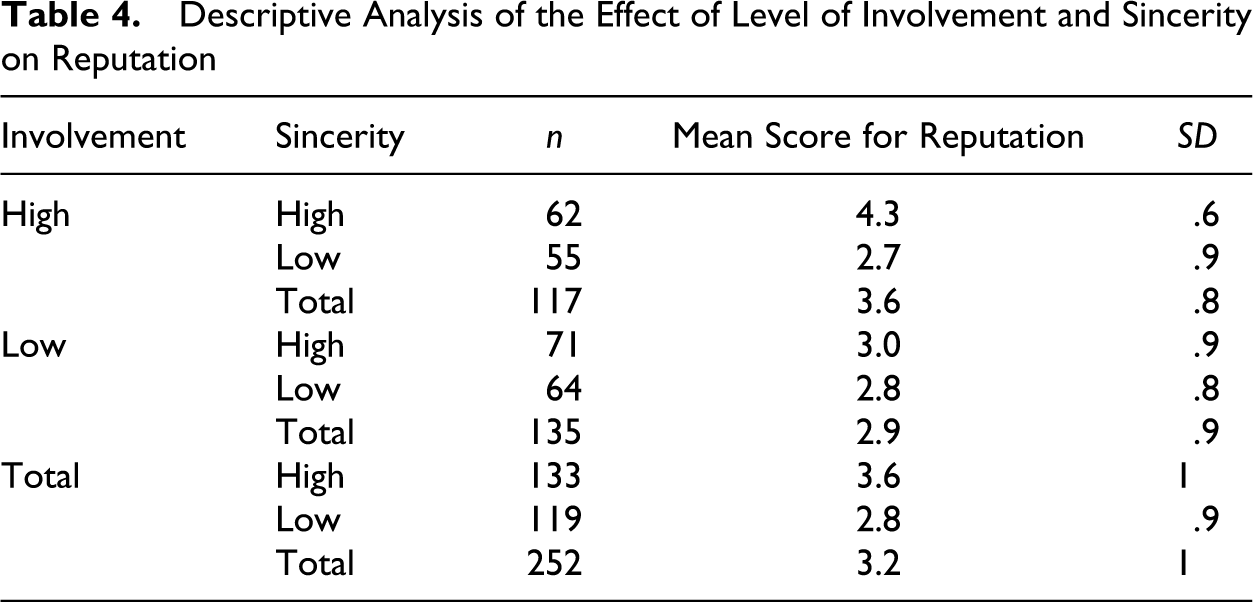
Table 5 shows a factorial analysis of the effect of each independent variable on the dependent variable, reputation, and the interactive effect of the two independent variables (RH4a). Both involvement [F(1, 248) = 34.9, η p 2 = .1, p < .01] and perceived sincerity [F(1, 248) = 72.9, η p 2 = .2, p < .01] have a significant main effect on reputation. The interactive effect of involvement and sincerity on reputation was significant [F(1, 248) = 46.3, η p 2 = .2, p < .01]. Participants who were highly involved and perceived the apology as highly sincere had a higher overall score on the reputation items (M = 4.3, SD = .6) than the other participants did (see Table 4). Therefore, the findings supported RH4a. Thus, Toyota’s reputation was most likely to be repaired for those participants who were highly involved with the recall case and who perceived the CEO’s apology speech as highly sincere. Figure 1 illustrates the interactive effect between the level of involvement and the level of sincerity on reputation.

Interaction between level of sincerity and level of involvement on reputation.
Factorial Analysis of the Effect of Involvement and Sincerity on Reputation
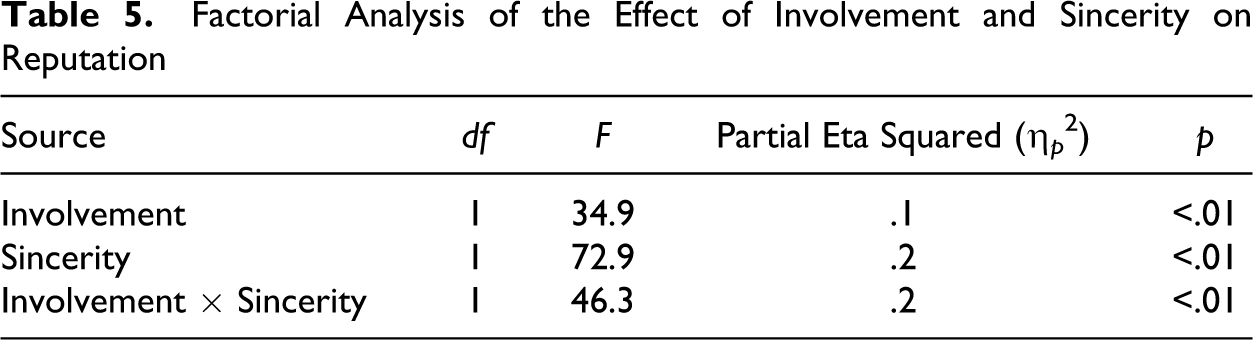
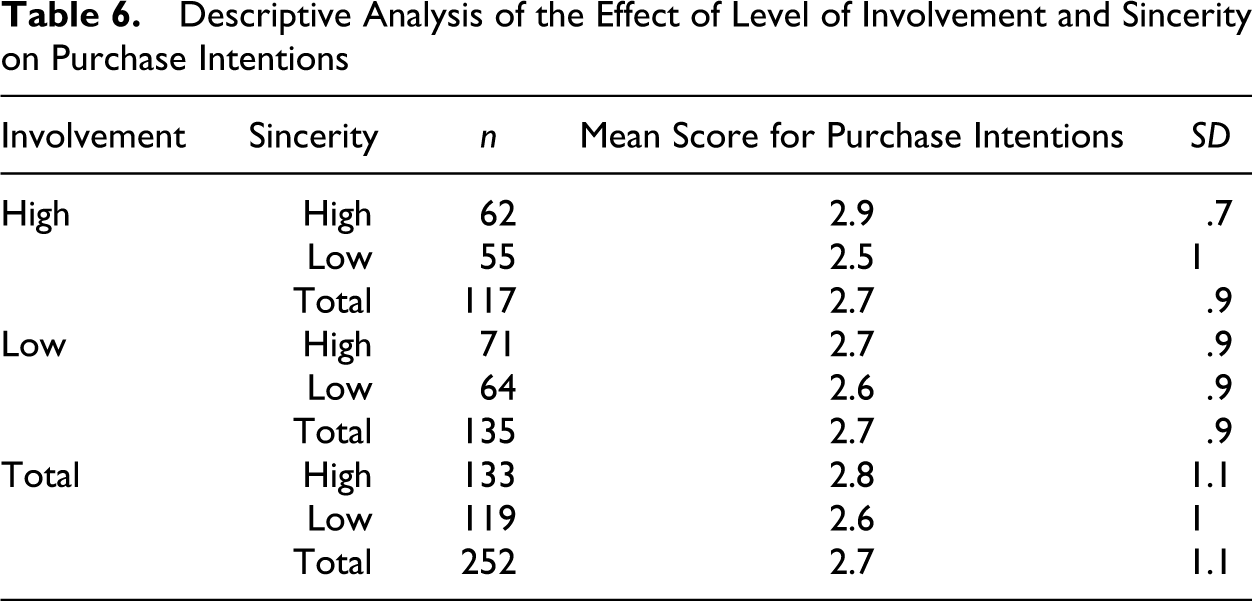
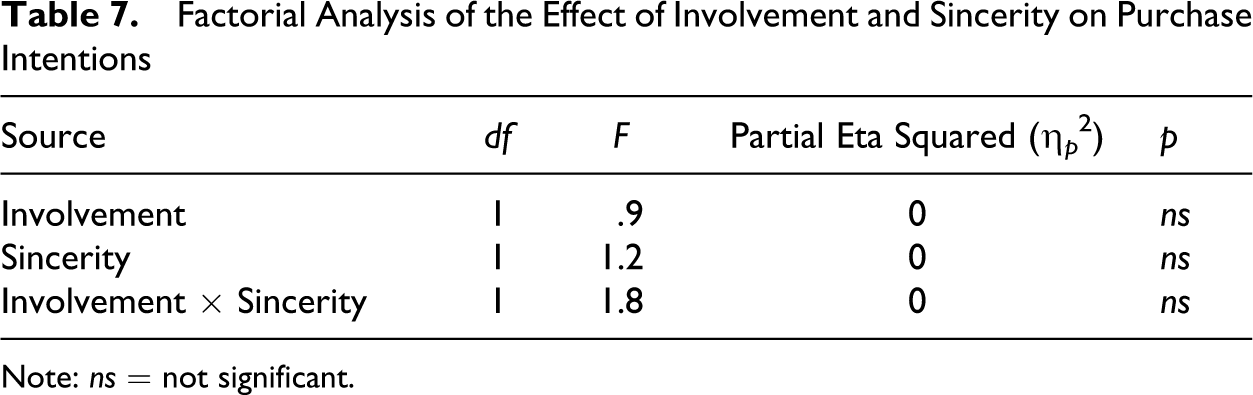
Table 6 shows the descriptive analysis of the effect of level of involvement and perceived sincerity on future purchase intentions, and Table 7 shows a factorial analysis of the effect of each independent variable on the dependent variable, purchase intentions, and the interactive effect of the two independent variables (RH4b). Neither involvement [F(1, 248) = .9, ns] nor perceived sincerity [F(1, 248) = 1.2, ns] had a significant effect on purchase intentions. In addition, the findings showed an interactive effect of involvement and sincerity on purchase intentions, but this effect was not significant [F(1, 248) = 1.8, ns]. Therefore, the findings did not support RH4b. Thus, participants who were highly involved with the recall case and perceived the CEO’s apology speech as truly sincere were no more likely to purchase a Toyota vehicle in the future than were those who were not highly involved and did not perceive the speech as highly sincere. As Figure 2 illustrates, the interactive effect between the level of involvement and the level of sincerity on purchase intentions was minimal and insignificant.

Interaction between level of sincerity and level of involvement on purchase intentions.
Descriptive Analysis of the Effect of Level of Involvement and Sincerity on Purchase Intentions
Factorial Analysis of the Effect of Involvement and Sincerity on Purchase Intentions
Note: ns = not significant.
Discussion
This study contributes in several ways to our understanding of public reaction to a crisis-response strategy. First, SCCT argues that crisis communication managers should select crisis-response strategies that match specific crisis types (Coombs & Holladay, 2002). Specifically, SCCT suggests that in a preventable crisis, such as a product recall, apology would be the best crisis-response strategy for restoring an organization’s reputation and increasing consumers’ intentions to purchase its products. But this study revealed that apology was an effective strategy only when the participants perceived the strategy as appropriate, sincere, and candid. This study also found that those participants who perceived the strategy as less sincere were more likely to retain a negative attitude toward the organization and be hesitant to purchase its products than were those who perceived the strategy as highly sincere. We could logically assume, then, that an apology might not work for every organization that is attempting to repair its damaged reputation and increase consumers’ future purchase intentions after a preventable crisis.
Second, this study incorporates the concept of product involvement as an important variable and examines how highly involved people perceive a real crisis-response strategy. We found that participants’ product involvement influenced the role of apology in crisis communication in that apology was a successful crisis-response strategy for those participants who were highly involved with the product. This finding is in line with other research findings that product involvement could potentially affect attribution in a crisis (Celsi & Olson, 1988; Choi & Lin, 2009b; McDonald et al., 2010; Salmon, 1986). Thus, as a crisis-response strategy in the case of a preventable crisis, an apology seems to be more successful with people (e.g., current consumers, stakeholders, victims and their families) who are highly involved with the organization or its products.
Third, as predicted, this study reveals that an apology is more effectively implemented with people who are highly involved with the organization or its products and perceive the strategy as sincere than it is with those who are not highly involved and do not perceive the strategy as sincere. According to situational theory (Grunig, 1997), people who are highly involved in an issue are more likely to externalize (generate) arguments on the topic, have a greater proportion of arguments supporting their position, seek issue-associated information, talk frequently about the issue with others, and express opinions (either supportive or contrary) on the topic than are people who are minimally involved. In the Toyota recall case then, it is not surprising that an apology was more effective with participants who were highly involved with the organization or its products because they were more likely to pay attention to communication activities implemented by the organization. Thus, organizations should target such highly involved people when delivering an apology.
In addition, sincerity is an important factor in increasing the effectiveness of an apology. According to our results, participants who perceived the apology as sincere were more likely to accept the apology than were those who did not. Therefore, organizations should demonstrate their sincerity while delivering an apology that is targeted toward highly involved people. After all, people’s involvement with an organization and the sincerity of an apology are important factors in increasing people’s acceptance of the apology and, in turn, restoring the organization’s reputation.
Finally, this study unexpectedly reveals that restoration of the organization’s reputation did not lead to an increase in participants’ purchase intentions. Previous studies found a positive linear relationship between favorable attitude toward a product and positive purchase intentions (Coombs & Holladay, 2007; Laufer & Jung, 2010). We used a linear regression model in this study to further investigate the mediation of postcrisis reputation on future purchase intentions and found that purchase intentions were not mediated by an increase in favorability of the postcrisis reputation (β = .09, R 2 = .03, F = 1.48, ns). This finding indicates that in a preventable crisis, such as an automobile manufacturer’s product recall, the public is more likely to hesitate to purchase a product made by the organization even after its reputation has been restored.
These findings imply that in today’s society, for an organization to effectively respond to a crisis using a certain strategy is not a simple but a very complex matter. According to Barnett and Hoffmanross (2008), the relationship between corporations, the government, and other social sectors is increasingly interconnected. Organizations must manage not only external resources, such as capital, labor, technology, and community, but also images (Kitchen & Laurence, 2003). Before purchasing a product, customers are affected by not just a single cue (e.g., a message strategy) but multiple cues, such as specific product attributes, including its quality and values; the manufacturer’s history; marketing strategies; and so on (Kang & Yang, 2010; Kumara & Canhua, 2010). Thus, in our study, the use of apology as a crisis-response strategy in the Toyota recall crisis was successful in restoring Toyota’s reputation with participants who were highly involved and who perceived the apology of Toyota’s CEO as highly sincere but did not lead to an increase in those participants’ intentions to purchase Toyota products in the future.
Implications
The results of this study have both theoretical and practical implications. On a theoretical level, the results extend SCCT by suggesting that product involvement is a worthy variable to examine when studying the effectiveness of crisis-response strategies in any given situation. For example, a number of researchers have emphasized that crisis-response messages have the desired impact when they directly reach the target audience (Coombs, 2006, 2007b; Gurau & Serban, 2005). In crisis situations, people receive strategic response messages from the related organization; however, as our results suggest, people do not necessarily interpret and perceive these messages in the way that the organization intends. Therefore, in testing postcrisis-response messages, communication scholars should consider the participants’ different levels of product involvement. Further, communication scholars should also investigate whether there are different traits (e.g., culture, personality, promotion or prevention orientation) that influence the impact of crisis-response strategies (Choi & Lin, 2009b).
On a practical level, crisis managers always seek ways to better inform and protect the public in the event of a crisis. Specifically, Berman (1999) attributed the increase in product recalls to a number of factors, including the increased complexity of products, consumers’ higher expectations for product quality and safety, global production, and closer monitoring by companies and government agencies. Crisis communication managers should consider such factors in order to design better response strategies. Specifically, crisis managers who deal with product-recall crises in the automobile industry should understand that public safety and protection should be their first priority (Laufer & Jung, 2010). Therefore, they should balance the safety needs of their consumers with their organizational reputation.
In addition, it is not easy for an organization to have a consistent persona because an organization has different images. That is, an organization is an economically, culturally, and politically diverse entity that cannot be easily perceived with a single image, so crisis managers would be hard put to project a positive overall image that fits all of these aspects of their organization (Barnett & Hoffmanross, 2008). Benoit (1995, 2004) suggested that using a combination of strategies can increase the effectiveness of an organization’s effort to restore its reputation. The results of our study show that apology would be a good strategy only with people (e.g., loyal customers) who are highly involved and perceive the apology as sincere. In addition to apology, compensation might be used with people (e.g., victims or their families) who are highly involved but view the organization in a negative light. Corrective action might be another choice with people (e.g., potential customers) who are less involved but hold a favorable image of the organization’s products. Strategic long-term plans would also be necessary with people (nonloyal customers who may potentially purchase the organization’s products) who are less involved and hold negative views of the organization.
Limitations and Future Study
This study has several limitations that provide possibilities for further research. First, this study measured Toyota’s reputation and the participants’ purchase intentions based on the participants’ ratings. Thus, this study somehow oversimplified the multidimensionality of the reputation construct, which is often dynamic and, in fact, developed over time. In reality, an organization’s reputation may change over time, and the public’s perception of the reputation may quickly shift as new evidence emerges (e.g., in media stories). Future studies may consider the dynamic, interactive nature of an organization’s reputation and the public’s perception of it in a given crisis situation. In addition, although we tried to collect the data for this study immediately after the Toyota CEO delivered an apology in order to minimize any confounding factors that might influence the participants’ perception of the organization’s reputation, it took us about 2 weeks to do so. As a result, participants may have been influenced by intersubject validity issues (e.g., participants already discussed the damaged image of Toyota then decided not to purchase a Toyota car) before they participated in the study.
Second, this study only incorporated Toyota’s apology strategy even though Toyota had in fact implemented several strategies (including denial) right after a rumor of the safety issue occurred in December 2009. Further research could measure the longitudinal impact of an organization’s different crisis-communication strategies.
Finally, this study compared the interactive impact of product involvement and apology in this preventable-crisis case. Future research might examine other essential components of SCCT, such as the severity of a crisis, different public perceptions of the organization’s level of responsibility, and the organization’s long-term history or reputation (e.g., distinctiveness, social responsibility) in postcrisis communication (Coombs & Holladay, 2008, 2009).
Conclusion
Product recalls are a serious problem in the automotive industry, and few industries face as many product recalls as it does (Birchall & Milne, 2009). The Toyota recall case is a good example for illustrating how apology, as a crisis-response strategy, can interact with consumers’ product involvement to influence the restoration of the organization’s reputation and consumers’ purchase intentions. The study findings suggest that people’s perception of a postcrisis strategy and their involvement with the organization or its products are important variables that should be incorporated into SCCT.
This study reveals that people who were highly involved with an organization or its products favorably perceived the apology that the organization offered in a crisis situation. Thus, organizations would extend the role of involvement by building a favorable reputation with the public before a crisis occurs because the two factors would act as a halo or shield to protect the organization’s reputation during a crisis (Coombs & Holladay, 2006). Further, this study suggests that in order for a crisis-management strategy to be effective, the organization may need to develop a separate message for each relevant factor of the crisis and for each targeted segment of the public because the organization’s varied images may affect consumption behavior in different ways.
Future studies should use SCCT to empirically test the effects of crisis-response strategies on crisis-communication outcomes. Such studies will help public relations professionals to better communicate with their audiences by selecting the most effective crisis-response strategies.
Footnotes
Declaration of Conflicting Interests
The authors declared no potential conflicts of interest with respect to the research, authorship, and/or publication of this article.
Funding
The authors received no financial support for the research, authorship, and/or publication of this article.