



Abstract
Professional writing scholars have often turned to activity theory (AT) as a rich framework for describing and theorizing human activity. But AT-based studies typically emphasize the uniqueness of activities rather than examining how certain types of activities share configurations. Consequently, these analyses often miss the chance to examine activities’ internal contradictions that are a result of interference between different configurations of activity. This article argues that a typology of activities can deepen our understanding of these internal contradictions. Drawing from a range of literature, it describes the general characteristics of different types of activities, providing examples from other AT-based studies. It concludes by discussing how this typology can help such studies to better analyze internal contradictions in activities.
Professional writing scholars have often turned to activity theory (AT) as a rich framework for describing and theorizing human activity, a framework that has especially helped to characterize particular organizations, workplaces, and disciplines. Activity theorists have examined the unique contours of a wide range of activities—those of dyads to those of entire populations—from unskilled to highly skilled work, from highly idiosyncratic to highly regulated activities. Across this range of studies, AT has provided a unified analytical framework leading to key insights about the specific, unique activity being analyzed.
So AT allows us to describe and analyze many different, unique activities. But how many types of activities are there? In one sense, the question is meaningless because AT’s unit of analysis, the activity system, is an analytic construct. That construct can make sense of individual cases, but each case is unique—moreover, participants within a given activity have different perspectives on it. Activities, such as those I listed, are all clearly different from each other, arraying different resources in distinct cycles or pulses of activity. They include agricultural, manufacturing, service, and knowledge work. They involve various divisions of labor and connections to other activities. Some are broadly collaborative while others are tightly bounded, enacted by small groups of people who might spend a lifetime together. Some are transient while others last much longer.
But in another sense, the question is valuable and potentially meaningful because it suggests the potential for further analyzing and understanding similar activities. Surely, for instance, the activities of Finnish and Californian courtrooms (Y. Engeström, 1992) share some similarities, similarities that are not shared by, say, the activities involved in online gaming (Sherlock, 2009) or sales (Ludvigsen, Havnes, & Lahn, 2003). Similar activities, we might expect, tend to use similar configurations of tools, rules, labor divisions, and actors and interact with similar sets of community stakeholders although the specifics tend to vary quite a bit. In particular, we can see similarities in the seed of each activity system—the object—and in the tempo of the cycle that pulses or transforms this system. In contrast, we might expect such configurations to be different for other, less similar activities, activities that attempt to transform dissimilar objects in different ways.
Let us hope so. After all, the AT framework has been used to analyze a long list of activity systems as disparate as hunting (Y. Engeström, 1987), blacksmithing (Y. Engeström, 1990), farming (Seppänen, 2004), education (Paretti, McNair, & Holloway-Attaway, 2007; Russell, 1997a, 1997b; Schryer, 2003), medicine (Y. Engeström, 1999; Varpio, Hall, Lingard, & Schryer, 2008), law (Engeström, Brown, Christopher, & Gregory, 1997; Schuster & Propen, 2011) and law enforcement (Christiansen, 1996; Puonti, 2004), sales (Ludvigsen et al., 2003; Nardi, Whittaker, & Schwarz, 2002), pulp making (Kallio, 2010), elderly care (Nummijoki & Engeström, 2010), engineering (Adler, 2007; Artemeva & Freedman, 2001; Morch, Nygard, & Ludvigsen, 2010), creative work (Guile, 2012), scientific and technical innovation (Miettinen, 1998, 1999, 2008), online gaming (Nardi, 2010; Sherlock, 2009), grant writing (Ding, 2008), and coworking (Spinuzzi, 2012). These studies provide valuable insights into their unique cases, but unless we can categorize this list of studies, identifying similar configurations and understanding how they work, we will have a hard time generalizing insights from them.
How many types of activities are there? Or to put it another way, can we construct a typology that can productively categorize professional writing activities? I believe we can, and the typology that I propose results in four ideal types.
Four Professional Writing Activities, Four Objects
Let us make the question more concrete by comparing four examples from professional writing studies, examples that we will return to later. The first illustrative study (Schuster & Propen, 2011) describes how crime victims are mentored by court advocates so that they can enter into the rigidly regulated activity of the legal court—an activity with a definite hierarchy, a sharp division of labor, a long and controlled cycle, and rigidly defined rules and tools. That work is quite different from that described in the second illustrative study (Ding, 2008), in which novice grant writers learned how to write grants that would interest the National Institutes of Health (NIH); that work tended to be rapid fire and transient and to include examining the needs, desires, and criteria of agencies outside the writers’ activity. Both studies describe activities that are quite different from the activity in the third illustrative study (Artemeva & Freedman, 2001), the activity of developing and maintaining corporate culture, with its focus on long-term identification between members of a mutually defined group—and the deep, developing conflicts between groups that define themselves differently. Finally, these three activities are also quite different from that in the fourth illustrative study (Sherlock, 2009), in which individuals from different walks of life temporarily collaborate in the networked, emergent activity of online gaming, developing mutual resources to better achieve the activity’s object. The activities illustrated by these four studies have deep differences in the object they try to transform, the pace of transformation, and the configuration of resources around them.
These deep differences should not be surprising: An activity system is defined by its object (Kaptelinin, 2005), an object that it attempts to cyclically pulse or transform (Y. Engeström, 2008b; Engeström, Engeström, & Vähääho, 1999). For instance, the object of law is the case, which must be transformed steadily and carefully in ways consonant with laws set by legislators and precedents set by courts so that the courts produce reliable and principled verdicts. In contrast, online gaming is a rapidly changing, contingency-riddled pursuit whose object (collaborative play) is less concrete, more shared, and more rapidly pulsed via constantly changing tools and rules. In each case, the activity tends to be configured to pulse the object: The tools, actors, rules, community stakeholders, and division of labor tend to develop over time to address the activity.
But despite their clear-cut differences, these activities are multiperspectival, making them difficult to fit cleanly into different bins or categories. In fact, they are arguably becoming more difficult to cleanly categorize, which paradoxically makes a typology of activity more useful than ever.
Multiperspectivity and Internal Contradictions
Activities are multiperspectival in that different people who are involved in the same activity tend to perceive different aspects of it and consequently tend to pulse the shared object in different ways, with different tempos, using different configurations of the resources. The law’s long cycle, for instance, may appear rapid to the individual plaintiff; the online game’s contingent object may appear less contingent to the person who organizes multiple campaigns. That is, people categorize the same shared activity differently, which leads to different configurations of the activity—configurations that can interfere with each other and develop internal contradictions.
In a complex collective activity, different stakeholders may have different motives (Hyysalo, 2005, p. 22; Nardi, 2005, p. 40) and perspectives on the shared object (Christiansen, 1996; Y. Engeström, 1999; Foot, 2002; Holland & Reeves, 1996). In any collective activity, an object is “multifaceted, evolving,” and even “dialogical” (Foot, 2002, pp. 132, 138), understood differently by different participants at different points, developing over time. Activities become polycontextual (Engeström, Engeström, & Karkkainen, 1995, p. 331) and polymotivated (Kaptelinin, 2005, p. 13; Nardi, 2005); stakeholders become more heterogeneous (Miettinen, 1998).
Activity theorists have recognized this issue of multiperspectivity and its resulting internal contradictions (e.g., A. Edwards, 2009; Y. Engeström, 2008b; Seppänen, 2004). Such contradictions may become more prevalent and important as activities become more connected and interpenetrated (Y. Engeström, 2008b; Spinuzzi, 2011). In response, activity theorists have attempted to describe different types of activities in order to better characterize such internal contradictions. But as we will see, the results so far have been mixed. This article describes a typology of activities that helps to systematically analyze these related internal contradictions.
Toward a Typology of Activities
In this article, I propose a typology of activities, one that describes four ideal types of activity. Although such ideal types are rarely adequate for characterizing actual activities, which are complex and multiperspectival enough to not be easily slotted into neat categories, they can provide a starting place for understanding common configurations of activities that are oriented around common types of objects. Based on that typology, I argue that internal contradictions can result from interferences between stakeholders’ differing perspectives on the object, perspectives that categorize the object as belonging to different ideal types. In these cases, different stakeholders have arrayed different activity systems to pulse the object as they perceive it in different ways. Those activity systems have taken on different configurations of tools, rules, actors, divisions of labor, and communities; they have adopted different pulses with different cycles, and in doing so, they have set up internal contradictions within the shared activity. My proposed typology helps us to detect and characterize such internal contradictions, resulting in more textured understandings of activities. Such a project is important for activity theorists in general, but particularly for professional writing researchers because professional writing is often used to bridge complex, knowledge-oriented activities that are inherently multiperspectival (cf. Spinuzzi, 2011).
First, I provide a background on AT, including the salient features of activity systems, relevant work related to typologies of activities, and typologies of work in other domains. Next, I discuss the proposed typology and its applications for analyzing activities and their internal contradictions, drawing examples from AT studies. Finally, I discuss implications for professional writing research based on activity theory.
What We Know About Activity
Activity theory, which is based on the work of Vygotsky, Leont’ev, and Engeström, is a sociocultural approach to understanding collective human activity (for an overview of AT, see Spinuzzi, 2011). I focus here on the activity system. The activity system is the unit of analysis of activity theory: an abstraction used to understand cyclical human activity. It forms around an object that the activity attempts to cyclically transform or pulse. For instance, Engeström and Escalante (1996) provided the example of farming, in which the object is a field that the farmer transforms from being “brute earth” to being a field full of grain in the course of a year. The object is transformed to meet an outcome—which, for the farmer, might be subsistence or (if the farmer manages to produce enough surplus or lives in a market economy) profit. To transform the object, the farmer uses various tools (farming implements, almanacs, etc.) and works with other actors (e.g., family, farmhands). These actors follow certain rules (both informal rules, e.g., when to plant and where to keep the implements, and formal rules, e.g., health and labor regulations), and they enact a certain division of labor (e.g., farm duties). Finally, the activity system also includes community stakeholders who may be involved in or affected by the activity but do not directly transform it (e.g., others in the farming community). The object that the activity system forms around is both objective (the raw materials and problems at hand) and projective (the use value that is envisioned for those raw materials and problems). In this example, the object includes both the construction materials and the building they will form (cf. Kaptelinin, 2005, p. 5; Miettinen & Virkkunen, 2005, p. 444; Nardi, 2005). In farming, the brute earth becomes a field of grain (Engeström & Escalante, 1996, p. 360); in metalworking, the raw metal becomes an implement (Y. Engeström, 1992, p. 107); in fishing, the fish becomes dinner (Leont’ev, 1978, p. 63). The object, then, is the raw material or problem space for the activity (Y. Engeström, 1990, p. 79). It defines what counts as an activity for a particular analysis (Miettinen & Virkkunen, 2005, p. 444). And in doing so, it delineates “real activities realised by identifiable people in identifiable locations” (Y. Engeström, 1987, chapter 5).
In his later work, Y. Engeström (2008b) referred to this cyclical transformation as pulsing, an appropriate metaphor because it draws us to think in terms of how slow and steady—or rapid and variable—these cyclical transformations can be. For instance, the growing season is indexed to a year, so farming tends to have a slow and steady pulse. In contrast, the trading activity that occurs on the floor where grain futures are traded has a much more rapid and variable pulse. Different objects lead to different kinds of pulses, which in turn require different kinds of activities—with different tools, rules, actors, communities, and divisions of labor.
Yet, as activity theorists have recently begun to recognize (e.g., Christiansen, 1996; R. Engeström, 1995; Holland & Reeves, 1996), objects exhibit multiplicity. They represent multiple perspectives, voices, dialogues, contexts, and boundary crossings. They are often hybrid, enfolding other objects and presenting different aspects to different people and thus networking different activities (Y. Engeström, 2008b; Spinuzzi, 2011). For instance, even in the seemingly simple activity of farming, the object—the field—expands to incorporate “administrative agencies, rules and subsidies” (Seppänen, 2004, p. 32) and “land, crops and the customer” (p. 48). The activity expands in other ways as well, pulling in tools from other domains (e.g., global positioning systems that can plot fields and weather satellites that can predict weather). These different expansions involve multiple perspectives, genres, understandings, and sometimes pulses—and can result in internal contradictions as these configurations conflict.
AT currently lacks a suitable typology for characterizing ideal types of activities in terms of multiperspectivity, so it has had trouble systematically characterizing the resulting sets of internal contradictions.
Typologies From Activity Theory
Activity theorists have long recognized, at least implicitly, that activity systems can be characterized in terms of broad types—types that can illuminate the configuration of each activity system. But these typologies have characteristics that sharply limit how they can be applied across cases.
Typologies based on historical progression
Some such typologies are expressed as broad categories of activities representing a historical progression rather than a set of competing, perspective-based configurations within the same activity. For instance, Y. Engeström (1987) characterized activities in terms of craft activity, rationalized activity, humanized activity, and collectively and expansively mastered activity; these types of activities are not set in a matrix, and Engeström largely characterized them via description rather than methodical comparison. In his later work, Y. Engeström (2008b, pp. 190–191) drew on Victor and Boynton (1998) to describe historically different types of production (craft, mass production, lean production, mass customization, and coconfiguration), each with its own objects and contradictions. But this typology depicts a historical progression of separate ideal types of activity with separate axes, not a matrix with the same axes—making comparison difficult. Y. Engeström (2008b) also mentioned three ideal types (hierarchies, markets, and networks) but did not attempt to develop a typology based on them (p. 207); Miettinen (2008, p. 170) did so as well. Elsewhere, Yamazumi (2009) suggested working toward a typology of societal agencies but did not offer such a typology and did not focus on categorizing activities themselves. These typologies can be applied to various activities, but they are not built on consistent criteria that could ground comparisons and are not centered on the object, the seed of the activity. In addition, in assuming a historical progression from one type to another, they do not provide guidance for analyzing hybrid activities in which different types of production, and thus different perspectives, coexist.
Typologies based on matrices
Other AT typologies have been expressed as matrices. For instance, Engeström, Brown, Christopher, and Gregory (1997) used a matrix with the axes of flexibility and collectivity to characterize a zone of proximal development whose quadrants represented professional craftwork, market-driven case management, bureaucratically regulated work, and informal, networked processing. But this matrix characterized development within an activity, not distinct types of activities or internal contradictions within the activity at a particular stage. Y. Engeström (2008a, p. 256) also proffered a matrix characterizing working spheres, which was based on the axes of formal–informal and repetitive–unique characteristics, but this typology was meant to characterize “an intermediate unit between collective activity and individual action” rather than types of activities. Jarzabkowski (2003) proffered a typology of activities based on the axes of actors, collective structures, and strategic activity but did not attempt to characterize objects or apply the typology beyond her specific cases. In general, these matrix-based typologies have tended to not be broadly applied, serving rather as a way to characterize specific cases. More important, they have tended to not illuminate internal contradictions based on competing perspectives within the activity. So although activity theorists have recognized the need for a typology of activities, their attempts thus far have tended to characterize activities by placing them within a single ideal type, in either a historical progression or a matrix. Such typologies have not provided a way to explore internal contradictions resulting from hybrid activities.
Typologies From Other Domains
Other domains have addressed the question of typing organizations, typically within a matrix configuration. Scholars and researchers in fields such as organizational theory, management theory, and warfare theory have often proposed typologies of organizations. Although organizations are not the same as activities, this work can still provide some guidance for us as we think through the question of a typology of activities. These typologies tend to examine and thereby illuminate different aspects of organizations. To put it colloquially, they slice the pizza in different ways, typically by using two aspects of the organization (e.g., stability and control) as axes for a matrix. The resulting typologies tend to produce roughly equivalent organizational types (see Table 1).
A Partial Comparison of Roughly Equivalent Frameworks for Describing Organizational Forms.

The sample of frameworks in Table 1 does not exhaust the typologies of organizations in this literature. For instance, Toffler (1980) argued that we have undergone three fundamental waves of change: agricultural work, industrial work, and knowledge work. Each is associated with different organizational configurations (Toffler, 1970). Building partly on Toffler’s work, organizational theorist Mintzberg (1979) argued that organizations fall into five structural configurations: simple structure, machine bureaucracy, professional bureaucracy, divisionalized form, and adhocracy (p. 301). Each structural configuration is associated with a different prime coordinating mechanism and a different key part of the organization. Later still, Snowden and his colleagues (e.g., Snowden, 2005; Snowden & Boone, 2007) developed the Cynefin framework, which built on Boisot’s I-Space to characterize organizations’ environments as simple, complicated, complex, and chaotic.
Each framework is complex, representing a substantial amount of thought and theorization, and I do not do justice to them with this brief characterization. They also look at different aspects of organizations, such as epochs, structural configurations, situational expectations and constraints, efficiency criteria, responses to environmental complexity, coordination mechanisms, and societal organization. And unfortunately, none are well suited for characterizing types of activities in the sense of AT: They do not characterize specific objects, which are crucial for identifying activities.
Yet, as Table 1 suggests, these frameworks do tend to provide rough congruencies. In all of these frameworks, we see discussions of constrained, authority-based hierarchies; low-trust, highly codified markets; and high-trust clans or communities with shared values. In most, we see discussions of cross-specialized networks characterized by swift trust and distributed or rotating leadership. (Furthermore, these four categories have some resonance with the aforementioned typology work in AT literature: Recall that three of these are categories to which Y. Engeström, 2008b, alluded but did not develop; all four resemble the quadrants that Engeström et al., 1997, described.) Each type of organization has its own tendencies and its own configurations. And most of these frameworks also allow for hybrid configurations in which different perspectives result in tensions between the ideal types.
Although these non-AT frameworks do not adequately characterize activity systems, they provide inspiration for the AT-based typology that I present here. I describe the typology and then discuss the quadrants in terms of published AT studies.
The Proposed Typology
As I just discussed, activity systems are identified by the object that they try to cyclically transform (i.e., pulse). The other elements of the activity align with this object; different objects require different combinations of elements and imply different pulses. To develop an adequate typology of activities, then, we must characterize these objects—keeping in mind that since objects are multiperspectival, specific activities will often appear as hybrids located within this typology rather than fit neatly into a given type.
For simplicity, I propose a two-dimensional matrix inspired by those of Quinn (Cameron & Quinn, 2011; Quinn & Rohrbaugh, 1981, 1983) and Boisot (Boisot & Child, 1996, 1999; Boisot, MacMillan, & Han, 2001; Boisot, Nordberg, Yami, & Nicquevert, 2011). This matrix has some features in common with the previous AT work I have described here but is distinct from these earlier efforts: It provides concrete comparative criteria rather than a historical progression, it allows us to characterize activities relative to the comparative criteria rather than place them within distinct types, and—most important—it characterizes activities based on the multiperspectival object, the seed of the activity. In this matrix, the perceived object of activity is characterized along these dimensions: How is the object defined? Is it defined explicitly and deductively or tacitly and inductively? Where is the object defined? Is it defined within the activity’s division of labor or outside it?
The matrix allows us to characterize activities in four quadrants (see Figure 1).
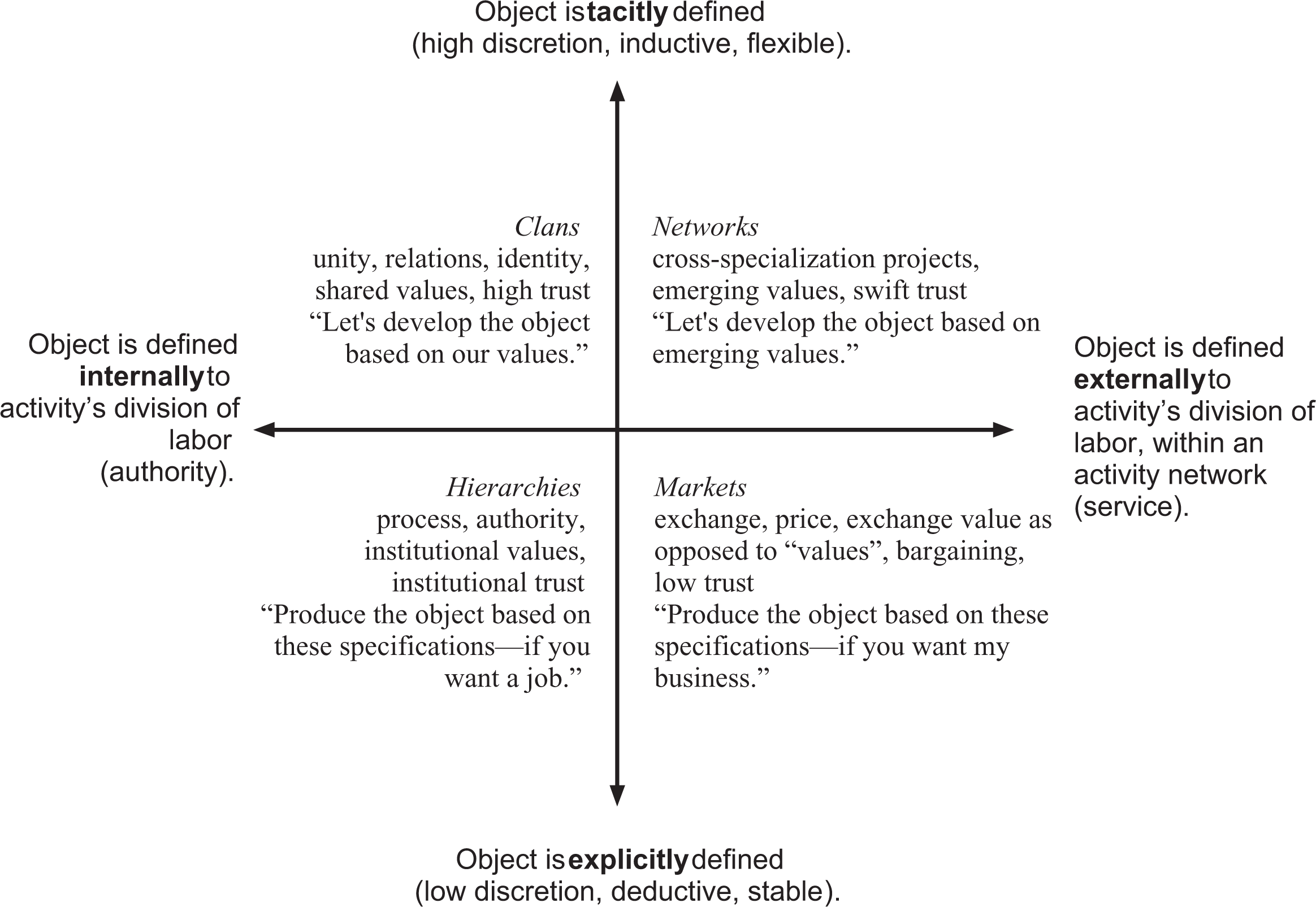
A typology of activities.
The Vertical Axis: How the Object Is Defined
The vertical axis represents how the object is defined. At the top of this axis, the object is tacitly defined (Polanyi, 2009), reached inductively. This work is often unique, involving initially loose tolerances and specifications. Examples include exploratory and creative work, workplace culture, so-called “wicked problems,” and emergent collaborations. At this end of the axis, the object is defined as the culmination of the activity, near or at the end of the activity’s cyclical pulse.
At the bottom of this scale, the object is explicitly defined (Polanyi, 2009), reached deductively. This work involves strict tolerances and specifications and tends to be repeated, as in manufacturing, court cases, and calls for papers in grant writing. At this end of the axis, the object is defined at the start of the activity, near or at the beginning of the activity’s cyclical pulse.
The Horizontal Axis: Where the Object Is Defined
The horizontal axis represents where the object is defined. On the left side of this axis are objects that are defined internally to the activity’s division of labor (i.e., by the actors who pulse the object). Examples of such activities might include manufacturing, in which the manufacturer internally develops specifications and ensures that it can produce goods based on those specifications, and internal governance, in which an organization decides how best to run its own affairs.
At the right of the axis are objects that are defined externally to the activity’s division of labor (e.g., by stakeholders in other activities within the activity network who will receive or also pulse the object). That is, the actors who pulse the object produce it based on someone else’s definition. One example of such activities is contract work, in which a contractor receives specifications from an organization and produces work based on those specifications.
This two-dimensional matrix results in four ideal activity types (the quadrants). First, I will discuss the quadrants and how they can help to characterize different types of activities. Then, I describe how multiperspectival objects might span different quadrants.
Using the Typology to Characterize Activities
The proposed typology characterizes ideal types of activities from a specific perspective—and consequently the types of objects that these activities transform. Drawing from the literature of previous typologies, I describe these four ideal types—hierarchies, markets, clans, and networks—treating them as separate (monoperspectival) types for discussion purposes and illustrating them using the four professional writing cases that I described earlier. Finally, I use these ideal types as a basis for discussing the hybrid, multiperspectival activities that we typically encounter in cases.
The Steady Pulse: Hierarchies
Hierarchies tend to be inflexible at dealing with change, bad at innovation (Cameron & Quinn, 2011; Galbraith, 1983; Mintzberg, 1979; Ronfeldt, Arquilla, Fuller, & Fuller, 1999; Weber, 1978). But for certain purposes, they are ideal. In particular, they tend to have a steady pulse: steady like an assembly line. That steadiness is what allows hierarchies to be efficient at doing things repeatedly and within explicit specifications (Mintzberg, 1979)—such as engineering (Adler, 2007; Haas & Witte, 2001), law (Engeström et al., 1997; Schuster & Propen, 2011), or education (Russell, 1997b; Schryer, 2003). In fact, as the typology shows (see Figure 1), they excel at pulsing objects that are explicitly and internally defined.
Take law, for example. As Schuster and Propen (2011) showed, law ideally results in predictable, uniform outcomes (i.e., it aims to provide uniform justice). To produce such outcomes, then, it tends to be rigid and slow to change, it involves broad promulgation and well-defined genres and procedures, and it follows a well-defined, hierarchical division of labor.
Object and outcome
Hierarchies excel at pulsing explicitly and internally defined objects, producing highly predictable outcomes. Think in terms of objects that are mass produced, highly controlled, and consistently processed to reach outcomes that are controlled, ordered, and predictable—often in terms of criteria such as quality, cost, and time (Adler & Heckscher, 2007; Bennis & Slater, 1998; Cameron & Quinn, 2011; Ronfeldt, 1996, 2007; Ronfeldt et al., 1999). Manufacturing provides such examples but so does law: Courts spend considerable time defining unique cases in terms of types of cases so that they can uniformly apply laws and precedents—and tools, genres, and procedures—in ways that are difficult to contest (Schuster & Propen, 2011).
Tools and rules
Hierarchies tend to use well-defined tools and rules to keep the pulse steady, the object explicitly defined, and the outcome predictable. Information tools such as databases tend to demand structured, explicit information (Boisot et al., 2001; cf. Weber 1978, p. 973). Knowledge about this information tends to be explicit and formalized rather than tacit (Polanyi, 2009). The object is pulsed according to specific, explicit rules (Ouchi, 1980) that are developed and promulgated by an authority (Cameron & Quinn, 2011; Ronfeldt, 1996, 2007; Ronfeldt et al., 1999). For instance, Propen and Schuster (2010) described how judges rely on rules such as explicit sentencing guidelines to determine how to sentence offenders, “Most judges praised the goal and objectivity of sentencing guidelines in determining duration and disposition and requiring judges to have good reason to depart (upward or downward) from them” (p. 18). In the case they described, a comparatively new genre, the Victim Impact Statement (VIS), was allowed at a specific part of the sentencing sequence but tended not to have much explicit impact on sentencing due to the highly regulated tools and rules that constrained the courts—although the authors recognized that the VIS could function as a vehicle for collective change via personal and emotional appeals.
Actors and community stakeholders
Hierarchies require a great deal of internal trust; they are trust intensive (Adler & Heckscher, 2007). They tend to focus internally (Cameron & Quinn, 2011) and to define the outcome in terms determined by the actors who pulse the object, not by the community stakeholders who receive it—for instance, by the company that owns the assembly line rather than by the customers who receive the products. In Propen and Schuster’s (2010) case, judges and victim advocates knew and accepted the limitations of their roles. Judges in particular valued the ability to make two trust-building moves via the available genres in the courtroom: They could display “objectivity and neutrality” in their work via the sentencing guidelines yet still show compassion by taking the VIS into account (p. 27).
Division of labor
This internal focus, paired with the explicit nature of the object, tends to result in departments that establish clear specialties and delineations of responsibility. Hierarchies demand control. So the division of labor involves clear lines of authority (Boisot et al., 2011; Cameron & Quinn, 2011; Mintzberg, 1979; Ronfeldt, 1996, 2007; Ronfeldt et al., 1999). Relationships between actors tend to be dependent—with those lower in the hierarchy depending on those above them—and trust intensive (Adler & Heckscher, 2007). In Propen and Schuster’s (2010) example, advocates and victims played roles that were explicitly differentiated from those of the judges, and the judges in turn played roles that were subordinate to those of legislatures and higher courts.
As I discussed, activities pulse their objects. And in hierarchies, that pulse tends to be steady, predictable, and repeated. The court has to treat two analogous crimes according to the same laws and sentencing guidelines, producing predictable outcomes. But as we look outward to how hierarchies interact with external activities, we see a different kind of pulse.
The Quickening Pulse: Markets
Markets, 1 like hierarchies, demand explicitly defined objects. But the objects are externally defined, that is, defined by stakeholders external to the activity’s division of labor. And this combination means that markets excel at some things that hierarchies do not.
Markets provide alternatives to internal capacity. Indeed, over the last several decades, companies have increasingly turned to the market to do things that they once did internally because the market can often produce these things more cheaply, flexibly, and effectively (Burton-Jones, 2001). So turning to a market solution means that an organization does not have to build its capacity and therefore can react more quickly to changes.
Market activities include sales (Kallio, 2010; Ludvigsen et al., 2003), entrepreneurship (Holt, 2008; Miettinen, 2008), and—defined broadly—grant writing and proposal writing (Ding, 2008; Hart-Davidson, Spinuzzi, & Zachry, 2007). For instance, although we typically do not think of grant writing as a market, it involves promising results that match the cost and performance specifications of a granting agency. To produce such outcomes, grant writers must quickly connect their own ongoing projects to the needs described in a call for papers and then describe how their projects will fulfill the specifications described in the call for papers without overpromising or overdetermining the results. Grant writing thus tends to be rapid but predictable; it involves establishing a well-defined system of exchanging grant money for results that meet explicit specifications, and this system involves a temporary, time-delimited labor agreement.
Object and outcome
Markets are good at pulsing objects that are explicitly defined and differentiated—objects that compete with other objects (Cameron & Quinn, 2011). The outcomes tend to be externally defined (i.e., defined by the community stakeholders outside an activity); an organization must give up control to seek market solutions (Mintzberg, 1979). But in return, the organization gains the outcomes of competitiveness and flexibility. In the case of Ding’s (2008) grant writers, each grant writer competed with the others who wrote proposals to obtain the same grant; part of grant writers’ task, then, is to demonstrate that they can best use the granting agency’s money to meet the stated goals in the agency’s call for proposals (CFPs) and produce a considerable number of additional benefits.
Tools and rules
For market solutions to work, inputs and outputs have to be explicitly specified and often standardized. Tools must include highly structured communication, such as exchange prices—a high level of abstraction and codification (Boisot & Child, 1999; Boisot et al., 2001)—so that the market can perform the job competently and efficiently without too much supervision. Rules are spelled out in formal contracts and (in the best cases) enforced via reciprocal self-regulation: The market determines the price (Boisot et al., 2001; Ouchi, 1980). In the case of grant writing, the rules are spelled out in the CFP and the formal institutional contract.
Actors and community stakeholders
In a market, the object is defined, broadly speaking, not by the people who pulse the object but by people in other activities who purchase it. (To use an obvious example, Hasbro produces toys based on market research—on what toy buyers want to buy—not on what its toy designers want to play with.) Relationships between actors and community stakeholders are not necessarily steady from exchange to exchange, pulse to pulse (Adler & Heckscher, 2007; Cameron & Quinn, 2011). In a pure market, trust between buyer and seller is low (Adler & Heckscher, 2007) because the market involves making exchanges between two otherwise unrelated activities, activities that may interact for just a single transaction. In grant writing, actors tended to find other ways to develop trust. For instance, part of the granting agency’s decision rests on the reputations of the grant writers, which is one reason why the doctor of philosophy students in Ding’s (2008) study tended to collaborate with their advisors who had a longer track record with grants.
Division of labor
Relations between activities in a market are independent and formal, based on the exchange of goods and services (Adler & Heckscher, 2007). The labor is coordinated horizontally via self-regulation (Boisot et al., 2001); that is, buyers and sellers coordinate their negotiations via highly structured but contextually shallow information such as price (or grant amounts) and specifications (or grant deliverables).
From the market’s point of view, the activity looks like a swap, or an exchange: money for goods and services. Each pulse is an exchange but not necessarily between the same two organizations each time. Although some exchanges can be time delimited, such as continuing grants, others are not. In some markets, more competition can quicken the pulse. Markets are optimized for low-information, high-velocity transactions, so the pulse—the transformation of the object—tends to quicken to transform the object more quickly.
The Variable Pulse: Clans
Clans, 2 like hierarchies and unlike markets, are internally focused: The actors who pulse the object define the outcome. But in this case, the object itself is defined tacitly rather than explicitly. The activities that characterize clans include close-knit work such as craft work but also may include team building and identity building, as in the professional-identity (Schryer & Spoel, 2005) or internal-culture formation that occurs in an organization (Artemeva & Freedman, 2001).
Internal culture is a common example of a clan because it develops in most organizations. One example is that of Apple Computer: As Cameron and Quinn (2011) told it, during his first term as CEO, Steve Jobs encouraged the Macintosh development team to consider themselves “pirates,” thereby defining themselves against the rest of Apple and even hoisting the Jolly Roger over their building (see Hansen, 2009). Such cultural divisions are fairly common in organizations. For instance, in Artemeva and Freedman’s (2001) study of an engineering company, the hardware and software groups were “deliberately segregated” (p. 174), followed different “lifestyles,” including very different work hours (p. 175), and received different kinds of support from upper management. Over time, the differences between these groups became exacerbated, eventually leading the software group to split from the company and form its own company.
Object and outcome
Clans work well for addressing customized objects, such as craft objects (Cameron & Quinn, 2011). The objects themselves are defined tacitly rather than explicitly and often inductively rather than deductively. They are also internally defined, typically leading to outcomes of team identity or belonging (Adler & Heckscher, 2007; Cameron & Quinn, 2011; Ronfeldt, 2007). Outcomes are often customized. In the case of internal culture (e.g., that of the hardware and software engineers in Artemeva & Freedman, 2001), clans inductively develop their own internal values over time, based on their internal needs and experiences.
Tools and rules
Since objects are defined tacitly and internally, they often involve tools that are unstructured and diffuse. Face-to-face coordination is common (Boisot et al., 2001), especially in terms of mutual adjustment, that is, “the coordination of work by the simple process of informal communication” (Mintzberg, 1979, p. 3). In this context, rules tend to be commonly held traditions, values, and beliefs within the tight-knit group of actors (Ouchi, 1980; Ronfeldt, 2007; cf. Weiner, 2013). For instance, hardware and software engineers in Artemeva and Freedman’s (2001) study developed very different rules about how and when to work, rules that helped to define the teams and that reflected their subcultures: The engineers in the hardware division worked from 8:30 a.m. to 5:00 p. m., with regularly scheduled coffee breaks, which they took together; they did not regularly come in on the weekends or work late hours. In the software division, engineers often worked an 80-hour week, staying late and working on weekends. (p. 175)
Actors and stakeholders
Actors are especially tight knit as they pulse the object. They sometimes become very clannish, defining themselves against others in the same organization. When Steve Jobs told his Macintosh team, “Let’s be pirates,” he placed them in a separate building on the Apple campus (Hansen, 2009). Like the Macintosh team, actors in clans tend to focus on group belonging and group integration (Cameron & Quinn, 2011; Ronfeldt, 2007), developing what Durkheim (1933) called mechanical solidarity. In Artemeva and Freedman’s (2001) study, the software engineers responded by turning their solidarity into action, starting regular meetings to formulate their grievances, bringing those grievances to upper management, and finally, when those grievances were dismissed, resigning en masse to form their own company.
Division of labor
Since they are so tight-knit, clans tend to have a very flexible division of labor, coordinating horizontally via negotiation (Boisot et al., 2001). They are interdependent, that is, dependent on each other as they coordinate to pulse the object. Consequently, they must develop and maintain high levels of trust (Adler & Heckscher, 2007), partly via shared values (Cameron & Quinn, 2011; Ouchi, 1980). For instance, the software engineers in Artemeva and Freedman’s study developed a flat structure and valued the “opportunity to communicate freely and easily with other employees at all levels” (p. 178); when they left to form their own company, they retained this relatively flat structure and ensured opportunities for free and easy communication via an internal e-mail system (which had been denied to them at the original company). The object, then, is an expression of the clan’s internal values. The clan often takes the activity as an aspect of internal human development and participation (Cameron & Quinn, 2011). The pulse is variable due to the internal, tacit definition of the object.
The Opportunistic Pulse: Networks
Networks, like clans, deal with tacitly rather than explicitly defined objects. But unlike clans and like markets, networks define their objects externally to the division of labor: The object is defined across a network of activities rather than within the division of labor of a single activity. To achieve these pulses, actors with different specialties tend to link up temporarily to swarm the object, dispersing at the end of the engagement (cf. S. J. A. Edwards, 2005; Ronfeldt et al., 1999). That is, these networks are typically adhocratic, rotating leadership during projects and communicating frequently as the object is inductively, tacitly defined. Adhocratic networks’ objects are temporary projects that require the collaboration of many different specialties organized around them (Toffler, 1970). This type of organization is sometimes called projectification (see Grabher, 2002, 2004; Guile, 2012; Midler, 1995). Adhocracies generally coordinate work via mutual adjustment, “by the simple process of informal communication” (Mintzberg, 1979, p. 3).
AT studies of adhocratic networks include creatives (Guile, 2012), interorganizational collaborations (Yamazumi, 2009), online gaming (Nardi, 2010), and coworking spaces (Spinuzzi, 2012) as well as “runaway objects” that are too interdisciplinary to be characterized by a single activity (Y. Engeström, 2008b). One example of an adhocratic network is that of the online gamers in Sherlock’s (2009, p. 264) study of World of Warcraft. In particular, Sherlock described how players practiced grouping, “a form of ad hoc collaboration between players that allows them to band together temporarily and work toward particular in-game objectives.” The game’s publisher did not require players to band together and provided little support for grouping, but players developed grouping strategies based on bringing together players with different specializations and strengths to accomplish specific goals—quite similar to the project-oriented adhocracies of specialists that Toffler (1970) described. The players supported grouping via a Grouping FAQ (frequently asked questions), WoWWiki (a user-maintained wiki), message board threads, and user interface modifications, among other genres.
Object and outcome
Networks pulse objects that require various types of expertise, particularly objects that require collaboration across specialties (and thus activities). Such objects are defined tacitly at first; for the cross-specialty collaboration to be fruitful, each specialization must naturally contribute to that definition, which develops inductively. In fact, one could argue that the cross-specialty collaboration itself is always an aspect of the object (Adler & Heckscher, 2007). This object is externally defined, that is, defined by stakeholders in the intersecting activities. This configuration is especially well positioned for producing innovative outcomes, outcomes that cannot be achieved by individual specialties (Adler & Heckscher, 2007; Cameron & Quinn, 2011; cf. Castells, 2003, p. 67; Guile, 2012; Mintzberg, 1979). For instance, in Sherlock’s (2009) study, players engaged in grouping to achieve “short-term objectives” such as private dungeons and quests (p. 271).
Tools and rules
The tools used by networks can be, and often are, unstructured, diffuse, and loosely coupled (Boisot et al., 2001). They are pulled together across specialties to attack unique problems, so they are often cobbled together for a unique engagement. Rules are emergent and tend to develop over the life of the collaboration, as they must be when a unique combination of specialists attacks a unique problem (Adler & Heckscher, 2007). In World of Warcraft grouping, for instance, the players themselves learned rules for selecting appropriate specialists for distinct grouping occasions (e.g., dungeons, quests), and they developed tools such as FAQs, wikis, and user interface modifications to support instances of grouping (Sherlock, 2009).
Actors and community stakeholders
Actors in networks can be internal to an organization (as in traditional adhocracies) or cross-organizational (e.g., Bilton, 1999; Dolan, 2010; Ronfeldt et al., 1999). Like actors in clans, actors in networks tend to be interdependent: Specialists need each other’s contributions if they are to complete the project (Adler & Heckscher, 2007). They are collaborative, attempting to reach outcomes that will mutually benefit people in their separate, networked activities. In World of Warcraft grouping, for instance, players lent their experience to new groups in which they were involved, but they also benefited community stakeholders by developing resources for grouping in general.
Division of labor
Networks do not have a necessary center of control; typically, they are horizontally controlled via the emerging collaboration (Boisot et al., 2001; Mintzberg, 1979). They tend to establish interdependent relations, and they must develop swift trust in order to work well (Adler & Heckscher, 2007). In Sherlock’s (2009) study, for instance, “grouping is defined by a division of labor that depends on players to make use of ‘different but complementary’ skills, the successful negotiation of which allows players to work more efficiently and effectively toward their outcomes.” These players evaluated their groups, and “these forms of evaluation become distributed and consolidated in the genre ecology of grouping that extends outside the game so that players can read these texts to learn what constitutes a ‘good’ group and how to identify problems that a group may encounter” (p. 271).
In networks, the pulse is opportunistic: The focus is on the opportunities that might be inductively defined at the meeting point of separate activity systems.
Contradictions in Interference Patterns
Up to this point, I have described activities as fitting more or less comfortably within the four monoperspectival ideal types that I presented. Yet they often do not—especially as we shift to the right of the matrix, in which multiple stakeholders collaboratively define the object. Any activity has multiple actors and stakeholders and thus multiple perspectives on the object, making it unlikely that the activity will fit neatly into an ideal type.
Multiperspectivity is most common, or at least most obvious, in knowledge work and has led activity theorists such as Y. Engeström (2009) to propose a shift from the current third generation of activity theory to a fourth generation: Third-generation activity theory still treats activity systems as reasonably well-bounded, although interlocking and networked, structured units. What goes on between activity systems is processes, such as the flow of rules from management to workers. [But] in social production and peer production, the boundaries and structures of activity systems seem to fade away. Processes become simultaneous, multidirectional, and often reciprocal. The density and crisscrossing [sic] of processes makes the distinction between processes and structure somewhat obsolete. The movements of information create textures that are constantly changing but not arbitrary or momentary. (p. 309)
Even in well-bounded activity systems, we can detect some interference between multiple perspectives. For instance, people who work in a hierarchy may also develop clannish relationships within their departments (Artemeva & Freedman, 2001), people in a hierarchically organized research group with its own internal agenda might also adopt goals held by external granting agencies (Ding, 2008), and people who buy a service in the marketplace might also form adhocratic networks with others buying that same service (Sherlock, 2009). In such cases, objects become multiperspectival, with different aspects perceived and emphasized by different stakeholders and at different points of the pulse.
As I noted, organizational typologies generally acknowledge that organizations tend to be hybrids, not ideal types. Similarly, we can understand activities as hybrids of different ideal types. To understand how, let us return to the AT studies that we have used as examples throughout this article.
Hierarchy Versus Clan
In Artemeva and Freedman’s (2001) case study, an engineering company’s hardware and software groups were segregated and treated differently by upper management. Although I focused on the clan aspects of this case earlier, different clan cultures developed within a bureaucratic hierarchy. In fact, Artemeva and Freedman argued that the clannish divisions developed because of “the introduction of a new product into the existing activity system” that “led to a reconstruction of internal relationships between different parts of the functioning organism” (p. 179). This new product, software, set up tensions that cascaded across other parts of the activity system: It necessitated a different pulse that was mediated by different actors, tools, rules, community stakeholders, and divisions of labor. This set of cascading issues emphasized and exacerbated the cultural differences between hardware and software engineers, causing them to identify more strongly in clans—and eventually causing those clans to part ways. Here, the tensions between hierarchy and clan configurations resulted in internal contradictions that touched various parts of the activity system, ultimately splitting it. But in other cases, those internal contradictions between configurations can serve as an engine for development and change.
Hierarchy Versus Market
In Ding’s (2008) case study, novice researchers working within defined, hierarchically structured research groups had to write competitive grant applications to external agencies. So although these research groups had their own, internally defined objects—to acquire grant money—the novice researchers also had to define these objects in ways that were attractive to the external agencies. That move from internal to external criteria was complex: To achieve the rhetorical goal of getting funded, applicants have to go beyond the production stage of grant writing; to examine its circulation and consumption stages; to understand its multiple audiences, i.e. reviewers and NIH officials; and to take into consideration multiple contextual factors and governing rules such as constituents of the community and division of labor. (p. 9)
Although Ding did not identify specific contradictions in her case, she described how novice grant writers had difficulty addressing the external audience. These novice grant writers had to learn a range of genres and the practices behind them, genres and practices that were situated in an unfamiliar external activity—the market—and conditioned by that activity’s values. Here, two configurations have developed around market and hierarchy objects. But unlike the activity in Artemeva and Freedman’s (2001) case, this activity retained its coherence; actors found ways to reconcile the internal contradictions in order to work within both configurations.
Market Versus Network Versus Hierarchy
In Sherlock’s (2009) case, the game publisher Blizzard marketed its game to a broad audience of players; some of these players became cocreators, developing various innovations (FAQs, user interface plugins, a wiki, a database) to support ad hoc in-game collaboration. The set of cocreated resources “transforms the activity of grouping; by producing and drawing on this genre ecology, players not only can scaffold their grouping activity in ways that are more enjoyable and efficient but can also more successfully integrate the ‘cross-functional’ design…. of character classes in the game” (p. 264). Earlier I focused on the network of players that Sherlock described, but this network is itself drawn from a market to which Blizzard sold its services. As Sherlock pointed out, players’ adhocratic use of these genres “interferes with Blizzard’s control over its own proprietary ‘fiction network,’” and “this contradiction has led to Blizzard partially closing the open system of genres—although in ways that do not completely deny open production and coordination” (p. 265; for a similar case, cf. Jones, 2012).
For both Blizzard and the players, the object was the game. But Blizzard saw the object as market oriented, a game for which a market would pay, while the players saw the object as network oriented, a game around which they could form specialized teams. Much of the time, these perspectives did not clash. But when they did, Blizzard partially closed the system, restricting access or information to protect its market investment. Although Sherlock did not go into this aspect, it is worth noting that Blizzard’s internal structure is likely hierarchical; during development, the game is likely perceived as a hierarchical object that must meet internally defined specifications. That is, at different points, the same object can be understood as the object of a hierarchy, a market, and a network.
Implications: What Interference Patterns Tell Us
At first blush, multiperspectival objects might seem to work against the usefulness of a typology of activities as an analytical tool. If different stakeholders understand the object of an activity differently, how can we type that activity productively? But as the case study examples suggest, contradictions form where stakeholders’ perspectives on the object place it in different quadrants: When a hierarchical bureaucracy and a clannish group of engineers clash over workplace culture, when a hierarchical research team must reposition its work to reach a granting agency’s objectives, and when a software publisher attempts to build a market by controlling the game that adhocratic networks are trying to modify. In these cases, different stakeholders have arrayed different activity systems to pulse the object as they perceive it in different ways. Those activity systems have taken on different tools, rules, actors, divisions of labor, and communities; they have adopted different pulses with different cycles.
Furthermore, as the Sherlock example illustrates, objects can be perceived in different ways at different points of a production and consumption cycle. For instance, the game could be perceived as a market object during its initial planning and artwork development, a hierarchical object during software development, a market object again during its rollout, and a network object during game play.
This typology, then, has implications for researchers, including professional writing researchers, who use AT to ground their research of human activity. First, the typology helps us to better examine activities in AT terms. In naming and describing different types of objects of activities, the typology focuses our attention on the configurations of resources that grow up around them. And since it is grounded in the basic concepts of AT, the typology is consonant with an AT analysis, allowing us to follow these objects back to the tools, rules, actors, community stakeholders, and divisions of labor that pulse them. By locating an object within the typology, then, we can better understand and examine the configuration and properties of a given activity.
Second, the typology allows us to better compare different activities. We may recognize, for instance, that maintaining team cohesion is very different from marketing an online game or writing a grant, and Californian and Finnish courtrooms, in contrast, are run in more similar ways. But by applying the typology, we can better understand what those differences and similarities are, and we can begin to generalize findings from one activity to similar activities. At the beginning of this article, I listed a set of AT studies and remarked that they were unique and hard to draw generalized insights from; the typology forms the basis for categorizing and comparing them.
Third, the typology can help us to better analyze and generalize interference patterns in competing configurations of activities seeking to pulse a multiperspectival object. That is, it helps us to understand how internal contradictions can form across configurations. Although researchers have examined how sets of contradictions often form between overlapping activities, those sets of contradictions have typically been discussed within each case, and again, they have often been seen as unique to a particular case rather than related across cases. When we see patterns of contradictions forming between markets and networks in Sherlock’s (2009) study, are these contradictions similar to the ones we see forming in, say, Yamazumi’s (2009) study of multiagency collaboration or in my (Spinuzzi, 2012) study of coworking? When we examine expansive “runaway objects,” such as open-source software or global warming (Y. Engeström, 2008b), can we characterize them more closely and better analyze their contradiction patterns? This typology offers a way to systematically analyze these related sets of contradictions as we further examine professional writing in increasingly complex, multidisciplinary knowledge-work environments.
Footnotes
Declaration of Conflicting Interests
The author declared no potential conflicts of interest with respect to the research, authorship, and/or publication of this article.
Funding
The author received no financial support for the research, authorship, and/or publication of this article.