




Abstract
White papers are commonly produced by for-profit organizations to market high-tech products and services and are often created by technical writers. But writers of this genre have little evidence-based research to guide them. To fill this void, the authors tested a rhetorical move structure with a sample of 20 top-rated marketing white papers and found that, despite the lack of industry standards for white papers, those written for marketing purposes display similar rhetorical moves: introducing the business problem, occupying the business solution niche, prompting action, establishing credibility, and providing disclaimers or legal considerations. Based on the results of this study, the authors advance guidelines for writers of this genre and suggest areas for future research.
Keywords
White papers are commonly used documents within corporate contexts. Ziff Davis Enterprise, an information technology (IT) publisher, reported in 2010 that white papers were used by 84% of commercial IT buyers, who read more than three of them per month on average (Pisello, 2010). Recently, the Content Marketing Institute (2016) surveyed individuals from more than 3,700 organizations in North America, representing a range of sizes and industries, and found that 71% of them used white papers as a marketing tactic. And the IEEE Spectrum (2015) Web site, which hosts industry-produced white papers, has claimed that 79% of registered visitors make purchasing decisions for their company.
White papers have rarely been mentioned within business and technical communication although Willerton (2007) found that 85% of the technical writers he surveyed agreed on the need to be familiar with them. McNair and Paretti (2010) noted that engineering students were collaborating to create white papers. Further, during her investigations of disciplinary genres, Mackiewicz (2012) found that white papers were important for supporting a disciplinary writing program for business students. Finally, Willerton (2012) outlined a white paper writing assignment for business communication students.
Unfortunately, McPherson (2010) found that “significant gaps do exist between academic representation of the white paper and the workplace artifact” (p. 1). Little research is available that would provide evidence-based guidance for writers of the genre. We believe that if consultants and educators had a deeper understanding of white papers, they could better aid professionals and prepare students, many of whom will be asked to write such documents by their employers. Toward that end, we first describe the context within which white papers are produced and then discuss the available guidance for writers of marketing white papers. Next, we explain our approach to studying the genre, describe our methodology for investigating rhetorical structure in high-tech marketing white papers, and present the results of that investigation. Finally, we offer five guidelines for writers of this genre and suggestions for future research.
Reading and Writing White Papers
Our search uncovered little research specifically focused on white papers. We located only three peer-reviewed articles (Willerton, 2007, 2008, 2012), one dissertation (McPherson, 2010), and one report from an industry expert (Stelzner, 2007a). In general, these sources agree that white papers represent an important interaction between organizational actors within the technology marketplace. As one industry expert says, “Any B2B vendor selling anything relatively new, relatively complex or relatively costly could likely benefit from a white paper” (G. Graham, n.d.). Thus, the quality of a white paper is commonly measured via the value of sales leads it generates for the sponsoring organization (Stelzner, 2007a; Willerton, 2007).
Industry sources overwhelmingly connect white papers with marketing. The report from the Content Marketing Institute (2016) shows that North American companies use several genres for business-to-business (B2B) marketing more often than they use white papers: 93% used social media (other than blogs) 82% used case studies 81% used blogs 81% used eNewsletters 81% used in-person events 79% used articles on corporate Web sites 79% used videos 76% used illustrations/photos 71% used white papers
But in an industry report specific to B2B technology companies (Regalix, 2015) in which marketing genres are broken down by product life cycle, white papers are listed among the top five genres used to present mature technology products to potential buyers (see Figure 1).
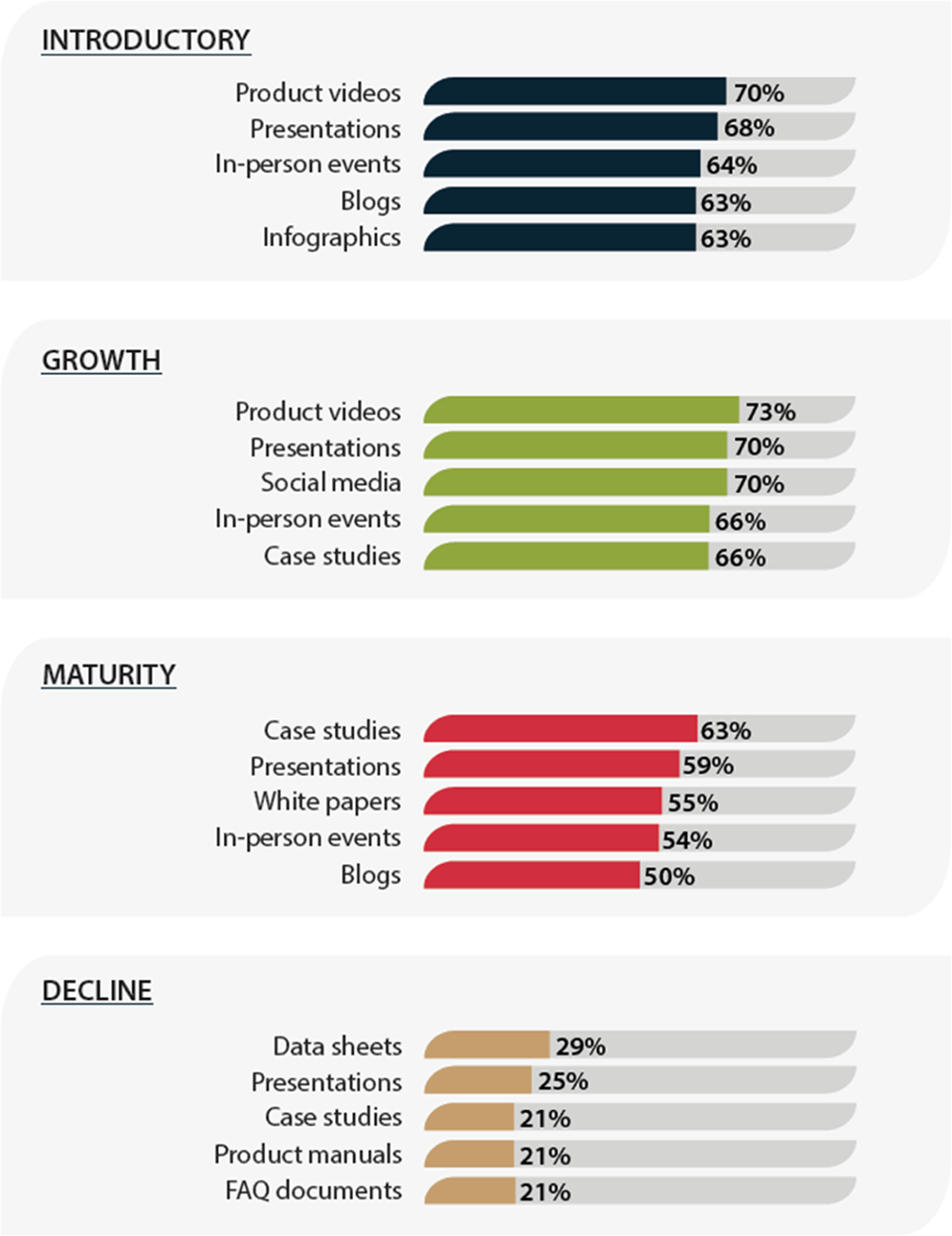
Percentage of business-to-business companies using different genres for high-tech marketing by product life cycle (Regalix, 2015).
Unfortunately, definitive answers to the most fundamental questions about the purpose of documents labeled as white papers are unclear (Willerton, 2007). For instance, in her analysis of hundreds of white papers, McPherson found that the documents were produced by a variety of organizations and that in addition to marketing technology products and services, they functioned as guides to working within regulations or standards reports on progress or the state of affairs on a topic or issue projections about the future of a field or a research agenda with recommendations statements of an organization’s position on an issue
McPherson classified white papers based on her assessment of their audience (business and finance, education and training, government and policy, etc.) rather than purpose. She settled on the quality of nonroutine as the white paper’s “essentially defining feature” (McPherson, 2010, p. 160).
Although they talk exclusively about high-tech marketing white papers, the leading industry experts still provide somewhat different classifications of the documents’ purposes. Stelzner (2007b) divided them into two basic classes: business benefits and technical. G. Graham (n.d.), on the other hand, classified them into three types: Backgrounder white papers describe the technical features and benefits of a product or service. Numbered-list white papers provide a light and lively roundup of highlights about some issue. Problem/solution white papers recommend a new, improved solution for a nagging business or technical problem.
When answering the question of whether there are any industry standards for white papers, Graham wrote, “In a word, no. Anyone can call anything a white paper. And they do.”
White paper writers can be in-house technical communicators or other employees inside the sponsoring organization, but more often they are freelance writers (Stelzner, 2007a). Authorship of white papers can vary significantly: Some white papers might be generic “overview documents”…and these might be created by a single person in the way that an academic report is produced. Other white papers, however, will need to serve multiple goals for multiple audiences, and technical communication educators need to prepare students to deal with those complex situations involving multiple authors and competing ideals. (Willerton, 2007, p. 197)
Guidance on Writing Marketing White Papers
In addition to the research we have noted, a handful of additional sources provide guidance to white paper writers based on personal industry experience rather than research evidence (Bly, 2010; G. Graham, n.d.; Klariti, 2015; Stelzner, 2007b). All these sources focus on white papers created for marketing purposes. Developing content for white papers is the area they mention most, and nearly all of them recommend determining a specific marketing goal. Stelzner’s (2007a) survey of writers found that generating sales leads was the most popular marketing aim, but Willerton (2008) reported that there is tension between informing and persuading readers. The engineering professionals he studied “stated that papers focusing more on selling than explaining are likely to get tossed aside” (p. 377). All sources agreed that effective marketing white papers adopt a soft-sell approach in which persuasion is secondary to informing readers. Nevertheless, their success is determined by marketing measures such as the number of sales leads generated (Stelzner, 2007a; Willerton, 2007).
One universal recommendation is to do good secondary research, and almost all the advice suggests the importance of explicitly citing the sources of that research. These industry experts agreed that interviewing subject-matter experts is essential; Stelzner’s (2007a) survey found that highly experienced white paper writers dedicated significantly more time to interviews. Most of the industry sources mention the need for informative, not superfluous, graphics to support the verbal content of a white paper. Finally, a couple of sources mention the time-sensitive nature of white papers; for instance, Willerton (2008) found that readers believed that marketing white papers have a limited shelf life.
These sources offer less guidance about organizing content, but they almost universally mention (a) describing the reader’s problem or challenge before offering the solution or product that is being marketed and (b) using an effective and efficient document design to help readers navigate the content.
Overall, we found relatively little guidance available to help novices write a marketing white paper, and little of that guidance is based on more than personal experience. To address this lack of evidence-based guidance for white paper writers, we pursued genre analysis research.
Our Genre Analysis Approach
There are three approaches to genre analysis (Flowerdew & Wan, 2010; Hyon, 1996). Two approaches grew out of applied linguistics: the English for specific purposes (ESP) approach (Askehave & Swales, 2001; Swales, 1990) and the Sydney School approach (Martin, 1992). The third approach, new rhetoric, grew out of North American ethnographic research (Freedman & Medway, 2004). We used the ESP approach for our genre analysis because of its clearly articulated pedagogy. For example, rhetorical move structure has been used to craft an array of exercises for building rhetorical awareness of a genre: (a) reconstructing a text from jumbled chunks representing individual moves, (b) analyzing model texts or peer drafts, or (c) planning an original text (Flowerdew, 2000).
While some novice writers of white papers might intuitively absorb rhetorical structures by learning about the context within which the documents appear and by reading successful instances of the genre, many more will need the kind of help that makes the structure explicit for them. Although explicit instruction in foundational writing concepts has been a controversial pedagogical choice in the United States since the 1970s (Freedman, 1993; Villanueva, 2003), explicit teaching is connected to writing quality (S. Graham & Perin, 2007; Parr & Timperley, 2010). We have witnessed the impact of explicit instruction in our own classrooms for many years. The fact that genres are a “moving target” means that developing guidance for writing them is a challenge. This challenge may be especially great with high-tech marketing white papers. But as educators and trainers, we refuse to accept that the difficulty of the challenge absolves us from our responsibility to attempt it.
Methodology
Our methods involved collecting a sample of white papers for which we developed a rhetorical move structure that we tested using a coding protocol.
Sample Collection
To develop evidence-based guidance, we conducted an analysis of the rhetorical move structure in a sample of 20 white papers drawn from TechRepublic, an online trade publication site targeting IT professionals. This sample size is consistent with other studies involving rhetorical move structure in the ESP tradition (Flowerdew & Wan, 2010; Yeung, 2007; Zhou, 2012). While others have noted that documents referred to as white papers have diverse purposes and content (McPherson, 2010), our study tackles one type, the high-tech marketing white paper. Identified by industry experts as ubiquitous and important (G. Graham, n.d.; Stelzner, 2007a), it is a genre that many business and technical communication students will be asked to write by their future employers (Willerton, 2012).
To meet our inclusion criteria, each paper in our corpus needed to both fall within the topic area of security or business intelligence and be included among the top-ranked white papers in spring of 2014. We limited the topic area to control for its impact on our findings and chose only top-ranked (as determined by TechRepublic readers) white papers as a proxy for document quality.
We took two additional steps to make our sample representative. First, in our procedure for building a corpus, we avoided oversampling from specific organizational sponsors by limiting each to two white papers per topic area. Second, we reviewed the 20 documents to ensure that each was designed (a) for B2B marketing and (b) to be read prior to a sale (G. Graham, n.d.).
All white papers were written in English and produced as PDF files for free download by registered users. Although we had hoped to include white papers from the other leading syndicators, KnowledgeStorm and BitPipe (G. Graham, n.d.; Stelzner, 2007b), they did not allow us to filter by rating, popularity, or other measures of white paper quality.
Table 1 summarizes the details of the corpus we tested. These top-rated marketing white papers were sponsored by 14 different organizations, and seven of the white papers listed an authoring agency external to the sponsoring organization. The mean document length was 12.2 pages (6.12 SD) and 2,739 words (1,111.3 SD). The mean page length was 286 words per page (163.04 SD), with text density ranging from 37 to 565 words per page.
Corpus of High-Tech Marketing White Papers.

Note. BI = business intelligence; S = security; IT = information technology.
Preliminary Move Structure
We developed a preliminary move structure by completing three activities. First, we reviewed the available guidance from industry experts concerning content and arrangement (G. Graham, n.d.; Stelzner, 2007b). Second, we reviewed move structures that researchers developed for potentially similar genres that were identified in discussions with white paper writers (Willerton, 2007). These move structures included research article introductions (Swales, 1990), research article literature reviews (Kwan, Chan, & Lam, 2012), research grant proposals (Connor, 2000; Connor & Mauranen, 1999), business proposals (Lagerwerf & Bossers, 2002), and business reports (Yeung, 2007). And third, we examined a training set of four white papers, which were not a part of our tested sample, against the information we had gleaned through the first two activities. Then, using an iterative process similar to the grounded theory approach that requires moving between the data and the analytical framework (Glaser & Strauss, 1967), we derived a rhetorical structure of five moves and 18 subordinate steps (see Table 2).
Results of a Rhetorical Move Structure Analysis of 20 High-Tech Marketing White Papers.

Coding Procedure
The move structure shown in Table 2 served as the skeleton for our codebook, and we added specific examples and further definitions to the codebook for greater clarity. The coding was conducted in fall 2014 by two raters who were familiarized with the coding protocol and trained on how to apply the coding guidelines.
First, we conducted a preliminary test of the coding procedures, in which each rater independently coded two papers that were not included in the sample. Then, to resolve potential problems in the move structure and support intrarater and interrater reliability, we met with the raters and reviewed the coding decisions for consistency, discussing their comments and feedback on the move structure.
After completing the preliminary coding with the training set of white papers, each rater independently coded the entire data set that was included in the study sample. We reviewed the coded papers and recorded the individual codes for steps in a spreadsheet. Codes for moves were calculated by counting any subordinate step code as the presence of its superordinate move code (e.g., a code for Step 1a, 1b, 1c, or 1d in a white paper counted as a code for Move 1). To determine consistency of coding for each move and step, we calculated interrater reliability with Cohen’s (1960) kappa (κ) using ReCal2 (Freelon, 2010), following recent guidelines for content analysis (Krippendorff, 2011).
To address low reliabilities for some steps, we added a third rater, who followed the same procedure for coding all steps in all 20 white papers. When at least two of the three raters identified a step code in a white paper, we considered that step (and its superior move) as present in that white paper. Interrater reliability was recalculated with Cohen’s pairwise κ using ReCal3 (Berry & Mielke, 1988). After adding the third rater, we determined that the interreliability measures for all moves and all but two steps were above 0.40 (the specific statistics are available from us), the minimum level that others have deemed acceptable for coding nominal variables during theory development (Artstein & Poesio, 2008; King, 1994).
Results and Discussion
We discuss our study results according to the five tested rhetorical moves, highlighting how our findings relate to prior research and industry advice. We illustrate those findings with unedited examples from our corpus of white papers. Table 2 summarizes our results.
High-Tech Marketing White Papers Must Introduce a Business Problem (Move 1)
Our raters identified introducing a business problem (Move 1) as the goal of the first portion of the body of all 20 white papers in our corpus. This finding corroborates guidance from industry experts on the requirement to begin a marketing white paper by establishing a business problem (Bly, 2010; G. Graham, n.d.; Stelzner, 2007b).
Of the subordinate steps within this rhetorical move, introducing the territory (Step 1a) was identified in all 20 white papers—even the white paper that generated the lowest level of overall agreement: Meters provide data that offers insight into the operation of the data center infrastructure (i.e. power and cooling systems) within a data center. Specific types of meters exist for various reasons, from tracking the use of electricity to analyzing the power quality in a facility and reporting problems such as transients and harmonics to measuring the power usage effectiveness (PUE) of the data center. (no. 18, p. 2)
All 20 of the white papers in our corpus also introduced problems or market drivers for the territory (Step 1b), as in the following two examples: As energy initiatives and legislation continue to increase, the necessity for more in-depth metering to better understand and optimize energy use is also increasing. (no. 18, p. 2) The way attackers are going after corporate data and infrastructure these days means that it’s not a matter of if but when you’ll be forced to buy a ticket for the postbreach rollercoaster. (no. 15, p. 3)
In our corpus, 10 of the white papers raised questions or indicated gaps in using a generic solution (Step 1c). Here is an example on which all raters agreed: However, because few data-generating applications are designed by the same vendor with the express purpose of long-term compatibility, this is far easier said than done. In the same way, because systems may be custom built, incorporate elements from different verticals, contain legacy structures and applications, and may not be intended to talk to one another, there are rarely standardized hooks that facilitate back-end integration. (no. 2, p. 5)
An outline of the document structure (Step 1d) appeared in 16 of the white papers. Occasionally, these documents contained preview statements near their beginning: This Technology Spotlight discusses various aspects associated with deploying flash technology and explores the role that Hitachi Data Systems and its full portfolio of flash solutions play in this increasingly important market. (no. 6, p. 1)
Our findings for Move 1 suggest significant rhetorical similarity in the initial or introductory sections of white papers, grant proposals (Connor & Mauranen, 1999), research articles (Kanoksilapatham, 2012), and even “advertorials” (Zhou, 2012). Documents within these genres typically begin by establishing a territory and a niche, gap, or problem within that territory.
High-Tech Marketing White Papers Must Present a Solution to a Business Problem (Move 2)
Our raters identified occupying a business solution niche (Move 2) as the goal of the second portion of the body of 19 of the 20 white papers in our corpus. In hindsight, we should have eliminated white paper no. 20 from the corpus because it does not have a clear marketing function. To market a product or service, a high-tech marketing white paper must present a solution to a business problem, a required criterion we missed when we initially developed our corpus.
As for the subordinate steps for this rhetorical move, presenting a specific solution (Step 2a) appeared in 19 of our white papers. (The exception again was no. 20.) Here are two examples on which all raters agreed: IBM SPSS Statistics offers organizations the ability to do robust, in-depth statistical information analysis without doing any programming. (no. 3, p. 8) Meters enable you to benchmark the data center’s energy use, identify improvement opportunities and measure results from energy improvement projects. (no. 10, p. 2)
Describing business benefits of the solution (Step 2b) appeared in 16 of the white papers. Two of three raters agreed on these two examples: With Centrify, organizations are reducing the costs associated with identity lifecycle management and compliance by over 50%. (no. 13, p. 7) By employing a firewall that combines stateful capabilities with full context awareness, organizations can strike a balance between the high level of network security required to support these new business cases and the flexibility they require to maximize their business agility. (no. 12, p. 6)
Illustrating or applying the solution (Step 2c) appeared in 13 of our white papers. Sometimes this step appeared via an informative graphic (see Figure 2).
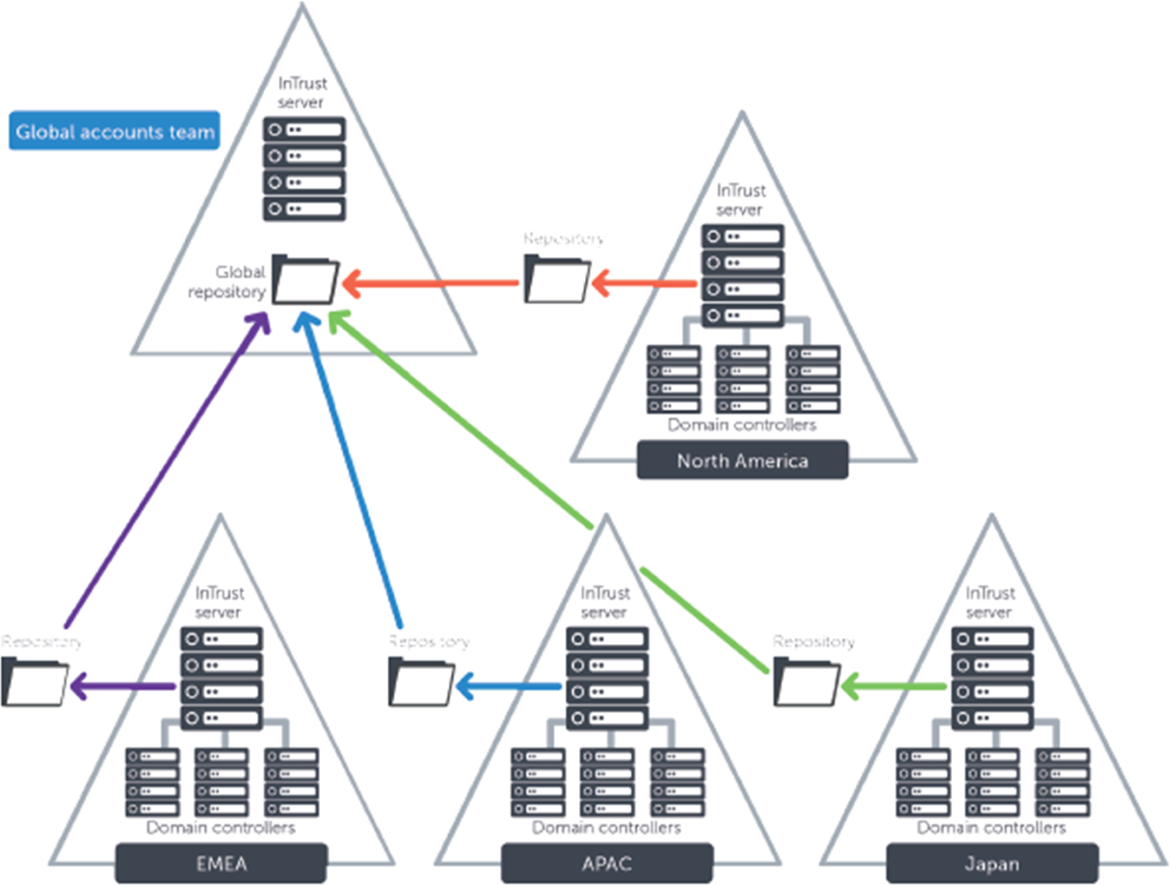
Graphic example illustrating or applying the solution (Step 2c, no. 14, p. 13).
Describing key features of the solution (Step 2d) appeared in 18 of the white papers in our corpus. In the following example, the features (e.g., “single entry point”) are combined with business benefits (e.g., “faster decision-making”): In essence, DaaS becomes a single entry point for public data, with enrichment and capabilities to extract and integrate the right data from the right sources with the right factoring at the right time, for faster decision-making and action with core business applications. (no. 9, p. 12)
Stating limitations of the solution (Step 2e) appeared in only four white papers. Here is one example on which two of the three raters agreed: Cost remains a key hurdle for many IT managers evaluating flash technology. Flash is a more expensive storage media than HDDs on a dollar-per-gigabyte basis. Significant cost justification is required to overcome the price disparity, especially when purchasing must be cleared through procurement departments that aren’t technology savvy. (no. 6, p. 5)
The final step within Move 2, establishing market sustainability of solution (Step 2f), appeared in just five of the white papers in our corpus. Consider these two examples on which two of the three raters agreed: Since releasing its initial product in 2005, Centrify has expanded its portfolio from one product to a suite of software and cloud services that span data center, cloud and mobile environments with comprehensive support for over 450 systems and 1,500+ applications. (no. 13, p. 7) All these services are backed by IBM’s significant technological expertise and our more than 40 years of networking experience. (no. 19, p. 6)
We will address what it means when a rhetorical step occurs rarely within our corpus in the concluding section of this article. Overall, our findings for Move 2 strongly suggest that white paper writers must provide a specific solution for a business problem and should also, at a minimum, describe the solution’s key features and its business benefits.
High-Tech Marketing White Papers Usually Prompt Reader Action (Move 3)
In 19 of the 20 white papers in our corpus, the raters identified content near the end of the document that prompted the reader to act (Move 3). According to Stelzner (2007b), this is a key feature of a marketing white paper.
Restating the territory (Step 3a) that had been introduced during Move 1 in the document appeared in 12 of the white papers. All raters agreed on the following example: Disaster recovery has never been more important, but too many organizations are hampered by lack of focus, lack of funding and insufficient skills. In addition, many organizations do not have the knowledge gleaned from previous disaster recovery experience to anticipate the myriad things that can go wrong. (no. 11, p. 10)
In nine of our white papers, market drivers that had been introduced in Move 1 were restated toward the end of the document (Step 3b). All raters, for example, agreed on the following example: Designing, developing and deploying a network that fully supports cloud computing solutions can be a challenging task.…It requires significant knowledge of the interactions between the network, enterprise storage components, enterprise servers and application portfolios. Without this knowledge, experience and expertise, a network may not optimally support the cloud computing environment. (no. 19, p. 7)
Issuing a call to action for a specific solution (Step 3c) was common, appearing in 15 of the documents in our corpus. Here is an example on which all raters agreed: Call Kaspersky today at 866-563-3099 or email us at From planning to deployment, we’re here to serve you. Whether you need our Enterprise Cloud Services team to help plan your configuration, Critical Application Services for guaranteed uptime, or our experienced, Fanatical Support staff to help manage your server—we’re available. (no. 1, p. 10)
In conclusion, like advertorials (Zhou, 2012), 19 of our high-tech marketing white papers prompted readers to act (Move 3)—even if those prompts were implied rather than explicit. As Willerton (2008) found based on his interviews with white paper readers, “papers focusing more on selling than explaining are likely to get tossed aside” (p. 377). Our findings suggest that high-tech marketing white papers have more in common with business proposals, in which an informative rather than overtly persuasive style is preferred (Lagerwerf & Bossers, 2002). But this finding contradicts industry-expert advice not to be vague in the call to action: “So tell them something specific: Go to this landing page. View a short demo. Take an online survey. Request a free trial of our product” (G. Graham, n.d.).
High-Tech Marketing White Papers Often Attempt to Establish the Author or Sponsor’s Credibility (Move 4)
The content of 16 of our white papers explicitly addressed the credibility of the author or sponsor (Move 4). A few white papers (four) did so by mentioning clients or customers of the specific solution offered in the white paper (Step 4a). Here is an example on which all raters agreed: This was a critical issue that was resolved for the Georgia Department of Transportation when they deployed new BI technology with next generation dashboards. They found one of the main benefits was that, “People are more aware that the information they’re looking at is accurate and up-to-date—so they can make decisions with confidence.” (no. 8, p. 4)
Similarly, four of our white papers established credibility by listing sources of information (Step 4b). For example, one white paper included links to several case studies as well as a list of links to “Sources” (no. 1, pp. 11–12). Industry experts consistently recommend that white paper authors list sources for their research (G. Graham, n.d.; Stelzner, 2007b). Although we might reasonably assume that readers perceive white papers that include sources as being higher quality (Willerton, 2008), the rarity of this practice in our corpus suggests that this rhetorical step requires further investigation in order to determine its applicability to high-tech marketing white papers.
In our corpus, 13 white papers provided information about the authoring or sponsoring organization (Step 4c). Often such information consisted of a physical address, contact information, and a link to an organization’s Web site. In some cases, the content more overtly established author credibility. All raters agreed on this example: HP creates new possibilities for technology to have a meaningful impact on people, businesses, governments, and society. With the broadest technology portfolio spanning printing, personal systems, software, services, and IT infrastructure, HP delivers solutions for customers’ most complex challenges in every region of the world. More information about HP (NUYSE: HPQ) is available at hp.com. (no. 4, p. 8)
For Move 4, we conclude that, like grant proposals (Connor, 2000; Connor & Mauranen, 1999), high-tech marketing white papers usually establish credibility by providing author or sponsor information.
High-Tech Marketing White Papers Often Provide Disclaimers or Legal Considerations (Move 5)
In our corpus, 17 white papers went on record with disclaimers or legal considerations. More specifically, four of our white papers included disclaimers by explicitly providing sponsor information when it differed from author information (Step 5a). For example, although authored by Ziff Davis Enterprise, one white paper included this footer on every page: “Sponsored by SAP BusinessObjects” (no. 8).
Industry experts (Stelzner, 2007b) have indicated that many white papers list legal considerations (Step 5b) such as copyright and other legal restrictions at the end of the document. Most high-tech marketing white papers in our corpus (15) listed legal considerations. For example, white paper no. 6 lists permission and licensing restrictions: Any IDC information or reference to IDC that is to be used in advertising, press releases, or promotional materials requires prior written approval from IDC. For permission requests, contact the GMS information line at 508-988-7610 or
Writer Guidelines and Suggestions for Future Research
Because white papers command heightened interest within contemporary organizations that provide high-tech products and services, we want to aid novices when writing in this genre. Based on our study of 20 white papers, as well as prior research and industry advice, we offer the writers of high-tech marketing white papers five guidelines for developing and presenting their content: Begin a marketing white paper by establishing a business problem. All of the samples in our corpus included this rhetorical move. Like many genres that begin by introducing a territory and a niche, gap, or problem (e.g., grant proposals, research articles), marketing white papers should introduce the territory and problems or market drivers for that territory when establishing the business problem. Present a product or service as a solution to a business problem only after establishing a business problem. In our corpus, 19 white papers displayed this rhetorical move. Using a soft-sell marketing approach might mean introducing the solution in a generic rather than a specific way before describing the solution (19 white papers), including its key features (18 white papers) and its business benefits (16 white papers). Issue a call to action in order to prompt readers to reach out to the sponsoring organization. Although 19 of our white papers included this rhetorical move, the call was often indirect, using an informative style that was more like a business proposal than a sales brochure. Establish credibility by mentioning clients or customers, providing information about the authoring or sponsoring organization, or listing information sources. In our corpus, 16 of the white papers included this rhetorical move. Provide disclaimers or legal considerations such as copyright. Of the 20 white papers in our corpus, 17 implemented this rhetorical move.
Because of the limitations of our study, four areas of research should be pursued to expand these guidelines. First, our study involved a relatively small sample within two topic areas at one point in time, so future research could examine other corpora of white papers in different topic areas from other time periods.
Second, further research could focus on the rhetorical steps with low occurrence from our study (i.e., those appearing in less than half of our corpus). In particular, six steps deserve further scrutiny in order to retain them within a rhetorical move structure for high-tech marketing white papers: Stating the limitations of the solution (Step 2e). The low occurrence of this step within our corpus might mean that it is not central to the genre. After all, these documents are marketing tools, so explicit mention of the solution’s limitations might not fit the rhetorical context. Establishing market sustainability of the solution (Step 2f). This step probably has a low occurrence because developing and communicating market sustainability of the solution require considerable efforts, and explicitly claiming such sustainability requires that the solution is indeed sustainable. Restating market drivers when prompting action (Step 3b). This step likely appears in only the highest quality documents. Authors who have put in the effort to develop and restate market drivers have probably created a more persuasive marketing white paper. Connecting the specific solution to clients or customers (Step 4a). Again, this step probably appears in only the highest quality documents, and its occurrence is a sign of more effective communication. Developing such content requires coordination with clients and customers, making content development more complex for white paper authors. Listing source of information for solution (Step 4b). This step’s low occurrence is simply the result of less thorough content development. Providing sponsor information (Step 5a). The low occurrence of this step might simply reflect the relative rarity of white papers produced by a named author other than the sponsoring organization.
For all of these steps, the connection between their occurrence and document quality requires further investigation.
Third, future research could elucidate differences in the ecosystem of related genres. For instance, future work could explore the relationship between high-tech marketing white papers and other subgenres of white papers (McPherson, 2010). Research could also investigate the relationships between white papers and other genres (e.g., proposals, case studies, brochures). We presume that industry experts do no identify proposals as a marketing genre because they are written for one specific organization even though they appear to include most of the same rhetorical moves as white papers do. Specifying white paper similarities and differences with other genres would be valuable in training business and technical communicators. In addition, because case studies are mentioned as a top marketing genre in industry reports, more research on them is clearly needed.
A post hoc review of information design in our corpus suggested that high-tech marketing white papers are typically designed to look like conventional business reports, with a design that is somewhat sophisticated but not as refined as that of brochures. In fact, all of the 20 white papers in our corpus used at least two colors, and more than half of them used a multiple-column layout. But all printed on standard-size paper (8.5” × 11” or A4) although one printed as a booklet with a single page folded in half, 13 included a cover page, and 17 appeared in portrait orientation, 2 used landscape orientation (i.e., as slide decks), and 1 used mixed orientations. The text density of three white papers in our corpus raised flags because they averaged fewer than 100 words per page, suggesting that they might be perceived as brochures. One industry expert explained the difference between these genres: A white paper is something between a marketing piece and a scholarly essay. It’s not a brochure, so it shouldn’t be as slick and colorful as one. But it’s got to be more visually appealing than a report cranked out of Word. (G. Graham, n.d.)
And fourth, further study could respond to the limitation inherent in our choice to adopt an ESP approach to investigating rhetorical move structure in white papers. Findings from studies using different approaches are needed. For instance, as we just mentioned, information design analysis is needed to differentiate white papers from other genres such as brochures. And reader-focused methods (De Jong & Schellens, 2000) could provide insight into quality, including credibility, that our descriptive study could not provide. Although we purposely chose top-rated white papers for our corpus, those ratings are not likely to mean that all documents were equally persuasive to readers at TechRepublic. The inclusion of several rhetorical steps hinges on a better understanding of their influence on readers’ judgments of white paper quality. Finally, lexical analysis methods (Tausczik & Pennebaker, 2009) could advance our understanding of the stylistic choices that white paper writers make and the psychological significance of those choices. This might be an especially fruitful avenue for addressing hard-sell versus soft-sell approaches to marketing in white papers.
Footnotes
Acknowledgments
The authors are grateful to the reviewers for their thoughtful comments and suggestions. They also want to acknowledge the exemplary work of their research assistants, Cameron Twilley and Kellie Wesser.
Declaration of Conflicting Interests
The authors declared no potential conflicts of interest with respect to the research, authorship, and/or publication of this article.
Funding
The authors received no financial support for the research, authorship, and/or publication of this article.