



Abstract
Background
Whole-body vibration (WBV) poses significant health risks, including musculoskeletal disorders and discomfort, especially for individuals exposed to prolonged vibrations, such as drivers and industrial operators. This study evaluates the effects of vibration transmissibility on varying human masses, seat materials, backrest angles, and acceleration levels, aiming to inform the design of ergonomic seating systems that enhance safety and comfort in vibration-prone environments.
Objective
To assess the impact of vibrations on human subjects with varying masses representative of the 50th and 95th percentile Indian male population in a seated posture. Also, evaluate the influence of different seat cushion materials and the effect of backrest angles on transmitting vibrations through the human body at different acceleration levels.
Methods
A comprehensive 4-layered CAD model of a human subject, incorporating skin, muscles, bones, and organs, was developed. Finite Element Method (FEM) analysis was employed to evaluate the transmissibility of vibrations for each condition.
Results
The study revealed how variations in backrest angles, seat cushion materials, and acceleration levels affect the transmission of vibrations through the human body. The FEM analysis, coupled with the detailed human model, provided insights into the potential consequences for ergonomics and overall well-being. A slightly reclined backrest angle (10°–15°) can reduce the vertical vibration transmissibility by shifting the body's center of mass and distributing vibration forces more evenly. Also, polyurethane shall provide good comfort and reduce the effect of vibration on human subjects.
Conclusions
The findings offer valuable information for designing ergonomic seating solutions and emphasize the importance of protecting human safety and comfort in environments prone to vibrations. This research contributes to developing safer and more comfortable seating arrangements, enhancing individual health and comfort.
Keywords
Introduction
The effect of whole-body vibration (WBV) on the human body under driving conditions is a significant consideration, particularly for individuals who spend extended periods behind the wheel, such as professional drivers, long-haul truckers, and even everyday commuters. Driving, especially on uneven or poorly maintained road surfaces, exposes individuals to continuous vibrations and oscillations, impacting their health and well-being. 1 The vehicle suspension system and road surface interaction primarily cause whole-body vibrations. These vibrations are transmitted to the driver's body through the vehicle's seat, steering wheel, and other contact points. The effects of WBV on the human body during driving can be diverse. They can include prolonged exposure to WBV, leading to muscle fatigue and discomfort, particularly in the lower buck-naked shoulders. 2 WBV can also impact overall health, including joints and connective tissues. It may contribute to conditions like osteoarthritis and joint pain. Mitigating the effect of WBV during driving is essential for the well-being of individuals who spend significant time on the road. 3 This can be achieved through several means, including vehicle design improvements, e.g., better suspension systems, good car seats with high-quality cushion materials, ergonomic seating, and driver training on proper posture to reduce the impact of WBV. 4 Bhatia et al. 5 conducted harmonic analysis in the sitting posture of the human subject to evaluate the feet-to-head and seat-to-head transmissibility. Kiran and Devi 6 investigated the effect of vibration acceleration values in all three Cartesian directions for three different drivers with different weights. These were measured on four road conditions using SV106 vibration measuring equipment. Gupta and Gupta 7 evaluated the inertial, physical, and dynamic properties of the vibrating model of the human subject. Floor-to-head transmissibility has been calculated using the LPM approach. 8 conducted an experimental investigation to evaluate farm tractors’ riding comfort. Agricultural tractor operators are subjected to whole-body vibrations when operating their machines, which can be hazardous to their health. They spend the majority of their time executing agricultural tasks. Singh et al. 9 conducted experiments on twelve male subjects in sitting posture at different backrest angles of inclinations 0o, 15o, and 30o. Subjects were provided excitation amplitude of (0.5, 1.0, and 1.5 m/s2rms) at 5, 8, 12, 16 and 20 Hz frequencies. Rakehja et al. 10 performed experimental work on seats to predict vehicle vibration power absorption during different operations. Nawayseh 11 conducted a study investigating the effect of transmitting vibrations from car seats to human subjects under different seating conditions. Jayasuriya and Sangpradit 12 experimented to assess the dynamic performance and ride comfort of the 4-wheel farm tractor's seat suspension system. Basri and Griffin 13 conducted a study to predict the discomfort of a subject sitting with an inclined backrest using whole-body vibrations. Toward and Griffin 14 conducted a study to determine how the apparent mass of an occupant affects seat transmissibility. Transmissibility of car seats has been measured with 80 occupants in a frequency range of 0.6 to 20 Hz with acceleration magnitudes of 0.5, 1.0, and 1.5 m/s2. Paddan et al. 15 concluded that the intensity of discomfort increases with increased recline angle. 8 Hz frequency was most sensitive in backrest angle between 0o to 67.5o.
Singh et al. 16 reviewed 112 studies about WBV focusing on measurement methods, critical vibration levels, and health impacts, especially musculoskeletal disorders. Lower back pain was the most common MSD among the heavy vehicle operators exposed to WBV. This also indicates a requirement for analyzing additional contributing factors. Using ISO guidelines along with advanced machine learning was also recommended to understand the health impacts of WBV in a better way as multivariate effects. Wang et al. 17 reported the main leg properties in human walking: axial stiffness, rest leg length, tangential stiffness, and force-free leg angles. Gait data were taken from eight participants, measured at several walking speeds and under varied contact conditions. It appeared that nonlinear axial stiffness is indeed higher than linear stiffness; however, tangential stiffness varied with phases of gait. Vasconcelos et al. 18 researched the effects of various WBV parameters on human reasoning. The participants were 40 university students who underwent tests with various WBV frequencies and amplitudes. The results were initial drops in cognitive performance, but a “learning effect” appeared; practice seemed to influence results more than vibration alone, mainly when more than one parameter was used.
Singh et al. 16 reviewed 112 studies about WBV focusing on measurement methods, critical vibration levels, and health impacts, especially musculoskeletal disorders. Lower back pain was the most common MSD among the heavy vehicle operators exposed to WBV. This also indicates a requirement for analyzing additional contributing factors. Using ISO guidelines along with advanced machine learning was also recommended to understand the health impacts of WBV in a better way as multivariate effects. Wang et al. 17 reported the main leg properties in human walking: axial stiffness, rest leg length, tangential stiffness, and force-free leg angles. Gait data were taken from eight participants, measured at several walking speeds and under varied contact conditions. It appeared that nonlinear axial stiffness is indeed higher than linear stiffness; however, tangential stiffness varied with phases of gait. 19 Vasconcelos et al. 18 researched the effects of various WBV parameters on human reasoning. The participants were 40 university students who underwent tests with various WBV frequencies and amplitudes. The results were initial drops in cognitive performance, but a “learning effect” appeared; practice seemed to influence results more than vibration alone, mainly when more than one parameter was used.
Wang et al. 20 proposed a simultaneous method for optimizing the base position of the mobile robot with cabin angle based on the optimized HSD index, intended for large spacecraft cabins. The stiffness of a heavy-duty robot was effectively described by first developing a nonlinear stiffness model of the joint concerning the gravity compensator mechanism. Dong et al. 21 established and validated a finite element model of the seated human spine for research work on ergonomics. Based on static, modal, and random response analyses, the model accurately described spinal motion, frequencies, and transmissibility during response to vertical vibration, including all complex stresses that could elevate potential risks of injury in the spine. Results can enhance seat comfort and safety by deeply understanding spinal vibration behavior. The response of the complex time-domain damping model to divergent free vibrations, where direct integration does not work well. For this purpose, an equivalent viscous damping model that eliminates the divergent term was proposed with the implementation of the average acceleration method. In numerical cases, it has proven to have converging results, the same as those from the original model, while verifying the efficiency of this method in calculations. 22 Sun et al. 23 reported an analytical model for seated humans’ biodynamic response to triaxial translational vibration in sagittal and coronal planes. Five modes that describe distinct body movements below 20 Hz can be found fitting measured data to modeled transmissibility. This model provides a validated method for identifying biodynamic parameters via body transmissibilities and modal properties.
Xu, Chang 24 investigated 3D-printed chain mail fabric made from polyamide 12, focusing on its adjustable stiffness. Using three-point bending tests and finite element modeling, they analyzed the effects of pressure and particle structure on bending modulus, energy absorption, and strength. Results showed a 20-fold increase in modulus, and energy absorption and strength increased 22- and 19-fold under pressures up to 60 kPa. Huang, Chang 25 studied the blast protection performance of helmets using finite element models of the head, Advanced Combat Helmet (ACH), and a fully-covered helmet inspired by the Iron Man design. Simulations revealed that ACH slightly increased brain injury severity by 5%, while a fully-covered helmet of the same thickness reduced injury by 5%. A fully-covered helmet with the same weight as ACH reduced brain injury by 65%. Optimizing helmet shape and thickness significantly enhances protection, offering insights for designing lighter, more effective helmets against blast waves. Liang, Mo 26 explored gait synergy for controlling lower limb assistive devices, focusing on optimal modeling and feature selection to improve human-machine interaction. Four neural networks were evaluated, along with three feature selection methods. The FS-Seq2Seq approach surpassed existing methods, offering a promising two-stage strategy for adaptive, synergic trajectory modeling in assistive devices. Inoue, Kuroda 27 developed a myoelectric prosthetic hand system that preserved wrist joint motion, enabling users to utilize residual wrist functionality. Experiments showed improved performance and reduced elbow compensatory motion compared to traditional prostheses. Gu and Ren 28 examined distal dexterity, variable stiffness, and triangulation mechanisms, categorizing designs and analyzing their advantages and drawbacks. Insights aim to guide the development of advanced surgical robotic systems for improved adaptability, safety, and efficiency in TORS. Li, Wang 29 developed ASMNet, a motion-generative network conditioned on action and style, to address limited style data in motion generation. Using a spatial-temporal extractor and adaptive instance normalization, the model produced stylistic motions with state-of-the-art performance. Cui, Ding 30 proposed H-DHGCN, a hybrid directed hypergraph convolutional network, to model high-order, directional relationships in 3D skeleton-based human pose forecasting. Using static and dynamic directed hypergraphs, the method effectively captured joint interactions and motion characteristics, outperforming state-of-the-art techniques on large-scale benchmarks. Ren, Liu 31 conducted a comprehensive survey on 3D skeleton-based action recognition, emphasizing its significance and deep learning approaches. The study reviewed methods using recurrent neural networks, convolutional neural networks, graph convolutional networks, and Transformers while analyzing the NTU-RGB + D datasets and top-performing algorithms. This is the first in-depth review of deep learning techniques for 3D skeleton data in action recognition. Zhao, Guo 32 proposed a coupling nonlinear energy sink (CNES) for vibration control in double-beam systems (DBS) and developed a theoretical vibration prediction model. Numerical analysis showed that properly tuned CNES parameters reduce vibrations without altering DBS characteristics, while unsuitable parameters worsen performance. CNES demonstrated targeted energy transfer and influenced magnitude-frequency responses, offering a feasible solution for simultaneous vibration control of sub-beams in DBS.
Klodowski et al. 33 studied lower-body skeletal loading analysis using a flexible multi-body approach. Liu et al. 34 proposed a study in which a multi-body numerical model having three dimensions was generated with the help of Life MOD and ADAMS and presented to analyze and simulate the load under bicycling conditions of the model. Shabana et al. 35 investigated a computational algorithm created and can be represented using a knee joint model in which a linear spring-damper element is used for modeled ACL and PCL. In contrast, the large displacement ANCF finite element is used to model LCL and MCL. Toward and Griffin 36 measured the vertical apparent mass of a human subject seated on a rigid surface with an adjustable backrest angle. Jain et al. 37 conducted a lab investigation of tractors and tractor seats, including measurements of the seats. Kolich 38 conducted a study and elaborated on the limitations of the process used to improve vehicle seat comfort. Servadio et al. 39 conducted a study to analyze the influence of tire characteristics on vibration transmitted from the ground to the driver's seat of a four-wheel drive farm tractor at high forward speeds. Bressel et al. 40 proposed a study on the transmission of whole-body vibrations in children when they are in a standing position. Jain et al. 41 conducted laboratory experiments on popular tractor seats with particular reference to sitting dimensions to predict the vibration effect. In this study, harmonic analysis was performed on two types of 50th and 95th anthropometric Indian human male subjects to find out the effect of vibration in sitting conditions with different backrest angles.
The issue is the substantial effects that WBV has on people. At the same time, they drive, particularly those compelled to spend a lot of time behind the wheel, such as long-haul truck drivers, professional drivers, and everyday commuters. This effect is significant since WBV has a variety of negative consequences on human health, such as joint pain, weariness in the muscles, discomfort, and the possibility of long-term health problems like osteoarthritis. Numerous facets of WBV have been investigated in the literature, such as how it is transmitted via various sitting materials, backrest angles, acceleration levels, and how vehicle architecture affects vibration absorption. To effectively create solutions for reducing the negative impacts of WBV on people, particularly when driving, a thorough analysis that incorporates these factors is necessary and leads to the following research objectives.
To assess the impact of vibrations on human subjects with varying masses representative of the 50th and 95th percentile Indian male population in a seated posture. To evaluate the influence of different seat cushion materials on transmitting vibrations through the human body. To investigate the effect of backrest angles on the transmissibility of vibrations and the resulting impact on individual comfort and well-being. To analyze the transmissibility of vibrations at different acceleration levels and its correlation with human anthropometric dimensions. To utilize FEM with a comprehensive human model incorporating skin, muscles, bones, and organs to understand the transmission of vibrations and its implications for ergonomics and general health. To provide essential insights for developing ergonomic seating solutions to enhance safety and comfort in vibration-prone environments.
This work is essential since it addresses the vital problem of WBV and how it affects people as they drive. WBV has been connected to several health problems, such as joint pain, muscular soreness, and exhaustion from prolonged driving. This is especially true for long-haul truckers and professional drivers. By examining the elements contributing to WBV transmission, such as backrest angles, cushion composition, and advancements in vehicle design, this study seeks to create practical solutions to reduce these negative consequences. The results of this research will help raise the bar for occupational health and safety regulations and direct the development of ergonomic seating options for cars that will improve comfort and lower health hazards. Furthermore, by employing cutting-edge modeling approaches, it will be possible to create prediction models that gauge how people will react to vibrations, opening the door to preventative actions that will lessen the risk of WBV-related health problems when driving.
Methodology
This study considered two types of human subjects, 76 kg, and 54 kg, representing 95th and 50th percentile anthropometric data of Indian human male subjects sitting in passenger seats at three types (0o, 12o, 21o degrees) of backrest angles shown in Figure 1. 3D CAD models of human subjects developed in 4 layers (skin, bones, muscles, and organs) and bus passenger seat looking like a real seat developed using SolidWorks 2022. The biomechanical properties of the 4-layer CAD model of human subjects and the properties of passenger seats have been taken with existing literature that includes density, Elastic modulus, Poisson's ratio, damping coefficient etc.41–47 In passengers’ seats, springs on the connection between the human subject with the seat pan and backrest of the seat provide stiffness and damping properties. Different types of cushion materials are Polyurethane foam, synthetic foam, and coir rubber foam, and rigid seats considered in existing literature45–47 for selecting providing good comfort while driving.
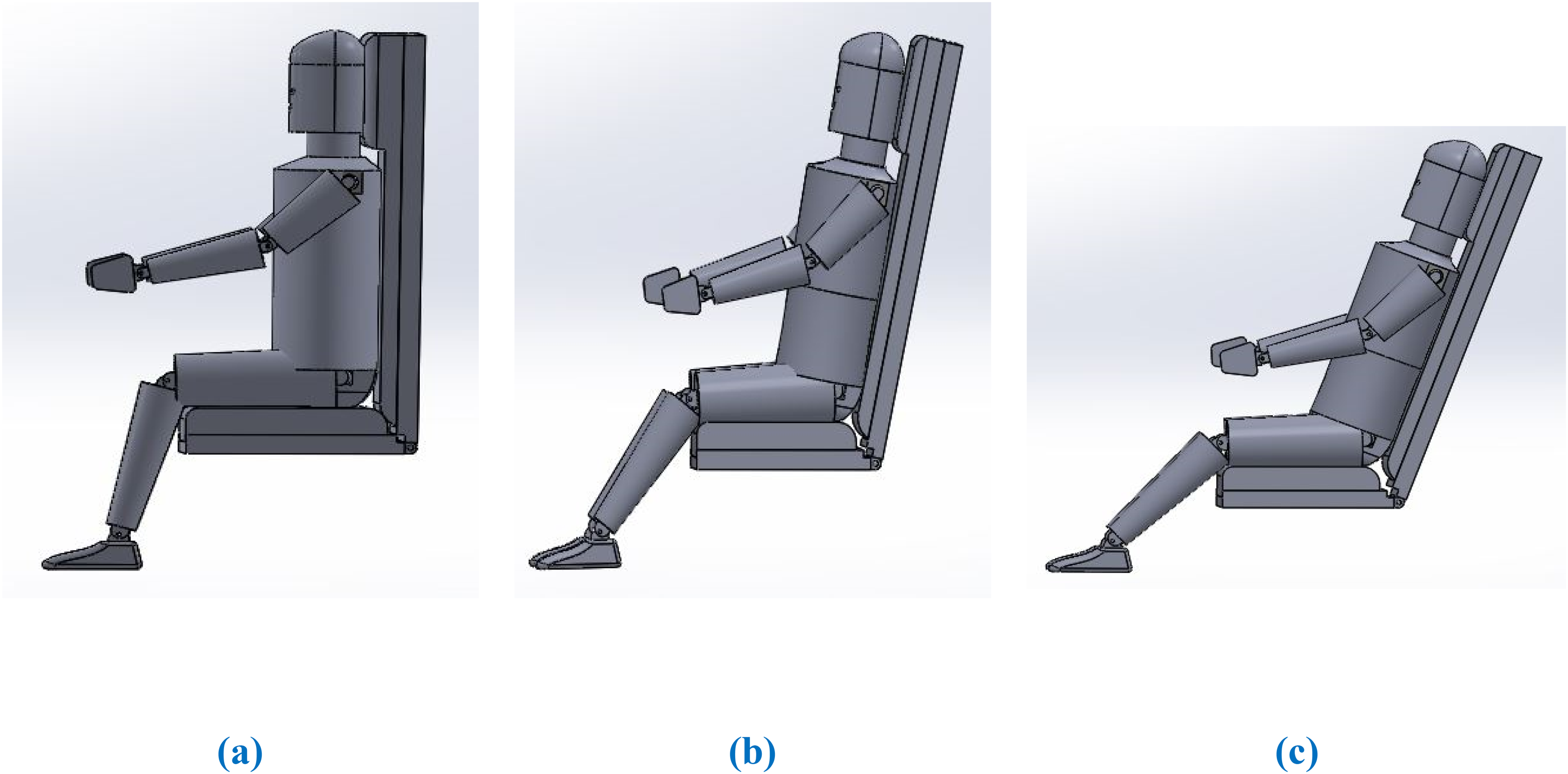
CAD model of the human subjects with a passenger seat; (a) 0o backrest angle; (b) 12o backrest angle; (c) 21o backrest angle.
The densities and other biomechanical properties of skin, muscle, bone, organs, and cushion materials were considered from existing literature.41–47 These values of densities were integrated into the simulation software, i.e., ANSYS 2022, to find the accurate mechanical response of each material under vibration. To simulate the density of cushion materials such as Polyurethane Foam, Synthetic Rubber Foam, Coir-Based Composite Cushions, and Rigid seat in simulation software, the properties of these materials is defined so that the simulation software uses this information to accurately represent how these materials will respond to vibrations and external forces under different conditions.
Using ANSYS 2022, harmonic response analysis has been performed on the generated CAD model of a human subject. Tetrahedral and hexahedral mesh elements have been used for individual parts of human subjects in 3D mesh, and quadratic and triangular mesh elements have been used in 2D mesh. The complex structure of the human subject is the basis for using tetrahedral mesh elements. As the mesh size decreases, the accuracy of the results increases; it also depends upon other parameters, but software generates fine mesh at a smaller mesh size. During meshing, it generates elements and nodes, and, in this work, the number of elements is 922928, and the number of nodes is 193537. The fixed support applied to the seat and feet of the human subject resembles the actual condition when the human body is sitting on the bus while traveling.
The ratio between STHT indicates the range of input vibrations’ transmission to different human body parts. In the current study, STHT is the ratio of acceleration at head to the acceleration at the seat i.e., excitation is applied at seat. Regarding specific road conditions, the bus driver has been subjected to accelerations of 0.5 m/s2, 1 m/s2, and 1.5 m/s2 and a frequency range of 0–20 Hz.
Results
This study performed and compared the effect of vibration on 76 kg and 54 kg human subjects under different backrest angles and two types of conditions, WB (backrest with seat pan) and NB (no backrest, only seat pan), to find out the difference in the vibrational effect on WB and NB conditions on a human subject. Different cushion material types are Polyurethane foam, synthetic foam, and coir rubber foam. Rigid seats are considered for selection, providing good comfort while driving. The static and dynamic analysis performed on cushion materials (Polyurethane foam, synthetic foam, and coir rubber foam) to expose the effect of stress, strain, and deformation on cushion materials to find out the best cushion materials have good stiffness and damping properties and providing good comfort.
Then, modal analysis was performed on both human subjects and was assembled with seats to find out the human subjects’ natural frequency and mode shapes. Mode shapes show the effect part of the human subject when it comes to contact with the vibrational surface. The natural frequency of both human subjects is shown in Table 1 and validates the results with existing literature Kitazaki and Griffin.
Results of Modal analysis for 54 kg and 76 kg human subject.

It has been found that for lower frequencies, the maximum effect of vibrations is visible on the upper segment (arms, neck, head, and organs) of the human subject, and for higher frequencies, the effect is mostly seen in the arms and hands of the human subject in both the masses of the human subject.
Then, all data was transferred into harmonic analysis to find out the response function of the human body while exposed to different excitation levels. The accelerations 0.5 m/s2,1 m/s2, and 1.5 m/s2 are applied on boundary conditions like seat base and feet and a frequency range of 0–20 Hz. To find out the STHT transmissibility at different seat angles. The results are briefly detailed showing in below:
SEAT to head transmissibility (STHT) of 76 kg and 54 kg human subject at 0.5 m/s2 accelerations under no backrest only seat pan condition
The results of STHT for 76 kg and 54 kg human subjects are shown in Figure 2 for different accelerations, and RMS acceleration excitation was found at 0.5 m/s2 without using a backrest.

Seat-to-head transmissibility at different seat backrest angles at 0.5 m/s2 with validate existing literature. (A) 76 kg (a) Polyurethane foam, (b) Synthetic rubber foam, (c) Coir-based composite cushion, (d) Rigid seat. (B) 54 kg (a) Polyurethane foam, (b) Synthetic rubber foam, (c) Coir-based composite cushion, (d) Rigid seat.
Polyurethane foam
At 0 degrees, the maximum transmissibility value found in 76 kg human subjects occurred at 1.83 at 3.18 Hz. The maximum transmissibility value in 54 kg human subjects occurred at 1.59 at a 3.18 Hz frequency. Then, the value of transmissibility decreases with increases with frequency. At 12 degrees, the maximum transmissibility value was found in 76 kg human subjects at 2.24 at 3.03 Hz. The maximum transmissibility value in 54 kg human subjects was 1.96 at a 3. 03 Hz.At 21 degrees, the maximum transmissibility value found in 76 kg human subjects was 1.09 at 2.93 Hz. The maximum transmissibility value in 54 kg human subjects occurred at 0.94 at 2.93 Hz.
In the existing literature, Mehta et al. 45 laboratory testing tools were used to determine the transmissibility of several seat cushion materials when exposed to vibration frequencies between 1 and 7 Hz. In Mehta et al., 45 the maximum transmissibility value was 1.69 at a 3.96 Hz frequency.
Synthetic rubber foam
At 0 degrees, the maximum transmissibility value is found in 76 kg human subjects, which occurred at 3.21 at a 3.65 Hz frequency. The maximum transmissibility value in 54 kg human subjects was 2.83 at a 3.65 Hz frequency. At 12 degrees, the maximum transmissibility value in 76 kg human subjects occurred at 3.89 at 3.5 Hz. The maximum transmissibility value in 54 kg human subjects occurred at 2.98 at 3.5 Hz. At 21 degrees, the maximum transmissibility value was found in 76 kg human subjects, which occurred at 2.02 at 3.4 Hz. The maximum transmissibility value in 54 kg human subjects occurred at 1.78 at 3.4 Hz. In existing literature by (45), the maximum transmissibility value was 3.01 at a 3.96 Hz frequency.
Coir-Based composite cushions
At 0 degrees, the maximum transmissibility value in 76 kg human subjects occurred at 4.71 at 4.58 Hz. The maximum transmissibility value in a 54 kg human subject occurred at 1.45 at a 4.58 Hz frequency. At 12 degrees, the maximum transmissibility value in 76 kg human subjects occurred at 5.71 at 4.43 Hz. The maximum transmissibility value in 54 kg human subjects occurred at 4.38 at 4. 43 Hz. At 21 degrees, the maximum transmissibility value in 76 kg human subjects occurred at 2.96 at 4.33 Hz. The maximum transmissibility value in 54 kg human subjects was 2.61 at 4.33 Hz. In existing literature by, 45 the maximum transmissibility value was 4.30 at a 3.96 Hz frequency.
Rigid seat
At 0 degrees, the maximum transmissibility value found in 76 kg human subjects occurred at 6.63 at 3.18 Hz frequency. The maximum transmissibility value in 54 kg human subjects occurred at 5.58 at 3.18 Hz frequency. At 12 degrees, the maximum transmissibility value in 76 kg human subjects occurred at 7.40 at 3.03 Hz. The maximum transmissibility value in 54 kg human subjects occurred at 6.17 at 3.03 Hz. At 21 degrees, the maximum transmissibility value in 76 kg human subjects was 3.85 at 2.93 Hz. The maximum transmissibility value in 54 kg human subjects occurred at 3.40 at 2.93 Hz.
In the existing literature, 48 performed an experimental study to find out the seat-to-head transmissibility of 58 human subjects seated on different elastic seats with back support, without back support, and right seat at three types of vertical vibration 0.25, 0.5, 0.75 m/s2 RMS at 0 to 20 Hz frequency. In the study by, 48 the maximum transmissibility value was 1.77 at a 3.18 Hz frequency.
SEAT to head transmissibility (STHT) of 76 kg and 54 kg human subject at 1 m/s2 acceleration under no backrest only seat pan condition
The results of FTHT for 76 kg and 54 kg human subjects are shown in Figure 3 for different accelerations, and it was found that at 1 m/s2 RMS acceleration excitation.

Seat-to-head transmissibility at different seat backrest angles at 1 m/s2 validates existing literature. (A) 76 kg (a) Polyurethane foam, (b) Synthetic rubber foam, (c) Coir-based composite cushion, (d) Rigid seat. (B) 54 kg (a) Polyurethane foam, (b) Synthetic rubber foam, (c) Coir-based composite cushion, (d) Rigid seat.
Polyurethane foam
At 0 degrees, the maximum transmissibility value is found in 76 kg human subjects at 1.93 at 3.18 Hz frequency and in 54 kg human subjects at 1.68 at 3.18 Hz frequency. At 12 degrees, the maximum transmissibility value was found in 76 kg human subjects, which occurred at 2.37 at 3.03 Hz, and in 54 kg human subjects occurred at 2.07 at 3.03 Hz. At 21 degrees, the maximum transmissibility value was found in 76 kg human subjects of 1.16 at 2.93 Hz and in 54 kg human subjects of 1 at 2.93 Hz. In existing literature by, 45 the maximum transmissibility value was 1.69 at a 3.96 Hz frequency.
Synthetic rubber foam
At 0 degrees, the maximum transmissibility value is found in 76 kg human subjects at 3.38 at 3.65 Hz frequency and in 54 kg human subjects at 2.98 at 3.65 Hz frequency. At 12 degrees, the maximum transmissibility value was found in 76 kg human subjects, which occurred at 4.09 at 3.5 Hz, and in 54 kg human subjects, it occurred at 3.60 at 3.5 Hz. At 21 degrees, the maximum transmissibility value was found in 76 kg human subjects at 2.12 at 3.4 Hz and 54 kg at 1.87 at 3.4 Hz. In existing literature by, 45 the maximum transmissibility value was 3.01 at a 3.96 Hz frequency.
Coir-Based composite cushions
At 0 degrees, the maximum transmissibility value is found in 76 kg human subjects at 4.96 at 4.58 Hz frequency and in 54 kg human subjects at 4.37 at 4.58 Hz frequency. At 12 degrees, the maximum transmissibility value was found in a 76 kg human subject at 6.01 at 4.43 Hz and in a 54 kg human subject at 5.29 at 4.43 Hz. At 21 degrees, the maximum transmissibility value was found in a 76 kg human subject at 3.12 at 4.33 Hz and in a 54 kg human subject at 2.75 at 4.33 Hz. In existing literature by, 45 the maximum transmissibility value was 4.30 at a 3.96 Hz frequency.
Rigid seat
At 0 degrees, the maximum transmissibility value was found in 76 kg human subjects at 6.68 3.18 Hz frequency and in 54 kg human subjects at 5.89 at 3.18 Hz frequency. At 12 degrees, the maximum transmissibility value was found in 76 kg human subjects, which occurred at 8.16 at 3.03 Hz; in 54 kg human subjects, it occurred at 7.20 at 3.03 Hz. At 21 degrees, the maximum transmissibility value was found in 76 kg human subjects at 4.07 at 2.93 Hz and 54 kg at 3.59 at 2.93 Hz. In existing literature by, 48 the maximum transmissibility value was 1.77 at a 3.18 Hz frequency.
SEAT to head transmissibility (STHT) of 76 kg and 54 kg human subject at 1.5 m/s2 accelerations under no backrest only seat pan condition
The results of FTHT for 76 kg and 54 kg human subjects are shown in Figure 4 for different accelerations and found at 1.5 m/s2 RMS acceleration excitation.

Seat-to-head transmissibility at different seat backrest angles at 1.5 m/s2 with validated existing literature. (A) 76 kg (a) Polyurethane foam, (b) Synthetic rubber foam, (c) Coir-based composite cushion, (d) Rigid seat. (B) 54 kg (a) Polyurethane foam, (b) Synthetic rubber foam, (c) Coir-based composite cushion, (d) Rigid seat.
Polyurethane foam
At 0 degrees, the maximum transmissibility value is found in 76 kg human subjects at 2.27 at 3.18 Hz frequency and in 54 kg human subjects at 1.98 at 3.18 Hz frequency. At 12 degrees, the maximum transmissibility value was found in 76 kg human subjects, 2.78 at 3.03 Hz, and in 54 kg human subjects, 2.43 at 3.03 Hz. At 21 degrees, the maximum transmissibility value was found in a 76 kg human subject at 1.37 at 2.93 Hz, and in a 54 kg human subject occurred at 1.19 at 2.93 Hz. In existing literature by, 45 the maximum transmissibility value was 1.69 at a 3.96 Hz frequency.
Synthetic rubber foam
At 0 degrees, the maximum transmissibility value is found in 76 kg human subjects, which occurred at 3.93 at 3.65 Hz frequency, and in 54 kg humans, which subjects occurred at 3.46 at 3.65 Hz frequency. At 12 degrees, the maximum transmissibility value was found in 76 kg human subjects of 4.76 at 3.5 Hz and in 54 kg human subjects of 4.20 at 3.5 Hz. At 21 degrees, the maximum transmissibility value was found in 76 kg human subjects, which occurred at 2.47 at 3.4 Hz, and in 54 kg human subjects, it occurred at 2.18 at 3.4 Hz. In existing literature by, 45 the maximum transmissibility value was 3.01 at a 3.96 Hz frequency.
Coir-Based composite cushions
At 0 degrees, the maximum transmissibility value found in 76 kg human subjects was 5.77 at 4.58 Hz frequency and in 54 kg human subjects at 5.07 at 4.58 Hz frequency. At 12 degrees, the maximum transmissibility value was found in 76 kg human subjects at 6.99 at 4.43 Hz and in 54 kg human subjects at 6.16 at 4.43 Hz. At 21 degrees, the maximum transmissibility value was found in 76 kg human subjects at 3.63 at 4.33 Hz and in 54 kg human subjects at 2.61 at 4.33 Hz. In existing literature by, 45 the maximum transmissibility value was 3.20 at a 3.96 Hz frequency.
Rigid seat
At 0 degrees, the maximum transmissibility value is found in 76 kg human subjects at 7.83 at 3.18 Hz frequency and in 54 kg human subjects at 6.91 at 3.18 Hz frequency. At 12 degrees, the maximum transmissibility value was found in a 76 kg human subject, which occurred at 9.56 at 3.03 Hz; in a 54 kg human subject, it occurred at 8.43 at 3.03 Hz. At 21 degrees, the maximum transmissibility value was found in 76 kg human subjects at 4.79 at 2.93 Hz, and in 54 kg human subjects occurred at 4.23 at 2.93 Hz. In existing literature by, 48 the maximum transmissibility value was 1.73 at a 3.18 Hz frequency.
SEAT to head transmissibility (STHT) of 76 kg and 54 kg human subject at 0.5 m/s2 accelerations under seat pan with backrest condition
The results of STHT for 76 kg and 54 kg human subjects are shown in Figure 5 for different accelerations, and it was found that at 0.5 m/s2, RMS acceleration excitation was used with the backrest and seat pan with the same cushion materials.

Seat-to-head transmissibility at different seat backrest angles at 0.5 m/s2 validate existing literature. (A) 76 kg (a) Polyurethane foam, (b) Synthetic rubber foam, (c) Coir-based composite cushion, (d) Rigid seat. (B) 54 kg (a) polyurethane foam, (b) Synthetic rubber foam, (c) Coir-based composite cushion, (d) Rigid seat.
Polyurethane foam
At 0 degrees, the maximum transmissibility value is found in 76 kg human subjects, which occurred at 1.67 at 3.18 Hz frequency, and in 54 kg human subjects, it occurred at 1.45 at 3.18 Hz frequency. At 12 degrees, the maximum transmissibility value was found in 76 kg human subjects at 2.05 at 3.03 Hz and in 54 kg human subjects, which occurred at 1.79 at 3.03 Hz. At 21 degrees, the maximum transmissibility value was found in 76 kg human subjects at 0.99 at 2.93 Hz and in 54 kg human subjects at 0.85 at 2.93 Hz. In existing literature by, 45 the maximum transmissibility value was 1.69 at a 3.96 Hz frequency.
Synthetic rubber foam
At 0 degrees, the maximum transmissibility value is found in 76 kg human subjects at 2.79 at 3.65 Hz frequency and in 54 kg human subjects at 2.46 at 3.65 Hz frequency. At 12 degrees, the maximum transmissibility value was found in 76 kg human subjects, which occurred at 3.38 at 3.5 Hz, and in 54 kg human subjects occurred at 2.59 at 3.5 Hz. At 21 degrees, the maximum transmissibility value was found in 76 kg human subjects, which occurred at 1.75 at 3.4 Hz, and in 54 kg human subjects occurred at 1.54 at 3.4 Hz. In existing literature by, 45 the maximum transmissibility value was 3.01 at a 3.96 Hz frequency.
Coir-Based composite cushions
At 0 degrees, the maximum transmissibility value is found in 76 kg human subjects at 4.10 at 4.58 Hz and 54 kg at 3.61 at 4.58 Hz frequency. At 12 degrees, the maximum transmissibility value was found in 76 kg human subjects at 4.96 at 4.43 Hz and in 54 kg human subjects at 4.37 at 4.43 Hz. At 21 degrees, the maximum transmissibility value was found in 76 kg human subjects at 2.57 at 4.33 Hz and in 54 kg human subjects at 2.27 at 4.33 Hz. In existing literature by, 45 the maximum transmissibility value was 3.20 at a 3.96 Hz frequency.
Rigid seat
At 0 degrees, the maximum transmissibility value is found in 76 kg human subjects at 5.58 at 3.18 Hz frequency and in 54 kg human subjects at 4.48 at 3.18 Hz frequency. At 12 degrees, the maximum transmissibility value was found in 76 kg human subjects at 6.82 at 3.03 Hz and in 54 kg human subjects at 5.97 at 3.03 Hz. At 21 degrees, the maximum transmissibility value was found in 76 kg human subjects, which occurred at 3.39 at 2.93 Hz, and in 54 kg human subjects occurred at 2.95 at 2.93 Hz. In existing literature by, 48 the maximum transmissibility value was 1.73 at a 3.18 Hz frequency.
SEAT to head transmissibility (STHT) of 76 kg and 54 kg human subject at 1 m/s2 acceleration under seat pan with backrest condition
The results of STHT for 76 kg and 54 kg human subjects are shown in Figure 6 for different accelerations, and it was found that at 1 m/s2 RMS acceleration excitation, the backrest and seat pan used the same cushion materials.
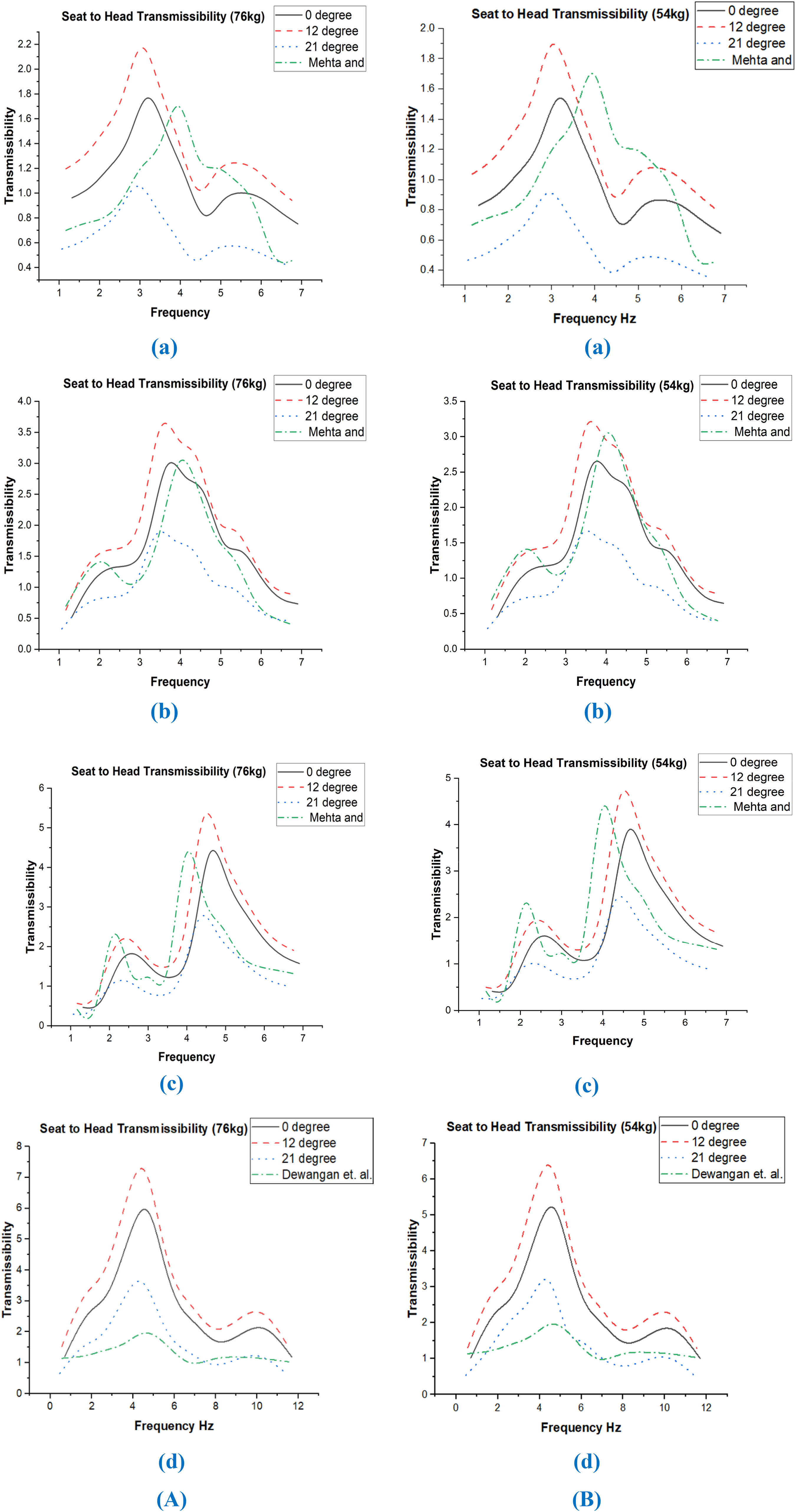
Seat-to-head transmissibility at different seat backrest angles at 1 m/s2 validates existing literature. (A) 76 kg (a) Polyurethane foam, (b) Synthetic rubber foam, (c) Coir-based composite cushion, (d) Rigid seat. (B) 54 kg (a) polyurethane foam, (b) Synthetic rubber foam, (c) Coir-based composite cushion, (d) Rigid seat.
Polyurethane foam
At 0 degrees, the maximum transmissibility value is found in 76 kg human subjects at 1.76 at 3.18 Hz frequency and in 54 kg human subjects at 1.53 at 3.18 Hz frequency. At 12 degrees, the maximum transmissibility value was found in 76 kg human subjects at 2.17 at 3.03 Hz and in 54 kg human subjects at 1.89 at 3.03 Hz. At 21 degrees, the maximum transmissibility value was found in 76 kg human subjects, which occurred at 1.05 at 2.93 Hz, and in 54 kg human subjects occurred at 0.91 at 2.93 Hz. In existing literature by, 45 the maximum transmissibility value was 1.69 at a 3.96 Hz frequency.
Synthetic rubber foam
At 0 degrees, the maximum transmissibility value is found in 76 kg human subjects at 2.94 at 3.65 Hz frequency and in 54 kg human subjects at 2.59 at 3.65 Hz frequency. At 12 degrees, the maximum transmissibility value was found in 76 kg human subjects, which occurred at 3.56 at 3.5 Hz, and in 54 kg human subjects occurred at 3.31 at 3.5 Hz. At 21 degrees, the maximum transmissibility value was found in 76 kg human subjects at 1.84 at 3.4 Hz and 54 kg at 1.62 at 3.4 Hz. In existing literature by, 45 the maximum transmissibility value was 3.01 at a 3.96 Hz frequency.
Coir-Based composite cushions
At 0 degrees, the maximum transmissibility value is found in 76 kg human subjects at 4.31 at 4.58 Hz frequency and in 54 kg human subjects at 3.80 at 4.58 Hz frequency. At 12 degrees, the maximum transmissibility value was found in 76 kg human subjects at 5.22 at 4.43 Hz and in 54 kg human subjects at 4.60 at 4.43 Hz. At 21 degrees, the maximum transmissibility value was found in 76 kg human subjects at 2.71 at 4.33 Hz and in 54 kg human subjects at 2.39 at 4.33 Hz. In existing literature by, 45 the maximum transmissibility value was 3.20 at a 3.96 Hz frequency.
Rigid seat
At 0 degrees, the maximum transmissibility value is found in 76 kg human subjects at 5.89 at 3.18 Hz frequency and in 54 kg human subjects at 5.15 at 3.18 Hz frequency. At 12 degrees, the maximum transmissibility value was found in 76 kg human subjects, which occurred at 7.19 at 3.03 Hz, and in 54 kg human subjects occurred at 6.30 at 3.03 Hz. At 21 degrees, the maximum transmissibility value was found in 76 kg human subjects, which occurred at 3.59 at 2.93 Hz; in 54 kg human subjects, it occurred at 3.12 at 2.93 Hz. In existing literature by, 48 the maximum transmissibility value was 1.73 at a 3.18 Hz frequency.
SEAT to head transmissibility (STHT) of 76 kg and 54 kg human subject at 1.5 m/s2 accelerations under seat pan with backrest condition
The results of STHT for 76 kg and 54 kg human subjects are shown in Figure 7 for different accelerations, and it was found that at 1.5 m/s2 RMS acceleration excitation, the backrest and seat pan used the same cushion materials.

Seat-to-head transmissibility at different seat backrest angles at 1.5 m/s2 validate existing literature. (A) 76 kg (a) Polyurethane foam, (b) Synthetic rubber foam, (c) Coir-based composite cushion, (d) Rigid seat. (B) 54 kg (a) polyurethane foam, (b) Synthetic rubber foam, (c) Coir-based composite cushion, (d) Rigid seat.
Polyurethane foam
At 0 degrees, the maximum transmissibility value is found in 76 kg human subjects at 2.08 3.18 Hz frequency and in 54 kg human subjects at 1.81 at 3.18 Hz frequency. At 12 degrees, the maximum transmissibility value was found in 76 kg human subjects, which occurred at 2.55 at 3.03 Hz, and in 54 kg human subjects occurred at 2.23 at 3.03 Hz. At 21 degrees, the maximum transmissibility value was found in 76 kg human subjects at 1.25 at 2.93 Hz and in 54 kg human subjects at 1.08 at 2.93 Hz. In existing literature by, 45 the maximum transmissibility value was 1.69 at a 3.96 Hz frequency.
Synthetic rubber foam
At 0 degrees, the maximum transmissibility value is found in 76 kg human subjects, which occurred at 3.42 at 3.65 Hz frequency, and in 54 kg human subjects, which occurred at 3.01 at 3.65 Hz frequency. At 12 degrees, the maximum transmissibility value was found in 76 kg human subjects, which occurred at 4.14 at 3.5 Hz, and in 54 kg human subjects occurred at 3.65 at 3.5 Hz. At 21 degrees, the maximum transmissibility value in 76 kg human subjects occurred at 2.15 at 3.4 Hz and in 54 kg at 1.89 at 3.4 Hz. In existing literature by, 45 the maximum transmissibility value was 3.01 at a 3.96 Hz frequency.
Coir-Based composite cushions
At 0 degrees, the maximum transmissibility value is found in 76 kg human subjects at 5.02 at 4.58 Hz frequency and in 54 kg human subjects at 4.42 at 4.58 Hz frequency. At 12 degrees, the maximum transmissibility value was found in 76 kg human subjects at 6.08 at 4.43 Hz and in 54 kg human subjects at 5.36 at 4.43 Hz. At 21 degrees, the maximum transmissibility value was found in 76 kg human subjects, which occurred at 3.15 at 4.33 Hz and in 54 kg human subjects at 2.78 at 4.33 Hz. In existing literature by, 45 the maximum transmissibility value was 3.20 at a 3.96 Hz frequency.
Rigid seat
At 0 degrees, the maximum transmissibility value is found in 76 kg human subjects at 6.90 at 3.18 Hz frequency and in 54 kg human subjects at 6.04 at 3.18 Hz frequency. At 12 degrees, the maximum transmissibility value was found in 76 kg human subjects, which occurred at 8.42 at 3.03 Hz, and in 54 kg human subjects, at 7.38 at 3.03 Hz. At 21 degrees, the maximum transmissibility value was found in 76 kg human subjects at 4.23 at 2.93 Hz and in 54 kg human subjects at 3.69 at 2.93 Hz. In existing literature by, 48 the maximum transmissibility value was 1.73 at a 3.18 Hz frequency.
Comparison in the values of transmissibility of 76 kg and 54 kg human subject
The transmissibility obtained for 76 kg and 54 kg human subjects at different seat angles are obtained, compared, and validated with existing literature, as shown in Table 2. It has been observed that the value of STHT for 76 kg significantly differs from the values for 54 kg. At a 21o angle, the value of STHT is less compared to other seat angles for 76 kg and 54 kg human masses. STHT was maximum for a 21-degree angle for 76 kg and 54 kg human subjects.
Comparison and Validation of transmissibility obtained in the current study with existing literature at 0.5 m/s2.
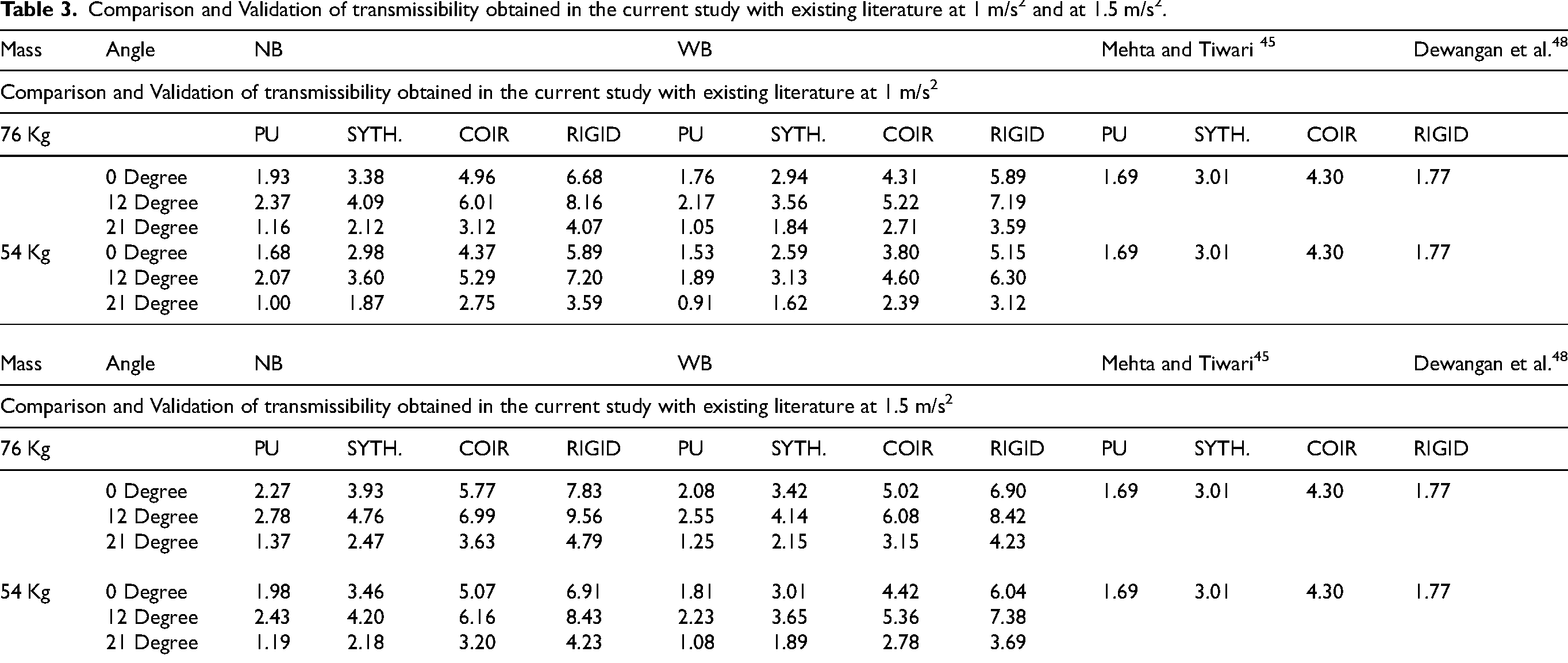
At 1 m/s2 acceleration, the maximum transmissibility value is also found at a 12-degree angle, and the minimum transmissibility value is also found at 21 degrees. However, compared to 0.5 m/s2 acceleration, a higher effect of vibration was found at 1 m/s2 for both 76 kg and 54 kg human subjects, as shown in Table 3.
Comparison and Validation of transmissibility obtained in the current study with existing literature at 1 m/s2 and at 1.5 m/s2.

At 1.5 m/s2 acceleration, the maximum transmissibility value was also found at a 12-degree angle, and the minimum transmissibility value was also found at 21 degrees. However, compared to 0.5 m/s2 and 1 m/s2 acceleration, a higher vibration effect was seen at 1.5 m/s2 for 76 kg and 54 kg human subjects, as shown in Table 3.
The transmissibility obtained for both 76 kg and 54 kg human subjects sitting on a seat with no backrest (NB) and with a backrest (WB) applied 0.5 m/s2,1 m/s2,1.5 m/s2 acceleration at different seat angles and different seat cushion materials to found the maximum STHT transmissibility values compared and validated with existing literature as shown in Table 2, Table 3.
Discussion
In this study, three types of acceleration excitation 0.5 m/s2, 1 m/s2, 1.5 m/s2 applied to car seats, and three types of cushion materials: polyurethane foam, synthetic rubber foam, coir-based composite seat cushion materials and one rigid seat considered. The maximum transmissibility value is found in rigid seats because no seat cushion has been used, and no stiffness and damping properties are found in rigid seats. They are only made from carbon steel, and the lowest value is found in polyurethane foam at all acceleration excitation because polyurethane has good stiffness and damping properties, so they provide good comfort and reduce the effect of vibration on human subjects.
The seats are adjusted in three angles to find the best angles for car seat to provide good comfort. At different seat angles, the peak values of transmissibility are found at 12o seat angle, and the lowest peak is found at 21o angle. The maximum transmissibility was found at 1.5 m/s2 and the minimum at 0.5 m/s2 because transmissibility values increase with increased acceleration. In comparing NB and WB modes, the maximum highest values are found at NB mode because the NB mode has no backrest used, so human subjects have no backrest support and feel uncomfortable.
Mehta and Tewari
45
and Dewangan et al.
48
performed an experimental study in the existing literature.
45
performed an experimental study on polyurethane foam, synthetic rubber foam, and coir-based composite seat cushion materials.
48
performed an experimental study on rigid seats. The experimental study results are found to be lower than the FEM study. As a result, the existing literature results are lower than as compared to FEM results. As per the results, the designers can use the following guidelines to reduce vibration exposure.
Cushion Materials:
Designers can use viscoelastic materials for seat cushions since they have high energy absorption properties and high damping, which help to reduce the transmission of high-frequency vibrations to the human body. Designers can also use multi-layered cushioning (combining materials with different mechanical properties) to dissipate vibration energy more effectively than a single-material cushion.
This study highlights how cushion materials’ density and mechanical properties directly influence their vibration-damping performance. With its low density and superior damping characteristics, polyurethane Foam showed the lowest vibration transmissibility. In contrast, the Rigid Seat, modeled with significantly higher density and no damping properties, demonstrated the highest vibration transmissibility. These findings emphasize the critical role of material selection and density in designing effective vibration-dampening solutions for ergonomic seating.
Backrest Angle:
A slightly reclined backrest angle (10°–15°) can reduce vertical vibration transmissibility by shifting the body's center of mass and distributing vibration forces more evenly. It will also help reduce the direct transmission of vibrations to the lower spine.
Seat Design Considerations:
For seat design, ergonomically contoured seats that support the lower back and thighs as key areas of the body can be incorporated. This can help reduce concentrated pressure points and equally distribute vibration forces. Also, the designers can consider adaptive seat designs that adjust according to the body structure and occupant's weight to provide more vibration dampening.
Implications of the study
This study has broad implications that include a range of topics, including predictive modeling, vehicle design, occupational health, and regulatory compliance.
Occupational Health Improvement: One of the main implications is the potential improvement in occupational health for those exposed to WBV while driving, such as long-haul truckers and professional drivers. This work can help establish guidelines and practices to lower the risk of musculoskeletal problems, tiredness, and other health concerns associated with extended vibration exposure by identifying elements contributing to WBV transmission and understanding its influence on health. Ergonomic Design Guidelines: The design of ergonomic seating options in cars, such as enhanced suspension systems, movable backrest angles, and better cushion materials, might be influenced by the study's conclusions. Following these recommendations can improve driver comfort, lessen tiredness, and lower the chance of developing long-term health problems from WBV exposure, all contributing to overall well-being. Regulatory Standards and Compliance: The study's results may impact compliance with occupational health and safety regulations and standards. The knowledge gathered from studying WBV transmission and its impact on human health can help create laws requiring automakers to follow specific guidelines to reduce the amount of WBV that drivers and passengers are exposed to. Innovations in Vehicle Technology: The study's results might lead to developments in car technology, such as improved suspension systems, seat designs, and materials, as vehicle design is critical in reducing WBV. These developments can increase comfort, lower health hazards, and improve people's driving experiences. Predictive Modeling for Risk Assessment: Predictive modeling tools that evaluate the risk of WBV-related health concerns depending on driving circumstances, vehicle configurations, and personal characteristics may be made possible by the advanced modeling and simulation approaches used in this work. These techniques can be useful for guiding measures to reduce health hazards associated with WBV exposure and for risk assessment in occupational contexts.
The study's implications encompass various domains such as occupational health, ergonomic design guidelines, regulatory standards, vehicle technology advancements, and the creation of predictive modeling tools for risk assessment. The ultimate goal of these endeavors is to augment safety, comfort, and well-being in the context of working while driving.
Conclusions
The human subjects corresponding to different anthropometric dimensions corresponding to the 50th and 95th percentile male Indian human population have been considered to determine the effect of vibrations while exposed to different accelerations and sitting on different cushion materials with different backrest angles. The maximum transmissibility value is found at rigid seats and the minimum value for polyurethane foam at all acceleration values. The peak transmissibility values are found at 12o seat angles at different seats, and the lowest peak value at 21o angle. The maximum transmissibility found at 1.5 m/s2 and minimum at 0.5 m/s2 shows the transmissibility value increases with acceleration increase. The maximum highest values are found in NB mode when comparing the conditions of NB (No backrest) and WB (With backrest) mode. While comparing the value of transmissibility for different masses of human subjects, it shows more for 76 kg instead of 54 kg. The best angle of the backrest was a 21-degree angle, and the best cushion material found in this study was polyurethane foam, which performed best at every acceleration excitation applied, provided good comfort, and reduced the high vibration effect.
Limitations
One limitation of this study is the focus primarily on the impact of WBV on human subjects during driving, which may not fully capture the complexities of real-world driving conditions. Furthermore, the study's breadth could be constrained by the particular accelerations, frequencies, and seating arrangements that were investigated, which could result in the absence of additional variables that could affect WBV transmission and human health consequences. Furthermore, despite their value, modeling, and simulation approaches may not be able to fully capture human reactions to vibrations encountered in real-world driving situations, indicating the need for additional validation and model improvement.
Future scope
Increasing the study's scope to encompass a wider variety of driving circumstances, road surfaces, and vehicle kinds may yield a more thorough comprehension of the effects of WBV on people. Furthermore, examining the enduring consequences of working with WBV and carrying out extended research projects may provide insights into advancing musculoskeletal conditions and additional health concerns among long-haul truck drivers and drivers. Advanced sensor technologies and real-time monitoring systems might be included in cars to enable ongoing WBV-level assessments, quick feedback, and risk-reduction actions. Additionally, investigating cutting-edge materials and technology for creating ergonomic seating arrangements and refining car suspension systems may result in fresh ideas for reducing WBV transmission and raising occupants’ overall comfort and safety. Lastly, incorporating machine learning and artificial intelligence into predictive modeling tools may enable customized risk assessments and adaptive interventions based on personal traits and driving circumstances, opening the door to future approaches to WBV-related health issues that will be more successful.
Footnotes
Acknowledgements
The authors would like to thank Ongoing Research Funding program,(ORF-2025-803), King Saud University, Riyadh, Saudi Arabia for funding this work.
ORCID iDs

Ethical considerations
This study did not include human subjects or experimental procedures that required ethical approval.
Funding
The authors disclosed receipt of the following financial support for the research, authorship, and/or publication of this article: Ongoing Research Funding program,(ORF-2025-803), King Saud University, Riyadh, Saudi Arabia.
Declaration of conflicting interests
The authors declared no potential conflicts of interest with respect to the research, authorship, and/or publication of this article.
Data availability
Data will be made available on request.