




Abstract
Background
Prior studies concentrated the application of regulatory focus on employees’ positive actions and behaviors. No such validating regulatory focus scales limit its future research opportunities.
Objective
The paper validates the regulatory focus scale initially created by Wallace and Chen (2006) within the context of Malaysia.
Methods
Initially, a review of the literature was carried out to identify the core components of regulatory focus and the relevant items. Subsequently, these items were evaluated by expert panel. A systematic sampling approach was applied, yielding 344 responses from the Malaysian healthcare workers. Partial Least Square-Structural Equation Modeling (PLS-SEM) was employed as regulatory focus was operationalized as second-order formative construct because it formed by the prevention- and promotion- focused which considered as first-order reflective constructs. After that, the regulatory focus scale was assessed for convergent validity and discriminant validity.
Results
The results revealed that two dimensions namely promotion- and prevention-focused are well-suited for assessing regulatory focus. Regulatory focus is defined by these two dimensions. If any of these elements are omitted, the nature of regulatory focus could be changed.
Conclusions
This study contributes to the body of knowledge by validating regulatory focus scale as scale validation studies are scarcely found.
Introduction
While employees commonly pursue goals such as career progression, increased competition and acknowledgement, they use diverse strategies and approaches to attain these goals. 1 Regulatory focus suggests that employees manage their goals and strategies in accordance with their prevention- and promotion-focused orientations in the workplace. 2 An individual's regulatory focus influences their actions and behaviors. 3 Employees with strong prevention-focused preference prefer obligation, safety, security and comply with rules. 4 They are more aware of job demands and encouraged to meet the job demands such as deadlines, errors and standards. 5 This reduces their anxiety and burnout to navigate those job demands. 5 In contrast, employees with strong promotion-focused concentration on career advancement and activities that enhance their visibility and status. 6 Employees with promotion- focused increase their innovative work behaviors. 6 According to Wang, 7 promotion-focused predicts creative thinking in adolescents because promotion-focused adolescents are more likely to explore various problem-solving strategies which can lead to more creative ideas. Additionally, employees with a promotion-focused tend to create more developmental opportunities in their jobs because they typically are more proactive about seeking opportunities that allow them to better to grow and move on (e.g., skill expanding, taking challenging projects). 8 It aligns with Sustainable Development Goal (SDG) goal 8 to foster inclusive economic growth and productive employment.
However, there is a lack of research on validating regulatory focus scales. Prior studies9–11 concentrated the application of regulatory focus on employees’ positive actions and behaviors. No such validating regulatory focus scales limit its future research opportunities. 12 For instance, examining whether regulatory focus contributes to employee higher levels of productivity and ultimately organization outcomes. Scale is a necessary part of empirical research because it allows for the collection of knowledge about a phenomenon.13,14 Scales give scores to the phenomena that cannot be directly measured. 14 Additionally, despite the regulatory focus scales having been utilized in earlier studies across different cultures, it raises questions about the scale validity. For example, in Fernando 5 study of 462 Sri Lankan manufacturing and service organizations, their Confirmatory Factor Analysis (CFA) of regulatory focus scale was inadequate to achieve convergent validity due to low Average Variance Extracted (AVE). It suggests that a scale that is valid in one culture may not be valid in another culture. 15 Cultural differences in employee behaviors highlight the need to investigate if regulatory focus patterns observed in the Malaysia population are consistent with those found in other cultural settings. Hofstede's cultural dimensions theory (e.g., individualism, collectivism and long-term orientation) suggests that national culture impacts values and behaviors. 16
Malaysia has a combination of cultural backgrounds i.e., Malay, Chinese and Indian traditions shape the different business cultures. 17 It is characterized by friendly business relationships, respect hierarchy and group or team work. 18 These cultural differences may influence employee actions and indicate that the regulatory focus needs to be validated in Malaysia specifically. 17 Thus, the primary objective of this study is to validate regulatory focus scale in the Malaysia settings. By doing so, it encourages more studies on regulatory focus, especially comparing regulatory focus across different settings. Further, this study benefits the organizations to produce positive employee behavior and leads to customer experience, satisfaction, long term relationships and competitive advantage. The structure of the study includes a literature review in section two. Section three describes the methodology followed by findings in section four. Section 5 presents discussions, research implications, limitations and future research directions.
Literature review
Regulatory focus definitions
Regulatory focus introduced by Higgins 2 which suggests that individuals are inclined to control their own thoughts and behaviors when pursuing goals. Individuals show different adjustments in the process of pursuing goals. According to Higgins, 2 there are two types of regulatory focus: 1) promotion focus and 2) prevention focus. Promotion focus is related to obtaining rewards and focus on growth and aspirations. Prevention focus is related to avoiding punishment and failure. Regulatory focus explains how individuals respond to problems they encounter. It explains why people have different goals, motivations and actions. Some individuals concentrate on achieving success, while others focus on avoiding failure. Additionally, Brockner 19 extends regulatory focus by recognizing that employees may choose to have a promotion or prevention focus depending on the work context, tasks and goals.
Some work events or projects may require employees to operate with a promotion focus, while others may need a prevention focus. 4 In fact, these two complement each other as demonstrated in Petrou 20 because employees can improve their work performance by optimizing both a promotion and prevention focus. The recent regulatory focus studies integrate technological advancements and remote work. 21 Promotion focus managers are more likely to search opportunities and perceived challenges via technological diversification. 21 There is growing emphasis on how innovations and adaptability can shape regulatory focus to align with strategic objectives. 22 Regulatory focus studies are typically divided into two dimensions: 1) promotion focus and 2) prevention focus based on Higgins. 2 The study follows by dividing regulatory focus into these two categories.
Research gaps
There are on-going disagreements on the scope and dimensions of regulatory focus scale in the healthcare industry due to its different characteristics compared to other industries. The healthcare industry is characterized by the intense demands (e.g., long work hours and emotional stress), rapid changes of health concerns and technologies. 23 This may affect healthcare workers’ regulatory focus perceptions as a stressful work environment enhances prevention focus mindset. 24 Healthcare workers may prioritize error reduction and maintain safe practices rather than take risks to use new approaches. 24
Besides that, the regulatory focus scales in other industries fail to capture the unique nature of the healthcare industry, raising concern regarding the scale reliability. These scales are not contextually relevant to the healthcare environment when it is applied to the healthcare workers. Regulatory focus scales developed for other industries often include questions from the customer perceptions or individual experiences beyond the healthcare industry. For example, in scales developed by Christner 25 or Jin 26 some survey questions may ask respondents about personal experiences related to childhood (e.g., “How well can you express joy when good things happen to you?”) or consumer behavior in hospitality and tourism industries (e.g., “I feel like I have made progress toward being successful in my life”). These questions require experience or behavior that is not applicable to healthcare workers, who face different professional challenges and stressors. Healthcare workers are typically focused on patient care, safety and medical protocols rather than personal or consumer-related behaviors.27,28 As a result, these questions may feel irrelevant or difficult for healthcare workers to answer, which undermines the reliability of the scale.
Moreover, regulatory focus scale is fragmented due to inconsistent application and empirical testing across studies. This is evident in some studies which have independently tested the two dimensions while others have analyzed all two dimensions as a single construct.29–31 In other words, various approaches have been used to empirically validate regulatory focus across different studies, each focusing on different aspects of regulatory focus. Subsequently, this variability makes it challenging to interpret, compare studies and draw firm conclusions about the validity of the regulatory focus scale. These research gaps encourage the study to investigate reliability and validity of regulatory focus.
Methodology
Research design
This research aimed to validate a regulatory focus scale developed by Wallace. 32 A quantitative study was conducted using an online questionnaire survey. The study followed the recommendations of Tay 33 or Tay 34 or Tay 35 regarding scale validation. Initially, an expert panel was employed to review and verify the scale items, having minor modifications based on their feedback. The revised scale items were then pilot tested with 50 healthcare workers and given the reliability scores. Given the high reliability scores of the revised items, a Confirmatory Factor Analysis (CFA) was conducted with a sample of 344 Malaysian healthcare workers. The reliability and validity of the regulatory focus scale were examined based on CFA.
Population, sample and data collection process
This study examined a total population of 214626 Malaysian healthcare workers (e.g., physicians, dentists, pharmaceutical officers, nurses, physiotherapists and medical laboratory technicians). 36 The healthcare industry was chosen for this study likely because it represents a diverse group of professionals with different roles and responsibilities, offering a rich context for examining regulatory focus. 37 Healthcare workers are often required to make important decisions under pressure and high-stakes environments, which may make their regulatory focus particularly relevant. 38 The preferred sample size is 500 (10 hospitals×50 healthcare workers) following Roscoe's 39 sample size guideline. Of 500 healthcare workers, each worker in the hospital workers’ name list was chosen (i.e., 500/214626 × 100%) using the systematic sampling method. A total of 500 healthcare workers were selected after repeating this process. There were 355 licensed hospitals in Malaysia.
However, only ten hospitals in Kuala Lumpur agreed to participate after requesting from the hospitals’ human resource departments. 500 online questionnaires were sent to the healthcare employees in the participating hospitals. To ensure participants were familiar with their work environment, the study only included employees with a tenure exceeding six months at their respective hospitals. 40 Participants had one week to complete the questionnaires. Ultimately, 365 completed questionnaires were collected, resulting in a 41.48% response rate. Such response rate was adequate for quantitative studies. 41 12 responses were removed from the data because the respondents provided identical answers, resulting in 353 questionnaires for further analysis. The respondents mainly are nurses (42.4%), female (53.5%), 25 and 34 years old (47.7%), less than 5 years of work experience (31.4%) and hold non-executive positions (76.5%).
Measurement
Regulatory focus scale was adapted from Wallace. 32 Prior studies that used regulatory focus scale developed by Wallace 32 showed high reliability scores. For example, Kim 30 reported the reliability coefficient is 0.96. Similarly, Zhuang 42 has a reliability value of 0.924. This measurement is relevant to business organizations. Additionally, the items and dimensions of the measurement fully capture regulatory focus, making it appropriate for the study. The scale has two dimensions: prevention- and promotion-focused. Each dimension has 6 items, rated on a Likert scale of 1 (never) to 5 (almost always). Specifically, a sample item for promotion-focused is “getting my work done no matter what,” while a sample item for prevention focused is “I often follow the rules at work”.
Regulatory focus was operationalized as a second-order formative construct because it was formed by the prevention- and promotion- focused which are considered as first-order reflective constructs. Their changes influence the regulatory focus. An increase in prevention-focused perhaps lead to an increase of regulatory focus despite that such changes do not involve promotion- focused. Prevention- and promotion- focused lacked a shared theme and the structures were neither interconnected nor interchangeable. Additionally, they together defined regulatory focus as different constructs.
The prevention- and promotion- focused are first-order reflective constructs because each item is highly similar and describes the same underlying concept. Removing an item does not change the meaning of each dimension. For example, promotion-focused items refer employees’ concern for accomplishing a greater quantity of work more quickly. Hence, the meaning of promotion-focused was not affected by the elimination of these similar items.
Findings
Experts’ review
This study employed an expert panel to review and refine scale items, following the practice of Monteyne. 43 The expert panel consisted of four researchers with expertise in organizational behavior and experience in developing related scales. The expert panel requires a minimum of three and a maximum of ten experts for a satisfactory outcome. 44 In fact, only four researchers who agreed to participate received appraisal sheets to determine the usefulness, understandability and necessity of the scale items. These appraisal sheets included the constructs’ meanings, Likert scales, items, guidelines and suggestions (refer to Appendix 1). The four researchers rated each item's usefulness to the construct on a four-point scale i.e., 1 = not relevant, 2 = somewhat relevant, 3 = quite relevant, 4 = highly relevant. 45
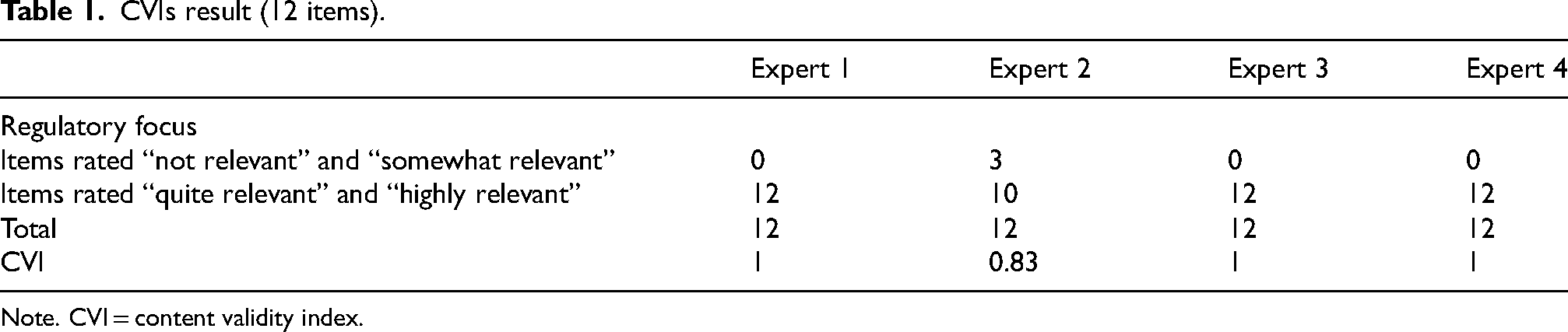
A four-point rating scale was used to avoid neutral responses. 46 The Content Validity Index (CVI) was calculated using the ratings of the four researchers. 45 The CVI is calculated by dividing the total number of items by the sum of scores for items rated as “quite relevant” and “highly relevant”. 47 A CVI of 0.70 or higher is considered to indicate excellent content validity. 47 The CVI in the study was above the threshold (see Table 1). In brief, the four researchers confirmed that items developed to measure regulatory focus were suitable and no items needed to be removed. The scale items were further refined by obtaining feedback from the four researchers. The wordings were standardized to improve coherence. Further, vague statements were revised to ensure clear and specific statements. For instance, the item “I know how many tasks I can complete” was changed to “I have a clear understanding of the number of tasks I can complete within a given time frame.” Appendix 2 describes original and modified items for regulatory focus.
Pilot test
A pilot test of the regulatory focus scale was conducted with 60 healthcare workers in Selangor, Malaysia after establishing content validity via online questionnaires. This is to assess their understanding of the scale items and clarity of questionnaire instructions regarding regulatory focus. 48 According to Tay, 33 pilot test samples typically range from 30 to 100 participants to assess the suitability of the questionnaire. 57 participants submitted their questionnaires within a week.
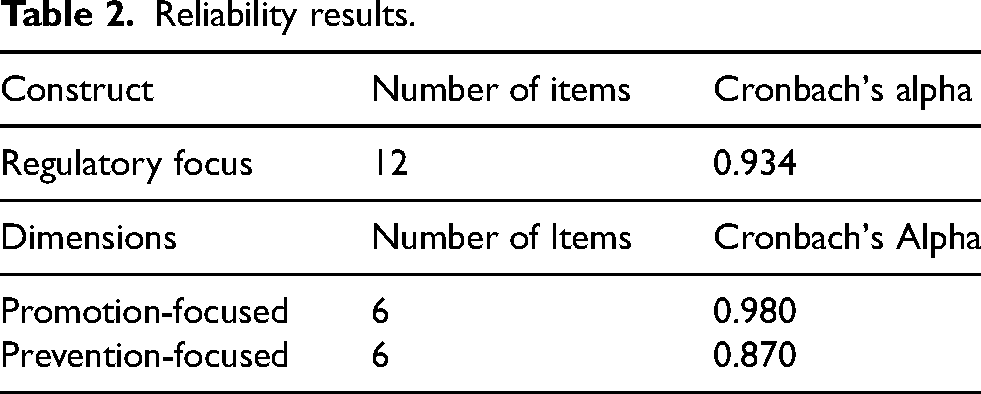
Seven questionnaires were discarded due to a lack of response variation, leaving 50 questionnaires for analysis. The reliability results that analyzed via Statistical Package Social Science (SPSS) 28 showed reliability coefficients above 0.70, meeting Nunnally's 49 threshold value (see Table 2). The respondents’ feedback showed that they understood the regulatory focus items, so no changes were made to the questionnaire.
CVIs result (12 items).
Note. CVI = content validity index.
Reliability results.
Data screening
The data screening process assesses missing data, outliers and normality. Missing data and univariate outliers were not found among 353 data. However, 9 data were multivariate outliers because their Mahalanobis distances were larger than the chi-square score and p value less than 0.001. 50 These nine multivariate outliers were removed, leaving 344 data points for further analysis. The normality was assessed using Z-values for skewness and kurtosis. Both were less than 3.29, suggesting that the regulatory focus was normally distributed.
Reliability and validity testing
First-order reflective constructs
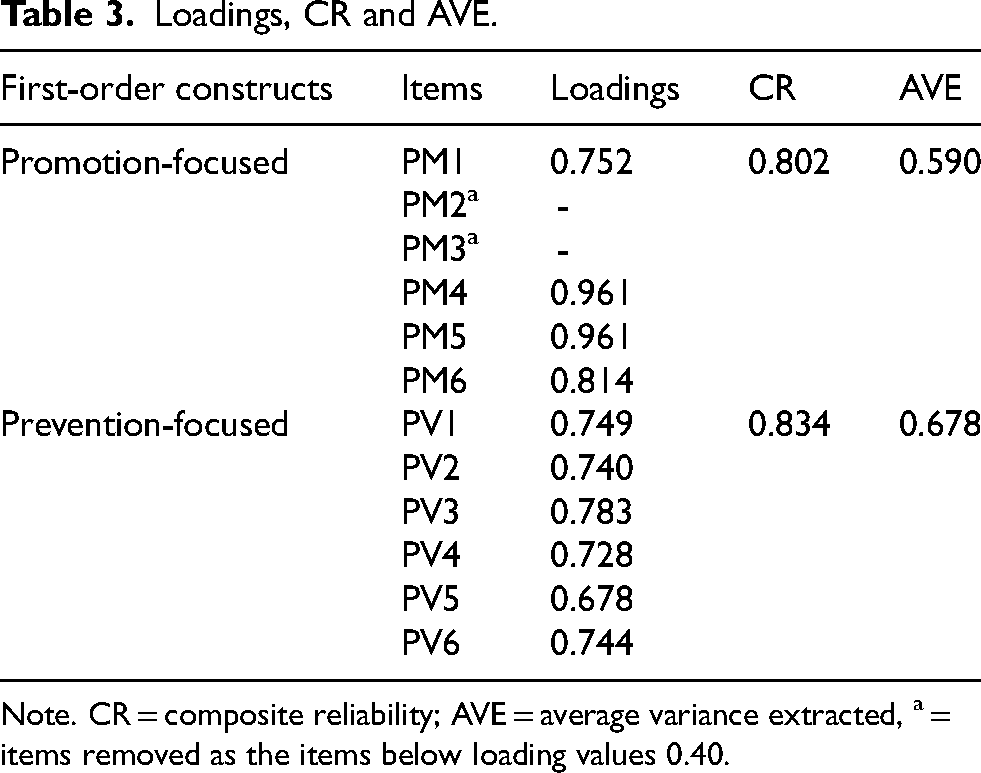
When analyzing using Partial Least Square-Structural Equation Modeling (PLS-SEM), CFA covers convergent validity and discriminant validity. 51 Both assess the reliability and validity of the first-order constructs. 52 Convergent validity examines whether different constructs used to measure the underlying concepts lead to consistent findings. 51 To evaluate convergent validity, item loadings, composite reliability (CR) and average variance extracted (AVE) were used. 53 Item loadings refer to the strength between the items and the constructs. 54 The minimum threshold for an item to be considered a good indicator of the construct is 0.70. 55
Table 3 shows that all item loadings exceeded the minimum threshold of 0.70. Composite Reliability (CR) is the internal consistency and reliability of the items to measure the same construct. 56 CR exceeded 0.70 is generally considered acceptable, indicating good CR. 55 Average Variance Extracted (AVE) explains the amount of variance captured by a construct from its items. 53 AVE that larger than 0.50 is the generally accepted threshold for demonstrating convergent validity. 53 The AVE values were above the 0.50 threshold, indicating that the convergent validity of the first-order construct is adequate (refer to Table 3).
Loadings, CR and AVE.
Note. CR = composite reliability; AVE = average variance extracted, a = items removed as the items below loading values 0.40.
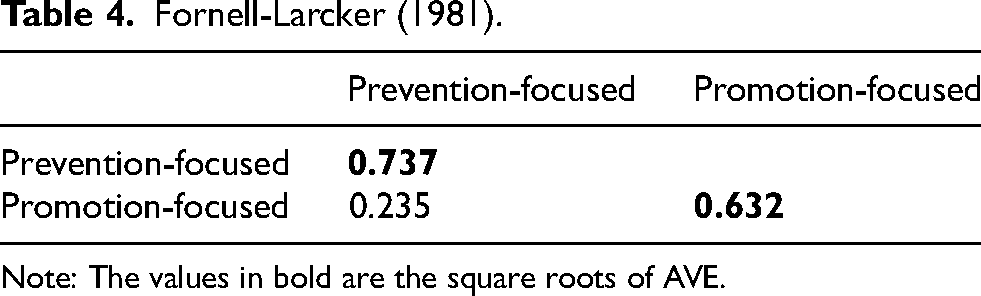
Discriminant validity refers to the extent to which a construct is distinct and different from other constructs. 53 To validate discriminant validity, Fornell 57 is applied. It can be achieved when the square root of the AVE for each first-order construct must exceed the correlation coefficients between construct and others, as shown in the corresponding rows and columns. 57 Overall, the correlation coefficients for the first-order constructs were greater than the square root of the AVE for each construct (refer to Table 4). Therefore, discriminant validity for all first-order constructs was confirmed.
Fornell-Larcker (1981).
Note: The values in bold are the square roots of AVE.
Second-order formative construct
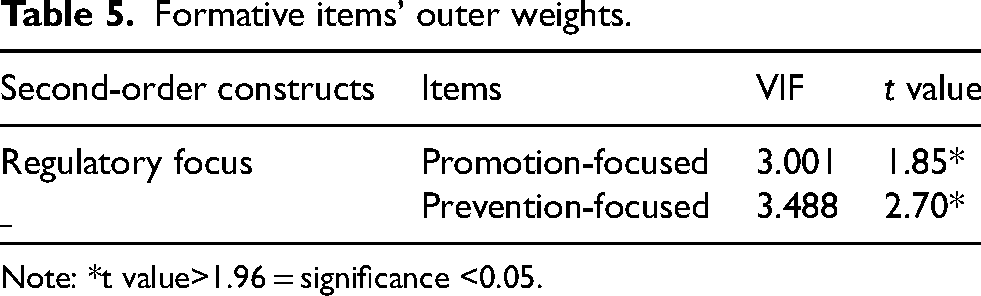
To analyze second-order formative construct, two methods were used: 1) Variance Inflation Factor (VIF) and 2) the outer weights of the formative items. VIF identifies the items that are highly correlated with others. 53 If an item has a high VIF, it might be redundant and removing it could improve the research model. 58 Typically, a VIF value greater than 5 is considered multicollinearity issues. 53
The results in Table 5 demonstrated that all VIF values were below 5, suggesting that multicollinearity issues do not pose problems for the items. Checking outer weights that are statistically significant can be performed by bootstrapping. 59 If the p-value is less than 0.05, suggesting that the formative item forms the construct. Table 5 results displayed that the outer weights of the formative items were significant at p < 0.05, confirming that the formative items contribute to the formation of the second-order constructs.
Formative items’ outer weights.
Note: *t value>1.96 = significance <0.05.
Discussions
This study validates the regulatory focus scale within the context of Malaysian healthcare workers. To achieve this, various processes were used to assess the regulatory focus scale proposed by Wallace. 32 Initially, the study used a panel of experts to review the scale items. Based on the experts’ suggestions, the items were revised to improve their clarity (refer to Appendix 2). This process ensured that the cross-industry regulatory focus items were validated before being distributed to Malaysian healthcare workers, preventing any potential misinterpretation of the survey. Subsequently, a pilot study demonstrated high reliability coefficients, indicating that none of the items were removed from any of the dimensions. Additionally, statistical examination processes i.e., loadings, CR, AVE, Fornell, 57 VIF and items’ outer weights confirmed that two dimensions were well-suited for assessing the regulatory focus scale.
Thus, this study could serve as a catalyst for further research on regulatory focus in the Malaysia context as recommended by Foley. 60 Moreover, the results suggest that the regulatory focus scale is applicable in other settings, such as Malaysia in contrast to Wallace 32 research conducted in the United States. However, there is one important consideration for future research that should be highlighted. The original items for the promotion-focused dimension did not align with the items in the present study. Two items were eliminated due to the low loadings. It highlights differences in the items for the promotion-focused dimension within the Malaysian context. Meanwhile, the original items for the prevention-focused dimension were consistent with the corresponding items used in the present study. The results confidently show that these dimensions exhibit similarities in the Malaysian context. Having said that, the regulatory focus scale can be widely used in the contexts with similar cultural settings or in comparison research.
Theoretical and managerial implications
This study examined regulatory focus using a combined measurement model that incorporates both formative and reflective constructs. Unlike earlier research 61 which used the traditional reflective approach to assess regulatory focus through SEM, this study argues that the reflective approach is not sufficient for all measurement models. Consequently, it offers new insights into regulatory focus scale by adopting a combined measurement model that is relatively under-explored. Additionally, the study enhances previous models based on the traditional reflective approach by utilizing the PLS-SEM method. This study employed a thorough scale validation process encompassing content validity, pilot test, tests for reliability and validity to ensure the accuracy of the regulatory focus scale. The results demonstrated that the regulatory focus scale is reliable and valid. Thus, it can be confidently utilized by future researchers and practitioners. This study builds on existing measurements by identifying dimensions of regulatory focus. Earlier research29–31 lacked agreement on the dimensions of regulatory focus, often using only selected dimensions without clear justification. Through a thorough validation process, this study has demonstrated that two dimensions of regulatory focus offer a systematic and reliable framework for future research. From a managerial implications’ perspective, this study recognized workers vary in how they respond to workplace demands and resources. A prevention focuses workers appear to be more susceptible to the negative effects of job demands. In contrast, workers with a weaker promotion focus tend to have lower levels of work engagement, commitment, job satisfaction and gain the most from job resources. Such recognition could be beneficial for HRM professionals and management level in various ways. They may create customized interventions to enhance workers’ well-being, performance and career development (e.g., coaching and conflict mediation). Additionally, organizations could design and evaluate interventions to strengthen either a promotion- or prevention- focused among employees by modifying organizational feedback and reward systems.
Limitations, directions for future research and conclusion
This study has several limitations that future research should consider and address. Firstly, although the sample size is adequate, the gender distribution is imbalanced. There was a higher number of women than men, resulting in an under-representation of the male demographic in the sample. Secondly, the sample is primarily composed of respondents in the lower-level job positions i.e., non-executive roles. This concentration in job positions may lead to a selection bias. Future research should assess the effectiveness of the regulatory focus scale using more diverse samples to generalize the findings. It builds a stronger understanding of the scale's relevance across different gender and job positions groups.
Thirdly, this study suffers cognitive bias problems given that it only measured the perceptions of individual respondents. Respondents may change their answers to align with social expectations or norms, giving responses that they believe are more acceptable rather than what they truly feel or believe. In the future, the regulatory focus scale can be examined in relation to multi-level outcomes such as the team and organizational levels as suggested by Xi. 62 To conclude, the regulatory focus scale has been validated and suitable for use in the contexts with similar cultural settings or in comparative studies. The findings also emphasize differences within the promotion-focused dimension as two items were excluded due to their lower loadings. In this regard, this adjustment ensures the scale's reliability and enhances its applicability in future research.
Footnotes
Acknowledgements
Not applicable.
Ethical approval
Approval was granted by the Ethics Committee (EC Ref No.: TARUMT/EC/2025/E- circulation/October 01).
Informed consent
Not applicable.
Funding
The authors received no financial support for the research, authorship, and/or publication of this article.
Declaration of conflicting interests
The authors declared no potential conflicts of interest with respect to the research, authorship, and/or publication of this article.