



Abstract
BACKGROUND:
This study aimed to investigate the relationship between safety attitudes and safety performance considering the mediating role of safety climate in the petrochemical industry.
METHOD:
The statistical population of this study included all 1700 employees in the petrochemical industry of Iran, among whom 320 were randomly selected as the participants and completed the research questionnaire. Then, the validity (content, convergent, and divergent) and reliability (Cronbach’s alpha and composite reliability) of the instrument were examined, and the research hypotheses were tested using Smart partial least squares (PLS) software.
RESULTS:
The results showed that the model has goodness of fit and, thereby, the positive effect of safety attitude on safety performance was confirmed. In addition, the mediating role of safety climate in the relationship between safety attitude and safety performance was proved. That is, 39.6% of the total effect of safety attitude on safety performance was explained through the mediating role of safety climate.
CONCLUSION:
The findings of this study can improve safety culture and bring about excellent safety performance in petrochemical industries.
Keywords
Introduction
Recently, numerous incidents and fires have oc-curred in Iranian petrochemical industries where expert opinion about the roots of these incidents and fires is not limited to technical issues, failure in components, or other malfunctions. As a result, an increasing concern about safety in the petrochemical industry has emerged. Despite the application of engineering controls, provision of safety instructions, and adoption of safety and health laws, related studies have shown that there are still many incidents in such occupational workplaces [1]. For example, the incident rate in the US petrochemical industry was reported 0.9 per 100 workers in 2004, and this figure was reduced to 0.6 percent in 2009. In other words, it decreased by a rate of less than 35% in a 5-years period [1, 2]. Occupational hazards and safety performance may be affected by various factors. In 2003, O’Dea and Flin reported four fundamental factors associated with positive safety outcomes (accidents and minor errors): senior management, management, supervisory, and operator factors. Senior management factor includes safety attitude, leadership style, and responsibility. The management factor is divided into seven categories, namely commitment to safety, intervention in safety, safety priority, leadership style, interaction, communication, and human management approach. The supervisory factor consists of supportive supervision, partnership participation, director autonomy, and participatory supervision. Finally, the operator factor holds five subcategories, including labor interference, worker autonomy, employee risk perception, worker integrity, and worker motivation. These factors are influenced by various aspects, such as safety leadership, safety/safety culture, and emp-loyee behavior [3]. In 2000, Clark proposed a theoretical model of safety culture and its impact on safety behavior, and reported that safety culture influences safety behavior through two mechanisms directly by developing latent failures and indirectly by developing work climate. Latent failures often result from the organization or management negligence (i.e., the management disregards the issue of safety), which can lead to unsafe employee behavior. The work climate can be regarded as a reference for conducting safe or unsafe behaviors, including safety violation, reporting accidents, incidents and near misses, and professional safety behaviors [1]. With regard to the previously mentioned points, numerous studies have been carried out in order to identify the relationship among variables, such as safety attitude, safety climate, safety performance, safety behavior, safety motivation, and on the like in various industries. For example, Newaz et al. investigated how safety climate factors influence workers’ safety behavior. In this study, different relationships between key safety climate factors and psychological contact of safety were examined to explain the influences which they had on each other [4]. Similarly, the relationship between safety behavior and safety climate has been examined by Gregory et al. [5]. Schwatka et al. also evaluated the relationship between safety climate and safety behaviors in a construction industry. They concluded that safety climate was related to safety behaviors in that industry [6]. The lagged relationships among safety climate, safety motivation, safety behavior, and accidents were also examined by Neal et al. The results clarified the direction of the relationships among safety-related constructs and the levels at which these effects operated [7]. In another study, Neal et al. assessed the relationship between safety climate, safety knowledge, safety motivation, and safety behavior and investigated the antecedents and consequences of safety climate and safety behavior [8]. However, the aim of most of these studies was to assess the effect of these variables on safety performance, while only a few number of them have assessed the mediating role of these variables. One of these studies is the one conducted by Wu et al., who examined the mediating role of safety climate in the relationship between safety leadership and safety performance. The findings revealed that safety climate mediated the relationship between the two variables [9]. However, the aim of the current study was to investigate the relationship between safety attitude and safety performance with the mediating role of safety climate in a petrochemical plant. Table 1 presents and compares different studies already conducted on safety performance assessment using different variables and approaches. According to this table, this is the first study that evaluates the effect of safety attitude on safety performance by considering the mediating role of safety climate through PLS technique in the petrochemical industry.
Features of this study versus other studies
Features of this study versus other studies
The remainder of this study is organized in the following sections. First, some details pertaining to the research concepts are presented in Section 2. Then, the research methodology and its different steps are dealt with in Section 3. The results and discussion are provided in Section 4. Finally, Section 5 is dedicated to the conclusion of this research.
Safety performance and factors affecting it
Safety behavior is an integral part of safety performance [8]. According to Clarke’s model, there are two important factors, i.e. safety management and safety climate, that largely affect safety behavior and safety performance. Chang et al. pointed out that if a good safety climate is dominant in an organization, then the values and beliefs will be adequately visible. In this context, a common understanding of workers’ safety behavior can be achieved by the wor-kforce’s safety awareness [10]. Accordingly, safety management, safety climate, and safety performance affect each other in different ways [9]. Currently, the majority of developed countries have come to the understanding that the infrastructures of advanced management systems and technology alone do not account for achieving sustainable development; ra-ther, employees’ safety behaviors, values, and beliefs, along with their own attitudes and the organizational attitudes toward safety principally constitute safety climate, which is necessary for the prevention of accidents [11]. The individual factor is one of the human factors affecting safety performance, which can be physical, mental, or psychological in nature. Some of the individual factors are typically related to personality and are, thus, unchangeable, whereas others pertain to skills, attitudes, risk perception, and motivation that can be improved by taking pertinent measures, such as training [12].
Safety attitude
Attitude refers to the intrinsic and desirable state of people for evaluating individuals, objects, and si-tuations and interpreting them in favorable and unfavorable conditions [13]. Individuals’ attitudes towards their behavior and actions has a highly significant influence on safety climate and can directly or indirectly change their behavior [14]. Determining the type of attitude toward safety in a system is an important predictor of risk behaviors and can highly affect the probability of occurrence of accidents [15, 16]. Research on the effect of psychological and organizational factors on behavioral risks and the probability of injury and harm at workplace has shown that safety climate has a great impact on these factors [17].
Safety climate and its dimensions
The term safety climate was developed by Zohar in the 1980s and was defined as “Personnel’s common understanding of policies, procedures, customs and safety practices, such as the overall importance and priority of safety in the workplace” [18]. Safety climate is a multidimensional factor and is regarded as an important advance in occupational safety. Safety climate measurements can provide an overall overview of the organization’s safety status and safety culture at a specified time [19]. The safety climate that governs each work environment is derived from values, perceptions, individual and collective interests, qualifications, and behavioral patterns that determine employees’ commitment to the organization’s safety management and occupational health [7]. In Glendon and Litherland’s study, safety climate questionnaire and safety behavior checklist were used to measure employees’ safety performance in road construction companies. They concluded that there was no relationship between safety climate and the measured safety behavior [20]. By the same token, Khalaghenejad et al. investigated the relationship between safety climate and safety performance among all employees of Sarcheshmeh Copper Complex and showed that safety climate directly affects safety performance. In addition, the safety knowledge obtained through safety stimulation has been reported to influence safety performance [21].
The relationship between safety attitude and safety climate
The literature review has shown that safety climate is positively and significantly associated to safety attitude [22]. Safety climate acts as a reference framework which guides behaviors and is reflected in individual’s beliefs about safety. Donald et al. introduced three factor models of safety climate, namely safety attitude (people or the organizational roles that construct the safety climate), attitude behavior (e.g., knowledge, satisfaction, and actual behavior), and safety activity (e.g. wearing safety clothing and attending safety meetings) [23]. Accordingly, there are two approaches about the concept of safety climate that should not be confused with the concept of safety climate. In the first approach, safety climate results from the actual characteristics of workplace that can be discovered by asking people questions. However, the second approach assumes that safety climate is generated by individuals’ attitudes towards safety and their perceptions of the workplace features. Based on the definition of safety climate, a detailed examination of these two approaches reveals that safety climate cannot be defined as a simple summery of people’s perceptions about their workplace [24] because there are safety stereotypes among most workers that can make a scant contribution to the discrimination of the particular safety climate in the organization. The effect of safety attitude and safety climate on safety performance has been demonstrated in numerous studies [4, 25–28]. In contrast, few studies have reported the mediating role of the safety climate among various safety variables [9, 29–33]. However, safety attitude, safety climate, and safety performance may influence each other in different ways. Figure 1 shows the relationship between these three variables; therefore, the following hypotheses can be formulated:
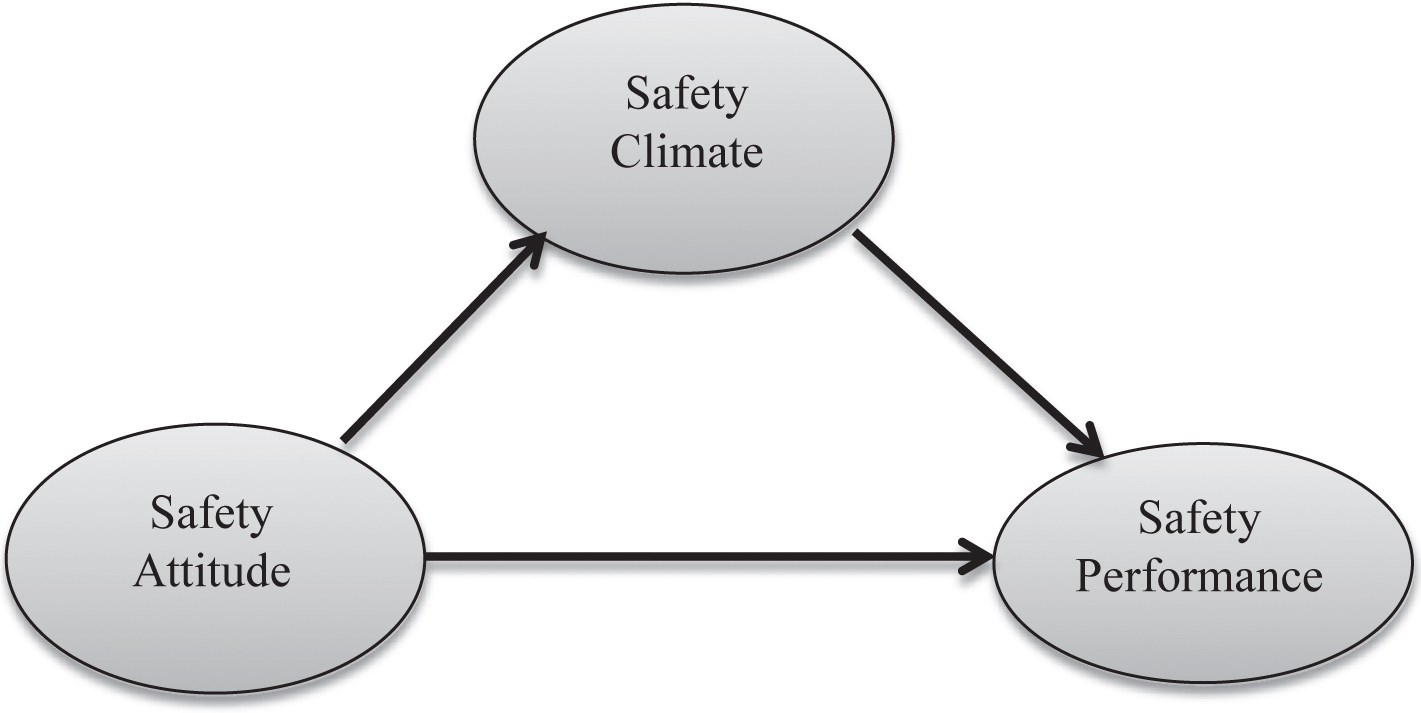
Path analysis of the proposed model.
Hypothesis 1: Safety attitude positively affects safety climate in the mentioned industry.
Hypothesis 2: Safety attitude is positively related to safety performance in the mentioned industry.
Hypothesis 3: Safety attitude partially impacts safety performance through the mediating role of safety climate.
The present study is a cross-sectional study that was conducted between February and August 2009 and aimed to investigate the relationship between safety attitude and safety performance with the mediating role of safety climate among employees with at least three years of work experience in one of the petrochemical complexes in Iran. The statistical population of this study consisted of a total number of 1700 employees of a petrochemical plant, out of whom 313 ones were randomly selected as the participants of this study. A total of 400 questionnaires were distributed among the staff through systematic random sampling, but the number of 320 valid questionnaires was returned. Thus, the response rate of the participants equaled 80%. It is noteworthy that all the respondents were male and their education level ranged from high school diploma to university degrees. The employees of the company were involved in various professions and sectors, such as welding, cutting, painting and insulating, telecommunication, scaffolding, mechanics, maintenance and repair, lining, electricity, administration, planning, and storage.
Measuring instruments
Data collection was fulfilled through three questionnaires pertaining to safety attitude, safety per-formance, and safety climate that had been designed by an export panel of ten experienced supervisors. The idea of questionnaire items were derived from prior studies [7, 34]. The safety attitude questionnaire included 21 items that examine one’s overall attitude toward safety, safety priority in doing tasks, safety communications, etc. For example, one item reads: “When working safety is the most important issue in my mind, or I’m eager to report my unsafe work conditions”. Each item was rated on a five-point Likert scale (from completely agree to completely disagree). The safety performance questionnaire incl-uded 7 items in two sections, namely safety compliance and safety participation. One item, for instance, reads “I promote safety plans in the organization or I help colleagues reduce the risks when they are working in hazardous situations”. The safety climate questionnaire included 22 items. Examples of safety climate issues read “The management insists on safety and health of the work environment; There is free communication on safety issues at the workplace; The proper tools and equipment for every occupation are easily available; and The employees are usually involved in improving the safety practices policy”. No reverse-question or negative score was used in the instruments.
In this study, three types of validity (i.e., content, convergent and divergent) were used to evaluate the validity of the instrument. Content validity was evaluated to show how well the instrument measures the theoretical construct based on expert judgment. Convergent validity, on the other hand, was examined by Average Variance Extracted (AVE) to find out how well an item correlated with the other items that apparently measured the same concept. Finally, divergent validity was assessed to discover how one item was not related to another item by comparing the cor-relation coefficients of variables and the root of AVE.
The reliability of the instrument was assessed using Composite Reliability (CR) [13] and Cronbach’s alpha method. Of course, CR is more suitable for PLS, which prioritizes factors according to their individual reliability. Moreover, CR, unlike Cronbach’s alpha, does not assume that all factors are equally reliable, and the reliability of factors is calculated not in absolute terms, but in relationship or correlation with their constructs. Therefore, it can be considered more powerful and rational than Cronbach’s alpha [13].
Data analysis method
The hypotheses of this study were tested using SMART- PLS. In fact, PLS was chosen since it can evaluate all paths at the same time and does not need a large sample size. In the first step, path modeling was used to evaluate the significance of the paths associated with the variables. Also, loading factor was used to determine the correlation between items and variables via Bootstrapping technique. It approximates the estimator sampling distribution by resampling and replacing it with the original sample in order to obtain more consistent results [35]. According to Chin, if the path coefficient is larger than 0.6, the relationship between the two variables will be strong. However, if the path coefficient ranges from 0.3 to 0.6, there will be a moderate relationship, and values smaller than 0.3 indicate a weak relationship [36]. In this context, the effect of the variables on each other was determined by t-value coefficient. In this light, the values greater than 1.96 are representative of a positive effect, the t-values between –1.96 and +1.96 indicate that there is no significant effect, and t-value lower than – 1.96 indicate a negative effect.
In the second step, the total fitness of the model was also determined using Goodness of Fit (GOF) index. In PLS method, the fitness of model is determined by calculating GOF value, which is a global criterion. This index can be calculated by Eq. 1. Wetzels at el. determined three values of 0.01, 0.25, and 0.36 as weak, medium, and strong for GOF, respectively [37]. It may serve as a baseline value for validating the PLS model.
R2: average correlation square value. Here, R2 represents how much variance of the data is explained by the model.
Communality indicates the amount of variability explained by a latent variable.
In this line, Sobel test was used to determine the indirect effect of the mediating variable. This test is basically a specialized t-test (Z-value) that determines whether or not the reduction in the effect of the independent variable, after including the mediator in the model, is significant and, thus, it determines if the mediating effect is statistically significant. The Z-value can be calculated by Eq. 2.
a: path coefficient between the independent variable and the mediator
b: path coefficient between the mediator and dependent variable
c: path coefficient between the independent and dependent variables
Sa: standard error of a S b = standard error of b
To measure the indirect effect size of the mediating variable, a statistic called Variance Accounted For (VAF) is used. It takes a value between 0 and 1, and its proximity to one indicates the stronger effect of the mediating variable. In fact, this value measures the ratio of the indirect effect to the total effect. It can be calculated by Eq. 3.
The results of this study are presented in Table 2. According to this table, the mean score of all items of the questionnaires is larger than 4, which suggests that these variables have a desirable status for analysis. The results of Kolmogorov-Smirnov test (Table 3) also confirm this conclusion. Furthermore, considering the significance level of the variables in this research, which is lower than 0.05, it can be inferred that the data related to the variables of this study do not follow a normal distribution. Based on the results obtained from Table 3, the P-values of all variables are smaller than 0.05. Therefore, the variables in this study are not normally distributed and we are allowed to soundly test the model hypotheses using SMART-PLS. The steps of the present study are as follows:
Descriptive statistics of research variables
Descriptive statistics of research variables
Kolmogorov-Smirnov test for checking the assumption of the normality of the research variables
Step 1: Validity and reliability of the instrument
The validity of the instrument was evaluated in terms of content, convergent, and divergent validity measures. To determine the relevance of the items in the instrument, the validity of the items was evaluated by ten experts [38, 39]. Then, the convergent validity of the instrument was evaluated by AVE. According to Magner et al. [40], the proper value of AVE is≥0.4. Therefore, with regard to the values of AVE presented in Table 3, the convergent validity of the instrument is confirmed. The divergent validity of the instrument is also presented in Table 4. As shown in this table, the root AVE value of the variables is greater than the correlation between them in the lower and upper left-hand sides of the main diameter. Therefore, it can be stated that the relationship between measures from different constructs is very low in the present study. In other words, the divergent validity of the instrument is confirmed.
Loading factor, convergent validity and reliability of the instrument
The reliability of the instrument was evaluated by Cronbach’s alpha and CR. Moreover, loading factor measurements were also performed by calculating the correlation between the items and variables. The loading factors of 0.50 and above are considered good and very significant [41]. Therefore, items with loading factors smaller than 0.50 are not shown in Figs 2 and 3 and Table 4. However, only the loading factor values above 0.50 were presented in Table 4 and the correlation between these items and variables is statistically significant.

Structure of the model.

Results of t-value.
Step 2: Significance of the mediating role
As it was mentioned earlier, to evaluate the relationship between the variables and their effects on each other, the structure of the PLS model should be drawn at first. Figure 2 shows the model structure and Fig. 3 indicates the results of t-value in the PLS model.
With regard to the path coefficients obtained from Fig. 1, this study attempted to assess the mediating role of safety climate. For this purpose, Sobel test was used and its value was calculated as Eq. (1).
Since Z-value is greater than 1.96, it can be stated that the mediating role of safety climate between safety attitude and safety performance is significant (with the confidence interval of 95%). In this context, VAF was used to determine the indirect effect size of the mediating variable (safety climate). VAF was calculated using Eq. 3 and according to Fig.2.
This means that 39.6% of the total effect of safety attitude on safety performance is explained by the mediating role of safety climate. A number of studies have reported the effect of the safety climate on the safety performance [9, 43]. In the same way, it has been found that there is a strong relationship between safety attitude and safety performance [9, 22]. However, to the best of the authors’ knowledge, the mediating role of safety climate in the relationship between safety attitude and safety performance has not been studied so far despite the interactive relationship between safety attitude and safety climate. In this regard, various research findings have shown that individuals’ perception of safety policies, procedures, and practices can be affected by safety performance [7]. On the other hand, the mere positive attitudes towards safety do not suffice to improve safety performance, but the industry should establish a good safety climate in the workplace to enable workers to have a deeper understanding of safety and positive attitude towards productive safety training. Since safety climate and safety attitude are affected by each other, positive attitudes toward safety can lead to the dominance of a positive safety climate and such a climate can direct positive attitudes toward safe behaviors. In this vein, as employees’ attitudes affect or are affected by the prevailing climate in an industry, only some aspects of safety attitude and perception vary across people and organizations [24]. Therefore, little is known about the mechanisms by which safety climate affects individuals’ safety behaviors in the plant [4]. However, studying the mediating role of safety climate between the safety attitude and safety performance assumes great importance in order to identify the mentioned mechanisms.
Step 3: Total fitness of model
The results of inner and outer models are presented in Table 6. Based on these results, the total fitness of the model was determined using Goodness of Fit (GOF) index.
Correlation matrix and divergent validity of the instrument
Total fitness of model
The GOF value equals 0.368, which exceeds the cut-off value of 0.36 for the large effect sizes. Therefore, the model fitness is strong. It means that the empirical data fit the model satisfactorily and have substantial predictive power in comparison with baseline values. In the other words, the model sufficiently explains the empirical data in this study.
Step 4: Hypothesis testing
The results of hypothesis testing are presented in Table 7. As it can be observed in this table, the results confirm the hypothesized relationships in this study. The relationships are significant at the level of 0.01 in the model (Fig.1&2). The effects of safety attitude on safety climate and safety performance were 0.383 (t = 5.802, p < 0.01) and 0.291 (t = 4.291, p < 0.01), respectively, while the effect of safety attitude on safety performance through safety climate path was 0.396 (t = 4.162, p < 0.01). Therefore, it can be concluded that safety climate has a mediating role in the relationship between safety attitude and safety performance in such a way that 39.6% of the total effect of safety attitude on safety performance is explained by safety climate. Therefore, safety climate is termed as a predictor of safety performance [44]. On the other hand, the employees within a good safety climate are able to have a deeper understanding of safety and a positive attitude towards safety [9]. Accordingly, the mediating role of safety climate in addition to the numerical values provided by the Z-value and VAF may also be confirmed by a theatrical logic.
Results of hypothesis testing
The main purpose of this study was to assess the relationship between safety attitude and safety performance with the mediating role of safety climate in a petrochemical plant. Accordingly, three separate questionnaires pertaining to safety attitude, safety performance, and safety climate were used for data collection. The results indicated that safety attitude had a positive effect on safety climate and safety performance. Furthermore, safety climate had also a positive effect on safety performance. Furthermore, the average effect of safety climate and to some extent the strong effect of safety attitude on the intrinsic variable of safety performance were also revealed. It is evident that 39.6% of the total effect of safety attitude on safety performance is explained through the mediating role of safety climate variable. Of course, this study, like others, has some limitations that should be addressed. Since the current study was conducted as a cross-sectional analysis, the determination of the causes and effects was difficult. In the other words, it is not easy to establish the proper sequential relationships among the research variables. Hence, it is evident that conducting more studies for further cross-validation in the future is required.
Author contributions
Gh.A Shirali developed the study concept, framework, and methods. All authors contributed to the conduct of the trial, interpretation of results, and revision and correction of this paper, which was drafted by Gh.A Shirali. All authors read and approved the final version of this paper.
Conflict of interest
The authors declare no conflicts of interest.
Footnotes
Acknowledgment
The study was approved by the Ethics Commit-tees of the Ahvaz Jundishapur University of Med-ical Sciences under ethics number IR.AJUMS. REC.1398.484. The authors express their thankful regards to AJUMS. They would also like to thank the petrochemical industry for their help.