



Abstract
Background
The design of valves in continuous process industries, such as on Floating Production, Storage, and Offloading (FPSO) platforms, often shows a significant gap between regulatory standards and the practical needs of operators and maintainers. While integrating ergonomics in the early project stages can improve efficiency and safety, a disconnect persists between a design's formal compliance and its usability.
Objective
This study aims to analyze the ergonomic challenges and systemic barriers that limit the integration of operational knowledge in the valve design process on FPSO platforms.
Methods
A qualitative, descriptive case study was conducted on two FPSO platforms operating on the Brazilian coast between September 2022 and March 2024. Data were collected from multiple sources, including technical document analysis, interviews, participatory observation, and valve design review sessions. Activity ergonomics guided the research to integrate user knowledge into design specifications.
Results
The research identified that the rigid application of valve categorization criteria and a lack of adaptation to local anthropometric data lead to a design that does not fully meet user needs. Case studies show that compliance with standards fails to guarantee usability, resulting in design decisions that prioritize one component at the expense of another's accessibility.
Conclusion
The effective integration of ergonomics and operator knowledge in early stages is essential for safer and more efficient design, but participation alone is insufficient. This study concludes that project processes and tools must be enhanced to systematically transfer operational knowledge to engineering, aligning normative requirements with actual work demands.
Keywords
Introduction
The design of industrial systems in the oil and gas sector requires the integration of technical, organizational, and human factors throughout all project phases. 1 Ergonomics applied to project supports this integration by aligning engineering requirements with the conditions of real work.2,3 The Activity Ergonomics approach emphasizes that knowledge of actual work must be included from the early stages of project to prevent incompatibilities and guide design decisions.4,5 This perspective considers the operator's contribution as part of the project process and uses work variability as a basis for analysis and improvement. 6
Although advances have been made, integrating ergonomics and engineering remains a continuing challenge. Project processes in regulated industrial environments are often driven by standards and compliance requirements, which limit operational experience. 7 In offshore settings, spatial and organizational constraints further restrict how project solutions are adapted to real work conditions. 8 The limited feedback between operation and design affects knowledge transfer and the continuity of ergonomic improvements.9,10
It is a challenge to fully integrate operational needs into valve design, and the failure to do so can lead to direct and severe consequences that transcend mere technical adjustments. In the complex offshore environment, this discrepancy can directly compromise the operational safety, equipment reliability, and the health of workers. When projects rely strictly on standards without considering local anthropometric data or real maintenance demands, the result is a system where operators must adopt improvised solutions, increasing the risk of errors, accidents, and long-term health problems. Moreover, design choices that favor the accessibility of one component over another create a cycle of inefficiency, leading to costly rework and reduced system resilience. Given these challenges, it is necessary to analyze the valve design process in depth to fully comprehend the existing gaps and their implications.
Ergonomics underscores the importance of a dynamic approach that fosters harmony between technical requirements, design dynamics, and end-user needs. 11 The increasing emphasis on Human Factors in FPSO platform design is further underscored by the Brazilian National Agency for Petroleum, Natural Gas, and Biofuels (ANP), which has intensified its oversight and imposed stricter requirements. 12
Paradoxically, the absence of a comprehensive ergonomic strategy in engineering projects persists. Critical aspects such as safety, reliability, and occupational health are frequently subordinated to economic priorities, a contradiction that reveals the limits of relying solely on regulatory compliance, as the literature demonstrates that many projects overlook the impact of working conditions, resulting in negative consequences.1,13
The Activity Ergonomics approach, which considers work as the starting point for design, promotes more integrated and safer solutions. 6 While involving users in the design process enables early identification of problems and a deeper understanding of their needs,14,15 participation without effective integration is insufficient. One of the main challenges in offshore projects is the limited transfer of operational experience to the design process. This is because there is often little feedback from platforms already in use to inform engineering decisions. Furthermore, when an operational problem is identified on an active platform, the time required to implement a change in a new unit's design can be several years, hindering the quick application of learned lessons. 16 The lack of ergonomic integration from the initial phases of offshore platform design results in a significant disconnect between the design and the actual work of the maintenance team, leading to operational inefficiency, increased costs from rework, and the creation of unsafe and unhealthy working conditions. 17
Despite advancements in integrating ergonomics into offshore projects, issues persist, including a lack of clarity regarding the ergonomist's role and difficulties in interdisciplinary collaboration. 10 The often technocentric nature of these projects tends to emphasize technical aspects over the operational needs of the workforce. The complex and voluminous regulatory frameworks, while robust, are often difficult for operators to manage, creating a persistent gap between theoretical design and practical application. 18 In high-risk environments, this gap can have severe consequences for safety and efficiency, underscoring the need for design processes that more effectively incorporate operational experience.
International incidents, such as the P-36 and Deepwater Horizon disasters, illustrate how design decisions that neglect human-system integration compromise situational awareness and operator performance. In the P-36 case, explosions and the subsequent sinking of the platform, resulting in 11 fatalities, were linked to poorly implemented alarm systems, control-room interfaces that impaired operators’ situational awareness, and organizational shortcomings such as insufficient emergency training and a safety culture overshadowed by production imperatives. 19 Similarly, Deepwater Horizon—also with 11 fatalities—was not only the result of a failed cement barrier in the Macondo well but also of misinterpreted diagnostic tests, loss of situational awareness during abnormal conditions, and systemic weaknesses in communication, risk management, and cross-learning from prior incidents.19,20
The accidents’ review shows that Human Factors Engineering (HFE) programs, when applied systematically from the earliest stages, anticipate safety-critical tasks, improve decision-making, and minimize risks. 19
Several regulators—including the UK HSE, Norwegian PSA, and Brazil's ANP—now recommend structured HFE programs to ensure that operational needs, equipment accessibility, and user performance are considered during facility design. However, HFE application across projects remains inconsistent, often due to a lack of clear processes for translating ergonomic insights into design specifications. 20 This reinforces the need for project-specific tools and methodologies, such as intermediary objects, to bridge the gap between normative requirements and real work practices. Intermediary objects are tools created and shared to support communication, anticipate outcomes, and record decisions, making design discussions visible and concrete. They serve as a vital resource for transmitting knowledge and experience among the professionals involved. 21
Recent studies reinforce that integrating knowledge from real work situations into the early stages of design is essential to anticipate operational constraints and ensure effective, safe, and practical solutions.10,16,17 Moreover, ergonomics participation from the earliest design phases creates opportunities for incorporating operational feedback before architectural, mechanical, and piping constraints become irreversible.
Therefore, this study aims to evaluate the valve design process in FPSO (Floating Production, Storage and Offloading) platforms, investigating the ergonomic challenges and positive aspects that promote more effective integration of the various actors involved. The research seeks to contribute to the field by providing a critical analysis and practical solutions that reinforce the importance of operational experience in the design of offshore systems.
Method
This study forms part of a long-term research program launched in 2018 by Federal University of Rio de Janeiro (UFRJ) in partnership with a Brazilian oil and gas company, aimed at developing methodologies to embed ergonomics into the design of offshore production units. The program originated with the development of a basic reference project for FPSO platforms, which provided a framework for integrating ergonomic criteria into engineering practice and later informed the company's internal human-centered design procedures. Within this broader effort, ergonomics was established—for the first time in the company's history—as an independent discipline guiding design from the earliest concept phases. Previously, ergonomics operated mainly as architectural support, entering late in detailed design, when many decisions were already locked in. The evolution of this agenda is discussed in.9,10
The present research focuses on ergonomics activities conducted during the detailed design phase (September 2022 to May 2024), when principles defined in Basic Design were translated into concrete technical solutions. Because this was the first deployment of ergonomics as an autonomous discipline, the study closely monitored the effectiveness of the technical specifications and how they were being implemented. The strategic focus on valve systems reflects their role as a critical interface—whose salience became more evident as detailing progressed—where regulatory requirements, engineering spatial constraints, and real operational needs for accessibility, handling, and maintenance frequently converge and conflict. This scope offered a strong case for examining how ergonomic criteria are translated into design specifications.
In the initial stage of the broader program (2018–2021), multiple offshore visits were carried out to analyze work practices and define technical parameters for ergonomic specifications. However, due to regulatory and project constraints regarding valve systems, no field observations were dedicated exclusively to valves at that time. As projects advanced, the topic of valve design progressively surfaced in discussions and worker reports on accessibility, handling, and maintenance challenges observed in other platform activities, justifying its selection as the unit of intervention and analysis in this article.
Case setting
During the detailed design phase, the period of this study, the researchers systematically followed the detailing stages of two production units (P1 and P2). This process involved continuous participatory intervention and systematic data collection, interacting directly with designers and operational representatives.
Researchers participated in weekly alignment meetings dedicated to discussing ergonomic issues related to the valve categorization list. These meetings, held across different time zones, involved teams from the contractor and the client, covering both hull and topside areas. An FPSO platform project is typically divided into two main areas called Topside and Hull (Figure 1). The Topside area refers to the upper half of the structure, usually of modular design, above sea level, where the oil production plant is installed. The Hull, in turn, refers to the ship's structure, most of which is below sea level, but also includes the accommodation block.

Schematic representation of the two main areas of an FPSO platform: Topside (production plant above sea level) and Hull (vessel structure below sea level, including accommodation block).
Approximately 84 meetings for the P1 hull, 81 for the P1 topside, and 30 for P2 were documented during this period. Participation was also relevant during the formal Design Review (DR) sessions, which occurred at project milestones (e.g., 30%, 60%, 90% completion). Specific valve DRs were held for platforms P1 and P2, totaling five sessions dedicated to resolving critical and non-compliant issues.
Participant observation was central, allowed the researchers to actively engage in activities, acting as active members of the ergonomics team, engaging in weekly alignment meetings and participating in formal DR sessions for platforms P1 and P2. This immersive role allowed for direct contribution to decision-making and a deeper understanding of the process from within. 23
Due to restrictions on project access and offshore travel, only one on-site visit was conducted to a reference FPSO platform. This two days field trip provided the opportunity to observe the use and maintenance of valve systems under real conditions and to validate assumptions made during design reviews. The data from this visit were used to compare design assumptions with actual operational practices.
Activity ergonomics was employed to integrate user knowledge into work situations’ designs through constant dialogues with workers and the inclusion of users in design decisions. Specific guidelines were provided to improve working conditions and workers’ health without compromising the designers’ flexibility and production objectives.14,24
Analysis
Evidence was collected from various sources, as proposed by Yin, 22 to allow for data triangulation. The collection process included the analysis of technical documents (specifications, meeting minutes, and central valve lists), the conducting of workshops and interviews with engineers, operators, and maintenance teams, and direct observation during project meetings. The use of these varied sources was fundamental to gaining a comprehensive understanding of the investigated phenomenon, capturing both the formal perspective (documents) and the informal one (interactions and observations).The frequency and duration of these activities are consolidated in Table 1.
Summary of data collection.

Source: Authors.
In this study, the unit of analysis is defined as the process of valve categorization and positioning in FPSO projects and a their relation to work conditions. This choice reflects the central role of this process as a mediator between regulatory requirements, engineering practices, and operational knowledge. By focusing on this unit, it was possible to observe how ergonomic considerations were, or were not, translated into design specifications, and how decision-making unfolded in activities such as technical meetings, DR sessions, and the use of technical documents.
Data analysis was a critical and iterative process, guided by a qualitative approach aimed at revealing the gap between design practices and the actual work experience of the crew. The study concentrated on identifying recurring problems and evaluating the decision-making dynamics that emerged during DR sessions and project meetings. Specifically, the analysis was conducted through:
Discrepancy Analysis: Observations and meeting records were examined to identify and document instances where design standards and valve categories conflicted with operational needs. This included analyzing situations where ergonomic solutions were dismissed in favor of technical requirements, thereby demonstrating the project's hierarchy of priorities.
Content and Thematic Analysis: Data from interviews, workshops, and meeting minutes were analyzed to extract central themes reflecting workers’ perceptions of the design process. The analysis sought to understand their work logic, the difficulties they faced, and their suggestions for improvement that were not fully incorporated.
The following table consolidates the frequency and duration of data collection activities for this study, providing a detailed overview of the researchers’ engagement in the valve design project.
Results
This study delves into the valve design process in oil and gas extraction platforms such as FPSOs, which encompass activities ranging from exploration and production to refining, energy generation, and marketing. The focus is on the role of the ergonomics team involved in the design process.
It is worth noting that these are the first production units to have ergonomics as an independent discipline involved from the early stages of the, 10 leading to many discoveries and adjustments regarding the role of ergonomics as the process unfolds.
Categorization criteria
The company has implemented valve categorization to effectively manage and comply with platform regulations. This classification takes into account the criticality, function, and frequency of valve use, as outlined in the “Guidance Notes on the Application of Ergonomics to Marine Systems”. 25 Developed collaboratively, the categorization is divided into three main categories.
Category 1 encompasses valves critical for normal or emergency operations and frequently used in routine maintenance. Examples include block valves for PSVs (Pressure Safety Valves), essential for personnel and process safety, cargo protection, and environmental protection, where failure can cause severe damage.
Category 2 comprises valves that are not crucial for regular or emergency operations and are utilized during maintenance at intervals exceeding six months. This category includes manual valves for standard startup and shutdown, as well as pneumatic and hydraulic valves that require thorough maintenance due to mechanical stress in offshore environments.
Category 3 encompasses valves that are seldom used in specific situations, such as during commissioning. These valves only require occasional maintenance and are not essential for continuous operations.
To facilitate understanding, Table 2 summarizes the three valve categories, indicating their functional scope, operational relevance, and examples of application. This visual representation aims to clarify the formal structure of the classification implemented by the company.
Valve categorization criteria.
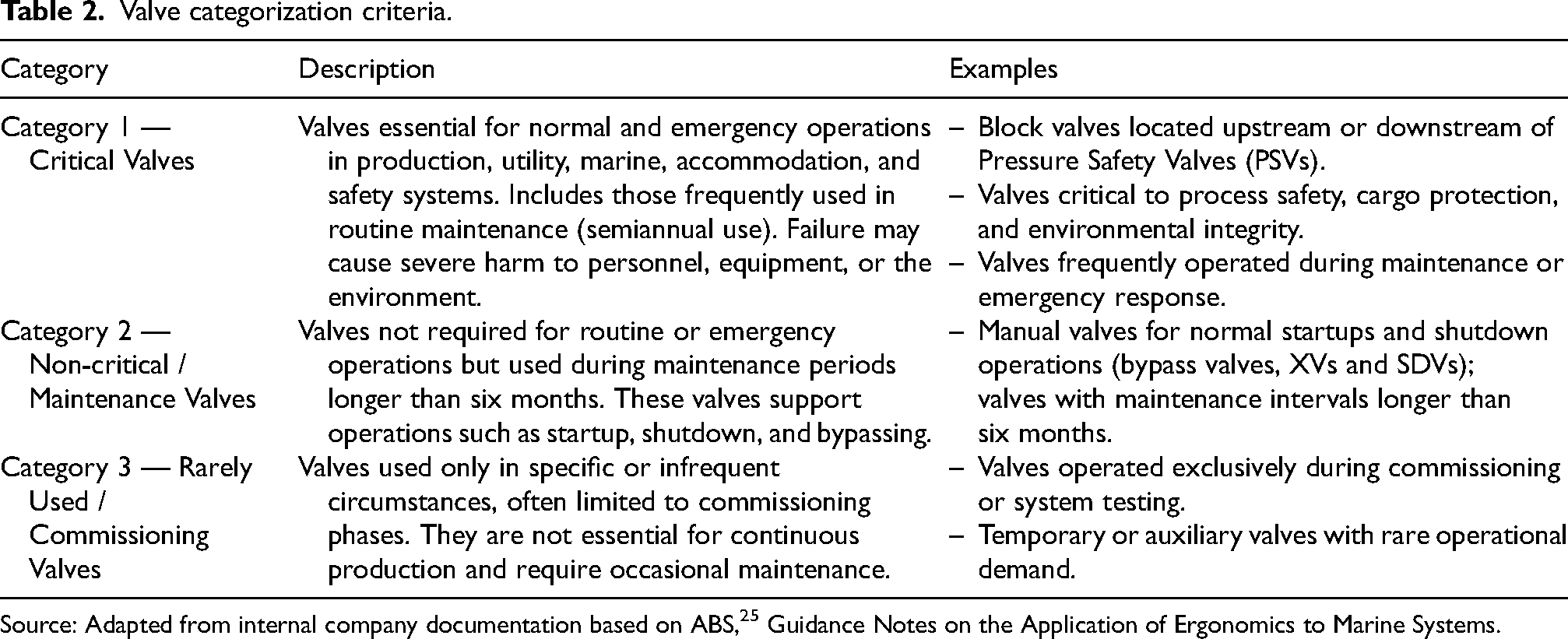
Source: Adapted from internal company documentation based on ABS, 25 Guidance Notes on the Application of Ergonomics to Marine Systems.
The categorization is outlined in the company's Technical Specifications (TS), which offer guidance to facilitate valve operation and maintenance, enhance safety, and prevent ergonomic issues. The TS is categorized into topside and hull, addressing ergonomic requirements for platform construction, valve location, accessibility, and safe operation parameters. In essence, the TS establishes clear guidelines for categorization, which are crucial for operational efficiency and regulatory compliance, ensuring that all ergonomic requirements are met. The following section will elaborate on how this categorization is put into practice.
Stages of categorization in the project process
The basic design of the units is internally developed by the company (contractor). At this stage, a preliminary list of unit valves with available information is issued. However, at this stage of the project, the operation and maintenance teams of the future unit are not yet defined, so the list is drawn up by the project team based on normative criteria and with the support of a professional designated to represent the operation. For the topside area, it is the process team, and for the hull, it is the naval projects team.
In the detailing phase, the design is carried out by contracted companies after a bidding process. At this stage, one of the activities of the contractor's ergonomics team is to monitor this design process. A central aspect of this analysis is the consideration of specific principles of valve location and access, as determined in international guidelines and by the documents prepared by the client.
During the detailing phase, the contracted company takes on the responsibility for the detailed elaboration of the valve list, including valves not initially foreseen. This list is then meticulously reviewed by the contracting ergonomics team and validated by the operations team. This process is particularly challenging due to the large number of manual and automatic valves on an FPSO platform, which can reach up to 20,000 valves, requiring a meticulous approach to ensure that each valve is categorized according to the established criteria and that operators can consider real working situations for efficient categorization.
Once the ergonomics team incorporated the obligation of positioning the valves according to the categories into the project's technical specifications, it had an impact on the project activity of the units themselves, as the project teams (especially piping) needed information and validations from the operations team to proceed with the project. This included the circulation of items such as valve lists (with detailed module, height, tag/identification, wheel position, etc.), 3D models, and emails between project teams and future users, mediated by ergonomics.
Throughout this process, cases were identified where the definition of the relationship between category and valve position was not easily resolved, and this was one of the reasons that led to the holding of specific ergonomics events to discuss the valve project, involving designers, operators, and ergonomists.
After adjustments, the contracted company prepares a final ergonomics report, which is required by Brazilian regulatory authorities for the platform's operation release, demonstrating the project's compliance with the established criteria.
Real-world cases from the valve categorization design process
To illustrate the limitations of the valve categorization process and the incomplete integration of operational experience, this section provides an analysis of cases. These specific examples demonstrate how rigidly applied design criteria can create a significant disconnect from the reality of work, ultimately impacting crew safety, efficiency, and working conditions.
Between presence and participation: operational challenges in design processes
During the valve categorization process, the participation of operations teams proved to be relevant, and representatives were indeed present throughout the development stages. However, this presence was marked by technical and organizational constraints that limited its effectiveness.
The 3D model, a detailed digital representation of the entire platform—usually divided into modules to facilitate visualization and information management—was extensively used during all stages of the process. This tool served as the basis for validating valve access and height data indicated in the categorization lists. When operators received these lists, they used the model to check whether the proposed access was adequate. However, its use was hindered by the large file size and the performance limitations of the available equipment.
During one valve categorization validation meeting, an operator from platform P1 stated: “I can only open the 3D model on my personal computer, because on the company's computer the program freezes.” This technical issue reduced operators’ autonomy during verification and slowed down the pace of design reviews, as not all participants could access the 3D model easily.
The Design Review (DR) sessions also presented significant participation challenges. These meetings, which bring together representatives from multiple disciplines (engineering, operations, maintenance, and ergonomics) are mainly coordinated by the contracted shipyards, located in different time zones. Sessions generally followed the schedules of Asian teams, with up to a 12-h time difference from Brazil, meaning that for Brazilian representatives, meetings often took place during the night.
In addition, English was the official working language, though it was not the native language of any participant. This made communication slower and required additional effort for translation and clarification. Another limiting factor was the large number of attendees, often ranging from 40 to 80 participants per session, which reduced speaking opportunities and hindered in-depth discussions on ergonomic and operational issues. Under these conditions, operator participation, although formally ensured, became less effective, with greater difficulty in raising issues or suggesting timely adjustments.
In another meeting regarding platform P2, during discussions between operators and company ergonomists, one participant mentioned a recently commissioned unit, operational since 2018, which had a temporarily coupled OMS platform—a module attached to the production unit to allow more personnel onboard for maintenance activities—specifically used for valve access maintenance. The operator noted: “Even though it's a recent platform, there are still issues with valve access; the access routes on that platform are very complicated, it's hard to move around.”
This account highlights the persistence of spatial constraints even in newer projects, reinforcing the need for field experience to be translated more systematically into design specifications. Another operator added: “The learning curve of FPSOs is very limited because when one project starts, the previous one is still running; it's not always possible to apply modifications in time.” The overlap between project schedules limits feedback between units and hinders the consolidation of lessons learned.
These observations compose the factual framework of the challenges faced by operations teams in the valve categorization and validation process, encompassing technological, organizational, and communicational aspects.
Limitation of categorization criteria: A conflict with operational reality
A primary challenge in valve design is the application of criteria that do not fully adapt to the actual function of the equipment. A notable example is the paradox of automated valves, such as SDVs (Shutdown Valves). According to technical specifications, these valves are classified as Category 1, which requires total accessibility. However, because they are operated remotely, the need for on-site manual access is significantly reduced. This disconnection leads to a disproportionate design effort to ensure access that will be rarely used, while the accessibility of Category 3 valves, which are used for infrequent maintenance, is often neglected.
In contrast, Category 3 valves are often installed in areas that are difficult to access, such as at elevated or confined locations, based on the assumption that their infrequent use minimizes operational risk. However, when maintenance or operation becomes necessary, the combination of restricted access and the considerable weight of these valves, some exceeding 6 tons, requires complex load-handling procedures and exposes workers to significant physical strain and potential accidents. This situation illustrates how the rigid application of categorization criteria, without contextual assessment of ergonomic and operational conditions, can compromise both safety and efficiency.
During a 60% Design Review session for platform P1, the production coordinator addressed the prioritization of PSV (Pressure Safety Valve) block valves. He highlighted the tension between accessibility criteria and maintenance requirements, stating: “Regarding the PSVs, it is preferable to ensure access to the PSV disassembly area rather than to the upstream and downstream valves (PSV block valves). The same criteria for emergency and frequency of operation were applied, and if we combine them, we end up with a problem.”
This statement reveals the dilemma faced during design reviews: although PSV block valves were also classified as Category 1, the prioritization of the PSVs themselves—automated valves located throughout the topside area—was justified by their recurrent maintenance demands. There are more than 300 PSVs across the platform, each requiring periodic removal for calibration and weighing up to five tons, which poses significant handling challenges. The coordinator's decision aimed to facilitate this recurring process, even if it placed manual block valves outside ergonomic accessibility standards.
The absence of a detailed handling plan for heavy components in the early design stages resulted in a compromise that favored maintenance over operational usability—an example of how rigid categorization can obscure the complexity of real work situations.
In a 90% Design Review session for the P2 hull, a new constraint emerged: structural weight control. The project had already exceeded the recommended weight limit for safe operation, reducing oil storage capacity and making weight reduction a strategic priority. In this context, each new access structure directly affected operational feasibility.
During the session, the team examined the 3D model of the area (Figure 2). The red markings represented an existing access platform designed to allow reach to the main valve lines. However, the operations team identified difficulties in reaching the last set of valves and proposed adding a new platform, shown in green, to access Category 1 valves located at higher elevations. The proposal led to a technical discussion about its necessity and impact.

3D model screenshot of the area examined during the 90% design review session. The red platform represents the existing access structure designed to reach the main valve lines. The green platform illustrates the proposed addition aimed at improving access to Category 1 pressure relief valves (PVs) positioned at higher elevations. Source: the authors.
The piping representatives questioned whether the modification was justified, considering the project's goal of weight reduction. The operations team argued that certain pressure relief valves (PVs) “frequently fail and lack a bypass, requiring the associated pump to be stopped for maintenance.” The operations coordinator emphasized that the PVs needed to remain accessible and classified as Category 1, highlighting the need for rapid intervention in case of failure.
After measuring the PV height (approximately 1.16 m), the team concluded that adequate access could be maintained without adding the new platform. The final decision kept the PVs (semi-internal pressure relief valves) as Category 1, while the block valves were reclassified as Category 2. The additional platform was removed from the design to meet weight-reduction requirements.
This episode illustrates how categorization criteria become subjects of ongoing negotiation, especially when structural and operational factors conflict. It also demonstrates the active role of different specialists — operations, piping, and ergonomics — in mediating between normative prescriptions and the real conditions of work.
Anthropometric limitations of normative standards and their impact on usability
Another issue observed in valve categorization is the application of anthropometric standards without proper adaptation to the local workforce. International regulations, such as those from the ABS, which guide platform design, base their measurements on population data from the United States, which may not be representative of the Brazilian population.
To complement the analysis, a two day embarkation was carried out on a reference offshore unit, primarily aimed at observing other design-related aspects of equipment use and maintenance. During this visit, the research team also took the opportunity to examine several valves in operation, comparing design assumptions with actual working conditions. Due to time constraints and restricted access to certain areas, it was not possible to document a larger number of cases. Nevertheless, the situations observed revealed similar patterns to those identified in project analyses, and one representative example was selected to illustrate this study.
This matter was clearly demonstrated during a visit to an operational platform. A valve with a horizontally positioned handwheel was within the acceptable height range according to the standard. Still, it required an excessive biomechanical effort for a female crew member to operate, as shown in Figure 3. According to ABS criteria, the maximum acceptable height for handling Category 1 valves is 1753 mm. The person in the photograph, with a height of 1650 mm, had to operate a valve whose axis was approximately 1750 mm from the deck.

Demonstration of access to a valve wheel on a platform.
The image illustrates that due to her stature, the operator had to work on the valve with her arms raised above her heart, a posture that leads to premature muscle fatigue. The design metric, limited to the valve's axis height, did not consider critical factors for operation, such as the handwheel's diameter and the force required to operate it.
Discussion
The projects currently under observation are the first within the company's divisions to be overseen by a dedicated ergonomics team, implementing a specific TS for valve design. Our results showed that the validation and DR stages were decisive moments for incorporating operational experience, since conflicts between categorization criteria and the reality of work emerged precisely in these sessions. Active participation by operators was fundamental and ensured that many of the proposed solutions were in fact viable, but the data also revealed important limits: time pressure and regulatory demands frequently impeded the full integration of workers’ contributions. This sugest that participation, when not accompanied by decision-making power and adequate organizational conditions, risks becoming limited rather than transformative.
In recent projects, the expansion of operational participation through hybrid meetings and digital platforms has improved the integration of user knowledge into design decisions. Tools such as 3D models have enabled operators to visualize access points and evaluate proposed solutions remotely, which is especially valuable for geographically distributed teams. However, this form of collaboration also revealed that technological resources alone do not guarantee meaningful participation. Effective knowledge exchange depends on adequate computing infrastructure, coordination across time zones, and linguistic and organizational support that transform remote presence into genuine collaboration. Within the broader context of collaborative design, these mediated interfaces between disciplines are critical spaces where operational knowledge is effectively translated into design decisions.
What we saw was that the categorization system itself restricted flexibility. The rigid classification of automated and manual valves generated compromises, such as the decision to prioritize the maintenance of PSVs over the accessibility of block valves. Despite being a rational choice from a maintenance perspective—as it facilitates the handling of heavy components—it confirms a systemic limitation: the categorization protocol does not anticipate the complex trade-offs that exist between different operational needs. Without a systematic process for mediating these conflicts, ergonomic and operational risks end up being managed informally, depending on on-the-spot negotiations rather than a structured evaluation.
Another point that drew attention in the results was the one concerning anthropometric standards. The case of the operator working raising their arms above heart level showed that compliance with international norms (ABS) does not, by itself, guarantee usability and safety. The design metric, which was limited to the valve's axis height, failed to account for critical factors such as the handwheel's diameter and the actual force required for operation. The use of anthropometric data, as per Iida, 26 reinforces the inadequacy of using universal standards. Iida 26 emphasizes the importance of developing anthropometric standards for the workforce of each specific situation. This limitation in adapting anthropometric parameters demonstrates a disconnect between the design and the physical reality of the workforce. Although based on a single documented case, similar accessibility issues were repeatedly reported during project meetings and operator interviews, suggesting that this limitation is not isolated but rather systemic across the observed platforms. The fact that this issue was not raised during project discussions, even with operators of both genders present, suggests a gap in the process for team engagement and critical reflection on design decisions.
The study reinforces the importance of the effective participation of operations and maintenance teams from the early stages of the project to ensure that their needs and challenges are considered, resulting in a more effective and efficient design. The opportunity for participation in the DR sessions, and the continuous involvement of operators in the process, giving opinions and participating in meetings and the construction of documentation, is an important step. Technical exchange is also essential, allowing the ergonomics team to technically understand the functions of the operation in the practice of the project. However, mere participation is not enough. It is fundamental that the project tools and processes are aligned to translate operational experience in a systematic and meaningful way into the project, ensuring a participation that is not just rhetorical but genuinely effective, where operators can influence decisions and reflect critically on them, rather than just accepting what is being proposed.
This discussion aligns with current perspectives in collaborative design, which emphasize that the success of design activities depends on how the interfaces between participants are organized and mediated. Boujut and Blanco 27 point out that these interfaces—where technical, organizational, and experiential knowledge intersect—are decisive for the co-construction of design decisions. In this sense, the quality of communication, the shared understanding of representations, and the use of intermediary artefacts become critical elements for ensuring that operational insights effectively inform engineering solutions. Similarly, researchs in distributed engineering projects 28 demonstrates that digital tools and shared artefacts can serve as negotiation zones that support collaboration across spatial and disciplinary boundaries. However, these instruments only fulfill their role when the conditions of use—time, infrastructure, and preparation—are properly managed.
Finally, the use of intermediary objects —tools and documents used to facilitate communication and integration between different project phases—needs a re-evaluation. The consequences observed are the use of these tools without their full potential being realized. Most of the project's stakeholders do not appropriate them as an opportunity to improve the project and the experience, and their use ends up being merely bureaucratic. As observed during alignment and design review meetings, these artefacts — such as valve lists, 3D models, and technical reports — were frequently used only to check compliance or record decisions, with limited space for collective interpretation or negotiation among participants. This also results in poor effective communication within the project. A more effective use of these objects can improve team coordination and ensure that all aspects of the project are considered in an integrated manner. This re-evaluation must focus on transforming these objects from simple information repositories into true mediators of dialogue, capable of giving visibility and weight to ergonomic considerations in the most critical design decisions.
This study presents some limitations. First, the analysis of only two FPSO platforms restricts the generalization of findings to other contexts. Second, the research focused on the design phases, without monitoring the commissioning or the long-term impacts. Another important limitation concerns the restricted opportunities for embarking on offshore units, which reduced the possibility of conducting additional anthropometric validation cases and direct field observations. Also, the analysis relied mainly on participatory observation in design meetings, capturing the discourse about work rather than direct observation of activity. This limitation was mitigated through data triangulation, including document analysis, design reviews, and a short field visit for on-site validation. The integration of ergonomics was also facilitated by a favorable organizational context, which may not be replicable elsewhere. Finally, part of the data relied on self-reports and participant observation, which are susceptible to biases. These limitations point to the need for future studies that extend to different contexts, project phases, and work situations.
Conclusions
This study demonstrates how ergonomics can be effectively embedded in the design of offshore platforms, particularly in the categorization and positioning of valves. Its main contribution lies in showing that the early inclusion of ergonomics establishes structured opportunities for dialogue between designers and operators, especially during Design Review sessions, where practical access solutions can be negotiated before engineering constraints become irreversible.
Building on these findings, future research should broaden the analysis to other ergonomic dimensions of offshore systems, accompany projects through commissioning and operation to assess long-term impacts on safety and health, and compare different organizational and regulatory contexts to understand how they shape the incorporation of ergonomics. The development of improved categorization frameworks and more interactive intermediary objects also represents a promising direction for strengthening the translation of operational knowledge into engineering practice.
Footnotes
Acknowledgements
The authors would like to acknowledge the support of the National Council for Scientific and Technological Development (CNPq, Brazil), which provided a Master's scholarship that enabled the development of this research.
Ethical approval (name of institute and number)
Not applicable.
Informed consent
Not applicable.
Funding
Not applicable.
Declaration of conflicting interests
The authors declared no potential conflicts of interest with respect to the research, authorship, and/or publication of this article.