



Abstract
Keywords
Introduction
Comfort in the use of hand tools is a key factor in ergonomic design, as it influences user perception, work efficiency, and the prevention of musculoskeletal disorders. Previous studies have addressed the relationship between ergonomics and comfort in various hand tools, but there is a gap in the specific understanding of the descriptors associated with comfort in hoe-type tools. Given that these tools continue to be widely used in agricultural sectors, it is essential to identify the factors that influence the perception of comfort to improve their design and optimize the user experience. In this context, the present research hypothesizes that there are specific ergonomic descriptors that can be directly linked to the perception of comfort in hoe-type tools. The objective of this study is to define and categorize these descriptors using a user perception-based approach, combining qualitative and quantitative methods to provide information applicable to the design and selection of ergonomic tools.
Agricultural sector and hand tools
Agriculture has played an essential role in the economic development of nations, both in advanced and emerging economies, serving as a growth engine that has aided other industries. 1 According to the World Bank, 2 agricultural growth is one of the most essential strategies for ending extreme poverty, increasing shared prosperity, and feeding a population that is predicted to reach 9.7 billion by 2050. It is so important for economic growth that it accounted for 4% of gross domestic product (GDP) in 2018 and can reach 25% in some developing countries. Furthermore, this growth is projected to be two to four times greater than in other sectors, which is significant given that a 2016 study found that agriculture employs 65% of low-income adults. 3
This is important especially for a country like Colombia, which has an abundance of agricultural resources that are underutilized. 4 Considering the global food demand growth projections for 2050, 5 agricultural products will become a critical component of exporting countries’ economic development. According to the Global Household Survey 2020, rural Colombia accounts for approximately 24% of the total population, with small producers facing significant challenges in terms of access to land, capital, technology, and product marketing. These conditions have an impact on the remuneration for their work, the accumulation of money, and their ability to achieve desirable levels of well-being. 4
Even though contemporary industry's efforts have been focused on automation, manual tools continue to be the primary articulation for the human-product relationship of workers inside the workplace. 6 As a result, manual-use technologies are the primary means of labor for farmers, allowing them to complete tasks with less effort and more efficiency, while also assisting in the transformation of the environment and advancement in life. 7 However, they continue to exist in the context of the traditional, such as hoe-type general-use tools. These are part of the culture of Colombia's small farmers, and their primary function is to prepare and maintain the land for cultivation.
Several authors have identified developments in technology as a source of agricultural productivity growth.8–11 Despite this, it is vital to note that acceptance and possible adoption of innovations in a well-defined environment necessitates understanding the needs and realities of the users, in this case, small farmers. As a result, before designing or selecting a manual tool, it is critical to understand what the final users are looking for in terms of comfort when using a specific manual tool, and how this can be addressed during the design process, to meet these needs and promote product acceptance and adoption. The development of products based on scientific findings may enable manufacturers to produce better tools than competitors, and designers to create products that are positively rated by most of their users. 12
Similar to other industries, industrial workers feel uneasy about harnesses like personal protective elements (PPE) and, in some cases, reject them because of their opinions about how the products are made and the possible consequences of using them, such as prolonged suspension from the harnesses that cause pain, discomfort, and anxiety. 13 It has been shown in multiple studies conducted in the same sector that incorporating user-centered design criteria leads to lower costs, less delays, higher output, and higher end-user satisfaction. 14
Comfort and discomfort
Even though different definitions of comfort exist in the literature,15,16 comfort can be defined as a subjective construct of human nature that is affected by different types of factors: physical, physiological, and psychological. 17 According to Peter Vink, 18 comfort is a personal experience of one's relationship with the environment; that is, a product is not comfortable in and of itself, but becomes comfortable through use; as a result, perception is influenced by acquired concepts that are congruent with the subject's aesthetic. At the same time, discomfort is viewed as an unpleasant state for the human body in response to its physical environment. 19 Therefore, designers and engineers, with the assistance of various experts such as physiatrists, psychiatrists, and ergonomists, among others, have attempted to incorporate comfort characteristics into design, treating it as a new requirement in the development of new products. 20
Taking this into consideration, many authors have created models to explain and express product comfort.12,15,19,21–23 Similarly, it is stated that the manufacturers of manual tools recognize the importance of the idea of comfort, which is becoming increasingly relevant when making purchasing decisions. Furthermore, it is associated with positive feelings such as reliability, security, ease, and satisfaction, whereas discomfort is associated with negative feelings such as pain, pressure, difficulty, and irritability. 18 Well-designed manual tools with ergonomic quality can reduce the risk of upper extremity occupational injuries. They can also provide a comfortable working environment for employees, which translates into higher job satisfaction and higher product quality for customers. 24
Ergonomic descriptors
Ergonomic principles enable the development of tools for improving and redistributing both old and new products. 23 Applying these appropriate characteristics (descriptors) can significantly alter the human-product interaction, since their attributes and characteristics influence operator perception during use.25,26 The literature presents studies that have established many ergonomic descriptors, with which one may conceptualize, choose, or evaluate manual tools in terms of comfort and discomfort.
The mentioned information is supported by several studies that have evaluated manual tools in terms of comfort and discomfort. The literature shows research on garden tools, 27 screwdrivers,28,29 pliers,30–32 sanders, 33 wire tie hooks, 34 knives, 35 carpentry tools 17 and hand saws, 36 among others. However, these studies show that the descriptors discovered only work for those tools, implying that more research for manual tools, such as hoe-type tools, is required.
Methods
The research is proposed as part of a mixed-methods study design that is sequential in two phases, relational, prospective, and cross-sectional, with the aim of defining the ergonomic descriptors related to the perception of comfort for azadón-style manual tools, keep in mind that, according to Veisi, 37 comfort/discomfort descriptions vary depending on the type of manual tool. The classification of the descriptors identified in factors of various nature is anticipated, with comfort being one element that is influenced by several factors and its interaction with the environment. 15
Participants in the research
It is defined as a purposeful sample of a non-probabilistic, unpaired type between the Pre-study and Study. As inclusion criteria were considered men and women over the age of 18 who did not have trunk-related diseases and who knew how to use manual hoe-style tools were given consideration. In this manner, the project coordination contacted the recipient farmers to conduct a survey of those who volunteered to participate in the study, who would then be contacted by the research team.
In the first phase of the pre-study, a semi-structured interview was conducted to determine the terms associated with comfort (Group A with N = 25) and discomfort (Group B with N = 25), for a total of 50 participants. In the second phase of the study, a semantic differential instrument was used to evaluate the perception of comfort, in which 64 people participated. It is worth noting that the sample was not paired between both phases. The population's weight ranged from 52 kg to 78 kg, and its height ranged from 1.48 m to 1.82 m. The average body mass index was 22.90 with a 1.94-point deviation.
The study's target population currently resides in four municipalities in the province of Velez in Santander, Colombia, but due to the conditions of the 2020 SARS-COV-2 health crisis, where the national government initially ordered the complete locked up of the population and later presented mobility restrictions to cross the territory, the project was adjusted to these restrictions.
Therefore, the pre-study activities were carried out via phone calls and video calls using the “Zoom” platform, and the study activities were carried out using “Google Forms”. In addition, the health crisis and limitations on using these channels made it necessary to expand the sample populations with participants beyond the scope of the project, as long as the predetermined criteria for inclusion and exclusion were followed.
Pre-estudy: definition of ergonomic descriptors related to the perception of comfort and discomfort in hoe-type hand tools
This process took place over two phases. Initially, the participants’ definitions of the ergonomic descriptors were recorded through a semi-structured interview with the prompt, “Describe how you feel in an experience of comfort (Group A) or discomfort (Group B) with a hoe-tool?” As is well known, if one wishes to measure the perception associated with this idea, one must do so by applying remote instruments. The reason of this is that literature demonstrates that the absence of one does not imply the presence of the other. 15
In a second stage, ergonomic descriptors were selected by a literature review in the Web of Science and Science Direct databases, using the iteration of 9 search equations using the keywords: manual tools, comfort, discomfort, ergonomic, usability, and user experience. Finally, the information gathered from interviews and written sources was compared. A preliminary list of ergonomic descriptors connected to the perception of comfort and discomfort in a hoe-tool was then obtained.
Study design: association between comfort-related descriptors
With the Pre-study results in hand, it was asked of the participants (N = 64) to establish their perceptions of each descriptor according to the pairs of bipolar adjectival terms, considering the degree of comfort that their experiences had brought about. The tool used was the semantic differential, where the classification “Strongly related” was at the extremes and was decreasing to the neutral value of “I dońt know” in the middle (see Figure 1). After gotten the results, a principal component analysis (PCA) was performed. The PCA was conducted using SPSS statistical software. After normalizing the data, the correlation matrix was calculated to derive the eigenvalues and eigenvectors, which reflect the variability recorded by each component. Eigenvalues greater than one were employed as a criterion to identify the most significant components. To facilitate comprehension, Varimax rotation was applied, and the data were subsequently projected into the newly reduced space.
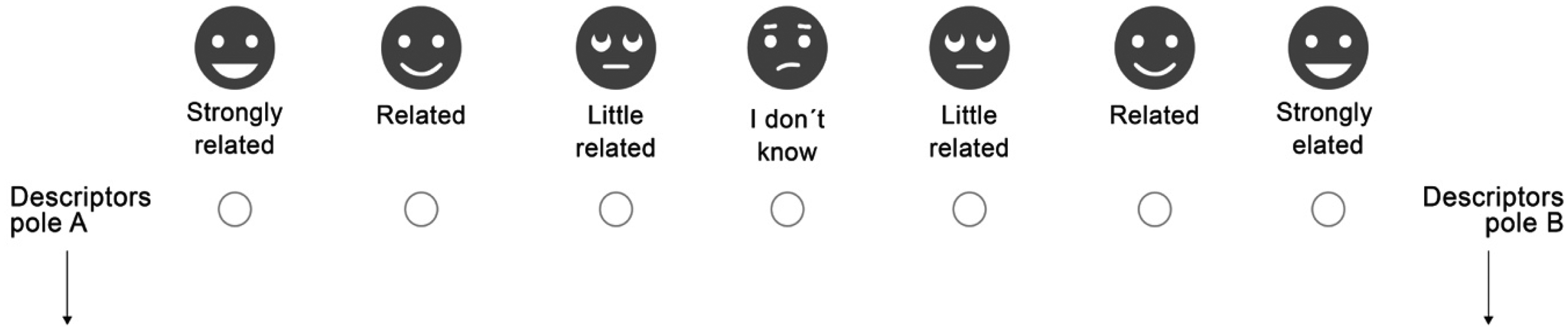
Measurement tool based on the Semántic Differencial (SD).
Semantic measurement tools
The semantic differential (SD), developed by Charles Osgood 38 was the measurement tool used to analyse descriptors and their relation to comfort perception. It allows for the connection between a word and the symbolized object it denotes. The opposed bipolar adjectives identified in the pre-study were used to conduct the evaluation; they were separated by a graduated categorical ordinal rule and supported by emoticons. This is because the population in the study is rural with low educational levels, making it difficult to translate an abstract idea into a rigorous evaluation like those provided by Karwowski & Marras. 39 The participant must mark the location of what they are thinking in relation to both poles.
For the study, it was preferable to use a subjective measure, keeping in mind that comfort is viewed as a human construct, which means that the individual's subjectiveness is influenced by user experience. 15 As a result, its perception, which refers to human feelings, information processing, and sensory entry grading are examined. 12 Finally, it was decided to use a continuous evaluation system (among the set of descriptors) to define the descriptors associated with comfort perception, because this type of system, according to Kong, 40 has a higher level of sensitivity.
Analysis of data
Initially, a qualitative analysis of the data gathered from the 50 participant interviews in the pre-study was performed using NVivo software. The responses were transcribed, and the information was coded for its analysis (description of fundamental conditions in a tool and emotional type characteristics) and a subsequent analysis of the relationships based on information similarity.
With the information gathered in the pre-study and the study, an exploratory and descriptive data analysis was performed to better understand their behaviour. In the study, the Cronbach's alpha coefficient was used in the first instance to determine the reliability of the measurement scale used with the SD. It was determined that values greater than 0.06 are sufficient to ensure that the results obtained from the project's instrument are reliable. In addition, to reduce the dimensionality of the obtained responses, a principal component analysis (PCA) with Varimax rotation was performed, allowing for the best representation of the data by arranging them according to the most important aspect that reflects the information gathered.
Results
Pre-study: identification and categorization of comfort descriptors
In the first instance, a preliminary screening of the responses obtained from the 50 semi structured interviews on participant perceptions of comfort and discomfort was carried out, considering the work of Kuijt-Evers et al. 41 Thus, meanings that were too general and/or that were a description of basic conditions in a tool (for example, have a handle, allows to plough, do not lose the handle), emotional characteristics (for example, motivation, optimism, uncertainty, and boredom), or comparable definitions (for example, to be light / to have little weight) were dropped, and a preliminary list of 27 descriptors identified based on the voice of the users was obtained.
In a second part, a volume of studies ranging from 1190 to 23,872 was obtained using 9 equations and established reference terms. It was determined that the equation that yielded items related to the study's goal and an appropriate volume of review in accordance with the duration of the investigation corresponded to (“hand tools” AND (comfort OR discomfort)) for a total of 371 items. There were two filters, the first of which involved reviewing the titles and summaries of each article, and the second of which involved reviewing the complete documents, reducing the number of articles from 371 to 87 (purge 1) and finally to 46 (purge 2). A screening process for duplicity and similarity in meaning was carried out, yielding a total of 55 descriptors identified in literature.
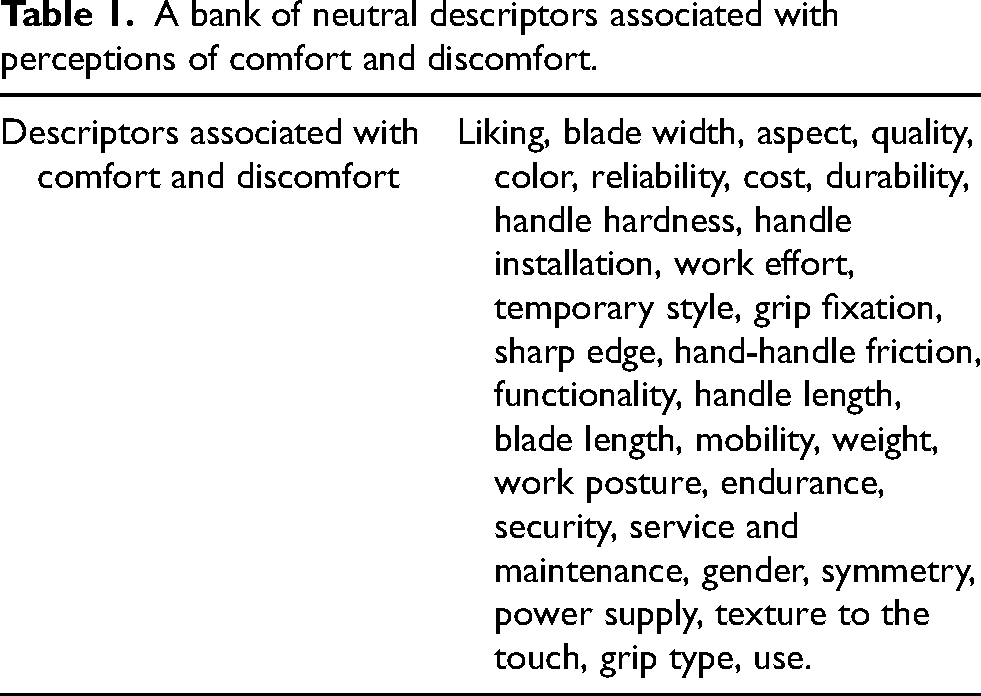
Finally, the information obtained from interviews and literature was compared, and those that were duplicated or had similar meanings were eliminated. Terms that were considered very technical and could cause little understanding to the study's target population were simplified, and they were grouped together to form a single conglomerate with a total of 30 neutral descriptors (see table 1).
A bank of neutral descriptors associated with perceptions of comfort and discomfort.
Study: relationship between comfort descriptors and user perception
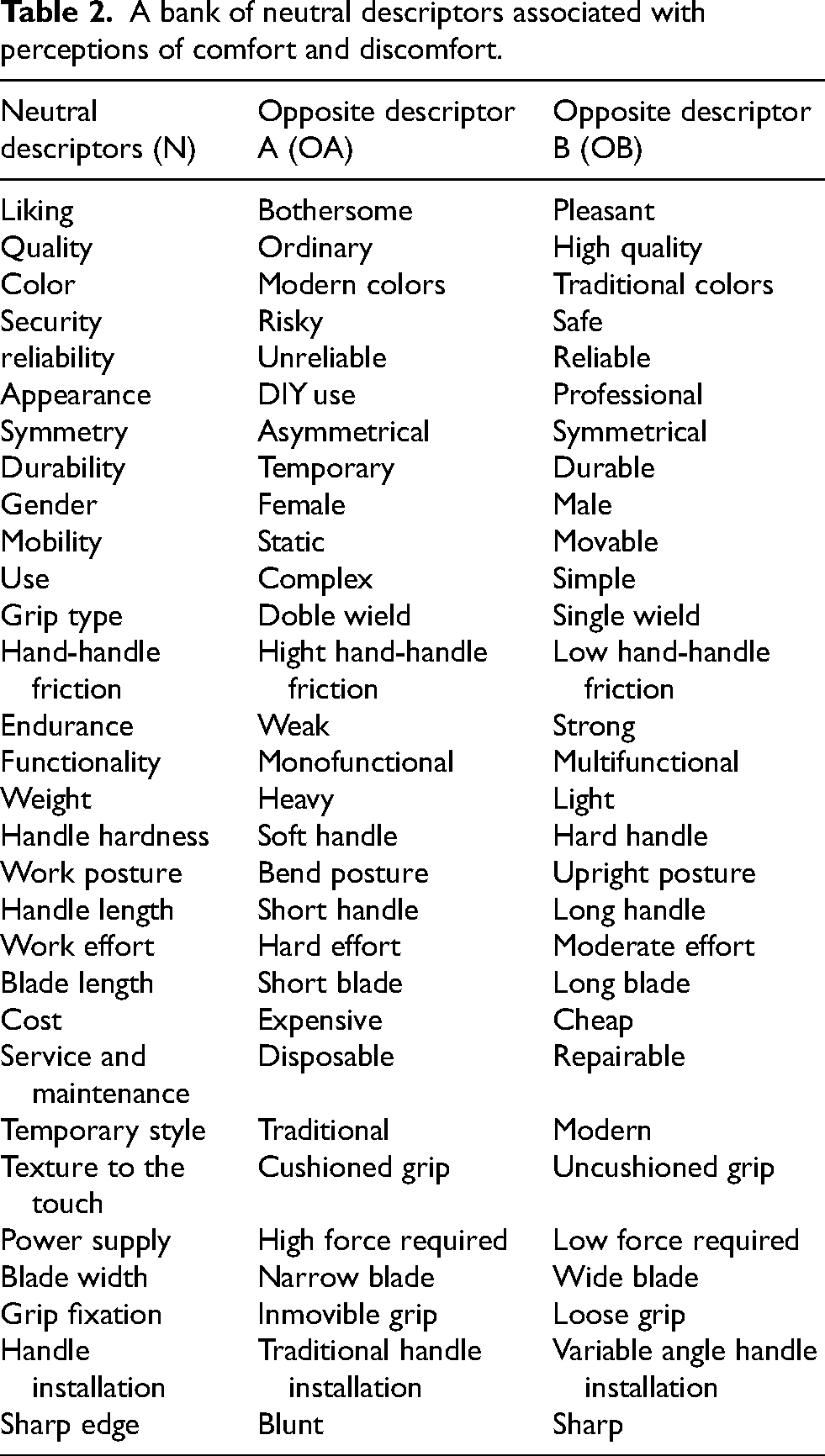
Following the SD guidelines (table 2), each of the 30 descriptors was assigned a pair of opposite character adjectives, avoiding the use of negative attributes or the use of the word “no” because it is necessary to avoid categorizing the identified attributes as positive or negative and then applying the semantic differential instrument, reducing participant confusion. Finally, the descriptors are organized around three key elements: options A (OA), options B (OB).
A bank of neutral descriptors associated with perceptions of comfort and discomfort.
The figure 2 is produced after using the SD test and the descriptions for neutral and bipolar opposites (Table 2). It depicts the adjectives’ behavior and how they relate to the idea of comfort. Most of the findings indicate that the adjectives in the OB column are preferred. Therefore, 27 of the 30 adjectives in this column have a frequency distribution that is larger than 70%; these adjectives are associated with comfort.

Distribution of responses in terms of the comfort descriptors connected to comfort perception (N = 64).
It is noteworthy that a strong correlation was found between the term “very comfortable” located in the bottom right corner of the figure with the: “Loose grip”; “Hard handle”; “Reliable”; “High quality”; “Cheap”; “Single wield”; “Strong”; “Wide blade”; “Long blade”; “Multifunctional”; “Safe”; “Simple”; “Symmetrical”; “Movable” (See figure 2).
Finally, in figure 2 was shown that the pair of adjectives “modern colors/traditional colors” did not exhibit a clear tendency regarding their relationship with comfort (OA = 1, N = 26, OB = 37); a majority association of “neutrality” with 41% and with “traditional colors” with 58%. Regarding the neutral adjectives “Appearance” and “Gender”, their respective distributions are OA = 10, N = 17, OB = 37 y AO = 8, N = 25, OB = 31, hence none of the two opposites were thought to be connected to comfort.
The outcome of the statistical test for Cronbach's alpha is 0.89, indicating that the measurement tool used to get the descriptors associated with the term “comfort” in hoe-type tools may be regarded as reliable.
Principal component analysis (PCA) and descriptors grouping
The study findings of PCA with varimax rotation indicated that the descriptors may be categorized into seven primary variables with eigenvalues exceeding 1, as seen in Table 3. The refined load matrix reveals the association between each variable and the main components; elevated loads indicate a strong association between a variable and a particular component. In this instance, they are organized into nine categories to describe the data in a reduced space.
Classification of descriptors associated with hoe-type manual tool comfort based on PCA with varimax rotation.
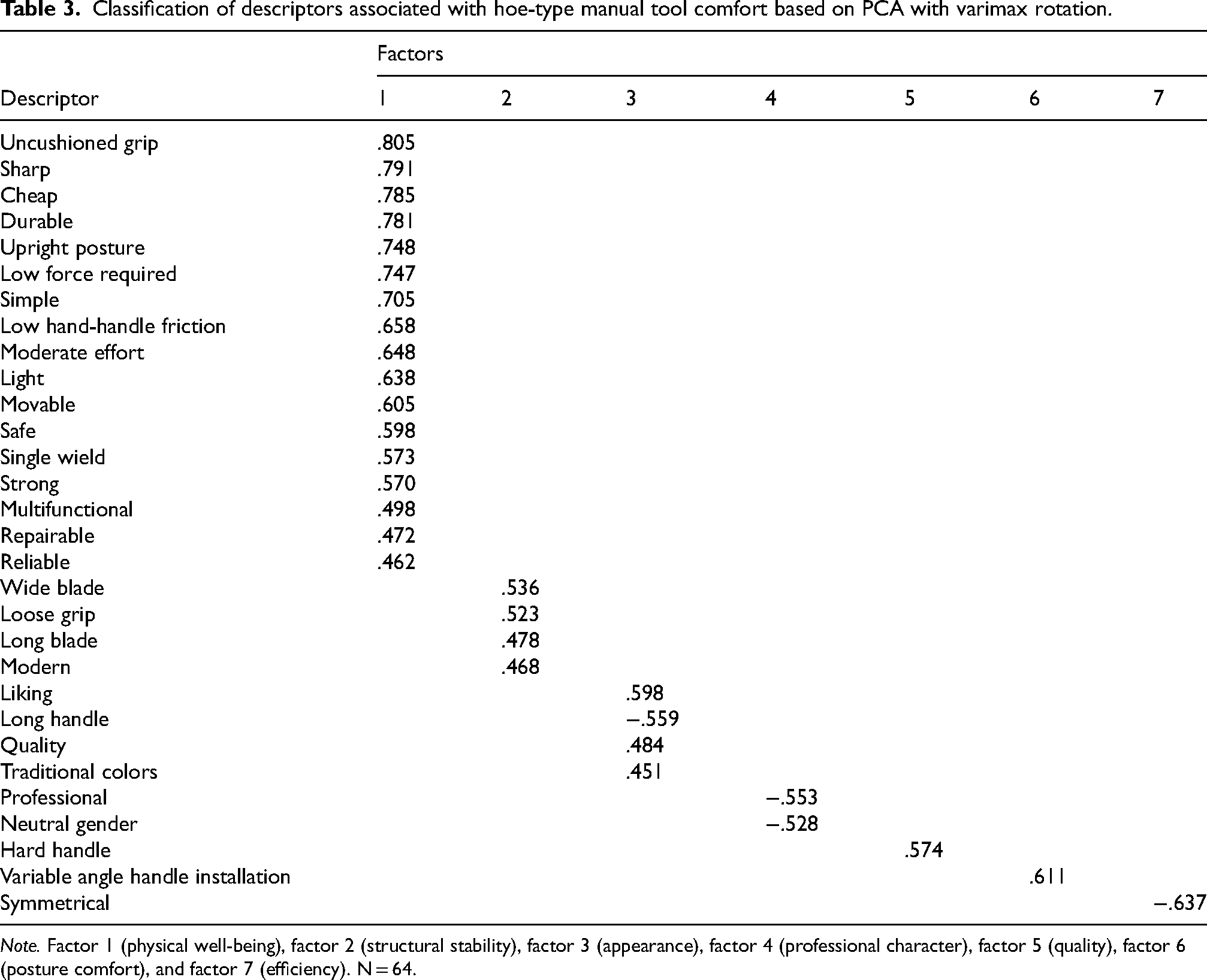
Note. Factor 1 (physical well-being), factor 2 (structural stability), factor 3 (appearance), factor 4 (professional character), factor 5 (quality), factor 6 (posture comfort), and factor 7 (efficiency). N = 64.
The distribution of the new categories shows that the descriptors related to the first factor explain 18.95% of its internal variance, the second factor 9.42%, the third factor 7.62%, the fourth factor 7.98%, the sixth factor 6.96%, and the seventh factor 6.27%, resulting in a cumulative variance of these seven factors of 63.99%.
Descriptors related to the first factor include Uncushioned grip, Sharp, Cheap, Durable, Upright posture, Low force required, Simple, Low Hand-Handle Friction, Moderate Effort, Light, Movable, Safe, Single Wield, Strong, Multifunctional, Repairable and Reliable. Therefore, it has been identified as a physical well-being factor. Perceptions of the other factors correspond with structural stability (factor 2), appearance (factor 3), professional character (factor 4), quality (factor 5), posture comfort (factor 6) and efficiency (factor 7).
In this sense, the most important cluster corresponds to factor 1, which brings together 17 of 30 descriptors related to comfort. In it, can be observed that the descriptors are related to the physical well-being characteristics that generate a hoe-type tool, in comparison to the other factors discovered.
Discussion
Despite the advances in the selection and evaluation of hand tools, existing systems still lack a comprehensive approach that combines all key aspects of the user experience. According to the review by Wang et al., 43 current systems often focus exclusively on the design of the tool (such as shape, weight, and materials) and on identifying the risks associated with its use (such as injuries or accidents). However, they do not adequately incorporate the user's perception of comfort and physical interaction with the tool. This gap presents an opportunity for research like ours, which identifies seven key components of comfort perception in hoe-type tools, based on users’ direct experience. These findings provide a solid foundation for transforming the design, considering factors such as physical well-being, postural comfort, and efficiency, thereby contributing to the prevention of musculoskeletal disorders and improving work performance.
Our daily lives are filled with both comfort and discomfort. A possible definition of comfort is “a general positive user interaction experience with a product”. 12 This element draws the interest of manufacturers since it is thought to play a significant role in purchasing decisions. If designers want to create manual tools that provide a high level of comfort, they should focus on improving functionality and physical interaction while using them. In this regard, aesthetics plays a crucial role since it is the first point of interaction between users and products, since it is impossible to generalize the predictors of a product's comfort.13,17
The perception of comfort is not universal; it is modulated by cultural and contextual factors. A transcultural study in nine countries revealed significant differences in preferences for beds, pillows, and seats, highlighting, for example, the preference for soft surfaces in North America compared to firmer options in China and Germany. 44 These findings underscore how habits, cultural norms, and familiarity with certain objects influence the subjective experience of comfort. Although the concept can be considered global, its meaning varies culturally, which poses a challenge for international design and manufacturing. Therefore, integrating psychological, ergonomic, design, and cultural sensitivity criteria is essential to develop solutions that align with diverse comfort expectations.
As a result, the goal of this study was to connect the idea of comfort with physical descriptors (formal-aesthetic) to establish a link between the configurable elements of a hoe-type tool and the users’ perception of comfort. When designing and selecting manual tools, comfort perception takes into account ergonomic, biomechanical, and psychological criteria. As a result, when designing or selecting a manual tool, it is critical to understand what the ultimate users value in terms of convenience and how this may be addressed in the design process. 17 A user-centered approach to designing hand tools, based on anthropometric criteria, user feedback, and an understanding of physical load, can significantly improve their comfort and functionality. Similarly, the design of vehicle interiors highlights the importance of physical attributes such as shoulder space, head space, and knee space, to improve occupant comfort. 45 This parallel suggests that, whether in hand tools or vehicle design, understanding the physical needs of users is crucial to optimizing comfort and preventing fatigue. In agricultural tasks such as weeding, the use of lightweight tools that reduce the workload is key to minimizing physical strain and improving efficiency. 46 Moreover, manual weeding operations can cause considerable physical and mental fatigue, affecting the health of the workers. 47 Additionally, manual weeding operations can generate considerable physical and mental fatigue, affecting the health of workers. 47
Likewise, various studies have shown that improving ergonomic conditions not only reduces discomfort but also increases operational performance. Kumar et al. 48 demonstrated that the redesign of workstations, through the adjustment of structural parameters, not only reduced the physical load on workers but also improved efficiency in the production process. These findings reinforce the importance of considering comfort as a key factor for the acceptance and productivity of hand tools.
Every year, more emphasis is placed on user ergonomic needs, such as how to work safely, efficiently, and comfortably.49,50 This is because they influence how users do their tasks.21,51 This growing tendency may be linked to the modernization of the agriculture industry, the spread of the idea of human-centered design, and increased knowledge of ergonomics. 52 However, in activities such as manual weeding, uncomfortable body postures sustained for long hours increase the workload and jeopardize the physiological well-being of the workers. 53 Moreover, weeding has been classified as a ‘very heavy’ task in terms of basal metabolic rate (BMR), which evidences its high physical. 54
Similar to the study by Bisht and Khan 55 which identify comfort in the context of manual tools as being most concerned with functionality, there are studies like Kuijt-Evers 22 which asserts that the two most crucial aspects of comfort are functionality and physical interaction. This research associated the term “comfort” with descriptors such “Fits the hand”, “it is functional”, “it is easy to use”, “it has a good force transmission”, “it has a nice-feeling handle”, “it offers a high task performance”, and “it has a good hand-handle friction”. In line with these prior findings, the current study indicates that the most significant factor is that related to physical well-being (factor 1), which is associated with the following descriptors: “Uncushioned grip”, “Sharp”, “Cheap”, “Durable”, “Upright posture”, “Low force required”, “Simple”, “Single wield”, “Strong”, “Multifunctional”, “Repairable”, and “Reliable”. While tools like the hand hoe have proven effective in weed control,56–58 prolonged use can cause fatigue and slow down work, affecting the user's efficiency. 59
It turned out that aesthetics has a smaller influence on comfort, as in the case of the present study. This may be because agricultural work with a hoe-type tools continues to be required to produce vegetables, legumes, and aromatic plants all over the world. 60 To put it another way, they are tools that, by design, include physical risk factors that contribute to the development of musculoskeletal disorders and injuries. 61
It was discovered that one of the comfort descriptors corresponds to a hoe-type tool with “Uncushioned grip” which goes in the opposite direction of other literary findings. According to a study conducted by Kuijt-Evers 41 when using hands to twist screws in wood, the existence of a protection prevents the hand from slipping forward on the screwdriver handle. According to Veisi, 37 stability is required when working with cylindrical handles since the grip force exerted must be reasonable to avoid hand sliding and handle axis rotation. According to the current study, the employment of this protection may result in a decreased grip force, which is an undesirable aspect in this kind of tools. This finding highlights the importance of ergonomic design in hand tools, as modifications in the grip can influence the effort required and the user's stability. 62
You 32 observed that a rubber grip and torsion spring in Cleco-type pliers exhibited less myoelectric activity than a normal metal handle. When compared to metal one, the use of rubber in the handle boosted participant satisfaction by 41%. In this sense, because there are a limited number of research involving hoe-type devices, data from studies involving other manual instruments are utilized as references. As a work hypothesis for a future investigation, a rough-textured handle could interfere with crop preparation and maintenance duties where the hand must glide smoothly over the handle. The implementation of ergonomic tools has proven to be an effective strategy for reducing muscle fatigue and improving efficiency in intensive manual tasks, suggesting that future studies should evaluate the impact of different textures on user performance and comfort. 62
According to the RAE, appearance (factor 3) corresponds to the visual appeal of people and objects at a distance, with colors being the most noticeable feature. In this regard, in relation to the neutral descriptor “color” the study discovered a minor association of “neutrality” 41% to traditional colors (58%). Color is a significant factor in the perception of comfort, providing identity to an object based on the context in which it is found, while keeping in mind that its meaning can vary among cultures, human groups, and even within the same social group. 63 Because of this, even if color is an excellent coding system, 64 the inability to have unique cultural meanings makes difficult its interpretation by analogy. This may explain why 37 of the 37 study participants associated traditional colors with comfort, whereas 26 of them associated traditional colors with neutrality and only one person with modern colors.
Visual appeal (factor 3) transcends chromatic perception, playing a key role in shaping comfort expectations. In product design, particularly in environments like automotive seating, certain visual attributes act as anticipatory signals that allow for the inference of ergonomic and emotional qualities before any physical interaction. Previous studies have shown that elements such as integrated headrests or angular shapes are associated with a sporty type of comfort, while rounded shapes or separate headrests evoke more traditional notions. 65 In line with these findings, the present study identifies specific visual attributes—liking, long handle, quality, and traditional colors—as key mediators in the subjective construction of comfort.
Regarding the term “Handle length”, Vanderwal 66 realized that using a long-handled hoe in a study comparing it to a short-handled one, reduced the amount of time needed to prepare a specific area of land by 35% without increasing the required effort (cardiac frequency), improving the worker’ s productivity. Additionally, it was shown that using a long-handled hoe significantly lowers the likelihood of experiencing pain in any region of the body as well as accidents-related injuries. Because of the pain and other health issues that are associated with their use, the state of California in the United States banned the use of short-handled hoe-type tools (less than 1.2 meters in length) in 2005. 67
It's believed that the appearance is viewed as having no effect on comfort while using manual tools because it is an aesthetic aspect of the product. However, Kuijt-Evers 42 discovered that the professional appearance does really have a significant role in the comfort at first glance. The above illustrates the significance of factor 4, “Professional character” as a characteristic to take into consideration while designing manual tools since it affects consumers’ purchasing decisions.
The findings of the neutral descriptor “gender” agree with those of Mondragón Donés 7 who showed a tendency toward either a masculine or feminine adjective. The author does not support the use of such descriptors since, in a study with hammers, he obtained correlations that were extremely low or practically zero, i.e., it is a variable with no significance to the other variables and is thus useless. It is difficult to assign a gender grade to hammers since they are typically viewed as consumer goods.
The quality perceived (factor 5) may be defined as “a positive user interaction with the product in all relevant usage scenarios”. 68 This means that, to provide a perception of a product's quality, the focus is on positive interactions with it, which in this case are accomplished through the human-product interface and the hand-handle relationship, which, according to the findings of the present study, correspond to a tool with durable characteristics. It is well known that factors including the operation mode, anthropometric population data, material, and form must be considered while designing a grip. 69 When it comes to the design and selection of manual tools, physical factors related to hand-to-handle interaction play a significant role in determining how comfortable or uncomfortable a user will feel when using a manual tool.
The current study defines postural comfort (factor 6) as having a “variable angle handle installation” that allows configuring the inclination between the hoe's handle and blade based on user characteristics and activity-specific demands to facilitate a suitable working posture and assist in reducing pronated columnar flexion. This is consistent with the findings of Fathallah, 60 who found that changing work posture had a major influence on the prevention of primary and particularly secondary back pain. Hence, reducing discomfort may assist to reduce the chance of acquiring musculoskeletal illnesses. 70 This principle of ergonomic adaptation has been supported by recent research such as that of Kumar et al., 48 who employed the Taguchi method to optimize workstation design by evaluating factors such as the height of the workbench, the horizontal distance of the object, and the tilt angle of the support. They demonstrated that small adjustments in these structural variables—particularly the height of the conveyor—can significantly reduce forces in the lumbar region and improve postural comfort in industrial contexts.
However, using a “variable angle handle installation” alone is insufficient to achieve an ergonomically correct posture; it also requires the use of a “long handle” which has a significant impact on posture when using a hoe tool because it allows for a more ergonomically correct posture. 66 Furthermore, research demonstrate that utilizing long handles in such instruments minimizes scapula discomfort and promotes an upright posture.69,71,72
The functional, ergonomic, and aesthetic features of a product are vital in establishing its utility, and they impact consumer acceptance or rejection since they are connected to the user's comfort while employing it. The degree of usability is determined by efficiency (factor 7), the efficacy and satisfaction that an object generates when used, 73 and acceptance of the level of performance obtained. The research indicates that a product's acceptability is connected to the amount of productivity that a person obtains while using it, which may be altered by a manual instrument with “symmetry” features. This is because an imbalance on the horizontal of the instrument may lead the user to lose control of his or her use, thereby impacting work performance. As a result, the perceived level of productivity falls, influencing user perception of comfort, because, in the case of manual tools, when a user achieves a high level of productivity, it translates into a good user experience of comfort, according to Kuijt-evers et al. 21
Conclusion
The current study allowed us to connect the idea of comfort to 30 configurable elements of a hoe-type tool. On the one hand, it was found that 17 of the 30 attributes are associated with physical well-being and are required to provide a comfortable work environment. On the other hand, there are six more factors that correspond to perceptions of structural stability, appearance, professional character, quality, posture comfort, and efficiency. It is concluded that, despite the existence of descriptors that contribute to convenience in many types of manual tools (for example, functionality, simplicity, quality, and durability), the associated descriptors cannot be generalized, as evidenced by other studies. The preceding is determined by the product's configurable characteristics and its relationship to the environment. It is hoped that the results obtained will support not only the design of such tools, but also their appropriate selection based on ergonomic quality criteria, which will ensure their acceptance and adoption by users.
The study represents a novel contribution to the field of ergonomic design by identifying and categorizing, for the first time, specific comfort descriptors in hoe-type tools. Unlike previous research that has addressed hand tools in industrial or domestic sectors, this work focuses on an agricultural context, providing empirical data on how the perception of comfort influences the user-tool interaction. The findings obtained allow for the establishment of a useful framework for the development of more ergonomic tools aligned with the needs of the end user.
The study had limitations, primarily because to the constraints imposed by the Covid-19-related health crisis, which required interviews to be done via telephone and video chats. Furthermore, additional study is required to evaluate the usage of ergonomic descriptors and their relevance to risk reduction when utilizing hoe-type tools.
Despite these limitations, the results provide a solid foundation for future research in ergonomics applied to agricultural tools. Subsequent studies could validate these descriptors through experimental tests under real-use conditions. Moreover, the methodology employed in this study can be replicated for the evaluation of comfort in other types of hand tools, thereby expanding its impact on the design of ergonomic products.
Footnotes
Acknowledgments
The authors want to thank the research group GEPS: Grupo de Ergonomia, Producto y Significado for the execution of the project “Development of the agro-industry of aromatic plants and their derivatives as an agent of economic and social technological progress in the Santander countryside. Science, Technology and Innovation”.

Ethical considerations
The research project was approved by the Universidad Industrial de Santander's Ethics Committee for Scientific Research. This research was deemed to be of low risk following the Helsinki Declaration, the Belmont Report on Human Treatment in Research Work, and Resolution Number 008430 (1993) of the Colombian National Ministry of Health.
Funding
The author's report that this project was funded by Fund for Science, Technology and Innovation - FCTeI of the General System of Royalties - SGR from Colombia [BPIN-2018000100044].
Declaration of conflicting interests
The authors declared no potential conflicts of interest with respect to the research, authorship, and/or publication of this article.