



Abstract
Background
Work Based Incentives Planning has shown itself to be beneficial.
Objective
This exploratory study tested a model where benefits planning services are provided, with an emphasis on state and local benefits,
Method
A total of 12,527 Colorado DVR records of persons who were active for DVR services and had reached eligibility between 7/1/2021 and 12/31/2023, were deemed eligible for the study and analyzed.
Results
We found that 80% of the Benefits Planning Group were in the Most Significant Disability DVR prioritization category vs 67% in the No Benefits Planning Group. While the Benefits Planning Group were significantly less likely to have a successful DVR closure (competitive integrated employment) than the No Benefits Planning Group, the Benefits Planning Group did have a significantly higher change in hourly wages and work hours from plan to close than the No Benefits Planning Group. Those in the Intensive Benefits Planning Group had a significantly higher rate of competitive integrated employment than those in the Not Intensive Benefits Planning Group.
Conclusion
The benefits planning approach tested is promising. The dose of benefits planning is also important.
Keywords
Introduction
While Vocational Rehabilitation (VR) offers many services to increase competitive integrative employment outcomes for people with disabilities, individuals may not take advantage of these employment activities if they fear losing their Social Security disability benefits or other entitlements if they are employed (Kaya et al., 2023). One way to reduce the fear of losing financial benefits is to provide education around work incentives offered through these benefit programs. Work incentives benefits counseling (WIBC) aims to do this. The Rehabilitation Services Administration (RSA) defines WIBC as support services for people with disabilities who do not understand how their disability benefits (e.g., Supplemental Security Income (SSI) and Social Security Disability Insurance (SSDI)) and entitlements are impacted by employment income if they decide they want to work. In some circumstances, individuals may not even consider employment as an option because they do not know how earned income affects their benefits. The goal of WIBC is to help people with disabilities make an informed choice around employment, earned income, disability benefits, and entitlements.
Background
Research has shown that WIBC can increase knowledge of work incentives – especially expedited reinstatement, freedom to work, and impairment related work expenses (Pettit, 2021). Not all groups, however, may equally benefit. Pettit (2021) reported that for participants in their study, benefits counseling around social security work rules was more successful for SSI recipients than SSDI recipients or dual beneficiaries.
Regardless, benefits counseling does show promise. WIBC has been found to be effective in increasing employment rates for persons with disabilities (Delin et al., 2012; Hartman et al., 2015; Kaya et al., 2023; Kregel, 2012; Leahy et al., 2014; Schlegelmilch et al., 2019; Tremblay et al., 2004, 2006) and increasing outcomes gained through employment (Delin et al., 2012). Kaya et al. (2023) reported that Vocational Rehabilitation clients who got WIBC and, as a result, learned about the impact of working on their social security disability benefits and ways to transition to work without instantly losing benefits, were more likely to find competitive, integrative employment. Kaya et al. (2023) also reported that recipients who received WIBC worked fewer hours than those who did not receive WIBC, suggesting that the benefits counseling helped people with disabilities to choose a path that best met their needs.
While much is known about the advantages of WIBC, there is still more to be learned. For example, does the benefits counseling model work for people with disabilities who are not yet on Social Security Disability benefits. Historically WIBC has been provided to individuals receiving federal disability benefits such as SSI/SSDI. This is because the original funding for benefits counseling was provided through Work Incentives Planning and Assistance sites (WIPAs) (https://www.ssa.gov/work/WIPA.html). Social Security Administration funded the original benefits planners who were called Community Work Incentive Coordinators (CWICs) (https://yourtickettowork.ssa.gov/about/history). Over time, these positions prioritized benefits counseling to individuals receiving SSI/SSDI and those who are working or holding a job offer. Past researchers have found that persons with disabilities who received both VR services
Colorado DVR Benefits Planning Services Model
In 2017, the Colorado Division of Vocational Rehabilitation (DVR) added benefits counseling to its fee schedule. The Colorado DVR benefits counseling (aka benefits planning) model is similar to other models in that the benefits planners need to be certified. Colorado DVR identifies certified benefits planners in their fee schedule as individuals that successfully completed the Cornell University WIP-C course and practicum or successfully completed the Virginia Commonwealth University CWIC or CPWIC certification. These courses are offered nationally and are the typical training certifications for benefits counseling. As part of these certification trainings, benefits counselors learn how to complete a benefit summary and analysis, a tool used to explain the interactions of earned income with confirmed federal disability programs as well as state and local benefits programs.
The Colorado DVR benefits planning model, however, is unique in terms of who can receive the DVR authorized service. Benefits planning services paid for by the Colorado are described as involving …”an analysis of an individual's current Social Security benefits (SSI and/or SSDI), as well as Medicare, Medicaid, housing assistance, food stamps, and other federal, state, and local benefits” (Colorado Department of Labor and Employment DVR Fee Schedule, 2023, p. 135), services offered by WIP-C or CPWIC certified benefits counselors/planners. Colorado DVR's model appears to be unique because DVR counselors are able to authorize benefits counseling, also referred to as benefits planning, at eligibility, before an individual has a job offer. This means the individuals can obtain accurate information about the impact of earned income on federal, state, and local benefits while planning for employment and identifying goals for wages and work hours. Furthermore, Colorado DVR can authorize clients to receive benefits counseling who do not receive SSI or SSDI and who only receive Medicaid, Temporary Assistance for Needy Families, Supplemental Nutrition Assistance Program, Cash Assistance, Utility assistance or Housing assistance (state and local Benefits). The authors were unable to find other programs using certified Benefits Planners who work with persons with disabilities who do
Goals of the Study
While looking at the outcomes of benefits planning is insightful, it would also be important to understand who receives benefits planning services. Previous research found that not all VR clients receive WIBC at the same rate (Kaya et al., 2023). Groups more likely to receive WIBC included individuals who were: (1) White, (2) had a high school degree or higher, (3) lived in a private residence, (4) had a physical disability. Understanding if these differences exist is important if competitive, integrative employment and earnings is the desired outcome because race and education level have been shown to be correlated to income (racial wealth gap (Aladangady & Forde, 2021; Avila-Acosta et al., 2025), college and income (Pew Research Center, 2014)) thereby biasing the sample. As a result, one goal of the analysis will be to understand if the group receiving benefits planning services significantly differs from the group who is not.
Finally, there is the question of the amount of benefits planning. While not much has been done on the dose of WIBC, Delin et al. (2012), using a volunteer sample, found that those who had some WIBC had better employment outcomes than those who had none. Perhaps more importantly, they did find a positive relationship between the amount of WIBC and employment outcomes, and income, when they controlled other factors such as previous employment outcomes, age, gender, educational attainment, and broadly defined disability categories. This shows the strength of WIBC. The biggest limitation of the amount of WIBC a person in their study received was how much the program was able to provide. Again, their participants were receiving SSI or SSDI and therefore could differ from those who are who are receiving VR services and only other public benefits. Influenced by the previous research on WIBC, the goal of this exploratory study was to understand:
if those who receive Colorado DVR benefits planning services differ from those who do not; if Colorado DVR benefits planning services lead to employment, higher wages, longer work hours; and the relationship between the amount of benefits planning and the outcomes.
Methods
Data Source
This exploratory study was a retrospective analysis using administrative data with no personally identifiable information (PII). Data was pulled by DVR staff from the April 2024 archive of Colorado DVR's production database and anonymized prior to being shared for analysis. The Colorado DVR Data Governance Committee determined there was no concern with how the data was used for this project.
Cases included in the analysis were those that were active between for services between 7/1/2021 and 12/31/2023 and reached eligibility as a minimum progression on the case because this is the first point a DVR counselor can authorize benefits planning services. This includes cases that may not have an Individual Plan for Employment (plan) yet. Moreover, an individual may be represented in the data more than once if they had multiple cases during this period that fit the inclusion criteria. The total records that fit our inclusion criteria were 12,527.
Most of the outcome analyses of interest–competitive integrated employment, increased hourly wages, employment benefits, and longer work hours– dictated that cases had to have an Individual Plan for Employment and reach closure status, for understanding the impact of benefits planning on achieving competitive integrated employment. For these analyses, a sub-group was used. The total number of records that meet inclusion for this subgroup is 4,706. It is noted in the results if the total group (N = 12,527) or subgroup (n = 4,706) was used.
Data Elements
Most data elements for the analysis were used exactly as they are entered into the DVR data system. A few were adjusted for the analysis. Colorado's state data subcommittee who assisted with Colorado's 2024 National Expansion of Employment Opportunities Network (NEON) efforts (Colorado's state data subcommittee) helped guide this effort and provided input on collapsing data categories to create larger data groups. It should be noted that this subcommittee included DVR staff, including those familiar with the data, WIP-C certified benefit planners, CPWICs, CWICs, family advocates, and state agency representatives. These data decisions are shared below.
Analysis Overview
To answer the research questions for our exploratory study, three analyses were conducted. There are some limitations to the analysis. First, the continuous outcomes were non-normal with unequal variance, so the decision was made to compare median values across groups for most analyses. The use of medians is helpful when there are data points that are much higher or lower than the rest, or outliers as they are often called. Also, because of the nature of the data and the exploratory nature of the project, the decision was made to conduct separate tests. A total of 18 separate statistical tests were conducted. This can introduce error but, again, given the exploratory nature of this project, using a multiple test correction meant we might err on the side of saying something is not significant that could have been if the groups were more equal.
Results
Comparing Those Who Get Benefits Planning Services to Those Who Do Not
The first research question asked if those who received benefits planning services differed significantly from those who did not. To answer this research question, all 12,527 cases who fit the inclusion criteria were included. T-tests on interval data, chi-squares on the categorical data and Wilcoxon two sample tests on the ordinal data were performed to determine if the groups were significantly different. While the groups do differ (Refer to Table 1) some of the characteristic differences are slight. For example, the median age of those in the Benefits Planning Group was three years older than those in the No Benefits Planning Group; and 5% of the Benefits Planning Group identified as having two or more races vs 3% in the No Benefits Planning Group.
Participant Characteristics by Benefits Planning Service Status.
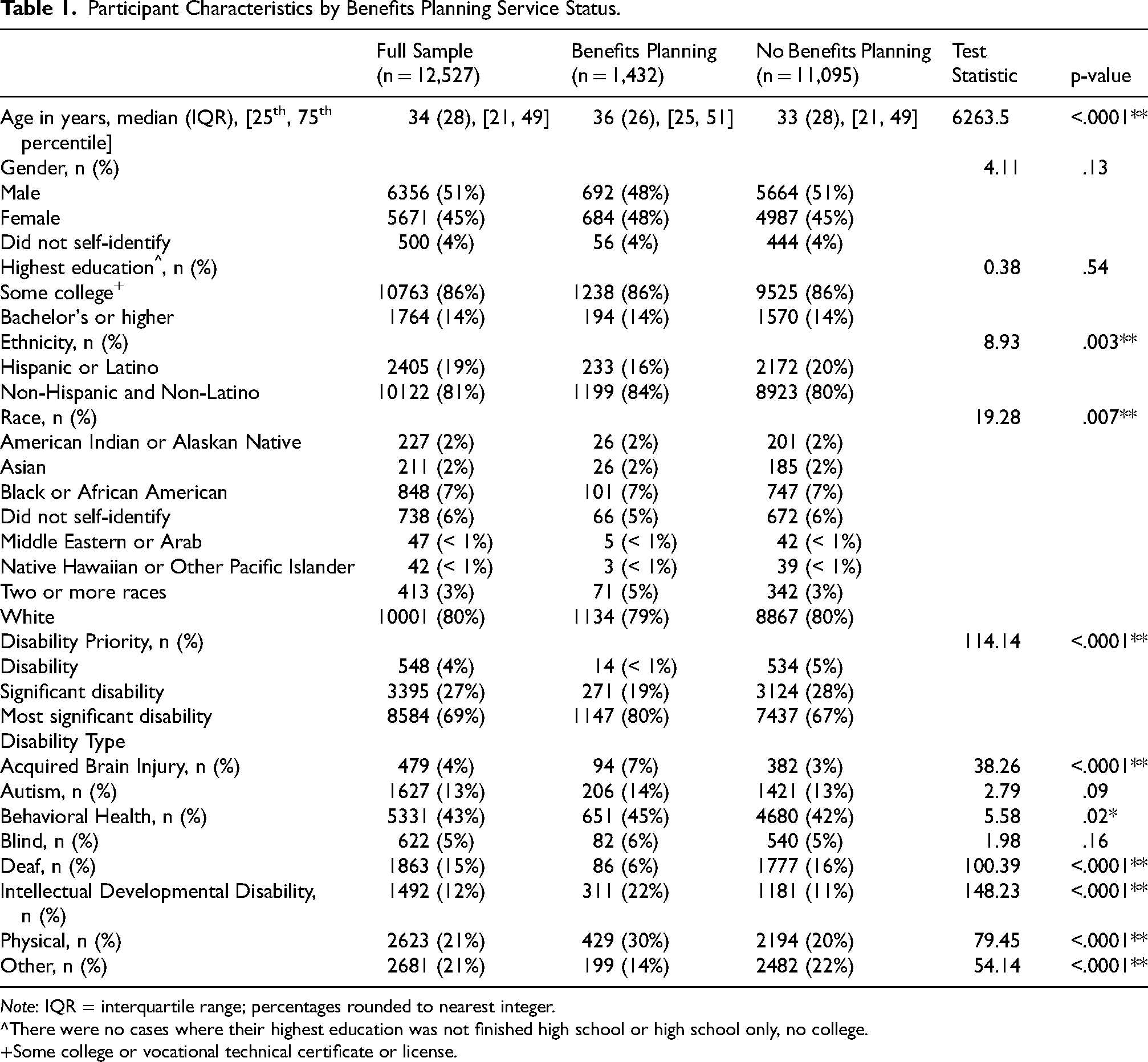
Note: IQR = interquartile range; percentages rounded to nearest integer.
There were no cases where their highest education was not finished high school or high school only, no college.
Some college or vocational technical certificate or license.
Other gaps were bigger. Specifically 84% of the Benefits Planning Group identified as non-Hispanic vs 80% of the No Benefits Planning Group. With regards to disability type, individuals with an acquired brain injury, intellectual or developmental disability, or physical disability were significantly more likely to be in the Benefit Planning Group while those who identified as Deaf or Other Disability were significantly more likely to be in the No Benefits Planning Group. The biggest gap, however, was in disability priority status. 80% of the Benefits Planning Group were in the Most Significant Disability DVR prioritization category vs 67% in the No Benefits Planning Group.
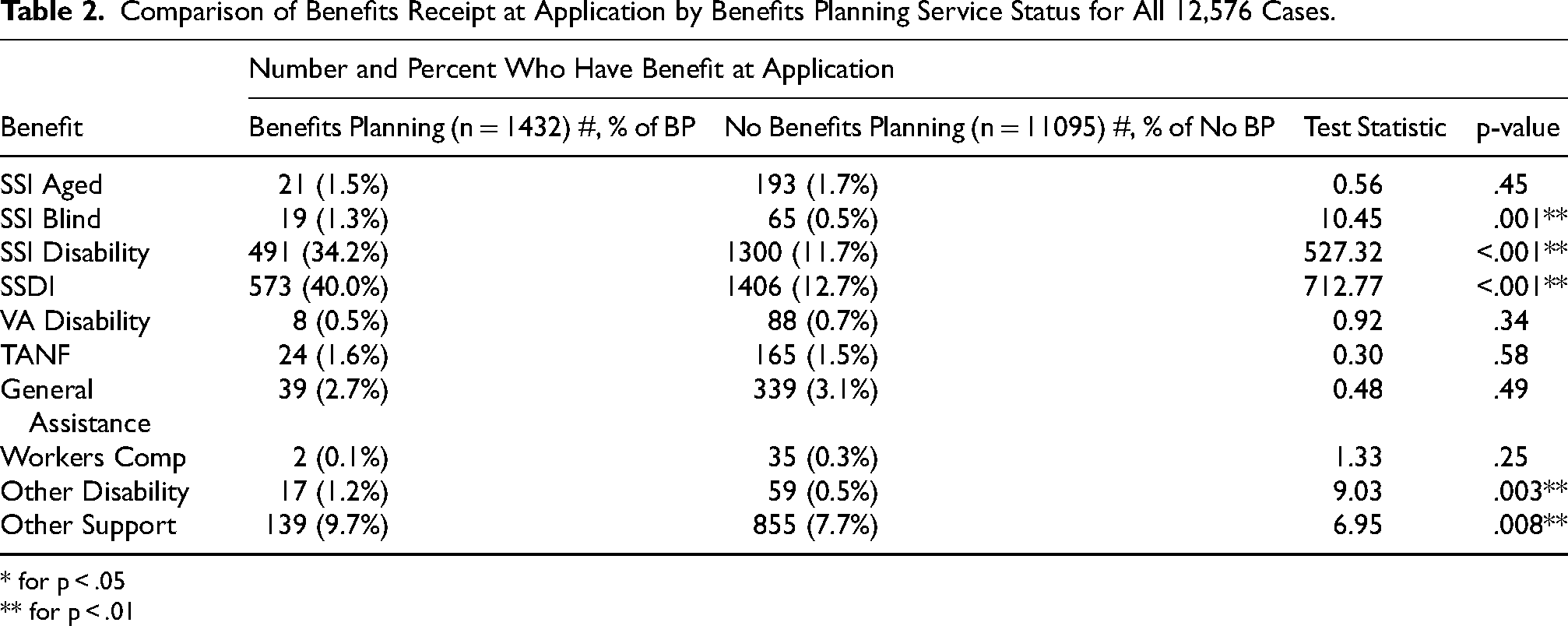
It was also possible that groups differed in which benefits they were receiving when they enrolled with Colorado DVR. As a result, we looked at benefits at intake. As described in Table 2, a chi-square revealed that the groups did significantly differ during the application period with more of the Benefits Planning Group having SSI Blind, SSI Disability, SSDI, Other Disability, and Other Support at application than the No Benefits Planning Group.
Comparison of Benefits Receipt at Application by Benefits Planning Service Status for All 12,576 Cases.
* for p < .05
** for p < .01
Exploring Benefit Planning Outcomes
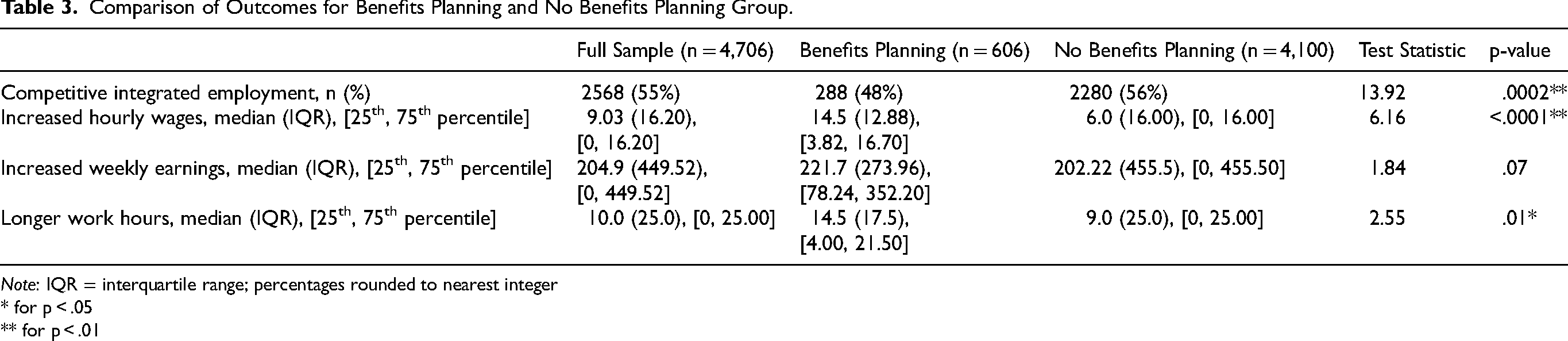
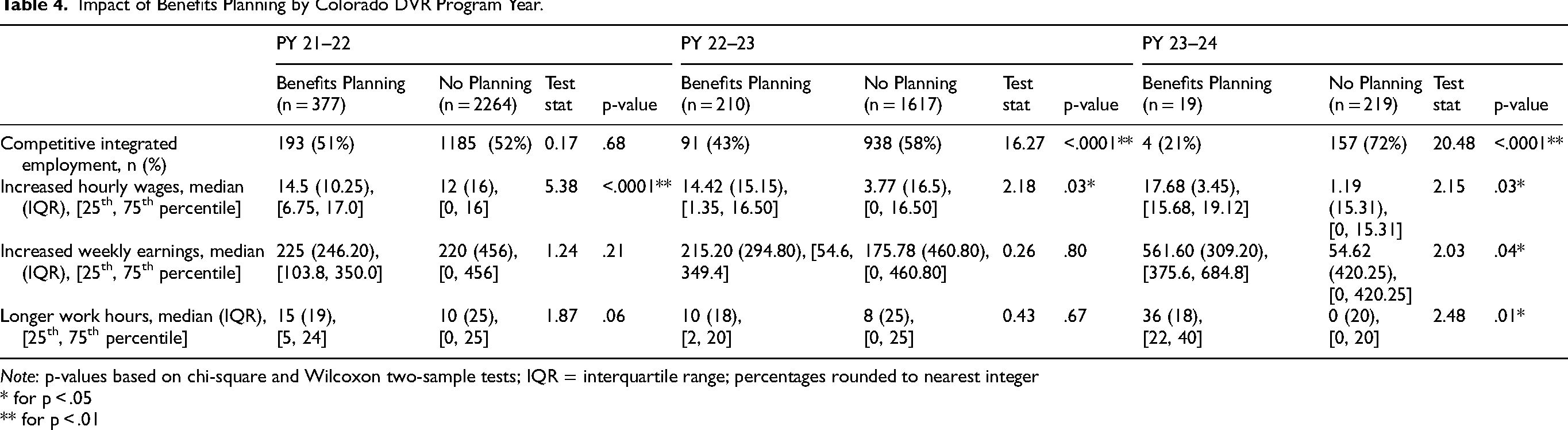
Our next set of research questions asked if benefits planning services, which could be delivered before an individual has a job offer and is not limited to individuals who receive SSI/SSDI, led to (1) competitive integrated employment, which we defined as a successful DVR closure, (2) increased hourly wages from plan to close, and (3) longer work hours from plan to close and if those changes differed by the DVR program year. Because these outcomes are tied to a closed status, only the 4,706 cases who met our criteria—had a plan and close status—were included. Of the 4,706 cases included in the analysis, 606 cases showed that at least $1 was spent on benefits planning services while 4,100 cases showed that no money had been spent on benefits planning services (Refer to Figure 1, the rectangles with rounded edges).
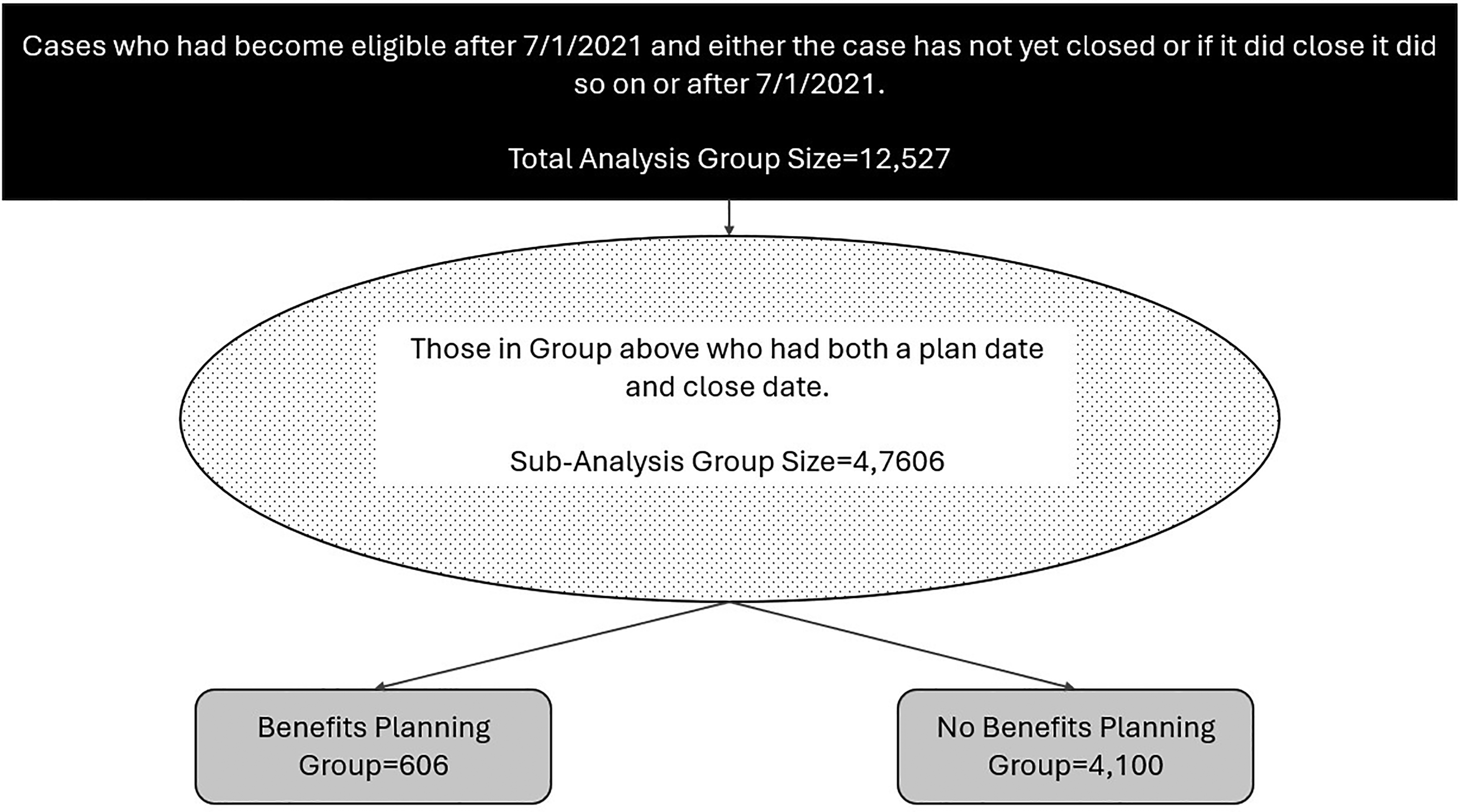
Analysis groups showing benefits planning status for those who had a plan and close date.
Comparison of Outcomes for Benefits Planning and No Benefits Planning Group.
Note: IQR = interquartile range; percentages rounded to nearest integer
* for p < .05
** for p < .01
Impact of Benefits Planning by Colorado DVR Program Year.
Note: p-values based on chi-square and Wilcoxon two-sample tests; IQR = interquartile range; percentages rounded to nearest integer
* for p < .05
** for p < .01
Amount of Benefits Planning
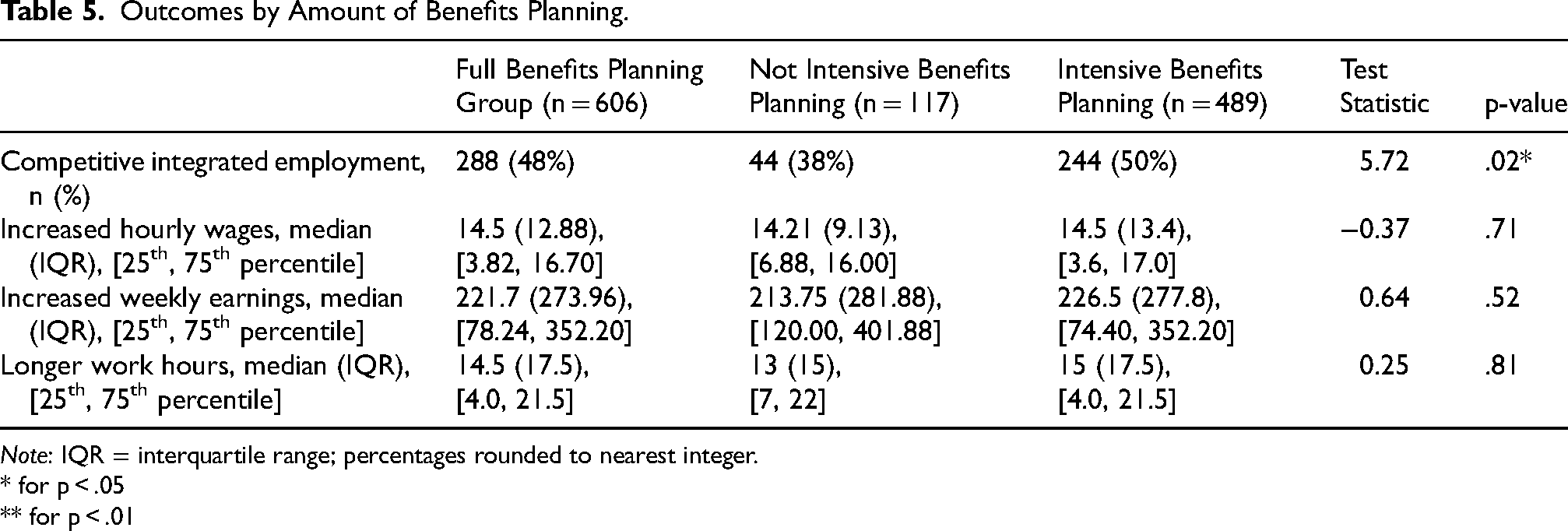
The last research question attempted to look at amount of benefits planning. The 606 cases in the Benefits Planning Group were placed in the Intensive (DVR paid for four or more hours of benefits planning services) or Not Intensive (DVR paid for less than four hours of benefits planning services) sub-groups. Of the 606 cases who received benefits planning services, 489 (80.7%) were placed in the Intensive Benefits Planning Group and 117 (19.3%) were placed in the Not Intensive Benefits Planning Group. As shown in Table 5, the Chi-square test showed those in the Intensive Benefits Planning Group had a significantly higher successful DVR closure (competitive integrated employment) than those in the Not Intensive Benefits Planning Group. Based on the Wilcoxon two-sample tests, there was not, however, a difference in the two groups with regard to change in hourly wages, weekly earnings, or work hours from plan to close.
Outcomes by Amount of Benefits Planning.
Note: IQR = interquartile range; percentages rounded to nearest integer.
* for p < .05
** for p < .01
Discussion
The goal of this exploratory study was to better understand the impact of benefits planning services with an emphasis on state and local benefits planning as well as the timing of when benefits planning is offered. In Colorado, benefits planning services is not just limited to those who already receive Social Security benefits (SSI and/or SSDI). At application, there were cases of both the Benefits Planning Group and No Benefits Planning Group that were receiving each type of benefit. The Benefits Planning Group, however, did differ in that they were significantly more likely to be receiving SSI Blind, SSI Disability, SSDI, Other Disability, and Other Support. The Benefits Planning Group also differed from the No Benefits Planning Group in other significant ways. Similar to Kaya et al. (2023), there was a difference in race/ethnicity. For our participants, a higher percentage of cases who received benefits planning were non-Hispanic/non-Latino. However, the biggest gap between the Benefits Planning and No Benefits Planning Groups was the DVR prioritization category. Eighty percent of the cases in the Benefits Planning Group met the Most Significant Disability DVR prioritization category vs 67% in the No Benefits Planning Group. It is possible that these characteristic differences may better explain the difference in successful closure than the receipt of benefits planning services.
In Colorado, benefit planning services are also provided to vocational rehabilitation clients before the individual has a job offer so that individual can build the life they want while keeping the federal, state, and local benefits they need. While not much has been done on the dose of work-incentives benefits planning (WIBC), the volunteers in Delin et al., 2012's study who had some WIBC had better employment outcomes than the volunteers who had none. Our findings build on this by not just comparing those who got benefits planning versus those who did not, but also looking at the amount of benefits planning received. For the cases we looked at, only those who received intensive benefits planning were more likely to have competitive, integrative employment than those who received less intensive benefits planning. As a result, we believe it is important that future research takes the amount of benefits planning services into account when looking at the outcomes. One potential future study is to understand if there is an ideal level of benefits planning services needed for the outcome of competitive, integrated employment by understanding that this outcome may be moderated by many variables such a person's disability, job history, etc.
Moreover, for the cases in our Benefits Planning Group who did get employed, there was a positive impact. Specifically those cases showed a higher median increase in hourly pay and a higher change in median hours worked per week. The increase in hourly pay and hours worked per week resulted in a higher increase in earnings for the Benefits Planning Group versus the No Benefits Planning Group in PY 23–24. While the differences between the two groups may be because the No Benefits Plan Group had less room for growth, it is important to note that those with Benefits Planning did in fact see a growth, especially those who received four or more hours, or what we deemed as intensive, benefits planning.
Limitations
As with any administrative data set there is a limitation to what data is available. While it is helpful to see that benefits planning services were paid for, it is difficult to tell the quality of that service. Colorado's state data subcommittee decided to focus on how many hours of benefits planning services were provided because it was available in the data we had access to. The committee noted it would have preferred to also look at a BSAs, see if a client received a BSA, etc. For a future project, it would be beneficial to look at the quantity (or dose) and quality of benefits planning services to better understand the impact on the desired outcome of competitive, integrated employment.
It is also possible that type of benefit received may impact the outcome of benefits planning services. In this study there were not many cases receiving only state and local benefits. Because not much is known about this area, a future study examining the group receiving SSA disability benefits to a group receiving only state and local benefits may be beneficial to understand the impact of benefits planning services.
Another limitation in our analysis was that because this was an exploratory study and, as a result, the analysis conducted were exploratory in nature, multiple test corrections were not imposed. Perhaps even more importantly, the study was conducted with data only from Colorado DVR. As a result, the benefits planning services analyzed are unique because Colorado DVR is pioneering a new benefits planning delivery that allows DVR counselors to authorize these services
Conclusion
Work Based Incentives Planning has been shown to be beneficial. Inspired by that success, Colorado DVR offers a slightly different model – benefits planning services to DVR consumers who are receiving federal, state, and/or local benefits at application
Our exploratory study, however, did find that Colorado's approach to offering benefits planning services, especially for those who received intensive benefits planning, to Colorado DVR clients was beneficial. The Benefits Planning Group showed important growth. Specifically, the Benefits Planning Group reported significantly higher increases in (1) hourly wages, (2) hours worked per week, and (3) weekly earnings from the time they had a plan with DVR until their case was closed versus the No Benefits Planning Group. The dose of benefits planning may also be important. DVR cases that received four or more hours of benefits planning (intensive benefits planning) had significantly higher successful DVR closure (competitive integrative employment) than DVR cases with less than four hours of benefits planning. We believe this model shows promise, but more research is needed.
Footnotes
Acknowledgements:
The authors would like to thank the following for their assistance with this project: Katie Taliercio, Disability Collaboration Manager with the Colorado Division of Vocational Rehabilitation; Colorado's state data subcommittee who assisted with Colorado's 2024 National Expansion of Employment Opportunities Network (NEON) efforts; Lee Sylvester from the Developmental Disability Resource Center; and Douglas Alves the Independent Living Program Coordinator at The Colorado Office of Independent Living Services.

Ethics Statement and Informed Consent
The data provided for analysis contained no personally identifiable information. The DVR Data Governance Committee determined there was no concern with how the data was used for this project and waived the requirement for approval.
Author Contributions
Conceptualization, YKG, PP, WP
Formal analysis, YKG, HS, WP
Funding acquisition, PP
Investigation, YKG, PP, WP
Methodology YKG, WP, HS
Project administration, PP
Writing—original draft, YKG, PP, WP, HS
Writing—review and editing, YKG, PP, WP, HS
All authors have read and agreed to the this version of the manuscript.
Funding
The authors received no financial support for the research, authorship, and/or publication of this article.
Declaration of Conflicting Interests
The authors declared no potential conflicts of interest with respect to the research, authorship, and/or publication of this article.
Data Availability
The Colorado Division of Vocational Rehabilitation provided de-identified individual case level administrative data to the authors for this study only. Cases included in the analysis were those that were active for Colorado DVR services between 7/1/2021 and 12/31/2023 and reached eligibility as a minimum progression on the case. The authors had access to this data because of their roles on the Colorado NEON project. This data is not publicly available, and those who contributed it do not have permission to share it publicly outside of its aggregate use in this article, which contains no PII.