



Abstract
The online delivery of higher education courses and programs continues to expand across academic disciplines at colleges and universities. This expansion of online education has been precipitated by, among other things, (a) the rise in personal computer ownership, (b) the ease of access to the Internet, (c) the availability and continuous improvement in technology for the delivery of online courses, and (d) the increase in demand for online courses by both traditional and nontraditional students. However, the proliferation of online education has not been enthusiastically supported by all constituents of higher education. Specifically, some faculty members remain resistant to the shift to online course delivery. This article applies the Transtheoretical Model of Change to the process of gaining faculty support for, and involvement in, online learning. After briefly reviewing current issues in online education and making a case for its adoption, we describe sources of faculty resistance and offer recommendations for interventions that may be applied to transforming faculty resistance to support and eventually to active participation.
Introduction
Technological advancements are among the most significant catalysts for organizational change and transformation (Lewin & Gold, 1999). However, despite the pervasive use of technology in the execution of daily activities (e.g., electronic communications, social networking, and accessing breaking news events), and the increasing demand from students for constantly available and flexible online learning options (Allen & Seaman, 2011), the use of online technology in the delivery of higher education has not been fully embraced. With regard to using advanced technology in the university classroom, change has been slow and often fraught with conflict and ambivalence.
Three important caveats should be mentioned. First, while fully online courses have been slow to develop, some new and creative applications of technology in higher education have been emerging over the last few decades. These include the use of wikis and blogs for group work, smartboards and iPads for in-class assignments and exercises, and Skype and Facebook chat for student-to-student or student-to-faculty interaction (Macduff, 2012), just to name a few. Second, proprietary (for-profit) institutions (e.g., University of Phoenix, Kaplan University, and Walden University) have dominated the online market for quite some time—attracting a niche of learners desiring convenience in the pursuit of higher learning. Third, there has been a recent increase in the number of online courses and programs referred to as MOOCs (Massive Open Online Courses). MOOCs are online classes hosted by some of the nation’s top institutions and offered to hundreds (sometimes thousands) of enrolled learners with minimal involvement by the instructor (Zhu, 2012). There is virtually no limit on the number of students that may be enrolled in such courses.
Traditional brick-and-mortar institutions, founded as on-ground learning facilities for higher education, have been very slow to adopt online education for their traditional degree-granting programs. In this article, we first make a case for the inclusion of online education as part of a basket of offerings at traditional on-ground institutions. We then discuss the uncertainty and resistance to change at these colleges and universities and identify faculty as an instrumental constituent whose advocacy is critical to the adoption of online education. Next, we identify several personal sources (adapted from Self & Schraeder, 2009) of faculty resistance with online education. Finally, we use the Transtheoretical Model of Change (TTM; Prochaska, Redding, & Evers, 2008) to propose ways of effectively facilitating faculty readiness or openness for the change, as well as faculty readiness to become involved in the change.
A Case for Online Education
In this section, we present three primary arguments for online learning: (a) technological advances strengthening a trend in online education, (b) pedagogical research citing the merits of online education, and (c) the benefits online education holds for students. Each is discussed in turn next.
Technological Advances
The most important argument for online education is the need to adapt to our current technologically advanced environment. Online education is part of a growing trend (Wang, 2006) due in large part to the advances in course delivery software and increasing Internet sophistication of students. According to a recent survey of online learning (Allen & Seaman, 2011), the number of students taking online classes has doubled since 2005; in addition, 75% of institutions reported an increase in demand for online courses (Allen & Seaman, 2010). While still not as pervasive as its traditional on-ground counterpart, online learning is showing impressive growth, something traditional colleges and universities should acknowledge and begin to leverage.
Moreover, technological innovation is a well-documented external force for change in the organizational development and change literature as technology creates one of the most imminent needs for change (Lewin & Gold, 1999). Indeed, those organizations that fail to effectively adapt when faced with rapidly advancing technology may become stagnant or decline in their organizational life cycle, which may ultimately lead to their failure (Lewin & Gold, 1999). One such example of a company that perished due to its inability or unwillingness to adapt to technological advances is America’s former top video-rental chain. Blockbuster was forced into bankruptcy and eventually closed all of its stores after being bested by Netflix, an innovative startup with a rent-by-mail business model. Blockbuster’s demise was attributed, in large part, to its complacency and outdated business model. It ignored digitization when it was first introduced and later unsuccessfully attempted to chase the trend Netflix had mastered years earlier (Baskin, 2013).
Blockbuster is just one example in a list of organizations (e.g., IBM, Eastman Kodak, Blackberry) that failed to move swiftly enough when technology demanded that they change their business model. Whereas organizations such as Netflix harnessed the technological evolution and were able to gain considerable market share in their respective industries, thus illustrating that to thrive in the increasingly competitive marketplace, organizations (including institutions of higher education) must align their strategic goals with their competencies, organizational assets, organizational structure (Fornaciari, Forte, & Mathews, 1999), and the demands of new technology.
One example of higher education institutions embracing technology and rapidly gaining market share is the online-learning initiative edX. The result of a collaboration in 2012 between Harvard University and the Massachusetts Institute of Technology (MIT), edX is an open-source (freely available) learning platform designed to offer high-quality online and on-campus education (edx.org). The process of credentialing students for knowledge acquisition and creating universally accepted metrics to assess the success of edX and other online programs of its kind are important challenges still being explored. Nevertheless, the significance of this new venture must be underscored given that two of America’s Ivy League institutions worked together to offer free online education worldwide. Signaling its impact on the online education arena, edX has rapidly expanded to include a consortium of global leaders in higher education and has been named by Forbes as the world’s largest not-for-profit MOOC (High, 2014). The example of the success of edX is not to suggest that all traditional institutions should pursue the development of MOOCs (which is only one aspect of edX’s role in online education). Rather, edX illustrates how centuries-old traditional institutions are capable of adapting to current technological innovation.
Pedagogical Research Support
Online courses can deliver innovative content in an efficient and rigorous manner (Abrami, Bernard, Bures, Borokhovski, & Tamim, 2011) to the extent that they are facilitated by motivated, well-trained faculty (Valentine, 2002; Yang & Cornelious, 2005). Additionally, because of an increase in research and pedagogical papers on the topic of online learning, instructors can access research-based recommendations for facilitating learning in an online classroom (e.g., Oliveira, Tinoca, & Pereira, 2011; Parlamis & Mitchell, 2014; Payne & Johnson, 2005). Instructors may also leverage published information about student motivation and multimedia learning strategies that have been systematically investigated in the last decade (Abrami et al., 2011).
Benefits for Students
Among the many benefits for constituents of higher education, online learning allows for greater flexibility and autonomy for students. A large proportion of current students belong to the millennial generation (born between 1980 and 2000). Millenials are technologically savvy multitaskers who regard the Internet as a primary source of information. These students desire classes that are accessible across great distances of space and time. Online education (a) removes geographic restrictions, (b) features round-the-clock accessibility, and (c) eliminates commuting costs of both time and money (Institute for Higher Education Policy, 2000). Students benefit in that their choices of school or program are expanded, they can better manage their personal lives, and they can therefore take a more self-directed approach to learning.
In summary, online learning is the beginning of a trend that is transforming higher education. However, despite the myriad benefits for organizations and students, and the support offered to faculty through research-based pedagogical articles and books, there is still a great deal of resistance to the online format by some faculty. We propose that for this technological transformation to take place in higher education, individual faculty members must be at the core of the change effort.
Faculty as Central to Planned Change in Higher Education
Faculty, who are both the recipients and agents of change, must be open to online education to increase the likelihood of its successful implementation. Faculty are initially the recipients of the change as the decision to adapt online education is often initiated by administrators in the institution. While change agents (e.g., deans, department chairs, or program directors) may initiate the shift to an online format, the faculty, both individually and as a collective entity, have the power to fight or embrace the change. A pattern of faculty resistance to change has been identified previously and particular cognitive biases (e.g., endowment effect and loss aversion) have been identified as possible causes for the resistance (Halpern & Hakel, 2003; Tagg, 2012).
We maintain that the values of autonomy and academic freedom are strong among faculty. If faculty view an initiative as interfering with these values, the vehemence with which they protect these values can be intense. The reactions can be passive or active but, ultimately, will form the foundation for the success or failure of initiatives. As such, the role of faculty as change agent in the implementation of an online class format needs to be addressed directly. It is imperative that faculty are on board with the change to online learning for it to succeed; if faculty resist the change, they will likely have the power to make the initiative fail.
One illustration of the power of faculty to halt progress on an initiative is the failure of the University of Illinois Global Campus program. Although singular online degree offerings already existed at the department and program levels throughout the university, Global Campus was intended to be the online-exclusive entity of the University of Illinois system. Global Campus was launched in 2008 with an $18 million investment to compete with the very private for-profit institutions it was fashioned after, such as University of Phoenix Online. However, faculty were particularly suspicious of the for-profit business model, the hiring of untenured and non-tenure-track faculty to teach the online courses, as well as the use of course material and syllabi of faculty of traditional (on-ground) courses. Global Campus failed merely a year and a half after its launch due in large part to faculty resistance of its online delivery model. In fact, the faculty senate at each of the three campuses voted not to support the program as proposed (Kolowich, 2009).
In contrast, UMassOnline, which used a similar profit-driven business model, gained faculty support and is still thriving more than a decade after its 2001 launch, generating revenue in excess of $78 million. A division of the University of Massachusetts system, UMassOnline, deviates from Global Campus in that the same fully credentialed faculty teach both the online and on-ground classes. Also, UMassOnline supports on-ground courses in a blended-learning format so that online students may occasionally choose to attend class in an on-campus classroom (Carter, 2009).
Whereas UMassOnline illustrates the central role faculty play in the success of a change to online learning, Global Campus illustrates how faculty resistance to online education may result in its failure. We address possible sources of faculty resistance below.
Sources of Faculty Resistance to Online Education
The literature on resistance to change dates back several decades to the work of Coch and French (1948) and Kurt Lewin’s (1951) force-field theory. The seminal research conducted by Coch and French (1948) indicated that when presented with change, individuals or groups will stand in opposition to that change, and these individuals or groups will display negative reactions that need to be overcome (Lawrence, 1969). In addition, it was proposed that acceptance of change is affected primarily by the degree to which individuals are involved in the change process. In other words, employees participating in various aspects of the change, including how it is implemented, experience significantly less resistance to the change.
More recently, thinkers in this field have begun to modify this conceptualization of resistance. In particular, the notion that resistance is primarily negative and irrational and resides within the individual has been challenged (cf., Burke, 2011; Dent & Goldberg, 1999; Piderit, 2000). Some maintain that resistance should be more appropriately characterized as ambivalence (positive hopes about the potential of the change coupled with concern about possible adverse outcomes) and caused by the interaction of the person and the environment (Burke, 2011). Furthermore, Ford, Ford, and D’Amelio (2008) argue that resistance is a type of sensemaking that should be viewed as an opportunity where change agents play a role in creating or minimizing resistance. In the process of sensemaking, individuals interpret information regarding the change before taking action based on the interpretation (Gioia, Thomas, Clark, & Chittipeddi, 1994).
Self and Schraeder (2009) suggest that sources of resistance can be categorized under particular domains of readiness, as adapted from Holt, Armenakis, Field, and Harris (2007). Specifically, they contend that sources of resistance originate from personal and organizational factors, as well as factors relating to the content and processes of the change itself. Since we are focusing on the individual faculty member as the most important element of successfully adopting and implementing the online education format, we address only the personal factors of resistance as they relate to the individual faculty member.
As outlined by Self and Schraeder (2009), personal factors that contribute to resistance to change include attributes specific to the change recipient including, but not limited to, personality characteristics, individual needs, and the potential for benefit or harm to one’s well-being. Likewise, Yukl (2006) observed that although sources of individual resistance may vary in approaches and terminology used, they usually center on themes of fear and threat. Therefore, we combined the attributes of the personal factors and common themes throughout the literature with personal and anecdotal experiences with online learning. This resulted in the following four possible sources of faculty resistance to online education: (a) cultural assumptions and values; (b) fears of the unknown, loss, and failure; (c) fear of disruption of interpersonal relationships; and (d) concerns about the external impact. We discuss each of the four in greater detail below and offer some potential rebuttals, not to refute or invalidate faculty concerns, but rather as an attempt to provide a more balanced discussion (see the four personal sources listed in Table 1).
Possible Sources of Faculty Resistance to Online Teaching Due to Personal Factors.
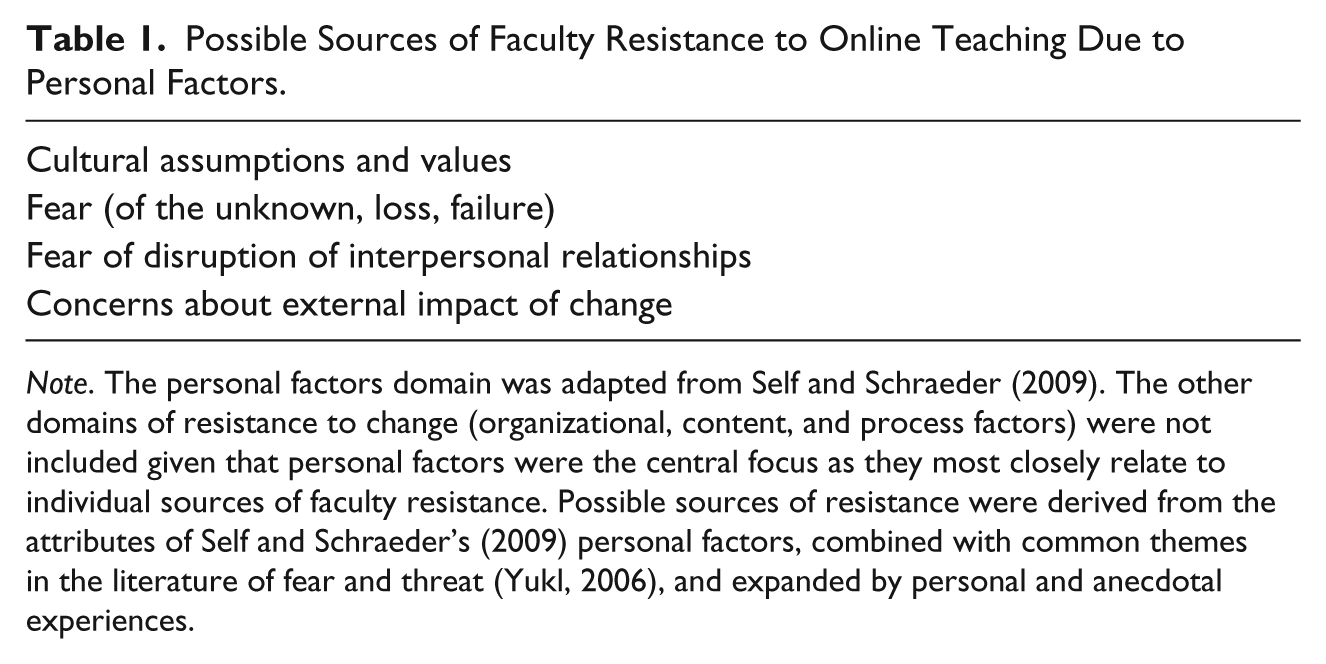
Note. The personal factors domain was adapted from Self and Schraeder (2009). The other domains of resistance to change (organizational, content, and process factors) were not included given that personal factors were the central focus as they most closely relate to individual sources of faculty resistance. Possible sources of resistance were derived from the attributes of Self and Schraeder’s (2009) personal factors, combined with common themes in the literature of fear and threat (Yukl, 2006), and expanded by personal and anecdotal experiences.
Cultural Assumptions and Values
Two related misperceptions faculty have about online education are that quality cannot be controlled and learning cannot be assured (Allen, Seaman, Lederman, & Jaschik, 2012; Lin, Singer, & Ha, 2010). Many faculty hold a historical perception of online institutions being degree factories offering a low-quality education at a high cost. This is no longer the case as many traditional, elite universities have accredited degree-granting online programs. Ironically, this assumption is difficult to dismiss without interaction and engagement with online learning.
Additionally, the prevailing cultural paradigm of traditional higher education is instructor-centered, as opposed to the online education model that is widely held as student-centered. According to this traditional instructor-centered model, students seek knowledge from instructors teeming with information and experience who disseminate the knowledge in a face-to-face format where instructors can assess nonverbal cues indicating whether or not transference of learning is successful. Opponents of online learning remain skeptical regarding the identity of the student behind the screen and regard online education as inferior, questioning the extent to which knowledge is transferred absent of visible nonverbal cues as affirmation (Allen et al., 2012). Recent research indicates that although online education provides little to no face-to-face instructor–student interactions, learning seems to be unaffected. In one such study (Parlamis & Mitchell, 2014) researchers compared master’s-level online and on-ground negotiation classes taught by the same instructor and found no significant differences in knowledge acquisition (as measured by negotiation outcomes, mean course grades, and self-report measures) between students in the two courses.
While the issue of confirming the identity of online students is still a work in progress, one may argue that on-ground instructors also do not always confirm student identities (e.g., via the use of a state issued picture identification). To assure the identity of online students, instructors can require online students to complete assessments using certified proctors who may confirm students’ identification before administering assignments in a monitored environment. Instructors can also use online tools, such as Turnitin, to help detect and deter plagiarism. Turnitin is proprietary software that compares a student’s submitted written work against all other works ever submitted in the widely used system. It also helps verify that student papers are not simply copied from sources on the Internet.
Fears of the Unknown, Loss, and Failure
Expanding on Self and Schraeder’s (2009) personal attribute of potential for benefit or harm to one’s well-being, we propose that a second source of faculty resistance to online education is related to fears of the unknown, loss, and failure. First, faculty may fear technology as something they do not know or understand. While this particular fear may be somewhat generational in nature, it may be gradually addressed through training and immersion strategies, whereas other faculty concerns may be more difficult to address. Second, faculty may fear technology as a time-consuming medium that may upset the balance of teaching, research, and service in academia. Specifically, faculty may fear the amount of time and preparation required to teach well online, where some students’ expectations may include having 24-hour access to instructors and instant feedback on coursework or correspondence. While some research estimates that the time spent teaching online may be double or triple that of a traditional on-ground course (Palloff & Pratt, 2007), other research shows evidence to the contrary. For example, Lazarus (2003) conducted a longitudinal case study of time spent on online teaching tasks (e.g., email, discussions, and assignments) and found that it was comparable (3.5 to 7 hours per class) to on-ground classes. Third, some faculty members may fear the loss of their comfortable, stable, and well-crafted in-classroom teaching model and fear that their teaching strategies may fail in the new online environment. Fifth, and related to the fear of loss, faculty may fear failure if they make the change to online education. A faculty member may find it difficult to relinquish the success he or she has found in teaching on-ground courses for the unknown outcome of teaching online. A star instructor in the traditional classroom may fear the loss of some shine in the online environment.
Fear of Disruption of Interpersonal Relationships
Expanding on Self and Schraeder’s (2009) personality characteristics personal attribute, we propose that a third source of faculty resistance to online learning is related to fears of disruption of interpersonal relationships. Faculty may fear the loss of personal relationships with students (Lin et al., 2010). The personality of some faculty teaching traditional courses is such that they genuinely relish interactions with students both inside and outside of the classroom. These interactions, which sometimes develop into lifelong friendships, may involve the instructor giving students career advice, providing mentorship, or simply being a sounding board for students’ ideas. The possible threat of decreased job satisfaction from not witnessing one’s impact on students’ lives may prove too great for some to transition to online teaching.
Concerns About the External Impact
Our fourth and final proposed personal source of faculty resistance to online education builds on Self and Schraeder’s (2009) individual needs attribute. Faculty may express concern about the impact the change will have on the reputation of the college or university. They may perceive that the reputational hit the university may experience because of the change to online teaching would negatively impact them personally in terms of future job prospects—thus potentially limiting their ability to provide for the needs of themselves and their families. Given the previous examples of highly regarded institutions successfully embracing online education—including Harvard University and MIT’s edX initiative and the University of Massachusetts’s UMassOnline program—faculty concerns of this regard may be somewhat dissipated by learning such information.
The unique role that faculty play in the change process, as well as the aforementioned sources of personal resistance, underscore the need for a change model that captures the profound importance of the individuals taking part in that change. However, many of the change models that have been applied to organizational change are largely based on the organizational level of analysis and tend to be top-down (e.g., Burke & Litwin, 1992; Kotter, 1995; Lewin, 1951). In contrast, the TTM of change (Prochaska et al., 2008) addresses change at the individual level of analysis.
Transtheoretical Model of Change
The TTM is a framework created by integrating several major theories of behavior intervention in a manner designed to directly address the issue of individual behavior change (Prochaska et al., 2008). The framework has been widely and successfully applied to alter individual behavior in a variety of situations including smoking cessation (DiClemente & Prochaska, 1982), personal finance (Xiao et al., 2004), sun protective behaviors (Borschmann, Lines, & Cottrell, 2012), and teaching ethics in business schools (Tyler & Tyler, 2006). Applied across scores of behaviors, in numerous international settings, using diverse populations, the TTM is a robust framework for application to our discussion of faculty readiness for online education as well as readiness to facilitate online education.
The TTM comprises three dimensions: a temporal dimension, a cognitive–behavioral dimension, and an individual difference dimension (Prochaska et al., 2008). First, the temporal dimension accounts for the fact that change is a process that unfolds over time and in stages. There are a total of six stages (Prochaska et al., 2008) in which the individual may find him/herself: (a) precontemplation (not considering change within the next 6 months), (b) contemplation (considering change within the next 6 months), (c) preparation (considering change within 30 days and taking preparatory steps), (d) action (practicing new behavior for less than 6 months), (e) maintenance (sustaining the new behavior for more than six months), and (f) termination (confident in new behavior with no temptation to relapse). Whereas the temporal stages specify the when-to-change, the processes associated with the cognitive–behavioral dimension specify the how-to-change (Treasure & Schmidt, 2001).
The processes contained in the second TTM dimension, the cognitive–behavioral dimension, account for the behavioral, cognitive, and emotional shifts that need to take place at the different stages. The 10 processes are (a) consciousness raising, (b) dramatic relief, (c) self-reevaluation, (d) environmental reevaluation, (e) self-liberation, (f) helping relationships, (g) counterconditioning, (h) reinforcement/contingency management, (i) stimulus control, and (j) social liberation (Prochaska et al., 2008). Each of the processes will be described in greater detail later as they apply to the recommendations made—all except for social liberation, which has an unclear empirical connection to the stages (Prochaska et al., 2008).
The third TTM dimension, the individual difference dimension, contains decisional balance (weighing the pros and cons of engaging in the new behavior) and self-efficacy (having confidence that the change can take place or, temptation to disrupt the change and relapse into old habits; Prochaska et al., 2008).
The fundamental assumption of the TTM is that in order for behavioral change to occur, these three interrelated dimensions (temporal, cognitive–behavioral, and individual difference) must be addressed. Accordingly, individuals who are most likely to change are those who (a) recognize the benefits of change, (b) are confident that they will not relapse into old behaviors, (c) successfully move through each of the six stages, and (e) successfully navigate the processes encountered in each of the stages (Prochaska et al., 2008). By extension, we posit that faculty should not only view online education as valuable and nonthreatening, they must also be willing to engage in behavior to facilitate online education and be confident in their ability to successfully do so. They must be ready for change as well as be ready to change.
While the TTM has been applied in a few educational contexts (e.g., Tyler & Tyler, 2006), to date, we are unaware of its application to the current context of online education. Consequently, we introduce specific recommendations in this article to help transform faculty mindsets as well as faculty behavior to facilitate online education. The recommendations presented are derived from reimagining applied techniques based on the TTM research in addition to current practices at our own and similar traditional institutions.
According to the TTM (Prochaska et al., 2008), several change activities are necessary for transformation to occur. While behavioral changes occur in later stages, cognitive, emotional, and evaluative changes are more likely to occur in the earlier two stages. As previously discussed, these “processes of change” entail cognitive, emotional, and behavioral changes and take place across time such that there is an observed integration between stages and processes. As a result of this integration, we present each recommendation as it applies to a specific process occurring within the transition from one stage to another, beginning with the first two stages of the TTM. (Table 2 includes a summary of our recommendations as presented within the TTM stages and processes.)
Specific Recommendations for Faculty Change to Online Education Based on TTM.
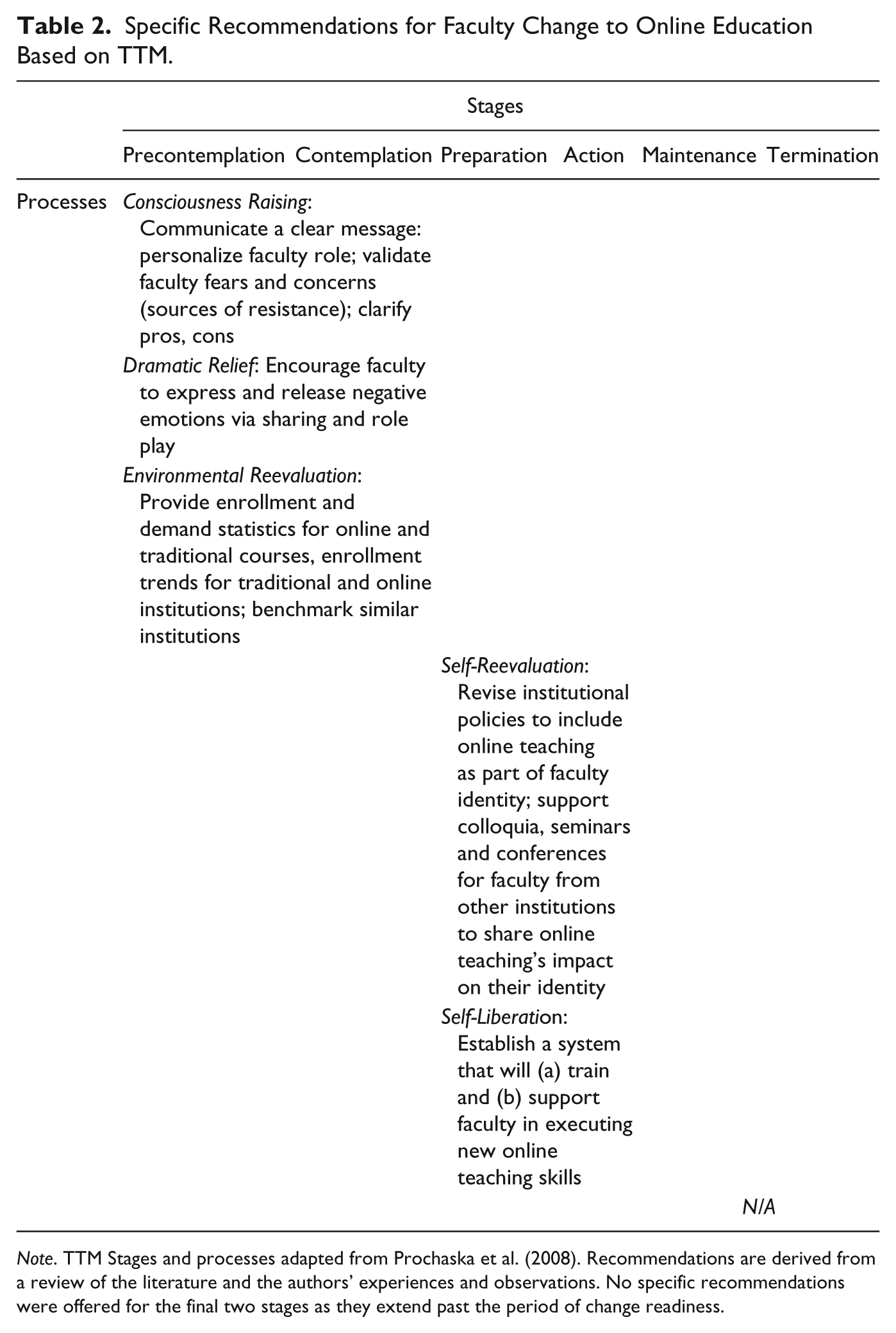
Note. TTM Stages and processes adapted from Prochaska et al. (2008). Recommendations are derived from a review of the literature and the authors’ experiences and observations. No specific recommendations were offered for the final two stages as they extend past the period of change readiness.
Recommendations for Faculty Readiness to Change Based on the TTM
There are three change activities that take place between the precontemplation and contemplation stages: consciousness raising, dramatic relief, and environmental reevaluation (Prochaska et al., 2008). Similar to Lewin’s (1951) organizational change concept of unfreezing or Self and Schraeder’s (2009) creating readiness, these three processes collectively involve providing information to change recipients that would disrupt the status quo and present a clear and convincing need for change. This is essential since change recipients are often unaware of the need for change and are most resistant during the first two stages (Prochaska et al., 2008).
Given that the first three processes occur together during the first two stages of TTM, the first three recommendations offered below may be addressed together.
Recommendation 1
Consciousness raising is about learning new information that will support the healthy new behavior (Prochaska et al., 2008). Therefore, our first recommendation is for higher education administrators to engage faculty in the consciousness raising process by communicating a clear message to faculty who are at this stage the recipients of change. The message should include personalization of faculty’s role in leading the change to online education (that it is ultimately faculty’s choice to engage in the process, not the administration’s), validation of faculty fears and concerns, and objective clarification of the risks and rewards associated with the change.
Recommendation 2
Dramatic relief begins with emotional experiences and may be managed if appropriate action is taken (Prochaska, et al., 2008). To engage faculty in the dramatic relief process, our second recommendation is that administrators continue the two-way communication process by allowing faculty the opportunity to fully express and experience their emotions surrounding the move to online education. Activities may include several scheduled sessions for faculty to give personal accounts of experiences with online education, share stories, engage in role-play sessions, and have a chance to ask administrators any questions related to the change.
Recommendation 3
Environmental reevaluation involves both cognitive and emotional aspects as the change recipient begins to process how he or she may impact others by engaging in or abstaining from the change behavior (Prochaska et al., 2008). In other words, faculty may begin to realize the positive impact that their facilitating online education would have on their careers, their students, their institutions, and higher education in general. In addition, they may realize the negative impact not facilitating online education may have on all concerned.
To engage faculty in environmental reevaluation, we recommend that administrators present objective data such as the increasing demand for online courses, current enrollment trends of their institution and traditional institutions overall, the growth of proprietary institutions and MOOCs, as well as benchmark colleges and universities that have successfully made the transition to online education. In so doing, administrators may provide a message of discrepancy and efficacy (Armenakis, Harris, & Mossholder, 1993)—that change is both necessary and possible. The shift to online education must be clearly communicated in such a manner that faculty perceives it as a natural next step in the evolution of their institution—it should make sense within the larger organizational context. Although change leaders cannot control this sensemaking, communication can significantly help influence the process (Sloyan, 2009).
If change recipients engage in the previous three processes and successfully navigate the first two stages, they then progress to the preparation and action stages during which two processes occur: self-reevaluation and self-liberation (Prochaska et al., 2008).
Recommendation 4
When the change recipient prepares to engage in the new behavior, self-reevaluation occurs as the individual imagines himself/herself with and without the change behavior (Prochaska et al., 2008). To assist faculty in successfully progressing through the self-reevaluation process, we recommend that administrators along with faculty governing bodies (e.g., faculty senate) formally revise institutional policies regarding teaching (e.g., annual performance review, tenure, and promotion) so that they reflect online teaching as one of many aspects of faculty’s role in the institution. In order for sustained change to take place, it is critical that faculty realize that the change to online learning and teaching can be incorporated into the new identity of what it means to be a professor. In addition, we recommend that administrators organize and/or offer seminars and colloquia where faculty from other universities may share how teaching online classes has affected their roles as faculty. If feasible, faculty should also be supported in their attendance at academic conferences (or individual workshops/sessions) with an online education focus.
Recommendation 5
Once individuals have successfully advanced through the previous four processes and decided that there are more pros than cons associated with engaging in the change behavior (decisional balance), they may then encounter self-liberation—an active process that involves going beyond the belief that one is capable of successfully implementing the change and taking action on said belief by using newly acquired skills (Prochaska et al., 2008). Therefore, our fifth recommendation is to recruit faculty to experience online learning first hand, from the perspective of a student. For example, faculty can begin to learn about the online pedagogical approach by being a student in an online class that teaches faculty how to design, deliver, and manage online courses. Several institutions already have instituted such training classes. However, there are online vendors (e.g., Jesuitnet, Embanet) that offer such training as well.
Recommendation 6
Our final recommendation is an extension of the previous one as it relates to the self-liberation process. We propose the establishment of a system to provide faculty the support to exercise their newfound autonomy with the confidence (self-efficacy) necessary to begin and continue to teach online. For instance, the institution may establish a program or unit staffed with individuals who can provide academic technology support to faculty teaching online. In so doing, faculty may receive technical support in creating new online courses or transitioning traditional on-ground classes to an online format, training in new technologies, and troubleshooting assistance as needed.
During the final two stages of the TTM, maintenance and termination, four processes occur: counterconditioning (learning the new behaviors associated with the change), helping relationships (seeking and using social support for the maintenance of the new behavior), contingency/reinforcement management (emphasizing reinforcement for engaging in the new behavior), and stimulus control (removing temptations for relapsing and installing cues that encourage the change). We offer only general recommendations for the processes occurring in the final stages of the TTM although we proposed specific recommendations for each of the processes of its first four stages. This is because the first four stages of the TTM characterize readiness for change and readiness to change, whereas the focus of the last two stages is on maintenance and termination.
In general, we recommend that rewards, reminders, and a social network to support online education all need to be in place by the final stages. For instance, administrators may offer faculty additional compensation and/or a reduced course load for developing new online courses or adapting a traditional course to an online format or as incentive to continue teaching online. In addition, faculty mentoring and support sessions for new online instructors should be implemented. For instance, online education liaisons—well-trained faculty who are proven effective at teaching online—may be designated within each academic unit (department, program, or college) to serve as a touchstone and source of support for new online faculty.
Limitations, Implications, and Future Directions
In this article, we propose the application of the TTM, a robust model of individual behavioral change, to create faculty readiness to facilitate online education and to manage the personal factors of resistance to change. This adaptation of the TTM framework to the higher education domain is novel because the TTM is a model predominantly used by health care professionals to change individuals’ lifestyle behaviors. While we established the appropriateness of the model and offered research-based recommendations, we would be remiss in not addressing some of this article’s limitations, which we discuss next. We then highlight implications and make recommendations for future research.
Limitations
One limitation is that we do not offer empirical data on which to base the stated recommendations for use in a higher education context. Although they are gleaned from impactful research, to our knowledge they have not been empirically tested in academia. A second limitation is that although we discussed four possible domains as sources of resistance (personal, organizational, the content, and process of the change itself), we examined only personal factors as a source of faculty resistance to change. Third, the possible sources of faculty resistance to online education suggested were primarily based on affect—particularly fear and threat. As such, the research-based rebuttals presented may do little to alter faculty’s affective states if they are deeply rooted. Finally, while we mentioned previously that the successful implementation of online education would result when faculty are ready for change and to change, we primarily addressed the latter, which entailed behavioral changes.
Implications
The aforementioned limitations notwithstanding, there are several implications of the current conceptual article. For faculty, this article will prove informational for those unfamiliar with the existing evidence regarding the efficacy and efficiency of online education. Should the recommendations be implemented as stated, faculty will have a voice in the development of online programs at their institutions. While this does not guarantee that they will choose to teach online, those faculty who do select to participate in online education will be better equipped if trained appropriately before attempting to do so. This will no doubt lead to greater ownership of the change, resulting in faculty empowerment and commitment to the change. For administrators in higher education, the recommendations in this article are additional tools that may be used in the complex series of steps involved in determining if and how to introduce online education programs at their institutions.
Future Research
Our first two recommendations for future research are related to the previously stated limitations. First, we recommend empirical investigations of the suggestions for creating readiness in a college or university transitioning to online education. Our literature review found no empirical investigation of the domains of readiness and the institutional conditions within the higher education context.
Second, as we only attended to personal factors, we recommend that future research empirically examine the other three domains of resistance to change (organizational factors, process factors, and content factors) both individually and collectively. Research into organizational resistance factors may include distrust of the organization and change leaders, organizational politics, and the history of change in the organization; process factors for investigation may include the level of involvement in the process and perception of a problematic process; content factors may include perceptions that change is not needed and that change is wrong (Self & Schraeder, 2009).
Third, future research could investigate not only the readiness of faculty to facilitate online education but also the readiness of students to engage in online learning. Psychometrically sound measures developed for just that purpose (e.g., Parnell & Carraher, 2003) may prove helpful in identifying students who would excel in the online learning environment, thereby increasing the observed effectiveness of online education.
Conclusion
Online courses are offered at many traditional higher education institutions. However, some faculty still experience varying degrees of personal resistance to the Internet delivery format. Therefore, our discussion of resistance sources and corresponding rebuttals was not to marginalize or invalidate faculty concerns and feelings. Rather, it was an attempt at a balanced discussion of very valid issues. Furthermore, we do not presume that the future of higher education resides with online education alone and that the demise of traditional, face-to-face instruction is inevitable. Instead, we regard online learning as an additional selection in the higher education basket of offerings.
Consequently, to help address some of the personal factors contributing to faculty resistance to online education, we recommended that higher education administrators enact a strategic plan that begins with providing a message that, among other things, encourages faculty members to engage in processes leading first to a change in mindset then a subsequent change in behavior. To help address this readiness for change issue, we made a case for online education by presenting arguments related to technological innovation, pedagogical evidence, and the potential benefits online education holds for the primary constituents of higher education—students. In addition, we offered some research-based rebuttals to personal sources of faculty resistance. Finally, we offered specific recommendations framed by the TTM to help address both faculty readiness for change and readiness to change.
Footnotes
Acknowledgements
The authors wish to thank the blind reviewers and Michael Small for their extensive contributions during the revision process.
Declaration of Conflicting Interests
The author(s) declared no potential conflicts of interest with respect to the research, authorship, and/or publication of this article.
Funding
The author(s) received no financial support for the research, authorship, and/or publication of this article.