




Abstract
This article describes an innovative interdisciplinary collaboration between English faculty and an organizational behavior (OB) professor to scaffold case analysis writing in an upper-level OB course at an English-medium university in the Middle East. Case analysis writing is challenging for students as an academic genre or type of writing because they do not always know when to report on the case, when to explain OB concepts, and when to go beyond reporting or explaining by using analysis in support of claims. Combining the English faculty’s linguistic knowledge with the OB professor’s disciplinary knowledge, we developed visual support materials to make the valued features of case analysis writing explicit for students. We describe two sets of instructional materials that we used to help students meet genre expectations. We provide evidence from multiple data sources, including on-going analysis of student writing, that points to the effectiveness of our innovative interdisciplinary collaboration. Our findings provide evidence of the benefits of distributed responsibilities in teaching and assessing university students’ communication skills in disciplinary contexts, particularly for L2 learners.
Keywords
Expectations and Challenges of Case Analysis Writing
The case analysis is a prominent written genre in business administration and management programs. Although expectations for the genre vary across course contexts, case analyses follow a problem-solution structure: an analysis using disciplinary concepts to identify problems or opportunities in the case, and solutions or recommendations, supported by the preceding analysis, for enhancing the company or organization’s practices (Forman & Rymer, 1999; Gardner, 2012; Gardner & Nesi, 2012; Leenders & Erskine, 1989; Lundberg et al., 2001; Nathan, 2013). As an apprenticeship genre that aims to prepare students for specific workplace writing tasks (Gardner & Nesi, 2012), a case analysis carries with it the expectation that students demonstrate their “current knowledge and understanding, or to apply theory in practice” and also show their “ability to deal with practical problems associated with their chosen profession” (Gardner, 2012, p. 14). Given its multiple purposes, the case analysis genre poses challenges for students.
Through our iterative design-based research, we have found that without adequate support, students misinterpret the assignment to be asking them to merely demonstrate their understanding of the case or disciplinary knowledge (Miller & Pessoa, 2016; Mitchell et al., 2021). Thus, many students engage in knowledge display rather than knowledge transformation (Scardamalia & Bereiter, 1987), failing to meet the genre expectations of applying disciplinary concepts to evaluate the case, identify problems, and argue for potential solutions. While disciplinary faculty have the content knowledge to support students with their writing, many are often not well-equipped to make genre expectations explicit for students (Dreyfus et al., 2016).
To address these student challenges, the first four authors, English faculty with training in linguistics, have developed research-informed pedagogical interventions to scaffold case analysis writing in disciplinary courses. Scaffolding, a term first introduced by Wood et al. (1976), refers to the process of providing assistance or support to learners so that they can perform a task beyond their own reach if pursued independently when “unassisted” (Wood et al., 1976, p. 90). In this article, we focus on our interdisciplinary collaboration with an organizational behavior (OB) professor, the fifth author, to scaffold the case analysis in an upper-level OB course at an American university’s branch campus in the Middle East where most of the students have English as an additional language. The OB professor reached out to the English faculty when she learned about our large-scale interdisciplinary project with information systems (IS) faculty to scaffold case analysis writing at all levels of the IS curriculum at our institution (Mitchell et al., 2021; Pessoa et al., 2019; Pessoa et al., 2020). The OB professor had extensive industry experience, but was teaching this course at our university for the first time and was aware of the writing challenges many of our students face as second language (L2) learners of English and understood the need and importance of making expectations explicit. By combining the English faculty’s linguistic knowledge with the OB professor’s disciplinary knowledge, we developed learning materials and implemented instructional strategies to make genre expectations explicit for students.
Building on the English faculty’s IS research, we collaborated to scaffold a particular case analysis assignment, the case proposal, for the OB professor’s course. In the case proposal, the students were to use OB concepts to analyze a case provided by the professor, identify problems and/or opportunities for improvement, and provide recommendations. By calling it a case proposal, the OB professor sought to emphasize the problem-solution nature of the assignment and the overall “recommending purpose” that motivates the entire document (Gardner, 2012, p. 28). The way the case proposal assignment was conceptualized and scaffolded aimed to help students develop the necessary skills they will need as professionals in an effort to align curriculum content with actual managing practice.
This article describes our process of collaboration, provides details of the assignment, and focuses on two sets of instructional materials that we developed and used to help students write analytically and argumentatively to meet genre expectations. Our collaborative approach is innovative in several ways: (1) the case proposal was a semester-long project that was completed in parts and was built up through revisions; (2) rather than being a more traditional “closed” case analysis assignment, students were provided with companies/case topics (in video format) and corresponding transcripts as a starting point; students had to choose one company/case topic and then find additional case data and OB sources related to the OB theme/concepts they wanted to explore; (3) our scaffolding materials provided detailed descriptions of the valued language features of the case proposal; (4) our in-class writing workshops incorporated a diagnosis of the most important problems of the part of the case proposal that students needed to revise for the following submission and a preview of the upcoming sections the students needed to complete; and (5) the students received feedback from both language and disciplinary experts on each part of the case proposal. We provide evidence from multiple data sources that points to the effectiveness of our innovative interdisciplinary collaboration to scaffold the case proposal in this OB course. We suggest that our collaboration provides further evidence of the benefits of distributed responsibilities (Arkoudis & Doughney, 2014) in teaching and assessing university students’ communication skills in disciplinary contexts, particularly for L2 learners.
The Class and the Case Proposal Assignment
The collaboration reported here took place at branch campus of a U.S. university in the Middle East where all courses are taught in English and the curriculum largely follows the main campus. This article focuses on our collaboration in two iterations of an OB course taken by second- through fourth-year students who mostly major in Business Administration. The course examines how organizational context—including individuals, groups, processes, and structures—influences workplace behavior. It introduces insights and frameworks from behavioral and social sciences to prepare students to think and act strategically in the workplace. Disciplinary concepts from OB covered in the course include the following: organizational culture; motivation, engagement, and performance; leadership; decision-making; and organizational change. As is typical in undergraduate curricula, the central concepts, insights, and frameworks in this course are limited to the perspectives shared in the textbook (Konopaske et al., 2018). However, students need to collect additional organizational behavior insights from peer-reviewed sources. In their case analysis write-up, students are expected to use general definitions from the textbook, but based on their research, they are also expected to show a more nuanced understanding of the concepts and to apply disciplinary knowledge that is less mainstream. Overall, the course has three main learning goals: (1) increasing OB knowledge for interpreting organizational workplace behavior; (2) applying OB knowledge to identify, analyze, and predict organizational behavior problems, and recommend solutions; and (3) analyzing qualitative OB data and information sources to formulate evidence-based arguments.
These learning goals were assessed through the completion of the written case proposal high-stakes assignment (worth 40% of the course grade) that required students to analyze and evaluate a company through one or more OB lenses (i.e., course concepts, insights, and frameworks) and identify problems or opportunities for the company’s improvement. They had to use this analysis as the basis for recommendations for optimizing the company’s organizational behavior.
We adopted a process-relational orientation (Oliver & Gershman, 1989) to the course design: as a team, we scaffolded the writing process for this semester-long case proposal project by segmenting it in three main parts: the Situation Analysis, the Problem and Opportunity Analysis, and the Recommendations. After the students submitted the Situation Analysis, they received feedback on it, revised it, and resubmitted it along with their first draft of the Problem and Opportunity Analysis. They repeated this process when submitting the Recommendations, and again when submitting the final draft of the entire case proposal (see Figure 1 for a summary of all the sections of the case proposal). Thus, students understood the case proposal to be a high-stakes assessment of their ability to analyze and evaluate a case using OB knowledge, a written product built through this multistep writing process that was supported by our team-oriented approach to explicit instruction.
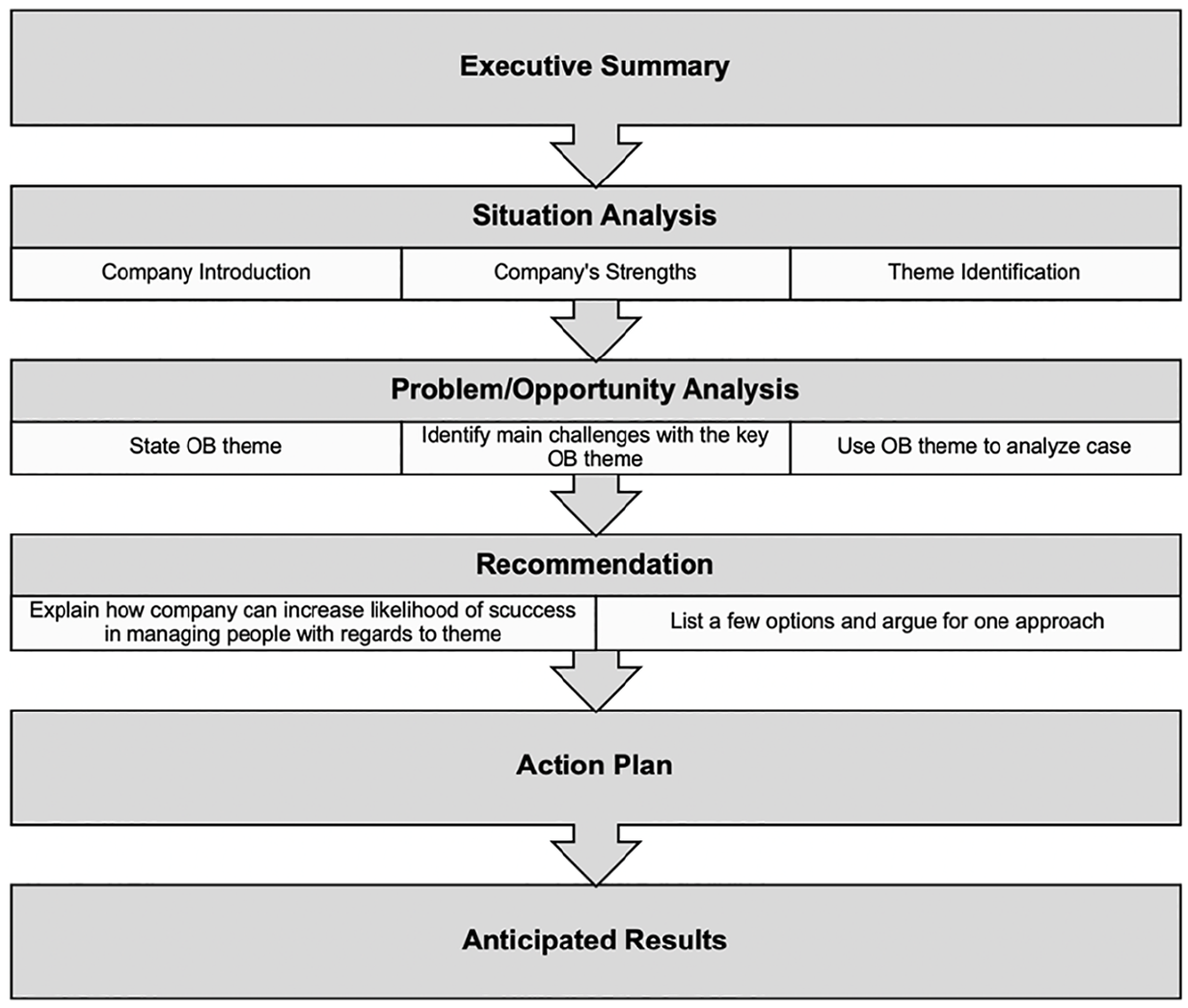
Summary of all the sections of the final case proposal submission.
The requirements for each section of the case proposal were made explicit to students. In the Situation Analysis, students were expected to provide a company overview, list the strengths of the company as it relates to managing people, and identify and define an OB concept(s) that emerged as salient in the case. In the Problem and Opportunity Analysis, students were expected to identify the main challenges, problems, or opportunities of the company through the lens of the OB concept(s) they identified in the Situation Analysis. They were expected to analyze the company’s current situation and potential consequences of not addressing the problems or opportunities identified. Students supported their analysis with evidence from the case and evidence-based literature that related to their selected OB concept of analysis. In the Recommendations section, students were expected to provide evidence-based recommendations for how the company could increase its likelihood of success by using the key OB concept to manage their people.
Design-Based Research and Language-Focused Approaches for Scaffolding the Case Proposal
Our interdisciplinary work employs design-based research (Anderson & Shattuck, 2012), an iterative approach that involves collaboratively designing scaffolding materials and analyzing student writing in order to refine our materials to address students’ writing challenges. As guests in a classroom, we, the English faculty, adopt a context-sensitive approach to our collaborations. Our approach is informed by our research-based knowledge of the genres but is tailored to each classroom according to the disciplinary instructor’s particular expectations and learning goals. For the collaboration in OB, the English faculty met several times with the OB professor to understand the assignment and her expectations, which led to 3 hours of transcribed interviews that formed the initial foundation of the pedagogical intervention. During these interviews, the OB professor shared materials from case analysis writing used in OB courses on the university’s main campus. She also discussed the importance of writing evidence-based case proposals, writing grounded in reliable sources (i.e., published work on the case or similar companies) and accurate use of OB theories that are relevant to the case. Based on these conversations, we cowrote the assignment guidelines, dividing the case proposal into three main parts to be submitted throughout the semester. In preparation for the writing workshops, we cowrote a mentor text (i.e., a text that is used as an example of effective writing) that exemplified the valued features of the case proposal. We provided students with an evaluation rubric that we cowrote to explicitly assess their OB knowledge as it was communicated through language choices in their case proposals according to the genre expectations covered in the workshops.
The three writing workshops were offered during class before each of the three main segments of the case proposal were due (see Figure 2 for a summary of the focus of each writing workshop). Workshop 1 focused on introducing the main purpose and parts of the case proposal and scaffolding the Situation Analysis, the first part submitted by the students. Workshop 2 focused on addressing student challenges with the Situation Analysis (using excerpts from students’ drafts), and on scaffolding the Problem and Opportunity Analysis. Workshop 3 focused on student challenges with the Problem and Opportunity Analysis and scaffolding the remaining sections. Before submitting their final case proposals, many students met with the OB professor and/or the fourth author to address specific concerns. After this first semester’s collaboration, we surveyed the students about the workshops, and the English faculty interviewed the OB professor to gain insights on the whole process and then engaged in close linguistic analysis of student writing to gain deeper insights into students’ challenges with the entire case proposal. We used this knowledge to refine our scaffolding materials for the second iteration of the course (not discussed in this article).
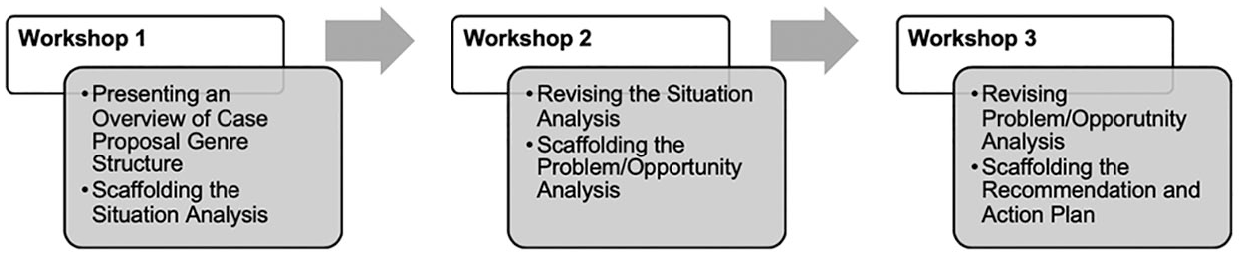
Summary of the focus of the three writing workshops.
Our language-based approach to scaffolding the case proposal and analyzing student writing draws on genre-based pedagogy informed by systemic functional linguistics (SFL; Halliday, 1985) and legitimation code theory (LCT; Maton, 2014). SFL is a theory that sees language as a resource for making meaning in a particular context. In SFL, genre is defined as “a staged, goal-oriented, purposeful activity in which speakers engage as members of our culture” (Martin, 1984, p. 25). SFL genre-based pedagogy aims to make explicit the social purposes of genres and the linguistic choices needed to meet genre expectations. To do so, genre-based pedagogy invests heavily in front-loaded pedagogy through intensive scaffolding. This scaffolding is conducted using the teaching and learning cycle (Rothery, 1994), an interactive and iterative writing-focused pedagogic cycle of teaching and learning activities that includes three main stages: Deconstruction, Joint Construction, and Independent Construction of text. The stages in this cycle aim to progressively shift the gaze of learners from analyzing successful mentor texts (Deconstruction) to creating texts, initially with expert guidance (Joint Construction) and then individually or in learner groups (Independent Construction).
LCT was developed as a way to understand how knowledge is built by knowers in fields of practice, such as school subjects. Students need to know not only how language is used in disciplines to create meaning but also how that knowledge is legitimated within disciplines. Recent studies combining SFL and LCT have shown how they can be complementary in informing pedagogical practices (e.g., Macnaught et al., 2013).
Using these theoretical approaches, in our writing workshops we deconstructed mentor texts with students to identify the case proposal’s valued features. We also used student writing to contrast effective and less effective ways of meeting genre expectations and jointly construct revisions to less effective texts. In the next two sections, we provide more details about specific SFL and LCT tools that we used to address students’ challenges writing the Problem and Opportunity Analysis section of the case proposal.
Scaffolding the Process of Analysis to Prepare for the Problem and Opportunity Analysis
Workshop 2 focused on scaffolding the Problem and Opportunity Analysis section prior to students drafting it. We began by explaining the prewriting process of analysis that was necessary to write this section. We then unpacked the language features of analysis and argumentation so that the students understood how to turn this prewriting process of analysis into a written draft. Based on the English faculty’s research in other classrooms (Miller & Pessoa, 2016), we knew it was important for students to understand what it means to analyze so they could move beyond knowledge display and engage in knowledge transformation.
The materials we discuss in this section are based on Humphrey and Economou’s (2015) description of analytical and argumentative discourse patterns: analytical writing involves applying disciplinary frameworks—specialized analytical lenses from the discipline—and using the disciplinary frameworks to present and organize the information; argumentative writing involves making evaluative claims supported by reasons and evidence. In the case proposal, the students are expected to use OB concepts to analyze the case, then use this analysis in support of their evaluations of the company’s problems or opportunities and their solutions or recommendations. Thus, in our workshop, we taught students the process of applying an OB framework to sort disparate pieces of information from the case, and how to synthesize their application of the framework to determine their overall evaluation of the case.
To make the prewriting process of analysis explicit for students, we used the visualization in Figure 3.
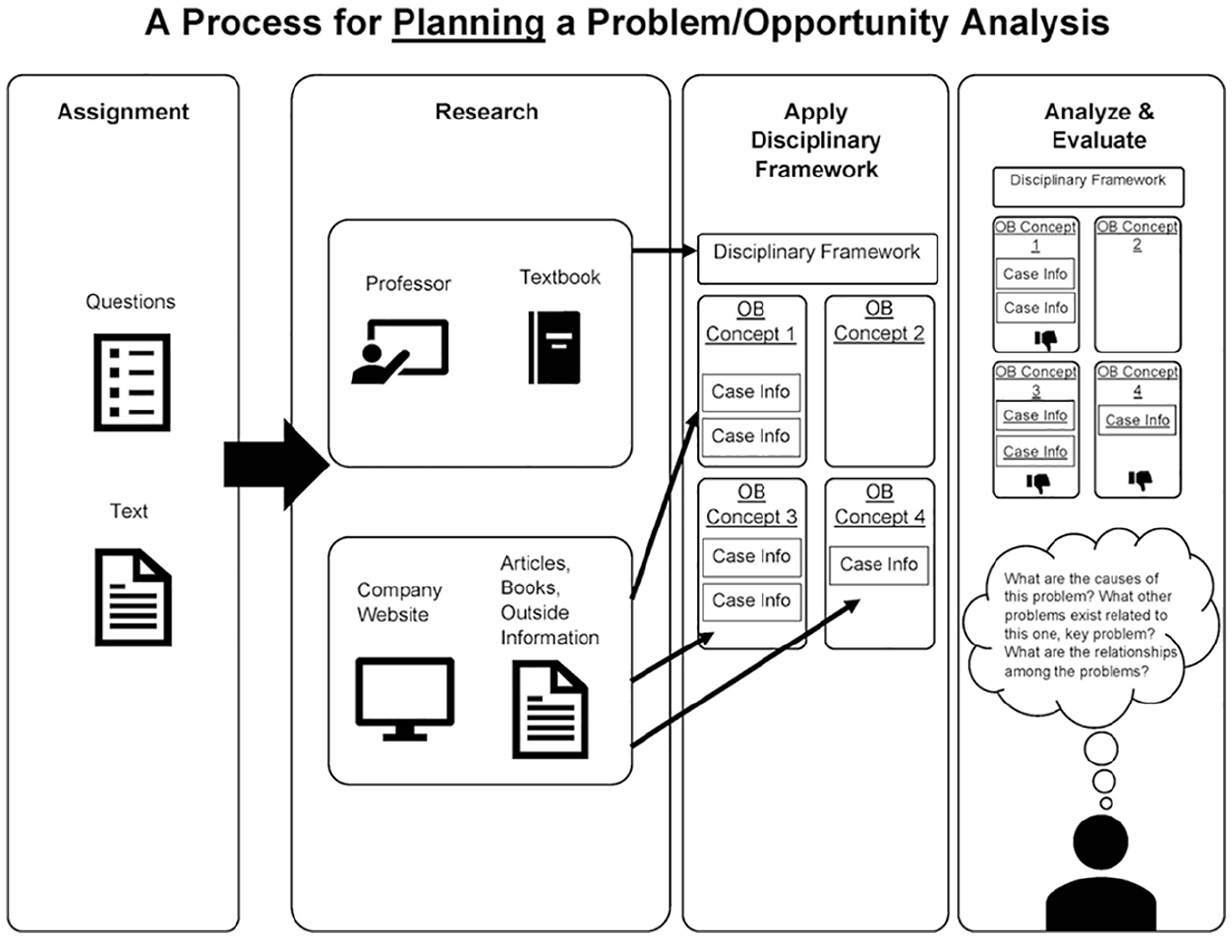
Visualization of the prewriting process of analysis.
With this visualization, we showed how, in order to engage in analysis, students need to: consider the assignment questions and case sources; use disciplinary framework(s) provided by the professor or textbooks as an analytical lens to interpret the details of the case (the “data”); and group details of the case according to relevant elements of the disciplinary framework. Then, we explained that they must use this analysis to evaluate the case.
To make the process of analysis more concrete for students, we illustrated the prewriting process using a fictional sample case that we created: M University (MU). We chose a university as a sample case because we thought it would be easy for the students to relate to it and imagine themselves in the role of a consultant investigating its organizational behavior. We started by reminding students that in the classroom context, they were provided a selection of cases, but in the professional world, organizations issue a “request for proposal” or directly reach out to consultants requesting them to examine their organization, identify problems, and provide recommendations. We asked students what kind of data they would need to collect at MU to develop a clear understanding of the university, identify problems, and propose solutions.
As the students took on the imagined role of consultants, they responded with ideas for data collection like: conducting surveys and interviews with the management, faculty, staff, students, and alumni; gathering information about the university’s history; reviewing annual reports; and observing classes, events, and the university’s daily life. We then generated examples of the types of information that could be gathered from these sources and wrote them on the board. For example, we mentioned that MU had recently appointed a new dean whom the faculty did not particularly like because of his tendency to be a micro-manager. The faculty used to be engaged, with excellent course evaluations and active research agendas. However, since the appointment of the new dean, the faculty had not been as committed and productive, as the sense of community that once existed among them had seemingly disappeared. We made it explicit to students that these data about MU that we provided were analogous to the videos and other materials about their case that they would need to analyze.
We then asked the students if they could associate any OB concepts with what was “observed” in the MU data. We wrote the concepts they mentioned on the board and together we connected them to the information from MU, determining, for example, that all the comments about the dean and his administrative team related to the OB concept of leadership and that the faculty’s lack of engagement and commitment related to motivation. Thus, the students understood that in this case, the consultant would identify leadership and motivation as two problems at MU and address these negative evaluations about the leadership style and lack of motivation of the faculty through recommendations to improve the university’s organizational behavior. As we talked about MU, we frequently referred back to the visualization in Figure 3 and made explicit connections between our analysis of this fictional case and what they would do with their own case.
We then told students that they could use their prewriting analytical work to produce an outline for the Problem and Opportunity Analysis. We showed students what this outline would look like for the case of MU with another visualization (see Figure 4) that includes information from our mentor text. This visualization shows how the writer arrived at an overall evaluation of the case via the analysis process, and how the analysis is incorporated as supporting evidence for the evaluations. We then compared this outline with our mentor text (Figure 5). Together, this activity and these scaffolding materials modeled the process of analysis from prewriting to drafting and provided students with tangible resources for crafting an analytical, argumentative Problem and Opportunity Analysis section.
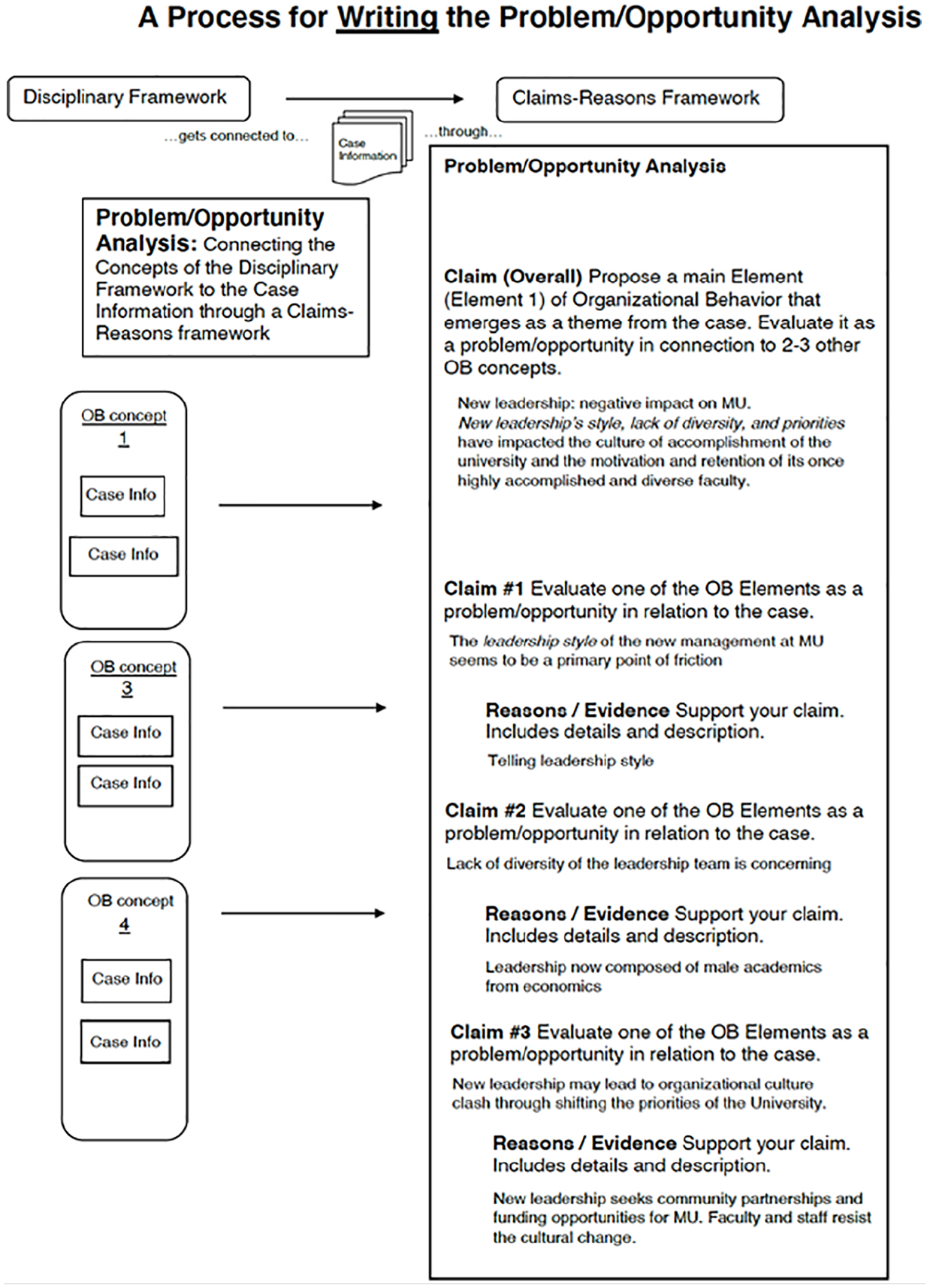
Visual representation of process to use analytical pre-writing to write the problem and opportunity analysis section of the case proposal.
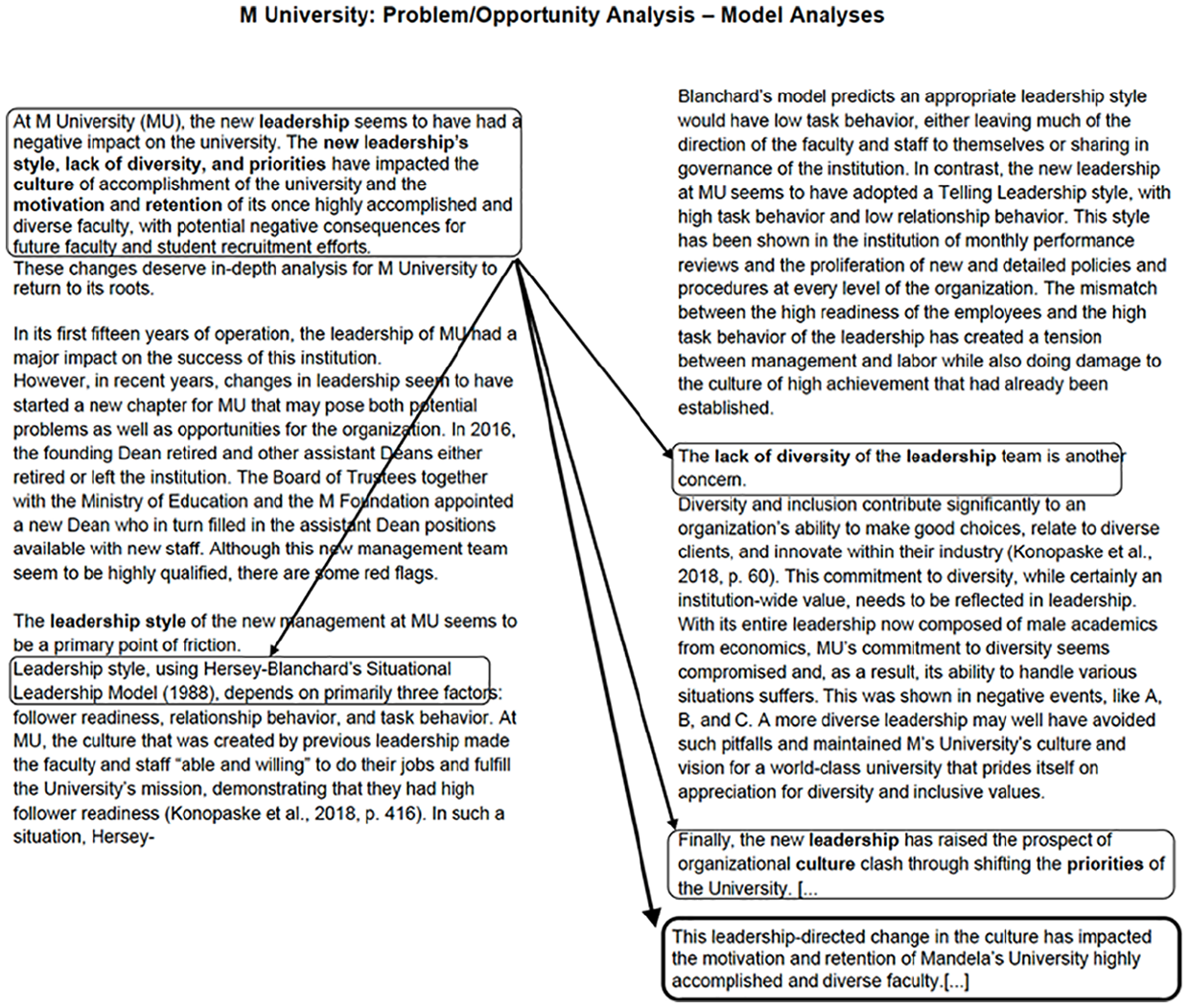
Excerpt of mentor text of the problem and opportunity analysis section of the case proposal.
To help students understand more thoroughly the language resources of analysis and argument, we prompted them to inductively analyze some of the language choices and general strategies of the mentor text by asking as follows: How is the text structured? What are some of the language choices that tell you about its structure? What is the main claim of the text? How do you know? What is the main claim of each paragraph? What reasons are provided for each claim? Are they persuasive? Why? As can be seen in Figure 5, the mentor text is structured with an evaluative claim about leadership—a theme that emerged from the case—and several supporting claims that use related OB concepts: lack of diversity, priorities, culture, and retention. The text uses these OB concepts to present and organize information the subsequent paragraphs by making evaluative claims in the topic sentences supported by details from the case.
Two Heuristics to Scaffold Analytical Writing at the Paragraph Level: Semantic Waves and I know, I See, I Conclude
When we reviewed students’ drafts of the Problem and Opportunity Analysis, we found that our work to scaffold analytical argumentative writing seemed to be having a positive impact, but we also noticed two important areas for improvement: some students focused mostly on re-presenting information from the case or displaying their understanding of disciplinary knowledge; and even students who were more effectively using disciplinary knowledge to analyze the case still needed help making connections between their claims and support. Therefore, in preparation for Workshop 3, we developed a second set of materials to help students revise their Problem and Opportunity Analysis. These materials emphasize how to structure paragraphs and create logical relationships between disciplinary knowledge and case information. Specifically, we gave students two heuristics based on research in LCT (Maton, 2014; Maton & Howard, 2018) and SFL (Hao, 2015), and then provided sample materials that used these two heuristics in combination to illustrate the valued features of analytical case proposal writing.
In Workshop 3, we started with the wave heuristic (Maton, 2014; Maton & Howard, 2018), which provides a way of considering how students need to move between different types of information in a text. Drawing on models from LCT, we focused on two key dimensions of the knowledge in OB: how dependent information is on a context, such as the case; and how strongly tied the information is to the target content of OB knowledge, such as explanations of OB theory. The information presented in a case proposal can range from very abstract (e.g., OB concepts such as leadership or motivation)—and therefore not as dependent on context—to more concrete (i.e., information about the case)—and thus more dependent on context.
With this wave heuristic, we aimed to help students avoid paragraphs that focus mostly on: abstract OB knowledge without providing concrete information from the case, as seen in in (1) below; or case information without sufficiently connecting it to OB knowledge, as seen in (2) below, where the first sentence is about the abstract OB concept leadership, but the rest of the paragraph is concrete and context-dependent.
Motivation is prioritizing a choice among other alternative forms of voluntary activities, and the individual has complete autonomy over it. People’s motivation is highly dependent on their perception on the value of effort and the belief that the effort will help the individual achieve the goal. Therefore, having a group of different individuals makes the organization exposed to people that maintain different levels of motivation. Having employees with different levels of motivations makes it harder for the organization to construct motivation strategies. Moreover, people are motivated by different factors. Having people with very different mentalities and backgrounds entails that each individual will have different motives. Thus, making it harder for the organization to motivate employees. Overall, continuing to emphasizing differences and having an over diverse culture, will make the process of motivating employees more challenging and difficult.
Leadership has a significant impact because it creates incentives that help the employees work toward accomplishing the company’s goals (Konopaske et al., 2018, p. 403). Whole Foods’ leadership principles are to be purpose-driven and empowering. Whole Foods’ mission is to nourish people and the planet. As its selling products clearly suggest, this purpose drives the company to set the standards of excellence for food retailers. Furthermore, they have a 5% donation policy for local charities (p. 8, 00:04:39:15). Whole Foods leadership empowers employees, as was portrayed in the case video: “he [Mackey] let his workers vote on whom to hire on their team, share in the profits, and know everyone else is being paid” (p. 7, 00:03:22:16). This is one of the policies that defines Whole Foods.
We used the visualization in Figure 6 as a way to conceptualize and illustrate a preferred paragraph structure, noting to students that paragraphs in academic writing often move in waves of meaning: they begin with general/abstract/decontextualized information, then move toward more specific/concrete/contextualized information, and finally tie together meanings with more general/abstract/decontextualized information at the end of a paragraph or section.

Visualization of wave heuristic.
The second heuristic we provided in Workshop 3—I know; I see; I conclude—was one that we adapted from Hao’s (2015) SFL-based work on patterns of reasoning in students’ biology lab reports. In case proposal writing (and in case analysis writing, in general), some information is strongly concerned with and related to the disciplinary knowledge, such as explicit explanations of OB concepts: what the student knows from textbooks and class materials. Other content is less related to the disciplinary knowledge, such as descriptions of factual information from the case: what the student sees when watching videos or reading about the company. Still other content is in-between, representing an understanding of the case through the lens of the disciplinary knowledge: what the student concludes by applying general OB knowledge to the particular case (we explained to students that this latter rhetorical move could either be a think or conclude move, depending on their level of certainty). Thus, the rhetorical structure of the analysis section of case analyses can be understood to comprise combinations of know, see, and conclude moves (cf. Swales, 1990), as the author strategically oscillates between disciplinary knowledge and case information to draw conclusions. The conclude moves are vital to the case proposal because they are where students demonstrate that they are generating new knowledge about the case that can be used as the basis for their recommendations. We represented this heuristic with the visualization in Figure 7.
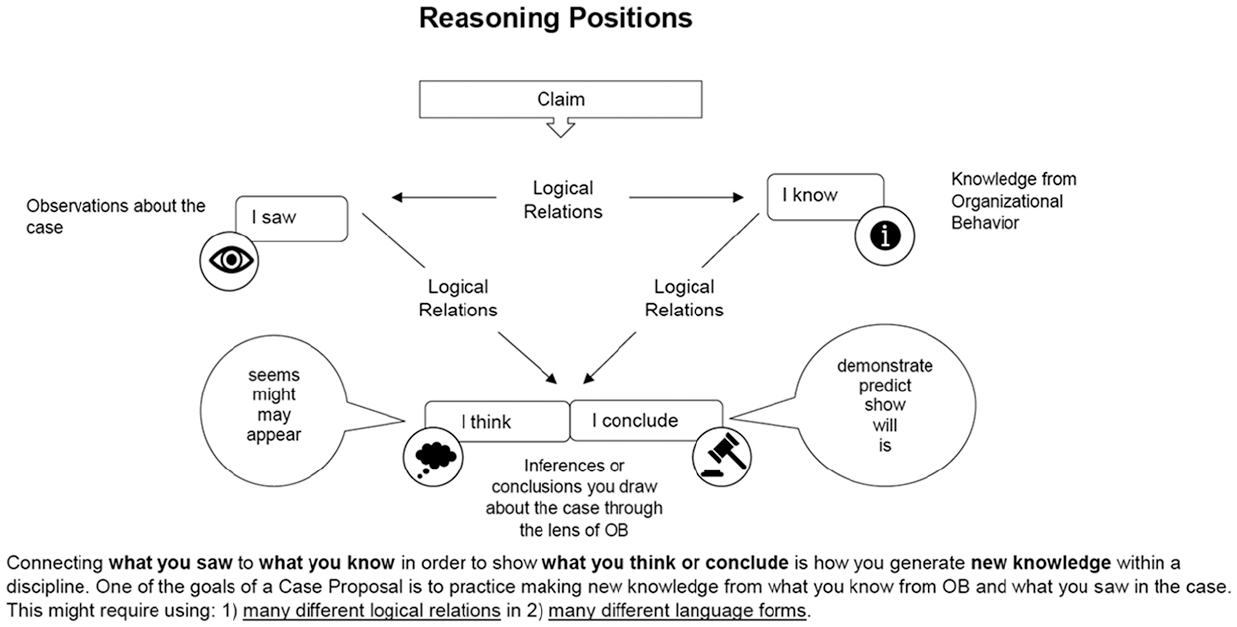
Visualization of the I know; I see; I conclude heuristic.
We also provided a list of specific types of logical relationships, along with language for articulating these relationships, as seen in Figure 8. This list provided explicit ways to connect claims and support, giving students tools for moving between know, see, and conclude moves. By labeling each relationship with an icon, we established a shorthand for annotating sample texts.
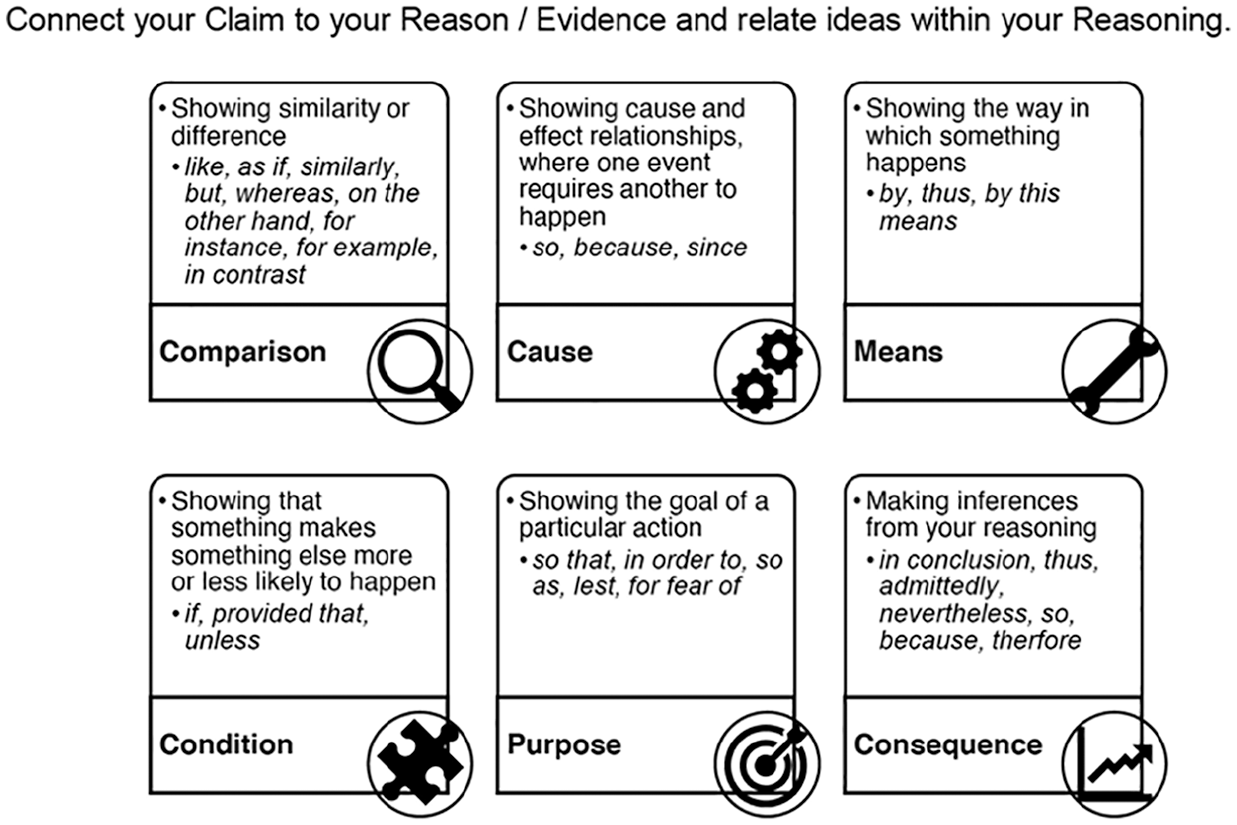
A taxonomy of logical relationships and corresponding language to articulate them.
Finally, we provided an annotated visualization of a paragraph of our mentor text that combined all of these materials. With this visualization, we showed students how to: begin a paragraph with a claim that merges information from the disciplinary theory and the case (i.e., a conclude move that has been formulated by analysis prior to drafting); then move to OB knowledge for a definition or explanation of the concept that will be used to analyze the case (i.e., a know move); then alternate back forth between know, see, and conclude moves—all in an effort to build an argument supported by an analysis of the case. As seen in Figure 9, we segmented this paragraph into boxes indicating whether the information represents OB knowledge, case information, or interpretations of the case through the OB lens.
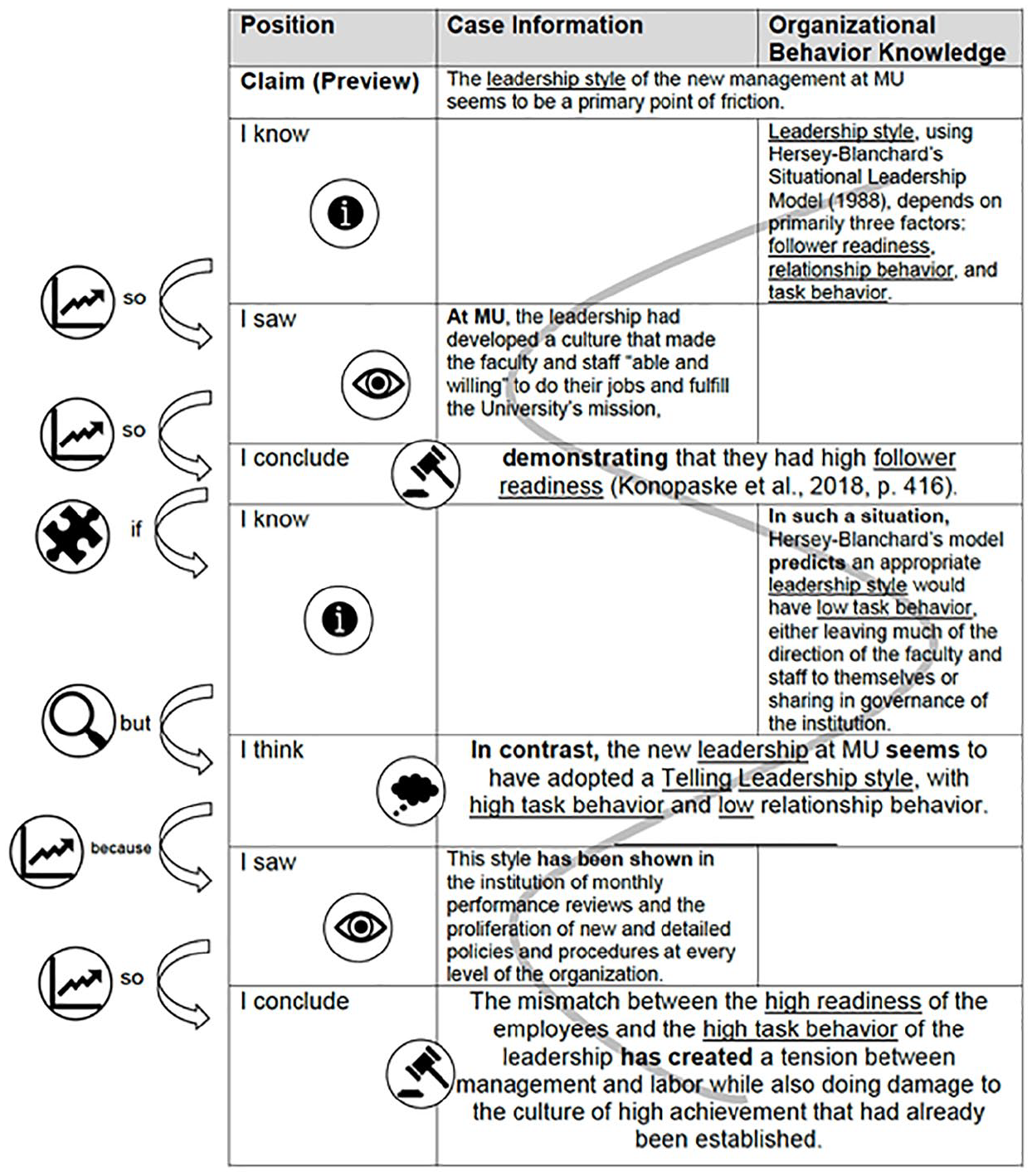
Visualization of a paragraph from a mentor text illustrating the two heuristics and types of logical reasoning.
In the visualization, we used the icons representing the different types of logical relationship to mark the connections between the know, see, and conclude moves. We overlaid the paragraph with the image of a wave to emphasize this valued way of oscillating between the different types of information, a visual technique that was particularly useful when contrasting this mentor text with visualizations of less effective paragraphs. For example, Figure 10 shows a visualization of the student text (shown earlier, in [1]) that focuses solely on representing OB knowledge, a meaning “flatline” (Maton, 2014, p. 121) rather than creating a wave of meaning that moves between OB knowledge and case information.

Visualization of sample student text with a “meaning flatline.”
To help students apply the knowledge embodied in the visualizations, we gave them several sample paragraphs to analyze with their peers. They filled in a worksheet identifying the know, see, and conclude moves (K, S, C) and the logical relations that connect them, as seen in Figure 11. We discussed their analysis and how to improve the logical connections.
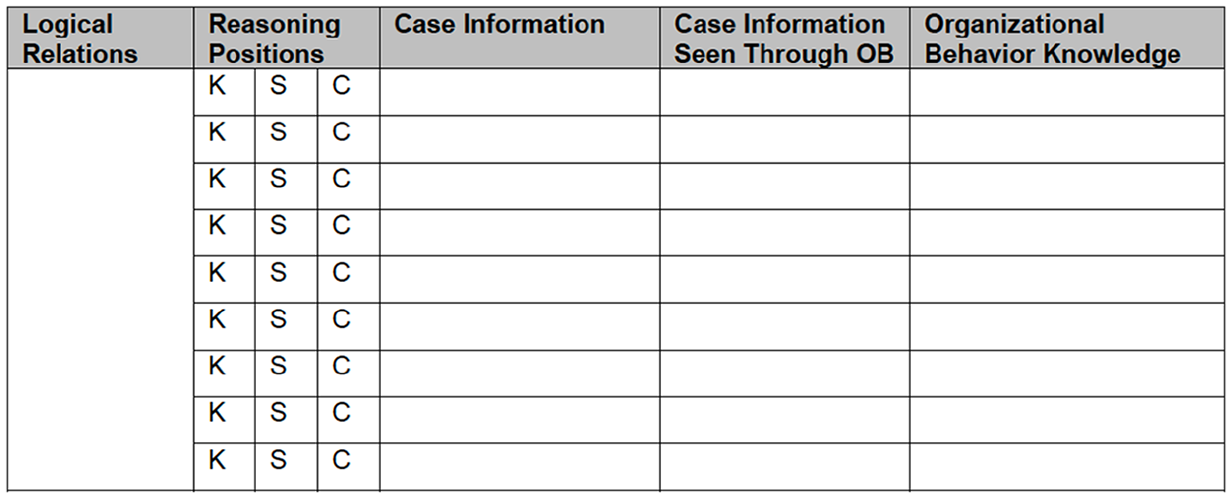
Worksheet for student analysis of know, see, and conclude moves and logical relations in sample texts.
Evidence of Effectiveness of the Collaboration
We have evidence from multiple data sources that point to the effectiveness of our interdisciplinary collaboration to scaffold the case proposal in this OB course. First, grades improved consistently across all semesters. For example, in the first collaborative iteration of the course, the average grade of all rough drafts combined was 82%, but the final case proposal draft average was 91%. 1 The combination of language and OB expert feedback on students’ drafts, along with the strong emphasis placed on the importance of revision, seem to have positively impacted student writing; in each stage of the writing process, we gave students specific tools and advice for addressing the most common challenges we noticed in their drafts. Second, feedback surveys about the effectiveness of the collaborative teaching practice indicate that 59% of students said the case proposal writing workshops were helpful to a great extent.
Third, the first four authors’ close linguistic analysis of student writing (Pessoa et al., under review) suggests that students are applying the instruction through improved argumentation and analysis, particularly in the Problem and Opportunity Analysis section. We analyzed 33 student texts to examine uptake of the semantic wave and know-see-conclude heuristics using an analytical rubric we devised for that research. Our findings show that no paper was solely dedicated to knowledge display throughout the entire text. Albeit with some variation in the degree of effectiveness, all students engaged in knowledge transformation through analytical and argumentative writing. For example, (3) is an excerpt from a student case proposal that shows that the student is using the disciplinary concepts to organize and present the information. In the first paragraph in (3), the student introduces the problems he identified in the case (Ford Motor Company’s CEO transition) using OB concepts (indicated in bold). These concepts are then picked up as claims in the topic sentences of subsequent paragraphs, showing that the student is using them to organize and present the information.
The potential issue in the Ford case is the perilous
The Moreover, another area potentially damaged by Ford’s Consequentially, when
The paragraph in (4) shows how students are also applying the know, see, conclude heuristic to create logical connections between what they know about the OB discipline and the details of the case. The student starts with a claim, a conclude move (think/conclude moves are italicized in [4]), that uses the OB concepts of organizational structure and employee role complexity to evaluate the case, suggesting that Zappos’ nonhierarchical structure could create challenges in two ways: role conflict and payment for ambiguous roles. In the paragraph that explores the former, the student begins by bringing in OB knowledge with a series of know moves (
2. By having such a decentralized and democratic organizational structure such as holacracy, Zappos is in danger of having overbearing role complexities [ . . . ]
Finally, in addition to the positive impact on students, the collaboration has been mutually beneficial for all of us. On one hand, the English faculty have enriched their understanding of OB concepts and their application, and the case proposal genre expectations. They have used this understanding to make recommendations to the IS program at our university, suggesting that an advanced case analysis assignment like the case proposal could help bridge students’ progression from more pedagogical case analysis writing to the more professional writing assignments of their capstone course (Pessoa et al., 2020). On the other hand, the OB professor has enriched her linguistic knowledge of the genre. Specifically, she has become very adept at identifying students’ challenges with the case proposal and draws on the scaffolding materials during lectures and in her written feedback to students. She was increasingly active during the writing workshops and eventually developed her own metalanguage to explain the process of analysis to students which has informed our most recent materials. For example, she tells students that when they analyze the case, they are putting on special “glasses” to see it through an OB lens, and she mimics this with body movement (by pretending to put on glasses). During her meetings with students to discuss case proposal drafts, she also uses the outline for structuring the Problem and Opportunity Analysis (Figure 2) and has now asked students to submit their outline with their case proposal so that they show their thinking and writing process, and she can ensure that their writing follows from their outline. In the most recent iterations of the course, the OB professor has taken full control of the writing workshops, keeping them in the syllabus and leading them herself.
Conclusion and Future Work
Our work in this OB course shows how productive and innovative interdisciplinary collaborations can be in supporting student learning, providing further evidence for the value of combining language and disciplinary expertise to support disciplinary writing development (Dreyfus et al., 2016; Pessoa et al., 2019). Our collaboration to scaffold the case proposal is grounded in our design-based research in the OB course and the English faculty’s prior work scaffolding the case analysis genre in the IS discipline (e.g., Pessoa et al., 2019; Pessoa et al., 2020). This foundation facilitated our innovative approach to scaffolding the case proposal to help students more effectively meet genre expectations. Students worked on their case proposal throughout the whole semester and completed it in parts that were built up through recurrent revisions. We presented evidence that suggests that the language focus of our scaffolding materials was effective in making expectations explicit for students through the use of our mentor text that highlighted the valued analytical and argumentative features of the case proposal. We addressed student challenges in writing workshops where we used excerpts from student writing and discussed ways to revise student writing to more effectively meet genre expectations. We reinforced student learning throughout the writing process with individual feedback from both the OB and English faculty.
Our work in this course is ongoing. As mentioned earlier, the OB professor has now taken ownership of the materials and is leading the workshop on her own, and the English faculty are documenting how her use of the scaffolding materials and linguistic knowledge evolves. Such ownership on the part of the disciplinary faculty is an important component of this kind of interdisciplinary collaborations in order for them to have sustainable impact. Even though the English faculty no longer lead the writing workshops, they continue to refine the materials to scaffold the case proposal as they refine their knowledge of this genre. The OB professor pointed out that the students need more support on writing recommendations and connecting their recommendations to their analysis, and we are currently developing materials to address this need. The materials presented here are a starting point to help students meet the case analysis genre expectations.
Footnotes
Declaration of Conflicting Interests
The author(s) declared no potential conflicts of interest with respect to the research, authorship, and/or publication of this article.
Funding
The author(s) disclosed receipt of the following financial support for the research, authorship, and/or publication of this article: This manuscript was made possible by NPRP grant #8-1815-5-293 from the Qatar National Research Fund (a member of Qatar Foundation). The statements made herein are solely the responsibility of the authors.
