



Abstract

The Journey Toward Equitable Education in South Africa
As part of a global movement, South Africa is embracing political and academic change designed to enhance the lives of all students. Small, gradual courses of actions serve to level the educational playing field for students with and without disabilities. Kliptown Youth Project by design serves as evidence of a small, but persistent transforming agent in the inclusive education of students with disabilities. Investigations into these practices serve as a catalyst for educators who support students with disabilities. This article highlights the complexity of educating disadvantaged student populations in South Africa.
History of Special Education
South Africa has over 1 million students with disabilities. The greatest prevalence of disabilities in children is cerebral palsy, moderate cognitive, severe-profound, and Down syndrome (Saloojee, Phohole, Saloojee, & IJsselmuiden, 2007). With the dismantling of apartheid in 1996, a pressing concern for educational reform in South Africa led to the 1996 National Commission’s exploration of Special Needs in Education and Training (NCSNET) and the National Committee for Education Support Services (NCESS). Policy makers were charged with the yearlong task of investigating current trends and recommending new reforms to forge an impartial national course of action.
The NCSNET and the NCESS initiatives let to the formation of White Paper 6 (Daniels, 2010). White Paper 6 consisted of proposals to arm teachers with relevant strategies; they included providing support to diverse learners while compensating for the effects of historical inequalities. This impartiality in education precipitated detrimental consequences for South Africa’s students with disabilities, resulting in an overwhelming number of students unprepared to learn or take their place in the newly formed post-apartheid society. Students with disabilities in South Africa are challenged with the inability to comprehend complex ideological practices found in modern school environments (Daniels, 2010).
White Paper 6 noted the importance of looking at deep systemic procedures, such as curriculum and methodologies that traditionally marginalized South Africa’s diverse learners. This reform focused on the importance of professional development for teachers and the removal of systemic obstacles hindering the implementation of fair practices. White Paper 6 further reports on teacher perception of students with disabilities and the impact of their perception on student progress (Ntombelas, 2011). As a requirement for reaching the objectives of White Paper 6 guidelines, teachers were expected to collaborate with the community, policy makers and stakeholders. This teacher buy-in was considered crucial in broadening the knowledge of equitable educational practices. The efforts to reform education in South Africa for students with disabilities have been riddled with challenges. Post-apartheid educational architects laid a blueprint to support students with disabilities as a first-time venture.
The first public special education settings were originally designed for White students. This model was adapted from the medical field, and teachers viewed these students as dependent and inferior. In 1863, the Roman Catholic Church opened a school for deaf children. From this, over 100 church-sponsored schools to serve students with physical disabilities, visual impairments, or hearing impairments were built. In 1928, the supervision of special education schools was under the auspices of governmental rule. This rule was extended solely to White students (van Jaarsveld, Vermaak, & van Rooyen, 2011).
By the 1950s, apartheid was deeply rooted in South African culture, with schools often being a vehicle for its implementation. Schools were required to instruct students in the doctrine of apartheid separation. Also in the 1950s, South African women began to advocate for better treatment and organized the Defiance Campaign to rally women in an effort to gain political freedom from carrying the required passes and establish equitable practices for students. The Bantu Education Act of 1953 hosted a eugenic philosophy towards Blacks and students with disabilities. Students were to be educated only toward their employment lot, which was basically labor-intensive work not requiring mental competence.
The 1980s found South Africa plagued by strikes, rallies, and revolts in response to the inequality prevalent in the school system. South African students, while striving for an opportunity to learn, began to demand change. South Africa had a literacy rate of less than 60% in the 1980s, resulting in more than 500,000 unskilled and uneducated youth (The World Literacy and Factbook, 2011). Students with disabilities were often kept home or received inadequate services through poorly staffed, separated, inferior settings. In the 1990s, 8 million adults could not read, causing great concern within the business sector. This statistic, coupled with global political pressure, spurred South Africans to unite in hopes of undoing the ideology of apartheid.
Present Educational Practices in South Africa
Part of the dismantling of apartheid practices included the National Policy for General Affairs Act (No. 76) of 1984. This policy was an attempt, although weak, to standardize codes of implementation among all South African students. One concept of the act was to require education for all students (Tikly & Barrett, 2011). White Paper 6 required compulsory education for all students. The specific compulsory age requirements differed based on ethnicity, making the notion of compulsory education obligatory at best. White students were required to attend school from age 7 to 16, whereas Black students were required to attend from age 7 until approximately seventh grade. These requirements were rarely enforced, making them noneffective and inconsistent.
Another glaring inequity was the certification of White teachers (96%) teaching in White schools compared to that of Black teachers teaching in Black schools (15%). These policies, along with others, presented hurdles for new policy writers to bring fairness to Black students. The General Affairs Act (1984) more often supported institutionalized discrimination against the very students it was designed to help.
South Africa has since adopted a system titled Curriculum and Assessment Policy Statement (CAPS). This system consists of foundational phases that each grade level is required to adhere to. The foundational phases consists of (a) development of a home language, (b) one additional language, (c) mathematics, (d) life skills, (e) natural science/technology, (f) social science, (g) arts and culture, and (h) economics. Implementation of the CAPS system is labeled as a right to basic education (South Africa.info, 2011).
Disparity
With the launching of apartheid in 1948, further exclusionary positions of segregation were institutionalized barring Black students with disabilities. The early medical model of separate, White-only special education systems perpetuated disparity. These treatment practices were not considered applicable to Blacks students with disabilities, who were often seen by teachers as innately inferior and uneducable (Naicker, 2007). South Africa had 19 separate education districts during apartheid, making it a challenge to bring consensus and a unified pedagogy (Mitchell, 2005).
The literal term apartheid means apart, and this is how education was divided up during apartheid rule. The education of White students was governed by the Department of Education and Culture in the House of Assembly (HOA), Indian student education was ruled by the House of Delegates (HOD), Colored (mixed) education was governed by the House of Representatives (HOR), and Black African education was ruled by the Department of Education and Training (DET). The four entities operated under one parent umbrella, Department of National Education (DNE), which distributed finance in direct correlation to the ethnicity of the students (O’Brien, 2010).
Based on the Gini coefficient (a statistical measure of equality), wealthy and low-socioeconomic-status South African students experience the most evident disparity comparatively in the world (Daniels, 2010). Although the major divide still centers on ethnicity, the second condition dividing South African students is the separation between students with disabilities and their typical peers, especially Black students. In their study of racism in South African schools, Vally and Dalamba (1999) found that exclusion of Black students from White schools still was prevalent in post-apartheid society.
In an effort to neutralize the effects of apartheid practices in education, educational policy makers are defining inclusion and addressing the entire context in which inclusion can be implemented (Taylor, Mabogoane, Shindler, & Akoobhai, 2010). One of the first steps to provide inclusive educational settings met a twofold purpose: to allow Black African students access to the same educational resources as Whites and also to provide students with education in their native language. With the adoption of English and native languages, educators became more standardized in their practices (Operario, Cluver, Rees, MacPhail, & Pettifor, 2008).
Black students learning English resulted in a more formalized education ethos, providing greater access to the curriculum traditionally used in the White schools (Engelbrecht, 2006). One place in South Africa where citizens are striving to support Black students in obtaining an equitable education is within the Kliptown Youth Project (KYP).
Kliptown Youth Project
One group of individuals making a profound impact on the academic success in the lives of South African children are the directors and instructors of KYP. The project boasts a population of 380 children, from early childhood through 12th grade. Students with disabilities are included in functional and academic instruction. Students receive tutoring in all subject matter, but high school students receive intensive instruction in math and English in preparation for the graduation exams (Kliptown Youth Project, 2011).
In 2007, a group of leaders and youth gathered together to begin an educational program model titled Kliptown Youth Project targeted at supporting all students, including those with disabilities. There is an unemployment rate of over 70% and an equally high pregnancy rate in the community. Designers of KYP forged a union with the community to provide tutorial services, nutrition, guidance and clothes. The project puts a face on the novel practices springing up to address the inequalities of South African students with disabilities in inclusive settings.
Kliptown Youth Project’s 380 students attend local schools each day and are given direct instruction in subject matter geared toward passing the matrices high school exams. The matrices exams, which are administered in English, determine whether students receive a high school degree. Students are tutored in math and English. Students attend first grade to Tertiary (i.e., college & university). Six professional teachers work with 8th to 12th graders exclusively. Fifteen additional staff members are assigned to students to provide small-group and one-to-one tutoring services. Students attend the project during the school week and return home each night to live with their families. Students with disabilities are fully included in academic services and receive support from the staff as well as others students.
Students completing high school receive a National Senior Certificate, which is also considered a high school diploma. The matrices, or high school proficiency exam, consists of six test sections. Students complete two language courses as well as four elective subjects ranging from agriculture and technology to mathematics and visual arts. Each individual subject must be passed with a cumulative score of 75%. An individual portfolio of work samples worth 25% is evaluated and factored in for the total score (Nair, 2003).
Kliptown Youth Project students receive tutoring Monday through Thursdays and after school. An emphasis is placed on all components of the matrices examination, which is given at the end of the senior year. In addition to academic tutoring, students participate in athletic programs such as ancestral dance and soccer. The 15-member staff at KYP are recent graduates of the project. In 2009, the entire graduating class of the project successfully passed their high school matrices exams. This 100% graduation rate is notable because the South African graduation rate is 68.3% (Lafon, 2009). The project’s positive educational environment is encouraging to all the youth as the instructors display a persistent belief in education. Whereas the 2010 KYP senior high class did very well, they did not have a 100% pass rate as did the 2009 class. In 2009, 12 out of 12 Kliptown senior high school students passed the matrices exams.
Evaluating Kliptown Youth Project
Murray and Zvoch (2010) stated the importance of teacher practices on student achievement. When teachers utilize effective strategies they build academic relationships that foster educational enrichment. Jones (2010) created a KYP Survey (see Table 1) and conducted personal interviews with eight project instructors to determine the academic strategies instructors found beneficial to serve youth with and without disabilities. Interviewees’ ages ranged from 20 to 29 years. Four females and four males were interviewed. Instructors completed surveys and answered questions regarding the effective instructional practices at KYP. Table 1 contains sample survey questions used in the research.
Kliptown Youth Project Survey

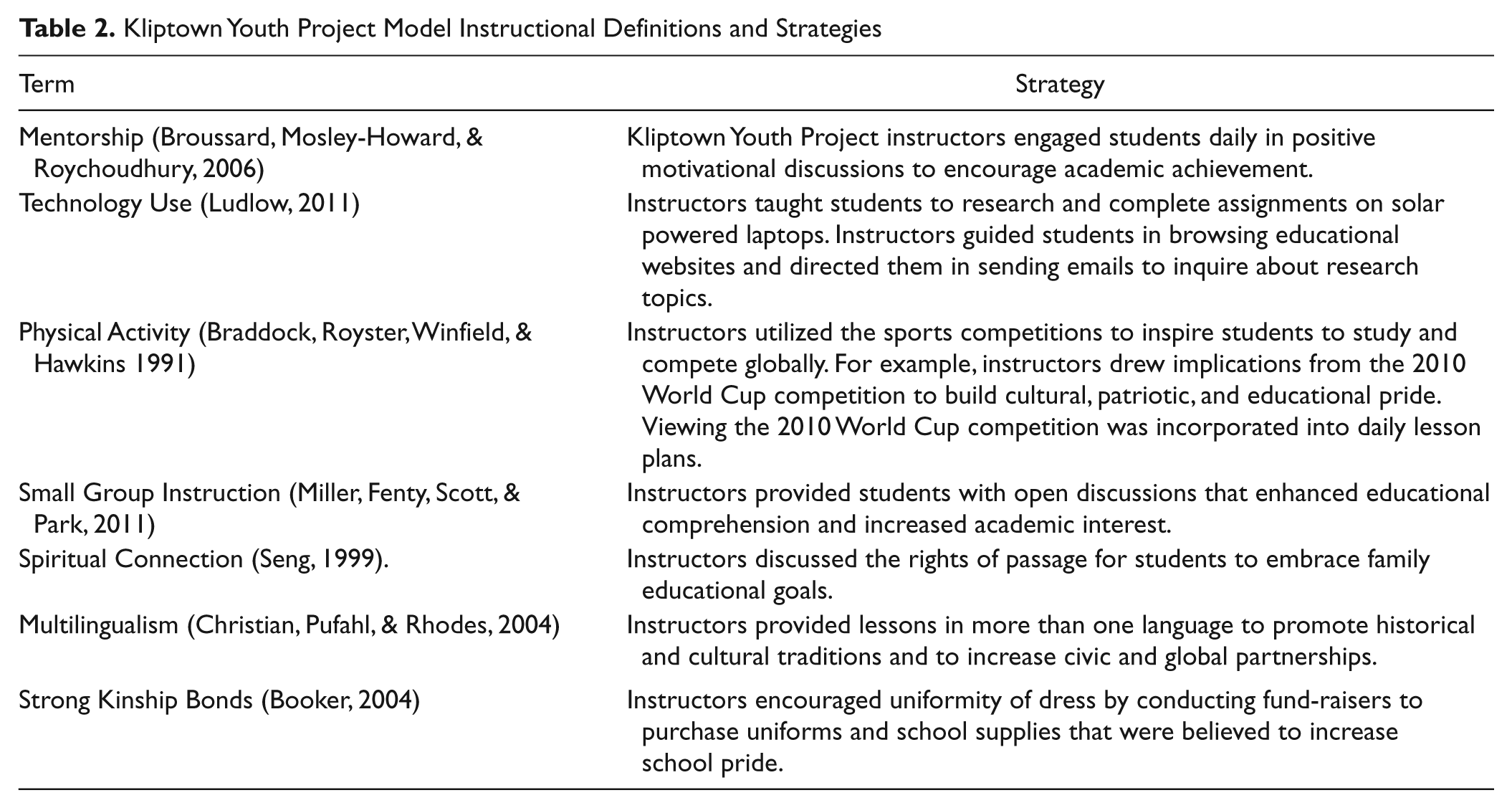
Kliptown Youth Project instructors, along with volunteer parents, provide support to students with disabilities. The KYP model incorporates well-defined practical strategies necessary to promote favorable academic outcomes for all students, including those with disabilities. During personal interviews, interviewees identified strategies that were effective in supporting the needs of all students: (a) mentorship (b) technology use, (c) physical activity, (d) small-group instruction, (e) spiritual connection (f) multilingualism, and (f) strong kinship bond (see Table 2).
Kliptown Youth Project Model Instructional Definitions and Strategies
Kliptown Youth Project is open to all students in an effort to bring the best of educational practices and ensure an equitable education for South African students. The project adds a special dimension to South African education. It is about “hands, minds, and hearts,” as all participants are fully engaged in academic and cultural practices conducive to positive future endeavors. The project incorporates many instructional strategies to educate and inspire all youth to achieve their goals. KYP’s inclusion of all students is making an impact in their lives now and in the future. Instructors identified materials, curriculum, and interventions utilized in supporting all students involved in the project. This information gives a voice to all those involved and speaks to what is going on in this township.
Conclusion
Educators in South Africa still grapple with creating supportive environments for students with disabilities. Grassroots initiatives, such as those identified in KYP, share in the development of centers designed to support students with and without disabilities. Whereas new political policies are partly responsible for an increase in appropriate education in South Africa, sustained change is also a result of continual evaluation of teacher practices and reform based on evaluation. The success of the project is due in part to strategies incorporated by motivated instructors who build academic pride through cultural practices. A lesson to be learned from KYP is that all students benefit when these global initiatives are institutionalized. A further lesson derived is that when marginalized populations receive innovative support, it increases their skill set while forming a sense of academic belonging.
The strategies incorporated in the project may be generalized across all global educational settings to support diverse learners. By using these strategies, students with learning disabilities are better equipped to navigate through school and beyond. The implementation of teacher strategies serves as a model for the success of a vast number of groups who are disadvantaged for one reason or another.
Footnotes
Declaration of Conflicting Interests
The author(s) declared no potential conflicts of interest with respect to the research, authorship, and/or publication of this article.
Funding
The author(s) received no financial support for the research, authorship, and/or publication of this article.