



Abstract
Many schools have adopted schoolwide intervention blocks as a component of response-to-intervention (RTI) implementation to ensure that students who need intervention are receiving it. However, virtually no peer-reviewed guidance exists for helping teachers manage this time effectively. This article presents a blueprint for organizing intervention block time so that all students benefit. Teachers and principals should consider (a) identifying appropriate assessment and intervention resources, (b) determining professional development needs to improve capacity for intervention delivery, (c) using personnel resources in the most effective way, (d) structuring the time to deliver interventions and engage students who are not receiving intervention, and (e) optimizing the physical space available to deliver interventions. Specific planning considerations are outlined and suggestions for monitoring fidelity of implementation are presented.
As of 2011, 94% of schools across the county reported some level of response-to-intervention (RTI) implementation (Spectrum-K12, 2011). RTI involves providing multiple tiers of evidence-based instruction to meet students’ individual learning needs. The RTI framework comprises several common features, including universal screening of all students, multiple tiers of instructional and intervention service delivery, a collaborative problem-solving method, and an integrated, ongoing data collection and formative assessment system to inform educational decisions at each tier (Batsche et al., 2005; Fuchs, Fuchs, & Compton, 2012). At the school level, decisions such as (a) which universal screening and progress monitoring tools to use, (b) how often to meet for problem solving, and (c) how to deliver instructional interventions are influenced by the district and also by local contextual factors specific to the individual school community. While in many ways this offers an opportunity to develop a culturally responsive RTI approach, much of the existing research on RTI has focused on exploring assessment practices across tiers and the efficacy of specific interventions (e.g., Gresham, 2007; Mastropieri & Scruggs, 2005; VanDerHeyden, Witt, & Gilbertson, 2007), which may provide an overly simplistic view of RTI, overlooking the complexities involved in sustainable schoolwide implementation.
While RTI models depend on the implementation of evidence-based instruction and intervention, coordinating tiered instructional delivery in a way that effectively capitalizes on building resources has been one of the most daunting aspects of schoolwide implementation (Fletcher & Vaughn, 2009). A primary goal of RTI is to address the needs of all learners (i.e., students with and without disabilities, struggling learners, English language learners, gifted learners) in the general education classroom by using preventive evidence-based instruction.
RTI and Special Education
The relationship between the RTI framework and the delivery of traditional special education services (i.e., those outlined in Individualized Education Plans [IEP]) remains a source of considerable confusion. For example, some believe that Tier 3 is special education or that special education exists outside of the RTI triangle—neither of these interpretations is quite accurate (Fuchs, Fuchs, & Stecker, 2010). Within an RTI framework, the learning and behavioral needs of all students are addressed, including students with special education needs. Ongoing collaboration between general and special educators at all tiers of the model allows for sharing of strategies and skills related to assessment, differentiation, and progress monitoring that will benefit students with and without disabilities (Murawski & Hughes, 2009).
For students with the most significant of learning and behavioral needs, the framework aims to ensure that instruction is delivered in responsive way in which intensive instructional components are systematically faded as goals are met and until the least restrictive intervention has been reached (Barnett et al., 2006). As such, many of the same principles apply in terms of the organization and delivery of supports for students with and without disabilities (e.g., scheduling time outside of core instruction to meet students’ needs, monitoring effectiveness and fidelity of interventions). Interventions are also fluid and domain specific. Therefore, a student with a reading-related disability may benefit from Tier 2 or 3 math or behavioral interventions outside of the context of his or her IEP.
Why Create a Schoolwide Intervention Block?
In light of the highly varied intervention needs of students within a single class, Murawski and Hughes (2009) have suggested, “It would be folly to imagine that individual teachers can accomplish this alone” (p. 4). One of the biggest challenges to successful RTI implementation is finding time to consistently deliver interventions (Easton & Erchul, 2011; Kupzyk, Daly, Ihlo, & Young, 2012) and increasingly, many schools are adopting a schoolwide intervention block as a structure to allow for collaboration among all school personnel, including special educators, general educators, and other staff, to provide targeted and organized delivery of interventions. However, a recent search of ERIC and PsycINFO generated no peer-reviewed articles exploring this promising infrastructure, substantiating other scholars’ calls for more research that investigates the complexities of schoolwide RTI implementation (Fletcher & Vaughn, 2009; Wixson, 2011). This article acknowledges the potential of schoolwide intervention blocks in allowing teachers to deliver targeted instruction in a way that capitalizes on the building’s resources and proposes a blueprint for organizing intervention block time so that all students benefit.
As noted, one of the biggest challenges to successful RTI adoption is finding time to consistently deliver interventions (Easton & Erchul, 2011; Kupzyk et al., 2012). Between assemblies, end-of-unit assessments, field trips, and the like, teachers often find their time for interventions constrained by other activities. Many schools are thus adopting a schoolwide intervention block to organize the delivery of interventions (Hall, 2008). Scheduling an intervention block is envisioned as a promising option for increasing the efficiency, effectiveness, and fidelity of intervention delivery (Hall, 2008; Harlacher, Walker, & Sanford, 2010). Schoolwide intervention blocks are defined as a designated time during the day (generally lasting 30 to 45 min) when all students needing Tier 2 or Tier 3 interventions can receive specialized instruction.
The Components of RTI: An Overview
It is helpful to briefly review the essential features of the RTI framework, including what is meant by intervention. The conceptual model of RTI comprises several common features, including universal screening of all students, multiple tiers of instructional and intervention service delivery, a problem-solving method, and an integrated data collection system to inform decisions at each tier of service delivery (Batsche et al., 2005; Gresham, 2007; Wixson, 2011). The RTI framework represents a shift from the traditional “wait-to-fail” approach (Burns, Riley-Tillman, & VanDerHeyden, 2012) to a proactive approach, in which differentiated instruction and intervention are provided to all children to prevent small gaps in student achievement from becoming large ones (Murawski & Hughes, 2009). Emphasis is placed on differentiated core instruction at Tier 1, which is delivered to all students and has a high likelihood of bringing the majority of students to acceptable levels of proficiency. Students who are not making sufficient academic gains when provided with core instruction alone receive supplemental Tier 2 instruction in small groups of three to six students several times per week (Fuchs & Vaughn, 2012). Tier 3 involves the application of individualized, intensive instructional interventions provided daily that are designed to increase the rate of student progress. Interventions, then, are evidence-based instructional approaches that supplement and intensify classroom curriculum and instruction to meet student needs. An intervention can be academic or behavioral, but all interventions must have (a) a plan for implementation, (b) evidenced-based pedagogy, (c) criteria for successful response, and (d) assessment to monitor progress. The effectiveness of interventions is determined by collecting data about students’ progress on a regular basis. Educators collaboratively evaluate the data (e.g., via progress monitoring cycles every 6 to 8 weeks or more often) to make informed decisions about instructional needs and to modify the intensity or type of supports provided (Batsche, Curtis, Dorman, Castillo, & Porter, 2007; Gresham, 2007). In this way, intervention can be provided quickly and responsively to all students who need it, regardless of whether they have been identified with special education needs.
Delivering Interventions
Some schools are adopting an “all-hands-on-deck” philosophy in which (nearly) all of the educators in the building temporarily become interventionists in an effort to maximize teaching resources (e.g., Lembke, Garman, Deno, & Stecker, 2010). In this article, interventionist refers to a licensed educator who is able to provide direct instructional intervention in a particular area of the curriculum. Incorporating an intervention block in a school’s master schedule offers several advantages, including (a) facilitating fidelity of implementation (Hall, 2008); (b) communicating to teachers that the school’s administration values the activity; (c) allowing for cross-class (and even cross-grade), data-informed intervention groupings; (d) creating predictability for students and teachers; and (e) ensuring that interventions are supplemental to core instruction. However, using an intervention block effectively requires careful planning and ongoing monitoring to make sure everyone is getting the most out of the time.
Planning the Logistics of an Intervention Block
Using an intervention block effectively can be more challenging than teachers might think. One way to begin this effort is by ensuring that there is a school leadership team or RTI steering committee that is composed of representatives from school leadership, teachers, support staff, and specialists. Some of the things that the RTI steering committee should consider include (a) identifying appropriate assessment and intervention resources, (b) determining professional development needs to improve capacity for intervention delivery, (c) using personnel resources in the most effective way, (d) optimizing the physical space available to deliver interventions, and (e) structuring the time to deliver interventions and engage students who are not receiving intervention. This list may seem daunting and leave teachers feeling like they are left with another period to plan, which is an overwhelming thought considering the many demands teachers face daily. But with some lessons learned from schools that have successfully implemented intervention blocks, the process can actually be more or less painless, efficient, and highly effective in providing interventions that support core Tier 1 instruction. Many schools use interventions blocks to provide Tier 2 interventions only. However, depending on student need and personnel availability some schools find that they are able to deliver small-group Tier 2 interventions as well as individualized Tier 3 interventions during the block.
Identifying Assessment and Intervention Resources
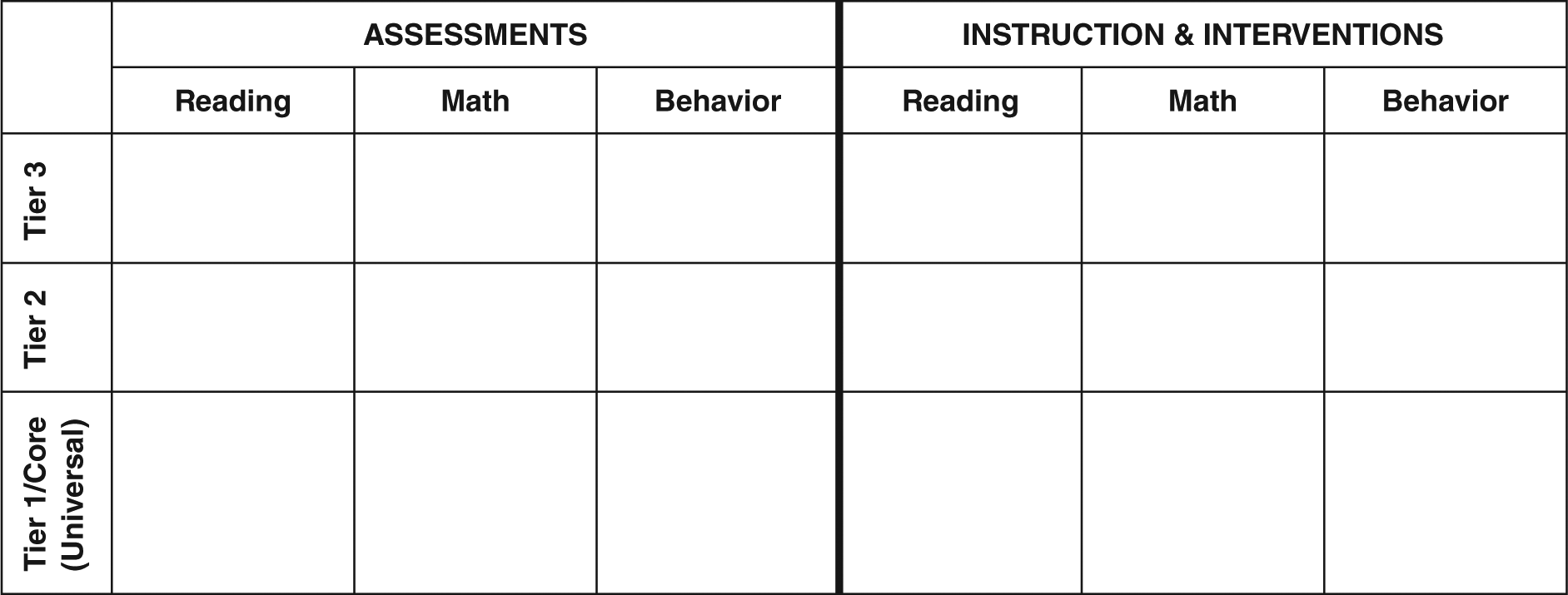
When a school decides to use a universal intervention block model, there are several steps that schools need to take even before the new schedule is in effect. For one thing, administrators and teachers need to think strategically about what assessments and interventions the school already has the knowledge and resources to provide (Easton & Erchul, 2011). In the planning phase, an assessment and intervention inventory can be instrumental. When schools sit down to create an inventory, they often find that they have more resources than they thought: One teacher has a vocabulary building program in her closet that she has not used in years; another was trained in providing peer-mediated intervention at a previous job; and the principal, who was trained as a special educator, knows a particular reading program. When teachers and administrators actually itemize the assessment and intervention resources existing among the staff, they often realize that techniques they use as part of their everyday teaching practices, applied more strategically and intensively, could serve as interventions.
The assessment and intervention inventory depicted in Figure 1 provides a mechanism for organizing resources within a school. Initially, the RTI steering committee at a school might work together to complete this inventory, and then committee members may take the inventory to grade-level teams to make sure that they captured a complete picture of available assessments and interventions.
Assessment and intervention inventory.
Determining and Addressing Professional Development Needs
The RTI steering committee should then use student data to discuss areas in which interventions or assessments are still needed (e.g., comprehension interventions in the fourth and fifth grades or progress monitoring in math; Easton & Erchul, 2011). By comparing areas of need with the interventions and assessments currently available, the committee will be able to identify gaps. Once these gaps are identified, the committee can think about creating a professional development (PD) plan for the upcoming year that targets areas of highest need. A PD plan for the year may include finding time for teachers to teach each other or to swap intervention programs to learn and use. For example, the principal could organize a conference-style PD session in which teachers choose among sessions delivered by other teachers. These sessions would demonstrate an evidence-based intervention, how it is delivered, to which students, what area of difficulty it will address, and how to monitor progress. Teachers can then attend one or two sessions based on the needs of their current students. When there is an area of intervention needed for which no one in the building is trained, teachers may need to look outside of the building for additional support or training, or they may need to look online at websites, like the National Center for Response to Intervention (www.rti4success.com) or the National Center for Intensive Interventions (www.intensiveinterventions.org), which provide summaries of evaluations of various intervention programs. Similarly, if an assessment to monitor progress of a particular skill is still needed, teachers may want to talk with same-grade colleagues at other schools to see what tools they are using.
Maximizing Personnel Resources
Once assessments and interventions have been inventoried and plans have been made to cultivate new skills and interventions within the building, the RTI steering committee will need to start thinking creatively about assigning staff to be interventionists in different classrooms. This is a way to provide extra support to students who do not have identified special education needs. Considerations include the following: Are there specials teachers (e.g., music, art, physical education, occupational therapy, speech) who will be available since all students are engaged in the intervention block? What about the school psychologist, social worker, or principal? Are there technology resources available during this time to support students with supervision? By adopting an “all-hands-on-deck” approach that pools teaching resources, schools are able to deliver services to the greatest number of students possible (Lembke et al., 2010).
After compiling a comprehensive list of available interventionists, it is time to start thinking about who will be the best fit and where. Consider where highly specialized educators, such as the literacy specialist and English as a Second Language (ESL) teacher, might have the most leverage. For example, the ESL teacher can work on vocabulary strategies with English learners who are newcomers. If there is a need for socioemotional interventions, perhaps the behavior specialist would be well suited to the task. For students without identified special education needs who are not receiving an intervention, consider independent work or project-based learning facilitated by a specialist in the building, such as the art teacher. Anticipate which personnel might need additional training to support intervention delivery or even classroom management if they are monitoring independent work. There are many different considerations that are specific to individual schools, but it is important to assign the most highly qualified educators to the students whose intervention needs are greatest.
Structuring Intervention Time to Engage All Students
When schools adopt an RTI model, there is usually a big emphasis on collecting and using data to make decisions about who receives intervention and for how long (Burns, Scholin, Kosciolek, & Livingston, 2010). However, many teachers do not know how to use data effectively (Schildkamp & Kuiper, 2010), and even when they are comfortable using data, they tend to perceive that they do not have permission to step outside their core responsibilities to conduct data analysis (Ingram, Seashore Louis, & Schroeder, 2004). But research has shown that the organizational context of a school can facilitate improved use of data (Schildkamp & Kuiper, 2010). Specifically, teachers must have time to collect, analyze, and, importantly, talk about and interpret data in collaborative meetings (Datnow, Park, & Wohlstetter, 2007). To this end, the school leader should build dedicated time into the schedule for collaborative grade-level problem solving, and the RTI steering committee should develop decision rules, also known as cut scores, to facilitate teachers in identifying which students need intervention (Silberglitt & Hintze, 2005). Figure 2 provides a tool that schools can use to organize grade-level student data. Using this tool in conjunction with student data, teachers can come together to determine which students need interventions and in which areas (i.e., English language arts/reading, math, or behavior). This tool provides a bird’s-eye view of student needs at each grade level to help teachers think collaboratively about how to structure the 40-min intervention block.
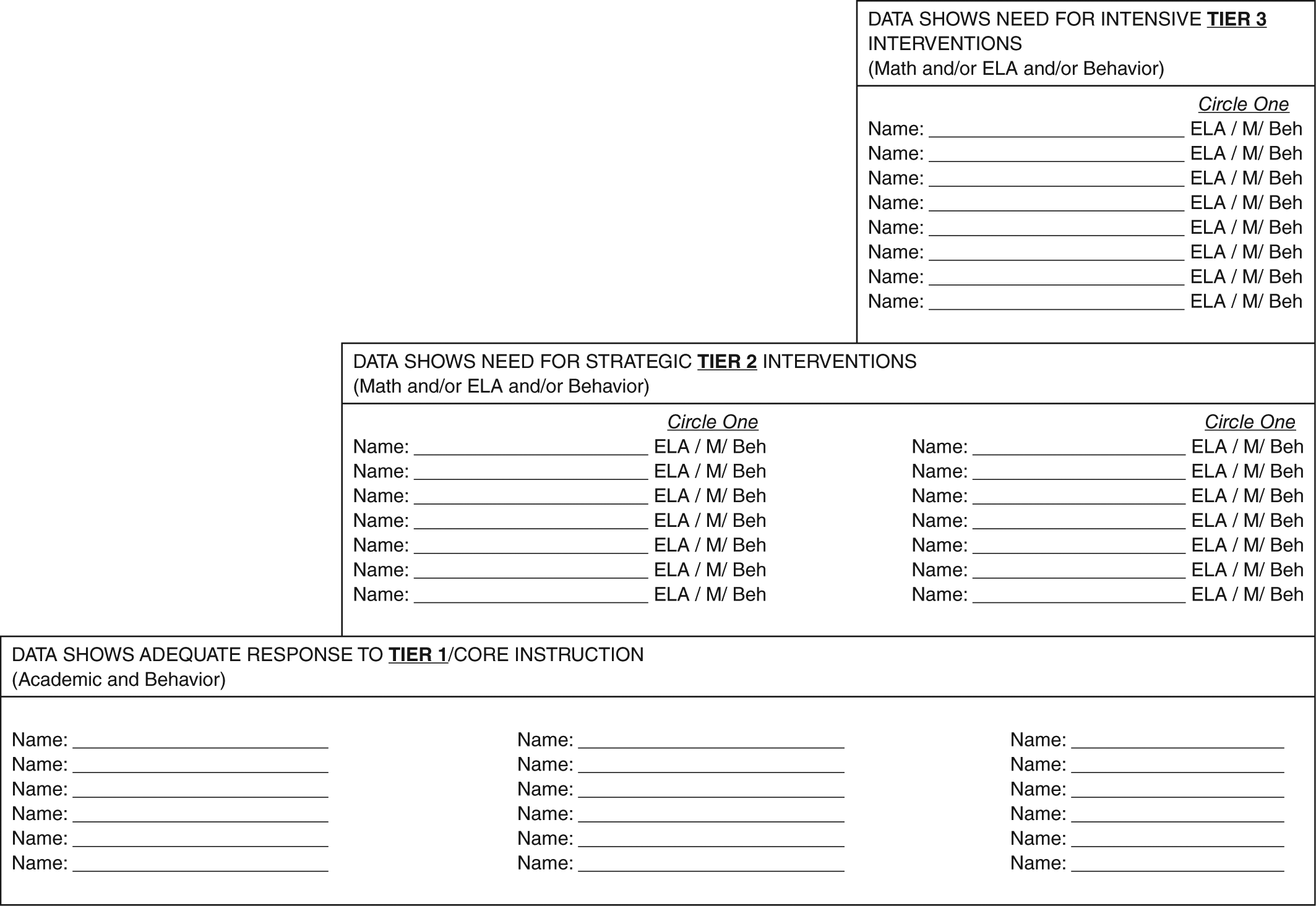
Grade-level data organizer. Adapted from “A Collaborative Planning Framework for Teachers Implementing Tiered Instruction,” by S. K. Stuart and C. Rinaldi, 2009, Teaching Exceptional Children, 42(2), p. 54. Copyright 2009 by Council for Exceptional Children. Reprinted with permission.
Once teachers have a sense of the types of interventions needed, they must figure out how to use the intervention block time to engage all students. This can be one of the most challenging aspects of having an intervention block, but creative use of resources can help. In schools adopting intervention blocks, classroom teachers generally have another person (e.g., paraprofessional, tutor, literacy specialist) assigned to help out during intervention block time. Other same-grade teacher colleagues likely have additional personnel support coming to help them as well. It is often helpful to pool collective personnel resources to figure out how to support all grade-level students during the intervention block time (Lembke et al., 2010).
Figure 3 depicts a fifth grade with two homerooms of students (44 students total). The schoolwide intervention block occurs from 9:00 to 9:45 a.m. every day except Friday. The grade-level teachers used universal screening data in reading and math to create eight small, leveled groups. Groups A and B are the highest-performing students who have met benchmarks. Two educators are in each room. In other words, one classroom teacher and the paraprofessional are in Homeroom 101, each working with a group for about 20 min. A second classroom teacher and a special educator are in Classroom 102, each working with a group for about 20 min. In this way, four groups are taught at a time, while the other four groups work independently or work together using a peer-assisted instructional strategy. After 20 min, the groups switch, so that all eight groups receive 20 min of intervention and 20 min of independent work. The paraprofessional works with the highest groups. Other groups are mixed depending on area of need.
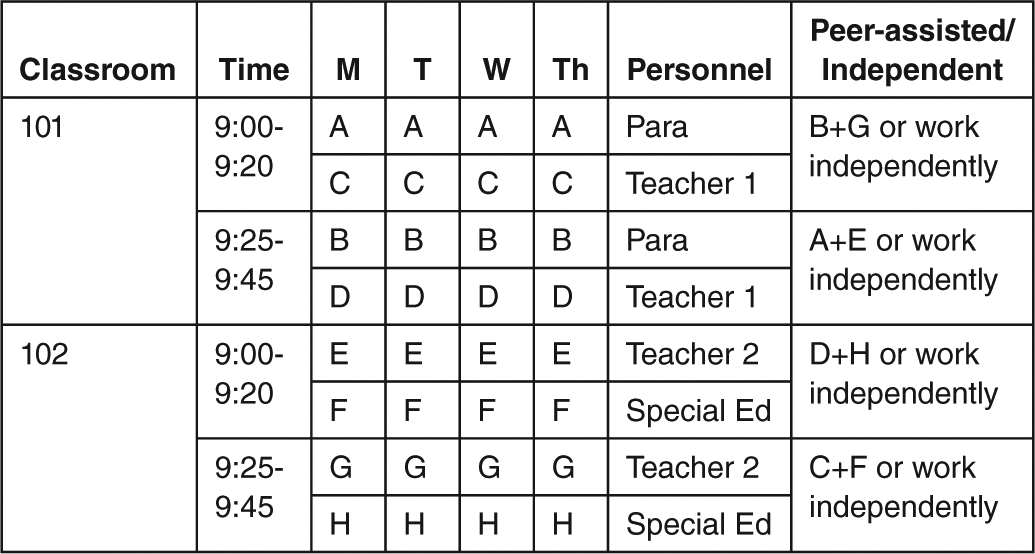
Sample intervention block schedule.
Students at Benchmark
In this example, there are students whose data do not indicate a need for Tier 2 or Tier 3 intervention. When establishing an intervention block, teachers often worry about what those students will do while their classmates are receiving intervention. First and foremost, it is important to remember that the goal of RTI and thus the intervention block is to provide supplemental, consistent, and high-quality interventions to those students who need them (Burns et al., 2010, p. 110). This time can also benefit students at or above grade level, giving them opportunities to go deeper with the curriculum and become engaged as teams on problem-based learning. Sometimes there are personnel available to work with students who are already at benchmark (e.g., Groups A and B in Figure 3). In this case, remember to assign the most highly qualified personnel to work with the students who have the most challenging needs. In the previous example, the paraprofessional was assigned to support the students at benchmark, while the general and special educators worked with students needing Tier 2 or Tier 3 intervention.
However, personnel are not always available to work with students at benchmark or to monitor their independent work. Just as with every period of the school day, classroom routines and procedures will facilitate the effectiveness and quality of the intervention block (Rimm-Kaufman, Curby, Grimm, Nathanson, & Brock, 2009; Simonsen, Fairbanks, Briesch, Myers, & Sugai, 2008). For that reason, especially when initially establishing the intervention block, it is recommended that students who are not receiving interventions should take part in a simple but engaging academic activity, such as independent reading at their instructional level. Teachers should allow students to choose their own book, with some guidance for identifying “just-right” books, to increase the likelihood that they will remain motivated and on task during this time. (Sanden, 2012), Other teachers have discovered that once the intervention block is running smoothly and extra staff are available, they are able to do some sort of enrichment activity (e.g., literature circles, problem-based learning) during the block. Table 1 shows some options for engaging students who are not receiving Tier 2 or Tier 3 intervention during the block.
Options for Engaging Students at Benchmark During Intervention Block.
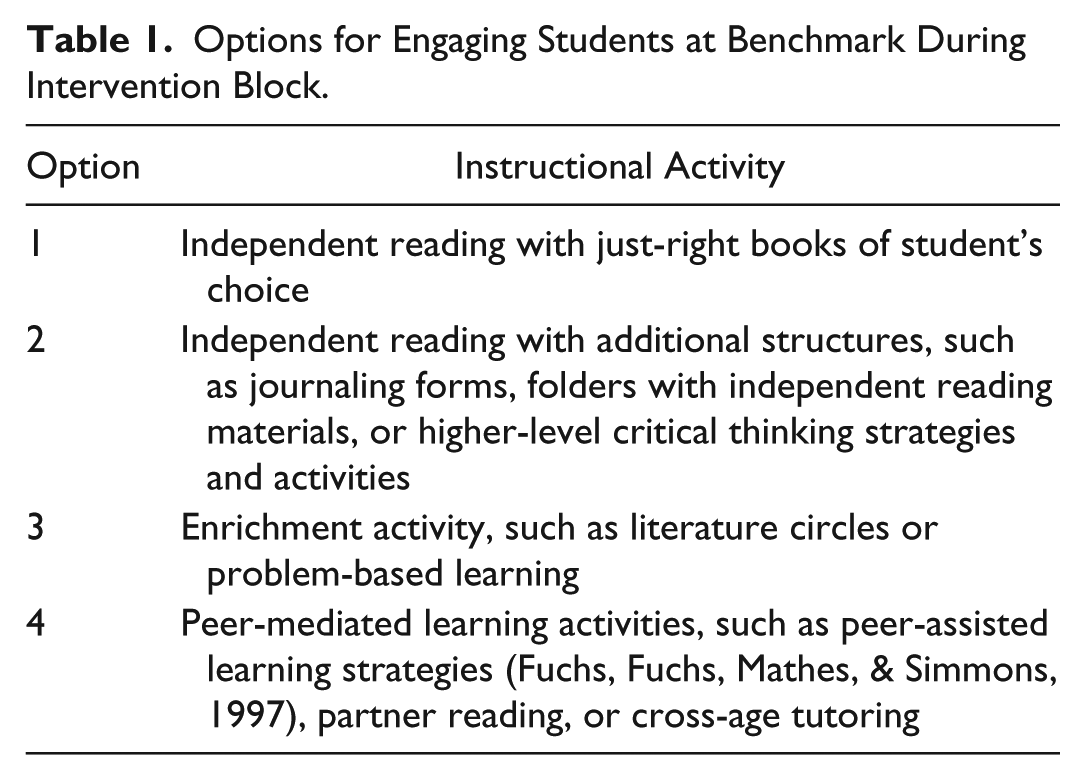
The fourth option listed in Table 1 highlights peer-mediated learning activities as a possibility for engaging learners who are not receiving intervention. In this way, students can work together in a structured and cooperative dyad to develop academic skills. Peer-assisted learning strategies (PALS) (Fuchs, Fuchs, Mathes, & Simmons, 1997) is one specific peer-mediated learning process that is used to improve reading fluency and comprehension. Teachers strategically pair students, and the partners work on different activities that address fluency and comprehension using a structured protocol for immediate corrective feedback in a reciprocal teaching interaction. The PALS strategy offers a script for student dyads so that student interaction is highly structured, reinforcement and feedback are consistent, and social skills and cooperation are developed. Collaborative strategic reading (CSR; Klingner & Vaughn, 1998) is another cooperative strategy in which students work in groups to improve their reading comprehension. In this strategy, students take on specific roles to facilitate each other’s understanding of a text. These are just two of several paired or cooperative student learning experiences that may make sense during an intervention block. Teachers should begin by establishing intervention groups and then find a setup that works well for students not receiving intervention.
Using Space Wisely
It can be complicated to have students working on so many different things at the same time, but it does not need to be chaotic. The physical arrangement of a classroom impacts student behavior (Simonsen et al., 2008), and it is possible to arrange classroom space to maximize the effectiveness of the intervention block time. First of all, teachers should be consistent and make sure that the time is predictable. For example, as much as possible, groups should meet in the same place each time they meet. Depending on the physical setup of the classroom, this may entail moving furniture for intervention groups. If furniture does need to be moved, the first thing that teachers should do is give students clear instructions about what the intervention block setup looks like. Posted pictures and schedules should show where things should go, or markings on the floor with masking tape should show where desks/tables belong. Teachers should be explicit about what students’ roles are (i.e., who moves what; what goes first, second, etc.). Before having students move into another room for intervention, consider whether the teacher can come to them. This will reduce transition time and increase minutes available for instruction. If students do have to move, establish a routine for what materials to bring, how to line up, and where to sit in the new classroom. Considering space with an eye for efficiency will minimize transition time and maximize time for learning (e.g., see Simonsen et al., 2008).
Avoiding Pitfalls in Using an Intervention Block
Maintaining Dynamic Groupings
After putting all of the work into assigning staff, developing data-informed groups, deciding on intervention strategies, and developing routines, it is tempting to let the intervention block run and not make any changes. This is one of the biggest pitfalls associated with having intervention blocks. It is essential to remember that RTI groups are dynamic (Murawski & Hughes, 2009) and should change throughout the year to reflect students’ progress in particular areas based on data. So when teachers establish groupings within the intervention block, they should prepare themselves and students for the likelihood that they might change. A teacher who is assigned to a small group of students working on phonics at the beginning of the year, for example, might be reassigned to supervise students who are not receiving interventions when midyear screening data and teacher problem-solving reveal that many students have made sufficient progress and only a small portion of the class still requires intervention.
When should teachers make changes? This represents one of the most-researched areas of RTI implementation (Ball & Christ, 2012; Riley-Tillman, Burns, & Gibbons, 2013; Shapiro et al., 2012; Shinn, 2007) and yet still remains an area of challenge in many schools (Burns et al., 2010). While a discussion of the implications of various decision-making models is beyond the scope of this article, schools should adopt some guidance about progress needed to make changes to an intervention. Remember that for all students in intervention groups, progress-monitoring data should be collected (biweekly for students receiving Tier 2 interventions; weekly for students receiving Tier 3 interventions). The RTI steering committee should establish criteria about the rate of progress needed to release a student from intervention. On the flip side, it is important to decide on criteria that indicate when a student needs a different or more intensive intervention. In some cases, it may make sense to modify an intervention for an entire group. Other times, an individual student should be moved to a different intervention group (e.g., from reading accuracy intervention to a fluency intervention) or can be phased out of intervention all together if he or she has met all benchmarks. As a rule of thumb, changes to intervention groups should occur at least at the midyear point when universal screening assessments will be readministered and other midyear data are collected (e.g. diagnostic tests, classroom data, attendance).
Monitoring Fidelity
Intervention blocks are only as effective as schools make them. Although many teachers start off with the best of intentions about maintaining dynamic and flexible groupings, ensuring smooth routines, and differentiating instruction across groups, it can be easy to lose momentum when other responsibilities begin to pile up or when interruptions, like field trips or snow days, disrupt the routine. As such, as with any intervention or program, assessment of implementation fidelity is critical to understand ensure practices are effectively in place (Durlak & DuPre, 2008). Many schools use a checklist of essential practices to monitor fidelity (Schulte, Easton, & Parker, 2009). It is generally most practical to have teachers self-report their fidelity, using a checklist like the example shown in Figure 4. Periodically, an outside observer who understands the components of the intervention block (e.g., another teacher) should also observe fidelity, with more frequent observations when fidelity is of concern (DiGennaro, Martens, & McIntyre, 2005). This observer should provide feedback and suggestions as needed, which has been shown to improve fidelity (Noell et al., 2005).
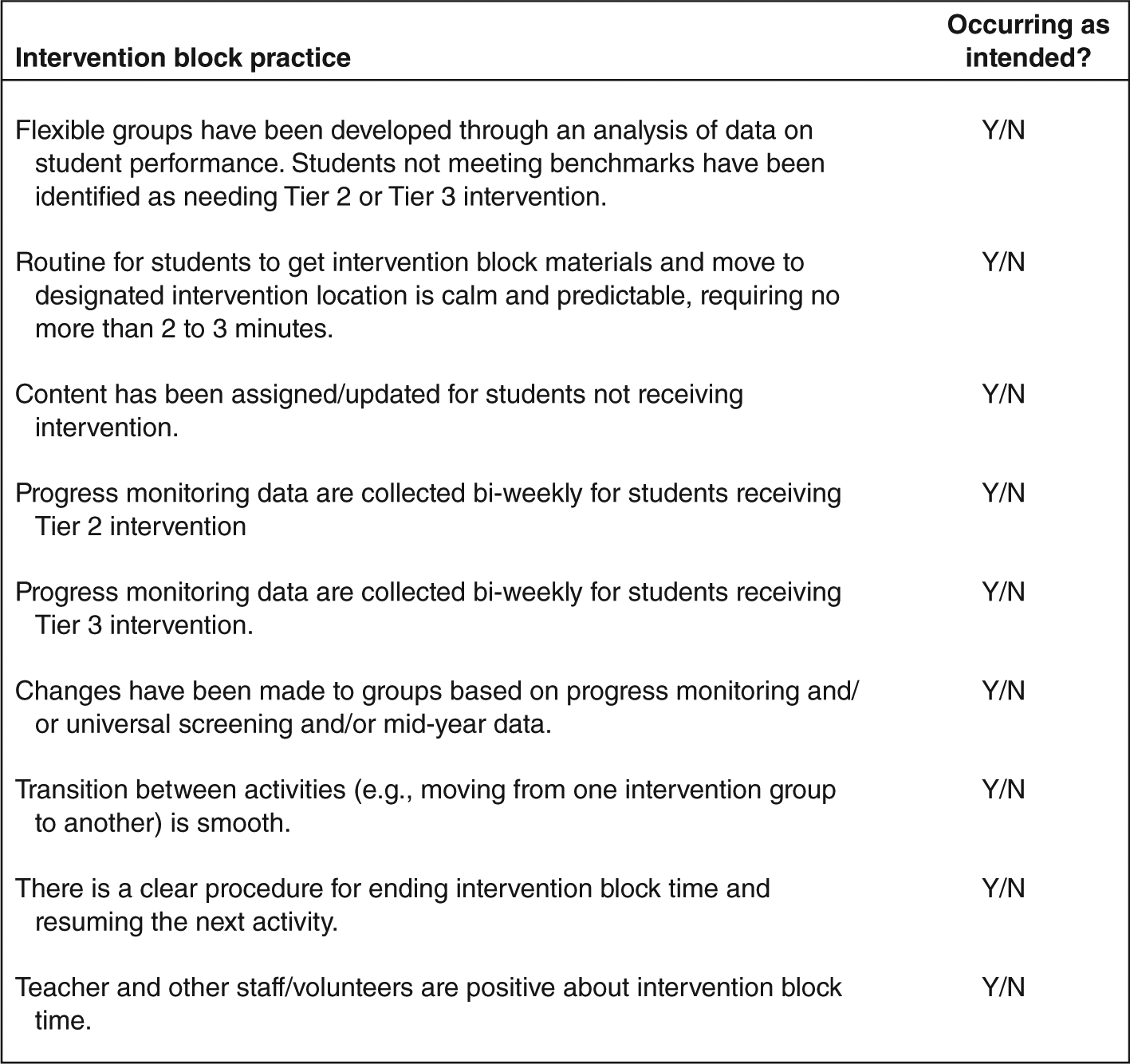
Monitoring fidelity of intervention block practices.
Responding to the School Context
Finally, it is worth noting that while the schoolwide intervention block represents a model that is gaining traction as schools advance their implementation of RTI, it may not be the best fit for all schools. In K–12 or even K–8 schools, it is sometimes impossible, and moreover, impractical, to find a universal time for all students to receive intervention. In these cases, the school sometimes creates leveled intervention blocks (e.g., K–2, 3–5, 6–8, 9–12) or individual grade levels carve out common time for the delivery of interventions. Even if it does not make sense to have a schoolwide block, at a minimum it is very helpful to organize common intervention time at each grade level in order to pool and strategically assigned and distribute some instructional resources. When planning the delivery of interventions, be sensitive to the school’s unique context and use that as a starting point for determining what model makes the most sense.
Conclusion
Many schools have adopted schoolwide intervention blocks as a way to implement RTI and ensure that students who need intervention are receiving it, but virtually no guidance exists for helping teachers manage this time effectively. This article has shared lessons learned to create a blueprint for organizing intervention block time so that all students benefit and so that teachers do not become overwhelmed in making it all happen. Planning structures, identifying resources, and determining professional development needs are key to beginning the process described in this article. Looking beyond classroom teachers to pool and maximize personnel resources inside and outside of the school increases the likelihood that students can benefit from the intervention block. Organizing instructional time strategically will also support the sustainable implementation of the intervention block for teachers and students. By incorporating data-informed instruction, careful planning for logistics, and ongoing self-assessment of practice, intervention blocks can become a powerful schoolwide structure for engaging learners with disabilities and their typical peers in differentiated and responsive instruction.
Footnotes
Authors’ Note
Diana Baker is now Assistant Professor of Education at Hobart and William Smith Colleges, Merritt Hall, Geneva, NY 14456. Claudia Rinaldi is now Chair, Department of Education & Associate Professor, Lasell College, 1844 Commonwealth Avenue, Newton, MA 02466.
Declaration of Conflicting Interests
The author(s) declared no potential conflicts of interest with respect to the research, authorship, and/or publication of this article.
Funding
The author(s) received no financial support for the research, authorship, and/or publication of this article.