



Abstract
One of the most frequent problems in reading comprehension is the difficulty in making inferences from the text, especially for students with mild disabilities (i.e., children with learning disabilities or with high-functioning autism). It is essential, therefore, that educators include the teaching of reading strategies to improve their students’ ability to extract inferential information from texts. This article describes one such strategy for improving inference-making called “Detective Questions.” It is a strategy that, in an explicit and scaffolded way, teaches children to discriminate between inferential and literal information and to find the information they need to answer questions on the text. The inclusion of this type of strategy improves children’s reading comprehension in a motivating way and may therefore become an essential part of the teacher’s repertoire of techniques for teaching reading.
Daniel is in third grade and after a lot of hard work with his teacher, he has managed to read very quickly; he now makes very few mistakes in spite of the words being long or infrequent. However, his teacher, Mr. Martin, has noticed that, in spite of Daniel’s improvement in reading fluency, he still does not manage to answer all comprehension questions correctly. His teacher has analyzed the errors made by Daniel and has observed that he can answer all the literal questions properly but not the inferential ones. … Mr. Martin has even noticed how Daniel, on occasion, re-reads the text looking for the answers and finally says, “It doesn’t say that here” (See Note 1).
One of the most difficult skills that young readers need to acquire is the ability to deduce information that does not appear explicitly in the text—that is, the ability to infer. In inferential comprehension, readers must combine different types of information, such as personal experiences, prior knowledge, and/or information extracted from previous parts of the text. In contrast, literal comprehension involves recognizing and remembering facts exactly as they were written in the text (Woolley, 2011).
The complexity of drawing inferences leads to many students with disabilities showing deficits in reading comprehension (Laing & Kamhi, 2002). For example, there are children like Daniel who, in spite of having good decoding skills, find it difficult to make inferences. This fact is corroborated by a substantial body of research, which shows that many children have adequate reading fluency but difficulties in drawing inferences (Fletcher, Lyon, Fuch, & Barnes, 2007; Oakhill, 1993). Kispal (2008), in a review of the literature, suggested that the ability to draw inferences predetermines reading comprehension: This means that poor inference-making causes poor comprehension, and not vice versa.
Readers with autism spectrum disorders (ASD), particularly with high-functioning autism (HFA), may find it difficult to make inferences. As Griffin, Griffin, Fitch, Albera, and Gingras (2006) explained, individuals with ASD have deficits in understanding complex social interactions, which in turn affect their reading comprehension skills, especially inferential comprehension (Myles et al., 2002; Saldaña & Frith, 2007). In this regard, studies involving children with ASD or HFA have demonstrated a paradoxical combination of good word identification (i.e., in the sense that they are fluent readers) and difficulties in reading comprehension (O’Connor & Klein, 2004).
Children with learning disabilities (LD) are another group of readers who find it difficult to make inferences. The majority of students with LD (at least 80%) have severe problems when learning to read, not only in decoding but also in comprehension (Gersten, Fuchs, Williams, & Baker, 2001). However, after specific and sustained intervention, there is generally an improvement in the decoding abilities of these children, but their reading comprehension problems persist, especially in the understanding of inferences.
Nevertheless, a body of research on intervention in reading comprehension has established that children with reading comprehension difficulties can be taught to use inference-making strategies effectively (Cain & Oakhill, 1998, 1999; Dewitz, Carr, & Patberg, 1987; McGee & Johnson, 2003; Risden, Trabasso, & Basche, 2001; Watson, Gable, Gear, & Hughes, 2012; see Woolley, 2011, for a review). Byrnes (2000) highlighted that even though reading fluency is a primary objective, an improvement in children’s inference-making abilities cannot be expected if the teacher focuses only on decoding and reading fluency tasks. For this reason, it is necessary to include explicit instruction of the process of drawing inferences in reading comprehension, in such a way that it is first modeled by the teacher and then practiced by the students (Woolley, 2011). Therefore, it is essential for teachers to go beyond teaching decoding and include explicit comprehension techniques, such as inference-making.
Teachers can use many strategies to help readers make correct inferences. In this column, one of these strategies, called “Detective Questions,” is described. This strategy could be used to improve the inference-making ability of children with ASD, HFA, and LD. The Detective Questions strategy can be carried out in a whole-class elementary school context, where it will benefit not only students with ASD, HFA, or LD but also other children in the classroom. However, it can also be applied individually or to small groups, depending on the difficulties experienced by students.
The specific example given in the following paragraphs is designed for third-grade elementary school children, although it may be adapted for students of any age group by increasing the difficulty of the texts, the vocabulary, and the type of inferences to be made.
Step 1: The Concept of Inference
The purpose of the first step is to help children understand the concept of inference, although it is not essential that this word be used. Rather, the main objective is that children understand what inference-making means. The teacher could begin with an explanation, as follows: “Today we’re going to do an activity about hidden information in stories. This is because the authors of stories do not always write everything they mean. So sometimes if you’re reading a story, you have to look for hidden clues to find the information the writer hasn’t written. Let’s look at some examples.”
Now the teacher presents some short, easy sentences, where the inference is evident, to facilitate as much as possible the comprehension of the inference concept. For example, the teacher might say: “Paula had to go back home to put on her coat,” and then ask: “What season of the year is it, winter or summer?” The class as a whole will answer this question, and the teacher will explain that, although the information is hidden, the children can easily answer the question. The teacher can now conclude the explanation by pointing out that although the word winter does not appear in the text, the children know that it is winter thanks to another piece of information that is present in the text, in this case the word coat.
This first step does not take much time; however, if the teacher realizes some children with difficulties have not understood, the same procedure may need to be repeated with other sentences. For example, another sentence that can be used at this level is: “Claudia spent the whole afternoon grading exams because she wanted to give the students their grade the next day.” The question could be: “What is Claudia’s job?”
Step 2: Differentiating Questions
The main purpose of this stage is to assist children in learning to differentiate two types of questions: literal questions (i.e., “transparent”) and inferential questions (i.e., “detective”).
For this purpose, the text should meet the following criteria:
It should be short (between about 100 and 200 words).
It should be a narrative. Inferences happen more automatically in this type of text because they have a close correspondence to everyday life (Graesser, Singer, & Trabasso, 1994). Expository texts can be used once the procedure of this strategy has been mastered by the child.
It should contain vocabulary that is suitable for the age of the children. Poor vocabulary knowledge is one of the most frequent deficits linked to reading comprehension problems (Clarke, Snowling, Truelove, & Hulme, 2010). The selected text should therefore include words already known to the children to ensure that any lack of vocabulary knowledge on their part does not interfere with the making of inferences.
By taking into account these criteria, the teacher can be sure that vocabulary in the text is easy enough for the children to follow so that most of their cognitive effort can be devoted to understanding its meaning.
The following text and procedure exemplify this step:
Two little mice which were playing in a valley woke up a lion who was beside a tree. Suddenly, the wild animal grabbed one of the mice, the bravest of them all. This mouse promised the lion that if he let him go, he would be his servant. This made the lion laugh, but he decided to free the little mouse. Some time afterwards, the lion was caught by a hunter. He couldn’t escape and his roars were heard throughout the jungle. The little mouse, when he heard this, went to the lion’s aid and chewed through the strings of the net with his sharp little teeth. This is how the little mouse kept his promise and saved the life of the king of the animals.
(Author’s version of Aesop’s fable The Lion and the Mouse)
The children must read the text very carefully because they know that afterwards they are going to answer questions about it. It is necessary to give all the children plenty of time to read it, especially students with LD, as they often have difficulties associated with accuracy and speed in decoding. These problems imply that children with LD need more time to read words (Jiménez-Fernández, Vaquero, Jiménez, & Defior, 2011). A way to reduce this difference in reading time is for the teacher to read the story out loud at medium speed while the students follow along on their own.
When the students have finished reading, the teacher asks if they have understood all the words they have read in the story. The purpose of this question is to be sure that there are no vocabulary problems that might hinder subsequent inference-making.
Now the teacher asks two questions and then demonstrates the differences between literal and inferential questions by comparison, saying, for example: Now, we are going to compare these two questions:
Question 1: Who woke the lion up?
Question 2: What was the lion doing beside the tree?
Please, underline in blue the answers to the questions you have found in the story.
The teacher will now allow some time for the students to carry out the activity, and then there will be a whole-class feedback, with the teacher saying something similar to:
Have you been able to find and underline the answer to Question 1?
The teacher then checks that the children were able to underline the answer to Question 1 (two little mice) and, if not, helps them to find the answer and underline it.
What about Question 2? Have you been able to underline the answer?
The teacher confirms that the children have not been able to underline the answer in the text, even though some of them knew the answer to Question 2. The lion was sleeping is the answer for Question 2, but you can’t underline it, right? This is because the storyteller has not written the answer to Question 2, but you could look for and find the clues in the text to answer it.
Which clue did you find to help you answer Question 2? Let’s circle it in red.
The teacher should check that all the children are circling “woke up” and at the same time explain that these two words gave us the clue that helped us answer the question, even though the author did not write the answer (see Figure 1).

Example to discriminate the answer to the “transparent” question (underlined) and the clue for the “detective” question (circled).
After the difference between the two types of questions has been clarified, the teacher now gives them names: “The questions with the answers you can underline are called ‘transparent’ because they are crystal-clear. The other questions are called detective questions because the answer is not written in the story, and you need to find clues in order to answer them. You have to be like a detective.”
Once the children know how to proceed, thanks to the first example, the teacher will give them new questions so that they can classify them as either “transparent” or “detective.” When the children have classified the new questions, the teacher corrects them and if necessary explains why they are of one type or another. The time devoted to this activity will depend on the age and degree of difficulties presented by the students in the group, and by the complexity of the text.
Step 3: Clues
This step goes into further detail about how to look for clues that will help answer detective questions. A useful strategy is to circle in the text words that are related to the question, for example, the verb “woke up” in Question 2. Here the teacher will explain that this verb helps us to deduce that the lion was asleep.
After the first example has been presented, the teacher asks the students to begin to identify the clues by circling them, which will help students answer the questions classified as detective questions in Step 2. While the children are doing this activity, the teacher will monitor students’ work and if necessary point out clues. See Figure 2 for an example of a template for use in activities with the different types of questions.

Template to support the activities with the different types of questions.
Last of all, it is of particular interest that children differentiate information not appearing in the text but which can be deduced (i.e., inferential) and information not appearing in the text that cannot be deduced. With this aim, the teacher introduces a third type of question: “trick questions.” The teacher explains that this kind of question has an answer that cannot be found in the text (i.e., like detective questions). The answers cannot be deduced nor can the students “look for clues” in order to answer them. Using the previous text, a trick question could be “What was the hunter’s name?” (see Figure 2). Once the expression has been introduced, the teacher proposes other examples in order to make sure that the children have understood it.
Once these three steps have been acquired (see summary in Figure 3), the complexity of the texts may be gradually increased. For example, expository texts may be introduced, and the difficulty of the inferences needed to answer the detective questions may be heightened. In addition, students may no longer be allowed to use colors or the template may be removed.
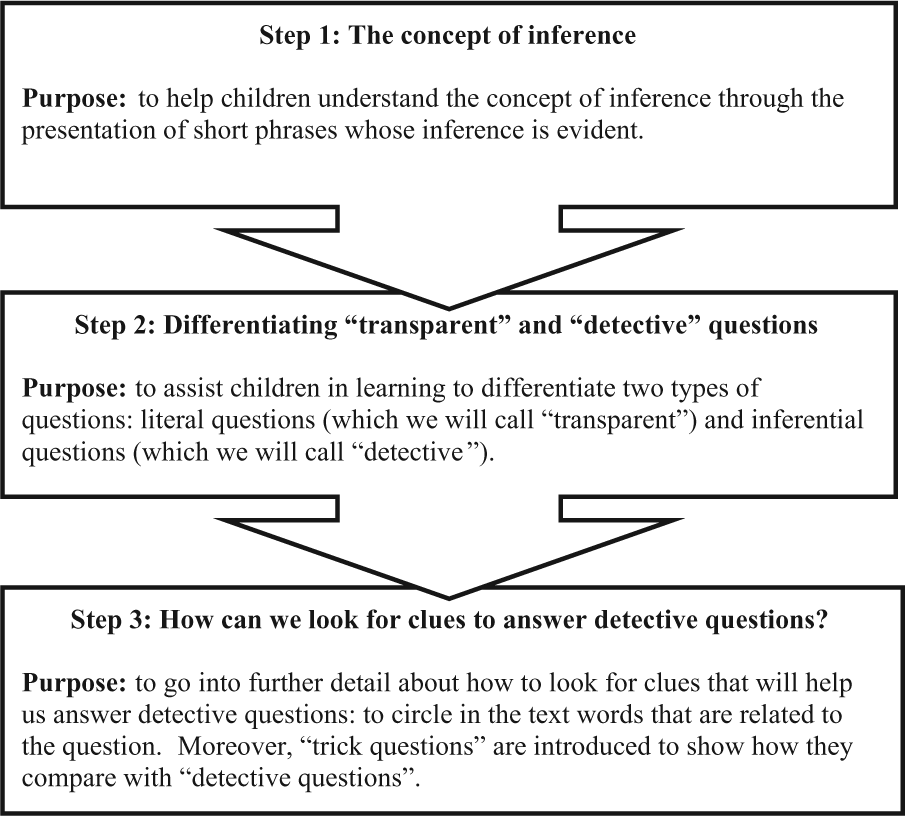
Summary of the steps of the Detective Questions strategy.
Other activities can be included to reinforce reading comprehension strategies. Here are instructions for two of the most effective variations:
Give children a text without any questions and ask them to formulate detective, transparent, and trick questions. This activity can be carried out individually or in small groups, each working with a different text. Once the questions have been written, the groups exchange texts and they must answer the questions written by the other groups.
Ask the children to add information to the text so that detective questions turn into transparent ones. For example: “Two little mice who were playing in a valley woke up a lion who was
In summary, reading comprehension difficulties are found frequently in children with different types of mild disabilities (Gersten et al., 2001). Especially problematic are those related to inference-making (Saldaña & Frith, 2007). This column has proposed an example of a strategy that may be used to support inferential understanding, called “Detective Questions.” This technique is based on teaching students to detect which questions are inferential and to look for information in the text that will help answer them. The three main steps to apply it have been described in an explicit and scaffolded way. These may be adapted depending on the child’s age and the specific difficulty students may present.
This strategy is only one example that has demonstrated its effectiveness in the daily teaching of elementary students and should naturally be an integral part of overall teaching techniques for the monitoring of reading. It is advisable to use different types of reading comprehension strategies to help children with disabilities to overcome their comprehension deficits and to develop into expert readers.
Footnotes
Declaration of Conflicting Interests
The author declared no potential conflicts of interest with respect to the research, authorship, and/or publication of this article.
Funding
The author disclosed receipt of the following financial support for the research, authorship, and/or publication of this article: This work was partially funded through research grant PSI2010-21983-C02-01 of the Spanish Ministry of Competitiveness and Economy (MINECO). It also was supported by research group HUM-820, of the Regional Government of Andalusia, in Spain.