



Abstract
Developing culturally responsive and relevant individualized educational programs (IEP) is becoming increasingly more important as the student population becomes more diverse. Current supports available for IEP teams primarily address the technical aspects of the IEP (e.g., writing goals that are measurable) but offer little assistance in designing culturally responsive and relevant IEPs. This article provides a tool and process for integrating culturally responsive and relevant aspects into the IEP document and process. The Culturally Responsive and Relevant IEP Builder (CRRIB) was developed to guide IEP teams through this process and could be used to conduct assessments, evaluate current practices, and guide the development of interventions, strategies, and supports for students. The CRRIB helps maintain the team’s focus on enhancing the student’s cultural competence, incorporating the student’s prior experiences, and valuing the family’s frame of reference. A sample of the CRRIB with student information is included.
The increasing number of students from culturally and linguistically diverse backgrounds in the United States provides educators with opportunities and challenges. According to U.S. Census (2010) data, about 30% of the population identifies with culture or ethnicities other than White/Caucasian, with 21% of the population speaking a language other than English at home. Diverse classrooms hold the potential for strengthening cultural understandings and celebrating diversity. Some of the challenges of diverse classrooms include designing and implementing culturally responsive and relevant curriculum, instruction, and assessment practices. Of significance are the challenges faced by special education teams in developing culturally responsive and relevant individualized educational programs (IEPs) as quite often, students from diverse backgrounds are overrepresented in some disability categories. Although the Individuals with Disabilities Education Improvement Act (IDEIA) of 2004 details the support to be provided to all students with disabilities, including those students who are culturally and linguistically diverse, there is little guidance available for developing culturally responsive and relevant special education services.
At the same time, developing culturally responsive and relevant IEPs is becoming increasingly more important as the student population becomes more diverse.
The IEP is one of the hallmarks of special education (Bateman, 2011; Yell, 2016). The IEP document and the meetings during which the IEP is developed determine the type, frequency, and quality of the services and supports that students with disabilities receive. Teachers and parents devote a great deal of time and attention not only to the actual IEP document and multidisciplinary meetings but also to the implementation of the IEP. Evidence-based practices, effective inclusion, and supplementary aids and services are examined intensely and thoughtfully considered as teams design and implement IEPs. Research and practice have provided educational professionals and parents with substantial guidance on designing many of the key elements of IEPs, such as writing appropriate goals, increasing parent involvement, improving communication, accurately assessing students’ present levels of functioning, developing linkages to instructional planning, and identifying related services (Bateman & Linden, 2006; Kauffman & Hallahan, 2011).
Current supports available for IEP teams primarily address the technical aspects of the IEP (i.e., writing goals that are measurable) but offer little assistance in designing culturally responsive and relevant IEPs. However, the recent efforts that have focused on providing culturally responsive and relevant instruction in general and special education provide some guidance for IEP teams (Barker & Grassi, 2011; Garcia & Tyler, 2010; Hamayan, Marler, Sanchez-Lopez, & Damico, 2013; Klingner & Eppolito, 2014; Utley, Obiakor, & Bakken, 2011).
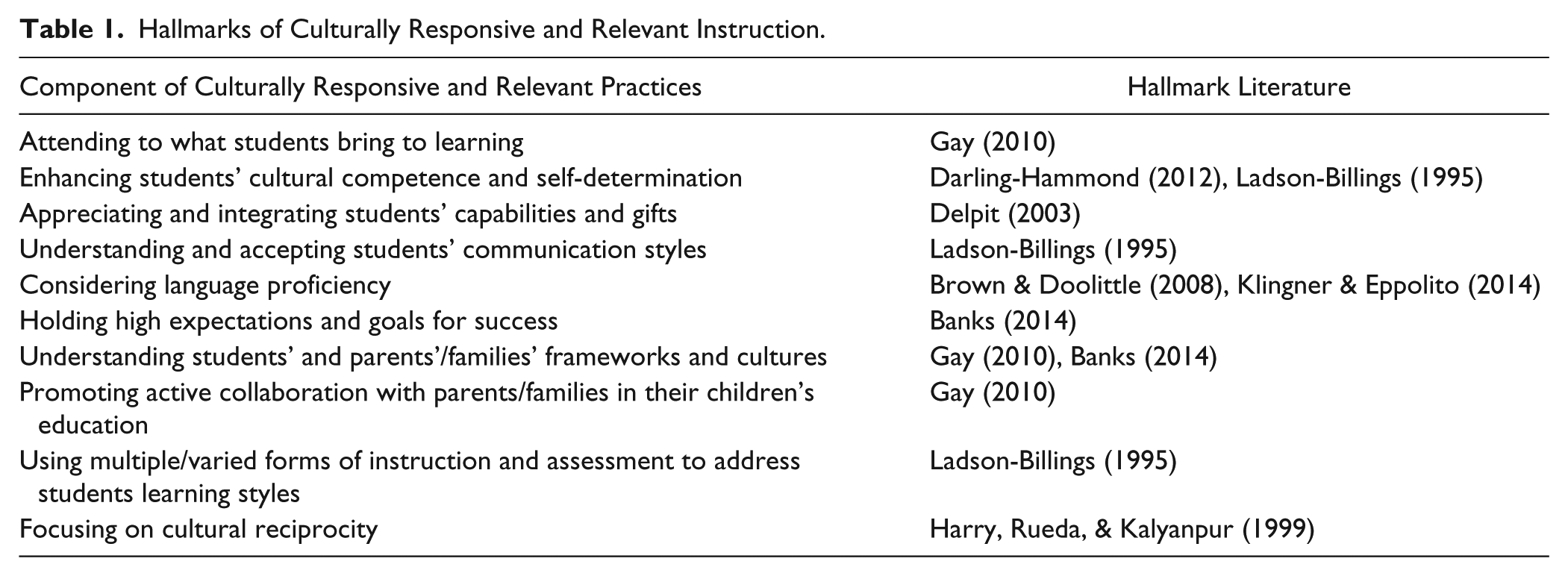
Culturally responsive and relevant instruction (a) highlights the importance of knowing, appreciating, and maximizing what students bring to their learning (Gay, 2010; Kea & Trent, 2013; Klingner & Eppolito, 2014), (b) enhances students’ cultural competence and self-determination (Calderon, Slavin, & Sanches, 2011; Ladson-Billings, 1995), (c) facilitates the capabilities and gifts of students (Brown & Doolittle, 2008; Delpit, 2003), (d) incorporates students’ experiences into instruction (Gay, 2010), (e) provides cultural reciprocity (Harry, Rueda, & Kalyanpur, 1999), and (f) holds high expectations (Banks, 2014; Hamayan et al., 2013; Utley et al., 2011). Hallmarks of culturally responsive and relevant pedagogy from research and practice are summarized in Table 1.
Hallmarks of Culturally Responsive and Relevant Instruction.
Attention has also been focused on the disproportionate representation of racially, culturally, ethnically, or linguistically diverse students receiving special education services and on the assessment practices that lead to the outcome of over- and underidentification of diverse students identified as having a disability (Cavendish, Artiles, & Harry, 2015; Harris, Sullivan, Oades-Sese, & Sotelo-Dynega, 2015). The Checklist to Address Disproportionality in Special Education (CADSE; Fiedler et al., 2008) is a good example of a tool designed to assist school teams and parents through early identification, intervention, referral, multidisciplinary assessments, and eligibility determination processes in avoiding disproportional representation of diverse students in special education. Fiedler et al. (2008) designed the CADSE to prompt staff and parents to think about diversity and how it impacts assessment and identification decisions. The CADSE was also developed as a tool to help schools think systematically about the environment and culture of the school itself. For example, one element of the CADSE prompts schools to ask if the school culture supports and celebrates diversity. The tool is excellent for addressing the issues of disproportionality, but after students are identified and are being provided special education services, a culturally responsive and relevant IEP needs to be developed. For example, teams need to seek information and input from parents and families as equal partners in the process, and they need to exclude environmental, socioeconomic, cultural/linguistic, or instructional factors prior to making decisions for the students. Teams need guidance in the process of integrating these and other culturally responsive and relevant elements into the design of the IEP.
The Culturally Responsive and Relevant Builder Tool
The Culturally Responsive and Relevant IEP Builder (CRRIB) was developed to address the need for a tool to guide IEP teams through the process of designing culturally responsive and relevant IEPs. The foundation of the CRRIB includes the required elements of the IEP (Yell, 2016) as defined by the IDEIA (2004) and the hallmarks of culturally responsive and relevant pedagogy that have emerged from research and practice (see Table 1). In the process of developing an IEP, the IEP team develops a comprehensive view of the student, from present levels of performance to measurable goals for the future. At the heart of the IEP is knowing who a student is, having positive expectations and high goals for the student, and understanding the context students bring to the educational setting.
The elements of the IEP are well aligned with the culturally responsive and relevant instructional hallmarks that have emerged from research (Banks, 2014; Gay, 2010; Ladson-Billings, 1995). For example, two hallmarks of culturally responsive instruction include using students’ cultural knowledge and integrating students’ prior experiences (Gay, 2010). These hallmarks are complementary to the IEP process of discussing students’ experiences and knowledge with parents and families. Ladson-Billings (1995) pointed out that with culturally relevant instruction, students should experience academic success. The quest for student accomplishment and achievement is a goal of all IEP teams as they provide specially designed instruction that facilitates student success. Culturally responsive instruction also places value on maintaining and strengthening students’ culture as well as self-actualization and self-determination about personal values and norms (Darling-Hammond, 2012). As IEP teams proceed through the process of designing or revising IEPs, it is an opportune time to consider the cultural responsiveness and relevance of the IEP. The CRRIB contains cultural consideration prompts that can focus the IEP team’s efforts and result in an IEP that enhances the student’s culture, incorporates the student’s strengths, and builds cultural competence.
The CRRIB is a matrix designed to guide IEP teams through a series of questions about cultural responsiveness and relevance as they consider and discuss each of the major elements of the IEP. The CRRIB is divided into four sections aligned with the major elements of the IEP (i.e., columns) and questions focusing on cultural considerations (i.e., rows). The four sections of the IEP elements include (a) foundation (levels of functioning, goals, measurement of progress), (b) participation and support (related and/or supplementary services and participation in general education), (c) assessment/accommodations (accommodations/measuring achievement, alternative assessments, program modifications), and (d) transition (transition services, instruction, community activities, employment, postschool objectives). These sections include most of the required elements of the IEP, but additional sections could be added as needed. For example, if the student requires some type of intervention for behavioral challenges or if the student requires an extended school year plan, teams could add these sections as well as the required components for each section. Another example is if the student requires behavior interventions, a behavior intervention plan that is designed from a functional behavior assessment (Yell, 2016) could be designed using the CRRIB.
In the matrix rows, questions guide the IEP team in considering cultural responsiveness and relevance of each IEP element. The questions include how the elements
Take into consideration student’s and family’s frame of reference;
Capitalize on the student’s performance style and maximize the student’s intellectual, social, physical capabilities and strengths;
Maintain the student’s and family’s cultural competence and ensure they have a voice in the process;
Use the student’s prior experiences;
Take into consideration the student’s and family’s frame of reference;
Capitalize on the student’s performance style and maximize the student’s intellectual, social, physical capabilities and strengths; and
Facilitate success by defining success in collaboration with the family.
Questions for the CRRIB matrix can be revised or added as needed to match cultural contexts. A sample of the CRRIB matrix can be found in Table 2. The CRRIB can also be used as a tool to gather information at various stages of a student program. Each row of cultural considerations would be completed with information suggested on the crossbar above (e.g., present levels of performance, measurable annual goals). Teams could also use the cultural considerations in the CRRIB to conduct assessments, evaluate current practices, and guide the development of the interventions, strategies, and the supports for students. As the IEP team discusses and develops the elements of the IEP, the cultural considerations in the CRRIB help maintain the team’s focus on enhancing the student’s cultural competence, incorporating the student’s prior experiences, and valuing the family’s frame of reference. A sample of a completed CRRIB is later presented.
The Culturally Responsive and Relevant IEP Builder (CRRIB) Matrix Sample.

Eduardo
Eduardo is a second-grade bilingual student. He is a kind and cheerful child who loves learning about animals and drawing dinosaurs. He comes from a loving and close family that includes his mother, Elisa, a well-respected veterinarian; and his father, Miguel, a middle school math teacher and high school baseball coach. Eduardo also lives with his 11-year-old sister, Julia, and his Abuelita [grandmother], Delia. They travel often around the United States and Mexico, their native country, to visit extended family. Eduardo spends a lot of time with his family either at the veterinarian clinic his mother owns, playing baseball with his dad and sister, or learning how to cook with his Abuelita. (See Note 1.)
Eduardo enjoys school because of his friends and teacher but has been struggling academically for the past couple of years. He was referred to special education for a suspected reading and writing disability last year at the beginning of first grade after extensive interventions through the response-to-intervention model. After being assessed with the Woodcock-Muñoz to rule out a language acquisition issue, he qualified for special education services for a specific learning disability in reading and writing.
Eduardo is currently reading at a kindergarten level in both English and Spanish at school and at home. Eduardo’s family, including his grandmother, are very involved in his education and would like to further assist him achieve his IEP goals at home. His father spends 20 to 30 min reading with Eduardo every day as his teacher suggested, and as a reward, Eduardo plays baseball with his father after their reading session. Eduardo’s sister, Julia, has become a reading buddy in her brother’s class, and at the veterinarian clinic, he likes to read information about each animal that his mom Elisa helps.
An Example of the Matrix
In Eduardo’s case, the IEP team, including the parents/family, developed an in-depth understanding of his present levels of functioning in order to develop appropriate goals and learning strategies. They used the CRRIB as they evaluated Eduardo’s current performance and data from assessment. Using Eduardo’s literacy goals as an example (see Table 3), it is clear that various strategies for enhancing Eduard’s strengths were highlighted as a result of the IEP team’s attention to cultural considerations. The goals section of Eduardo’s CRRIB is included here.
Example of Literacy Goals.
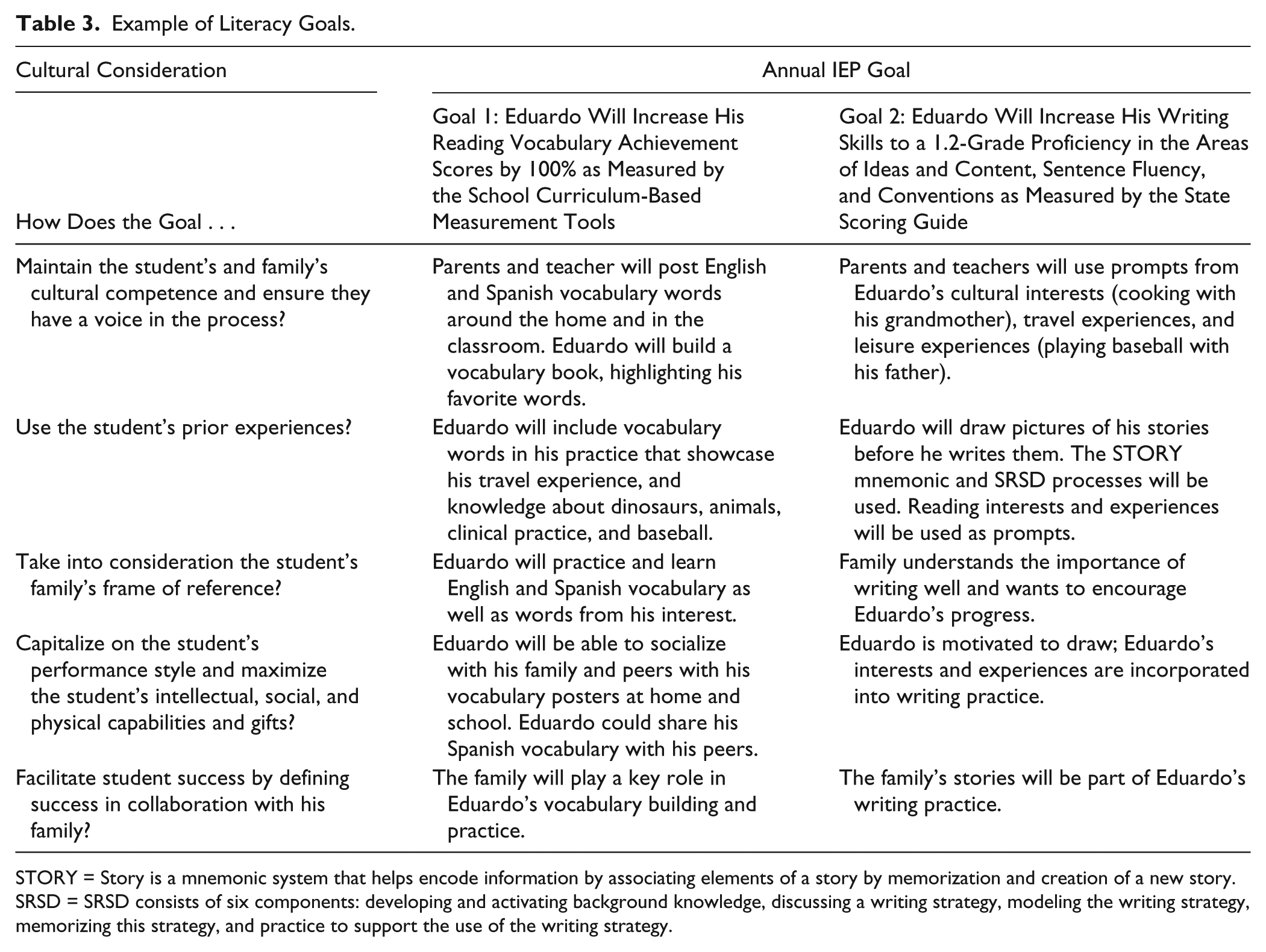
STORY = Story is a mnemonic system that helps encode information by associating elements of a story by memorization and creation of a new story. SRSD = SRSD consists of six components: developing and activating background knowledge, discussing a writing strategy, modeling the writing strategy, memorizing this strategy, and practice to support the use of the writing strategy.
For Eduardo’s literacy goal of increasing his reading achievement scores, the team integrated the reading of Spanish and English books, both at home and at school, as a way of enhancing Eduardo’s cultural competence and incorporating his strengths. For the goal of increasing his reading vocabulary, the team incorporated Spanish vocabulary but also Eduardo’s and his family’s interests of traveling and the veterinarian clinical practice that Eduardo knows well. For Eduardo’s goal of improving his writing, the team integrated Eduardo’s love of drawing as well as writing prompts from his culture and family life. The team was guided by the CRRIB through the development of each element in the IEP, focusing on the cultural considerations that can enhance, personalize, and increase the quality of the special education services that Eduardo receives.
Conclusion
As the diversity of the student population increases, it becomes critical to provide culturally responsive and relevant instruction. Assessments also need to be conducted with cultural considerations at the forefront. Students who are receiving special education services also need culturally responsive and relevant IEPs. While research has demonstrated the importance of culturally responsive instruction (Banks, 2014) and evidence-based approaches in the design of IEPs (Bateman, 2011), melding these considerations together during the IEP process holds potential for more student success. The CRRIB is a tool that IEP teams can use to guide them through the process of developing IEPs that are responsive to a student’s culture, incorporate student’s experiences and strengths, and consider the family’s frame of reference, beliefs, and values.
Throughout the IEP process, it is important to build on students’ strengths by using culturally responsive and relevant practices. In order to provide an appropriate education for students from culturally and linguistically diverse students with or without disabilities and help decrease the disproportionate representation of this population in special education, it is key to collaborate with the student’s family and community as well as include the student’s input in any decision-making process. Just as Eduardo may enhance his reading and writing skills through culturally responsive and relevant IEPs and services, all students may be likely to benefit from the same. Future research on the use of the CRRIB to enhance students’ IEPs and outcomes would greatly serve students with disabilities and their families.
Footnotes
Declaration of Conflicting Interests
The authors declared no potential conflicts of interest with respect to the research, authorship, and/or publication of this article.
Funding
The authors received no financial support for the research, authorship, and/or publication of this article.