




Abstract
Communication is an essential skill that develops in early childhood and links to later academic and social success. However, some children, such as those with autism spectrum disorder (ASD), struggle to develop sufficient social communication skills and may require speech language therapy and targeted support from educators to achieve functional communication. Unfortunately, educators, including teachers and paraeducators, may have limited knowledge and skills to best support the social communication needs of students with ASD. Therefore, this article introduces a research-based strategy, POWR:
Effective communication is linked to higher academic and social outcomes for children (Justice, Bowles, Pence-Turnbull, & Skibbe, 2009). However, communication challenges are common among children with autism spectrum disorder (ASD), as social communication deficits are a primary characteristic of the disorder (American Psychiatric Association, 2013). Early intervention and educational supports are essential to help children with ASD develop the social communication skills necessary for success in school and life (Landa, 2007).
Students with ASD are often provided with speech services to support social communication development (Binger & Light, 2007; Landa, 2007). However, speech services alone are not sufficient to meet all of the social communication needs of students with ASD (Katz, Maag, Fallon, Blenkarn, & Smith, 2010). That is, speech is the verbal production of language (Otto, 2017), while communication requires an exchange of information between partners (Landa, 2007) marking the critical importance of opportunities to interact with various adults and peers to support the development of social communication skills. Speech language pathologists and educators must work together to ensure students with ASD have opportunities to communicate with multiple adults and peers to support social communication development of (Douglas, McNaughton & Light, 2014). Unfortunately, research indicates that educators often lack the skills and preparation required to support the communicative needs of students with ASD and may require targeted training to ensure the appropriate social communication development of students with ASD (Kaiser & Roberts, 2011; McLeskey, Tyler, & Saunders Flippin, 2004; Raghavendra, Olsson, Sampson, McInerney, & Connell, 2012).
This article introduces POWR (Prepare, Offer, Wait, and Respond), a research-based communication strategy (Douglas et al., 2014; Douglas, Light, & McNaughton, 2013; Douglas, Kammes, & Nordquist, 2018; Douglas, Kammes, Nordquist, & D’Agostino, 2018; Douglas, Nordquist, Kammes, & Gerde, 2017) that can be used by educators and other partners (e.g., peers) to support the social communication of students with ASD (Douglas, Kammes, & Nordquist, 2018), especially those with limited speech. The POWR strategy includes several interaction skills that have been shown to encourage social communication for students with ASD such as environmental arrangement and access to AAC (Park, Alber-Morgan, & Cannella-Malone, 2010), providing opportunities to communicate (Broberg, Fern, & Thumberg, 2012; Van der Meer et al., 2013), waiting for communication (Broberg et al., 2012; Trottier, Kamp, & Mirenda, 2011), and responding to communication (Broberg et al., 2012). In addition, the POWR strategy includes instructional techniques that are found within existing educational and behavioral approaches, including (a) requiring frequent responses/providing frequent communication opportunities (Archer & Hughes, 2010; Landa, 2007), (b) providing wait time (Landa, 2007), and (c) responding to the student immediately (Archer & Hughes, 2010; Landa, 2007). Each of these techniques has been shown to support the social communication of students with ASD (Odom, Collet-Klingenberg, Rogers, & Hatton, 2010). Furthermore, the POWR strategy includes skills that are recommended practice for educators (e.g., promote, enhance, and respond to communication, familiarity with AAC systems; Council for Exceptional Children, 2015; Division for Early Childhood, 2014). Last, the strategy mnemonic POWR aids educators in the memorization of the strategy steps to promote consistent use.
Empirical research evaluating POWR found that communication partners such as educators (Douglas et al., 2013; Douglas et al., 2014), parents (Douglas et al., 2017; Douglas, Kammes, & Nordquist, 2018), and siblings (Douglas, Kammes, Nordquist, & D’Agostino, 2018) provided increased communication opportunities and increased responses to the communication of children with communication challenges, including children with ASD (Douglas et al., 2014; Douglas, Kammes, & Nordquist, 2018), after POWR training. In return, communication turns for children with communication challenges increased. Collectively, this work and the foundation of the strategy within existing evidence-based educational and behavioral approaches supports POWR as a research-based practice that is beneficial with students with ASD. The POWR strategy can help a range of communication partners, such as teachers, paraeducators, and peers/siblings, support students with ASD. This article provides guidance for educators to effectively implement and reinforce the POWR strategy in their classroom, which in turn will increase the communication of students with ASD.
Students with ASD who have limited speech often require augmentative and alternative communication (AAC; Mirenda, 2009). An AAC system may include the use of signs, gestures, picture symbols, and speech-generating devices used to communicate within the educational environment (Light & Drager, 2007; Nunes, 2008). Research has shown that AAC intervention improves communication (Kasari et al., 2014; Romski, Sevcik, Barton-Hulsey, & Whitmore, 2015), reduces challenging behavior (Machalicek, O’Reilly, Beretvas, Sigafoos, & Lancioni, 2007), and supports social skill development for students with ASD (Trottier et al., 2011). However, simply providing access to an AAC system does not ensure an improvement in communicative skills (McNaughton & Light, 2013). Communication partners (e.g., teachers, paraeducators, peers) must provide communicative supports along with access to an appropriate AAC system (Kent-Walsh & McNaughton, 2005). It is essential that educators consistently utilize strategies, such as POWR, to support social communication for students with ASD who require AAC. However, recognizing that not all students have formal AAC systems in place and utilize a variety of systems (e.g., picture symbols, speech generating device), POWR supports a range of AAC modes from formal, high-tech communication devices to more informal and/or low-tech AAC modes such as gestures.
Guidelines for Implementing the POWR Strategy
The POWR strategy helps communication partners (e.g., teachers, paraeducators, peers) support the social communication of students with ASD through four steps. These steps include
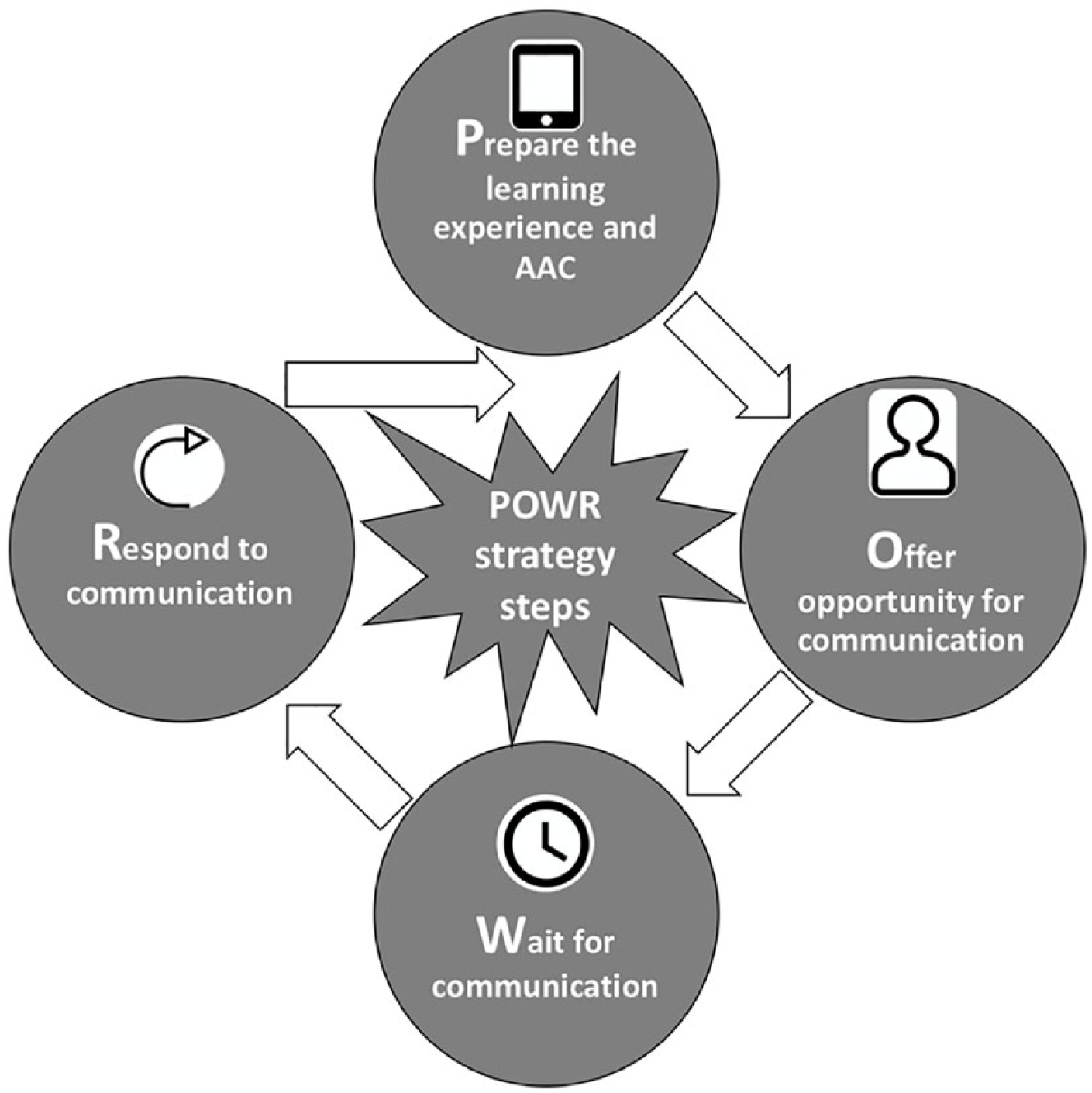
POWR strategy steps.
Prepare the Learning Experience and AAC
The first step of POWR is prepare the learning experience and AAC. Educators generate multiple learning experiences for their students every day. The
Prepare the learning experience and AAC is completed before an interaction takes place. During this step, the educator selects a developmentally appropriate learning experience that is motivating for the student and allows many opportunities for communication (Binger, Maguire-Marshall, & Kent-Walsh, 2011; Paul & Norbury, 2012). In addition, seating and positioning, to maximize motor control, is considered for students who have coexisting motor challenges (Costigan & Light, 2010). The educators’ knowledge of the student, including the student’s skills, interests, and communication methods, is then used to individualize the learning experience. This may include the use of natural reinforcers during the learning experience to pique student interest (Kaiser & Roberts, 2011). Communication might occur through eye gaze, pointing, gestures, facial expressions, sign language, picture symbols, and/or a speech-generating device. Students with ASD often use multiple modes to communicate so any means that the student might use should be prepared and accepted during the activity.
Next, the educational team members should work together to prepare the AAC system with vocabulary that is fun, functional, and fits the student’s personality and culture (Williams, Krezman, & McNaughton, 2008). Vocabulary selection for AAC systems has been noted as a challenging process for educators, so teamwork is vital (Caron, Light, & Drager, 2016). Vocabulary might include the use of new signs, the creation of a picture board with vocabulary for the specific activity, or new words programmed into a speech-generating device. Educators can also add vocabulary to the AAC system during the activity as needed (see Caron et al., 2016). Vocabulary should include the full range of speech such as nouns, verbs, and adjectives (Trembath, Balandin, & Togher, 2007). In addition, vocabulary to promote social interactions should be included to encourage prosocial communication (e.g., “Do you want to play? It is your turn. I like . . .”). Communication partners can provide models using the AAC system to support AAC proficiency (Sennott, Light, & McNaughton, 2016). During the activity, formal AAC systems should be positioned to be accessible to both the student and the communication partner. Once the learning experience has been prepared, the remaining steps in POWR can be used.
Offer Opportunities for Communication
During the second step, offer opportunity for communication, the educator creates an environment where the student is expected to communicate frequently. This includes providing the student with choices, asking questions, and commenting about what is happening in the activity (Binger & Kent-Walsh, 2012). Offering opportunities encourages the student to become an active participant (Binger, Kent-Walsh, Ewing, & Taylor, 2010) and is essential for fostering communication. Research shows that when more communication opportunities are offered, the student will communicate more frequently (Binger et al., 2010).
Offering an opportunity for communication can take many forms. For example, during a shared reading experience an educator might first provide the student with an opportunity to communicate which book she or he would like to read by providing book choices. The educator may then offer an opportunity for communication by reading a page and asking the student to comment (e.g., “What is the bear doing now?”) or by asking a question that relates the story to the student’s life (“What do you like to do with your brother?”). Similarly, opportunities could be provided in other learning experiences by providing choices (“Do you want to sing or paint?”), by asking questions (“What animal should we add to the song next?”), or by commenting (“Yay, I love dogs!”). Peers can also support the communication of students with ASD by offering frequent opportunities for communication by asking questions (“Would you like to play with me?”), providing choices (“Should we play at the art center or the building center?”), or commenting about the activity (“Wow, you built a very tall tower”; Kamps et al., 2015).
Wait for Communication
After educators have offered an opportunity for communication, they should wait for communication. While most educators recognize the importance of waiting for a response, the
Providing sufficient wait time is especially important when the student with ASD uses an aided AAC system, such as a speech generating device or picture symbols (Binger et al., 2010). Many AAC systems require navigation skills to locate appropriate vocabulary and respond to communication opportunities (Light & McNaughton, 2014). In cases where students are learning to use an AAC system or need additional time due to motor challenges, more than 5 seconds may be necessary. The
Respond to Communication
The final step of POWR is responding to communication. Successful educators respond each time a student communicates (Binger & Kent-Walsh, 2012). Educators use multiple methods to respond to student communication every day. Similarly, responses from peers are an essential communication support. Thus, the
There are a number of ways educators and peers can respond to communication. This includes verbalizing behavior, expanding on communication, or extending communication (Kaiser & Roberts, 2011). For example, when the student is offered a choice of paint during an art activity and reaches for yellow paint, the teacher can verbalize the behavior by saying, “Oh, you want the yellow paint” and provide the student with yellow paint. Partners can also expand on student communication by adding words or descriptions. For example, if the student selects a ball during physical education by pointing and saying “ball,” a peer can respond by saying, “You want the basketball.” Finally, educators and peers can extend communication. If the student is mixing materials during a science activity and says “water” as water is poured, the partner can ask, “What ingredient do we add next?” Similarly, if a student says “all done” when working on an academic assignment, the partner might expand and provide a new opportunity for communication by saying, “You are telling me you are all done. What is next on our schedule for today?” For students who communicate using sign language, the partner can respond with both sign language and speech. Successful educators respond to all communication including gestures, sign, speech, or speech-generating devices.
The POWR mnemonic helps educators and other partners remember the strategy steps and repeat them to create an environment where communication is supported during a variety of learning experiences. The POWR strategy can be repeated over and over to create multiple communication events within each learning activity. In the previous example when the teacher responded by saying, “Oh, you want to use the yellow paint,” a new opportunity for communication could be provided to repeat the POWR strategy. The teacher could continue by saying, “I wonder what you will paint with yellow?”
The POWR strategy is effective in promoting social communication and easy to learn. During training sessions, paraeducators, parents, and siblings all learned to use the POWR steps with 1 to 2 hours of instruction (Douglas et al., 2013; Douglas et al., 2014; Douglas et al., 2017; Douglas, Kammes & Nordquist, 2018; Douglas, Kammes, Nordquist, & D’Agostino, 2018). Training was made up of descriptions of each step, video exemplars illustrating the strategy, and opportunities to apply the steps and receive feedback. Educators can implement the POWR strategy themselves or mentor other teachers, paraeducators, parents, and/or peers to use the POWR strategy by modeling each step, asking for identification of each POWR strategy step in action, and allowing the individual to implement the strategy. While the strategy is used, successful mentors offer guidance or suggestions for implementing the POWR strategy. After implementation, the use of reflection can help encourage further skill development. See Figure 2 for a sample POWR rating and reflection that could be used for this purpose. This form could also be used as a fidelity measure to determine adherence to the POWR strategy.
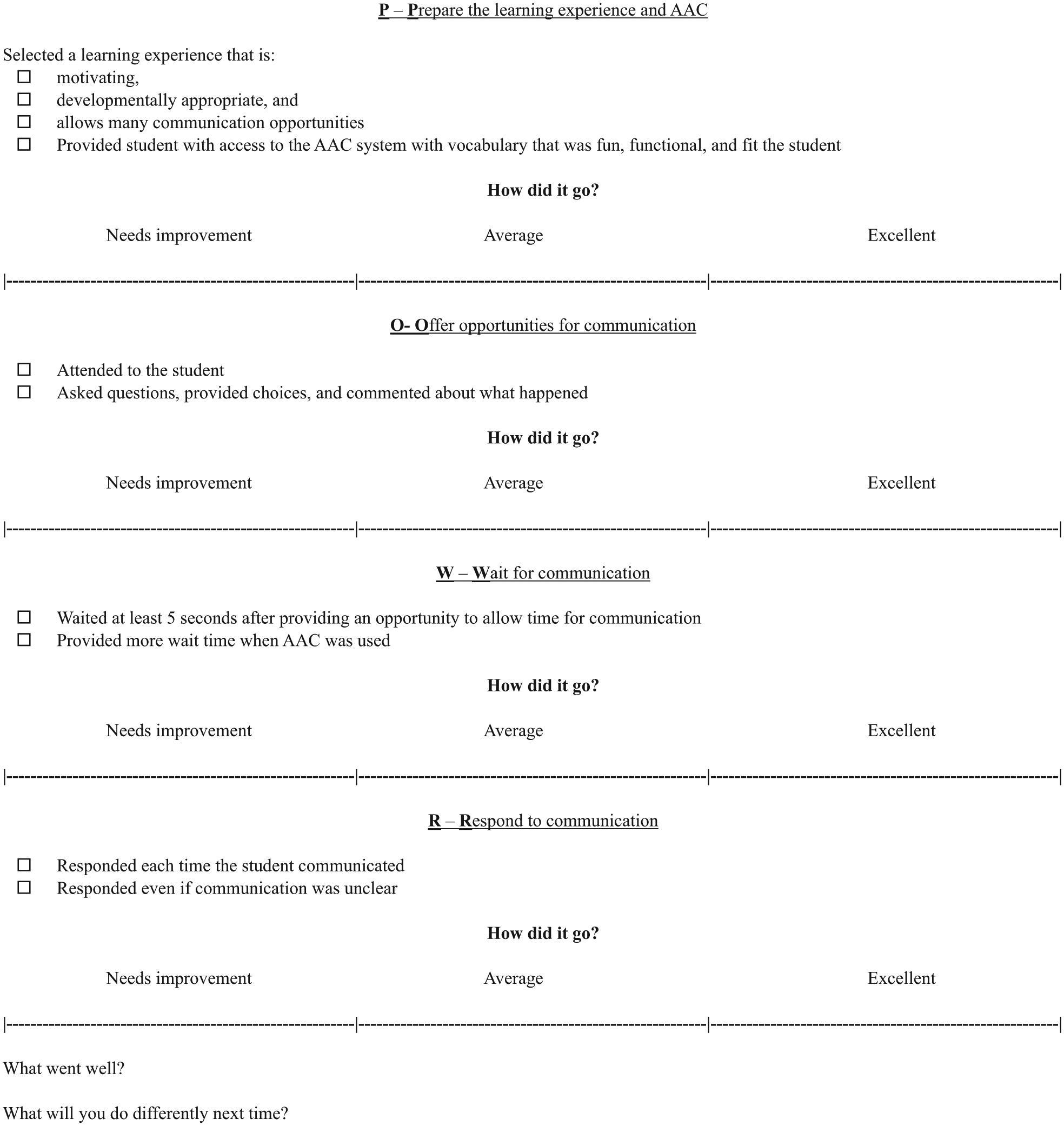
POWR rating list and reflection.
Conclusion
The POWR strategy is a research-based approach to help educators intentionally support the social communication of students with communication challenges, including ASD (Douglas et al., 2013; Douglas et al., 2014). Speech language therapy coupled with supportive communicative interactions from educators and other communication partners throughout the day can support the development of social communication for students with ASD. The mnemonic POWR will help educators remember, use, and reinforce the use of the four easy and effective steps,
Footnotes
Declaration of Conflicting Interests
The authors declared no potential conflicts of interest with respect to the research, authorship, and/or publication of this article.
Funding
The authors received no financial support for the research, authorship, and/or publication of this article.