



Abstract
Students with severe and persistent academic or behavioral challenges may benefit from data-based individualization (DBI). Starting with an evidence-based standard protocol and systematic progress monitoring, teachers can evaluate growth and implement individualized interventions to meet students’ needs. Specifically, this article addresses the systematic use of student data to determine content and pacing for intensive reading instruction. Insights from implementing this approach with struggling first grade readers in Tier 3 of an RTI framework are provided. Evidence-based standard protocols, strategic data collection and management, and team collaboration are crucial elements for successful implementation.
Despite decades of advancements in research, legislation, and practice intended to improve academic outcomes for struggling students in the United States, an estimated 2.5 million students require intensive academic interventions (Danielson & Rosenquist, 2014). Data-based individualization (DBI) is an approach that may benefit students with disabilities and their typical peers who require additional, intensive supports to meet their academic goals. With DBI, teachers use regularly collected data from curriculum-based measurement (CBM; Deno, 1985) to evaluate students’ response to intervention and make decisions about intensifying instruction. DBI may be implemented within the most intensive tier(s) of an existing response to intervention (RTI) framework and may be incorporated into special education if services are provided outside of the RTI framework. This article outlines how to enact DBI using recommendations from Lemons, Kearns, and Davidson (2014) to provide high-quality, intensive reading instruction to struggling first graders, offering reflections and recommendations on implementation.
Data-Based Individualization
The National Center on Intensive Intervention (NCII; intensiveintervention.org) defines DBI as a research-based framework for providing intensive instruction to students with severe and persistent academic and/or behavioral needs (see Figure 1). At its core, DBI depends upon a validated intervention program implemented with fidelity. Teachers set an appropriate goal for a student and monitor progress weekly using carefully selected measures. Ideal progress-monitoring tools are (a) linked to instruction, (b) sensitive to growth, and (c) easy to administer. If the student demonstrates lack of RTI, usually defined by four data points below the goal line (Fuchs, Fuchs, & Vaughn, 2014), the teacher conducts a diagnostic assessment to determine specific areas of need. With this information, the teacher can make systematic adaptations to the curriculum, adjusting content and/or delivery to target the student’s needs. Quantitative adaptations (e.g., more frequent intervention sessions, smaller groups) may be the first step to individualization. However, they may be constrained by personnel, time, or funds. In contrast, qualitative adaptations—addressing content or instructional focus—require greater expertise but may be less resource-intensive (Lemons et al., 2014). The teacher monitors progress during each adaptation period, noting specific strengths and weaknesses. If growth is sufficient, instruction and progress monitoring continue; if inadequate, further adaptations are made to intensify and individualize instruction. In this iterative process, all instructional decisions are tied to progress monitoring data and the predetermined goal, and tools may be adjusted to reflect students’ changing achievement and needs.
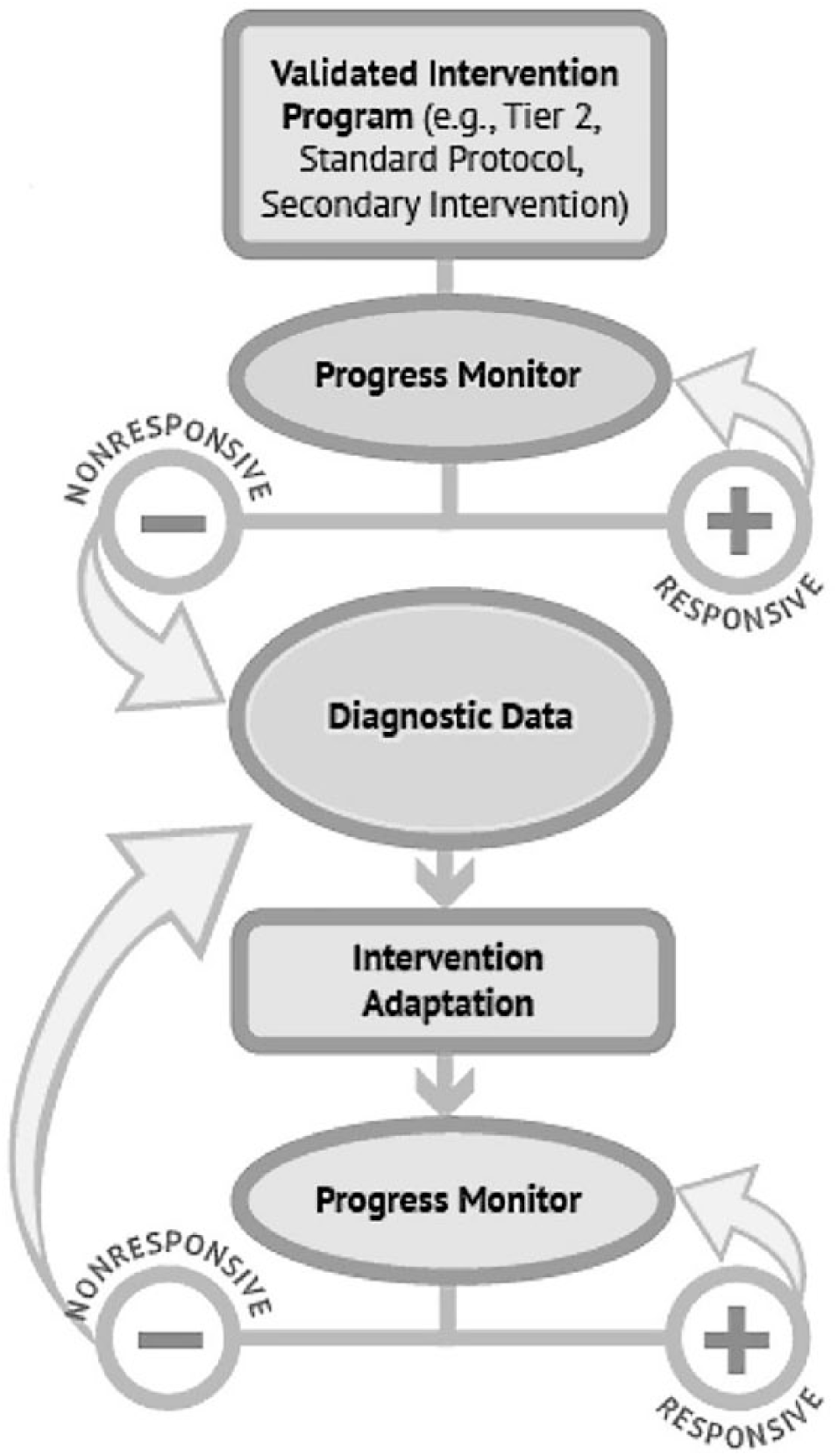
The iterative nature of data-based individualization. Reprinted with permission from Interactive DBI Process, by National Center on Intensive Intervention, retrieved from http://www.intensiveintervention.org. Copyright 2014 by American Institutes for Research.
To maximize effectiveness, NCII recommends teachers implement DBI as a team, collaborating with other school personnel. DBI teams work together to generate a comprehensive understanding of student progress. Teams streamline problem solving and enhance instruction by discussing data-based adaptations, sharing resources, and making decisions collaboratively. Team discussions invite multiple perspectives on one student, and also create a structure to identify patterns across students based on shared characteristics and potential treatments.
The Project: Supporting Struggling Readers with DBI
We partnered with Edmundson Elementary to begin implementation of DBI (see Note 1). Edmundson is a public school in an urban district in the southeastern United States, serving almost 600 students in grades K–4. Eager to meet the needs of early readers, Edmundson teachers identified struggling first graders with fall benchmark assessment scores substantially below grade level and in need of Tier 3 supports. The DBI team assessed students using additional measures of (a) phonological awareness (phoneme segmentation fluency; PSF), (b) decoding (nonsense word fluency; NWF), (c) letter sound fluency (LSF), and (d) oral reading fluency (ORF) from the DIBELS Benchmark Assessment (Good & Kaminski, 2011) to gain a more precise understanding of student skills. Then, the team used these data and end of year benchmark guidelines to create homogeneous reading pairs and set goals for students. Throughout the project student progress was monitored using weekly CBM measures. Of eight students identified for Tier 3 DBI, three cases are highlighted in the sections that follow.
Selecting a Validated Intervention Program
The DBI team of certified special education teachers provided daily Tier 3 reading intervention to student pairs. The team used Road to Reading (RTR; Blachman & Tangel, 2008) as the primary evidence-based standard protocol intervention package. RTR incorporates fundamental components of effective reading instruction (National Reading Panel [NRP], 2000) and intensive intervention (Vaughn, Wanzek, Murray, & Roberts, 2012). Sessions (30–40 minutes) targeted phonological awareness (PA), decoding, and encoding. Interventionists received initial training with RTR, practice, and ongoing support from research staff. During the intervention period, the team held weekly DBI discussions of student progress and instructional decisions. The DBI team meetings were centered on student data, incorporating findings from our measures with those of school personnel to get a detailed depiction of student strengths and weaknesses.
Although the first graders all experienced difficulties with reading, students’ specific abilities varied. Some had challenges in PA, evidenced by PSF data and informal observations. Others struggled with higher order demands of reading connected text fluently. In both cases, students required individualization to support their progress toward the eventual goal of fluent reading. Monitoring CBM data and engaging in error analyses allowed the DBI team to determine potential impact of these qualitative adaptations on individual students’ achievement and systematically adjust as necessary.
Progress Monitoring
A challenge for practitioners is to choose measures that comprehensively assess student skills and deficits, while also remaining sensitive to small changes in achievement. Two students’ data highlighted this challenge. Using guidelines from Fuchs et al. (2014) and Lemons et al. (2014), baseline scores were multiplied by 1.5 to set ambitious year-end goals for each student. Both students had one measure indicating inadequate growth, but implications differed based on student and measurement characteristics. One student, Kyle, showed growth in LSF and NWF, but had relatively stagnant PSF scores (see Figure 2). This measure identified a weakness in fundamental PA skills that otherwise would have been missed. The team adapted Kyle’s RTR sessions to target this skill gap, including intensive practice in “Guess My Word” and “First Sound” PA activities from the K-PALS curriculum (Fuchs et al., 2001) and added letter supports. Kyle continued to show inadequate response for two iterations of adaptations. However, after removing letter supports and changing his intervention to individual sessions, Kyle’s PSF scores spiked immediately and continued to grow.
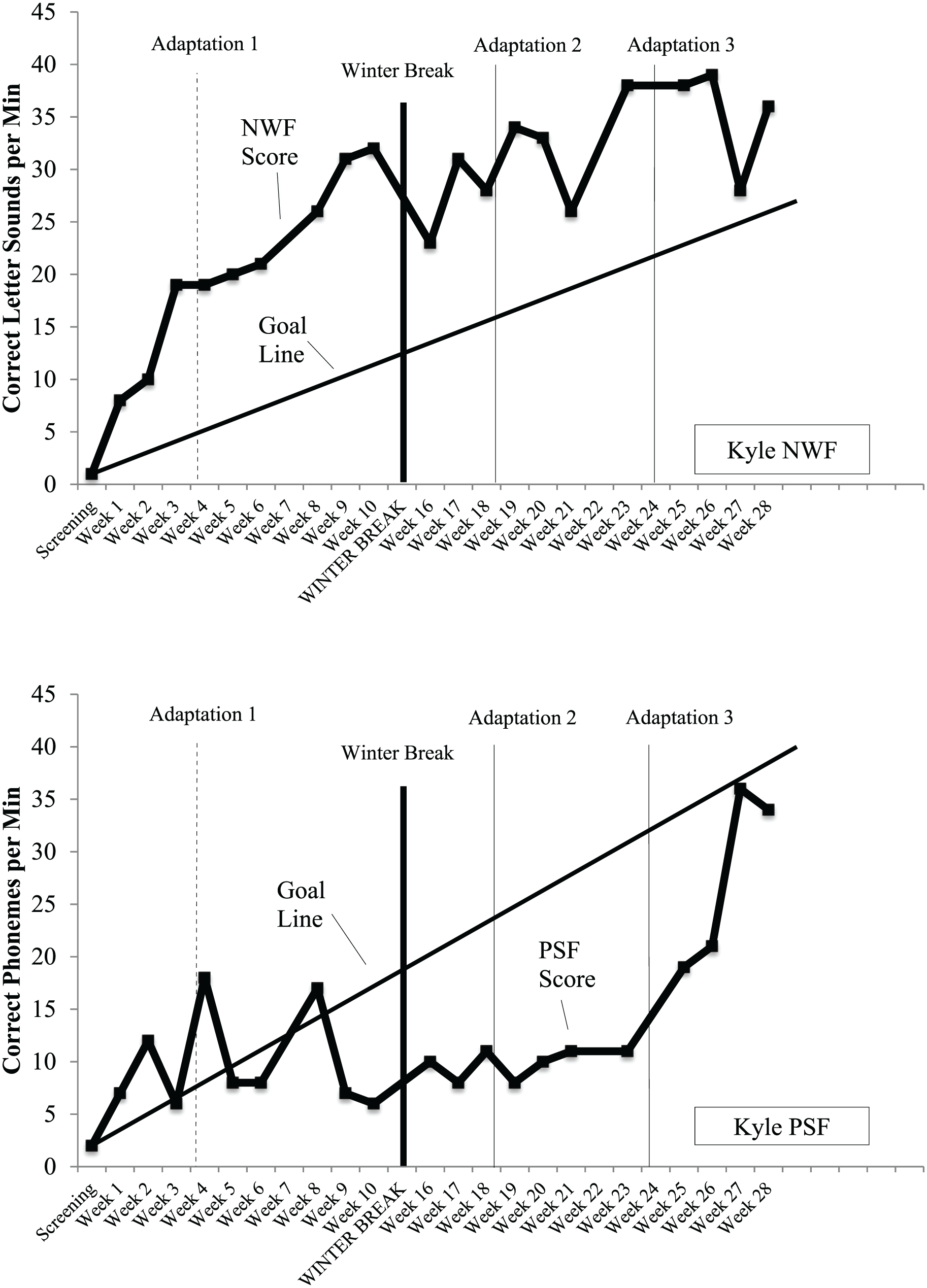
Comparing sensitivity of measures and responsiveness to adaptations.
In contrast, Kyle’s classmate, Chase, improved in PSF and NWF, but showed minimal growth in ORF (see Figure 3). Even after adapting instruction to include fluency training via timed and repeated reading, Chase’s ORF data fell below his goal line. It is important to note that because ORF does not have benchmark goals until the middle of first grade, and the students were already below grade level, ORF may not have been sufficiently sensitive for use in determining instructional adaptations. Targeting foundational skills was more appropriate.
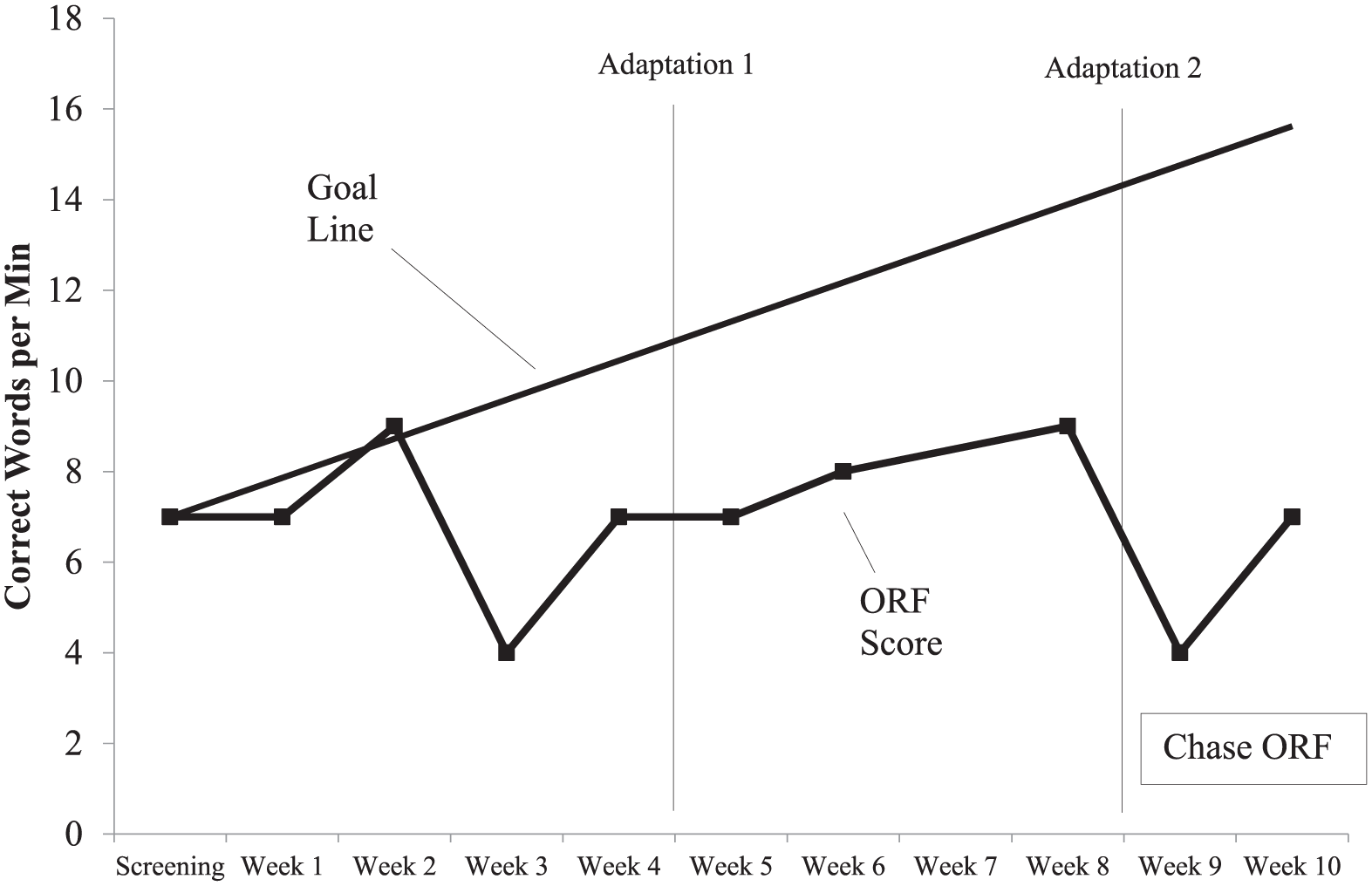
Considering sensitivity of measures.
Ongoing Intervention Adaptation
Students with pervasive and intensive needs often exhibit concomitant academic, behavioral, and motivational difficulties (Hinshaw, 1992; Kuchle, Edmunds, Danielson, Peterson, & Riley-Tillman, 2015), which may impact effectiveness of academic interventions (Nelson, Benner, & Gonzalez, 2003). This project addressed academic, behavior, and motivation challenges by adjusting the standard RTR protocol (e.g., subtracting 3 minutes from oral reading to spend on PA).
Phonics-based adaptations involved adding picture cues to letter cards and letter-sound sorting. The PA adaptations introduced activities focused on segmenting and blending sounds in words (e.g., h-a-t, haaat, hat). Together, these adaptations led to improvements in decoding for Monique, the most struggling reader (see Figure 4). On the other hand, fluency adaptations were implemented for Chase, who had mastered PA skills but struggled to read text fluently. In the standard RTR protocol, students read aloud decodable text aligned with the curriculum. In Chase’s adaptation, he spent more time on this step to build fluency using repeated readings (NRP, 2000; Samuels, 1979). Chase graphed his reading time during this activity, which increased motivation by incentivizing improvement.
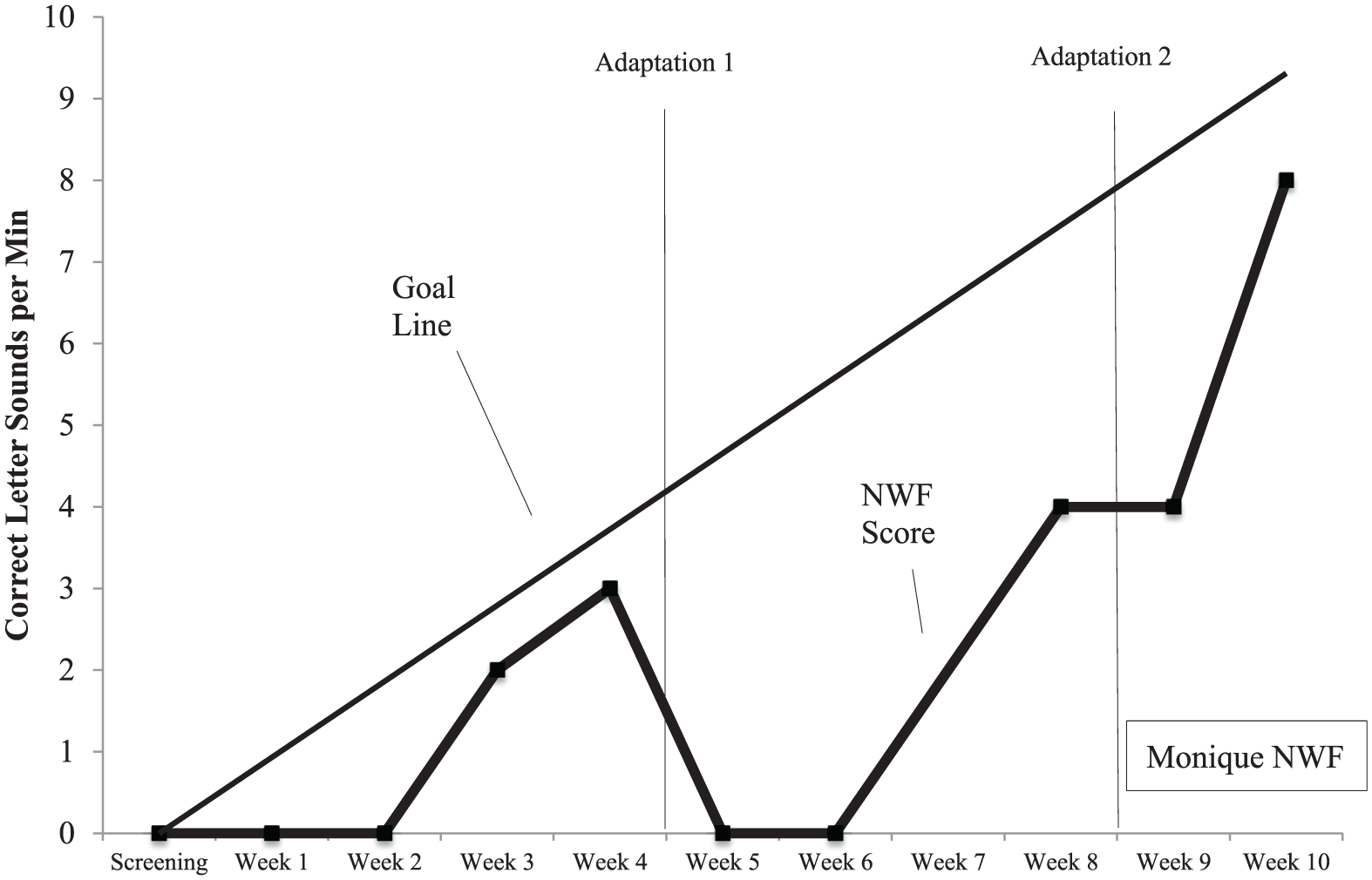
Focusing adaptations on phonics skills to bolster letter-sound correspondence.
In addition to adaptations regarding content, the team also adapted delivery to meet students’ varying behavior needs, including aggression (e.g., hitting the table, throwing instructional materials) and avoidance (e.g., hiding under the table, walking away). Two students used checklists to monitor adherence to school expectations, such as having a safe body and doing one’s best work. Additional behavioral and motivational supports were introduced as needed. These supports included token economies, behavior-specific praise, earned breaks, or academic games, depending on student preference and hypothesized functions of behavior.
Feasibility of Implementation
When thinking about starting DBI, questions of feasibility are inevitable: Can this really be done? Do I have the resources and the support I need to do this well? In short, the answer is yes. Here are some tips for implementing DBI successfully for the first time:
Final Thoughts
Data-based individualization is one approach to intensive intervention for students with persistent difficulties. Much of the benefit of DBI comes from the iterative, problem-solving process itself. Continuously monitoring student data creates a system in which you can make informed adaptations and assess the effect of those changes on student outcomes. Readers may learn more about DBI by completing modules available through the IRIS Center at Vanderbilt University (https://iris.peabody.vanderbilt.edu/module/dbi1/).
Footnotes
Declaration of Conflicting Interests
The authors declared no potential conflicts of interest with respect to the research, authorship, and/or publication of this article.
Funding
The authors disclosed receipt of the following financial support for the research, authorship, and/or publication of this article: The research described in this article was supported in part by Grant H325H140001 to Vanderbilt University from the Office of Special Education Programs within the U.S. Department of Education. Nothing in the article necessarily reflects the positions or policies of the funding agency and no official endorsement by them should be inferred.
