



Abstract
Self-regulated strategy development (SRSD) is an effective instructional approach used to teach academic strategies for skills such as writing and reading comprehension. Included in SRSD are direct strategy instruction and explicit procedures for teaching self-regulation skills, a method that has been effective at improving academic skills of students with disabilities, including those with emotional and behavioral disorders (EBD). However, due to pre-existing deficits in self-regulation skills, students with EBD may benefit from intensifying the four self-regulation skills already present in SRSD. This article provides practical examples for intensifying goal setting, self-monitoring, self-instructions, and self-reinforcement within the existing SRSD instructional approach.
Keywords
Self-regulation is a process students use to systematically support and orient their behavior during thinking practices and for achieving academic goals (Schunk & Zimmerman, 2003). A student’s ability to self-regulate behavior is an essential determinant of success in the classroom because it affects behavioral, social, and academic outcomes (Mason & Reid, 2018). Self-regulation includes both internal processes, such as using self-speech to talk through a problem, and external processes, such as using self-monitoring to determine success or lack of success in accurately completing tasks, including those that are academic in nature. Although self-regulation is a critical skill set for all students, the ability to self-regulate is even more relevant for students with significant emotional and behavioral challenges (Popham et al., 2018).
Students with emotional and behavioral disorders (EBD) often have difficulties during academic tasks such as maintaining effort, focusing on tasks, blocking distractions, and persisting when asked to engage in multi-component processes/tasks as required for reading comprehension and written expression (Garwood et al., 2018). These behavioral deficits or excesses can result in dismal outcomes for students with EBD in the areas of writing and reading when compared with their typical peers (Lane et al., 2008). In many cases, students with EBD have not developed the capacity to self-regulate their behavior by setting personal goals, monitoring their progress in meeting goals, using effective self-speech, or using self-reinforcement to achieve a specific goal (Mason et al., 2013). Providing students with EBD instruction so that they can independently self-regulate learning is important and is a well-established instructional practice.
One established practice is an approach known as self-regulated strategy development (SRSD), which incorporates explicit procedures for teaching self-regulation within an instructional approach to support student learning across a variety of content areas (Graham et al., 2013; Mason, 2013; Sanders et al., 2019). Self-regulated strategy development has an extensive research-base with established positive effects for improving reading comprehension and writing skills for students with EBD across grade levels (e.g., 2nd through 12th grade) and academic settings (e.g., Ennis et al., 2014; Sanders et al., 2018). Lessons for the different strategies taught using the SRSD approach provide recommendations for pre-requisite academic skills and guidelines for appropriate grade levels (Harris et al., 2008; Mason, Reid, & Hagaman, 2012). This article describes critical elements of SRSD required to support instruction: (a) self-regulation instruction to meet the needs of students with EBD and academic deficits and (b) explicit examples on how self-regulation components can be individualized and intensified as needed.
Self-Regulated Strategy Development
Self-regulated strategy development lessons are designed to consider students’ cognition, learning behaviors, and affect (Harris & Graham, 1999). Instruction includes an explicit focus on teaching learning strategies and self-regulation procedures—goal setting, self-monitoring, self-instruction, and self-reinforcement—to support students’ performance. Six stages are emphasized for strategy acquisition that is recursive, with any stage being revisited, as needed, to ensure students achieve mastery in the learning task.
Stage 1: Develop Background Knowledge
Many students, especially those with EBD, lack the prior knowledge necessary for learning across reading phases (i.e., before, during, and after reading) and the writing process (i.e., pre-writing/planning, composing, revising, and editing). Within the recursive SRSD stages, the teacher remediates these student deficits prior to introducing new concepts or moving to future stages. For example, a teacher might need to review academic terms, such as narrative, informative, and persuasive text genres, and attend to misconceptions, such as differences in revising and editing.
Stage 2: Discuss It
Students need to know the importance of learning and how to use a strategy for improving reading comprehension or writing performance. When introducing a strategy, the teacher should explicitly explain the purpose of each strategy step. The teacher discusses how to self-regulate performance by establishing goals for learning and applying the strategy while reading or writing. In this stage, the teacher also works with students on remediating negative self-instructions.
Stage 3: Model It
During modeling, the teacher thinks out loud by using self-instructions to model how to think throughout each step of the reading or writing process. All instructional materials and self-regulation procedures are used. The teacher models how to set a personal goal and how progress toward meeting the goal will be monitored. The teacher’s self-instructions are modeled to support the specific difficulties of students with EBD, such as (a) attending (e.g., “I need to focus on using the strategy and check-off each step as it is completed”) and (b) coping (e.g., “I do not like to read/write, but the steps make it easier”). The teacher also models self-reinforcement through positive self-instruction (e.g., “Wow! I thought that was going to be hard, but using the strategy made it easier”).
Stage 4: Memorize It
Memorization of strategy steps is critical for fluency, maintenance, and generalization (Harris et al., 2003). During memorization practice, students recite the steps of the strategy and, most importantly, they describe what is required at each step. The teacher assists the students in this stage by repeating the strategy steps and encouraging their independent statements of each step.
Stage 5: Support It
During this stage, the teacher works collaboratively with student groups, with student pairs, and with individual students. Support is gradually faded as responsibility for strategy application and self-regulation is shifted from teacher to student. The teacher helps students self-monitor each learning process and provides reinforcement through positive and specific feedback (e.g., “Good job remembering to look for the main idea in the first sentence. This helped you determine the author’s purpose for this paragraph.”). In addition, the teacher continues to monitor students’ use of positive attributions and self-instructions.
Stage 6: Independent Performance
Students work independently on a reading or writing task using the specific strategy while the teacher monitors their self-regulated strategy performance (i.e., implementation of the specific strategy). Providing practice in different contexts (e.g., within different subjects or settings) supports the generalization of the strategy and self-regulation procedures across tasks and subjects.
Individualizing and Intensifying Support
Within the SRSD instructional approach, teachers are encouraged to individualize and adapt lessons and activities to meet the specific and unique needs of their students (Mason, 2013). Intensifying, or adjusting the dosage or frequency, of the four self-regulation skills already integrated into SRSD (i.e., goal setting, self-monitoring, self-instruction, and self-reinforcement) is one way teachers can identify ways to individualize the SRSD approach for students with EBD to support desired increased academic outcomes (Fuchs et al., 2017). It can be helpful to look at the concept of intensifying self-regulation components using a multi-tiered system of support (MTSS), in which (a) all students receive universal supports and instruction at Tier I, (b) some students receive targeted supports and instruction at Tier II, and (c) few students are provided intensive supports and instruction at Tier III. For students with EBD, Tier I supports may not be enough to achieve the desired academic outcomes (Fuchs et al., 2017). The SRSD approach is frequently used as a Tier II targeted intervention for students who continue to struggle to master academic skills (Garwood et al., 2018; Sanders et al., 2018). However, as students with EBD already demonstrate deficits in self-regulation skills (Popham et al., 2018), the dosage and/or frequency of self-regulation skills may need to be further intensified as part of Tier III supports (Sanders, 2020; Sanders et al., manuscript submitted for review). Teachers should individualize intensifications based on student need. The following section provides examples of how goal setting, self-monitoring, self-instruction, and self-reinforcement can be intensified within the existing SRSD instructional approach and MTSS tiers.
Goal Setting
Goal setting is a vital aspect of self-regulation, during which students and teachers identify the target outcome for the lesson. Setting goals increases academic and behavioral outcomes as well as overall engagement, as students identify the expectation and evaluate their progress toward the goal (Covington, 2000; Harris et al., 2008). Self-regulated strategy development incorporates goal setting as a five-step procedure beginning in Stage 2 and continuing through Stage 6. Harris et al. (2008) defined the steps for goal setting, including (a) identify the goal and the steps to achieve it, (b) determine an action plan for achieving the target goal and self-assessment tool, (c) start the plan, (d) monitor progress toward the goal, and (e) amend the goal as needed. Students with EBD often struggle with goal setting due to a long history of academic failure, self-regulation deficits, a lack of previous exposure to goal setting, or little motivation to succeed academically (Popham et al., 2018). Teachers can provide guidance in creating an appropriate goal for students who are unfamiliar with goal writing or who set unrealistic goals (e.g., improve reading level by three grade levels in 6 weeks). In these cases, it is beneficial to intensify the goal writing supports already present within SRSD.
Explicit Instruction on Goal Writing
One way teachers can intensify the goal-setting component of SRSD is by providing explicit instruction on goal writing including the necessary components of a goal (i.e., specific, obtainable, moderately difficult; Schunk, 2005). This intensification would benefit students with EBD who have limited exposure to goal writing and/or a lack of understanding of what makes a good goal. Teachers can informally assess whether students need this intensification, by asking them (a) about their prior experience with goal setting, (b) to identify components of a good goal, and (c) to write a sample a goal. If goals are missing necessary components or students have little prior experience with goal setting, teachers should consider incorporating supplemental whole-group, small-group, or individual lessons on explicit goal writing (e.g., what makes a goal, practice writing goals). Through assessing student goals for the desired components (i.e., specific, obtainable, moderately difficult), teachers can evaluate the effectiveness of the goal-setting lessons and identify if additional practice is needed. Figure 1 provides an example of what the pre-assessment, goal-setting lesson components, and post-assessment might look like.
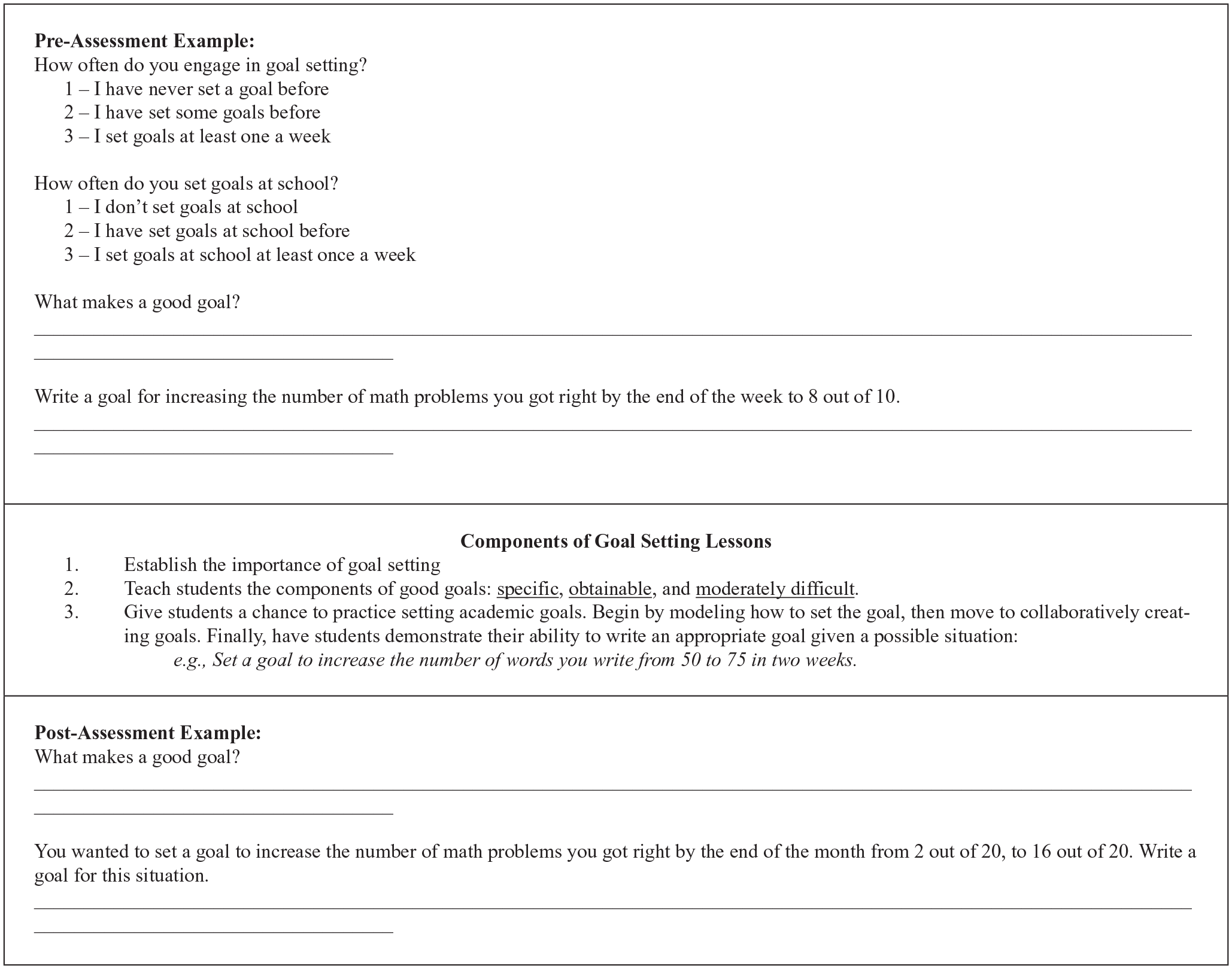
Assessing and intensifying goal setting.
Individual Conferencing
Another way to intensify the goal-setting component of the SRSD approach is through teachers hosting individualized conferences on goals prior to or after an academic activity. This intensification can benefit students who display pervasive negative self-talk, or students who are initially disengaged throughout the goal-setting process. Teachers should give individualized support, feedback, and encouragement during individual conferencing to increase student buy-in to the goal-setting process. Teachers may choose to begin by briefly reviewing student goals prior to and following an activity to review the goals, actionable activities to move toward completing the goals, the progress made toward the goals, and finally any necessary modifications to the goals. As the student becomes more comfortable with goal setting and monitoring, teachers can fade individual conferencing to either before or after the academic activity and eventually every other day or once a week. Figure 2 provides an example of an individual conferencing record sheet, which teachers can use to monitor student use of and progress on goals and guide students through the self-evaluation process. When students are able to use these pre- and post-activity checklists independently, teachers are ready to begin fading the frequency of individual conferences.
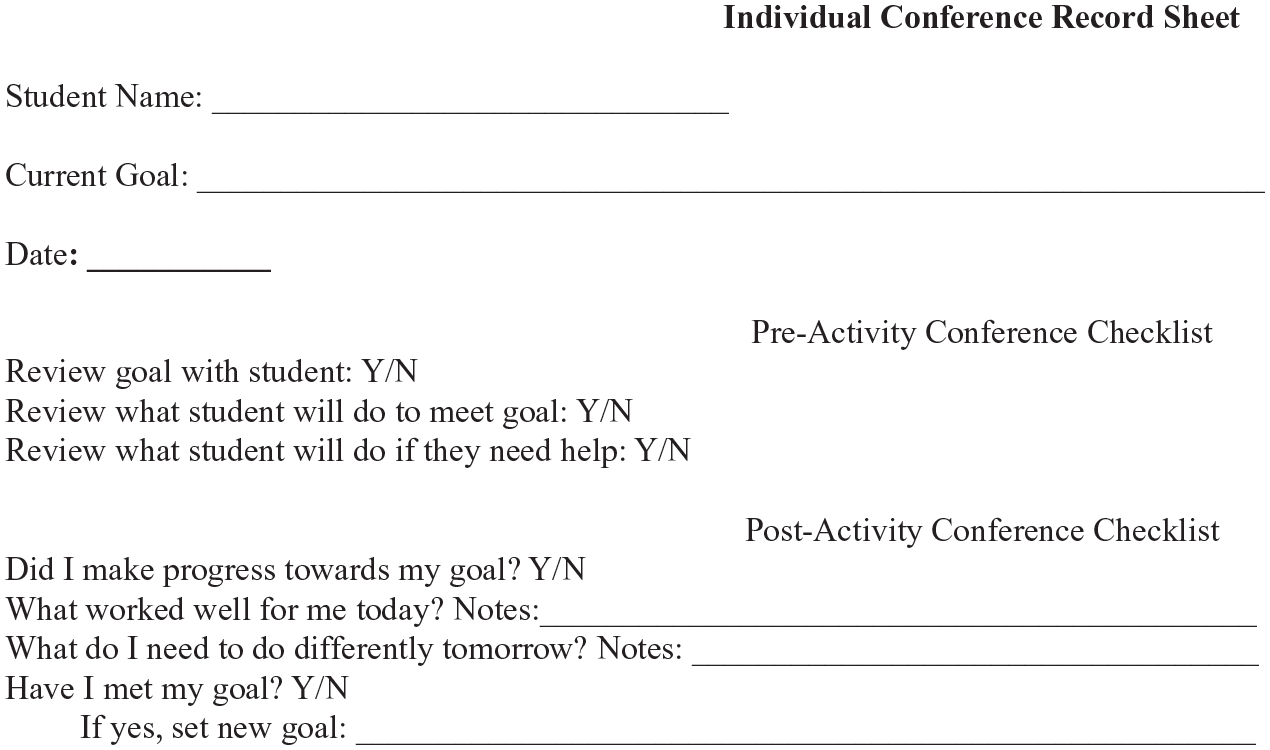
Individual conference record sheet.
Self-Monitoring
Self-monitoring is a foundational skill for self-regulation and involves a two-step process of assessing whether or not a target behavior has occurred and recording the behavior accurately (Huff & Nietfeld, 2009), often resulting in generating a plan for further action (Butler & Winne, 1995). Students with EBD frequently struggle with identifying an academic or behavioral expectation and then evaluating their progress accurately (Bercher, 2012), although it is an effective strategy to improve on-task behaviors (Mooney et al., 2005). Within SRSD, teachers integrate self-monitoring using a four-step process which includes (a) identifying which behavior(s) students will self-monitor, (b) determining students’ performance prior to self-monitoring (i.e., baseline performance), (c) training students about the benefits of self-monitoring, and (d) teaching students the self-monitoring procedures (Harris et al., 2008). The scripted SRSD lessons provided by Harris et al. (2008) and Mason, Reid, and Hagaman et al. (2012) include checklists for self-monitoring the use of strategy steps during academic performance; however, many students with EBD may struggle with academic engagement, which can be addressed through intensification of the self-monitoring supports already present in the SRSD instructional approach.
Self-Monitoring of Attention
Self-monitoring of attention is a student’s ability to self-assess how well they are paying attention to the academic task (Harris et al., 2005). Academic outcomes are directly affected by this skill. Many students with EBD frequently display off-task behaviors such as being out of their seat, talking to peers, making off-topic comments (Popham et al., 2018), or fail to finish academic tasks, even when given adequate time. Self-monitoring attention to task is one strategy for increasing academic engagement. To implement self-monitoring of attention, the teacher and student must first identify what it means to be engaged and off-task. Then, the teacher can demonstrate how the student can use a timer (e.g., an interval timer such as a MotivAider, 2000) that buzzes or beeps at either set intervals (e.g., every 2 min) or random intervals to monitor attention to task. Goal setting can be combined with this intensification to help students slowly increase their time on task. While it is unreasonable to expect students to be on task 100% of time, once the student is consistently on tasks 80% of time, they can fade the use of self-monitoring of attention. An example of a self-monitoring of attention checklist is found in Figure 3.
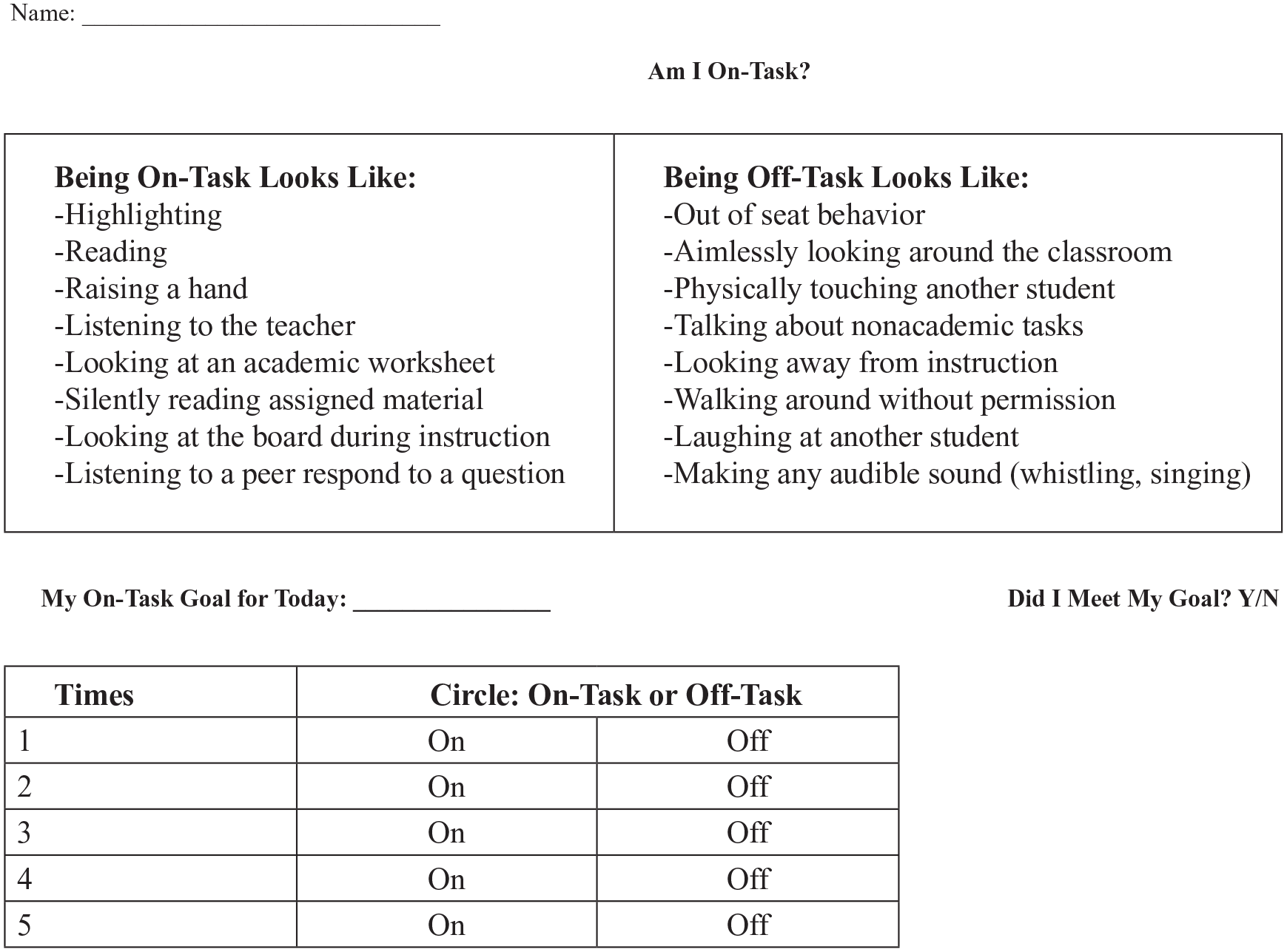
Self-monitoring of attention checklist.
Self-Monitoring of Time on Specific Tasks
At other times, students with EBD often struggle to effectively manage the time they spend on the smaller parts of a larger task (Sanders et al., manuscript submitted for publication). To address this, students can self-monitor the time they spend on each of these smaller parts of a task to evaluate their progress on a larger academic task. This intensification is helpful for students who frequently fail to complete academic tasks when given adequate time. To teach students how to monitor the time spent on smaller parts of a larger task, the teacher should first model how to preview the academic task (e.g., number of paragraphs to read or write). Then, the teacher should model how to identify the number of minutes they will spend on each part of the passage. For example, if a student is reading a three-paragraph passage, it may be appropriate to allocate 5 min per paragraph for the strategy. Then, the teacher models how to monitor progress while working through the task. This can be done through a preset timer that goes off at a set interval (e.g., every 5 min) so students can self-assess if they are making appropriate progress on their task. If not, the teacher models how they may need to reassess their time allocation, evaluate if their environment is conducive to work (e.g., am I talking to a peer instead of working), or if they need to ask for help or additional supports. By providing intensified scaffolded support with self-monitoring taught within the SRSD instructional approach, teachers facilitate students’ independent use of the strategy. To measure the effectiveness of this intensification, teachers can track the number of assignments students complete and the number of smaller tasks students complete within the time allocated.
Self-Instruction
Self-instruction, sometimes referred to as “self-talk or self-statements,” assists students in self-regulating behaviors or cognition and task completion (Graham et al., 1992). Self-statements are often described as the voice in your head, verbalizing and reflecting on the task at hand. Teachers facilitate student use of self-instructions using the following steps: (a) discussing the importance of self-talk and how it is positive and helpful or negative and destructive; (b) developing meaningful, individualized, and task-specific statements; (c) modeling when, where, and how the self-statements can be used during academic tasks and activities; and (d) providing opportunities for students to practice the use of self-instructions with scaffolded support from the teacher (Harris et al., 2008; Mason, Reid, & Hagaman et al., 2012).
Self-statements are helpful when a student assesses a task and identifies appropriate strategy steps (e.g., “What do I need to do first?). Self-statements also support a student during the task to assess progress and provide encouragement (e.g., “I’m doing a great job, and I’m almost halfway done!”) and at the conclusion of the task (e.g., “I’m going to double check my answer” and “I did a great job!”). Many students, including those who have histories of academic or behavioral deficits or excesses, have self-talk that is overwhelmingly negative (e.g., “I can’t do this” and “I’m too stupid to understand this”) and require explicit instruction and modeling to adopt and utilize more positive self-instructions (Mason, Meadan, Hedin, & Cramer, 2012).
Visual Prompts
The SRSD instructional approach recommends self-instruction statements initially be written down (many of the lessons include specific worksheets for this purpose), before being faded and internalized (Harris et al., 2008; Mason, Reid, & Hagaman, 2012). Some students with EBD may need more targeted, intensified visuals to support the generalization from written statements that are verbalized, to internalized statements. For example, students who struggle to use self-statements within the SRSD stages or who are slow to begin academic tasks benefit from this type of intensification. There are a few different ways to create targeted visuals for students. One way is to ask students to write their top three most frequently used personal self-instructions on a sticky note to put at the top of their paper or desk while they use the strategy. This type of student-created visual provides the student with a reminder to use the self-instruction without juggling an additional worksheet. Students who struggle to identify appropriate self-instructions for various situations within a task can benefit from a flowchart (see Figure 4). Flowcharts provide scaffolded instruction students need to use self-instruction during academic tasks. To assess the effectiveness of this intensification, teachers can ask students to self-report their use of self-instructions and self-monitor the ratio of their positive to negative self-instructions.
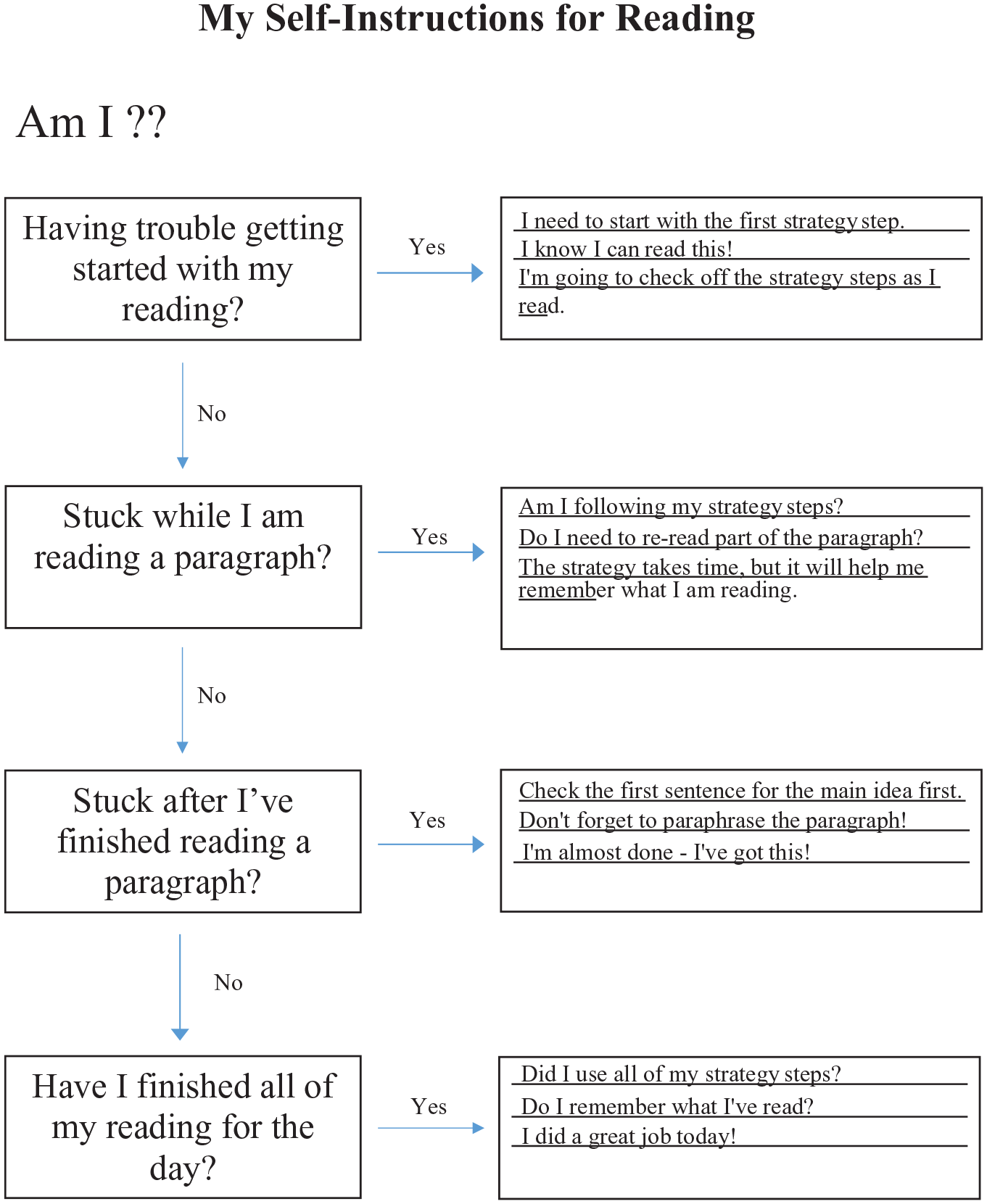
Self-instruction flowchart.
Verbal Pre-Corrections and Prompts
In addition to intensified visual supports, especially for students with EBD, teachers can provide auditory prompts through pre-correction or corrective feedback. For example, teachers can provide a pre-correction prior to students beginning a task (e.g., “Remember to use your self-instruction statements as you read the passage,” and “What is an example of a self-instruction you can use if you get frustrated?”) to increase and reinforce the use of the desired behavior (Ennis et al., 2012). This intensification is particularly helpful for students who consistently struggle to accurately complete one or two strategy steps. Once the teacher identifies the self-instruction(s) necessary to support the completion of targeted strategy steps, prompting students to rehearse self-instructions prior to beginning a task can increase the likelihood students will use the self-instructions at the appropriate time during the strategy. Teachers can ask students to self-report the number of self-instructions used, as well as tally the number of self-instructions statements used by students to assess the effectiveness of the intensification.
Self-Reinforcement
Self-reinforcement, the process of identifying a reinforcer and self-awarding when a specific criterion is reached (Graham et al., 1992), is the final self-regulation component taught and incorporated within SRSD. For many students, the ability to self-reinforce their behavior is shaped when they are positively reinforced for meeting or exceeding expectations (e.g., praise for completing a task, opportunities to engage in a desired activity; Reid et al., 2013). Many students with EBD struggle to meet academic and/or behavioral expectations, leading to fewer previous opportunities for positive reinforcement and fewer experiences of success (Scott et al., 2001). Therefore, many students with and at-risk for EBD may require additional intensifications to implement self-reinforcement, as they may need more frequent opportunities for reinforcement to shape or maintain desired behaviors (Mason, Reid, & Hagaman, 2012).
The SRSD instructional approach teaches students to self-reinforce when identified goals/criteria are met, such as after naming all the SRSD strategy steps or retelling a passage with the main idea and two supporting details. The teacher supports student development of self-reinforcement skills using a four-step procedure: (a) set the pre-determined criteria, (b) select a reinforcer, (c) establish the standard for determining if the criteria is met, and (d) self-award with the identified reinforcer (Mason, Reid, & Hagaman, 2012). The use of self-reinforcement within SRSD can be infused across all six stages and during each lesson, with reinforcement provided frequently (e.g., after completing each lesson) or after more complex criterion are met (e.g., after a student completes three essays using a writing strategy).
Self-Reinforcement Plans
While many students may be able to use the four steps for self-reinforcement without visual or written supports, a self-reinforcement plan can provide structure and guidance for students with little experience with this self-regulation component. Teachers should consider intensifying this self-regulation component when students display a lack of motivation to engage in academic tasks or if students are struggling to complete activities due to low buy-in. A self-reinforcement plan can serve as a written reminder of the responsibilities of both the student and the teacher, as well as directions on how the self-reinforcer will be administered. Student involvement in identifying the criterion and self-reinforcer(s) is crucial for buy-in (Mason, Meadan, et al., 2012) and should be completed with input from the teacher and student (see Figure 5). Assessing the impact of self-reinforcement can be measured through the number of days a student meets the agreed upon criterion and/or the number of times the student appropriately self-reinforces. In addition, as students experience success in meeting goal criterion and have the opportunity to self-reinforce their behavior, the schedule of reinforcement can be altered (e.g., moving from a 5-min break after every 15 min on task to a 5-min break after the task is completed).
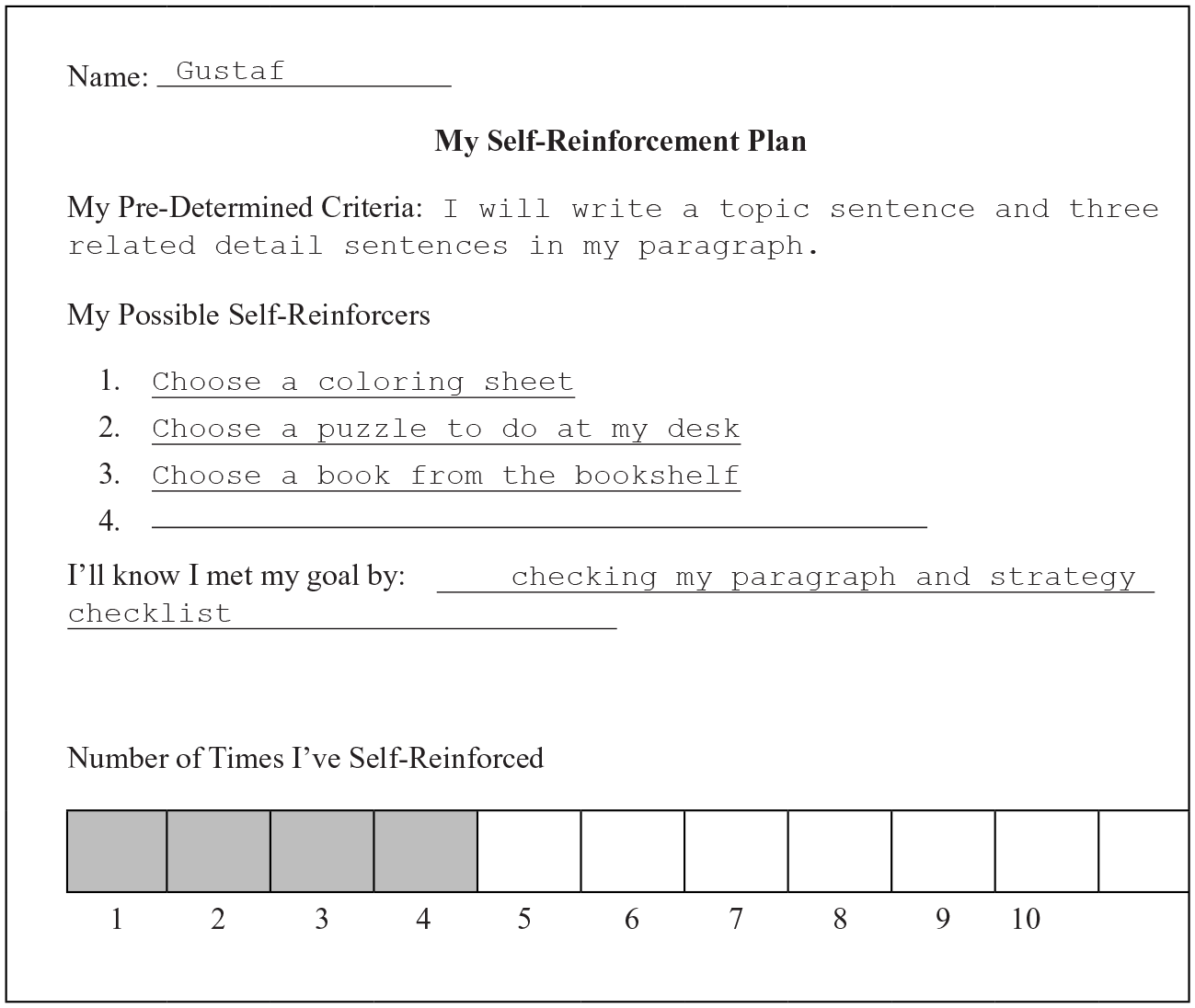
Self-reinforcement plan and graph.
Positive Reinforcement
Another potential intensification within the SRSD instructional approach is the use of additional positive reinforcement to motivate and support students with EBD. While the ultimate goal is for students to be able to self-reinforce after meeting pre-established criterion, integrating various forms of positive reinforcement can increase student motivation, particularly when initially learning a new or difficult skill and increase the likelihood desired behaviors will be repeated (Niesyn, 2009). Students with EBD may continue to benefit from external reinforcement for behavioral expectations due to behavioral excesses and deficits. Teachers can provide external reinforcement through the integration of evidence-based behavioral strategies, such as intermittent reinforcement and group contingencies, still within the SRSD instructional approach.
Intermittent reinforcement
Intermittent reinforcement occurs when the teacher sometimes reinforces a desired behavior (e.g., reading a paragraph, writing a topic sentence), with a desired reinforcer. For example, if a student correctly completes a strategy-step eight times during a lesson, the teacher can intermittently reinforce this behavior twice. Teachers can choose to intermittently reinforce students for demonstrating lesson competencies (e.g., correctly completing a strategy step) or using other self-regulation skills (e.g., appropriate use of a self-statement). Reinforcers can include both tangibles (e.g., school supplies, tickets for class-wide reinforcement system) and non-tangibles (e.g., praise).
Group contingency
Finally, teachers can intensify self-reinforcement by integrating group contingency reinforcement within their whole class. A group contingency reinforcement occurs when a consequence, such as a reward, is applied by the teacher when all or some members of a group (e.g., a class) meet a pre-determined criterion and is effective for students with behavior challenges (Little et al., 2015). It may be most effective if the pre-determined criterion is mastery-based (e.g., 100% of students use the strategy correctly) rather than performance-based (e.g., everyone scores an 80%), to allow the most students to feasibly meet the criterion regardless of individual academic skill level.
Conclusion
Research strongly supports SRSD for systematically teaching academic skills to mastery across content areas (e.g., writing, reading) and with students with EBD (Losinski et al., 2014; Sanders et al., 2019). Therefore, it is important to examine the self-regulation components in SRSD and ways in which instruction can be intensified for students with EBD. When applying SRSD and a specific content strategy, teachers will want to constantly teach, model, and assess student use, both fluency and accuracy, of the self-regulation components. Teachers should monitor student use of self-regulation skills, as it can be indicative of academic success (Niesyn, 2009). If students are not making academic or behavioral progress during instruction, intensifying one or more self-regulation components can help.
In addition to the intensification methods detailed in this article, teachers can also consider using the taxonomy of intensification domains put forth by Fuchs et al. (2017) to further individualize instruction. The interconnectedness of the SRSD instructional approach resides in its allowance for teachers to simultaneously address their students’ academic and social/emotional/behavioral needs as well as providing an array of reading, writing, and other content area strategies to select from based on student needs. Furthermore, SRSD allows teacher the flexibility to determine during which stage and to what degree self-regulation components can be intensified for improved student outcomes. When academic performance does not match teacher expectations within SRSD instruction, teachers can apply a number of potential intensifications to address student self-regulation as a means to strengthen academic engagement, attainment, and overall performance.
Footnotes
Declaration of Conflicting Interests
The author(s) declared no potential conflicts of interest with respect to the research, authorship, and/or publication of this article.
Funding
The author(s) received no financial support for the research, authorship, and/or publication of this article.
