




Abstract
Students with disruptive behavior problems can contribute to loss of instruction time in the classroom and may cause irritation for peers. However, peers can serve as powerful change agents in the classroom. Promoting positive peer interactions is especially important for students with emotional and behavioral disorder (EBD). One effective approach to promote prosocial behaviors and support students with EBD is positive peer reporting. The use of positive peer reporting decreases negative interactions among peers by increasing prosocial behaviors. This column reviews the literature about this strategy, discusses the ways in which it can be adapted to best fit the needs of students, and provides guidance and recommendations for how to implement these approaches in an applied setting.
Within the classroom setting, peers can be powerful change agents (Skinner et al., 2002). Positive interactions and social exchanges between peers can have a positive impact on students’ overall social development (Breeman et al., 2014). This can improve students’ attitudes toward school, thereby improving the classroom-learning environment (Murphy & Zlomke, 2014). Positive peer reporting (PPR) is a peer-mediated intervention that improves positive behaviors and social relationships across students and groups of students in various settings (Morrison & Jones, 2007).
The PPR involves brief, highly structured sessions during which students are provided the chance to specifically praise the behavior of peers (Skinner et al., 2002). The PPR strategy focuses on decreasing negative interactions among peers by increasing prosocial behaviors. The rationale for using PPR is that it is a practical alternative to students reporting on or focusing on misbehavior of their peers, often to get peers in trouble (i.e., tattling). Allowing peers to monitor and report on only challenging behaviors may unintentionally cause peers to overlook prosocial behaviors of students with emotional and behavioral disorder (EBD) (Skinner et al., 2002). In addition, responding to tattling results in loss of instructional time because the teacher has to investigate the misbehavior (Collins et al., 2020). In PPR, students do the opposite of tattling and “catch peers being good” and then report those positive behaviors publicly to the class during a specified time. The PPR strategy fits well into any existing classroom environment, is a positive and proactive approach, and is a Tier 2 targeted intervention within a positive behavioral intervention and support framework (Collins et al., 2018; Morrison & Jones, 2007). The PPR is related to many best-practice approaches for teaching social skills (e.g., modeling of skills, reinforcement of accurate responses, Walker & Barry, 2018) and it can be used to support the ongoing social skill development of students. However, PPR is typically conceptualized as a behavioral intervention and classroom management strategy designed to generally reinforce positive interactions between peers rather than directly teach discrete-specific social interaction skills as is done in social skill instruction.
The PPR has been shown to be effective in altering the social status of students in general education classrooms as well as self-contained classrooms. The PPR strategy has been implemented in rural, suburban, and urban settings as well in the South, Midwest, and Western regions of the United States (Collins et al., 2020; Skinner et al., 2000). Results from studies have indicated that PPR improves the learning environment, reduces problem behaviors, and improves social development and academic achievement (Reinke et al., 2009). For example, results from a recent meta-analytic review of peer reporting interventions (Collins et al., 2020) indicated that PPR had a positive impact on student disruptive behavior, academically engaged behavior, and social behavior. In addition, PPR strategies have been found to be efficient and flexible (Collins et al., 2020). Regarding efficiency, PPR requires relatively few resources to implement and can address the behavior of entire classrooms at once. In terms of flexibility, PPR interventions can be modified to a classroom setting, which likely affects the feasibility and teacher acceptability of the intervention. As a result, PPR interventions enhance the quality and quantity of social interactions for students.
The PPR is based on the assumption that some students with social interaction difficulties have become withdrawn or may have acquired appropriate social skills but have performance deficits in demonstrating the skills and therefore do not engage in these behaviors as frequently as their peers (Peterson-Nelson et al., 2008). Thus, the goal of the intervention is to provide reinforcement for prosocial behaviors by having peers publicly acknowledge those appropriate behaviors that were already occurring in the students’ natural environments. Furthermore, it is assumed that public acknowledgment would alter peers’ perceptions of targeted students (Skinner et al., 2002).
Positive Peer Feedback
Forming relationships and interacting with peers is a common difficulty for students with EBD (Magg, 2006). Often, these students struggle to effectively navigate the social environment of the school and can experience low levels of positive peer interactions, victimization, and/or exclusion (Magg, 2006). As a result, explicit instruction in social-emotional skills is often one component of support plans for these students (Bierman & Sanders, 2021). Although this can be a highly beneficial intervention for improving relationships with their typical peers, school staff can also implement positive peer feedback strategies to further support the development of positive relationships.
Although there is extensive literature related to PPR with elementary-age students, there are some studies that have shown the effectiveness of PPR with students in middle school (Ervin et al., 1996; Jones et al., 2000; Peterson-Nelson et al., 2008). Findings from these studies indicated that implementation of PPR procedures was associated with increased positive peer interactions (Ervin et al., 1996), increased cooperative statements (Jones et al., 2000) and improved social involvement (Peterson-Nelson et al., 2008) for older students with or at risk for EBD as well as decreases in negative comments between peers.
Initially, PPR was designed to be implemented for one student in a class or a small group of students (Hoff & Ronk, 2006). However, the intervention has been expanded to apply to the entire class so that students do not feel singled out (Hofstadter et al., 2009; Moroz & Jones, 2002; Morrison & Jones, 2007). The versatility of this intervention allows teachers to choose the method that best fits classroom needs. Three studies that utilized PPR as a class-wide intervention in 9th through 12th grade demonstrated that PPR was effective in decreasing disruptive and/or off-task behavior while also improving levels of engagement (Hofstadter et al., 2009; Lum et al., 2017, 2019). At the middle school level, other researchers have investigated the impact of a class-wide PPR intervention on disruptive behavior and increases in positive peer interactions among students with EBD (Hoff & Ronk, 2006; Moroz & Jones, 2002; Morrison & Jones, 2006; Peterson-Nelson et al., 2008). The results of these studies provide support for the use of peers as sources of positive reinforcement to improve prosocial behavior.
Individual Versus Group Contingencies
In selecting an appropriate reinforcer for students that engage in the PPR intervention, it is also important to decide whether rewards (we use the terms reinforcer and reward interchangeably) will be provided individually or via the use of group contingencies. Individual rewards entail providing each student with a reward for participating in the PPR intervention. Students could earn a small reinforcer such as a piece of candy, sticker, free homework pass, or a few minutes of phone time, if they participate in the PPR session by sharing an appropriate behavior-specific praise (BSP) statement with a peer (Grieger et al., 1976). Another option is to provide a small reinforcer to both the reporter and the recipient of the praise as done in studies by Morrison and Jones (2007). In addition, individual social reinforcement in the form of BSP from the teachers for both recipients and reporters in addition to tangible rewards is warranted (Murphy & Zlomke, 2014). One advantage of an individual contingency approach is flexibility and the ability to personalize rewards, if needed. Students may be permitted to choose which reinforcer they prefer from a variety of options, or the reward criteria may be altered for certain students depending on ongoing performance. This personalization allows for the determination of a maximally reinforcing reward for an individual student as opposed to having a general reward available for all students. However, this flexibility and individualization can also become overwhelming or too time-consuming for a teacher looking to streamline this intervention into already-existent classroom reward system.
If a group-based reward system is better suited for the needs of the students and teacher, there are three possible types that can be implemented. In a dependent group contingency model, the entire group (i.e., class) can earn access to a reward dependent upon the behavior of a smaller selected group of individual students (Litow & Pumroy, 1975). For example, an entire classroom of students may earn a movie day if five of the students in the classroom who have struggled with peer interactions submit two positive peer notes each day in the school week. In this model, the outcome for the larger group is dependent upon the behavior of the five students. Although this approach can be effective for altering the behavior of certain students, it can also create hostility between students in the classroom environment and the target students can feel singled out (Little et al., 2015). One way to possibly address these issues is to alter who the target students are on a weekly or daily basis (Hansen & Lingnugaris/Kraft, 2005).
Conversely, in an independent contingency, a contingency and reward are set for the entire group, but the reward is only provided to those individuals who have met the contingency criteria (Murphy & Zlomke, 2014). This approach is similar to providing rewards on an individual basis except the same criteria and reinforcement is used for all members of the group, which simplifies the overall intervention (Little et al., 2015). For example, students who submit at least two positive peer notes within a week can earn one free homework pass. One drawback of this approach is that students are less motivated to work together to meet the established criteria (Little et al., 2015), which is a skill that may be especially important for students with EBD.
An interdependent contingency remedies this issue by making access to the reward contingent upon the entire group meeting the contingency criteria together (Murphy & Zlomke, 2014). For example, the entire class must submit 30 positive peer notes to play games on Friday. Some researchers have investigated adding PPR to interdependent group contingency rewards (Murphy & Zlomke, 2014). Some additional examples of rewards are popcorn and a movie or extra free time (Cashwell et al., 2001). Allowing students to brainstorm and vote on the long-term reward is a viable option as well (Murphy & Zlomke, 2014). It is also important to make sure the reward is reinforcing for all students and attainable within the time allowed but difficult enough to be a challenge (Murphy & Zlomke, 2014). In addition, keeping the type of reward a secret until it is earned can be effective for preventing disengagement on the part of students who are less-motivated by certain rewards. Overall, when deciding which type of contingency to use, practitioners should match the particular needs of their students to the approach best suited to meet those needs. If it is difficult to find a universally rewarding option for an entire class of students an individual approach may be better, whereas if increased cooperation between students is the desired outcome, an interdependent approach may be warranted (Little et al., 2015).
Implementing Positive Peer Feedback
Students’ ability to interact with peers appropriately may vary. Students with specific learning disabilities, social skill deficits, and/or behavioral concerns will likely benefit from direct instruction in how to give appropriate praise to peers, which can allow them the opportunity to learn the positive behaviors and skills they are expected to demonstrate (Walker & Barry, 2018). The following guidelines are from steps used and suggested by Skinner et al. (2002).
Introduce and define positive peer reporting
Prior to implementation of the PPR intervention, the classroom teacher should spend about 20 min providing the students with the definition and rationale for using the strategy. The teacher explains that PPR is the opposite of tattling and that students are provided the chance to praise the specific behavior of peers and thereby focus on what peers do well. Students will be given the chance to earn reinforcement (e.g., points, activities) for reporting positive behaviors of peers.
Explain the procedure
Students are given directions related to the intervention and are trained in the specific steps on how to deliver the positive statement. They are instructed to pay particular attention to any peer’s positive behaviors during a selected time during the course of the day and to report the observed occurrences of positive behaviors during that time. Positive comments include behaviors like volunteering, sharing, helping a friend, showing good anger management, being honest, putting in effort on a task, giving others praise, encouragement or compliments, or any prosocial behavior like asking for help instead of giving up and waiting for the teacher’s help (Skinner et al., 2002). The teacher determines that the report of positive behavior is specific and genuine, and the child reporting the behavior receives reinforcement.
The teacher reviews the components of PPR, explains to the class that they will be practicing their peer interactions skill, and then role-plays what the strategy looks like by using different scenarios. For example, the teacher says to Otis, “I am going to role play being your peer. I noticed that you helped Juan with his heavy book bag.” So, I say, “Otis I noticed that you helped Juan with his book bag. That was being helpful.” The teacher can remind students to be specific, direct, and genuine in what they share with their peers. Next, students in the class can take turns practicing sharing positive statements with others in the room. Finally, the teacher provides BSP and corrective feedback to help students learn what type of statements is appropriate or not.
The following steps are used to report a positive behavior and include (a) look at the person if appropriate, (b) smile, (c) report something positive the person did or said today, and (d) say something like “You were helpful” or “I like the way you were honest” (Jones et al., 2000). The teacher may use an intervention script to help facilitate implementation of the intervention.
The extent of training and how to ensure students have reached mastery of the procedure vary from study to study; however, it is recommended that training include teacher modeling of the PPR steps, and many training approaches also include opportunities for students to practice the steps before intervention begins (Collins et al., 2020; Murphy & Zlomke, 2014). It may also be helpful to create a visual of the steps that students can use when delivering a positive report and/or require each student to demonstrate their knowledge of the procedure prior to intervention implementation (Collins et al., 2020).
Figure 1 outlines a PPR fidelity checklist. Video modeling (viewing a video of a similar-age model engaging in the targeted behavior) has been shown to be effective for supporting students with EBD prosocial skills (Clinton, 2016) and could serve as an additional instructional support when initially teaching students about the PPR steps. Teachers could recruit positive peer role models to demonstrate the process of praising a peer, record examples of them engaging in this behavior, and show it to classmates as way of reinforcing teaching about the steps of the PPR procedure.
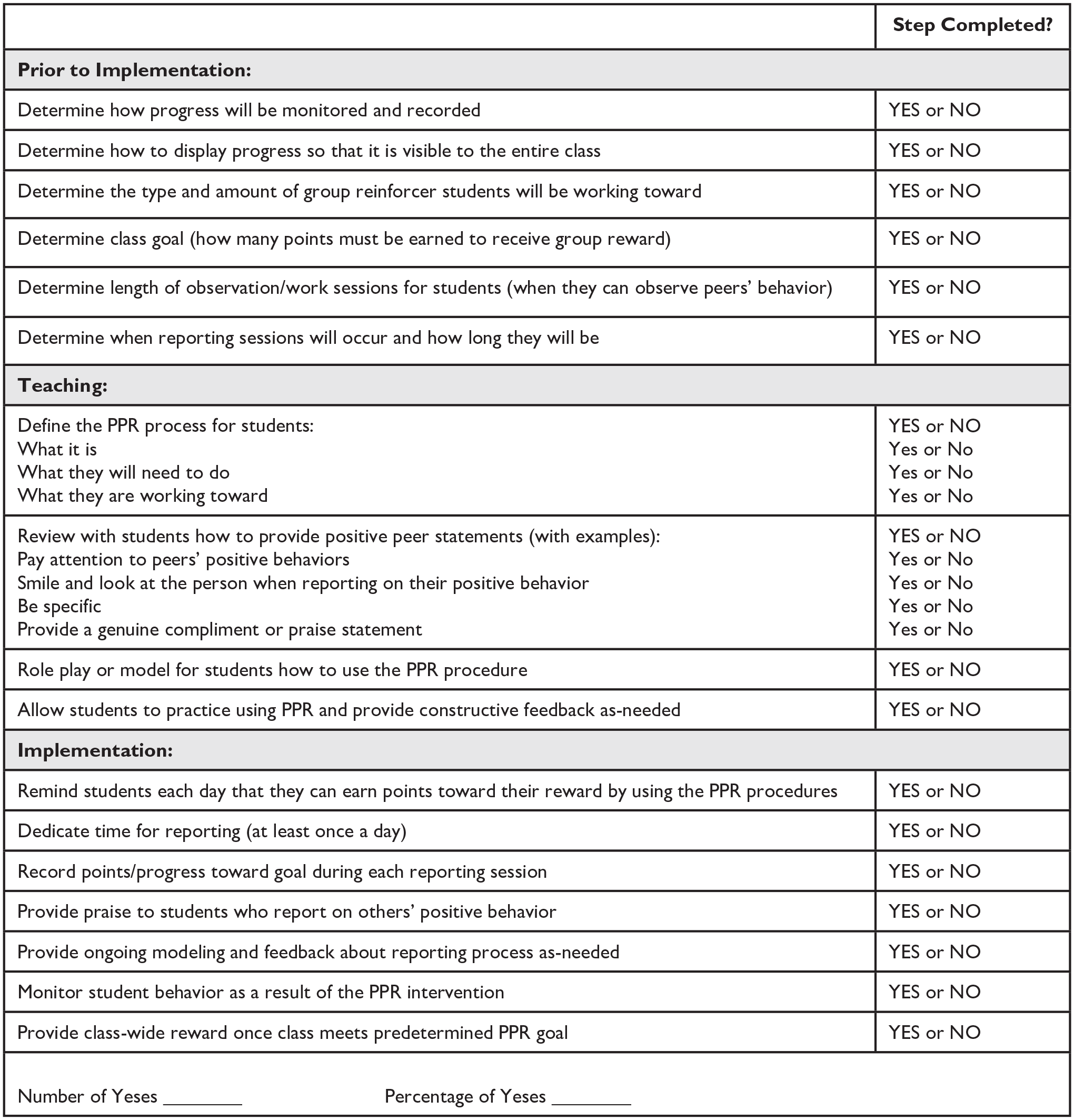
Sample teacher PPR fidelity checklist for an interdependent group contingency.
The level of training support needed will vary depending on the age and current social skills of students involved, with younger students and those with greater social skill struggles likely requiring more initial training support and practice. For example, if students are accustomed to interacting negatively with one another, it would be beneficial to spend more time upfront modeling what positive reports/compliments entail. This would require dedicating more time to showing students what positive comments sound like (e.g., “Positive comments point out something good that someone else has done and involve a tone of voice that sounds kind instead of sarcastic or annoyed”). Additional modeling would also include sharing examples (“Great job on your presentation!”) and non-examples (“Great job not messing up the assignment this time”), as well as monitoring student practice prior to implementing reinforcement procedures.
Determine the type and amount of reinforcement
First, the teacher should remind all students at the beginning of the day or class period that students can earn points for “Catching each other being good.” and that the points will lead to a larger reward. The teacher selects the type and amount of reinforcement that the students receive for reports of positive behavior. The teacher should provide reinforcement based on the individual or group reward system previously selected for the specific intervention protocol in their classroom. For example, after positive reporting a student may receive a preferred activity, earn points for an item they like, or apply the tokens toward a previously established token economy system that the teacher has in place in the classroom.
Determine the time of day and length of sessions
At the beginning of the selected session, the teacher explains that the first 15 min of class is spent with instruction. During the remaining 30 min, the class either splits into small groups to work on assignments or they work independently at their desk. Reporting sessions should last between 5 and 10 min and are usually conducted at a specified time as part of the class routine, at the end of a selected class period or at the end of the day (Lum et al., 2019). The teacher solicits comments from students, usually by asking them to raise their hand (Murphy & Zlomke, 2014). The teacher may refer to a visual aid indicating the steps to follow when sharing, if needed. If using a form of PPR in which students write positive notes on cards, then the teacher should plan to dedicate time each day to reading, or having the students read, the positive notes. Finally, the teacher should praise the reporter for sharing and the recipient for their positive behavior. This process should continue until all students have an opportunity to share a positive statement or until all notes for that day have been shared.
Monitor the effects of the intervention
The teacher monitors the effects of the intervention on the quality of peer interactions by coding interactions. For example, the teacher can designate interactions as positive, negative, or neutral (Skinner et al., 2002). The effects of the intervention can be monitored by using a simple frequency count and total the number of times students say something negative, neutral, and positive to each other during a specific time of day. A chart or datasheet can be created and displayed so all students can see their progress (see Figure 2).
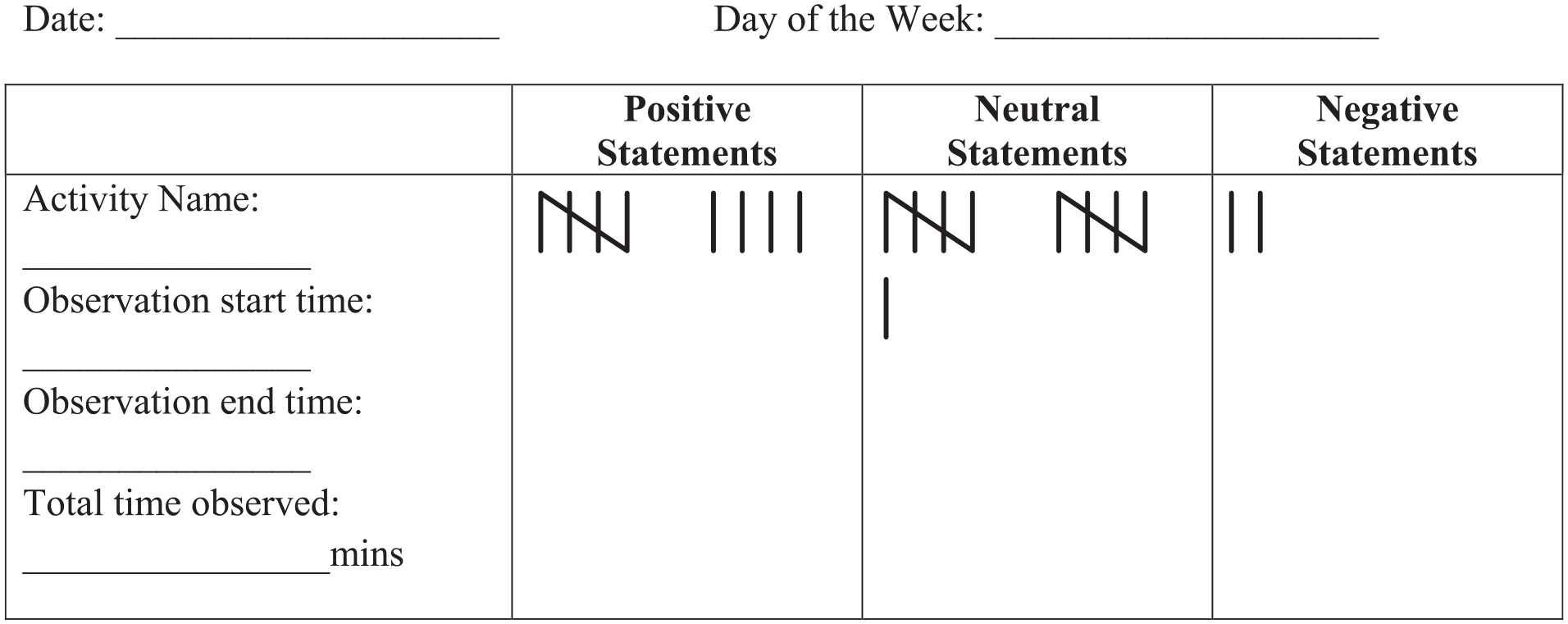
Sample intervention monitoring table—students’ statements toward peers.
An individual goal can be set where a student shares at least one positive comment a day. An example of an individual comment is “Heidi helped me find the right worksheet for their small group activity.” The teacher can also create a classroom goal to reduce negative interactions to fewer than five per day during reading class and increase positive statements to more than five per day during reading class. Once the class reaches the predetermined number of responses, the class will earn access to the predetermined reward. Finally, the teacher can monitor whether there are increases in positive interactions among the students outside of the structured time. For example, are students nicer to each other in the hallway and/or are they behaving more friendly toward one another (e.g., telling jokes, including one another, smiling at each other) in the classroom or during lunch?
Possible Challenges in Implementing Positive Peer Feedback
There are several possible challenges or hurdles practitioners may face when implementing PPR interventions. The first concerns determining reward criteria, or how many positive peer notes/tallies are required to access the predetermined award. It can be a challenge to determine an appropriate but challenging initial criteria, and if students fail to attain the expected number of notes/tallies that could lead to a decrease in motivation. Thus, it is suggested that practitioners set the initial criteria at a readily attainable level to ensure students are able to access reinforcement initially. These expectations can then be increased in subsequent weeks dependent upon the class’ performance.
Another challenge concerns which students receive the positive peer feedback in a classroom. It is possible that students who do not struggle behaviorally and/or who are well-liked by many others in the class begin to receive the majority of positive peer notes, thus further alienating or excluding students with social struggles. If this occurs, teachers can implement an additional PPR rule stating that students must write/share a positive note about a different student each time. This ensures that all students, including those who are most in need of positive peer interactions, receive feedback. A third challenge that may arise when implementing this intervention is determining rewards. As mentioned above, eliciting student input for reward choices can be an effective way of increasing motivation and buy-in (Murphy & Zlomke, 2014). There may be instances where a student tries to share the same statement that was already shared earlier. In this situation, the teacher can ask that students share a different statement. When the student complies the teacher can role model the PPR procedure and say, “That was a great example!” If a student refuses to share then the teacher can avoid a power struggle and offer a pass.
Rewards should match the magnitude of achievement as well, with smaller rewards used for individual contingencies (e.g., preferred item, healthy snacks, 5 min of free time) and larger rewards used for group-level larger achievements (e.g., movies, apps with fun academic games, 20 min of free time). To ensure rewards can be provided consistently, practitioners should also explore options that do not cost money (e.g., free time, extra recess, homework passes, listening to music while working, extra credit). Finally, it can be a challenge to maintain long-term student investment and enthusiasm for the intervention. It is important to ensure that PPR procedures are implemented with fidelity to sustain positive behavioral effects (Murphy & Zlomke, 2014). Furthermore, alternating/updating reward options, using a visual display of progress, and changing reporting and sharing approaches can support long-term buy-in and effectiveness.
Conclusion
The PPR is an effective teacher practice that can be implemented in essentially any classroom to increase positive peer-to-peer interactions and social exchanges (Breeman et al., 2014). Researchers have shown that teachers who implement positive peer feedback strategies support the development of positive relationships among their students. Given these benefits, it is important that classroom teachers plan for and provide numerous opportunities for peers to support one another by using positive reporting and feedback strategies among their students, particularly those with and at risk for EBD.
Footnotes
Declaration of Conflicting Interests
The author(s) declared no potential conflicts of interest with respect to the research, authorship, and/or publication of this article.
Funding
The author(s) received no financial support for the research, authorship, and/or publication of this article.
