




Abstract
The relationship between learning disabilities and behavior disorders is well documented and has led to the development of integrated interventions that target both academic and behavior deficits in elementary school–age students. This paper describes the rationale for, development of and implementation of an integrated academic-behavior intervention called academic and behavior combined support (ABC Support). The intervention was developed by integrating the critical intervention elements from two single-focus interventions (i.e., repeated reading and check-in/check-out) into a single comprehensive intervention designed to improve reading fluency for early elementary school–age students with reading disorders while also strengthening their engagement and compliance with behavior expectations.
Keywords
The well-documented connection between learning disabilities and behavior disorders has contributed to the development of integrated interventions that target both academic and behavior deficits (McIntosh & Goodman, 2016). Integrated interventions result from “the fusing of independent strategies or programs into one enhanced, coherent intervention approach” (Domitrovich et al., 2010, p. 74). The availability of integrated interventions enables school teams to coordinate supplemental academic and behavior support for students who require intensive interventions across both domains. Integrated interventions may be more efficient and effective in promoting change compared to single-focus approaches because their complementary active ingredients interact synergistically (Cook et al., 2012). Consider, for example, a single-focus behavior intervention that incorporates reinforcement procedures to strengthen learning-related behaviors (e.g., attention) but lacks opportunities for students to practice new behaviors in the context of performing academic tasks. When merged with an academic intervention that includes repeated practice, the benefits of both interventions are maximized because the targeted academic skills and desired behaviors are reinforced and rehearsed simultaneously within the same intervention context.
Development of Academic and Behavior Combined Support
Academic and behavior combined support (ABC Support) is an integrated intervention that combines a focus on developing oral reading fluency with strengthening behavioral engagement and compliance. The intervention was created to provide integrated support for elementary school–age students whose poor reading fluency (i.e., difficulty reading with sufficient accuracy, expression, and automaticity to understand what they read) and low compliance with behavior expectations put them at high risk for long-term, negative school outcomes.
ABC Support addresses reading and behavior deficits simultaneously through an integrated implementation of two single-focus, evidence-based interventions, repeated reading (RR; Chard et al., 2009) and check-in/check-out (CICO; Crone et al., 2010). Repeated reading is an oral reading intervention in which students read short, meaningful passages repeatedly to improve their fluency (i.e., accuracy and rate). Repeated reading has demonstrated a significant positive effect on fluency for students with reading disabilities, especially in the elementary grades (Lee & Yoon, 2017). Check-in/check-out was designed to reduce the frequency and severity of behavior challenges by providing explicit behavior expectations, frequent feedback about compliance with expectations, and reinforcement for appropriate behavior. It has been shown to be highly effective for reducing problem behavior among students at risk for behavior disorders (Hawken et al., 2014).
The ABC Support intervention was developed by delineating the critical intervention elements across both RR and CICO and then integrating the elements into a comprehensive packaged intervention. The process of integration involved (a) adding intervention elements present in one intervention but not the other to strengthen overall effectiveness while (b) merging elements shared across both interventions to maximize efficiency. The 10 intervention elements are as follows:
Implementation of Development of Combined Support
The structure of ABC Support ensures that each of the 10 intervention elements is incorporated into a comprehensive approach for improving reading fluency and behavior simultaneously. The intervention is designed to be conducted in a one-on-one format with individual students or as a small-group intervention with 2 to 3 students. Although procedures vary slightly between individual versus small-group implementation, the same intervention elements are present in either individual or small-group formats. The recommended length for the intervention period is 6 to 8 consecutive weeks, with at least three 20-minute sessions per week.
Targeted Students
Students targeted for ABC Support are early elementary students who fall below grade-level benchmarks for fluency (i.e., based on school-wide reading screening such as oral reading fluency probes) and engagement and compliance (i.e., based on school-wide behavior screening such as the Social, Academic, and Emotional Behavior Risk Screener; Kilgus et al., 2013). With an intentional focus on reading fluency, students who lack proficiency in pre-reading skills, such as alphabet knowledge or phonemic awareness, are not likely to benefit from this intervention. Likewise, students who are fluent readers but lack vocabulary knowledge or comprehension skills may not benefit directly, unless weak comprehension is due to limited fluency. In terms of behavior deficiencies, ABC Support was designed for students who demonstrate challenges in engagement and compliance. Students with extreme internalizing behaviors (e.g., social withdrawal) or severe externalizing behaviors (e.g., aggression) are not likely to have their needs addressed.
Intervention Materials
Each intervention session incorporates the same standard sequence of intervention steps. Two manualized resources guide and facilitate implementation and are available online at https://projects.wcer.wisc.edu/abcsupport. The first resource, ABC Support Manual, provides a detailed explanation of procedural guidelines and step-by-step, semi-scripted directions for conducting intervention sessions with individual students or small groups.
The second resource, Implementation Materials Handbook, contains all materials that are necessary for implementation. Included in the materials are 24 training passages of 145 to 150 words each for repeated reading practice. Half of the passages are narrative (i.e., fiction) and half are expository (i.e., non-fiction). Narrative and expository passages are alternated across intervention sessions. Based on the Spache (1953) readability formula, the difficulty level of passages is late second grade, ranging from 2.8 to 3.1. Two versions of each passage are included in the handbook: (a) teacher copy for recording errors and number of words read and (b) large-print copy for students to read.
Intervention Steps
Each session incorporates the following sequence of intervention steps. Interventionists use an implementation self-guide to ensure that steps are implemented in the correct order and as prescribed in the manual.
Step 1: Expectations. Begin each session with a review of expectations. The READ expectations card (see Figure 1) displays four expectations that address both reading and behavior. This card should remain in view for the entire session. The backside of the card should contain specific examples and non-examples of each expectation that are relevant to classroom rules and the student’s specific concerns.
Step 2: Goal setting. Determine the reading goal (i.e., words correct per minute; WCPM) and behavior goal (i.e., behavior points) for the session using the goal-setting guidelines included in the manual. Record the session goals on the reading and behavior graphs and help the student draw a goal line on each graph. In Figure 2, for example, the student’s reading goal is 60 WCPM by the third passage, and the behavior goal is 32 points that are earned across three check points.
Step 3: Prompting and repeated practice. Prior to the first timed reading of the training passage, remind the student about the READ expectations (e.g., “Remember to read carefully, but not too slowly; read with expression, excitement and enthusiasm in your voice; pay attention and keep a good attitude; and do your best reading and behavior.”). Ask the student to read aloud for 1 min from the student copy of the training passage for the session. As the student reads aloud, record reading errors on the teacher copy.
Step 4: Reading feedback, praise, and recording. Following the first passage reading, provide feedback about the student’s reading fluency (e.g., “You read 46 words correctly on that try.”). Ask the student to draw a circle on the reading graph to show the WCPM for the first passage reading. In Figure 2, for example, the student drew a circle to represent 46 WCPM. Finally, give at least one specific praise statement about the student’s reading performance (e.g., “You read that passage with a lot of good expression in your voice.”).
Step 5: Behavior feedback, praise, and recording. Use the behavior points card (see Figure 3) to provide feedback about the student’s behavior. For example, in Figure 3, the student earned only one point for “positive attitude and good attention” because he complained about having to read. Ask the student to circle the number of points earned for each expectation, ranging from 1 to 3 on the card. Finally, give at least one specific praise statement about the student’s behavior during the passage reading. Note that the order of Steps 4 and 5 may be reversed, with a focus on behavior (i.e., feedback, praise, recording) preceding the focus on reading.
Step 6: Modeling. Prior to the second passage reading, demonstrate the READ expectations (i.e., appropriate behavior and fluent reading) while reading the training passage aloud from the teacher copy. Implement the following procedure, which enables the student to see as well as practice fluent reading and appropriate behavior while reading. Specifically, read about one third of the passage at a rate that is appropriate for the passage content and commensurate with the student’s skill level. Stop reading in the middle of a sentence and ask the student to finish reading to the end of the sentence. After the student has finished reading, begin reading again. At two additional points in the remainder of the passage, repeat the procedure, that is, stop reading and ask the student to read to the end of the sentence.
Step 7: Prompting and repeated practice. Similar to Step 3, remind the student about the READ expectations before doing a second timed reading of the training passage.
Step 8: Reading error correction and behavior redirection. Implement an error-correction procedure immediately following the second passage reading. For this procedure, select one to three words the student read incorrectly or with limited fluency, particularly words that are central to the meaning of the passage. For each word, (a) say the name and sound of missed letters within the word (letter correction), (b) read the entire word correctly and ask the student to repeat the word 2 times (word correction), and (c) read aloud a phrase from the passage that includes the word and ask the student to read the phrase 2 times, pointing to each word while reading. In a similar fashion, redirect behavior that did not meet expectations by asking the student to demonstrate two positive examples of the expected behavior.
Steps 9 and 10: Reading and behavior feedback, praise, and recording. Implement the same procedures used in Steps 4 to 5 to provide feedback and record performance for reading and behavior based on the second passage reading. For example, on the second passage reading, the student had 57 WCPM (see Figure 2) and earned 11 behavior points (see Figure 3).
Steps 11, 12, and 13: Prompting and repeated practice followed by feedback, praise, and recording. Implement the same procedures in Steps 3 to 5 for the third timed passage reading.
Step 14: Graphing and rewards. After three repeated readings of the training passage, direct the student to draw a line to connect the three WCPM values on the reading graph and compare performance to the reading goal line (see Figure 2). Place a star on a reward chart if the reading goal was met. For example, the student read 66 WCPM by the third passage reading and surpassed the goal of 60 WCPM. Similarly, direct the student to record the total behavior points earned on the behavior graph and compare performance to the behavior goal line. Give a star if the behavior goal was met. In the example, the student earned 32 points and met the goal. If both reading and behavior goals are met, award a bonus star. Teachers may choose to yoke the stars earned during ABC Support intervention sessions to a classroom point-system allowing the student to earn a back-up reinforcer, such as extra computer time.
Step 15: Generalization and self-check. As a final intervention step, remind the student to use the I can read card outside of the intervention context (e.g., during homework completion, independent reading, or classroom instruction). This card is a small self-check tool affixed to the student’s desk or notebook designed to promote generalization of fluent reading and appropriate behavior during regular classroom reading activities. The card lists the READ expectations and cues the student to self-evaluate whether each expectation was met or not met during the targeted classroom period.

READ expectations card.
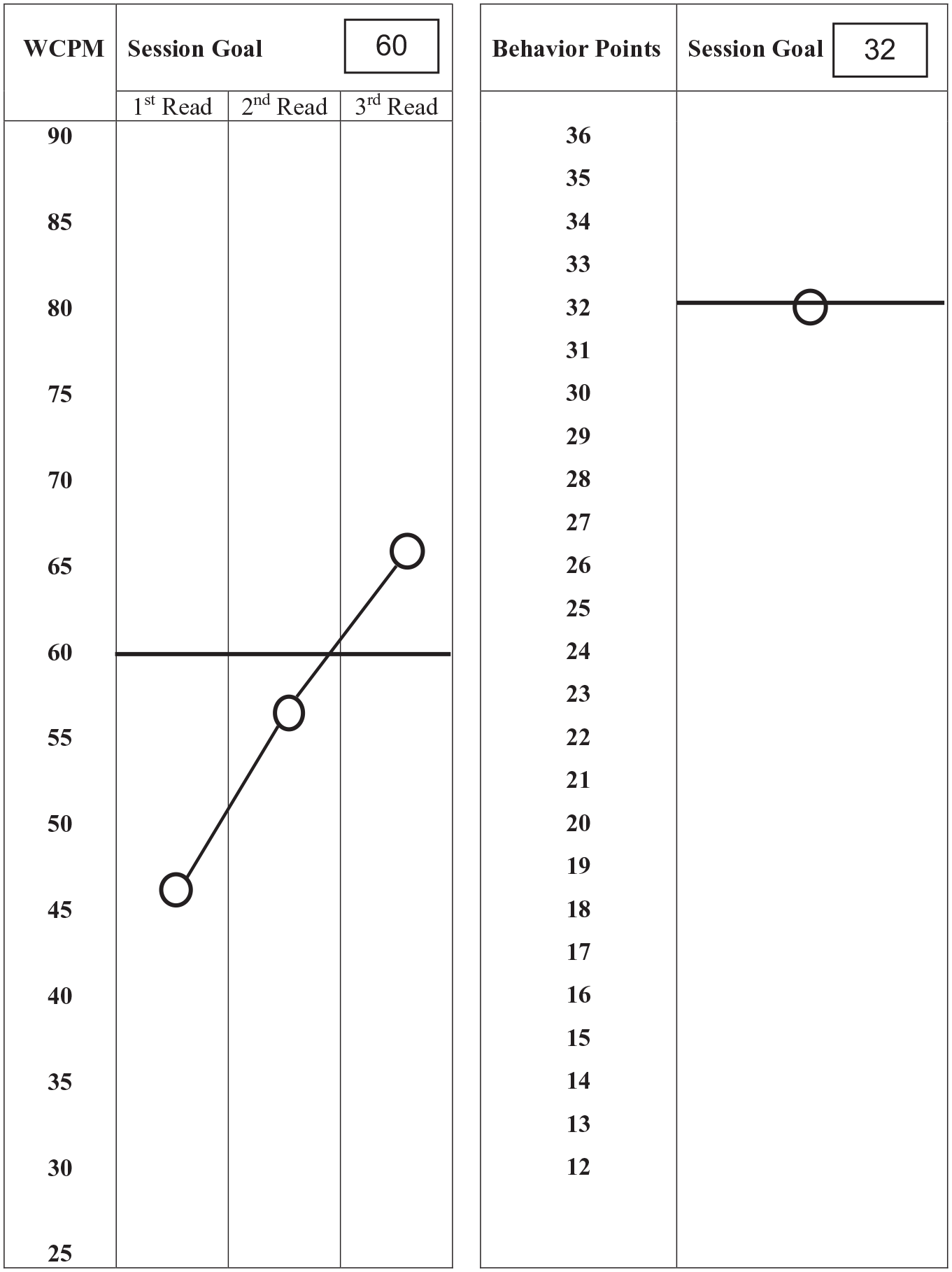
Reading and behavior graphs.
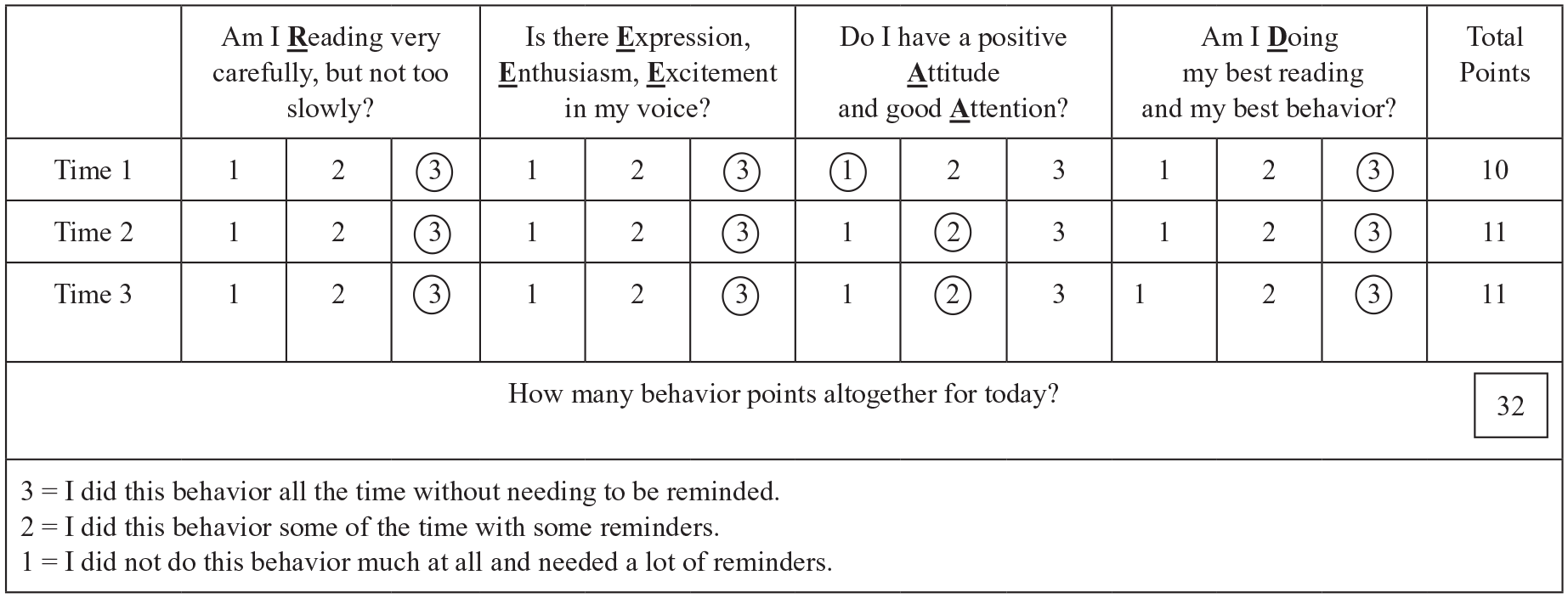
Behavior points card.
Intervention Adaptations
The ABC Support intervention was designed to be implemented with fidelity by a variety of school personnel (e.g., teachers, support staff, interventionists). The resources include manualized procedures and materials, as well as an implementation self-guide that describes each intervention step in the specific order as prescribed in the manual. Although important for all students to be exposed to the essential elements of the intervention, there is flexibility in the procedures to provide individualized support as needed. Interventionists are encouraged to adapt the amount of support to accommodate individual needs for varying levels of scaffolding. For example, whereas some students may require additional prompts and more frequent praise than what is scripted in the manual, others may be successful with a reduced level of prompting or less frequent praise. Although a detailed explanation of how to adapt all intervention procedures is beyond the scope of this article, the manual describes several strategies for providing more-versus-less support within each intervention element while maintaining a necessary level of adherence to the manualized procedures.
Conclusion
In a climate of declining resources and greater demands on schools, the benefits of single-focus academic and behavior interventions must be balanced against the potential for greater effectiveness and efficiency through integrated academic–behavior interventions (Kuchle et al., 2015). Integrated approaches are not limited to the reading-fluency skills and engagement-compliance behaviors targeted in ABC Support. The strong academic-behavior connection, combined with a growing need for efficient and effective interventions, underscores the value of developing integrated interventions for multiple types of academic skill deficits and behavior challenges.
Footnotes
Declaration of Conflicting Interests
The author(s) declared no potential conflicts of interest with respect to the research, authorship, and/or publication of this article.
Funding
The content and preparation of this paper were supported by the Institute of Education Sciences, U.S. Department of Education, through Grant R305A179961 to the University of Wisconsin-Madison, Wisconsin Center for Education Research. The opinions expressed are those of the authors and do not represent views of the Institute or the U.S. Department of Education.