



Abstract
This article summarizes the findings of a systematic review of 15 group and two single-subject experimental design studies that evaluated the effectiveness of phonological awareness interventions for dual language learners (DLL) in preschool through second grade. Studies were evaluated using a Consumer Reports-like rating system. Each study was rated on quality indicators for design characteristics, measurement and reliability, evaluation of treatment effects, and external validity. The effects of phonological awareness interventions for Latino children who are DLL in the early and primary grades are promising, although the studies’ results are tempered by conceptual limitations. Most studies demonstrated acceptable design characteristics and implementation fidelity. Few studies included measures of social validity and consumer satisfaction. Although the review did not identify a single treatment approach to be superior, preliminary evidence suggests that children can benefit from phonological awareness instruction that is explicit and allows for multiple response opportunities. The results of this review also indicate that children who are DLL benefit from bilingual phonological awareness instruction without detracting them from acquiring English phonological awareness skills.
Introduction
Children’s path to reading begins with strong early literacy skills that include phonological awareness or the manipulation and synthesis of spoken words at the word, syllable, and phonemic levels (e.g., rhyming, blending, segmenting, elision; Storch & Whitehurst, 2002). Children’s phonological awareness skills, in conjunction with their alphabet knowledge skills, enable them to apply the alphabetic principle to decode unfamiliar words. Young children with poor phonological awareness skills have difficulty unlocking the alphabetic principle and tend to be struggling readers (Byrne, 2014). Providing these children with effective phonological awareness intervention can reduce their risk of developing persisting academic difficulties (Storch & Whitehurst, 2002).
Many Latino children who are dual language learners (DLL) are at peril of falling behind their peers as only 42% of them enter kindergarten with adequate phonological awareness in Spanish or in English (Fuller, 2011). Reduced phonological awareness, combined with one or more risk factors such as low socioeconomic status, low maternal education, and limited home literacy experiences (National Research Council, 2006), place Latinos in greater jeopardy of becoming struggling readers. Despite substantial evidence that providing young monolingual children with early literacy instruction focusing on phonological awareness reduces their risk of becoming struggling readers (Ehri et al., 2001), research on effective phonological awareness intervention for young Latino children who are DLL is sorely lacking. Nevertheless, teaching phonological awareness skills to Latino children who are DLL during their early and primary grades could improve reading proficiency and academic success for this population.
The purpose of this article is to present a systematic review of the existing literature on phonological awareness interventions for Latino children in the early and primary grades. The primary aims of this systematic review are to summarize and evaluate the effects and quality of existing phonological awareness interventions applied to Latino children who are DLL. The secondary aims of this systematic review are to identify the gaps in the literature, to suggest future research directions, and to provide practitioners with guidelines for delivering effective phonological awareness interventions for Latino children.
Phonological Awareness Instruction for Latino Children Who Are DLL
When evaluating the quality and effects of viable phonological awareness interventions for Latino children who are DLL, an essential question is, “What is the best method for providing phonological awareness instruction to these children?” There is growing evidence that Latino children who are DLL benefit from some of the same phonological awareness instructional strategies as their monolingual peers (Castro, Páez, Dickinson, & Frede, 2011). Both Latino children who are DLL and monolingual children respond well to phonological awareness instruction that is focused and explicit, provides multiple response opportunities, and follows a systematic developmental scope and sequence (Ehri et al., 2001). However, applying these strategies without considering the unique language needs of children who are DLL is insufficient (Castro et al., 2011), as it fails to acknowledge our contemporary understanding of bilingualism. Latino people who are DLL are not simply two monolinguals in one, but rather individuals whose experiences with their two languages impact their learning (Bialystok & Feng, 2011). There is evidence supporting a bidirectional relationship between phonological awareness skills in their two languages, with children who have high phonological awareness skills in their first language also exhibiting high phonological awareness skills in their second language (Anthony et al., 2011). There also is evidence that the nature of a language influences the ease of phonological awareness tasks (Pollard-Durodola & Simmons, 2009). Because children who are DLL experience two languages, it is important to be cognizant of the differences between their two languages, and the potential influence that this difference plays in their phonological awareness acquisition. Adequate phonological awareness instruction for Latino children, therefore, needs to consider the following: (a) the relation between children’s phonological awareness skills across their two languages, (b) the similarities and differences between English and Spanish phonological awareness acquisition, and (c) how to best assess dual phonological awareness skills in Latino children to measure the effects of intervention.
Interlanguage relations of phonological awareness skills
Latino children’s Spanish and English phonological awareness skills are highly interrelated; those with high Spanish phonological awareness skills are also likely to exhibit high English phonological awareness skills (Dickinson, McCabe, Clark-Chiarelli, & Wolf, 2004; Durgunoğlu, Nagy, & Hancin-Bhatt, 1993; López & Greenfield, 2004). This theoretical finding is supported by growing evidence that Latino children who are DLL receiving bilingual phonological awareness interventions make gains in both their Spanish and English phonological awareness skills (Durán, Roseth, & Hoffman, 2010). However, children who are DLL and receive phonological awareness interventions in English make gains in English phonological awareness skills, but many fail to catch up to their monolingual peers (Castro et al., 2011). Providing young Latino children who are DLL with phonological awareness interventions that support their acquisition of phonological awareness skills in their two languages has the benefit of promoting their biliteracy and bilingual skills, as well as improving their employment and social opportunities as they transition to adulthood (Bialystok & Feng, 2011).
Differences and similarities of English and Spanish phonological awareness
Delivering interventions for Latino children who are DLL that support their acquisition of phonological awareness in both languages requires an understanding of the linguistic differences between English and Spanish (Pollard-Durodola & Simmons, 2009). Directly translating phonological awareness curricula from English to Spanish without considering the differences between the languages reduces the adequacy of phonological awareness instruction (Peña, Bedore, & Kester, 2016). English contains many monosyllabic, consonant-vowel-consonant (CVC) words (e.g., cat, mop, rat). In contrast, Spanish contains primarily three- to four-syllable words, consonant-vowel-consonant-vowel (CVCV) words, and few final consonants (e.g., l, d, n, s, r) (Jiménez González & García, 1995). These language differences affect the ease of a phonological awareness task in each language (Anthony et al., 2011; Gorman & Gillam, 2003). In English, the manipulation of words at the sound level is vital for reading, but in Spanish, blending and segmenting words at the syllable level are most predictive of future reading (Pollard-Durodola & Simmons, 2009). Although the typical sequence of phonological awareness development in English begins with larger speech segments (e.g., sentences, compound words) and progresses to smaller speech segments (e.g., words, syllables, phonemes), the developmental progression is different in Spanish (Gorman & Gillam, 2003). In Spanish, two-syllable words are easier to manipulate than three- to four-syllable words, and compound words are the most difficult to manipulate (Anthony et al., 2011).
Phonological awareness assessment and approaches to instruction
Strong phonological awareness interventions are contingent upon assessments that accurately capture the effects of these interventions on Latino children’s development of early literacy. Shortcomings in the assessments result in an obscured understanding of the effects of the phonological awareness intervention. Peña and colleagues (2016) warn against translating assessments directly from English to Spanish, as this reduces their validity. For example, an English phonological awareness assessment containing mostly monosyllabic, CVC words is inappropriate in Spanish. Thus, differences in the complexity of phonological awareness tasks in English and Spanish must be considered when constructing assessments to evaluate treatment effects validly.
Despite theories recommending the best approach of phonological awareness interventions for Latino children who are DLL, there is no empirically proven gold standard for this population. Hence, our understanding of effective phonological awareness interventions for Latino children in preschool through second grade is limited. Because phonological awareness is foundational to reading fluently, and children up to second grade are still acquiring the decoding skills to read texts, it is important to identify efficacious phonological awareness interventions for these children. A systematic review of phonological awareness interventions is needed to provide insight into the effects and quality of interventions available for children who are DLL, to provide practitioners with guidelines for phonological awareness interventions, and to guide future research.
A Systematic Review of Phonological Awareness Interventions for Latino Children
Systematic reviews allow for an exhaustive summary of the current body of phonological awareness interventions by evaluating the quality and efficacy of studies based on their design characteristics and intervention effects. A systematic review will help guide teachers and clinicians in selecting appropriate interventions for young Latino children who are DLL, and identify areas needing further research. This review extends previous reviews by including younger children (i.e., preschoolers) and by analyzing studies that have specifically evaluated the effects of phonological awareness interventions. Many of the previous systematic reviews only evaluated the findings of group design studies using effect sizes (Buysse, Peisner-Feinberg, Páez, Hammer, & Knowles, 2014). This review extends this body of literature by augmenting effect sizes with ratings of quality indicators, such as research design, measurement, and external validity. This review also expands upon previous reviews by including single-subject designs.
The following research questions were addressed:
Method
Selection of Research Articles
The literature search included studies published in peer-reviewed journals from 2000 to 2017 as this reflects the surge of research focusing on Latino populations in the last two decades. Studies included in this review met the following criteria: (a) they evaluated the effects of a phonological awareness intervention, (b) they had a phonological awareness outcome measure, (c) they targeted interventions for Latino children who are DLL in preschool through second grade, (d) they separated children who are DLL from the other participants in the study, and (e) they did not include children with identified disabilities (because we still do not have enough information regarding the typical development of Spanish and English phonological awareness skills in young Latino children who are DLL).
Studies were found using the Education Resource Information Center (ERIC), PsychInfo, and Google Scholar online databases using keywords: dual language learners, or English language learners, or bilinguals, or Spanish-English, as well as one or more of the following terms: phonological awareness, phonemic awareness, early literacy, emergent literacy, or reading interventions. These search terms represent ways research journals describe interventions related to phonological awareness. In total, 13 published studies met the criteria. We also searched for specific authors and journals that routinely publish research related to DLL literacy interventions, resulting in four more articles.
Research articles were selected from scholarly journals that applied a peer review process and were reputable in disseminating research related to early reading skills. These journals varied in their target audiences, including ones targeting general and special educators, speech–language pathologists, and psychologists. Searching for studies meeting the inclusion criteria across disciplines was important as these types of professionals are the ones most likely to deliver phonological awareness instruction to Latino children who are DLL. Studies were searched in a variety of journals, including Early Childhood Research Quarterly, Journal of Educational Psychology, Learning Disability Quarterly, Child Development, Journal of School Psychology, and Exceptional Children.
We first grouped articles by design, and evaluated 15 group design studies and two single-subject design studies. For each design, articles were divided by language of instruction: English-only, home language, or both languages. Studies were further divided into one of three types of phonological awareness instruction. phonological awareness + alphabet instruction included studies that combined phonological awareness instruction with teaching of alphabet letters and sounds. Phonological awareness-only instruction included interventions that focused only on teaching distinct phonological awareness skills. Curriculum-based instruction included interventions that taught phonological awareness skill in the context of other oral language and emergent literacy skills such as comprehension, vocabulary, and writing.
Criteria Rating System
This systematic review was completed using a framework for evaluating the effects and quality of interventions developed by Goldstein, Lackey, and Schneider (2014) that utilizes a set of quality indicators that are largely parallel across group and single-subject experimental designs. This framework has been used to review existing research on social skills interventions for children with Autism spectrum disorders (Goldstein et al., 2014). Individual studies were rated across four categories, as shown in Tables 1 and 2: (a) study design and internal validity (e.g, design, group equivalence; Gersten et al., 2005; Horner et al., 2005; Kratochwill et al., 2012; What Works Clearinghouse, 2018), (b) measurement features (e.g., reliability, implementation fidelity; Gersten et al., 2005; Horner et al., 2005), (c) results (e.g., effect sizes, statistical analysis, visual analysis; Kratochwill et al., 2012), and (d) external validity (e.g., setting, social validity, consumer satisfaction; Kratochwill et al., 2012). These four categories were selected because they have been well-documented as constituting quality indicators for group design (Gersten et al., 2005; What Works Clearinghouse, 2018) and single-subject experimental design studies (Horner et al., 2005; Kratochwill et al., 2012). Operational definitions for each quality indicator are presented in Tables 1 and 2. In total, 14 quality indicators were used for single-subject designs, and 15 quality indicators were used for group design studies. For both designs, a numeric rating was assigned to each quality indicator: 1 = unacceptable, 2 = minimal, 3 = acceptable, and 4 = exemplary.
Design and Measurement Quality Indicators for Group and Single-Subject Design Experiments.

Note. 1 = unacceptable; 2 = minimal; 3 = acceptable; 4 = exemplary; RCT = randomized control trial.
Characteristics and External Validity Quality Indicators for Group and Single-Subject Design Experiments.

Note. 1 = unacceptable; 2 = minimal; 3 = acceptable; 4 = exemplary.
Data Analysis
For each study, an average across the quality indicators was calculated (see Tables 3 and 4). An overall average of ratings also was calculated across intervention types to facilitate comparisons (e.g., all studies that used Phonological Awareness only instruction). Circles ranging from white to black were used to graphically represent scores for each criterion. White or partially white circles represent high ratings (i.e., white = exemplary, and partially white = acceptable) while low ratings are indicated by partially black (minimal) or black circles (unacceptable).
Evaluation of Group Design Studies.
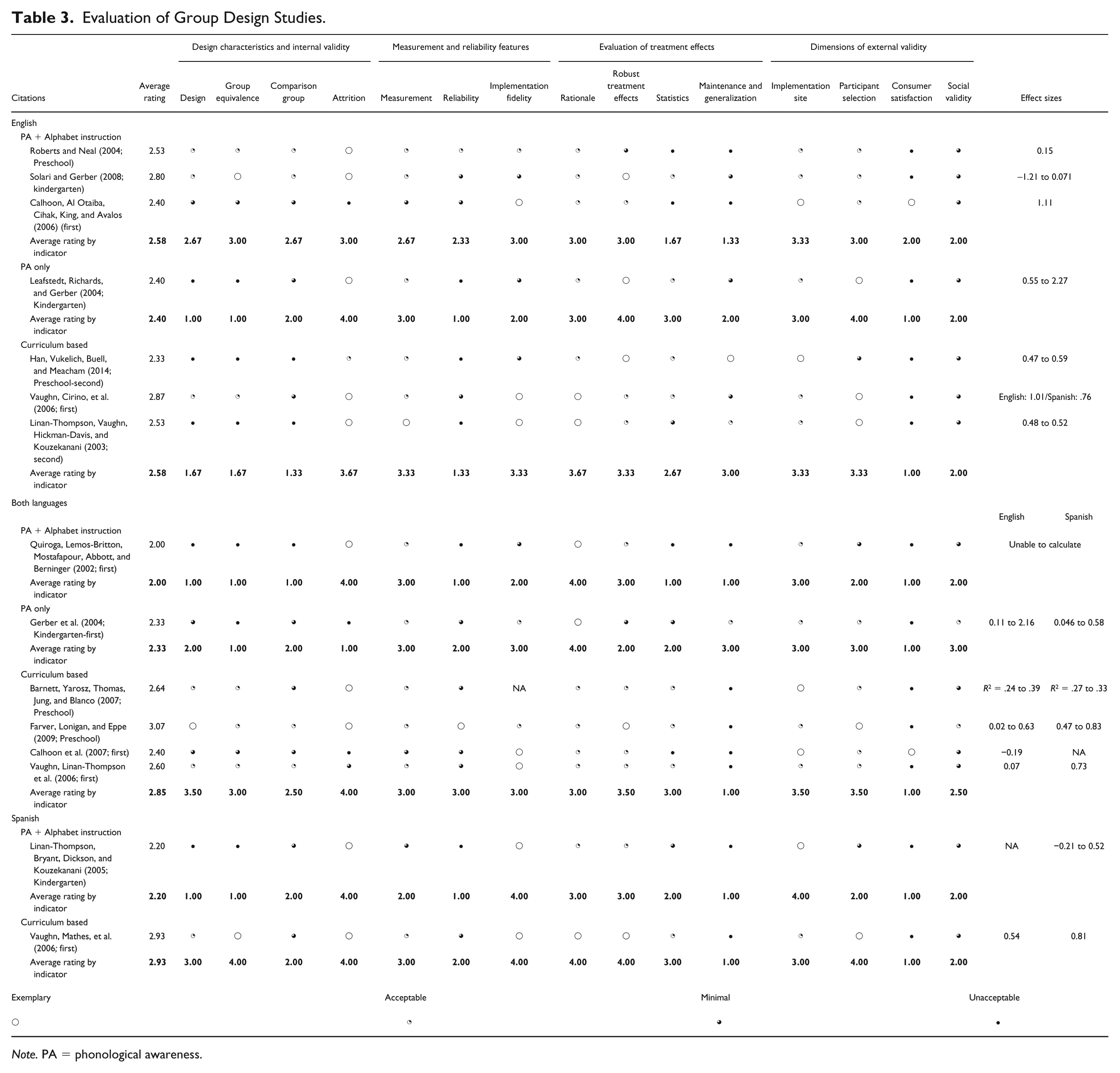
Note. PA = phonological awareness.
Evaluation of the Single-Subject Design Studies.

Note. PA = phonological awareness.
The authors, certified speech–language pathologists with experience conducting both group and single-subject design studies, evaluated the studies. Prior to conducting the current systematic review, they were trained on how to use the evaluation framework that is used in this study. They also completed a previous systematic review on another topic. The authors initially rated studies concurrently until their inter-rater reliability was 80% or higher. When they disagreed on one of the ratings, they discussed it with the third author until an agreement was made. For the current study, 20% of the studies were randomly selected to calculate inter-rater reliability using Cohen’s kappa (Cohen, 1992), which controls for chance agreement. Inter-rater reliability was very high (i.e., Cohen’s kappa = 0.904).
Dependent Variables and Effect Sizes
The dependent variables used to measure children’s gains in their phonological awareness skills varied across studies. English phonological awareness outcome measures included children’s gains on the Dynamic Indicators of Basic Early Literacy Skills (DIBELS; Kaminski, Smith, & Laimon, 2002), Individual Growth and Developmental Indicators (IGDIs; McConnell, Bradfield, Wackerle-Hollman, & Rodriguez, 2012), and the Word Identification and Word Attack subtests from the Woodcock-Johnson Test of Achievement (WJTA; Woodcock, McGrew, & Mather, 2001). Studies that evaluated Spanish phonological awareness outcomes also included assessments such as the Spanish version of the Comprehensive Test of Phonological Processing-2 (CTOPP-2; Wagner, Torgesen, Rashotte, & Pearson, 2013) and the Spanish version of the DIBELS, the Indicadores Dinámicos del Éxito en La Lectura (IDEL; Baker, Cummings, Good, & Smolkowski, 2007).
Effect sizes were calculated for both the group and single-subject design studies when the reported data permitted their calculation. Effect sizes for the group designs were calculated using Cohen’s (1992) d. A Cohen’s d of .20 is considered a small effect, .50 a medium effect, and .80 a large effect. For the single-subject design studies, effect sizes were calculated using Tau-U (Parker, Vannest, Davis, & Sauber, 2011). Tau-U calculates the percentage of non-overlap between the phases and the percentage of data showing improvement between the phases. The benefit of using Tau-U over other traditional non-overlap effect size methods (e.g., percentage of non-overlap data) is that Tau-U accounts for trend in the baseline. Tau-U is also flexible, allowing for a calculation of effects for each baseline-intervention pair and for a calculation of the average of all Tau-U scores. Tau-U yields scores ranging from 0% to 100% (Rakap, 2015). A score of 65% or less is considered ineffective or questionable, a score between 66% and 92% is considered effective, and a score equal to or greater than 93% is considered very effective. The Tau-U effect sizes were computed using a software application developed by Vannest and colleagues (Vannest, Parker, Gonen, & Adiguzel, 2016).
Results
Distribution of Studies
When looking at interventions by type of instruction, eight were Curriculum-Based, six combined Phonological Awareness + Alphabet Instruction, and three were Phonological Awareness-Only. Nine of 17 were delivered only in English, six in both languages, and two in Spanish. Of the English studies, four combined Phonological Awareness + Alphabet Instruction (three group and one single-subject design), two were Phonological Awareness-Only, and three were Curriculum-Based. Studies conducted in both languages included one that combined Phonological Awareness + Alphabet Instruction, one that was Phonological Awareness Only, and four Curriculum-Based interventions. Spanish language interventions consisted of one combined Phonological Awareness + Alphabet Instruction and one Curriculum-Based study.
Four studies focused on children in preschool, five targeted children in kindergarten, seven studies included children in first grade, and one study focused on second grade. Most interventions were delivered in small groups by teachers or paraprofessionals (Table 5). Interventions ranged from 6 weeks to a full-school year. The dosage of the interventions ranged from 15 to 50 min per session.
Description of Studies Systematic Reviews.

Note. PA = phonological awareness; CVC = consonant-vowel-consonant; PSF = Phoneme Segmentation Fluency; ORF=oral reading fluency; LNF=Letter Naming Fluency; NWF=Nonword Fluency; DIBELS = Dynamic Indicators of Basic Early Literacy Skills; WJTA = Woodcock-Johnson Test of achievement; IGDIs = Individual Growth and Developmental Indicators; DLL = dual language learners; CTOPP = Comprehensive Test of Phonological Processing; TOPP-S = Test of Phonological Processing-Spanish; IDEL = Indicadores Dinámicos del Éxito en La Lectura; Pre-CTOPP = Preschool Comprehensive Test of Phonological Processing; W-MLS=Woodcock-Muñoz Language Survey.
The phonological awareness skills targeted during instruction varied across studies. Common phonological awareness targets included rhyming, blending, syllable awareness, and phoneme segmentation. Of the 17 studies, six measured phonological awareness gains in both English and Spanish (Barnett, Yarosz, Thomas, Jung, & Blanco, 2007; Farver, Lonigan, & Eppe, 2009; Gerber et al., 2004; Vaughn, Cirino, et al., 2006; Vaughn, Linan-Thompson, et al., 2006; Vaughn, Mathes, et al., 2006 ). All but one of these six studies (Vaughn, Mathes, et al., 2006) delivered phonological awareness instruction in Spanish and English.
Judging the Overall Quality of Studies by Rating
Visual displays resembling Consumer Reports are presented in Tables 2 and 3. Studies can be evaluated by examining the number of white (exemplary = 4) or partially white (acceptable = 3) circles in comparison with the circles that are partially black (minimal = 2) or black (unacceptable = 1) for each quality indicator. An average rating of all the quality indicators can be found in the first column for each study. For example, Table 3 illustrates that Roberts and Neal’s (2004) study investigating the effects of an English intervention targeting phonological awareness and alphabet knowledge received an average rating of 2.53 (maximum = 4).
In total, 58% of the studies (10 of 17) earned an average rating of 2.5 or higher, meaning their ratings overall were in the minimal to acceptable range. The average ratings ranged from an average rating of 1.86 (Healy, Vanderwood, & Edelston, 2005) to 3.07 (Farver et al., 2009). The average rating by types of intervention was slightly higher for Curriculum-based (M = 2.79), followed by Phonological Awareness + Alphabet Knowledge (M = 2.39) and Phonological Awareness-only (M = 2.20). The average rating by language of instruction was highest for the Spanish interventions (M = 2.57), followed by the English language interventions (M = 2.44) and the bilingual interventions (M = 2.39). These averages should be interpreted with caution as there were many more English-only studies than bilingual or Spanish-only studies. Most studies failed to report measures of generalization and maintenance, or social validity. Only two studies (Calhoon, Al Otaiba, Cihak, King, & Avalos, 2007; Calhoon, Al Otaiba, Greenberg, King, & Avalos, 2006) reported the extent of consumer satisfaction.
Studies receiving the lowest ratings (Healy et al., 2005; Linan-Thompson, Bryant, Dickson, & Kouzekanani, 2005; Quiroga, Lemos-Britton, Mostafapour, Abbott, & Berninger, 2002) typically had minimal or unacceptable ratings not only on their measures of external validity, but on their design characteristics as well. For example, the Linan-Thompson et al. (2005) group design study lacked randomization, did not demonstrate group equivalence, provided only operational definitions of its measures, and did not report how reliability was calculated. Limitations in its design characteristics reduced the internal validity of the study and diminished confidence in the study results. Similarly, the single-subject design study by Healy and colleagues (2005) earned a low-average rating because it did not establish a steady baseline, used an AB design, and did not describe its visual analysis. Although the children in this study made gains in their intervention, the limitations in the study’s design affected researchers’ ability to interpret findings with confidence.
Effect Size Estimates
Tables 3 and 4 contain a column with effect size estimates for group design and single-subject designs, respectively. For the group design studies, Cohen’s d was calculated for 13 of the 15 group design studies. The effect sizes could not be calculated for one study due to limitations in the data provided (Quiroga et al., 2002). Although Cohen’s d could not be calculated for the Barnett et al. (2007) study, the authors provided an R2 value corresponding to a medium effect size in Spanish and English. An effect size could be calculated for only one of the two single-subject design studies (Gyovai, Cartledge, Kourea, Yurick, & Gibson, 2009), whose results yielded a Tau-U effect size of 52%, indicating questionable effects.
Types of Intervention
Looking across types of interventions, studies investigating the effects of Curriculum-Based approaches resulted in effect sizes ranging from small to large (Table 5). One study resulted in small effects (Calhoon et al., 2007), two studies had moderate effects (Barnett et al., 2007; Han, Vukelich, Buell, & Meacham, 2014), one had large effects (Vaughn, Mathes, et al., 2006), and four yielded mixed effects (Farver et al., 2009; Linan-Thompson et al., 2005; Vaughn, Cirino, et al., 2006; Vaughn, Linan-Thompson, et al., 2006). Studies that explicitly taught the phonological awareness skills assessed as outcome measures led to the highest effect sizes (Vaughn, Mathes, et al., 2006). The Barnett et al. (2007) and Han et al. (2014) studies yielded moderate effect sizes when using commercially available curricula such as High Scope and Creative Curriculum. It should be noted, however, that although children who were DLL in the Han et al. (2014) study made gains, they remained below their monolingual peers by the end of second grade. These researchers targeted rhyming in kindergarten, and phoneme segmentation in first grade.
Studies evaluating the effects of Phonological Awareness + Alphabet Knowledge instruction yielded mixed results. Two studies resulted in a small effect sizes (Gyovai et al., 2009; Roberts & Neal, 2004), one study yielded moderate effects (Linan-Thompson et al., 2005), one study resulted in large effects (Calhoon et al., 2006), one study had mixed effects across different phonological awareness outcomes (Solari & Gerber, 2008), and the effect sizes of one of the studies (Quiroga et al., 2002) could not be calculated. The Calhoon et al. (2006) study investigated the effects of providing first grade Latino students who are DLL with peer-assisted instruction targeting letter sounds, segmentation, and decoding. Children receiving this intervention made gains on the DIBELS Phoneme Segmentation and Nonword Fluency subtests. The Solari and Gerber (2008) study, which targeted phonemic segmenting and blending and phonics training, produced a large effect for initial sound identification, but small effects for sound omission and blending. The Roberts and Neal (2004) study had the weakest effects. This intervention targeted preschoolers and taught letter knowledge, letter writing, and rhyming. Although the children in this study made gains in letter knowledge, their rhyming skills did not improve significantly.
Because only three studies investigated the effects of Phonological Awareness-only instruction, determining the effects of this approach is premature. Two studies had mixed effects across phonological awareness tasks (Gerber et al., 2004; Leafstedt, Richards, & Gerber, 2004), and the effects of one study could not be calculated (Healy et al., 2005). The Leafstedt et al. (2004) study investigated the effects of an intervention targeting onset-rime identification and segmentation on kindergartener’s phonological awareness skills. The effects for this study were large for onset-rime identification, but moderate for segmentation, a phonological awareness skill the authors described as later developing.
Language of Instruction
We also evaluated the effects of studies by language of instruction. For the studies that only delivered instruction in English (see Tables 3 and 4), two studies had small effects (Gyovai et al., 2009; Roberts & Neal, 2004), two had moderate effects (Han et al., 2014; Linan-Thompson, Vaughn, Hickman-Davis, & Kouzekanani, 2003), three had large effects (Calhoon et al., 2006; Vaughn, Mathes, et al., 2006), two had mixed results (Leafstedt et al., 2004; Solari & Gerber, 2008), and the effects of one study could not be calculated (Healy et al., 2005). Only Vaughn, Mathes, et al. (2006) measured the Spanish phonological awareness gains of Latino DLLs when providing English-only instruction. First grade Latino children receiving English-only instruction targeting phoneme discrimination, segmenting, and blending made large gains in English, and in Spanish on the CTOPP.
The bilingual interventions yielded mixed effect sizes (see Table 3). One study resulted in small effects (Calhoon et al., 2007), one yielded moderate effects (Barnett et al., 2007), three led to mixed effects (i.e., effect sizes were not equal across languages; Gerber et al., 2005; Farver et al., 2009; Vaughn, Cirino, et al., 2006), and the effect size of one of the studies could not be calculated (Quiroga et al., 2002). Farver et al. (2009) and Vaughn, Cirino, et al. (2006) found that children receiving phonological awareness instruction in both languages made gains in Spanish, while still acquiring phonological awareness skills in English. In both studies, children receiving bilingual instruction made greater gains in Spanish than their peers who received English-only instruction. However, children’s phonological awareness gains across their two languages were not equivalent. For example, in the Farver et al. (2009) study, preschoolers showed moderate gains in Spanish and mixed gains in English.
The effects of the two studies investigating phonological awareness instruction in Spanish were also mixed (Linan-Thompson et al., 2005; Vaughn, Linan-Thompson, et al., 2006) (Table 2). The Linan-Thompson et al. (2005) study targeting Spanish phonological awareness skills (segmenting, blending) and phonics led to moderate gains in Spanish initial sound identification, but the gains on blending and sound omission were small. In contrast, the Vaughn, Linan-Thompson et al. (2006) intervention, Lectura Proactiva, targeting alphabet knowledge, text comprehension, and oral language skills led to large phonological awareness gains in Spanish, and moderate gains in English. These promising results highlight the need for further investigation of the effects of delivering phonological awareness instruction in Spanish to children who are DLL.
Discussion
As the number of Latino children who are DLL and are served by schools across the United States continues to rise (U.S. Census Bureau, 2011), it becomes even more crucial to carefully examine and evaluate the interventions designed to improve the educational outcomes of this population. Many Latinos who are DLL struggle to become proficient readers (Fuller, 2011), making it particularly timely to evaluate the current body of literature targeting reading instruction for this group of children. The findings from this systematic review not only provide an overview of the distribution, quality, and effects of existing phonological awareness intervention for these children, but they also provide important, general implications for conducting adequate interventions and research for Latino children who are DLL.
Distribution, Quality, and Effects of PA Interventions for Latino Children Who Are DLL
Distribution of studies
The first aim of this systematic review was to determine the distribution of existing phonological awareness interventions for Latino children who are DLL. The findings from the systematic review indicate that most phonological awareness interventions were Curriculum-Based, that very few interventions targeted preschoolers, and that most interventions were conducted only in English. These findings are surprising, given our contemporary understanding of effective phonological awareness interventions (Ehri et al., 2001; Shanahan & Lonigan, 2010) and our knowledge regarding the best practices for delivering interventions to children who are DLL (Castro et al., 2011; López & Greenfield, 2004).
This review reveals that only four studies have specifically examined the effects of providing phonological awareness interventions to Latino preschoolers who are DLL (Barnett et al., 2007; Farver et al., 2009; Han et al., 2014; Roberts & Neal, 2004). This is a notable finding because phonological awareness is a common metric of preschoolers’ school readiness (La Paro & Pianta, 2000) and a popular learning objective on widely used early childhood curricula such as Creative Curriculum and High Scope. Almost half of Latino preschoolers enter kindergarten with reduced phonological awareness skills in English and Spanish, placing them at greater risk for persisting reading difficulties (Fuller, 2011). But as the current literature stands, the bulk of phonological awareness interventions for preschoolers are based on monolingual children (Ehri et al., 2001), leaving practitioners ill-equipped to provide early, preventive phonological awareness interventions for Latino preschoolers during a crucial period of their development. The findings from this review indicate the urgency for future research focusing on the effects of phonological awareness interventions for Latino preschoolers who are DLL.
Another significant finding is that most phonological awareness interventions for Latino children who are DLLs were only conducted in English. Although this review revealed that Latino children can make positive phonological awareness gains when interventions are delivered only in English, Pollard-Durodola and Simmons (2009) propose that the goal of interventions for Latino DLL should not only be to attain English academic success, but also to promote their biliterate and bilingual development. Because phonological awareness skills are highly interrelated across children’s two languages, López and Greenfield (2004) and Anthony and colleagues (2011) recommend promoting Latino children’s bilingual acquisition of phonological awareness skills by delivering the interventions in Spanish, or by supporting English phonological awareness instruction with Spanish. These recommendations are aligned with the Revised Linguistic Interdependence Hypothesis (Verhoeven, 2007), which postulates that DLL children with strong phonological awareness skills in one language can apply these skills to their second language. Despite these recommendations, only two studies in this review delivered the phonological awareness interventions in Spanish (Linan-Thompson et al., 2005; Vaughn, Linan-Thompson, et al., 2006), and only Vaughn and colleagues measured whether children applied the phonological awareness skills they learned in Spanish to English after receiving Spanish-only intervention. These findings indicate a need for future DLL research to empirically measure whether providing Latino children with only Spanish phonological awareness interventions yields phonological awareness gains in their two languages. Findings from these studies will potentially increase our knowledge regarding DLL children’s bilingual literacy development.
Quality of studies
The second objective of this review was to determine the quality of existing phonological awareness interventions for children who are DLL. Most studies demonstrated strengths in their design and statistical analyses. However, few included measures of generalization (Gerber et al., 2004; Han et al., 2014) and social validity (Calhoon et al., 2007; Calhoon et al., 2006). Including measures of generalizations is important because the long-term effects of providing children who are DLL with instruction in English, Spanish, or both languages remains largely unexplored. Although some scholars assert the academic and social benefits of supporting DLL children’s language and literacy development in both languages (Bialystok & Feng, 2011), few studies have examined the long-term impact of language of instruction. Longitudinal studies are needed to increase our knowledge of typical dual language and literacy development in children who are DLL, as well as to inform policy makers about ways to reduce the persisting achievement gap in this population.
Effects of studies
The third objective of this review was to evaluate the effects of phonological awareness interventions for Latino children who are DLL. Overall, the effects of these studies were positive, yielding small to large effects. However, limitations in these studies make it difficult to directly compare which type of intervention and language of instruction is most effective for Latino children who are DLL. These limitations include the following: (a) brief descriptions of the interventionists and participants in the studies, (b) insufficient information about how to specifically deliver phonological awareness interventions, (c) minimal information about how phonological awareness interventions were adapted from English to Spanish, (d) heterogeneity in the phonological awareness assessments used to measure outcome measures, and (e) inadequate descriptions of the type and quality of the language of instruction occurring in the classroom (e.g., two-way bilingual, English immersion, transitional).
Despite these limitations, individual examination of the studies’ effects indicate that phonological awareness interventions containing direct instruction (Calhoon et al., 2006; Vaughn, Mathes, et al., 2006) resulted in the largest phonological awareness gains, regardless of type of intervention (i.e., Curriculum-Based, Phonological Awareness + Alphabet Knowledge, Phonological Awareness-only) or language of instruction. These finding are in line with the best practice recommendations from the National Early Literacy Panel (Lonigan & Shanahan, 2009), which recommends providing explicit phonological awareness instruction. Like monolingual children, Latino children who are DLL benefit from interventions that incorporate explicit instruction of phonological awareness skills, guided practice, contingent feedback, and multiple response opportunities. The studies with large effects also applied intensive phonological awareness instruction, ranging from 2 to 5 times a week for a minimum of 15 min per session, and interventionists delivered instruction in small groups. These findings were contrary to the study resulting in the smallest effects (Roberts & Neal, 2004). Roberts and Neal targeted letter knowledge and rhyming during whole-group instruction. Rhyming was taught by having children identify rhyming pairs with minimal feedback and practice opportunities provided. The weak results in this study could be attributed to rhyming not being as salient in Spanish (Pollard-Durodola & Simmons, 2009), a lack of explicit instruction, and reduced practice opportunities.
The most interesting finding from this systematic review is that most bilingual phonological awareness interventions yielded mixed effects, meaning that the magnitude of phonological awareness gains were not equivalent across languages. These findings have significant implications for DLL research. Gottardo, Gu, Mueller, Baciu, and Pauchulo (2011) note that a potential reason for these mixed findings for DLL children’s gains across their two languages could result from studies’ conceptual limitations. These conceptual limitations include unavailable descriptions of child, teacher, and classroom factors that might influence bilingual phonological awareness outcomes, and the use of direct English translations to develop Spanish interventions and assessments. Peña and colleagues (2016) warn against directly translating curricula or assessments, as this can reduce the validity of bilingual studies. To illustrate, Gerber et al. (2004) directly translated its English curriculum and targeted sound segmentation and blending in Spanish. Sound-level manipulations are not as salient in Spanish (Jiménez González & García, 1995). This difference between English and Spanish could have potentially tampered the results. Although addressing these conceptual limitations is vital in moving the field of DLL research forward, it is not an easy feat. There continues to be a gap in our knowledge regarding English and Spanish phonological awareness development in Latino children who are DLL and in the availability of appropriate assessments for this population.
Implications for Future Research
The findings from this systematic review augment our current knowledge regarding the quality and effects of existing phonological awareness interventions for Latinos who are DLL in the early and primary grades. This review has limitations, however, including the following: (a) the studies reviewed were from a relatively narrow time window, (b) the diversity in outcome measures make it difficult to directly compare studies, and (c) the questions of for whom and under what conditions these phonological awareness interventions are most appropriate remain unanswered. Limitations in the body of literature reviewed include the following: (a) the potential influence of teacher, child, and classroom-level factors were not reported, (b) the nuances of language of instruction across studies could not be fully explored, and (c) most of the Spanish phonological awareness interventions and assessments reviewed were direct English translations.
Despite these limitations, this systematic review illuminates current gaps in the literature, informing future research directions. These future directions include the following: (a) increasing the number of studies focusing on evaluating the effects of phonological awareness interventions for Latino preschoolers, (b) evaluating the effects of providing phonological awareness interventions in Spanish, (c) developing more valid Spanish phonological awareness assessments and interventions that take the language characteristics of Spanish in consideration, (d) exploring the interrelationship of DLL children’s phonological awareness skills across their two languages, and (e) conducting more longitudinal studies to better understand the bilingual and biliterate development of children who are DLL. Most notably, it is critical to continue identifying efficacious literacy-based interventions that are mindful of DLLs’ unique language, social, and academic needs.
Implications for Practice
Although the extant body of literature on effective phonological awareness interventions for Latino children who are DLL in the early and primary grades is limited, the results of this systematic review can be applied to provide practitioners with guidelines to help improve the phonological awareness skills of children who are DLL. Specifically, practitioners should
Provide children with phonological awareness interventions that contain direct instruction which is explicit and systematic, allowing for multiple response opportunities and contingent feedback.
Deliver intensive phonological awareness interventions in small groups for children who might be falling behind their peers.
Include phonological awareness instruction in early childhood settings to ensure children are not falling behind upon entering kindergarten.
Learn about the language differences between English and Spanish to avoid direct translations of phonological awareness curricula or assessments.
Support children’s acquisition of phonological awareness skills in both languages to promote their biliterate development.
Target phonological awareness skills that are salient in Spanish (i.e., syllable awareness rather than phonemic awareness) when the phonological awareness intervention is in Spanish.
Footnotes
Authors’ Note
The adaptation of the Consumer Reports graphical model in this article does not indicate any endorsement by or affiliation with Consumer Reports®. Consumers Union was not involved in any way in the creation, production, or application of the evaluation framework or ratings described in the article.
Declaration of Conflicting Interests
The author(s) declared no potential conflicts of interest with respect to the research, authorship, and/or publication of this article.
Funding
The author(s) received no financial support for the research, authorship, and/or publication of this article.
