



Abstract
This mixed-methods study aimed to test the feasibility, acceptability, and fidelity of involving early childhood education (ECE) staff without special education training or prior parent coaching experience in the delivery of an adapted evidence-based parent coaching intervention for young children with autism (Focused Playtime Intervention-Preschool, FPI-P). Ten staff members of a university-affiliated, inclusive ECE program were trained to deliver parent coaching procedures during temporary classroom closures due to the coronavirus disease 2019 (COVID-19) pandemic. Child participants included nine preschool students with ASD aged between 34 and 52 months. While findings highlight several opportunities for improving FPI-P staff training and implementation procedures, results demonstrate (a) the feasibility of involving ECE staff in the delivery of ASD-specific parent coaching to promote social communication, (b) that both parents and preschool staff viewed the experience as beneficial for themselves and the child, and (c) that parents perceived the program to be aligned with family-centered intervention principles.
Due to its focus on foundational learning skills (e.g., cooperating, personal skills such as managing emotions, and physical skills such as manipulating small objects) and play-based learning, early childhood education (ECE) settings are ideally suited for creating inclusive learning opportunities for children with or at risk for disability (Khayat, 2020). In an effort to make inclusive learning a reality, the U.S. Departments of Education and Health and Human Services published a joint policy statement, stressing that “all young children with disabilities should have access to inclusive high-quality early childhood programs” (U.S. Department of Health and Human Services [U.S. DHHS], 2015, 2016). Within ECE settings, respectful, reciprocal relationships with families are central to developmentally appropriate practice. That is, educators and parents should “share with each other their knowledge of the particular child and understanding of child development and learning as part of day-to-day and other forms of communication (e.g., family get-togethers, meetings, support groups)” (p. 18; National Association for the Education of Young Children [NAEYC], 2020). In addition to the NAEYC position statement on developmentally appropriate practice, the recognition that parents are essential partners in their children’s education is also codified in the performance standards governing the federally funded Head Start program, which provides ECE programming for low-income children and children with disabilities (Chase-Lansdale & Brooks-Gunn, 2014; U.S. DHHS, 2016). Research based on a nationally representative sample of 1,020 children enrolled in Head Start shows that center policies to promote parent involvement predict improvements in parenting practices (e.g., increased cognitive stimulation, decreased spanking and controlling behaviors) and gains in children’s academic and behavioral skills (Ansari & Gershoff, 2016).
Aligned with this emerging consensus from ECE professionals, researchers, and policy leaders, parent coaching is considered an essential element of successful early intervention for children with autism spectrum disorder (ASD; Nevill et al., 2018; Siller & Morgan, 2018). However, despite increased interest in adapting evidence-based interventions for children with ASD to school settings (Engelstad et al., 2020; Stahmer et al., 2015), to date, only two studies reported integrating ASD-specific parent coaching methods in center-based pre-K settings (Ingersoll & Dvortcsak, 2006; Ingersoll & Wainer, 2013). In both studies, Project ImPACT was implemented as part of children’s publicly funded, school-based early childhood special education (ECSE) program. Ingersoll and Dvortcsak (2006) reported on nine children (3 to 4 years of age) enrolled in one of two ECSE classrooms. The intervention was delivered by two ECSE teachers and two classroom consultants with training in speech-language pathology and occupational therapy. Intervention sessions were implemented over a period of 9 weeks and included six group sessions (conducted in the classroom in the evening) and three individual sessions (conducted in the classroom during the school day when classes were canceled). Ingersoll and Wainer (2013) reported on 27 children with ASD, enrolled in ECSE across three intermediate school districts. The intervention was delivered by 13 teachers (10 classroom teachers, 2 early intervention teachers, and 1 classroom consultant) and included six group sessions and six individual coaching sessions (in one school district, sessions were held during the day on teacher preparedness days; in the remaining two school districts, sessions were held in the evening). Across both studies, parents and teachers rated the intervention highly in regard to treatment acceptability, effectiveness, and usability. Furthermore, from pre- to post-intervention, parents improved their use of intervention strategies, children increased their rate of verbal communication during home observations, and parents/teachers reported gains in children’s social communication skills.
The wide-scale adoption of autism-specific parent coaching interventions in inclusive ECE settings has been hampered by limited fit within the complex structures and resource constraints of community-based programs. Mundy and Mastergeorge (2012) suggested that perhaps the best way forward is to adapt existing parent training curricula in collaboration with the school personnel who will implement them. Possible modifications to evidence-based parent coaching interventions could focus on aspects of the program structure (e.g., intensity), content (e.g., expanding communication focus to meet a wider range of child and family needs), or approach (e.g., community viable strategies to ensure fidelity and supervision). Involving ECE teachers in the delivery of parent coaching interventions for young children with ASD bears promise because it provides a unique and novel opportunity for aligning learning opportunities across home and school. By engaging in collaborative reflection, planning, and learning, the parent–teacher pair can develop a shared understanding of strategies to support children’s social communication development, integrating experiences from two important early childhood environments. Furthermore, by coordinating care across settings, creating partnerships between parents and teachers, and encouraging respectful and supportive interactions, this approach is fully aligned with principles and practices of family-centered intervention (Woods & Brown, 2011). This study was conducted during the first 3 months of the coronavirus disease 2019 (COVID-19) pandemic within a university-affiliated, inclusive ECE program. Temporary classroom closures were leveraged to conduct a mixed-methods study to test the feasibility, acceptability, and fidelity of involving ECE program staff without formal special education training or prior parent coaching experience in the delivery of an adapted evidence-based parent coaching intervention for young children with ASD (Focused Playtime Intervention [FPI]; Siller et al., 2013). We embraced a pragmatist orientation (focused on “what works” in real-world contexts) and used a convergent parallel mixed-methods design. In such a design, qualitative and quantitative data are collected in parallel, analyzed separately, and then merged (Creswell & Clark, 2018). Quantitative data such as observational ratings and parent surveys were used to measure (a) the fidelity of intervention implementation and (b) the extent to which parents perceive the intervention to be aligned with principles/practices of family-centered interventions. Qualitative data, such as staff focus groups and parent interviews, were collected to more fully characterize the experiences of preschool staff/parents in implementing/participating in the adapted parent coaching protocol. The reason for collecting both qualitative and quantitative data is to combine the two forms of data to bring greater insight into the feasibility/acceptability of staff-delivered parent coaching in ECE.
Method
Setting
This research was completed in an inclusive, university-based lab preschool for children with and without ASD (Preschool Education Lab [PEL] at Marcus Autism Center). PEL consists of three age-grouped classrooms for 2-, 3-, and 4-year-olds. Each classroom is staffed with three teachers and includes six children with ASD. Class sizes for the 2-, 3-, and 4-year-olds classrooms are 12, 16, and 18 children, respectively. Although the program is university-based, it resembles community-based private ECE programs in terms of funding, staffing, schedules, and licensing regulations. To address the core challenges of children with ASD in the classroom, PEL utilizes the Social Communication, Emotional Regulation, and Transactional Supports (SCERTS®) model (Prizant et al, 2006). SCERTS targets individualized intervention objectives for students, with the goals to improve social communication and emotional regulation. It uses transactional supports, which are intervention or teaching strategies embedded in everyday activities, to support learning and active engagement. It is the role of the PEL classroom coach to collaboratively establish goals with families and to coach teachers on implementing supports in the classroom.
Responding to the COVID-19 pandemic, PEL suspended in-person teaching between March 16 and May 18, 2020. During these 2 months, teachers offered a range of synchronous (e.g., online circle time) and asynchronous (e.g., schedules, activities, resources, and video recordings of classroom routines) online activities. In addition, parents of the children with ASD enrolled in PEL’s tuition-funded classrooms for 2- and 3-year-olds (N = 12) were invited to participate in the current parent coaching project. Because PEL’s 4-year-old classroom is state-funded, children in this classroom were not eligible to participate.
Participants
Nine out of 12 eligible families chose to enroll (response rate: 75%). Eight of the nine families completed all six sessions of the parent coaching protocol (two families completed one or two additional coaching/wrap-up sessions), whereas one family discontinued their participation after two sessions (completion rate: 89%). All children met diagnostic criteria for ASD on the Autism Diagnostic Observation Schedule™–Second Edition (ADOS-2; Lord et al., 2012). The children’s mean chronological age at the beginning of the study was 42.1 months (SD = 8.5, range = 34–52 months), and the majority of the children were male (N = 6). Eight of the nine mothers reported being married. In three families, at least one parent had attained a graduate degree. Among the remaining six families, four reported that all parents completed a standard college degree, and two families reported that the children’s mother had completed a standard college degree, whereas the children’s father had completed some college courses. All except two families reported an annual household income above US$80,000. Parents identified their children’s race/ethnicity as Hispanic (n = 1), African American (n = 3), White (n = 4), and multiracial (n = 1, White and Asian).
Furthermore, 10 PEL staff members implemented parent coaching and participated in focus groups (no attrition or missing data). PEL staff members included one classroom coach (MS, CCC-SLP; 12 years of experience), three lead teachers (bachelor’s degrees in education, ECE, or anthropology; 5–12 years of experience), three assistant teachers (bachelor’s degree in psychology, associate’s degree in social work, child development associate/specialist; 8–12 years of experience), and three support staff (one preschool supervisor [master’s degree in management and administration of educational programs, and bachelor’s degree in ECE; 26 years of experience] and two trainees [one MS student in speech-language pathology and one post-bachelor’s degree student preparing for graduate school]).
Intervention Procedures
FPI (Siller et al., 2013) is an evidence-based, autism-specific parent coaching intervention that aims to increase children’s social communication in the context of play routines. FPI was selected for this research because its focus on children’s social communication goals aligns well with the SCERTS model implemented in PEL’s classrooms. Results from two previous clinical trials have shown that FPI is associated with significant increases in the parental capacity for reflection and self-evaluation (Siller et al., 2018), responsive parental communication (Kasari et al., 2014; Siller et al., 2013), attachment-related child behaviors observed during a brief separation–reunion episode (Siller, et al., 2014), and children’s expressive language (i.e., medium-to-large treatment effect for children who entered FPI with an expressive language age equivalent <12 months, n = 24; Siller et al., 2013).
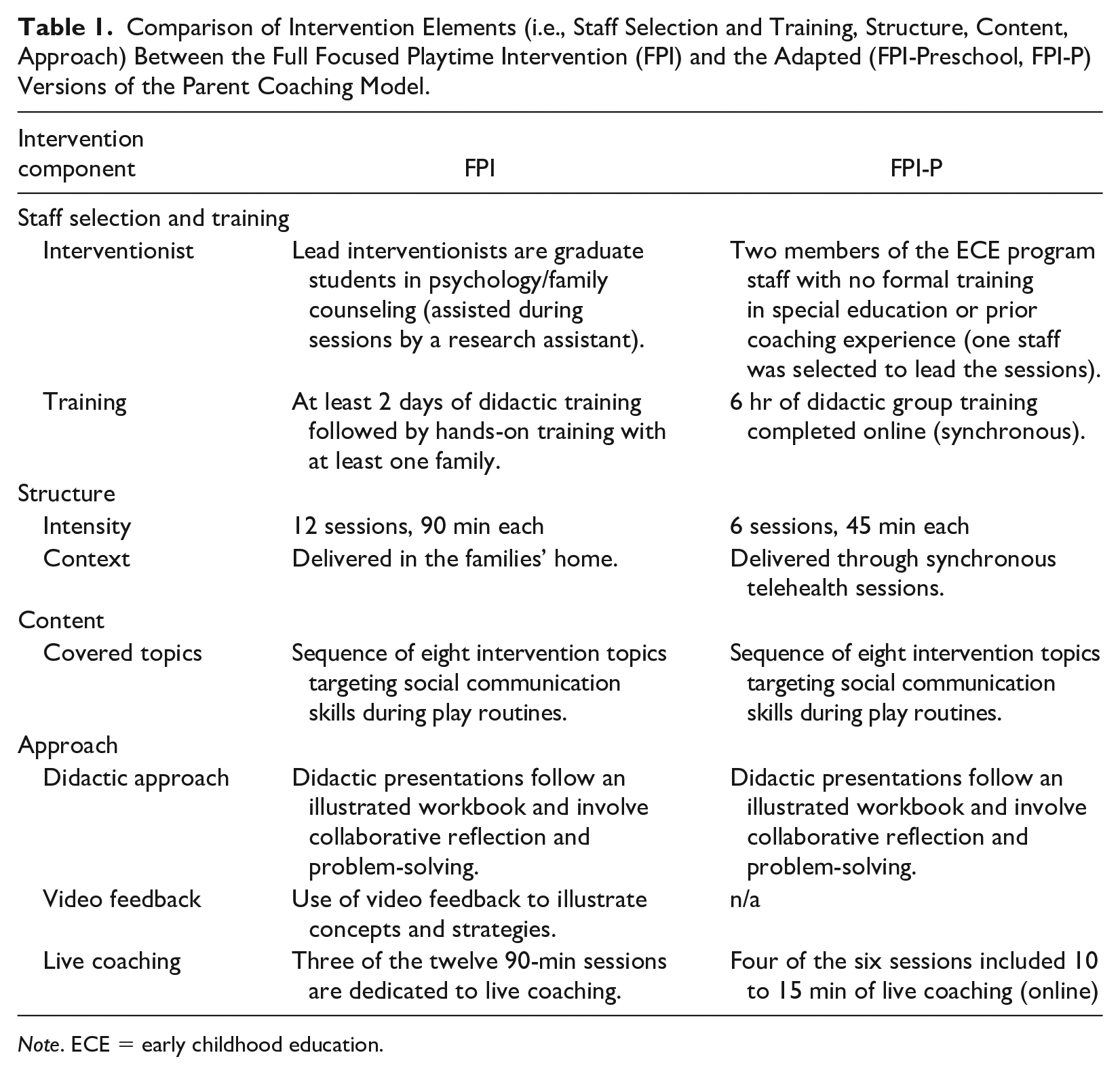
This research aims to test the feasibility, acceptability, and fidelity of involving ECE program staff without formal special education training or prior parent coaching experience in the delivery of an adapted evidence-based parent coaching intervention for young children with ASD. To support its implementation by ECE staff, FPI was adapted for this project (FPI-preschool [FPI-P]). Table 1 compares key intervention elements (i.e., staff selection and training, structure, content, and approach) between the full (FPI) and adapted (FPI-P) intervention model. Although the intervention content remained largely unchanged, adaptations were made to the procedures for staff training (i.e., from at least 16 hr of didactic training and hands-on training with at least one family to 6 hr of didactic training only), intervention intensity (i.e., from twelve 90-min to six 45-min sessions), delivery context (i.e., from in-home to telehealth sessions), and approach (i.e., whereas FPI uses a range of parent education strategies, FPI-P included fewer opportunities for in-the-moment coaching and did not use video feedback). Decisions to significantly reduce in-session time (i.e., session times were cut in half and there were half as many sessions) were driven by efforts to increase feasibility/acceptably from both the parents’ and teachers’ perspective. While the covered intervention topics remained intact, FPI-P included fewer practice opportunities (e.g., less live coaching, no video feedback). While these adaptations are significant, they seem reasonable because (a) FPI-P is not delivered as a stand-alone intervention but rather as an add-on to a fully aligned inclusive ECE program; (b) from the start of parent coaching, ECE staff had detailed knowledge of the enrolled children and established working relationships with their parents; and (c) parents and ECE staff viewed telehealth methods as an acceptable alternative due to the COVID-19 pandemic.
Comparison of Intervention Elements (i.e., Staff Selection and Training, Structure, Content, Approach) Between the Full Focused Playtime Intervention (FPI) and the Adapted (FPI-Preschool, FPI-P) Versions of the Parent Coaching Model.
Note. ECE = early childhood education.
FPI-P structure
The FPI-P was delivered by 10 PEL staff members. Each family received FPI-P from a team of two staff members, with one leading the parent coaching sessions and the second sharing observations/experiences when appropriate in the session (the division of roles between the preschool staff remained the same throughout the intervention period). Staff members and families were matched to ensure that (a) at least one of the staff members was a teacher from the child’s classroom, (b) staff members with limited classroom experience (e.g., assistant teacher, trainee) were paired with a staff member with more extensive classroom experience (e.g., lead teacher, classroom coach), and (c) weekly schedules were aligned. Training of staff members in FPI-P delivery involved a series of six synchronous online sessions (60 min each), during which the intervention developer (M.S.) described the content, structure, and approach of each session, and reviewed relevant sections of the treatment manual and parent workbook. To expedite implementation, training of staff members (April 2–16) and delivery of FPI-P sessions (April 3–May 6) overlapped.
FPI-P was delivered during six synchronous telehealth sessions that each lasted 45 min. Each intervention session consisted of five parts. (a) The coach greets the family warmly, provides a recap of the last session, and reviews play interactions (special play time) since the last session (5–10 min). (b) An episode of parent–child interaction is completed and observed with no coaching (7 min). (c) The relevant intervention topic is reviewed and individualized, using a range of adult learning strategies, including an illustrated workbook for parents, shared reflection on the observed play interaction, conventional teaching, and discussion of play outside the intervention session (at home or at preschool; 15–30 min). (d) A second episode of parent–child play is initiated (during Sessions 3–6 only) and used as an opportunity for the coach to provide specific and concise feedback about the parents’ play and/or strategies (highlighting positive contributions), and comment on the child’s responses (10–15 min). (e) The coach sets expectations for special play time interactions until the next session, and explains the worksheets used to reflect on these interactions (2 min).
FPI-P content
While preschool staff were expected to cover the intervention content in less time (compared with the full FPI model), the covered information remained unchanged. FPI-P consists of an ordered sequence of eight topics, which are covered during six sessions. During the first session, the parent and coach develop a detailed understanding of the child’s communication skills (Topic 1: When and how does my child communicate?) and discuss/reframe the parent’s goals (Topic 2: What do I hope to accomplish during play?). During the second session, parent and coach review strategies to arrange the environment in ways that are conducive to play (Topic 3: How do I develop a special play time routine?), develop a playtime routine that could feasibly be incorporated into the family’s daily schedule (special playtime routine), and review a framework for achieving collaborative play between parent and child (Topic 4: How to tackle play one step at a time?). This framework includes three subgoals (i.e., coordinating attention, coordinating actions, and sharing control) that are addressed sequentially in Topics 5 to 8 (corresponding to Sessions 3–6): Parent and coach discuss and practice strategies to support coordinated attention (Topic 5: Who gets to pick the toys?), ensure that parent and child establish a shared way of using the toys (Topic 6: Who decides the “correct” way of using the toys? Topic 7: How do I speak to my child during play?), and gradually shift increasing amounts of responsibility for initiating and maintaining the shared encounter to the child (Topic 8: How do I make play more balanced between me and my child?).
Research Design and Measures
This research was reviewed and approved by Emory University’s institutional review board. Parents participated in online sessions through a HIPAA-compliant web conferencing platform (Cisco Webex). All sessions were recorded using screen capture. A random sample of sessions was scored for adherence to the intervention manual (FPI-P Fidelity Rating Scale). In addition, after the last intervention session, parents completed the Measure of Process of Care (MPOC-56; King et al., 1995), and participated in an exit interview. Finally, preschool staff participated in focus groups. Interviews and focus groups were analyzed using qualitative research methods.
FPI-P Fidelity Rating Scale
A random sample of 24 intervention sessions, stratified by session number (i.e., 1–6) and professional background of the preschool staff (classroom coach, lead teacher, assistant teacher, and support staff), was selected for coding. All screen-captured intervention sessions were reviewed and scored independently by two trained researchers. Consensus discussions were used to resolve any disagreements in scoring. The FPI-P Fidelity Rating Scale was adapted from a checklist developed for in-home delivery of FPI (Siller et al., 2013) and focused on the delivery of structural elements, approach, and content. The structure domain included eight items (A1.–A8; Table 2) that were either recorded as present or absent (six items) or rated on a 4-point scale (A2. and A3.). The approach domain used 4-point rating scales to evaluate (a) the general didactic approach (four items [B1.–B4.]; for example, balances presenting information and engaging parent), (b) coaching of play interactions outside the session (three items [C1.–C3.]; for example, encourages practice of strategies), (c) coaching of play inside the session (three items [D1.–D3.]; for example, provides effective positive feedback), and (d) therapist responsiveness (three items [E1.–E3.]; parent questions are answered thoroughly). Finally, the delivery of intervention content was rated using three rating scales that capture the extent to which (a) the intervention content was explained accurately (F1.), (b) the interventionist asked questions to assess the parents’ understanding of the information (F2.), and (c) the interventionist develops a thorough understanding of the child’s behaviors, needs, and supports (F3.). The exact definitions of the content items differed for each intervention topic. Rating scales captured the extent to which each intervention component was demonstrated: 1 = not at all, 2 = somewhat, 3 = good, 4 = very well (a score of 3 was interpreted as meeting predetermined fidelity levels).
FPI-P Fidelity Ratings for All Approach and Content Elements, With Domain Total Scores Presented Separately for the Four Staff Groups.

Note. Descriptive statistics are M (SD) or %; ratings range from 1 to 4; a score of 3 is considered to meet predetermined fidelity level. FPI-P = Focused Playtime Intervention-Preschool.
Exit focus group for preschool staff
Three distinct focus groups were held for (a) lead teachers, (b) assistant teachers, and (c) support staff (including classroom coach). A semi-structured interview guide was used to facilitate focus group discussions. To reduce the possibility of social desirability bias in staff responses, focus groups were led by clinicians with training in speech-language pathology or clinical psychology, who were not otherwise involved in this project or the preschool. The interview guide consisted of open-end questions, as well as probing questions (e.g., “What was the most impactful part of this experience for you?” “What are your thoughts on the process by which you were trained?” “Was the focus compatible with the parents’ priorities and family life?” “How did you feel about the didactic/live coaching portions of each session?” and “What is one thing you would like to see done differently if we were to offer this intervention in the future?”). Focus group sessions lasted approximately 45 to 60 min, were administered online through Webex, and recorded through screen capture. Recordings were then transcribed verbatim by an independent transcription service and analyzed using conventional content analysis. This form of analysis is commonly used in studies with the aim of describing a phenomenon at a level that closely reflects the transcript content (Hsieh & Shannon, 2005). In this case, content primarily reflected the ECE staff’s perceptions related to implementing FPI-P.
The qualitative team consisted of a group of five researchers who first reviewed the focus group transcripts independently and completed open coding, a process in which units of text were assigned “codes” that represented their meaning on a manifest level. The research team then came back together to review the conceptualization of codes and to generate a codebook. Once the codebook was established, two research team members broke apart to reapply the final codebook to all focus group transcripts. Consensus coding was used for reliability and any discrepancies were brought to the full team for review. After each focus group was coded, categorization occurred in which the full research team reviewed the coded transcripts and organized codes into overarching categories that shared content (e.g., codes related to parent outcomes). In the final phase of abstraction, categories were grouped into overarching constructs (e.g., perceived outcomes; Elo et al., 2014). Coding was facilitated by MAXQDA software.
Qualitative results from the staff focus groups were confirmed using member checking procedures (Birt et al., 2016), that is, ECE staff who participated in focus groups were invited to participate in a 45-min meeting in which the identified codes, categories, and constructs were reported back to the staff. Prior to the meeting, staff also had the opportunity to review the qualitative results section and Table 3 of this article. Staff members were invited to clarify, amend, and correct the presented results. Seven staff members participated in the member checking procedures, and staff feedback confirmed the reported results (no new concepts emerged).
Constructs, Overarching Categories, Codes, and Definitions Based on Staff Focus Groups/Parent Interviews.

Note. COVID-19 = coronavirus disease 2019; FPI-P = Focused Playtime Intervention-Preschool.
Exit Interview for Parents
A semi-structured interview guide was also used to facilitate parent interviews. The interview guide consisted of open-end questions and probing questions (e.g., “What was the most impactful part of this parent coaching project for you?” “Did you see any changes in your interactions with your child because of your participation in this project?” “Was this focus compatible with your priorities and family life?” and “What is one thing you would like to see done differently if we were to offer this intervention in the future?”). The interview was completed by seven families. To reduce the possibility of social desirability bias in the parents’ responses, interviews were administered by a research assistant, or research fellow, who was not involved in the preschool or delivering FPI-P with the interviewed family. Parent interviews lasted between 9 and 35 min. Interview administration, transcription, and qualitative analyses were identical to the methods described for the analysis of staff focus groups, with the exception that the use of member checking procedures was not feasible.
Parent survey of family-centered intervention principles
Parents completed the MPOC-56 (King et al., 1995), which captures the extent to which parents perceive an intervention to be aligned with principles and practices of family-centered interventions. For this research, we administered three subscales: (a) the Enabling and Partnership subscale (16 items) captures behaviors that actively involve parents in their child’s care, particularly in decision-making and in eliciting parental input, concerns, and opinions (e.g., “offer you positive feedback and encouragement,” “trust you as the expert on your child”); (b) the Coordinated and Comprehensive Care subscale (17 items) captures behaviors that provide care in a way that is continuous and consistent over time, settings, and people (e.g., “show sensitivity to your family’s feelings about having a child with special needs,” “suggest therapy plans that fit with your families’ needs and lifestyle”); and (c) the Respectful and Supportive Care subscale (nine items) that captures care in which parents are viewed as individuals and equals, and all family members are treated with respect (e.g., “provide a caring atmosphere rather than just give you information,” “treat you as an individual rather than as a ‘typical’ parent of a child with disability”). Items are rated on a 7-point scale: 1 = not at all, 2 = to a very small extent, 3 = to a small extent, 4 = to a moderate extent, 5 = to a fairly great extent, 6 = to a great extent, 7 = to a very great extent. The test–retest reliabilities range from .78 to .88 for the MPOC scales, and the internal consistency reliabilities range from .81 to .96 (King et al., 1995).
Investigator triangulation/mixed-methods meta inferences
Investigator triangulation was achieved by comparing the emerging qualitative results to fidelity data and MPOC-56 scores. For example, categories related to the challenges of implementing FPI-P were compared with teacher fidelity data. Similarly, qualitative data from parent interviews (e.g., comments on the parents’ relationship with the preschool staff) were compared with their report on the MPOC-56.
Results
Fidelity of FPI-P Implementation
Of the eight families who completed FPI-P, the intervention was led by the classroom coach (one family; considered as the gold standard), a classroom lead teacher (two families), a classroom assistant teacher (two families), or preschool support staff (three families; this includes interventions led by the preschool supervisor or trainees). For five families, the parent participating in the intervention was the child’s mother, while for three families both parents participated (for one family, the mother and father alternated). Across the eight families who completed FPI-P, 51 intervention sessions were delivered and 24 sessions were coded using the FPI-P Fidelity Rating Scale. The mean session length was 42.7 min (SD = 8.6; range = 19–58). On average, sessions delivered by lead teachers (M = 34.2 min, SD = 10.1) were shorter than sessions delivered by the classroom coach (M = 46.3 min, SD = 7.1), assistant teachers (M = 45.2 min, SD = 8.1), or support staff (M = 45.3 min, SD = 1.9). The vast majority of session time was used to cover the intervention content. However, during some sessions, topics unrelated to children’s social communication and play were discussed, including questions about preschool operation during the COVID-19 pandemic (four sessions, ~2.5 min per session), sibling interactions (two sessions, ~4 min per session), or general questions about ASD (three sessions, ~4 min per session).
Implementation of FPI-P’s structural elements
Several elements of the session structure were implemented with great consistency: (a) the family was greeted warmly (A1.; 100%), (b) an episode of parent–child interaction was observed (A4.; 96%), and (c) at least one of the eight FPI-P topics was covered (A6.; 100%). In contrast, a review of parents’ homework assignments (A2.) was typically attempted (81%; rating >1), but not always judged as fully adequate (50%; rating >2). Similarly, a recap of the last session (A3.) was always attempted (100%; rating >1), but not always judged as fully adequate (60%; rating >2). Furthermore, parents only accessed the parent workbook during 63% of the sessions (A5.), homework assignments were explained in 45% of the sessions (A8.), and in-session coaching was only attempted in 44% of the sessions (A7.; applied only to Sessions 3 to 6).
Implementation of FPI-P’s approach and content elements
Table 2 summarizes FPI-P fidelity ratings for all approach and content elements, presented separately for each of the four staff groups (e.g., classroom coach, lead teacher, assistant teacher, and support staff). Due to the small sample size, the presented analyses are descriptive and statistical tests were not computed.
General didactic approach
Overall, the ECE staff’s didactic approach verged upon predetermined fidelity levels (score of 3), that is, average scores for (a) presenting relevant examples (B1.), (b) actively engaging the parent during the didactic portion (B2.), and (c) presenting developmentally appropriate/individualized content (B3.) ranged between 2.8 and 2.9. The ECE staff had more difficulty synthesizing the intervention content and providing the parent with clear suggestions for individualized support strategies (B4.; M = 2.3). Moreover, comparisons between the four staff groups revealed that the general didactic approach of lead teachers (M = 2.1) was rated lower, compared with the three remaining staff groups (M = 2.8 to M = 3.0).
Coaching approach
Coaching of play interactions that occurred both within (C1.–C3.) and outside (D1.–D3.) the intervention sessions was rated relatively low for lead teachers, assistant teachers, and support staff. While the classroom coach (gold standard) approached predetermined fidelity levels for both domains (C domain total score: M = 3.3, D domain total score: M = 2.7), the scores of the three remaining staff groups were low in comparison (C domain total score: M = 1.0 to M = 2.3; D domain total score: M = 2.1 to M = 2.4).
Overall responsiveness
The ECE staff’s overall responsiveness was rated consistently high, that is, all-staff average score on each item in this domain (E1.–E3.) approached the predetermined fidelity levels (M = 2.9 to M = 3.1). Similarly, differences in ratings between the four staff groups were not observed (E domain total score; M = 2.9 to M = 3.1).
Session content
Overall, the delivery of the session content was a strength, that is, the session content was explained accurately (F1.; M = 2.8), and the parents’ understanding was adequately assessed through questions (F2.; M = 2.7). In contrast, the most challenging aspect of delivering the session content was to individualize the intervention content to specific children (F3.; M = 2.2). Again, the classroom coach (gold standard) approached the preestablished fidelity criteria (F3.; M = 2.7), whereas the remaining three staff groups were rated low (F3.; M = 1.8 to M = 2.2).
Qualitative Analysis of Staff Focus Groups and Parent Interviews
Codes and categories identified during the qualitative analysis of staff focus groups could be subsumed under four general constructs that were broadly related to (a) feasibility, (b) implementation, (c) fit, and (d) outcomes. Although there were no differences in the occurrence of codes and categories between staff groups, certain codes or categories appeared more salient for particular groups. Qualitative analyses of parent interviews resulted in similar codes and categories, with the exception that the construct of feasibility did not emerge/apply. Table 3 summarizes the main constructs, categories, codes, and definitions that were derived across staff focus groups and parent interviews.
Feasibility
Statements about the feasibility of learning FPI-P could be subsumed under two overarching categories: statements related to the procedures for staff training and those related to staff confidence, self-efficacy, and perceived skill when implementing FPI-P.
Training
All staff groups referenced the amount, content, and pacing of training as playing a role in the feasibility of implementing FPI-P at fidelity. Specifically, support staff, lead teachers, and assistant teachers all stated that FPI-P training felt somewhat rushed. This theme appeared most salient for assistant teachers who emphasized, “needing a longer training period, and then being able to physically watch a couple of sessions just to see how it’s supposed to go.” However, even support staff with greater experience in parent coaching shared,
I didn’t really have time to study it, or really process it. I would have liked to have seen more video examples. That would have helped. (. . .) When I was in the moment, it seemed to have happened naturally, but yeah, I just think it was thrown a little too quickly. I would have liked more time. (Support Staff)
Confidence
Most staff shared that they had no prior experience with parent coaching, and that this lack of experience impacted their confidence when implementing FPI-P. For example, assistant teachers shared that the coaching role still felt unfamiliar and quite different from their traditional role as a teacher. However, while assistant teachers described limited self-efficacy during the first few sessions, they also reported that their confidence increased over the course of implementing FPI-P.
And I tried to be more like as a teacher because when I was trying to use the language or follow the training book, I think I was losing the parents a little bit. They probably felt, “She doesn’t know what she’s talking about,” “She’s lost and she’s trying to teach me.” But then when I became as a teacher, natural the way I am, it was like they feel like talking to you. (Assistant Teacher)
Implementation
Statements about the implementation of FPI-P could be subsumed under two overarching categories: those that described the process of implementing FPI-P and those related to the factors that impacted how easy it was for staff to implement FPI-P.
Implementation process
Staff reported difficulty attempting to follow the prescribed session content/approach at fidelity levels. They expressed that live coaching was the most difficult aspect of FPI-P sessions and also reported, at times, feeling the need to adapt session content to better meet the needs of the caregiver within that session. One lead teacher reported,
So, I felt like, for them to keep them hanging in there through the end I needed to almost add little points that maybe weren’t guided to that specific topic, just to keep them in it for the long haul.
Factors impacting implementation
When discussing FPI-P implementation, a number of codes emerged capturing factors that made FPI-P easier or more difficult to implement. For example, staff consistently indicated that having an existing relationship with participating caregivers made it easier to create an effective working relationship for this intervention and to develop intervention strategies for children that they knew quite well. As one assistant teacher shared, “that relationship that we have with our parents helped a lot with this intervention . . . we felt comfortable with them.”
Parents also consistently shared positive impressions of having a teacher they knew delivered FPI-P. This was reported to support child engagement within the sessions and rapport with the family, given their past experience working with their child within the classroom setting. One parent reported,
It was definitely helpful having people she was familiar with. And they had context that they shared, even maybe moments that we had not heard about that they had had with [child] in the classroom. That was helpful for them to be able to connect those dots.
In addition, staff reported that it was helpful to deliver FPI-P alongside another staff member, who was often able to augment their own skill set.
If I wouldn’t have had [staff] who really read the [manual], and read it word-for-word, then I would have struggled a lot more because I go into teacher mode. And I go into what I’m seeing, how do I fix it now, what can I tell the parent that would be useful for her at this time, and [staff] helped me stay grounded and focused on that specific lesson. (Lead Teacher)
Finally, staff and parents commented on how general family stress, particularly as it related to the COVID-19 pandemic, impacted the implementation of and participation in FPI-P.
The timing might have been off because this is a hectic time. And the mom was working from home as well. And there’d be times when she’d have to kind of cut the sessions a little bit shorter because there’s a meeting she has to go to, so the topic and everything was completely relevant. The timing, not so much. (Assistant Teacher)
Caregivers consistently reported that participating in FPI-P in the context of the COVID-19 pandemic was challenging. They shared that the added stress created by the pandemic made it particularly difficult to fully implement the acquired intervention strategies outside the structured FPI-P sessions. One parent stated,
For COVID-19, for a lot of us, it’s just too much with working and trying to do stuff with our kids, too. So, it’s not helpful in that respect, that I can’t implement what I’ve learned, really, because I don’t have the time to do that.
Fit
Reflections on the fit of FPI-P’s focus on social communication and play could be subsumed under two overarching categories: fit for the child, mainly in terms of their developmental level and needs, and fit with family’s goals and priorities.
Child fit
Most comments on the topic of child fit centered around a mismatch between the developmental, particularly verbal, level of many participating children and the framing of the content. Preschool staff noted the need for guidance in adapting the content more flexibly to children with various skill levels:
The intervention [. . .] was initially written for kids who are much lower in their language level than our kids in our preschool. So as a clinician, I felt like I was definitely having to work hard to adjust this content to fit our population and then to make it make sense to these parents. (Support Staff)
Although some caregivers reported that the goals of FPI-P were well-aligned for their child’s needs, other families expressed that the goals did not necessarily reflect their child’s specific developmental needs. One family shared,
The thing that we talked about was if it could be more customized to the family and the child at the things that they’re at, because since [child], I think, doesn’t necessarily struggle with some of the topics that were in the outline. (Parent)
Family fit
Staff reported mixed perceptions of the fit between FPI-P and families’ goals for their children. Specifically, they reported that families had goals and priorities outside of the scope of the intervention (e.g., feeding concerns) and staff reported feeling unsure how to balance the priorities of parents with delivering the intervention as written:
But what [child] really, really struggled with, what happens when I changed up the play, when little sister comes in or older brother comes in or appear at school. What do we do then? And then, having just one topic to do that was really, really just not enough for those families. So, it was hard not being able to go there. (Support Staff)
Similarly, although all caregivers in the study reported that they would recommend FPI-P to other families, two caregivers reported that the specific goals of the FPI-P program were not goals that were a top priority to the family.
It was really helpful to put words to some of the things we’re already doing, specifically identifying, “When we do this, this is a thing that’s helpful.” There was verbiage as opposed to me just instinctually doing some things. So, we were already doing a lot of that, so it was really nice to sort of reiterate and emphasize, “Okay, these are positives. Let’s keep doing this.” But I would say that for me, it’s more about him advancing in social areas with his peers and in school than it is about parent-child play time. (Parent)
Perceived outcomes
Statements about the perceived outcomes of participating in FPI-P could be subsumed under two overarching categories: outcomes on parents and preschool staff.
Parent outcomes
With regard to outcomes for the parents, several codes emerged, including parent intentionality, social support, and parent use of FPI-P strategies.
Parent intentionality
One of the most salient perceived outcomes was the parents’ increased reflection and intentionality during play. Preschool staff consistently reported that caregivers became more proactive in devoting time to play and in reflecting on their actions during play. One assistant teacher said, “I feel like [parent] was reflecting a lot and she did get a lot of critical thinking time about how her child communicates, how her child plays. So, I think she developed reflection skills.”
Yeah, the most impactful part of the experience I could definitely say was, being able to give the parent that I was working with that break, that purposeful break to be able to spend time with their child and just play together. As the mom was kind of like, she’s a single mom, and she’s like working full-time, so it was just hard for her just to find time to devote to her child – and with having these sessions, it was just a purposeful way to set up some time for her to be able to spend one-on-one with her child and just play and have that connection. (Assistant Teacher)
Social support
Another perceived outcome was the strengthening of relationships between parents and preschool staff, and gaining social support through the FPI-P sessions. The ability for parents to receive social support from preschool staff was thought to be particularly important in light of the COVID-19 pandemic. As one support staff shared, “And I feel like she [parent] wanted this. . . The parent really wanted this support, especially during this time of COVID when she doesn’t know what to do with her kid all day.” Another lead teacher reported,
I think just from that mental health standpoint of, I feel I’m ignoring my kid all day, but for this special play time, I am with him and during this coaching session, I’m with him so it gave her that organization to her day and her week that helped her to feel she was being productive. (Lead Teacher)
Similarly, parents reported that FPI-P sessions provided an important source of social support during a particularly challenging time due to the COVID-19 pandemic.
But it’s [social support] nice, right? Especially now when I’m all alone every single day. It’s nice kind of being able to have another adult to interact with and get feedback from. I told [staff] yesterday, I was like maybe these meetings have been more so for me too. (Parent)
Parent use of FPI-P strategies
Staff also reported that parents used FPI-P strategies such as the “special playtime routine,” and shared that this may have contributed to child outcomes, including an ability to anticipate and initiate play. One assistant teacher expressed, “We noticed pretty quickly that the child began to initiate play using [. . .] the play box within a matter of just a couple of sessions.”
Although some parents expressed difficulties practicing intervention strategies outside the FPI-P sessions due to the added stress of the COVID-19 pandemic, the majority of parents did report using the strategies in some capacity. Caregivers also shared that using the intervention strategies was beneficial to their child or family. One caregiver reported,
I learned that this whole thing of having the box and he knows specific items that are in that box and being able to show me or tell me what he wants to do. I think that’s big for him too to feel like he’s kind of a. . . He’s the biggest part of it and he can feel it, right? And, so, I think I noticed that with this [FPI-P]. It’s I guess for a lot of people, it would be like okay, he’s asking to play with this box with his toys in it with mommy, that’s not really that big of a deal but for us it is. (Parent)
Staff outcomes
Finally, several staff reflected on their own outcomes as a result of facilitating this intervention and reported that the experience helped them better understand their students, more generally working with students with ASD. This code appeared to occur more frequently for assistant teachers, who shared,
For me, I think it helped me to see the families in a different way because you get to see them in their natural environment. In their houses, and you can see what we do at the school compared to what they do at the house. [. . .] And it helped me understand the families better and the child. (Assistant Teacher)
Parent Survey of Family-Centered Intervention Principles
Analysis of parent responses on the MPOC-56 (N = 7) show high parent-reported alignment with family-centered intervention principles. Scores of 6 and above indicate that the parent views the principle to be evident “to a great extent.” Average scores on the Enabling and Partnership subscale range from 5.7 to 6.9 (M = 6.4, SD = .42). Average scores on the Coordinated and Comprehensive Care subscale range from 5.4 to 7.0 (M = 6.3, SD = .51). Average scores on the Respectful and Supportive Care subscale range from 6.4 to 7.0 (M = 6.8, SD = .23).
Mixed-Methods Meta Inferences About FPI-P Feasibility and Acceptability
Quantitative findings from fidelity ratings indicate that many aspects of FPI-P’s structural elements, content, and approach were implemented proficiently (ratings of 3 and above). In contrast, observational ratings revealed two areas with limited fidelity. (a) Coaching of in-session/out-of-session play revealed limited fidelity for lead teachers, assistant teachers, and support staff (Domains C and D; domain averages ranged between 1 and 2.4). This finding was expanded by qualitative analyses of focus groups. Preschool staff reported that live coaching of play interactions was the most difficult part of delivering FPI-P, emphasizing that this role was new in the beginning and that the staff’s self-confidence with coaching increased over time. (b) While session content was (for the most part) explained adequately, lead teachers, assistant teachers, and support staff found it more difficult to appropriately individualize the session content (e.g., Synthesizes didactic content, provides clear message, and suggests specific strategies [B4.; scores range from 1.8 to 2.3]; Develops a thorough understanding of the child’s behaviors, needs, and supports [F3.; scores range from 1.8 to 2.2]). This finding was expanded by qualitative analyses of focus groups, with preschool staff expressing the need for additional training in adapting the session content to more verbal children. Finally, quantitative findings from parent surveys (MPOC-56) revealed high parent-reported alignment with family-centered intervention principles (average ratings of 6.4, 6.3, and 6.8 for the Enabling and Partnership, Coordinated and Comprehensive Care, and the Respectful and Supportive Care subscales, respectively). This finding was expanded by qualitative analyses of focus groups, which revealed that preschool staff viewed existing positive relationships with families as an important driver of success in implementing FPI-P. Similarly, results from qualitative interviews revealed that parents viewed the opportunity to work with a familiar member of the preschool staff as an important strength of the current implementation of FPI-P.
Discussion
This mixed-methods study aimed to test the feasibility, acceptability, and fidelity of involving ECE staff without special education training or prior parent coaching experience in the delivery of an adapted evidence-based parent coaching intervention for young children with ASD (FPI-P). While the findings highlight several opportunities for improving FPI-P staff training and implementation procedures, results from this research demonstrate (a) the feasibility of involving ECE staff in the delivery of ASD-specific parent coaching to promote social communication and play, (b) that both parents and preschool staff viewed the experience as beneficial for themselves and the child, and (c) that parents perceived their participation in FPI-P to be aligned with family-centered intervention principles.
Past research that trained ECE professionals in implementing ASD-specific parent coaching targeted teachers within publicly funded, school-based ECSE classroom for 3- to 4-year-old children with ASD (Ingersoll & Dvortcsak, 2006; Ingersoll & Wainer, 2013). By focusing on special education classrooms within the public school system, parent coaching was implemented to extend children’s individualized special education programs. The current research differs from this approach in that it targets children with ASD enrolled in a private, state-licensed, inclusive child care learning center. Consequently, the ECE staff who participated in this research had no formal special education training (mostly AA or BA degrees in ECE) and parent coaching was implemented as a tool for promoting respectful, reciprocal relationships with families, which are a central component of developmentally appropriate practice in ECE (NAEYC, 2020). Specifically, parent coaching was used to teach parents of young children with ASD about social communication goals, to share strategies to promote development in these areas, and to align learning across the home and school setting.
Opportunities for professional development in private ECE settings are limited. To ensure feasibility within ECE settings, FPI-P staff training procedures were abbreviated quite aggressively for this project, that is, teachers participated in only 6 hrs of didactic, synchronous online training. This level of training seemed reasonable, given that all participating ECE staff (a) were experienced in implementing social communication goals for young children with ASD, and (b) had extensive experience in teaching young children. In contrast, prior research that trained ECSE teachers in parent coaching implemented a much more intense training protocol that included both didactic and hands-on components (18–50 hr of teacher time; Ingersoll & Dvortcsak, 2006; Ingersoll & Wainer, 2013). While Ingersoll and colleagues did not evaluate the teacher’s adherence to the parent coaching protocol, results from the current study demonstrate that, even with the abbreviated training protocol, ECE staff delivered several aspects of FPI-P with adequate fidelity (e.g., providing relevant examples of concepts and strategies [B1.], actively engaging parents during didactic portions [B2.], overall responsiveness [E1.–E3.], and delivery of session content [F1 and F2.]). Despite these strengths, other elements of FPI-P were implemented with less fidelity. For example, in-the-moment coaching of play interactions occurred only during 44% of eligible sessions (A7.) and the quality of coaching of in-session [C1.–C3.]/out-of-session [D1.–D3.] play was limited for lead teachers, assistant teachers, and support staff. Similarly, fidelity ratings indicated difficulties with individualizing the intervention content (F3.) and providing parents with a clear practice plan (B4.). Consistent with these results from observational fidelity ratings, qualitative analyses reveal that the staff training was indeed perceived as somewhat rushed, brief, and missing a hands-on component, and that some staff felt somewhat underprepared, particularly during the first few FPI-P sessions and the live coaching components. Future implementations of FPI-P should find creative ways to extend the staff training procedures (e.g., incorporate a hands-on training component and video examples) and provide staff with a clearer distinction between required and optional FPI-P elements. In this research, the didactic FPI-P training period overlapped with the period of intervention delivery. If FPI-P were to be implemented in community settings, preschool staff would likely implement the intervention with multiple families throughout the school year. Thus, one feasible opportunity for increasing the intensity of staff training is to leverage each staff’s first FPI-P family for hands-on training with performance feedback.
Finding ways of involving ECE teachers in the delivery of parent coaching requires careful attention to the teachers’ competing obligations/time constraints and creativity in identifying feasible and sustainable implementation settings. For example, Ingersoll and colleagues (Ingersoll & Dvortcsak, 2006; Ingersoll & Wainer, 2013) implemented parent coaching using a combination of group and individual sessions, and delivered intervention sessions within the classroom, either during days of classroom closure or in the evening. The current research was implemented during classroom closures related to the COVID-19 pandemic, and used a telehealth approach to deliver the parent coaching sessions. Results from this study contribute to a small body of research indicating that telehealth-based parent coaching interventions can benefit children with ASD and their families in a variety of ways (Sutherland et al., 2018). In a series of studies, Ingersoll and colleagues (Ingersoll et al., 2016; Pickard et al., 2016) demonstrate that parent coaching implemented through telehealth is perceived by parents as acceptable, and is associated with increases in parent self-efficacy, well-being, as well as knowledge and accurate implementation of intervention strategies. Furthermore, although a rigorous comparison with traditional parent coaching has not been completed, preliminary results suggest that telehealth-implemented parent coaching is associated with increases in children’s social communication, using both observational and parent report measures.
This research was completed during the COVID-19 pandemic. School, child care, community programs, and workplace closures during the COVID-19 pandemic led to high levels of social isolation, psychological distress, unemployment, and economic distress in families. In a national survey administered to families in the United States, Patrick et al. (2020) reported that, between March and June 2020 (the first few months of the COVID-19 pandemic), 27% of parents experienced a decline in their mental health, and 14% reported a decline in their children’s behavioral health, citing disruptions in child care as an important source of family stress. Families of children with neurodevelopmental disorders, including ASD, were impacted by disruptions in predictable routines, expectations, and behavioral/environmental supports integral to their well-being (Bentenuto et al., 2021; Kong, 2020; Summers et al., 2021). From the perspective of inclusive ECE programs for children with ASD, temporary suspension of in-person classrooms created an immediate need for adapting inclusion models to ensure continuation of services for children with ASD and evidence-based parent coaching provided a viable option. Liu et al. (2021) reported that a mobile-based education program implemented during the COVID-19 pandemic was associated with reduced anxiety, depression, and parenting stress among parents of children with ASD. Consistent with these findings, qualitative analyses from this research show that parents benefited from participating in FPI-P by experiencing increased levels of social support from familiar ECE staff. At the same time, teachers and parents also indicated that it was sometimes difficult to consistently participate in FPI-P, in part due to the added stress placed on parents of children with ASD during the COVID-19 pandemic.
While FPI-P’s focus on social communication during natural play routines was consistently viewed as important, both staff and parents expressed the need for a more flexible curriculum, both in terms of content (e.g., sibling interactions, behavior management, and autism knowledge) and children’s developmental level (i.e., targeting social communication goals across different levels of development). When evidence-based, manualized parent coaching is implemented in community settings, parents may opt to participate in a particular intervention (such as FPI-P) based on the content/topic. Furthermore, when delivering manualized parent coaching, practitioners inherently experience a tension between adhering to the intervention manual (i.e., fidelity) and meeting the individual families’ needs (i.e., family-centered care). Particularly, during unexpected events at the child, family, or community level (including events associated with the COVID-19 pandemic), effective engagement of parents requires that parent and provider jointly shape the intervention in ways that is responsive to and meets the families’ changing needs. Future research should investigate the ways in which parents and community providers collaborate to shape the implementation of evidence-based parent coaching interventions in ASD and test whether the extent to which such coproduction occurs impacts parent engagement and family outcomes (Batalden et al., 2016).
Future Directions
This study supports a number of future directions. First, this research was completed within a private child care learning center affiliated with an academic institution. Future research should investigate the feasibility of implementing FPI-P within community-based private child care learning centers, as well as publicly funded Head Start and pre-K programs. FPI-P’s current level of intensity (i.e., six 45-min sessions) may provide a promising starting point for such a program of research. Second, this research was completed in the context of temporary classroom closures within the COVID-19 pandemic. Future research should investigate whether FPI-P can be implemented equally during times of regular preschool operation. Finally, findings from this research suggest several future adaptations to the staff training and FPI-P implementation procedures. Aside from a more intense staff training protocol, findings suggest the need to (a) complement didactic training with video examples and hands-on training, (b) clarify the distinction between required and optional intervention elements, and (c) provide guidance on how to adapt the intervention content for children with more advanced language levels.
Limitations
This research has several noteworthy limitations. First, interpretation of current findings is limited by the small sample size (both children and teachers), and the possibility that the current participants are not a representative sample of young children with ASD or ECE program staff. Second, this study did not capture important process (e.g., the extent to which parents implemented FPI-P strategies, children’s active engagement during play interactions) or outcome measures (e.g., parent stress, child communication). Finally, this research did not include a comparison group, and the extent to which intervention outcomes differ, based on whether parent coaching was implemented by ECE staff, or a trained clinician, is unknown.
Conclusion
This research provides preliminary evidence to suggest (a) the feasibility of involving ECE staff in the delivery of ASD-specific parent coaching to promote social communication and play, (b) that both parents and preschool staff viewed the experience as beneficial for themselves and the child, and (c) that parents perceived their participation in FPI-P to be aligned with family-centered intervention principles.
Footnotes
Declaration of Conflicting Interests
The author(s) declared no potential conflicts of interest with respect to the research, authorship, and/or publication of this article.
Funding
The author(s) disclosed receipt of the following financial support for the research, authorship, and/or publication of this article: Preparation of this article was supported by The Marcus Foundation, Children’s Research Trust, and Chesed Inc.
