



Abstract
Experiential learning tends to succeed when students feel ownership over their experiences (Druian et al., 1980; Estes, 2004; King, 1988). Student ownership is often associated with several positive outcomes, including perceptions of development and long-term learning (Knapp, 1994; Sibthorp et al., 2007; Sibthorp et al., 2008). Experiential learning scholars have suggested that certain aspects can contribute to the emergence of student feelings of ownership, including giving students more control and involving them in decision-making (Griffith, 1990; Shellman, 2014; Sibthorp et al., 2008).
Despite our understanding of the importance of feelings of ownership in experiential learning, we know little about how these feelings emerge in experiential education settings. This oversight is problematic, as the emergence and evolution of feelings of ownership may affect the effectiveness of our educational approaches. In this study, we used the lens of psychological ownership theory (Pierce & Jussila, 2011) and conducted four waves of semi-structured interviews to explore the experiences of students as they developed psychological ownership over a class that followed the classroom-as-organization (CAO) approach.
At the end of our study, we learned that different factors reinforce each other to create the conditions in which psychological ownership appears in a CAO. Second, we learned that students anticipate their feelings of ownership and that psychological ownership persists after the class ends. Finally, we concluded that students do not want (or need) full control to feel ownership in an experiential learning course.
We proceed by first reviewing the literature concerned with feelings of ownership in experiential education. Next, we review the theory of psychological ownership and the literature on the CAO approach. We then proceed with our methods and findings.
Literature Review
Student Ownership in Experiential Education
Scholars have noted the importance of student feelings of ownership in experiential education for decades (Estes, 2004; King, 1988). For example, Druian and colleagues (1980) believed that “in successful experiential learning programs, students exhibit a high level of ownership of their products” (p. 9). There are many reasons why student feelings of ownership are so important in experiential education. Student ownership seems to be associated with a variety of positive outcomes. For example, scholars have suggested that students become active learners when they have feelings of ownership (Griffith, 1990; Hovelynck, 2003). Furthermore, student ownership seems to increase long-term learning and perceptions of development (Knapp, 1994; Sibthorp et al., 2007; Sibthorp et al., 2008). Ownership can also lead to creativity (Schaffer & Peterson, 1998), increased motivation (Soslau & Yost, 2007), and a sense of belonging (Swiderski, 2001).
Educators have also suggested factors that may contribute to the emergence of student feelings of ownership in experiential learning contexts. For example, giving students more control and responsibility seems to increase feelings of ownership (Griffith, 1990; Hains & Smith, 2012; Sibthorp et al., 2008) as does providing them with options and involving them in decisions (Daniel et al., 2014; Kohn, 1991; Shellman, 2014). Knapp (1994) further suggests that students gain a sense of ownership when experiential activities spring from their own interests and past experiences. Groups can also develop joint feelings of ownership when they engage in rituals or reflect on their experiences together (O’Connell & Dyment, 2003; Wittmer, 2001).
Despite the importance of student feelings of ownership in experiential education, we do not have a good understanding of the process through which these feelings emerge from students’ perspectives. Given the link between feelings of ownership and positive outcomes, gaining such knowledge would help educators design more effective experiential learning environments. One theory that can help us better understand the emergence of feelings of ownership is the theory of psychological ownership, which we review below.
Theory of Psychological Ownership in Organization Behavior
Pierce and colleagues (2001) defined psychological ownership as “that state in which individuals feel as though the target of ownership (material or immaterial in nature) or a piece of it is ‘theirs’ (i.e., ‘It is MINE!’)” (p. 299). Pierce et al. (2001) argued that individuals can develop feelings of ownership toward objects that are not their formal property. Later, Pierce and Jussila (2010) introduced the idea that psychological ownership can also be a characteristic of a group as a whole. This implies a sense of “us” and a collective feeling that the target of ownership is “ours.”
Pierce et al. (2001) and Pierce and Jussila (2011) also provided insight into three factors they viewed as central to the emergence of psychological ownership. At the individual level, having control over, investing oneself in, and intimately knowing the target of ownership would produce these feelings. Regarding collective psychological ownership, Pierce and Jussila (2010) suggested that control, investment, and intimate knowledge of the target need to be experienced by the group under a collective identity (i.e., this is ours). In addition, they suggested that collective psychological ownership would be influenced by collective identification, autonomy, interdependence, group cohesion, and team chemistry and that providing teams with less structure (thus allowing them to self-govern and exercise control over their activities) would likely be conducive to collective psychological ownership.
However, despite much progress made by scholars in our understanding of feelings of ownership, Dawkins et al. (2017) noted that most psychological ownership studies have used cross-sectional methodological approaches. Although we acknowledge the utility of these approaches in building the theory of psychological ownership, we agree with their contention that their dominance has hindered our understanding of the dynamic nature of psychological ownership in contexts in which conditions change over time (i.e., experiential learning settings). Given the need to understand the development of psychological ownership among students in experiential learning setting and the broader, theoretical importance of understanding the dynamic nature of psychological ownership, we decided to adopt an interpretivist approach and formulate the following research question:
We will further review the literature on the CAO setting approach and explain why we believe it is an appropriate context for our research.
The CAO
A CAO is an experiential learning approach in which students create and manage an organization as part of class activities (McDonald et al., 2011; Romme, 2003). According to Cohen (1976), who pioneered the CAO, “our objective is not to simulate an organization, but rather to create genuine organizational issues for students, to put them in the position of an organizational member” (p. 13). This approach gives students a chance to experience various aspects of organizational life, including group dynamics, conflict, leadership, problem-solving, and failure (Cohen, 1976; Romme, 2003).
A number of educators have noted that students develop feelings of ownership over the course of the CAOs they have studied (McDonald & Spence, 2016; McDonald et al., 2011; Sheehan et al., 2009). The reason might be that the CAO approach seems to involve students in experiences that include the three main antecedents of psychological ownership (i.e., control, investment of self, and intimate knowledge of a target). Regarding control, students involved in CAOs are given both the freedom and responsibility to participate in its management (Cohen, 1976; Dixon, 2011; Putzel, 1992, 2007; Sheehan et al., 2009). Regarding investment, CAOs tend to require large investments of time and energy from students (Dixon, 2011; McDonald & Spence, 2016). As Putzel (2007) explained, students do not just pretend to take roles inside the organization as their responsibilities are real and involve problems that oftentimes do not have easy solutions. Regarding intimate knowledge, students are expected to plan, organize, lead, and control class activities (Bright et al., 2016; Cohen, 1976; McDonald & Spence, 2016; Sheehan et al., 2009), all of which provide them with an intimate knowledge of the organization that they create and manage. We thus viewed the CAO setting as an appropriate venue in which to explore the development of psychological ownership in an experiential learning course.
Method
Research Context
SportsEvent (a pseudonym) is an elective class in the sports management department at a large American public university that follows the CAO approach. The course includes a fall and spring semester that consist of 3 and 6 credits, respectively. During those two semesters, students envision, plan, and organize a 1-day sports festival that takes place at the end of April.
About 20 to 25 students typically join the class in the fall. Some students opt out of the class at the end of the fall, whereas others join before the spring semester. Most students are juniors or seniors, with many of them having volunteered for the event during their freshman or sophomore years. To join the class, students provide a resume before interviewing with the main instructor. During the interview, the instructor presents the job descriptions of the seven departments: operations, volunteer management, registrations, fun zone (experiential marketing), finance, marketing, and sponsorship. Based on the interview (and consideration of student preferences), the instructor assigns each student to one of the seven departments.
The class meets twice a week for a total of 2½ hr. Students in each department also meet every week outside the class for about an hour to discuss their progress and future tasks. Each department meeting is facilitated by either a teaching assistant (TA) or the instructor. No official leader is assigned in the class.
Our analysis focused on the 2016–2017 edition of the class. The fall 2016 semester had one main instructor (the first author) and one TA. Activities in the fall semester consisted mainly of giving background information and lecturing about organizational behavior topics (leadership, conflict, goal setting, and project management). We also asked students to handle some assignments both directly and indirectly to the festival. For example, they had to clean the storage unit, organize activities for families during halftime of a university women’s soccer game, volunteer at a large regional event, and organize games for a local youth sport association. Although some of these activities directly contributed to the event (i.e., cleaning out the storage unit), others were designed as opportunities for groups to bond. Students also organized bonding activities among themselves, as when the operations department organized a soccer and a football game during the fall and spring semesters. As the fall semester advanced, the focus of the class shifted as students began envisioning plans for the event in April.
In the spring semester, the third author joined the first author as co-instructor of the class with the continued help of the TA. Students were assigned three tasks in the beginning of the spring semester: to finalize their vision of the event, to create a detailed list of tasks, and to create a budget for the event. In the second part of the spring semester, the co-instructors made a conscious decision to give more control to students. This period was mostly dominated by department updates about the organization of the event as the co-instructors intervened with questions or feedback when students faced challenges regarding major potential liability or organizational issues. The event took place on Saturday, April 29, 2017.
Participants
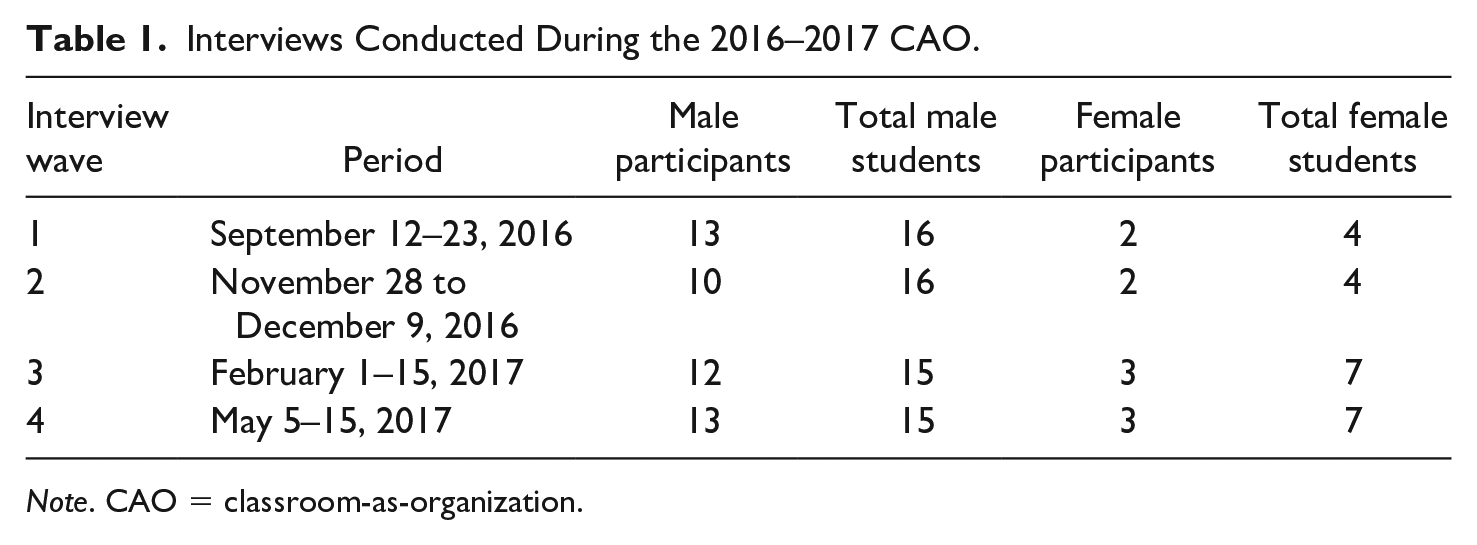
Twenty U.S. born students were part of the class during the fall 2016 semester (16 males, 4 females). Four students dropped the class at the end of the fall semester with six more joining in the spring, bringing the number of students to 22 (7 females, 15 males) in the spring semester.
Data Collection and Analysis
A qualitative methodology is appropriate in answering our research question because it allows researchers to capture the complexity and constructed reality from participants’ perspectives (Schram, 2006). To explore the subjective experience of students throughout the development of a CAO, the second author, who was not connected with the class, conducted semi-structured interviews with students at four different times that were approved by the Institutional Review Board at the University of Massachusetts Amherst. A summary of each of the interview waves is provided in Table 1. The interviews were audio-recorded with the permission of the interviewees. The interviewer used an interview guide that focused on general questions about the experience of the students and group dynamics in the class, such as “What are you working on in the class this semester?” and “How has your group worked together as the semester’s gone along?” The full interview guide is available through the journal’s online platform (See online supplemental material).
Interviews Conducted During the 2016–2017 CAO.
Note. CAO = classroom-as-organization.
The first author conducted the data analysis 2 years after the completion of the course by using McCracken’s (1988) five-step process. Gephart (2004) identified this process as a well-developed method for conducting qualitative analysis on interview data in the management field.
In the first stage of coding, the first author followed the recommendations and examples provided by Saldaña (2015) and used the NVivo 11 Pro software to create descriptive codes. In the second stage, he reread the interviews, reformulating some codes and deleting others that did not appear relevant to answering the research question. At this stage, the first author also coded parts of the text using nodes that represented key concepts in the psychological ownership theory. For example, in the folder containing concepts related to the psychological ownership theory, the first author had a node called “individual control” and a node called “collective control.” While reading the interviews a second time, he coded in those nodes any parts of the text that seemed to relate to those concepts.
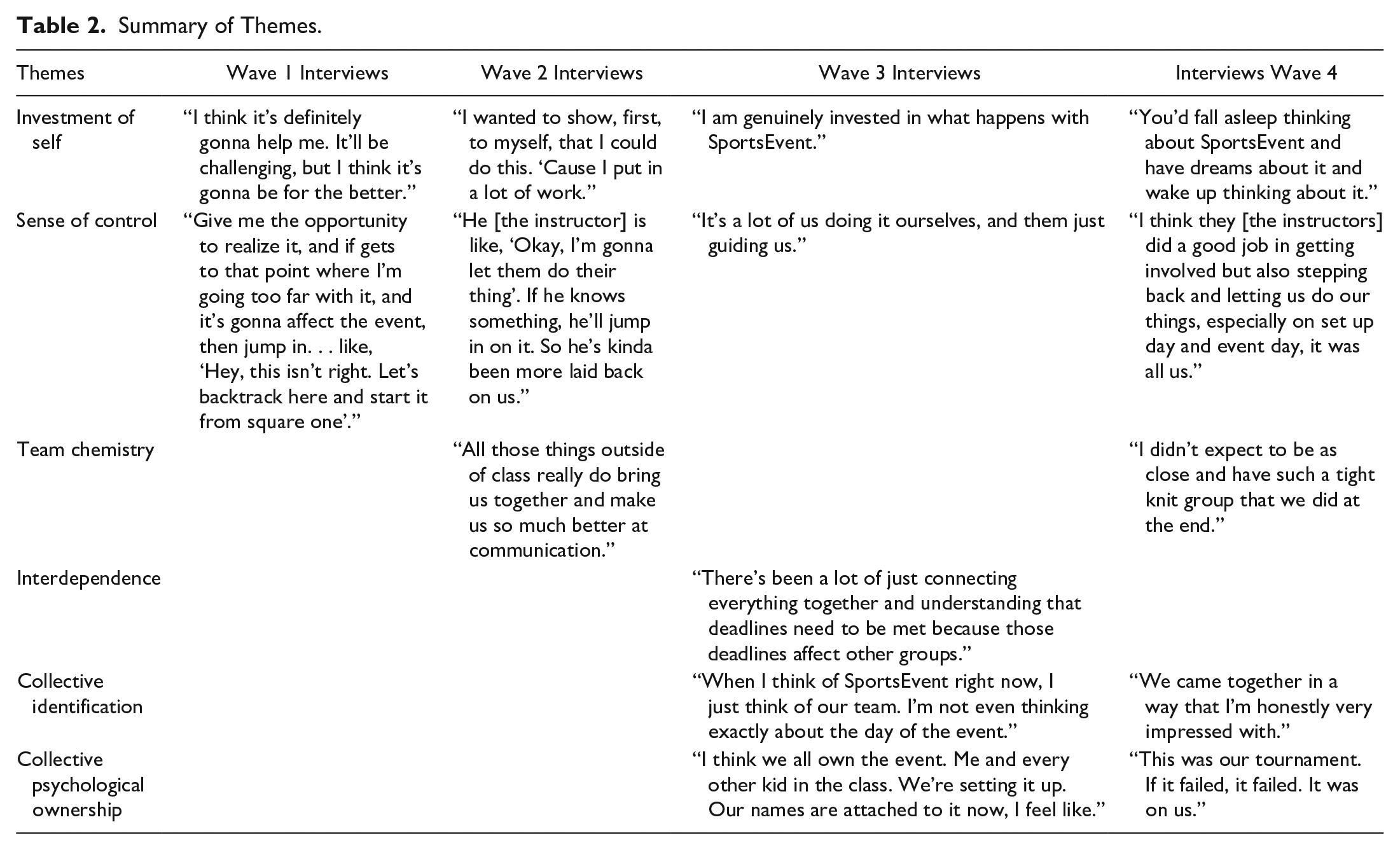
During the third stage, the first author searched for interconnections between the codes and tried to move them toward higher levels of abstraction. For this, he conducted Matrix Coding queries for the nodes associated with psychological ownership, the nodes associated with each question, and the codes created in the second stage. He then organized the nodes based on similarities and organized similar nodes in higher level parent nodes. In the fourth stage, he analyzed the codes collectively and further refined them by considering patterns of consistency and contradiction before deciding, in the fifth stage, which general themes characterized the interviews. The coding process was repeated for each wave of interviews, and the findings are summarized in Table 2. We further present in detail the dimensions associated with each wave of interviews. Pseudonyms were used to hide the identity of individuals mentioned in the findings.
Summary of Themes.
Results
Wave 1 Interviews (Beginning of Fall 2016 Semester)
During the first round of interviews, students indicated that they expected to experience high investment of self and control over class activities, two antecedents to psychological ownership. For example, students most often expressed the expectation that there would be a lot of work in the class. Interestingly, while acknowledging that they would experience high investment of self, students also welcomed this effort and thought it would be beneficial and fun. Dwain explained, “there’s gonna be time dedicated to it, but I’m not gonna be dreading it.”
Another expectation that students had at the beginning of the CAO was that the instructor would increasingly take a step back and give more control to the students. Winford linked his desire to have control of the event to the desire to feel ownership over it: “I want this event to be ours. I think it’s like a 75/25 split. The class should have 75% of the say and the power . . . what we wanna do, we’re gonna do.”
While expressing excitement at the idea of having high control over SportsEvent, students also made clear that they wanted the instructor to intervene whether they were making major mistakes. Talking about what he expected from the instructor, Herschel mentioned the following: If what we’re doing is going to ruin SportsEvent for years to come, I would like him [the instructor] to tell me, “Hey, don’t do that.” But until then, if it hurts a little bit, it would be best if he let us learn from our mistakes.
Wave 2 Interviews (End of Fall 2016 Semester)
At the end of the fall semester, students mentioned that they experienced high investment of self and increasing levels of control, confirming the expectations from the first wave of interviews. Students also reported experiencing increased levels of team chemistry, an antecedent to collective psychological ownership.
To begin with, students acknowledged that the class took more time and effort than they had initially anticipated, requiring a high level of investment of self. While organizing small sport events for local families, students faced unexpected problems related to the unpredictability of weather and the unreliability of outside partners, which required them to put in more time and effort. At the same time, as the class progressed and students started working on their vision of their event in April, students noticed an increase in the level of control they had in the class. It also appeared that the demanding experiences outside of the classroom in the beginning of the semester had a deep impact on the students, leading to team chemistry. Bennet recognized that “those kind of activities make people work together and get to know each other.” Dwain was enthusiastic about this unexpected team chemistry: “I feel like the class, from the last time I saw you [the interviewer], is such a tight-knit group. It’s truly amazing.”
Wave 3 Interviews (Mid-Spring 2017 Semester)
In the interviews conducted during the middle of the spring semester, students continued to mention two key antecedents to psychological ownership: high levels of investment and control over class activities. In addition, students experienced high interdependency and collective identification, two antecedents of collective psychological ownership; they also started openly expressing collective ownership of the event.
As mentioned above, students continued to talk about their high investment in class activities. Bennet mentioned that “I feel like I’m the most invested I’ve been since it started, so it’s a personal project that I’m hoping to play an important role in succeeding.” Another common theme from the previous round of interviews was that students continued to feel a sense of control of the class. Franklin noticed this aspect: “I feel like they’ve stepped back a lot. A lot of the classes are led by us and what we have to do that day, like presentations or updates or whatever it is.”
Students also began viewing their work as highly interdependent on others’ activity in the class. For example, for the marketing department to create flyers promoting the event, they needed information from other departments, including operations, sponsorship, and registrations. The sense of interdependence in the class activities contributed to a sense of collective identification. Aaron mentioned, “We’re so intertwined with one another, we’re working together . . . I would say now, we’re all pretty . . . I would say we’re one class.”
At this point in the spring semester, it also seemed that the collective sense of “us,” the sense of control felt by the students, and the high investment in the class gave rise to a sense of collective ownership over the event. This sense was exemplified in the responses to the question, “who do you think owns SportsEvent?” Caroline answered this way: “As students, we’re the ones that are putting it on. We’re the ones that are doing the heavy lifting. So for ownership purposes, I guess I’d give it to the students.” Some students expressed a belief that their feelings of ownership were linked to the decisions made by the instructors to give more control to the class. Delbert expressed his thoughts about ownership this way: Obviously, they [the instructors] will step in if we aren’t doing the work but all of us are putting in so much work to get this event going and they’re giving us the freedom to do so, so I feel like they’re letting us own the event.
Wave 4 Interviews (May 2017, After the Event)
Interviews conducted immediately following the event allowed us to capture students’ experiences in the weeks leading up to, and on the day of, the event. Students reported again high levels of investment and control and team chemistry, all antecedents to collective psychological ownership. Students also again reported a sense of collective psychological ownership.
Students’ investment of self appeared to peak in the last weeks before the event. With most participant registrations occurring in the final weeks before the event, all departments faced the challenge of finalizing the plans they worked on for months, completing a larger number of tasks, and dealing with inevitable unexpected situations. The last weeks before the event also marked a time when students felt the highest level of control over class activities as the instructors made the conscious decision to not intervene. Delbert mentioned, Especially the two weeks leading up to the event, they [the instructors] were there if we needed them but they didn’t put their nose into any of our business, and they really let us take control of the event, which I thought was awesome.
The intensity of the weeks leading up to the event appeared to contribute to a noticeable level of team chemistry among students. Some said that they had never experienced such bonding before and struggled to find ways to define what they felt, making analogies to the closeness of families or sport teams. Aaron mentioned that “as the class got deeper, I got closer with other people in the department. And yeah, I don’t wanna be corny, but I feel like to some extent it was like a family bond.”
Students also reported feeling a sense of collective ownership of the event. Herschel, for example, acknowledged that the instructor was always there, in the background, ready to step in if needed. However, his words also conveyed a belief that a collective sense of “us,” and a strong feeling of control, led to feelings of ownership over the event: For the most part, it seemed as if we were on our own. And obviously, we knew we weren’t on an island alone, but it definitely felt as if we were. . . This was our tournament. If it failed, it failed. It was on us. It didn’t really seem like [the instructor] was running it. It was that he was just making sure nothing disastrous happened.
Meanwhile, Winford talked about the impact that this sense of ownership had on him: “It’s really cool to just have something that I can reflect upon, and it’s mine. It’s not mine like as in a sole possession, but like, we did that.”
Discussion
The Dynamic Nature of Psychological Ownership and Its Antecedents in the CAO
Our findings suggest that in the context of a CAO the antecedents of psychological ownership have a dynamic evolution and that different factors play a role at different times in the emergence of psychological ownership. In our case, control and personal investment seemed to have an influence on psychological ownership throughout the duration of the project. However, team chemistry was salient at the beginning and end of the CAO, whereas an awareness of the interdependence of tasks was mostly present in the middle of the project. Meanwhile, collective identification seemed to intensify toward the end of the CAO.
In our CAO, the antecedents of psychological ownership interacted with one another, intensifying each other’s impact. This finding confirmed Pierce and colleagues’ (2003) idea that “the process by which psychological ownership emerges is associated with complex interactions among all of the elements of our theory” (p. 95). Having more control gave students a chance to invest more of themselves in the class, whereas interdependent, demanding activities led to the formation of team chemistry, and ultimately a collective sense of identification. The accumulation and interaction of these factors seem to have intensified in the second half of the CAO, which might explain the rise in students’ expressing feelings of ownership during these interviews.
Anticipatory and Persistent Psychological Ownership
Our findings also show that students did not begin working together with a blank slate from which feelings of ownership emerged. Rather, SportsEvent students had a mental image of what their experiences would be. They constructed this mental image based on what they heard about the class from other students, professors, and their own volunteering at the event, all of which formed an expectation that they would have a high level of control in organizing the event. These prior experiences with SportsEvent seem to have led some students to an early desire to control it, with some appearing eager to feel ownership over it.
Students in our sample also did not stop feeling that the event was theirs once it was over. Rather, once the event was over, students likely had more time to reflect and understand the impact of this major challenge that was “theirs” on their self-esteem and confidence. Feelings of psychological ownership during the development of the project (“we feel the event is increasingly ours”) transitioned into a form of persistent psychological ownership (“this event was ours”) that became a prominent part of the story that students told about themselves (“this event was ours, so we can do similar or even more ambitious things in the future”).
Psychological Ownership and Level of Control
As shown in our findings, students’ feelings of ownership emerged despite their understanding that they did not have full control over the class. Furthermore, students in the CAO mentioned repeatedly that they did not want full control and that they still wanted the instructor to step in if they were likely to make a major mistake. The theory of psychological ownership states that control can lead to psychological ownership (Pierce et al., 2001, 2003), but in our CAO’s case it was not clear how much student control was needed for the emergence of psychological ownership. Our findings suggest that educators can reap the benefits of student psychological ownership in CAOs without surrendering total control to students, although educators may struggle to find the right level of control that students need to feel ownership at different times in the evolution of the experiential learning setting.
Future Research
Moving forward, scholars could focus on uncovering when certain antecedents of psychological ownership appear and are more impactful than others in experiential education settings. Scholars could further study the way such antecedents of psychological ownership interact with each other and what effect that has on psychological ownership in classrooms. Researchers could also explore whether anticipatory psychological ownership influences later feelings of ownership experienced by students. Scholars may also seek to identify the level of control at which different people develop psychological ownership and might also look at what happens to psychological ownership and the outcomes associated with it if people perceive they have too much, or too little, control over a project or organization.
Limitations
The context of this study, while appropriate to answer our research question, represents a single iteration of a CAO at a large public university. This and other features of the course, including its two-semester length and the ability of students to add and drop following the first semester, make the context unique. Furthermore, given the interpretivist nature of our analysis, it is likely that some bias affected the analysis despite measures taken to limit it. Researchers could address these limitations by employing multiple case study designs, following classes with which they are not affiliated, and utilizing quantitative methods to test direct relationships between antecedents and outcomes of psychological ownership.
Conclusion
A wealth of scholarship suggests that feelings of ownership are beneficial for students’ development, yet the exploration of the dynamic nature of psychological ownership has been limited in experiential education. We hope to have added to our scholarly understanding of the means by which psychological ownership emerges in experiential classes, particularly CAOs, and thus inspired future researchers to further explore how feelings of ownership evolve and contribute to student development.
Supplemental Material
sj-pdf-1-jee-10.1177_1053825920973704 – Supplemental material for An Exploration of the Dynamic Nature of Psychological Ownership in a Classroom-as-Organization
Supplemental material, sj-pdf-1-jee-10.1177_1053825920973704 for An Exploration of the Dynamic Nature of Psychological Ownership in a Classroom-as-Organization by Ovidiu C. Cocieru, Matthew C. B. Lyle and Mark A. McDonald in Journal of Experiential Education
Footnotes
Declaration of Conflicting Interests
The author(s) declared no potential conflicts of interest with respect to the research, authorship, and/or publication of this article.
Funding
The author(s) received no financial support for the research, authorship, and/or publication of this article.

Supplemental Material
Supplemental material for this article is available online.
Author Biographies
References
Supplementary Material
Please find the following supplemental material available below.
For Open Access articles published under a Creative Commons License, all supplemental material carries the same license as the article it is associated with.
For non-Open Access articles published, all supplemental material carries a non-exclusive license, and permission requests for re-use of supplemental material or any part of supplemental material shall be sent directly to the copyright owner as specified in the copyright notice associated with the article.
