



Abstract
Most management students have had limited exposure to issues concerning organizational structure. This exercise offers a brief in-class experience of the differences of working in a functional structure versus a divisional structure. The instructor guides students to think about certain events, or challenges, confronting their simulated organization. Some of these challenges are best handled by a functional organizational structure, while others are much more taxing if organized that way. Conversely, a divisional organization can produce agile responses to certain initiatives but poses difficulties in coordinating across multiple divisions. Students can begin to sense how structure exerts a major influence on decision making.
Keywords
Most courses in organizational behavior (OB) devote some time to issues of organizational structure. Organizations structured in a functional fashion will face certain advantages and disadvantages, while those organized by divisions, such as by product, geography, or customer group, can experience other advantages and disadvantages. Most undergraduate students, and many graduate students, however, have limited experience in organizations of some complexity, and many have never thought about some key decisions that affect their workplace. Often they are aware only of the existence of a sales group, operations department, and finance function, or that the business is run through several divisions, each dedicated to different product lines or regions. This fact can fade out of awareness, and employees do not often talk about the implications of each structure. While most OB textbooks (e.g., Bauer & Erdogan, 2015; Robbins & Judge, 2012) will discuss issues of structure, including a list of the advantages and disadvantages of each, if a person has never worked in any organization more complex than about 10 people, it is hard to appreciate the virtues and limitations of any structure.
After teaching OB and organization theory for many years, I have been perplexed at the lack of appreciation for the impact of such a crucial management practice as type of structure. Some of our graduates may be joining an entrepreneurial enterprise that has grown beyond the first handful of employees, or working for a more established company with growing pains. Even relatively new professionals should acquire a tangible feel for how structure can offer a powerful boost in performance or inject inevitable frustration. Issues of organizational theory are inherently abstract and concern a higher level of analysis than micro-OB topics. Students are more likely to have experienced first-hand individual or small-group dysfunction, which actually may be caused or aggravated by inappropriate organizational design. A basic understanding of organizational design by graduates working in small entrepreneurial enterprises can equip them to be part of the conversation and decision making, improving the organization’s structure. A student who has merely listened to a lecture with just a list of bullet points will hardly be prepared to contribute in this way. Therefore, I have devised this rather simple 45-minute classroom exercise to allow students to “live” in two types of structures for a short time and experience some of the advantages and disadvantages of each.
Learning Objectives
At the conclusion of the activity, the learner will have
Gotten acquainted with advantages and disadvantages of functional and divisional forms of organizing
Increased his or her awareness of the critical need for communication among groups in a multifaceted organization
Increased his or her sense of the need for horizontal linking processes
Acquired an awareness of the sense of interpersonal affinity possible within one’s own work group and the resulting barriers between different groups, along with the possible consequences for performance
Conduct of the Exercise
The exercise centers on two rounds of activities, the first conducted by groups in a functional structure. The second round proceeds after reorganizing participants into groups in a divisional structure. The debriefing follows with all learners back together.
The instructor may have mentioned the issue of functional structure compared with divisional structures, but I suggest one can begin with a minimal prelude to the exercise, allowing inductive learning to occur without a formal didactic section to color the experience. I am assuming a class size of 15 to 30; suggestions for larger classes are given below.
Initial Instructions to the Class
Count off by 4s. [Urge them to remember their number. If desired, you can invent a fifth function.]
Now also count off A, B, C, D, and E in the same fashion. Keep your letter in mind for later.
Congratulations! You are now all employees of Fabulous Sports Enterprises [or any made-up name]. We offer customers five different lines of products: sneakers, exercise apparel, baseball gear, weight training equipment, and golf equipment. [This list may be written on the board.] Depending on your number, 1 through 4, your functional expertise is as follows [This list may also be written on the board.]: Accounting Human resources (HR) Sales and marketing Operations
Let’s have everyone with #1, Accounting, stand in this corner of the room. #2, HR, in that corner [and so on].
[Then ask the whole class:] How would you describe the way we are now organized? [Cue them for the answer, Functional.] What does that really mean? Why is that a useful way to organize? [Answer: People in the same function can easily confer with each other, understand each other, perhaps develop more functional expertise, etc.]
I recommend there be some physical space between the groups, so as to suggest actual distance in the work world. Thus, have perhaps only two or three teams stay in the classroom in opposite corners, and now ask one or two to locate themselves out in the hallway some distance from each other. Announce:
Please select one of your members to be the head of the group for now. I am the CEO, and I’m going to come around and announce certain “events” or challenges for the company. In your group discuss whether in the current way of organizing this challenge tends to be rather Easy or Difficult. Everyone should take a copy of the Personal Worksheet I’m distributing (Appendix A).
Round 1 (Functional)
Once people are in their assigned places, walk to each group and hand the group leader a small strip of paper indicating Event 1, the first segment cut out of the List of Events (Appendix B). Explain:
Your group is to discuss whether for the overall company, because of the way it is currently organized, this first challenge is relatively Easy (E) or Difficult (D). Mark E or D on your Worksheet next to Event 1, and add a few words about why you think that.
Visit every group and repeat the same instructions. Since the discussion is simple and quick, as soon as you approach the last group, you can go directly back to the first group and give them another small strip with Event 2 on it. They should repeat the processes of discussing and marking their sheets.
Repeat for Event 3.
Round 2 (Divisional)
When every group has agreed on their response to Event 3, announce:
Everyone should return to the classroom. [When all are within earshot:] THIS JUST IN: The CEO has decided to do a major corporate restructuring. From now on you will be organized according to product divisions. Remember your letter, A through E? I’m going to ask you to get in groups with these responsibilities: A. Sneaker division B. Exercise apparel division C. Baseball gear division D. Weight training division E. Golf equipment division
Assume that each division will contain at least one Accountant, at least one HR specialist, one Sales and Marketing rep, and one Operations person. [Depending on the size of the class, the second counting off might not provide an exact breakdown of the functional specialists from the first round.] Please go to your divisions now and await further challenges [directing them to corners of the room or locations out in the hallway].
Go to one group and give them Event 4, to be judged either Easy or Difficult, with discussion as to why. Continue to all the other product groups in turn, repeating these steps for Events 4, 5, and 6.
Debriefing and Discussion
When all six events have been discussed, ask the students to return to the classroom. They can be asked to remain standing or sit down in their product groups to continue the feeling of affinity with the latest group.
Pass out to each person a copy of the List of Events (Appendix B). Having this list will facilitate the debriefing discussion, as well as provide a takeaway for later review and study.
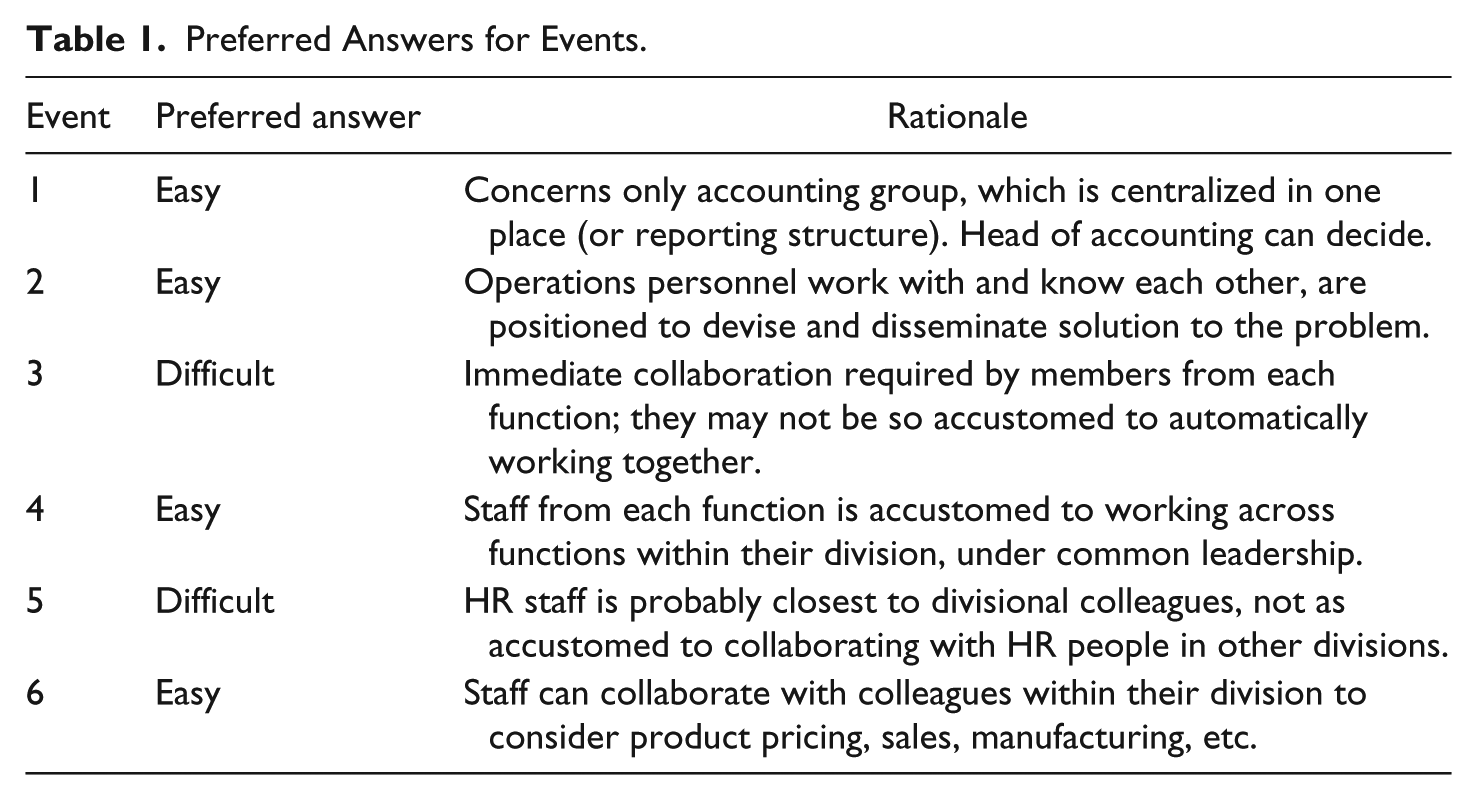
Conduct a discussion on how they rated each event. Table 1 provides suggested answers and the rationale for each.
Then debrief overall issues. Remind them that organizational groupings can have a big effect on both hard-edged business issues as well as interpersonal relations within and across groups. You can make the following points:
Pride in one’s division. A divisional setup can strongly suggest the feeling of “running your own business,” which can engender pride in the division—which may be a product line we set up, or a particular geographic region. That can inspire hard work, persistence, and “ownership” on behalf of one’s division.
Divisional rivalry. Note that this same pride in one division may give rise to rivalry between divisions (We’re the best division! Let’s hear it for the Golf Division!), which could detract from people’s interest in the OVERALL company. Is it possible that one group is pleased with record performance in its division, but at the same time, the whole company is losing its shirt?
Parochial functional views. Notice also that with the functional organization, rivalry, or at least a narrow view, could play out. For example, the operations people may be proud of having driven down unit cost of the product by 15% last year, but gross profit still dropped 50%.
Social affinity of a group. Notice that if all the accounting (or HR or sales or operations) people are grouped together, those are the people most likely to go out to lunch together or get together for drinks after work. They are probably buddies, which can really help get work done together within their group. It would not be the same if accountants were assigned to work groups associating daily with people from Operations, Sales and Marketing, and HR. A different kind of affinity is likely to emerge, for better or worse.
Potential lecture points. Continue the discussion as desired. Appendix C provides a list of the classic advantages of functional and divisional formats. Remind students that divisional organizations may be oriented around different geographic regions, rather than product-based divisions.
Linking mechanisms. The experience can also lead into the importance of linking mechanisms. Students are usually more familiar with vertical linkages, since those are explicit in the classic organization chart. Here we can emphasize those less obvious, horizontal linkages, as students can consider what kind of coordinating mechanisms would be needed for functional groups to work together. These coordinating mechanisms may entail simply walking to another office for face-to-face conversations, electronic systems, or routine voice or video conferences. How do functional specialists cross functional lines to devise a children’s line of products, involving marketing, operations, and HR? How do divisional personnel coordinate across divisions regarding changes in labor laws affecting the whole company?
Size requiring division. Instructors can make the point that functional organizations eventually may have to turn toward some version of a divisional structure if they grow and contain several and diverse products, lines of business, or regions. Students should know that the functional/divisional description essentially pertains to the “first cut” below the topmost executive. In fact, within each division, there may be breakdowns of subgroups into a functional focus, unless that level, too, is divisional.
Matrix structure. This exercise can lead into a discussion about the matrix form of organizing. While full-fledged matrix forms are relatively rare today, students should know that modified versions exist when divisional forms retain the vestige of Functional units, such as “shared services” with corporate-wide oversight of various divisions’ legal, HR, public relations, finance, IT, or other specialties. One diagnostic of meaningful structure is, “Who signs off on my performance appraisal?” If the corporate-level accounting staff signs off on the division head’s assessments of accountants, then there can be considered at least a “dotted line” connection to the division personnel, indicating a partial matrix concept. In any case, understanding the essence of functional and divisional forms through this simplified simulation is important, while a blending in medium- and large-scale enterprises is extremely common.
Considerations about reorganizing. The instructor should also point out that reorganizing an enterprise can be a highly complicated undertaking, and it does not happen often in actual practice. It is usually prompted by an ongoing pattern of problems. For example, management may detect that customer service under a functional form is not customized enough for varied product lines. Regional differences may create a need for customization in sales and marketing, product development, or production, which, in turn, calls for geographic divisions. The demands for increased technical expertise might suggest that law or finance would best be centralized in a partial matrix functional fashion, pulling those experts out of existing divisions. Such partial adjustments may indeed be made while retaining an overall divisional approach.
Preferred Answers for Events.
Preparation, Timing, and Adjustments for Larger Classes
One of the attractive features of this exercise is its minimal preparation. The instructor can simply print a copy of the Personal Worksheet (Appendix A) for each student and one copy of Appendix B, the List of Events (perhaps changed with different or better events) for use during the debrief. Additional copies of the List of Events can be printed and cut in strips so that each event can be given out, one per group.
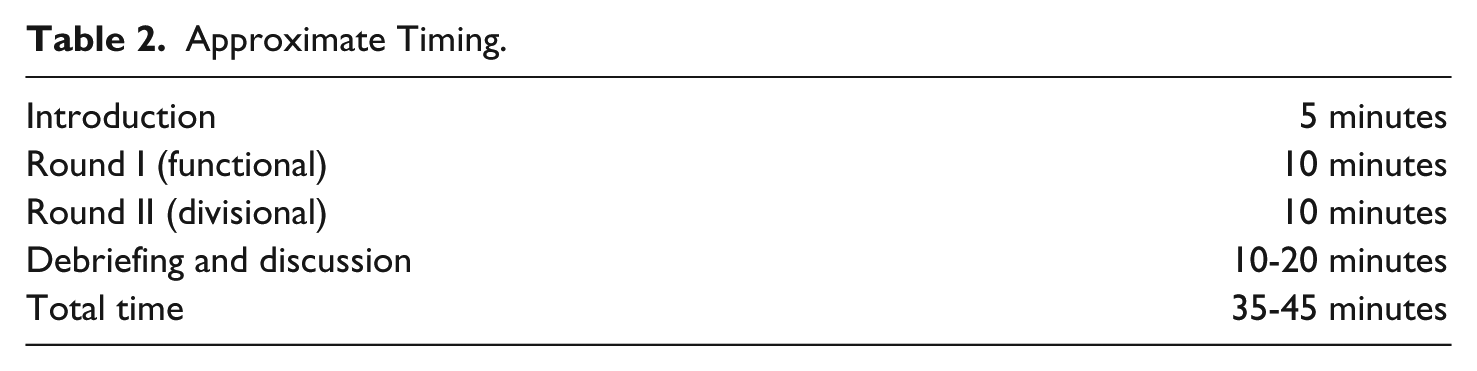
Another advantage is that the exercise can be completed in 45 minutes. Table 2 lists approximate timings for each phase of the exercise.
Approximate Timing.
A third advantage of the exercise is its scalability. The exercise is ideal for classes with 15 to 30 students, but larger classes can be accommodated with adjustments. For example, if a larger class called for more explicit logistics, indicators such as sticky colored dots to be put on one’s shirt could be prepared to indicate a different function and given out randomly to each person.
A larger class might also be handled by inventing a few more functions and divisions, while maintaining the same sequence of events. A much larger class of, say, over 50 students might require utilizing teaching assistants to conduct the same actions with two or more separate “enterprises” running in parallel in a larger space or different classrooms. Simple counting off in class could still be used to arrange one of the groupings (e.g., which division). If time permitted, as in an organization theory course, a more in-depth simulation could be structured to allow time for the leader of individual functional groups to visit other groups or for functional specialists to visit their counterparts in other divisions to “negotiate” how to solve the presenting problem. Events could be enlarged to require more challenge for that stage.
Conclusion
This exercise has proved to be a rather quick and simple way of acquainting students with the dynamics of two forms of organizing: functional and divisional structures. It may add to the typical OB class, where organizational structure is but one of many topics to be covered or it can be used to enrich a course on organizational theory. The exercise exposes students to a subject that too often seems opaque and enables them to experience some of the benefits and limitations of each organizational form.
Footnotes
Appendix A
Appendix B
Appendix C
Declaration of Conflicting Interests
The author declared no potential conflicts of interest with respect to the research, authorship, and/or publication of this article.
Funding
The author received no financial support for the research, authorship, and/or publication of this article.
References
Supplementary Material
Please find the following supplemental material available below.
For Open Access articles published under a Creative Commons License, all supplemental material carries the same license as the article it is associated with.
For non-Open Access articles published, all supplemental material carries a non-exclusive license, and permission requests for re-use of supplemental material or any part of supplemental material shall be sent directly to the copyright owner as specified in the copyright notice associated with the article.
