



Abstract
The purpose of this study is to explore the behavior and lifestyle of individuals in response to the coronavirus that the safety behavior of people in the coronavirus disease of 2019 pandemic. Hence, the study integrates the theory of planned behavior and the health belief model to understand the behavioral change in response to the coronavirus pandemic. The current study is qualitative therefore, a survey-based online questionnaire was used for data collection from university students and staff (faculty and nonfaculty) residing in top-tier cities of Pakistan, nonprobability convenient sampling was used to approach the audience. A two-stage approach was used to test the model using partial least square (variance-based structural equation modeling). The reliability and validity of the measurement model indicate that the data is reliable and valid. Outcomes prove all the relationships as proposed by the study, except for the impact of perceived barriers on intention and individual safety behavior. Perceived barriers act as obstacles that abstain individuals from following the standard operating procedures. The research agenda provides new insights into the fields of marketing, health care, consumer behavior, and behavioral studies. It contributes to the existing literature in the field of social marketing by studying the behavior and changes in the behavior of people in the global pandemic.
Keywords
Introduction
Primarily, the study focuses on safety behavior to study the change in behavior of people during the coronavirus disease of 2019 (COVID-19) pandemic. Complying with social marketing the study is based upon the integration of theory of planned behavior (TPB) (Ajzen, 1991) and health belief model (HBM) (Hochbaum et al., 1952) to understand the intention toward safety behavior and individuals’ safety behavior in the most widespread issue of coronavirus. Social marketing refers to an approach that helps to organize activities aimed to change or maintain an individual's behavior or behavior in society. The TPB is extensively used in the stream of social marketing. Whereas, HBM aims to identify the behavior of individuals that depends upon perceived threat, cost and benefit appraisal, self-efficacy, and cues to action (Glanz et al., 2008). The pandemic impacted different economies in different ways, every economy is struggling to contain the virus and avoid economic collapse. Different studies confirm that there is a dire need to control the virus through quarantine, social distancing, and personal hygiene, but the gap lies in the behavioral aspect (Khan & Ghauri, 2020; Awan & Aslam, 2020; Khan et al., 2020; Qazi et al., 2020). Previously conducted studies concluded that a positive relationship exists between the variables of TPB, that is, subjective norms, attitude and perceived behavioral control (PBC), and intention toward safety behavior (Ajzen, 1991; Ajzen & Madden, 1986; Akbari et al., 2019; McBride et al., 2020; Roos & Hahn, 2019). Former researches based upon HBM identified the importance of variables including susceptibility, severity, benefits, barriers, self-efficacy, and cues to action in predicting the behaviors of individuals (Hochbaum et al., 1952; Janz & Becker, 1984; Jones et al., 2015; Mukhtar, 2020a; Sheppard & Thomas, 2020; Wang et al., 2019b).
The pandemic also affected the mental and emotional wellbeing of the Pakistani public, either direct or indirect impact of the COVID-19 pandemic has increased tension, anxiety, and concerns (Rana et al., 2020). Empirical findings of different studies conducted in Pakistan show that the salient features of the outbreak have provoked health risks and perceived threats (Aslam et al., 2021; Hayat et al., 2021; Imran et al., 2020; Rana et al., 2020; Sipra et al., 2021). Mukhtar (2020b) added that issues related to “psychological distress, mental health issues, grief, shame, helplessness, hopelessness, posttraumatic symptoms, substance abuse, panic attacks, stress, anxiety, depression, loneliness, ambivalence, fear, anger, stigma and worry toward socioeconomic status” are prevailing in the society due to the global pandemic. Recent studies emphasized that policy makers and government should act upon implementation of stress mitigation and motivational programs to prevent people from the upsetting mental side effects of COVID-19 (Aslam et al., 2020; Riaz et al., 2021). Therefore, the current study is designed to study the behavior and intentions toward safety behavior that can be useful in self-motivation and can mitigate the negative psychological effects.
This research aims to study an individual's safety behavior and intentions to adopt precautionary behaviors as identified by World Health Organization (WHO, 2020). It incorporates TBP (Terry & O’Leary, 1995) and HBM (Hochbaum et al., 1952) to identify the motivators and triggers that can activate safety behavior. It employs an integrated model to highlight social marketing efforts by understanding behaviors. These factors include the predicting variables TPB including subjective norm, attitude, and PBC. It further adds up behavioral predictors of the HBM that encapsulates perceived threat appraisal, cost, and benefit appraisal, cues to action, and perceived self-efficacy. Hypotheses are based upon the association between predicting variables and individuals’ safety behavior with the mediation of intention toward safety behavior. This study would be very useful as it aims to fill the gap by identifying the safety behaviors of individuals in the time of the global pandemic. The study of an individual's behavior is the need of time; therefore, a combined model comprising of TPB and HBM is developed to understand the safety behavior in depth. The TPB further needs to be studied in the context of COVID-19, this study applies the integrated model to identify the intention toward safety behavior and individuals’ safety behavior.
Literature Review and Hypothesis Development
Subjective Norm and Intention Toward Safety Behavior
The TPB presumes that subjective norm is associated with behavioral intention. Different studies were conducted recently that hypothesized the link between subjective norm and intention toward behavior in line with TPB. These studies were conducted in contexts of students' behavior in information security (Yoon et al., 2019), HIV and AIDS prevention (Andrew et al., 2016; Siuki et al., 2019), etc. Extant literature shows that there exists a positive relationship between subjective norm and behavioral intentions. Therefore, this study tests the relationship concerning pandemics.
Attitude and Intention Toward Safety Behavior
Intention toward performing a behavior is based upon the attitudes of people. Attitudes may vary due to cultural differences (Rahman et al., 2015). Attitude laterally with subjective norms and PBC is an antecedent of intention toward behavior that is postulated by TPB. Conferring with the theory attitude is a powerful predictor of intention toward behavior (Akbari et al., 2019; Guerin & Toland, 2020; Rowe et al., 2016). The attitude of people toward safety behavior to prevent coronavirus is not yet studied.
PBC and Intention Toward Safety Behavior
The TBP provides robust models to explain human behavior. It assumes that perceived behavior control provokes the intention toward the behavior. It was added to comprehend the understanding of the previously developed theory of reasoned action because it is a very noteworthy predictor of intention. Extant literature infers that there exists a positive relation between PBC and intention toward safety behavior (Sultan et al., 2020; Sun et al., 2020; Ting et al., 2016). To study the volitional control toward intention toward safety behavior, we intend to test the following hypothesis.
Perceived Susceptibility and Intention Toward Safety Behavior
The subjective perception of individuals that they are prone to be affected by the adverse effects of any health issue is perceived susceptibility (Janz & Becker, 1984). This perception motivates them to follow preventive and precautionary measures, hence it activates the intention toward safety behavior. Studies grounded on Protection Motivation Theory (Rogers & Prentice-Dunn, 1997) extensively support this association (Choi et al., 2019). Therefore, the following hypothesis is developed.
Perceived Severity and Intention Toward Safety Behavior
Protection motivation theory (Rogers & Prentice-Dunn, 1997) incorporates threat appraisal that is based upon perceived severity and perceived vulnerability as predictors of intentions toward behavior (Hassandoust & Techatassanasoontorn, 2020; Huang et al., 2020; Choi et al., 2019). The risk perception creates hype to perform safety behavior such as vaccination and proper hand hygiene (Gaube et al., 2019). To study the threat appraisal and intention toward safety behavior we formulate the following hypothesis.
Perceived Benefits and Intention Toward Safety Behavior
Perceived benefits associated with intention toward safety behavior in the pandemic of COVID-19 refers to benefits that can be enjoyed by observing social distancing and following the precautionary guidelines by government and medical service providers. Extant literature proves the positive linkage (Choi et al., 2013; Liaw, 2008). Different studies were conducted in different contexts like breast cancer screening (Wang et al., 2019a), prevention of exercise-related injury (Gabriel et al., 2019), waste management (Mak et al., 2019), and various more, extended TPB by adding perceived benefits and other predicting variables.
Perceived Barriers and Intention Toward Safety Behavior
In line with perceived benefits, perceived barriers are also studied to collectively analyze the costs and benefits of performing or abstaining from a behavior. Perceived barriers were tested to be strong interpreters of health behavior (Jones et al., 2015). Other studies identified the intensity of barriers in intention toward breast screening (Wang et al., 2019a). In the COVID-19 pandemic, there are obstacles toward social distancing and quarantine that need to be highlighted.
Perceived Self-Efficacy and Individual's Safety Behavior
Health belief theories including the HBM (Hochbaum et al., 1952), presumes that an individual's safety behavior is positively influenced by perceived self-efficacy. often confused with PBC, but the present study undertakes that PBC is different from perceived self-efficacy as supported by literature (Parkinson et al., 2017; Tavousi et al., 2009; Terry & O’Leary, 1995). Extant literature supports this significant relationship (Mukhtar, 2020a; Tweneboah-Koduah, 2018; Zhang et al., 2017), therefore, the study hypothesizes the direct relationship between perceived self-efficacy and the individual's safety behavior.
Cues to Action and Individual's Safety Behavior
The triggers to act are referred to as cues to action that motivates individual to seek safety. The outcomes of cues to action are health-related behavior which supports the direct link between constructs. A range of studies conducted in different contexts such as safe driving behavior, seafarers safety behavior, breast cancer screening behavior, pesticides risks, etc. supports this relationship (Razmara et al., 2018; Tweneboah-Koduah, 2018; Yuen et al., 2020). The current study would try to investigate the cues to action in seeking individual's safety behavior in the global COVD-19 pandemic, therefore, we construed the following hypothesis.
Intention Toward Safety Behavior and Individual's Safety Behavior
Intention refers to the ability and readiness to adapt to new lifestyles or behavioral changes, the intention toward safety behavior identifies the individual's safety behavior (Bashir et al., 2019). TPB and TRA imply the relationship between behavioral intention and actual intention. Studies conducted on different topics found out the intentions impact the actual behavior of people (Cooke et al., 2016; Giampietri et al., 2018; Hegner et al., 2017; Jin et al., 2011; Kam et al., 2018). We also propose that intention toward safety behavior significantly influences the individual's safety behavior.
Subjective Norm and Individual's Safety Behavior
Since 1985 TPB is one of the commonly employed theories to understand behaviors and behavioral intention. Effectiveness and robustness increase the objectivity of the model. Originally the TPB and TRA incorporated intention to predict the actual behavior as a potential mediator. A wide range of studies concluded that intention toward behavior is a powerful mediator between subjective norm, attitude, perceived behavior control, and behavior (Ho et al., 2017; Obaidellah et al., 2019; Spence et al., 2018). It is equally important to change intention toward behavior to control the actual behavior (Hardeman et al., 2002).
Attitude and Individual's Safety Behavior
Referring to both TRA and TPB, attitude is assumed to have an indirect relationship with behavior, being intention toward behavior the potential mediator. When an individual is willing to adapt to new behavior or is ready to change his/her behavior then it automatically changes the attitude which helps in behavioral change. Complying with both the theories we also argue that intention toward safety behavior mediates the connection between attitude and individual safety behavior in the global pandemic of COVID-19.
PBC and Individual's Safety Behavior
PBC is the ability to regulate a person's behavior or to perform in a certain manner. This variable was lately added to the theory of reasoned action forming the “Theory of Planned Behavior.” According to theory, PBC is a powerful predictor of behavioral intention. (Ajzen, 2011) added that the PBC is strongly associated with intention as compared to the behavior, so we can measure the mediating role of intention toward safety. Therefore, we hypothesize that there is an indirect connection between PCB and actual safety behavior that is mediated by intentions toward safety behavior.
Perceived Susceptibility and Individual's Safety Behavior
Integration between the “Theory of Planned Behavior and Health Belief Model” added intention as a mediating variable between perceived susceptibility and an individual's safety behavior (Quine et al., 1998). Perceived susceptibility is directly related to intention toward safety behavior as supported by studies conducted in past to study behavioral intention toward human papillomavirus and its vaccination (Di Giuseppe et al., 2008; Ng et al., 2017).
Perceived Severity and Individual's Safety Behavior
We added intention as a mediating variable between perceived susceptibility and an individual's safety behavior to extend the TPB. Quine et al. (1998) identified that perceived severity has a strong linkage with intention rather than actual behavior. therefore, we believe that perceived threat (perceived susceptibility + perceived severity) is directly related to intention toward safety behavior as supported by studies conducted in past to study behavioral intention toward human papillomavirus and vaccination and forensic accounting services (Di Giuseppe et al., 2008; Ng et al., 2017). We consider intention as a strong mediator between the indirect linkage of the predicting variable and outcome behavior.
Perceived Benefits and Individual's Safety Behavior
According to the TPB “Intention” toward safety, behavior enables people to change their behaviors, the benefits associated with staying safe from coronavirus by adopting the new lifestyle by observing social distance, self-quarantine, and personal hygiene are indirectly related to actual behavioral change (Sheppard & Thomas, 2020). Previously conducted research shows that the cost–benefit appraisal provides a relevant path toward action (Quine et al., 1998). We assume that it is directly related to intention and indirectly connected to a person's safety behavior, therefore, we formulate the following hypothesis.
Perceived Barriers and Individual's Safety Behavior
Perceived barriers along with perceived cost are referred to as the cost–benefits appraisal in HBM, through the integration of the TPB (Ajzen, 1991, 2011; Ajzen & Driver, 1991) and the HBM (Champion & Skinner, 2008; Hochbaum et al., 1952) we added intention toward safety behavior as the mediating variable. The study intends to check how the change in intention would influence the actual behavior, therefore, we would measure the relationship through the following hypothesis.
Theoretical Framework
The theoretical framework of the research is predominately based upon the integration of the TPB and HBM. Figure 1 illustrates the model that will be tested in the research, clearly depicting the constructs, hypotheses, and theories.

Theoretical framework.
Methods
The research followed the descriptive research strategy to conduct quantitative research, the deductive approach was used to deduce and interpret the results. Complying with the purpose of the study the research is cross-sectional as it relies upon the collection of data in a specified time. The data was gathered from few of the universities located in the twin cities of Islamabad and Rawalpindi namely COMSATS University Islamabad, Iqra University – Islamabad Campus, Bahria University – Islamabad Campus, International Islamic University, National University of Science and Technology, and Foundation University Rawalpindi. The current study focused on primary data that was collected from university students and staff (faculty and nonfaculty), who are bound to adopt safety behavior due to a novel coronavirus pandemic. Data was collected through the survey method, the questionnaire was divided into two parts consisting of demographic details and secondly, variables related questions.
Measurement and Scales
The study used a survey questionnaire to collect data to study the validity and reliability of the integrated measurement model. The respondents were provided with a 5-point Likert scale starting from strongly disagree to strongly agree. The measurement items were derived from previously conducted studies as illustrated in Table 1. The scales for subjective norms, attitude, PCB, and behavior were taken from Kim & Han, 2010. The measurement items for perceived severity, susceptibility, cues to action, and perceived benefits were derived from Tweneboah-Koduah, 2018. The items for perceived barriers and perceived self-efficacy were adopted from the study of Yazdanpanah et al., 2015, whereas Lu et al., 2016 study was used to adopt the items for intention toward safety behavior. All the scales had well-established reliability and validity, hence were used for the current study.
Measurement and Scales.

Data Collection and Analysis
The data was collected through an online questionnaire that was divided into two parts comprising of the measurement scale followed by section 2 that was based on demographic information about the respondent. Around 750 questionnaires were distributed, but 580 questionnaires were filled out among which 20 outliers were eliminated. Responses were marked over the 5-point Likert scale to show the agreeableness of respondents with the statement starting from strongly disagree to strongly agree. The data was collected over a six-months’ period starting mid of August 2020 and ended in mid of January 2020. In Pakistan, the cases reported at the start (mid-August 2020) were ∼1,304 confirmed cases per million, that is, 288,047, whereas the death toll was 27.90 confirmed deaths per million, that is, 6,162. At the end of data collection period the spread of virus again boosted to 2,350 confirmed cases per million, that is, 519,291 total cases (mid-January 2020) with a total number of causalities of 10,951, that is, 49.58 confirmed deaths per million (Government of Pakistan-Stats, 2021).
After the data collection, missing values were treated through mean values, and data were transformed accordingly through reviewing, cleansing, encoding, and modeling data to discover useful information, informing conclusions, and supporting the decision-making process. A partial least square (PLS) (Hair et al., 2016) was employed to predict the behavioral outcomes. Variance-based structural equation modeling was used to test the model using PLS (SEM-VB) (Hair et al., 2014). The validity of the theoretical model and measurement model was assessed.
Ethical Consideration
This study consists of an analysis of data that is authentic and reliable, as original data was collected from universities of Pakistan. The respondents comprise of the university staff and students through online platforms and the record for every response is recorded, therefore there is no manipulation of data. The data is neither overstated nor understated. There was no exaggeration or overestimation of values; the results of different studies are also discussed. The authors are privileged with full credit of ownership, their ideas and concepts are mentioned with referring their names. The data was analyzed quantitatively, fairly and the results were presented without any inclination.
Results and Hypotheses Testing
Demographic Sample Characteristics
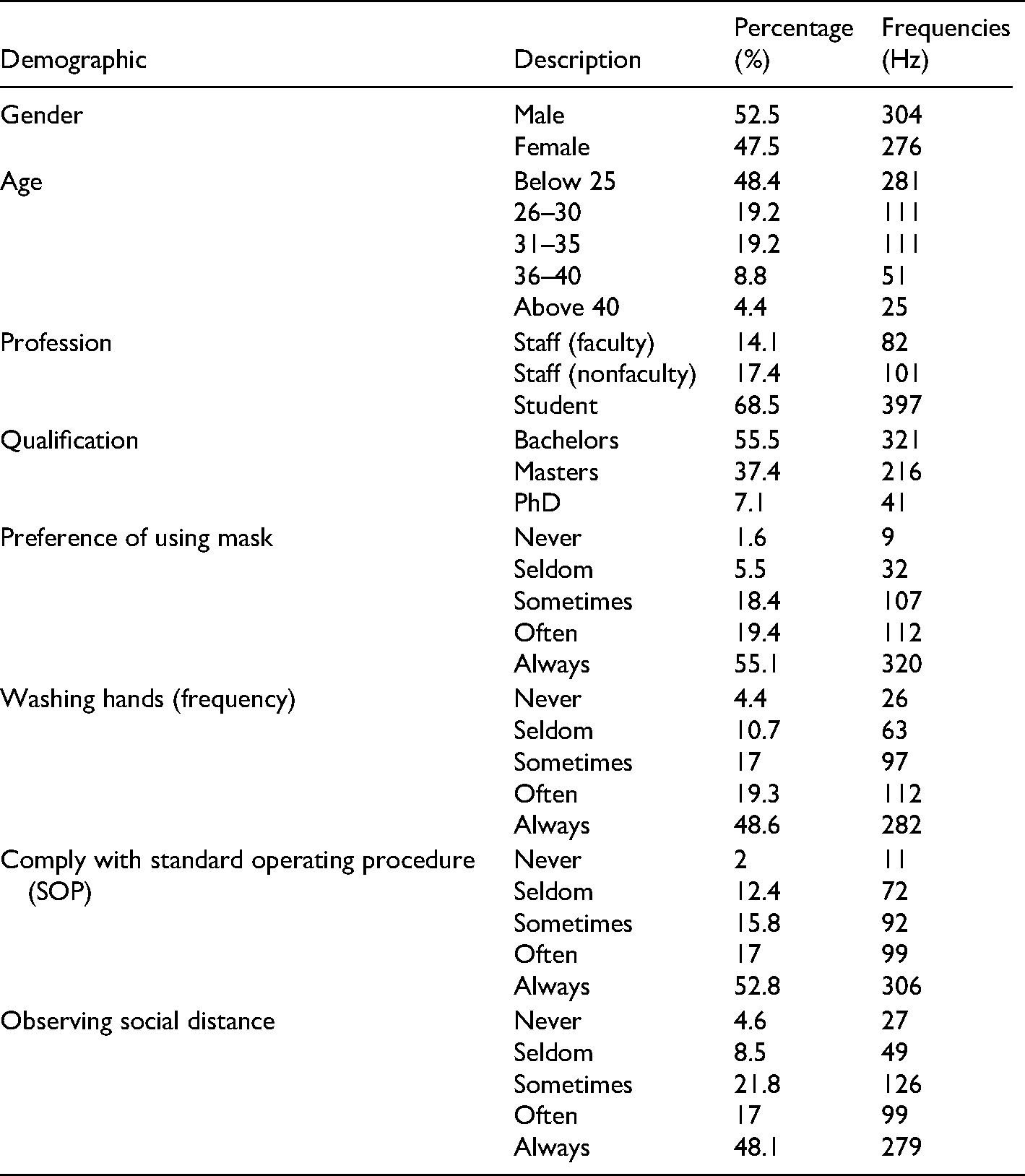
The questionnaire comprised of two parts where section no 2 was based upon the demographic characteristics of the respondents. The questions in this part gather data about age, gender, qualification, profession, and checklist about the COVID-19 prevention safety measures. The results showed that there was a total of 304 males that contributes to 52.5% of the sample, whereas females contributed to 47.5% that composed of 276. Likewise, the respondents were divided on age differences, the data contributed to a higher number of people below the age of 25 years that comprised 48.4% with a frequency of 281. Secondly, the population was composed of 19.2% of respondents who were between 26–30 and 31–35 years. Thirdly, 4.4% of people were above 40 years that comprised 25 people. Finally, 8.8% of people were among 36–40 years that constitute 51 people. The highest percentage of respondents composed of students, that is, 55.5%, staff (faculty), that is, 14.1%, and nonfaculty, that is, 17.4%. The checklist of observing preventive measures in times of global pandemic of COVID-19 comprised of the preference of wearing a face mask when going out, sanitizing hands frequently, complying with the standard operating procedures (SOPs) of COVID-19 pandemic. The details mentioned above are summarized in Table 2.
Demographic Characteristics.
Measurement Model Assessment
The validity and reliability of the model were assessed through measurement model, PLS (SEM) allows to test the measurement and structural model. Confirmatory factor analysis (CFA) was applied to assess the measurement model that checks the reliability and validity of results through different statistical approaches that include composite reliability, Cronbach's alpha, Rho, and average variance extracted and factor loadings (Hair et al., 2016). The constructs' validity and reliability including both convergent validity and discriminate validity were tested through the measurement model in Smart PLS 3.0. Path coefficients (beta values) were also tested in the measurement model that measures the type of relationship between predictor and outcome variable. The convergent validity was tested through the average variance extracted value whereas to measure the discriminant validity HTMT ratio, that is, hetero-trait mono-trait ratio was applied. Tests for convergent and discriminant validity shows that the data reaches all the required threshold as illustrated in Tables 3 and 4.
Construct Reliability and Validity.

Discriminant Validity (Hetero-Trait Mono-Trait [HTMT] Ratios).

Structural Model Assessment
After the satisfactory assessment of the measurement model, the next step in PLS-SEM is to evaluate the structural model. It measures the impact and relationship between the constructs, that is, the intensity and type of relationship that assists in decision making about hypothesis acceptance. Bootstrapping technique with 5,000 resamples was applied to assess the structural model through smart PLS 3.0 (Hair et al., 2016) (Table 5).
Coefficient of Determination (R2).

The coefficient of determination was tested through R2, acceptance criteria for R2 value nearer to 1, values near to 0 indicate weaker effect size (Hensler et al., 2009). The results attained in the study show that the R2 value for intention is 0.646 and for safety behavior is 0.750, it clearly shows that acceptance criteria for R2 are met. The values are shown in Table 6.
Hypotheses Testing (Direct Effects).

Hypotheses Testing
A total of 17 hypotheses were proposed in the study, amongst which 10 hypotheses were based upon the direct relationship between independent and dependent variables. Mediation hypotheses were also proposed in the current study of understanding the safety behavior of people in the global COVID-19 pandemic. Hypothesis 1 proposed that subjective norm is directly and significantly related to intention toward safety, results show that Hypothesis 1 is acceptable (β = 0.160, t = 2.564, p = .010). Hypothesis 2 designated the positive relationship between attitude and intention toward safety behavior, the results supported H2 with (β = 293, t = 6.192, p = .000). Hypothesis 3 was also supported as the outcomes indicated that there exists a significant positive association between perceived behavior control and intention toward safety behavior (β = 0.248, t = 4.748, p = .000). Perceived susceptibility was proposed to have a positive impact on intention and the results supported H4, with all values under the acceptable ranges (β = 0.077, t = 2.710, p = .007). Perceived severity and intention toward safety were found to be positively correlated (β = 0.115, t = 2.546, p = .011). Parallel with former studies the current study approves a positive significant relationship among perceived benefits and intentions (β = 0.102, t =t = 2.145, p = .032). Opposingly, Hypothesis 7 was rejected because the results indicate that there exists a negative insignificant relationship between perceived barriers and intentions as (β = − 0.015, t = 0.607, p = .544). Perceived self-efficacy, cues to action, and intention toward safety behavior were tested indirect relationship with the actual safety behavior to avoid catching the COVID-19 virus. The results authorize that there occurs to be positive significant linkage, therefore, H8 (β = 0.152, t = 4.625, p = .000), H9 (β = 0.131, t = 3.538, p = .000), and H10 (β = 0.681, t = 20.882, p = .000) are accepted. The effect size was also measured, and the results indicate a strong effect in all the relationships proposed as shown in Table 6.
H11 is accepted as it was proposed that intention mediates the relationship between subjective norm and individuals’ safety behavior (β = 0.109, t = 2.526, p = .012). Hypothesis 12 hypothesized that intention mediates the relationship between attitude and safety behavior, and the results supported H12 with results, i.e. (β = 0.200, t = 6.117, p = .000). Moreover, the relationship between perceived behavior control and safety behavior is also mediated by intention and the results approve (β = 0.169, t = 4.537, p = .000). According to H14 intention significantly mediate the relationship between perceived benefits and safety behavior, that is, (β = 0.070, t = 2.193, p = .028). However, the relationship between perceived barriers and safety behavior was not found to be mediated by intention toward safety behavior with (β = −0.010, t = 0.606, p = .544). Alongside, intention as a mediator was found in between perceived susceptibility and safety behavior, and, perceived severity and safety behavior as per H16 (β = 0.053, t = 2.670, p = .008) and H17 (β = 0.078, t = 2.471, p = .013).
Discussion
The outbreak of coronavirus disease is a kick-starter for many crises that include health, economy, family, financial, and many more (Shafi et al., 2020). It has impacted every individual's lifestyle including the stakeholder of academia. University students and staff are directly or indirectly affected by the global issue (Aucejo et al., 2020; Marelli et al., 2020; Sahu, 2020). The current study proposed that subjective norms are directly related to intention toward safety behavior in response to the coronavirus pandemic. It expresses that societal pressure forces people to indulge in safety behavior, hence proving the society collectively is promoting the safety behavior in response to the pandemic. The outcomes of this study are in line with former studies that believed in the direct relationship between subjective norms and intention toward actual behavior (Roos & Hahn, 2019; Ursavaş et al., 2019).
Due to the COVID-19 pandemic, people were bound to change their attitudes. Attitude is hence found to be a strong predictor of behavior (Akbari et al., 2019; Guerin & Toland, 2020; Rowe et al., 2016). The university staff and students confirmed that they had a serious expression toward the pandemic therefore, they admitted the usefulness of observing the safety behavior. According to the TPB perceived behavior control impacts the intention toward behavior (Sultan et al., 2020; Sun et al., 2020). Different studies highlight that volitional control forces people to follow a different behavior, this was also proved by the current study, where individuals believed that they could change their behavior and adopt safety routine because they can control their behavior (Nayanajith & Damunupola, 2019; Vasquez et al., 2019).
Conforming with the HBM, perceived susceptibility is postulated as a significant factor that accelerates preventive/safety behavior (Raheli et al., 2020). The outcomes of the study derived that perceived susceptibility and perceived severity played as perceived threats to create awareness about COVID-19. Yet forcing individuals to obey the SOP's, people acknowledged the usefulness of being cautious toward coronavirus (Costa, 2020; Elgzar et al., 2020; Paredes, et al., 2020). Perceived benefits exactly comply with this argument as it positively impacts the intentions toward safety behavior (Carpenter, 2010). The closure of educational institutions and lockdown helped in the provision of health benefits that somehow positively affected the environment as well (Wang & Su, 2020; Verma & Prakash, 2020).
People recognize their strength in making the change toward society, thus together with governments' efforts to contain the zoonotic virus people have enough strength to comply with the health standards (Costa, 2020; Raheli et al., 2020; Sheppard & Thomas, 2020). The intention was studied as a potential mediator that enhances the relationship between the predicting variables and the individual's safety behavior. Subsequently, intentions are directly associated with safety behavior. Considering the results, it is derived that the indirect relationship between perceived barriers and safety behavior is negative. Former literature provides shreds of evidence that barriers negatively affect the behavior of people as it relates to the obstacles in performing in a certain way (Julinawati et al., 2013). Therefore, we assume that in the case of the COVID-19 pandemic the perceived barriers act as the obstacles that refrain individuals from adopting the health behavior, it is due to a lack of awareness and poor execution of public health policy (Maqbool & Khan, 2020; Saqlain et al., 2020).
Conclusion
The novelty of the study can be recognized by nature and the descriptive framework proposed. The integration of TBP and HBM allowed us to understand how the community has adopted lifestyle changes due to the global pandemic of COVID-19. Research is experiencing huge growth as the virus has spread, the adverse effects are being addressed. The resultant reports displayed that all proposed relationships were proved except for the impact of perceived barriers on the intention and individual's safety behavior. Predominately the research recognizes the factors that force individuals to change their safety routine due to the uprising issue of COVID-19. Nevertheless, it can be deduced that the current study is the need of time specified in times of global pandemic contributing to both research and practice.
Theoretical Contributions
The current study is regarded as an empirical extension to the current marketing literature in the arena of social marketing. The study deliberately, executed different greatly effective theories to understand how community safety behavior changes if any natural calamity such as COVID-19 occurs. The global pandemic has resulted in a major inflow of researches, in many fields of study including the behavior aspect of the pandemic. Predominantly, the current study postulates that the structural integration of theories will expand understanding about the pandemic outbreak in fields of marketing. It empirically tested the effect of attitude, norms, severity, susceptibility, efficacy, cues to action, benefits, barriers, and behavioral control on the intention and safety behavior. Thus, extending the studies conducted by Sheppard and Thomas (2020); Tan and Wee (2020). The results posit that obstacles exist in changing the existing behavior in the Pakistani context. This attribute of HBM may be noted by future researches in different contexts. Moreover, studies conducted will help understand the nature of different natural calamities and how people change their behavior accordingly. The study is theoretically important as it identifies the issue of COVID-19 from a behavioral perspective. The importance of behavioral changes is highlighted by the current research that will help marketing researches in electronic word of mouth and other integrated marketing communication practices.
Practical Implications
Along with the theoretical contribution the study holds practical importance as well. It highlights the effect of COVID-19 on behavior. Thus, indicating the behavior changes that can be adopted to avoid catching the virus. It also discusses the importance of adopting safety behavior, which will prove to be a meaningful document for policymakers and the government. The government as a policymaker can take assistance from such kinds of studies to understand the behavioral intentions and patterns of the community. Communities collectively can defeat the virus by observing the safety behavior, therefore, policies, and strategies can be designed to overcome the worst effects of the COVID-19 pandemic. Practically, the research can be employed in different situations. If any other issue like the coronavirus pandemic occurs, then the outcomes of the study can be used to identify how people adapt to different behaviors in other sorts of health crises. COVID-19 is an issue of concern for the economy as well, therefore, studies of this kind will assist economists to understand the behaviors of people. The study was based on university students and staff (faculty and nonfaculty), henceforth, educationalists can design strategies and tactics to overcome the spread of the virus in educational institutions. The results indicate that perceived barriers negatively impact safety behavior which means that people are poised with obstacles therefore, the practitioners can identify how these barriers can be eliminated. Consequently, the study thoroughly recognizes the factors that force people to change behavior.
Limitations and Future Directions
The study methodically identifies the influencers of safety behavior, it deduces substantial outcomes that can be used in research and practice however, it lacks in some dimensions. Firstly, the research paper is based upon only one country, that is, Pakistan, therefore, it lacks generalizability. Future research can be conducted in different countries, even though comparative studies can also be conducted. Secondly, cross-sectional data was undertaken through the application of the online survey method, longitudinal studies can be employed in the future. Thirdly, the research was conducted without demographic distribution. The outcomes of the study deduced that perceived barriers have a negative impact on intention and safety behavior. Future researches may eliminate perceived barriers from the model. Furthermore, future studies may add powerful moderators such as environmental concern, knowledge, self-regulation, etc. Social support, culture, and values can be studied in the future as potential mediators. Different theories including social exchange theory (Kraus-Hoogeveen et al., 2020) can be integrated in the future. The study is the need of time, the research framework can be used in the future to study the behavior due to other unforeseen adversities. It is recommended to use different populations for the study, that is, medic and paramedic staff, general public, and employees.
Footnotes
Declaration of Conflicting Interests
The authors declared no potential conflicts of interest with respect to the research, authorship, and/or publication of this article.
Funding
The authors received no financial support for the research, authorship and/or publication of this article.
Author Biographies
