



Abstract
The articles in this symposium describe how advances in information technology present many challenges. I briefly review the other articles. I then conclude with a complementary approach to addressing the challenges. Specifically, a more just and productive society is more likely if more people work together to use artificial intelligence, Big Data, and other tools to further goals they select themselves.
Keywords
The articles in this symposium describe how advances in information technology present many challenges. I briefly review the other articles. I then discuss how new technologies can also help address the challenges they create. Specifically, a more just and productive society is more likely if more people work together to use artificial intelligence, Big Data, and other tools to further their own goals.
The Arguments
Choi and Kang (2019) raise the concern that the future advances in automation technology such as artificial intelligence (AI) may eliminate a large number of jobs. They demonstrate, with the use of several microeconomic scenarios, how technology could reduce employment in certain, quite common, instances. These scenarios present possibilities that would concern any reader. The real future could be even more disruptive to jobs if you consider some of the rapid developments in automated driving, tax accounting, song-writing, and medical diagnosis, among others.
As Choi and Kang (2019) discuss potential solutions, they do so with a “stakeholder view” of the firm. In this approach, managers incorporate concerns for current employees (among other stakeholders). The authors also claim that job destruction, like pollution, could be viewed as a negative externality. Thus, they propose that entrepreneurs consider the impact their new companies have on the employment of workers in their community, even those who may never become employees of their firms. Even if automation has high social costs, exhorting managers to “consider their businesses’ impacts on overall employment” will not have much effect. A single manager choosing how much to automate cannot affect employment or inequality in the economy. Perhaps, a movement might.
Certainly, there have been eco-friendly entrepreneurs who have reduced their firms’ environmental footprints. But as they were faced with higher costs, they often passed them onto their consumers. Similarly, a company harms consumers when it keeps prices high to avoid layoffs. And consumers are also stakeholders. Choi and Kang’s (2019) concerns for employees could reduce the overall well-being of society. This point is important because automation typically does reduce prices. For example, it is vastly less expensive to access a vast music library today than it was a generation ago. As automation spreads to more domains, prices almost always fall. Thus, productivity holds the promise of higher living standards on average.
D’Mello (2019) argues using some taxation of the winners to fund a universal basic income (UBI). A common concern about UBI is that it reduces the need for people to work. D’Mello (2019) points out a less-familiar advantage: A UBI acts as a safety net for entrepreneurs. He provides some theory and evidence that, in fact, some level of basic income can promote new business formation. I hope additional research can teach us what level and forms of social safety are consistent with rising innovation and productivity.
Zink (2019) is less concerned about how technology can increase productivity. He fears much current consumption is wasteful spending in a negative-sum race for status. He hopes that tribal forms of organization can reduce wasteful expenditures. These tribes, then, can solve local environmental problems. Like Zink (2019, and all mainstream economists), I worry that a free market provides incentives for environmental destruction. More than him, I think many of these challenges are global. For example, tribes will not have incentives to develop new antibiotics, redistribute aid to disaster-struck poor regions, or fight against global climate change. These large-scale challenges require larger-scale organizations than the tribes that Zink envisions.
Can Automation Be Part of the Solution?
Higher inequality from new technology calls for a familiar bundle of policies. It turns out the same policies are useful whether technology leads to fewer jobs or to lots of low-wage jobs.
First, promote competition in product markets. Competition can both reduce inequality and ensure most productivity improvements show up as lower prices—not just as higher profits. This means that we let entrepreneurs and companies introduce the best technologies for the market place without a special concern for total employment. In addition, as D’Mello (2019) argues, it can be efficient to tax the winners of winner-take-all markets. We can use the proceeds from these taxes to subsidize training for those left behind. When there are unmet social needs, subsidizing employment in the social sector can also be efficient—as argued by Zink (2019). I understand that strong political forces may keep us below the socially desirable level of redistribution.
I propose that we use automation, especially AI, as part of the solution. I suggest that we also include policies that build on the capabilities of new information technologies. The goal is to ensure that all citizens can use these new technologies to work together to spot and solve problems. Two centuries ago, many owners used industrial technology to deskill work and to reduce wages for skilled workers. The new machines were complex and costly. Thus, workers had little way to modify the new machines to complement their skills.
AI is very different. It is expensive to build data sets and large data processing centers. But it is relatively cheap to write AI routines to solve a specific problem. Imagine if
tens or hundreds of millions of students, employees, and citizens learned basic coding and problem-solving skills;
massive data sets (“Big Data”) were available on government spending, the economy, politics, health care, and so forth; and
all citizens could access powerful AI software.
A graphical programming interface (such as the Scratch programming language developed at Massachusetts Institute of Technology [MIT] 1 or Blockly games 2 ; see Figure 1) let users drag blocks of code to write a program. The start-up costs to learn such a language are far lower than a standard language because there is no need to learn where semicolons or parentheses go.
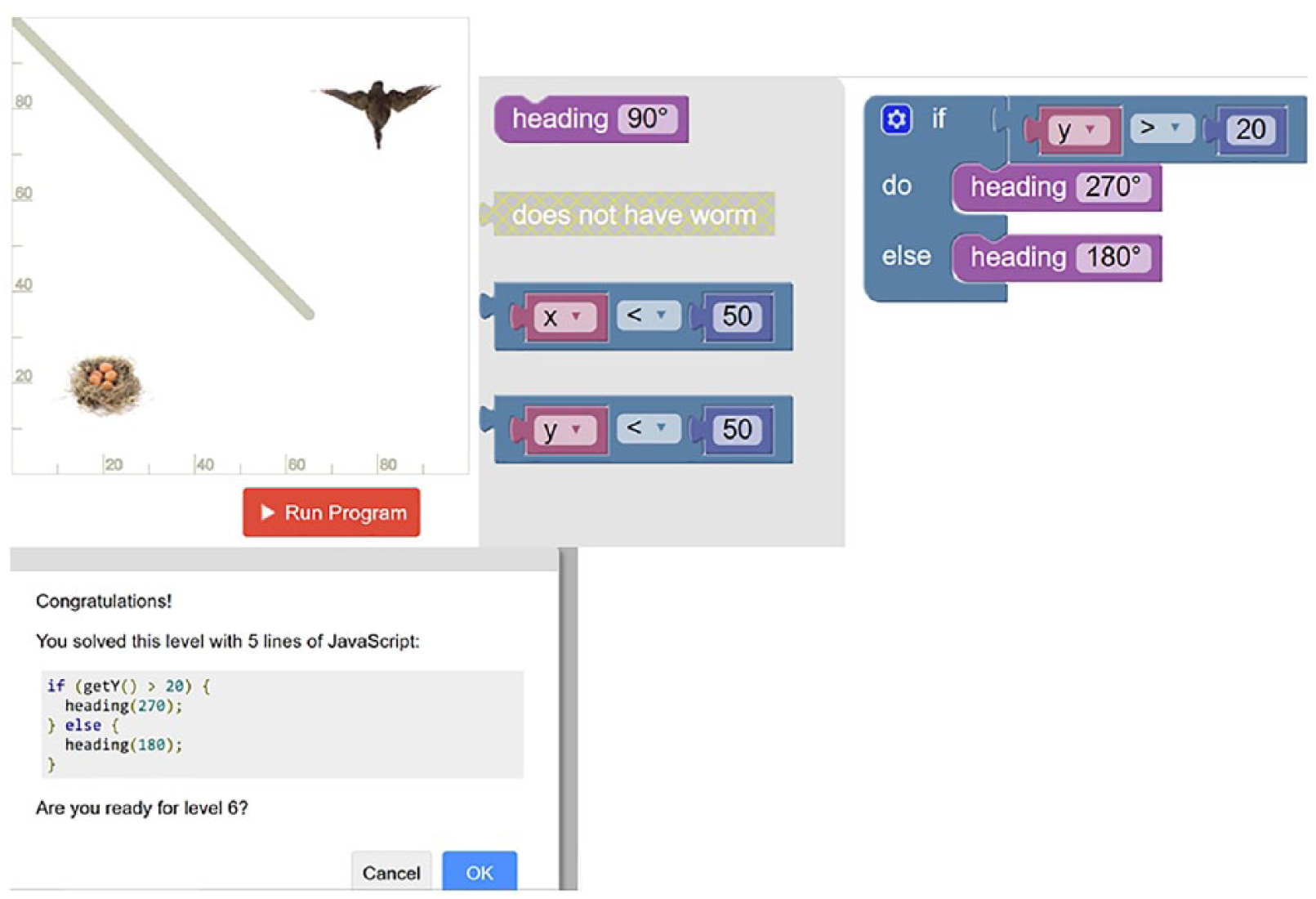
This video game teaches both a graphical programming interface and JavaScript. (https://blockly-games.appspot.com/)
The scenario of near-universal access to powerful technology is more likely if more software (programming languages, word processors, film editing programs, AI programs, etc.) and more hardware (medical devices, robots, etc.) used a common graphical programming interface. Already, one can program in a graphical programming interface and output Python, Java, or a slew of other programming languages. We could imagine similar economies of scope in programming if most programs and devices gave users the option of a familiar common graphical programming interface.
In this scenario, AI and Big Data empower citizens, future entrepreneurs, civic groups, and others to identify important problems and then to solve them. While this scenario might seem far-fetched to some people, leading companies like Google, Amazon, and Microsoft are taking steps to make it easier for nonspecialists to use AI. A Gartner study (Goasduff, 2017) predicts that 2018 will mark the year that AI democratization starts. Hundreds of start-ups are currently powering their applications with machine learning algorithms that Google and other leading technology firms have made available.
Complementing Zink’s (2019) emphasis on “tribes,” local groups could use these powerful tools to address local challenges. For example, citizen groups could analyze how to increase voting or monitor corruption. An environmental or religious group that wanted to decide what problem to prioritize could identify what forms of environmental degradation or family suffering were most important locally.
Complementing D’Mello’s (2019) emphasis on the importance of entrepreneurship, millions of people will have access to these new technologies to create new businesses. For example, a handful of creative people could work together to create a business that help people commute more efficiently, choose a home, save energy in cooling their home, find new music they like, and so forth.
In other domains, a union could easily test how best to reach potential members. A nation-wide or global network of community clinics could identify the best ways to promote healthy behaviors, customizing interventions for different subsets of clients. More generally, these new technologies (like literacy or email) empower all citizens to learn and to work together.
Returning to Choi and Kang (2019), the policy challenge is that we do not know how to design technologies that make AI and Big Data complements to human skills and accessible to dispersed entrepreneurs, nongovernmental organizations (NGOs), clubs, and tribes of every stripe. Thus, governments, NGOs, and the do-gooder parts of big IT companies (Google.org, and its kin) should start experimenting now. What forms of education and user interface help students of any age learn to use these tools? How can these tools help decentralized groups achieve their goals? What kinds of jobs can we keep and newly design?
Like electricity or the Internet, I suspect the new information technologies will have ever-growing effects on the economy over several decades. If we start now, we may be able to tilt the development of these technologies in ways that minimize unemployment and benefit more of the world. We have little time to lose.
Footnotes
Declaration of Conflicting Interests
The author(s) declared no potential conflicts of interest with respect to the research, authorship, and/or publication of this article.
Funding
The author(s) received no financial support for the research, authorship, and/or publication of this article.