



Abstract
A nationwide sample of undergraduate music education majors (N = 260; 69% completion rate) completed an electronic survey to determine awareness of music and general education policy and advocacy efforts. Students reported concern with the impact of policy on school music programs and their future careers. They were informed about music education policy issues at the state level but less so at national and local levels. Although respondents indicated involvement with professional associations, they rarely or never participated in policy initiatives. Methods courses provided policy information; professional organizations effectively convey policy information to undergraduates. NAfME Collegiate chapters offer music and general education policy-based activities, though many respondents were uninformed of their chapters’ efforts. Students were unfamiliar with key buzzwords, people, and acronyms of present-day education policy. Involving students in educational policy endeavors will equip them with a knowledge base from which to speak and act, securing the future of music education.
Government-mandated testing in reading, mathematics, and science has jeopardized funding and class time for public school music programs nationwide (Baker, 2012; Koza, 2010). Although the arts were included as a core curriculum subject in the reauthorization of the Elementary and Secondary Education Act, more commonly known as No Child Left Behind (NCLB; 2001), the funding was cut in 2003 due to “terminating small categorical programs with limited impact in order to fund higher priorities” (U. S. Department of Education, 2003, as cited in Chapman, 2004). Other issues occurred with NCLB such as scheduling time for music within the school day and declining enrollment (West, 2012).
To policymakers, the arguments for the benefits of music have never been as compelling as the pressure of high-stakes test results reflected in Adequate Yearly Progress (U. S. Department of Education, 2002) reports or the pressure of being in the public eye (J. A. Pika, personal interview, June 27, 2012; U. S. Department of Education, 2004). In turn, schools that are identified as not meeting Adequate Yearly Progress under NCLB are more likely than others to report a decrease in or elimination of instructional time for arts education (Baker, 2012; Koza, 2010; NCLB, 2001). To fight for the policies that are best for students and for the education profession, educators must first understand the policies in place, the processes by which they are made, and the people who make them. Only with a full comprehension of the current legislation can music teachers and those in the education field begin to (a) formulate opinions on existing policies, (b) explore alternatives, and (c) defend their positions with data (Michelli, 2005).
Music Education Policy
As the politics of education march on, “it may be our failure to act—simple inertia—that keeps the profession from responding to the forces that impact music educators as they enter the classroom” (Frierson-Campbell, 2007, p. 37). Hope (2007) contended that successful teachers are the best defense against loss of music programs. Music educators increasingly feel the need to justify their music programs and to persuade policy makers of the importance of music education. As the national, state, and local hard policies complicate the educational front, music educators often struggle to make their case attention-worthy (Elpus, 2007). Understanding the current political climate and its effect on the music education profession is important to solve the ever-increasing problems created by current education policy (Kos, 2010). Arriving at solutions on policy reform takes time and requires the organization and mobilization of those in our profession (Jones, 2009; J. A. Pika, personal interview, June 27, 2012). Music educators must leverage public opinion at the local, state, and national levels, especially within the media and business communities (J. A. Pika, personal interview, June 27, 2012). Looking ahead, Schmidt (2009, p. 42) defended that “the study of policy as an essential part of [music] teacher education could be the simplest way to bring young students’ attention to the fact that education is political and, as such, is never simple.” With this thought in mind, we must turn our eyes to the future of music education: undergraduate music education majors. The unfortunate reality is that they will inherit this unstable political landscape.
Becoming Attuned
In the current National Association for Music Education (NAfME) Policy Research Agenda (NAfME, 2012) questions are posed on why in-service music teachers are not involved in advocacy. Aguilar, Miksza, and Richerme (2013) brought to light that there is rarely an emphasis on policy in the undergraduate music education curriculum. Meanwhile, NAfME has begun to welcome undergraduate music education majors into the advocacy arena (http://hillday.nafme.org).
In this era of ever-changing education trends and policy reforms, such as the Race to the Top (RTTP) competition (U. S. Department of Education, 2014), the emphasis on Common Core (Common Core State Standards Initiative, 2014; U. S. Department of Education, 2013, 2014), and the evolving topic of teacher evaluation, undergraduate music education majors must be up-to-date on education policy (U. S. Department of Education, 2009). To develop undergraduate music education majors’ knowledge of these policies so that they are proactive and progressive educators, it is crucial that they have the skills to locate proposed and passed legislation and be informed of educational policy making and implementation efforts (Hunter, 2011). However, just how informed are they about policy’s influence on education, present-day music programs, and their future careers? A review of the small body of existing research on this topic has indicated that little is known about their awareness and understanding of education policy and its implications on music education. Herein lies an urgent concern for our profession.
Purpose of the Study and Research Questions
The purpose of this research was to explore the depth of undergraduate music education majors’ knowledge of education policy and associated advocacy efforts. We were interested in answering the following research questions:
How do they view the effect of policy on their future careers as music educators in public schools? Are they taking steps to further the aims of music education in public schools at the local, state, and national levels?
Method
Survey Construction
Development
The research questions served as a guide for the development of the survey. We used the web-based survey tool Qualtrics to create an electronic survey. A music education professor who has expertise in survey development reviewed the questionnaire and gave advice on the types of questions asked as well as their option responses. Using a think-aloud procedure, the survey was evaluated by music educators with 15 years of collective experience teaching music in the public schools, who were enrolled in a research methods course. Taking their suggestions into account, we modified the design of the survey and clarified the survey questions and subsequent option responses. We then pilot-tested the online survey with undergraduate music education majors (N = 10), whose feedback led to several changes in terminology, and finalized the design. The survey was submitted and approved by the university’s internal review board (the survey is available online as supplemental material at http://jmte.sagepub.com/supplemental).
Survey Dissemination
Electronic National Survey
The link to the survey was distributed nationally to music education faculty at 4-year institutions of higher education. We e-mailed the link to 150 music education faculty members, each employed at a small, medium, or large university from each state in the United States. Faculty members were either NAfME advisors or active in music teacher education as noted by participation in NAfME Society for Music Teacher Education symposia. Through snowball sampling, music education faculty were asked to forward the link to their undergraduate music education majors. Additionally, the link was posted throughout NAfME Online Forums, the NAfME Collegiate Advisory Council Interest Area website, and the NAfME Groundswell website. Due to confidentiality assurance, we were unable to ascertain participation generated from the NAfME websites. The survey link was active for 2 weeks.
Participants
Undergraduate music education majors who were at least 18 years of age were invited to participate in the survey. Demographic questions were designed to automatically exclude all underage, nonundergraduate music education majors from responding to the remainder of the survey. Under these requirements, 377 surveys were started, with a total of 260 surveys completed for a 69% completion rate.
Participants were asked to state their year in school and NAfME Division in the first bank of questions. Of those who completed the survey, 20% were freshmen, 26% sophomores, 29% juniors, and 25% seniors. Students indicated that their collegiate chapters were from the following NAfME Divisions: 33% Eastern, 10% Southern, 6% North-Central, 4% Northwest, 1% Southwestern, 1% Western, with 45% of the respondents unaware of the division to which their collegiate chapter belonged.
Content and Question Format
After the aforementioned demographic questions, participants were asked about their knowledge and concern on music education policy at the local, state, and national levels. The next bank of questions dealt with professional organizations, specifically the extent to which music education majors receive policy-oriented information from such organizations. Undergraduate music education majors then identified the main sources of their knowledge and understanding of education policy and whether it was through professional organizations, coursework, their own research, or other means.
In the subsequent section we asked participants to rate their familiarity with specific education buzzwords. The theme of the final section focused on participation in music education advocacy initiatives at the collegiate, local, state, and national levels. Participants were also given the opportunity to comment on both music education policy and advocacy through optional open-ended questions at the end of the survey.
Data Analysis and Results
Survey Results
We used Qualtrics to generate a report of survey results. The first question addressed the extent to which undergraduate music education majors were informed of education policy. Using a 4-point Likert-type scale, 52% of the respondents to this question (N = 251) indicated that they were most informed about music education policy at the state level, followed by 44% (N = 251) at the local level, and 40% (N = 250) at the national level. They (N = 260; 74%) were concerned slightly more about the effect of policy on public school music programs than on their future careers in music education (63%; see Table 1 and Figure 1).
Perceptions of Being Informed of Music Education Policy.

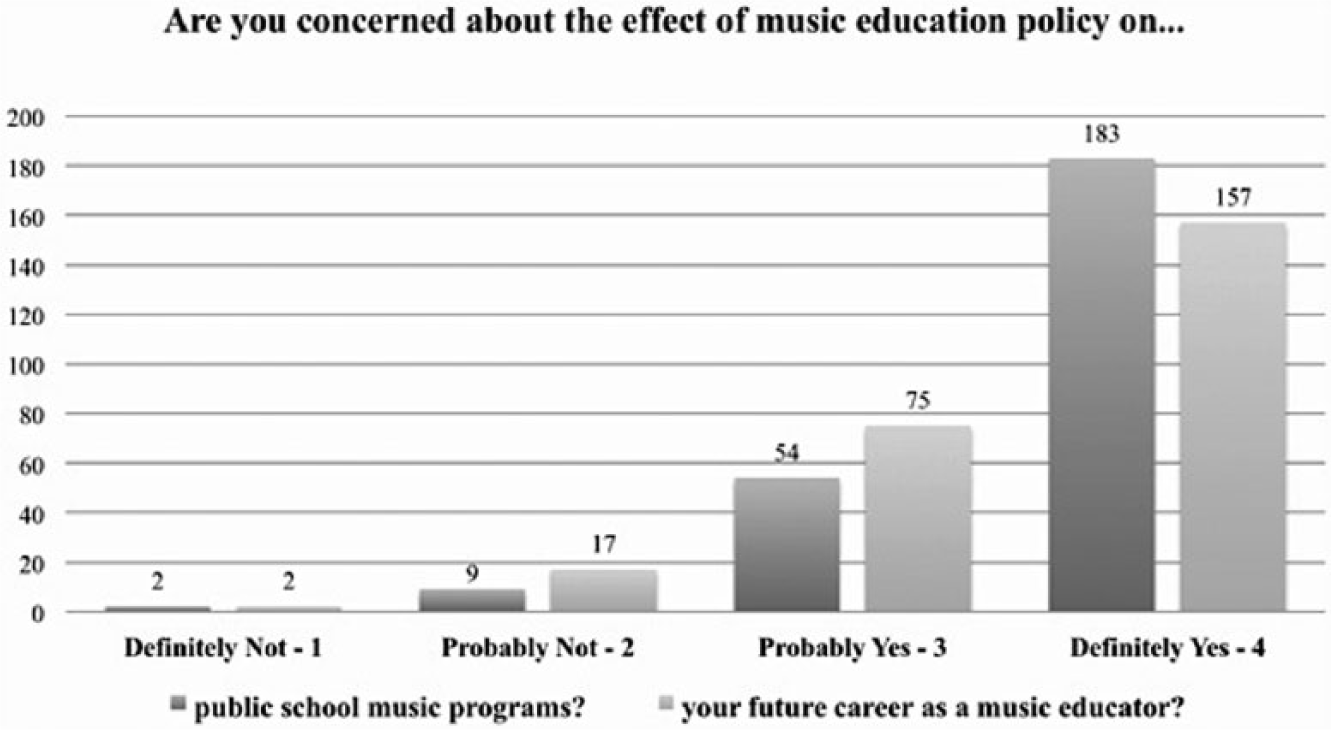
Concerns about the effect of music education policy.
We then inquired whether students sought out information on music and general education policy at the local, state, and national levels of implementation. Undergraduate music education majors (N = 251) tended to seek out information concerning music education policy primarily at the state level (M = 2.54; 54%), with national (M = 2.48; 40%) and local levels following closely behind (M = 2.48; 44%). They sought out general education policy at the national (M = 2.4; 36%), state (M = 2.38; 35%), and local (M = 2.31; 39%) levels less frequently (see Table 2).
Seeking Out Information About Policy.

Note. Scale of 1 = not at all to 4 = frequently.
In the following section of questions, we requested undergraduate music education majors to demonstrate how effective their professional organizations were at communicating information to members and advocating for music education in public schools. We also inquired about the extent to which their professional organizations presented information on music and general education policy. Students (N = 248-251) indicated that their professional organizations were effective at advocating for music education in the public schools (M = 3.24; 83%) and communicating music education policy to undergraduates (M = 2.68; 81%). They reported that NAfME Collegiate chapters generally offered clinics, workshops, and seminars on music education policy (M = 2.79; 68%) but focused less on education policy (M = 2.48; 60%). The number of don’t know responses showed that 47% of respondents (n = 80) did not know if their NAfME Collegiate chapter provided presentations on music education policy; 66% of participants (n = 99) were unsure whether their NAfME Collegiate chapter gave presentations on educational policy (see Table 3).
Professional Organizations.
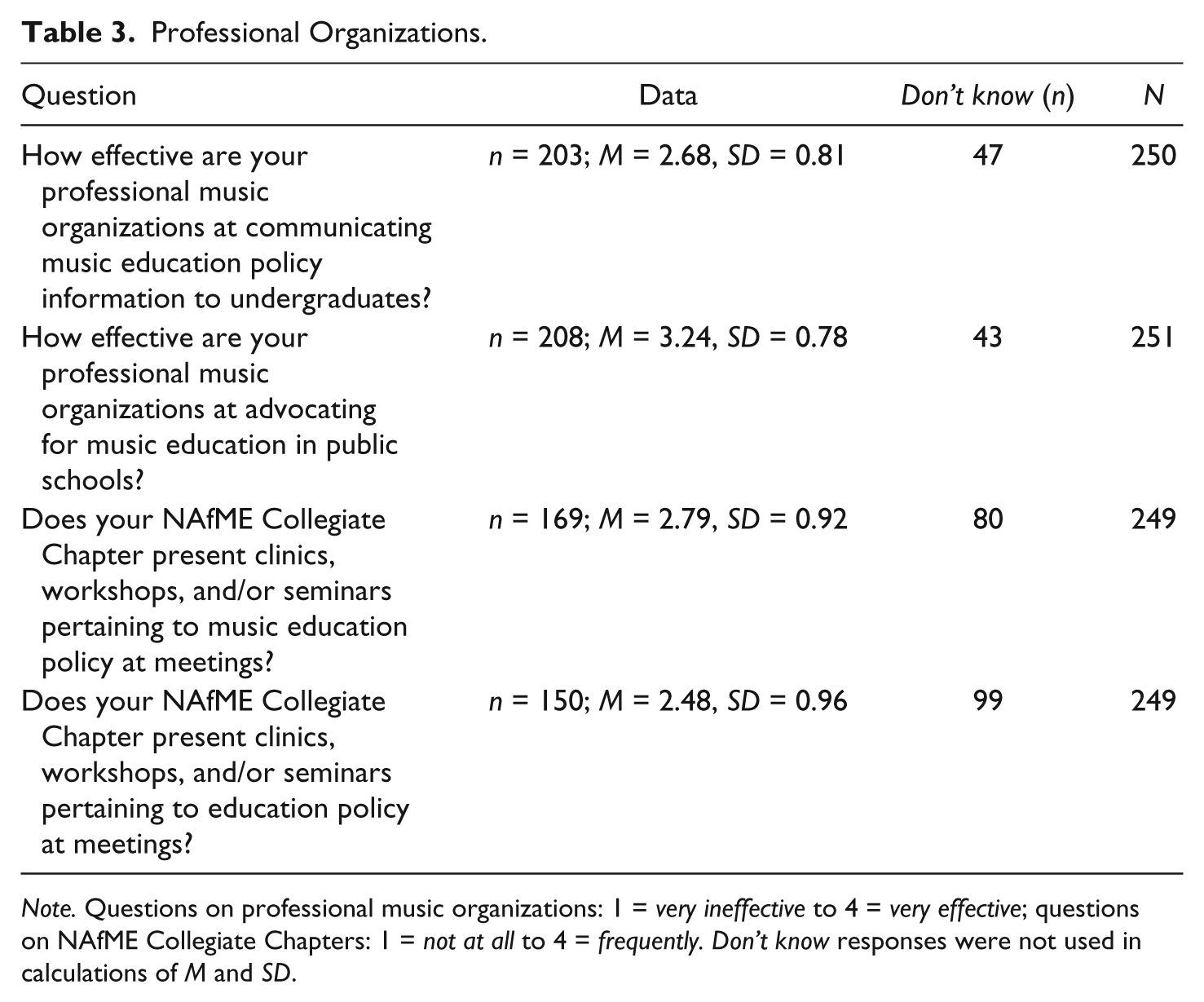
Note. Questions on professional music organizations: 1 = very ineffective to 4 = very effective; questions on NAfME Collegiate Chapters: 1 = not at all to 4 = frequently. Don’t know responses were not used in calculations of M and SD.
We also asked where undergraduate music education majors receive their information about education policy; participants were able to choose more than one answer (N = 436 total responses). Students’ selections demonstrated that music education methods courses (32%) were their primary source of information; 25% indicated that they learn about policy on their own. The students’ remaining responses showed they learned about education policy through a general education course (18%), learned about education policy in an educational policy course (11%), or did not learn did about education policy (11%); 3% chose “other” (see Figure 2).
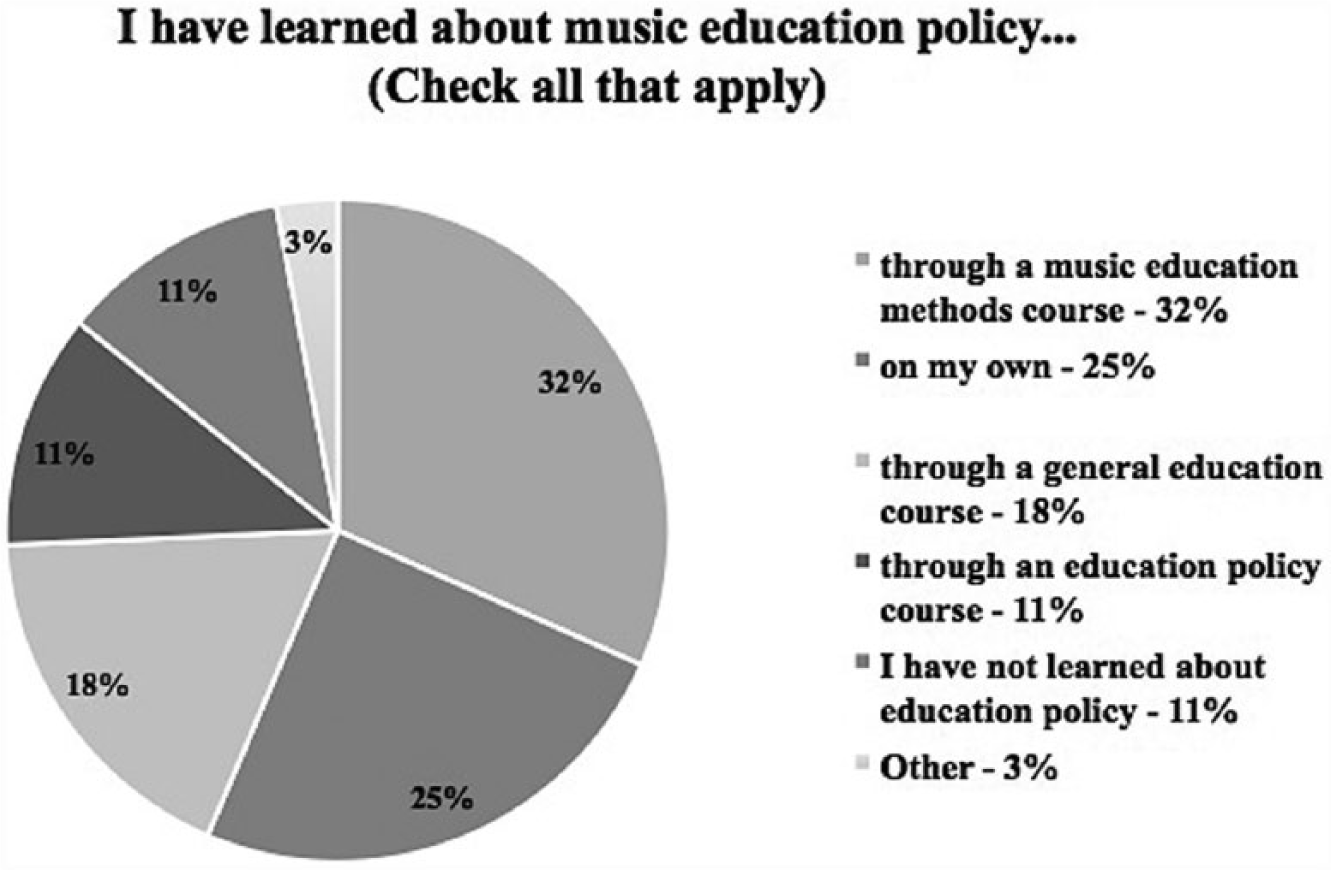
Sources of information about education policy, N = 436.
On a 4-point Likert-type scale, students (N = 260) were to rate their knowledge of current educational buzzwords, people, and acronyms in the education sphere. Charter Schools (M = 2.38; 42%) and Music Teacher Evaluation (M = 2.16; 36%) were somewhat known to participants. The least familiar were the following: Groundswell (M = 1.13; 90%), RTTP (M = 1.21; 89%), Elementary and Secondary Education Act (M 1.21; 86%), and STEAM (Science, Technology, Engineering, Arts, and Math; M = 1.39; 75%); 82% (M = 1.26) were unable to identify Arne Duncan (U.S. Secretary of Education). Seventy-four percent of music education majors (N = 252) did not know if their home state was an RTTP state (see Figure 3).
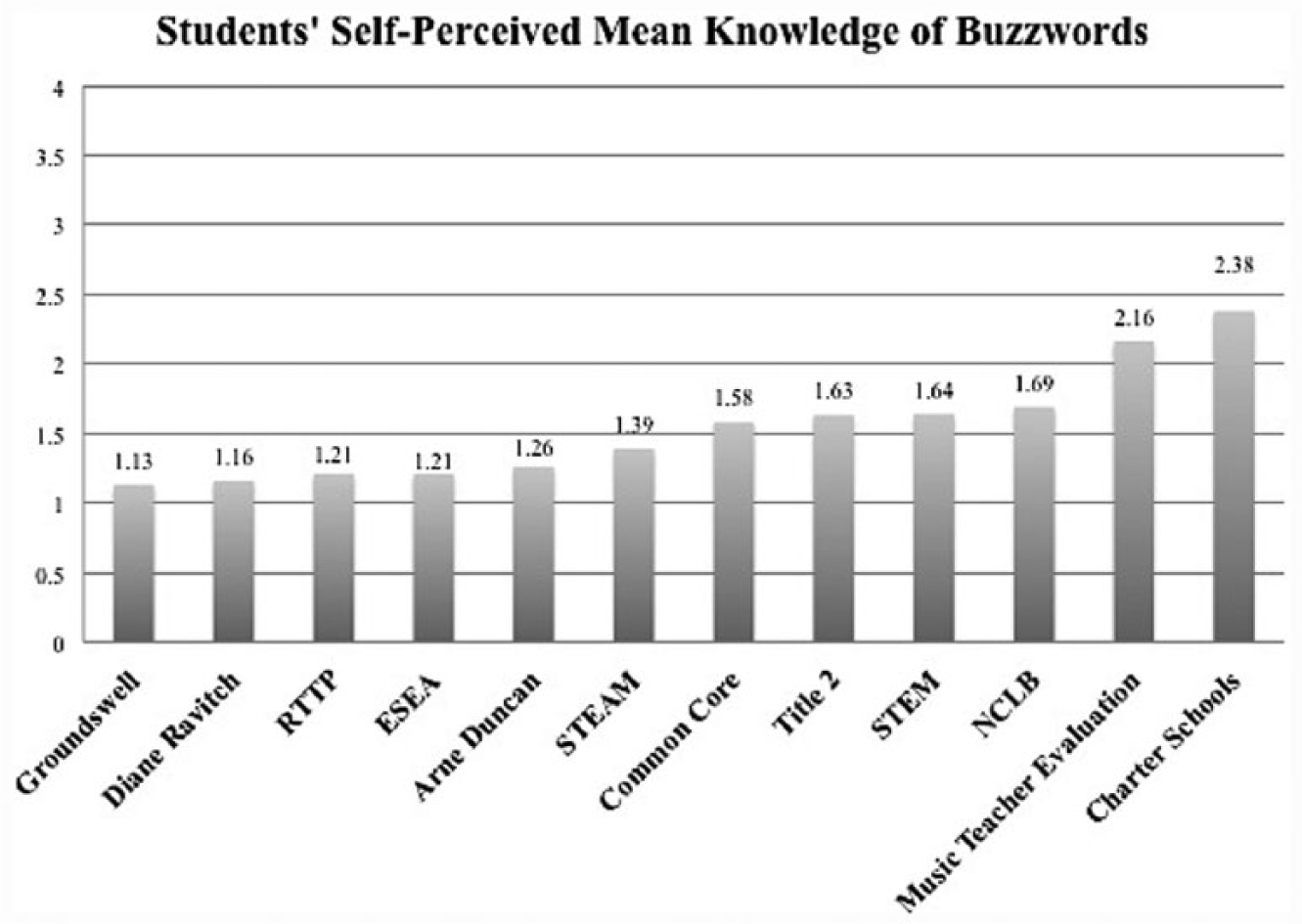
Students’ self-perceived knowledge of policy buzzwords.
In the next portion of the survey, students indicated their participation in advocacy initiatives at the collegiate, local, state, and national levels. Of 253 respondents, 88% reported that they rarely or never advocate for music education at the national, state, and local levels. Twelve percent indicated that they frequently participate in advocacy efforts at the collegiate level. Furthermore, the data revealed that music education majors’ participation in advocacy activities decreased as the scope broadened from collegiate to local, state, and national levels.
Next, we requested that participants describe specific advocacy initiatives they engage in. Fifty percent (N = 83) of those who responded to this question articulated that their participation was through involvement in collegiate chapters of professional organizations: NAfME, American String Teachers Association, and American Choral Directors Association.
Undergraduate Music Education Majors’ Remarks
The final questions of the survey were open-ended, providing participants with an opportunity to comment on music education policy and advocacy in music education. Although these remarks represent a small percentage of the survey population, they provide some insight on participants’ thoughts on music education policy and advocacy. On music education policy, 11 of the 19 respondents stated that they saw value in learning more about music education policy, but policy issues were often missing from the curriculum. As one participant said, “There needs to be a much stronger emphasis of this in collegiate music education programs.”
Thirteen of the 17 total respondents expressed that they felt unprepared to speak on behalf of music education. One participant asserted, They should offer advocacy courses for music and art teachers in their undergraduate [degree programs]. A huge part of our job is to just defend it [music education] with solid facts . . . not many other teachers have to focus on defending the importance of their fields of study.
Another student described taking the initiative as an arts and music advocate.
I don’t believe my university education has taught me how to be an advocate for the arts and music education. I have found ways to do some things in this area on my own, but not as a result of university classes or other university functions.
Conclusions
Undergraduate music education majors reported that they were concerned with the effect of education policy on school music programs and its implications on their future careers. Students indicated that they were most informed about music education policy issues at the state level as they seek out information at this level. They were less informed of music education policy at the national and local levels and much less aware of general education policy.
Within their professional associations, undergraduate music education majors indicated that they were involved with advocacy initiatives. A discrepancy, they reported rarely or never participating in these initiatives at the national, state, and local levels.
Students indicated that music education methods courses were a source of music education policy information and that their professional organizations effectively convey policy information to undergraduates and advocate for music education in public schools.
Although students were aware that their NAfME Collegiate chapters offer music education and, to a lesser degree, general education policy-based activities, many of the respondents were uninformed of the advocacy efforts of their chapters, despite their perceptions that they are knowledgeable.
Finally, undergraduate music education majors were unfamiliar with key buzzwords, people, and acronyms of present-day music education and general education policy. Notably, 90% of respondents were unaware of NAfME’s Groundswell (http://advocacy.nafme.org/about/), which has the purpose of “cultivat[ing] an online community of NAfME members from across the country interested in participating in advocacy initiatives, engaging in discussions about advocacy and regularly digesting advocacy news.”
Implications and Suggestions for Further Research
Implications for Practice
Richmond (2002) stated, “At its best, policy can be the social and institutional vehicle by which enlightened philosophy is carried out. Sometimes, however, policy is something less—a reflection of untested traditions, old habits, persistent prejudices, or political compromises” (p. 3). As with in-service teachers, an imperative for undergraduate music education majors is to critically examine long-standing practices, policies, and traditions (Campbell & Brummett, 2007) and consider, “Why should students study music? How will you defend a school music program? These are fundamental (and philosophical) questions that preservice music teachers must contemplate as part of their professional preparation” (Austin & Reinhardt, 1999, p. 27). Undergraduate music education majors need curricular opportunities to reflect on these essential questions.
Policy influences “every day education” from the micro to the macro level (Jones, 2009; Schmidt, 2009). Hunter (2011) noted that undergraduate music education majors need to be equipped with the skills to research, evaluate, and set policy into motion. Because undergraduate music education majors are largely unaware of the policy and advocacy activities of their professional organizations, and seem to accrue the most information from music education methods courses, providing opportunities for them to (a) develop a knowledge base of political forums to stay abreast of policy issues, (b) think critically about policy and advocacy, and (c) learn about and create proactive strategies for political action are key components to include within the music teacher preparation curriculum. Determining the catalysts that move undergraduate music education majors to action and how they use their base of policy knowledge once in the field will inform music teacher educators of how to construct or improve curriculum.
Crucial to this educational endeavor, the NAfME Collegiate, Groundswell (NAfME, 2013a), and those professional organizations involved in The Music Education Advocacy Roundtable (NAfME, 2013b) should place high priority on the involvement of undergraduate music education majors in their policy-making and advocacy efforts at the local, state, and national levels. The professionalization of undergraduate music education majors should include expanding their knowledge about policy so that they become agents of change long before entering the field.
Suggestions for Further Research
Researchers should study the impact of undergraduate music education majors’ participation in national, state, and local professional organization’s advocacy initiatives to determine their effectiveness. Descriptive accounts concerning pedagogical techniques of educating undergraduate music education majors to develop, articulate, and enact sound, philosophically based plans for political action might be pursued, particularly for the preservation of PreK–12 music programs. Studies such as these may serve to inform music teacher educators and professional organizations on how best to educate and involve students in policy pursuits.
Why Wait for the Downbeat?
The requirements of music teacher preparation programs are pressing between rigorous and congested music education curriculums, state certification, and national accreditation requirements. To add “one more thing” to the expectations placed on undergraduate music education majors prior to beginning their careers seems implausible. Yet it is necessary that they learn to proactively communicate the importance of music education, as reactionary arguments come too late. Undergraduate music education majors must be equipped to take action as they face the reality of a volatile political landscape. Involving undergraduate music education majors in educational policy endeavors will provide a political base from which they can speak and act.
Footnotes
Declaration of Conflicting Interests
The author(s) declared no potential conflicts of interest with respect to the research, authorship, and/or publication of this article.
Funding
The author(s) received no financial support for the research, authorship, and/or publication of this article.

References
Supplementary Material
Please find the following supplemental material available below.
For Open Access articles published under a Creative Commons License, all supplemental material carries the same license as the article it is associated with.
For non-Open Access articles published, all supplemental material carries a non-exclusive license, and permission requests for re-use of supplemental material or any part of supplemental material shall be sent directly to the copyright owner as specified in the copyright notice associated with the article.
