



Abstract
A strong connection has been drawn between failed and/or failing states and terrorism. Not all failed/failing states promote equal amounts of terrorism. This article compares failed states that promote high degrees of terrorism with those that promote low degrees of terrorism by using a twofold approach. First, ordinary lease square regression is used to examine the aspects of state failure in relation to terrorism and second, a comparison is drawn between failed states that promote high degrees of terrorism with those that promote low degrees of terrorism in a case study analysis of Somalia and the Ivory Coast. The results suggest that the relationship between state failure and terrorism is more complex than a simple linear causal process and that examination of the processes involved in state failure are integral in understanding why some states experience high levels of terrorist activity while others do not.
Keywords
Introduction
In the current geopolitical structure, asymmetrical warfare (terrorism) has increased in lethality. Moreover, current research suggest that this trend will continue (Ellis, 2003; Hoffman, 1998) and have wide spread consequences for a great number of people. The new age of religiously motivated terrorism (Bergesen & Lizardo, 2004; Ellis, 2003; Hoffman, 1998; Winkler, 2008) faces a highly complex new phenomenon, namely terrorists’ goals have become more vague and ambiguous (Bergesen & Lizardo, 2004), while weapons have become more sophisticated (Ellis, 2003; Hoffman, 1998) and targets exceedingly indiscriminate (Bergesen & Lizardo, 2004).
Previous terrorism research focuses on relationships between terrorism and political (Piazza, 2008) economic (Freytag, Kruger, Meierrieks, & Schneider, 2009; Schneider, Bruck, & Meierrieks, 2010), and social factors (Burgoon, 2006); yet does not consider the interplay of the three. Moreover, there is limited empirical research on the connections, relying heavily on case studies or theory building. The Failed States Index (Fund for Peace, 2009) has been used in its aggregate form to test for connections between state failure and terrorist activity; however, little research examines the variables that make up the Index. The present research employs quantitative analysis to examine the relationship between terrorist activity and failed states. First, ordinary least squares regression is utilized to ascertain which of the variables of social, economic, and political fragility are most closely associated with terrorist activity. Second, two case studies of Somalia and the Ivory Coast are utilized to explore the relationship between fragility and terrorism. These two countries were chosen because of similar scores on the Failed States Index while having very different outcomes of terrorist activity. The comparative case study analysis is used to contextualize how aspects of state failure differ in affects on terrorist activity.
The majority of prior research focuses primarily on the economic factors that foster terrorism. Therefore, examining the multifaceted components of state failure may shed light on the interdependency of economic factors on social and political forces. Research has been separated along political, economic, and social lines with little synthesis of the three. A broader view of terrorism’s roots may lead to a better understanding of the qualities of states at risk for fostering terrorist activity. Through deeper exploration of state fragility, theory may emerge to help counterterrorism policies transnationally. This study is driven by the theoretical position that state failure is intimately connected to terrorist activity; however, it strives to go beyond the superficiality of state failure and delve into the processes of such failure.
Literature Review
The first step in conducting a study on terrorism is defining the term terrorism. The present research employs the Global Terrorism Database (GTD) definition, “the threatened or actual use of illegal force and violence by a non-state actor to attain a political, economic, religious, or social goal through fear, coercion, or intimidation” (GTD, 2007; also see Schmid & Jongman, 1988, 2005). The GTD includes acts that meet two of the three following criteria:
The violent act was aimed at attaining a political, economic, religious, or social goal; the violent act included evidence of an intention to coerce, intimidate, or convey some other message to a larger audience other than the immediate victims; and the violent act was outside the precepts of International Humanitarian Law.
The Influence of Social Welfare Factors on Terrorism
Burgoon’s (2006) study of social welfare policies indicates that countries that put less effort into social welfare have more connections to transnational terrorism as well as terrorist incidents on their own land. Such policies as social security, unemployment, and health and education spending are said to discourage terrorism. Social welfare policies serve to reduce poverty, inequality, and insecurity (Burgoon, 2006; Schneider et al., 2010). Social welfare reduces economic insecurity, inequality, poverty, and religious extremism, which in turn reduce the likelihood of terrorism (Burgoon, 2006). Alesina and Perotti (1996) agree with Piazza (2006) that as populations increase, the likelihood of terrorism increases. Alesina and Perotti (1996) demonstrated that as democracy and social welfare increase, terrorism decreases.
Not all empirical research supports the social welfare argument (Freytag, Kruger, Meierrieks, & Schneider, 2011; Krueger, 2008; Krueger & Maleckova, 2003; Sageman, 2008). Terrorists predominately come from well-educated, higher socioeconomic statuses, making motivations more political than economic (Bergesen & Lizardo, 2004; Ellis, 2003; Hoffman, 1998; Winkler, 2008). Freytag, Kruger, Meierrieks, and Schneider (2011) demonstrate empirically that while terrorists themselves may be economically and educationally advantaged, the society that they come from is not. This environment, aspects of state failure, also fosters a large pool of economically disadvantaged and disenfranchised youth from which to pull potential recruits. Further, economic disparity between countries causes grievances against the current economic order and the disadvantage failing states experience (Blomberg, Hess, & Weerapana, 2004; Freytag et al., 2011; Harrison, 2006).
The presence of particular ethnic or religious communities with legacies of persecution or repression may also create black holes, where terrorist can hide. According to Korteweg (2008), terrorist groups can plug into the particular grievances of these local communities, gaining the advantage of popular support. Through community support, terrorists can hide, gain new recruits, and possibly have access to new resources. Important here is the fact that in tribal communities, a sense of duty and honor are paramount and, as such, obligations to help those in their tribe may be part of the moral code that terrorists exploit (Freytag et al., 2009; Kittner, 2007; Simons & Tucker, 2007). Ethnic divides and grievances along group lines also foster communities where terrorist activity thrives (Piazza, 2008).
Taking into consideration the research that has come before, and in particular, Piazza (2008), more exploration into aspects of state failure and their connections to terrorism is demanded. Through a comparison of case studies, this article examines exactly what the differences are in how a state fails and how these differences contribute to fostering terrorism.
The Influence of Economic Factors on Terrorism
Economic underdevelopment can be a catalyst for terrorist creation. Korteweg (2008) states that economic underdevelopment (e.g., areas of high poverty) may be advantageous for terrorist recruitment. Young men might have no other opportunities for employment than terrorist groups. Poverty is cited repeatedly as a main catalyst in terrorist group formation (Burgoon, 2006; Freytag et al., 2009; Li & Schaub, 2004; Piazza, 2008; Schneider et al., 2010). Even so, it may be the unequal distribution of wealth creating the conditions that spawn terrorist organizations (Burgoon, 2006; Li & Schaub, 2004; Piazza, 2008; Sageman, 2008). Much like Piazza (2011), Stewart (2000) found that increasing inequality fuels social discontent, political instability, and violence. Muller and Seligson (1987) found that misdistribution of land and income inequality are positively correlated to mass violence. Land reforms and rapid economic growth can further exacerbate this phenomenon.
Economic disparity between countries causes grievances against the current economic order and the disadvantage certain failing states experience (Blomberg et al., 2004; Freytag et al., 2011; Harrison, 2006). Ehrlich and Liu (2002) argue that Islamic rage is partially due to failure to achieve economic success. Upon examination of Pakistan’s failure to take off economically, Looney (2004) found that high fiscal deficits, unsustainable public debt, sharp deterioration in the distribution of income, and a disturbing rise in the level of unemployment and poverty. He argues that these are the factors that shape the increasing terrorist activity in Pakistan (Looney, 2004).
Minority economic discrimination increases the propensity of terrorist activity (Piazza, 2011). Politically marginalized people, with no remediation for discrimination, are more likely to resort to terrorism. When there are mechanisms in place to address these issues, marginalized people are much less likely to resort to terrorism. Piazza (2011) found that countries with high economic development and a high Gini index are subject to more terrorist activity; however, he cautions that the overall country economic status is not as important as the minority group’s economic status. While less developed countries seem to spawn terrorism, many factors contribute to the creation of a terrorist. Krueger and Maleckova (2003) found that although poor countries spawn terrorism, when controlled for civil liberties, the relationship disappears. While poverty may not breed terrorists, Freytag, Kruger, Meierrieks, and Schneider (2009) found that underdevelopment in the Middle East as well as other countries seems to be the bed from which terrorists do arise. The present research builds upon prior work by adding breadth by examining the economic indicators of state failure disaggregated from the Failed States Index. In addition, the present research adds depth by examining the economic failures of the two case studies.
The Influence of Political Factors on Terrorism
Terrorism is a form of asymmetrical warfare; military powers differ significantly between groups. As such, the targets, while not necessarily states themselves, are politically motivated and key to the analysis. Weber (1948) viewed the state as the legitimate source of force and, as such, states have a monopoly on the use of force. This is furthered by the states’ ability to tax in support of a standing army (Weber, 1948). Legitimacy is paramount to state formation in that people must believe in the legitimacy of the state to exercise force in order to be compliant. Legitimacy allows the government the right to govern. Another aspect of the state is a particular geographical location or the right to property. This is the basis of unequal distribution of resources and, as such, the basis for conflict (Giddens, 1999). As the recognized state has certain rights to property and the ability to assign property in the manner it sees fit, certain unequal distributions of resources may occur that can spur conflict.
Weber (1948) states three resources where conflict can arise: economic, power, and status (cultural). Collins (1975) provides an important perspective to examine the historical aspects of terrorism in light of Weber’s (1948) three resources. According to Collins, economic resources are those of material conditions. Power resources are those of social position within networks. Status or cultural resources are those that exert control over rituals that produce solidarity (Collins, 1975). Resources become important when groups mobilize in reaction to unequal distribution. Groups may mobilize in two ways, emotionally or materially (Collins, 1975). Emotional mobilization is important for terrorist groups because members must have a strong sense of group identity. The sense of group identity permits terrorist members to perceive their beliefs as morally right and to make sacrifices for the cause. Material mobilization is also important for terrorist groups, in that it encompasses communication and transportation as well as material and monetary supplies to sustain the conflict (Collins, 1975).
In opposition to the argument that failed states foster terrorism, Simmons and Tucker (2007), Sageman (2008), Bilgin and Morton (2004) as well as Patrick (2006) argue that the connection is tenuous at best. Failed states are too chaotic to promote terrorism, and there needs to be a degree of functioning that will allow the bare infrastructure to be in place so that terrorists can operate successfully (Patrick, 2006). Logistically, Simmons and Tucker (2007) argue that failed states are a nightmare for reliable operations. Simmons and Tucker (2007) propose that while people in failed states do gain skills that would be well utilized by terrorist organizations, the need for their skills locally is more critical. Simmons and Tucker (2007) posit that few failed states are utilized as training camps (with the exception of Afghanistan). This could be because terrorists are now receiving on the job training in the wars in Afghanistan and Iraq (Simmons & Tucker, 2007).
Korteweg (2008) cites seven aspects of comparative advantage that lead to the creation of “black holes” or spaces in which terrorism may grow. The most important of these aspects are remote areas of countries where the governments of those countries have little ability to control what goes on in the area. It is physically impossible to govern such areas; as a result, the areas may be forgotten regions of no man’s land. These are challenges to the state’s ruling authority that erodes the confidence in the ability of the state to assert its control (Zartman, 1995). These are nontransparent areas where the central government has questionable legitimacy and groups are free to operate unnoticed that Piazza (2008) terms stateless regions.
In failing states, there is challenge to governmental authority as well as lack of confidence in the state to control the territory (Piazza, 2008; Zartman, 1995). Hehir (2007) posits that failed and/or failing states suffer administrative incapacity, where the government is unable to provide basic services that are expected from such an entity. Lambach (2004) notes that there is not a clear threshold of failure and that there are distinctions between weak states that may still function in some aspects and collapsed states that have no ability to effectively govern. Failed states may retain the appearance of sovereignty (Takeyh & Gvosdev, 2002). This type of functioning may best suit terrorist organizations in that outward manifestation of sovereignty limits outside intervention (Piazza, 2008). The present research builds upon prior work by examining political indices that compose the Failed States Index. In addition, the present research adds depth by examining the political failures of the two case studies.
Hypotheses
This study is meant to examine the connections between failed states and terrorist activity. While the aggregate failed states score is statistically significant and linearly associated with terrorist activity, a deeper examination needs to be conducted on the individual components. Past research has focused on the linear relationship between state failure and terrorist activity; however, the relationship may not be linear. There may be a midrange of state failure that is most optimal for terrorist activities. The argument is informed by prior research (Li & Schaub, 2004; Mair, 2008) although in conflict with the most recent empirical findings (Piazza, 2008). There exists a range that fosters the most terrorist activity. While it has been put forth that the relationship between the total state failure score and terrorist activity is linear (Piazza, 2008), completely failed states are not hospitable to terrorism. Nor are states that experience the least amount of state failure immune from such activity.
Based on a review of the literature and theoretical understanding, the following hypotheses are explored:
Hypothesis 1: While the Failed States Index aggregate score has been significantly related to terrorist activity, a better model of prediction would be one that contains all 12 variables that comprise the Failed States Index.
Hypothesis 2: The predictive power of the 12 variable model from Hypothesis 1 will be significantly improved by the addition of the Global Peace Index (GPI) as an independent variable.
Hypothesis 3: There is a midrange of the total state failure scores that will be most strongly related to terrorist activity and a squared term of the overall Failed States score will be a better predictor of terrorist activity.
Data and Methods
Quantitative
The data for these analyses came from the National consortium for the Study of Terrorism and Responses to Terrorism (START). START is based at the University of Maryland, College Park, and is an open source. In conjunction with START, the GTD, also an open source, encompasses terrorist activities throughout the world from 1970 through 2008, with over 87,000 cases. The GPI (see Appendix A for list of indicators and operationalization of the overall GPT score) measures relative position of nations’ peacefulness, created in 2007 by the Institute for Economics and Peace, with data from the Economist Intelligence Unit (EIU): the lower the GPI score, the more peaceful the country. It consists of 149 countries and examines a set of 23 internal as well as external violence factors. Also utilized for this study is the Failed States Index of 184 countries measured on 12 variables and is an open source database.
Sample
The focus year of this study is 2008. The data for the study come from the START Center and consists of 187 countries, comprising 4,861 attacks and 104 terrorist organizations. The data were collapsed so that there is one entry for each country and the variable number of attacks was generated for each country. Once countries that had no information were eliminated, the total number of cases was 179 (see Appendix B for list of countries).
Dependent Variable
The dependent variable is the calculated rate of terrorist attacks within a country per 100,000 of the population. The calculation is a common measure of terrorism level in a given country (Piazza, 2008).
Independent Variables
The independent variables for Hypothesis 1 are the 12 indicators of the Failed States Index. The Failed States Index includes four social indicators, two economic indicators, and six political indicators (for the operationalization of the following measures, see Appendix C).
Social indicators
The Failed States Index uses measures of demographic pressure. These include the following: pressures from high population density relative to food supply, settlement patterns, border disputes, land ownership, and controls of religious or historical sites. The second social measure is massive movement of refugees and internally displaced peoples (IDPs). A legacy of vengeance seeking group grievances is a measure of atrocities committed against groups in forms of persecution, repression, or political exclusion. Chronic and sustained human flight, such as the “brain drain,” is used to measure the emigration of the middle class as well as growth of exiled communities (Fund for Peace, 2009).
Economic indicators
Uneven economic development along group lines is determined by group-based inequality in jobs, education and economic status, poverty levels, infant mortality rates, and education levels. Sharp and/or severe economic decline is a measurement of the society as a whole relying on per capita income, gross national product (GNP), debt, and business failures. Indicative of this variable is a collapse or severe devaluation of the national currency and increase in hidden economies (Fund for Peace, 2009).
Political indicators
Criminalization and/or delegitimization of the state is an indicator for government corruption with a lack of transparency, accountability, and political representation. Progressive deterioration of public services measures the disappearance of basic state services and protection of citizens. Widespread violation of human rights is a measure of the emergence of authoritarian, dictatorial, or military rule, along with large numbers of political prisoners. Security apparatus as a “state within a state” is the surfacing of private militias, which terrorizes opponents. The rise of factionalized elites demonstrates a fragmentation of ruling elites along group lines. Finally, intervention of other states or external factors indicates risk to the state’s sovereignty (Fund for Peace, 2009).
For Hypothesis 1, an ordinary lease square (OLS) regression model with the 12 indicators of the Failed States Index was run with the dependent variable of rate of terrorist activity. This allows for comparison of the effects of the 12 variables on the dependent variable and comparison to the model with only the total Failed States score. Both standardized and unstandardized coefficients were generated.
For Hypothesis 2, the independent variables were the total Failed States Index scores and the GPI scores. It is necessary to run nested models, with the full model of the Failed States score, along with the GPI, and a restricted model, excluding the GPI, so that a comparison can be made between the two, using appropriate statistical significance tests. By comparison of the models, the importance of the GPI becomes apparent. For Hypothesis 3, the total Failed States Index score was to be squared to test my hypothesis that this is not necessarily a linear relationship and compared to the model with the linear term.
Control Variables
Control variables for demographics are the population size and the median age of the country. Because crime in general is most heavily represented in the age group 15–35 (Ehrlich & Liu, 2002), controlling for the age structure of the country is important. Population size is a potential confounder if not included in the analysis, because as population size increases there is an increased potential for more criminal activity. The third control variable is a religious diversity measure, constructed based on the Herfindahl–Hirschman Index ([HHI] Hirschman, 1964). The HHI is a measure in economics of the size of firms in relation to the industry and an indicator of the amount of competition among them
The case study analysis provides depth by examining the interplay of the political, economic, and social factors to enhance the quantitative analysis. There is a need to look at countries whose failure scores are similar yet differ in levels of terrorist activity because processes involving the interplay of political, economic, and social factors are having differing outcomes. Feagin, Orum, and Sjoberg (1991) find that case studies permit the “grounding of observations and concepts about social action and social structures . . . [while] providing information from a number of sources and over a period of time.”
Case Studies
Choice of countries was based on the total failed states score, focusing on finding two failed states, one with high levels of terrorist activity and one without. The scores on the 12 indices were very similar, as were their global peace score, median age, population density, and governance score. In focusing on the 10 most failed states, 2 states, Somalia and the Ivory Coast, most closely aligned on the independent variables, while still differing on the level of terrorist activity (see Table 1 for comparison of 2 countries on key variables).
Case Study Variables
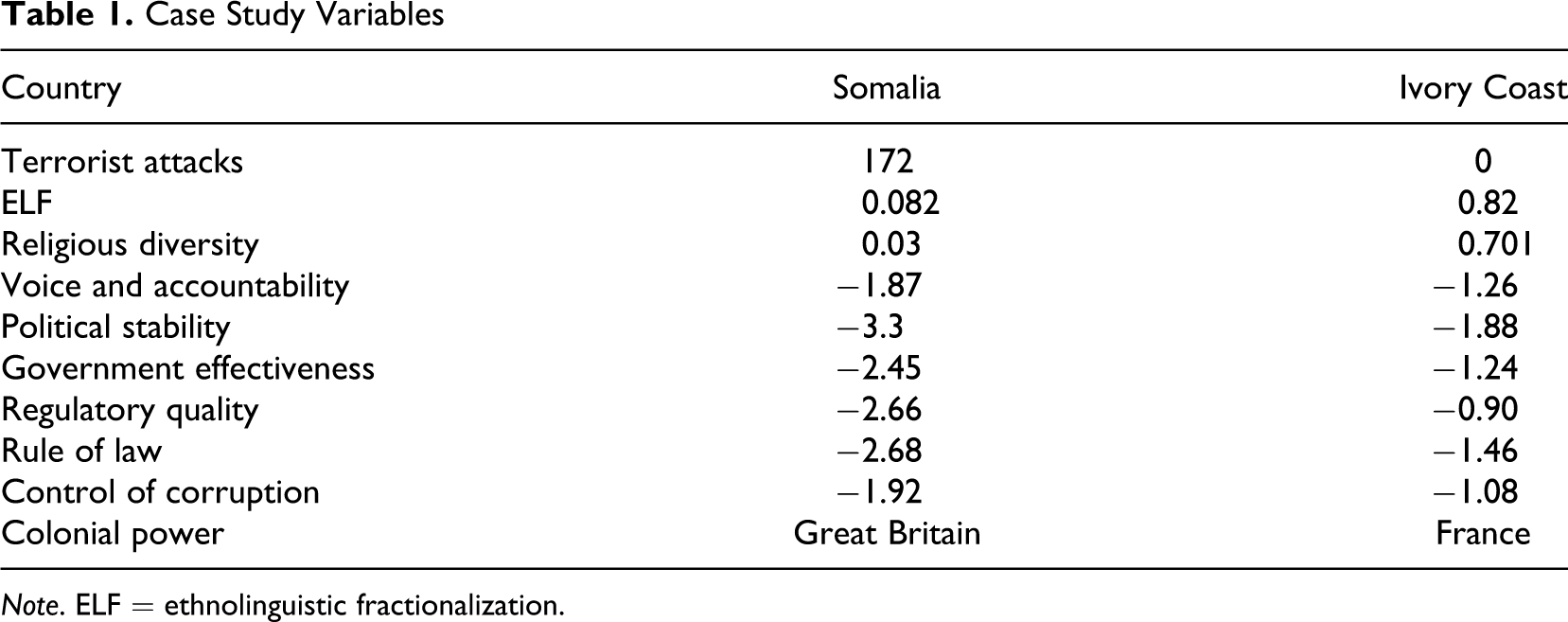
Note. ELF = ethnolinguistic fractionalization.
Dependent Variable
The dependent variable is the calculated rate of terrorist attacks within a country, which is my unit of analysis, as was the prior section.
Independent Variables
Diversity
Because of long histories of colonial oppression and ethnic conflict, it is imperative to investigate the differences in population diversity. The two measures used were one of ELF and religious diversity. The religious diversity measure was constructed based on the HHI.
Governance
The worldwide governance indicators (WGIs) were analyzed for both countries. The WGI examines the following measures: voice and accountability, political stability and government effectiveness, regulatory quality, rule of law, and control of corruption (see Appendix D for operationalization of the variables).
Colonization
Countries who colonized Somalia and the Ivory Coast, Great Britain, Italy, and France, respectively, are included as independent variables.
Results
Table 2 presents the means, standard deviations, and minimum and maximum values for all variables in the model. For the dependent variable, rate of terrorist attacks per 100,000 of the population (activity), the mean is 0.098, with a minimum of 0, a maximum of 3.111, and a standard deviation of 0.324. The failed states total score mean is 70.305. A total of 109 cases in the study have scores above this level, meaning a higher degree of state failure. The lowest score in the study is Norway, at 16.8, while the highest is Somalia at 114.201. The standard deviation for this variable is 23.561. The GPI score has a mean of 2.053, and 60 of the cases in the sample have a score greater than this. Iceland had the minimum score of 1.176 and Iraq had the maximum score of 3.154. The standard deviation is 0.486.
Descriptive Statistics for Independent, Control, and Dependent Variables
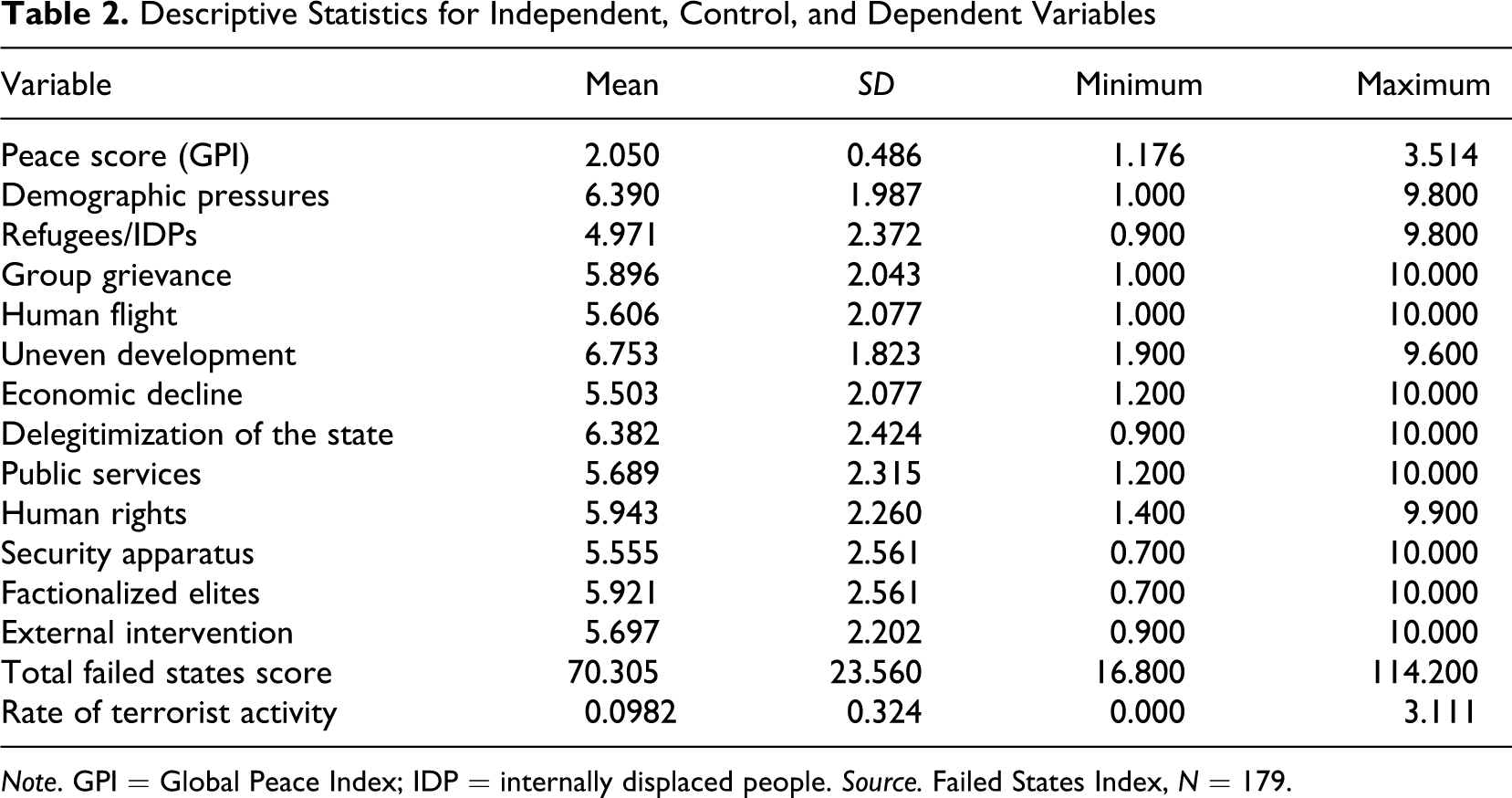
Note. GPI = Global Peace Index; IDP = internally displaced people. Source. Failed States Index, N = 179.
Multivariate Analysis
The results of the multivariate modeling efforts are presented in Table 3. The 12 variables of the Failed States Index (Model 2) are compared to the total failed states score (Model 1), using the control variables population, median age, and religious diversity. Both of these models were statistically significant to the .05 α level, but note that the 12 indices of the Failed States Index make for a better predictive model than the total score model.
Regression Predicting Terrorist Activity Rates by Failed States Indices Scores (N = 179)
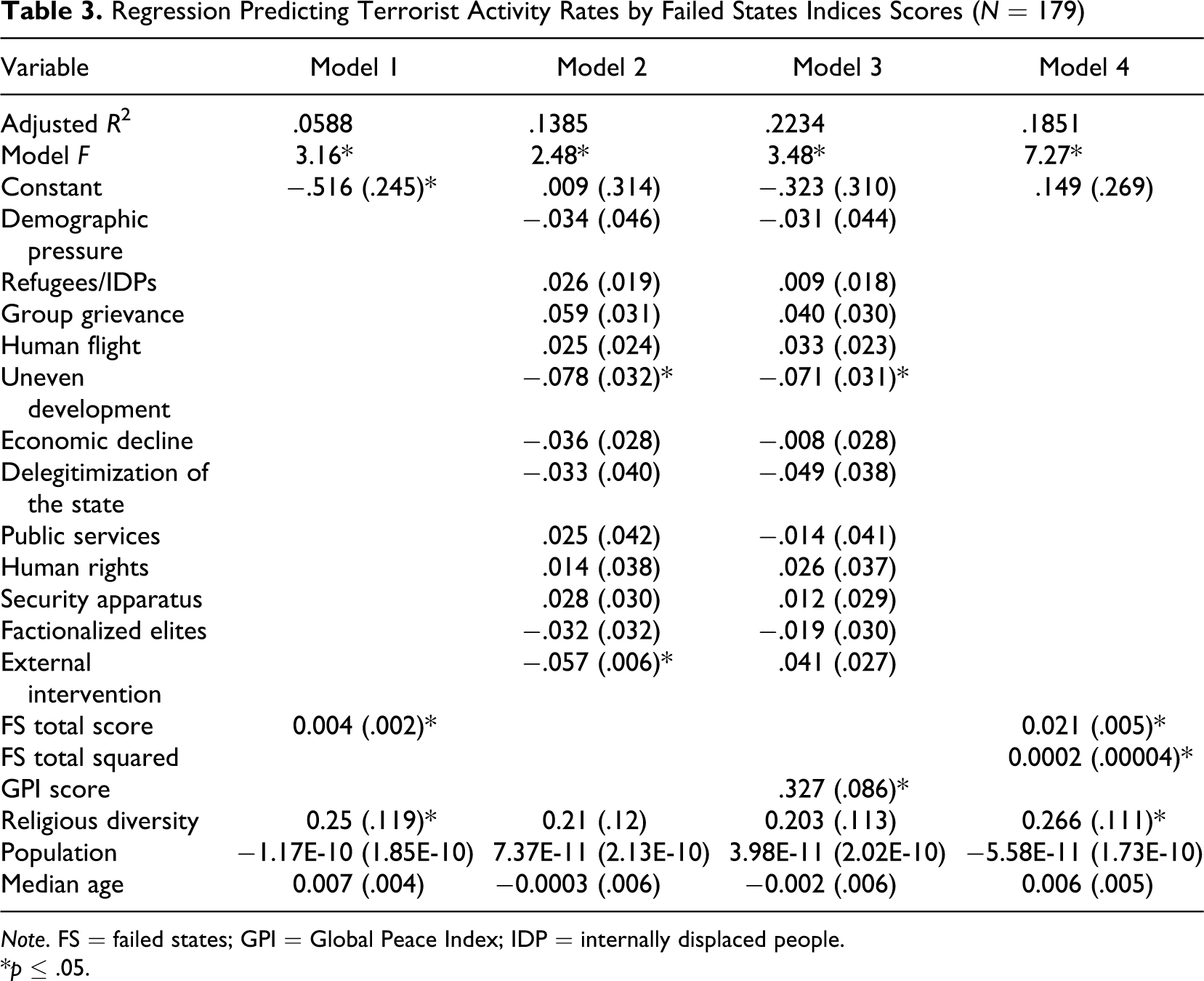
Note. FS = failed states; GPI = Global Peace Index; IDP = internally displaced people.
*p ≤ .05.
Adding the GPI improves the predictive power of the model for the 12 failed states (Model 3) while controlling for religious diversity, population, and median age. When examining the models for Hypothesis 2, nested models with the full Model 3 and the restricted Model 2 are compared. By adding the GPI, the model improves its predictive ability. There is approximately a 62% increase in explained variance between Models 2 and 3.
Finally, to test the hypothesis that the original relationship between the total Failed States Index score and rates of terrorist activity is not linear, a second-degree power polynomial was generated (Model 4). The second power polynomial is nonlinear in nature and provides for an examination of a nonlinear relationship (i.e., curvilinear). Model 4 has stronger predictive power than Model 1 as there is approximately a twofold increase in the explained variance between the models.
In this study, by disaggregating the Failed States Index, an improved model of prediction was constructed. On the surface, this supports Hypothesis 1 that a better model of prediction contains all 12 variables that comprise the Failed States Index. However, the items are strongly correlated, and their individual slopes are not significant, except for the slopes of uneven economic development and external intervention. Both have negative slopes, which intuitively does not seem right. While the model does seem to predict better than the original, this discrepancy leads me to believe that one must go deeper into this relationship. While it is important to look at the separate components that make up the Failed States Index, a deeper exploration into the variables involved in their individual construction may provide more explanation. This is the first step in a deeper understanding of how the factors of state failure influence terrorist activity. This may be indicative of a nonlinear relationship for the two statistically significant variables and will be explored in future research.
Case Studies
Age distribution in both countries is very similar, although the Ivory Coast is slightly older, having a median age of 19.6 years to Somalia’s 17.6. Birth and death rates are also slightly higher in Somalia as well. Literacy rates mirror these other differences, with Somalis faring slightly worse than Ivoirians. Somalia has over 1 million IDP, while the Ivory Coast has slightly less than 1 million (IDMC, 2010). The percentage of the population of Somalia living in urban areas is 37, while the Ivory Coast is 49. However, Somalia is seeing a growth in urbanization of 1½ times that of the Ivory Coast. Both countries have very young populations, which general research on violence demonstrates are more likely to commit violent acts.
Arable land is scarce in Somalia, which sees only 1.6% of its land usable. Struggle over land has fueled conflict within the country. Pastoralists have regularly crossed Kenyan and Ethiopian borders, while land scarcity fuels interclan rivalries (Dehez, 2009). The privileging of some clans, while disadvantaging others, further exacerbates this interclan conflict. Traditionally, clan elders handled such conflicts over land; however, with the government of Siyaad Barre introducing land registration laws that placed all land as state property until legal registration was completed, the privileging of some clans over others reinforced land conflict (Dehez, 2009). The land reform was meant to regulate agricultural economy as well as legalize inheritance claims through the registration process. Most small farmers who held inherited farms could not afford the bureaucratic process involved in registering claims. Pastoralists, largely not linked to government officials in a privileged manner, suffered difficulty in finding places to move herds.
The Ivory Coast’s political crisis also had roots in land tenure. While the Ivory Coast has a much greater percentage of arable land (8.8%), legal access to land has privileged some groups over others. In particular, migrants’ citizenship and land rights were pivotal to the civil conflict. The economic crisis of the 1980s fueled the discrimination of migrants and their rights to land, leading to the revocation of voting rights. The 1998 Rural land law (Bassett, 2009) was geared toward recognizing and formalizing customary land rights by procedurally setting out conditions to title land. This only served to highlight tensions between native Ivoirians and migrants because only citizens (native Ivoirians) could own land, while others could only gain long-term leases. Two percent of the rural land was legally registered. Land in protected forests served to further marginalize IDPs in that forests were deemed publicly held so those migrants who derived their livelihood in these areas could no longer use them. Further, the land reform threatened the mobility of pastoralists (Bassett, 2009).
Somalia and the Ivory Coast have very similar indicators on the Failed States Index; however, the most striking differences are in the areas of politics. This is perhaps predictable because Somalia has functioned without a government for a longer period than the Ivory Coast. Also operating in Somalia is the clan structure that pits groups against each other in very distinct separations. The warlord atmosphere is Somalia’s state within a state, and the ad hoc administration of law by those with the most power at the time leads to instability. This is not as much of a problem in the Ivory Coast, mostly because of outside intervention from France and the United Nations. Because of the Ivory Coast’s highly diverse population, there is not a clan structure in place to operate like there is in Somalia.
Progressive deterioration of public services gives the starkest difference between the two countries, with Somalia scoring 10 out of 10 and the Ivory Coast scoring 7.8. The ability of the Ivory Coast to continue to provide public services is heavily reliant on French intervention (Advameg, 2010) while Somalia has no such intervention. The other strong disparity worth noting is the rise of factionalized elites. Here the success of marginalized persons, and forced recognition of migrants by outside forces, helps the Ivory Coast’s score. Through long-term external intervention and forced inclusion of minorities (Advameg, 2010), the Ivory Coast has less factionalized elites than the clan driven, warlord country of Somalia.
The potential for economic development is also important for a state’s stability. As the difference in governance scores demonstrated, the Ivory Coast’s perceived ability to promote private economic investment allows its people to accept its governance more readily. Somalia again suffers from its lack of central government in that even if a company wanted to do business there is no clear group with which to negotiate. This is related to foreign capital penetration and dependency theory. Dependency theory (Dixon & Boswell, 1996) states that foreign capital penetration into less developed states provides short-term economic benefits, however, in the long-term it is detrimental. This is demonstrated in the Ivory Coast in that while France’s involvement has provided stability in times of chaos, the Ivory Coast is highly dependent on France and a French pullout would leave the country unable to provide basic utilities. The stability gained by French dependency lends itself to the perceived ability of the government to foster private economic development, leading Ivoirians to have more faith in their government. Conversely, Somalia’s lack of any government apparatus prevents it from having the ability to promote economic development. Related to dependency is the concept of debt. The Ivory Coast’s debt load is much higher than Somalia’s. This increases its connections to the world polity. By engaging with the World Bank and other global structures, the Ivory Coast is better situated in the world than Somalia. Furthermore, while the Gini Index for the Ivory Coast is higher than Somalia’s, indicating greater economic inequality, there is a greater amount of poverty in Somalia. It is not difficult for a country to have more equal distribution of wealth when there is little wealth. Somalia has no ability to provide the needed infrastructure and services to its people, while the Ivory Coast has benefited from outside intervention in these areas. Sen (2000) advocates development as freedom: thus, development may promote peace. The five essential freedoms for Sen (2000) are political, economic, social opportunity, transparency guarantee, and protective security. Development is an expansion of individual freedoms and as such may lead to a more stable state. If development is success, it is obvious where Somalia and the Ivory Coast are failing.
The diversity measures indicate that Somalia is a quite homogenous country, scoring .082 on the ELF and .03 on the religious diversity measure, indicating little diversity. In terms of religion, 97% of the population is Sunni Muslim. The Ivory Coast, by contrast, has an ELF score of .82 and a religious diversity score of .701, indicating a greater amount of diversity. Approximately a third is Muslim, a third is Christian, with the remaining one third comprising indigenous religions or no religion. While both countries have similar histories, their diversity scores are very different.
While ethnic diversity is very low in Somalia, conflicts are along clan lines. This is in part a reflection of the privileging of some clans by the ruling apparatus. Further, Somalis tend to be apprehensive of outsiders, having experienced such a violent and chaotic colonial history (Advameg, 2010). Contrasted with the Ivory Coast, which has over 60 different ethnic groups, Somalia would seem more capable of forging a national identity. On the contrary, the legacy of colonialism has only furthered divisions along clan lineage (Hayes & Robinson, 2010). And clan structure led to a massive power struggle between scores of rebel groups and subsequent civil wars (Homer-Dixon, 1999).
WGIs were analyzed for both countries. The overall score for Somalia was −1.9 (scale −2.5 to 2.5), while the Ivory Coast’s was −1.5. In looking at the components of governance examined, voice and accountability captures perceptions of the extent to which citizens are able to participate in selecting their government, exercising freedom of expression and association, and free media. The Ivory Coast, while still in the lowest 20%, is much better than Somalia, which ranks in the lowest 2% worldwide. Democracy may decrease terrorism in that it affords those with grievances other avenues of redress (Schneider et al., 2010). Components of political stability and government effectiveness have both countries in the lowest 10th percentile. These are measures of government stability and quality of public services as well as the government’s credibility. With Somalia operating for over 20 years with no central recognized government, and the Ivory Coast being in a state of transition for the last decade with its interim government continuously putting off elections, it is not difficult to understand these low scores.
Somalia scored −2.46 and the Ivory Coast scores just under the 20th percentile with a score of −.97 on the measure of regulatory quality. This measures the perception that the government has some ability to promote economic, private development. Because there is some sort of government in the Ivory Coast that is recognized by the international world and the French have continued their economic involvement. The Ivory Coast has weathered its civil wars and sharp economic declines much better than Somalia. France supplies many aspects of infrastructure, lessening pressure for these basics on the state. Somalia, with no internationally recognizable government and minute economic trade, has little hope of developing (Herblist, 2009). Also preventing quality of life in Somalia is the fact that without a recognizable government, international aid organizations have no coordination. This makes such agencies hesitant to provide aid to Somalia. For the measures of rule of law and control of corruption, both countries fell into the bottom 10th percentile (World Bank, 2010). Again, these scores are predictable because of the lack of governance each country has experienced.
Both the British and French colonized much of Africa; however, their methods of colonization were very different. The French emphasized cultural assimilation, replacing traditional African leadership with French bureaucracy (Hayes & Robinson, 2010). This left newly created postcolonial states with no governmental structure to rely on. The British, in contrast, relied on local elites to administer British rule. This created class divisions and thus a bureaucratic class was in place when independence was obtained. These crucial structural differences left nation-states with very different abilities for self-governing. Coupled with this is the haphazard way in which European powers created these nation-states, many times piecing together antagonistic groups in to one state (Cocodia, 2008). This is most clearly demonstrated in the case of Somalia, where independence left 3 million Somalis living in Kenya and Ethiopia once the lines were drawn. While neither Somalia nor the Ivory Coast was fully under British control, their colonial experiences were quite distinct. The French ruled the Ivory Coast and left them with a weak government apparatus once independence was attained in 1960; however, the French continued to maintain economic and military involvement through utilities and telecommunications as well as a strong military presence (ICEM, 2010). The British in the North, the French in the coastal region that is now Djibouti, and Italy in the South dominated Somalia. During World War II, Somalia was a hotbed for conflict between the British and Italians, extending the European-based war into the Horn of Africa. This speaks to McMichael’s (2008) belief that how states pursue development has far-reaching effects on social, economic, and political development. Somalia was in play during the cold war and because of the power plays by the United States and the Soviet Union much of its policy was externally influenced, while the Ivory Coast avoided this situation. Further, at the end of the cold war, Somalia saw an abrupt change in external intervention, as it was no longer key in the fight between capitalism and communism. Complicating Somalia’s state formation even more is that when independence was achieved and Northern and Southern Somalia were united, two distinctly separate states were brought together, having no common bureaucratic functions (Advameg, 2010). Further distinction between the two countries’ experiences is that while the Ivory Coast still experiences intense French involvement; Somalia has not enjoyed the stabilizing effects of continuous outside intervention.
Colonial influence when these countries gained their independence reflects how the struggle between three countries for control of Somalia left it much less equipped for self-governing than the Ivory Coast. Differences in the histories of the two countries indicate that the continued presence of the French in the Ivory Coast may serve as a stabilizing factor in the rebuilding of the country. While the Ivory Coast experienced French colonialism, which overall left countries less adept at self-rule postcolonially, and may be a source for its overall high state failure score, continued involvement has made critical contributions to its disaggregated scores being lower in some areas than Somalia. Somalia was not only brutally colonized by three different empires, but it continued to experience violent struggles between two of these countries until the end of World War II. The form that colonialism took, along with the structure of the government it leaves behind, are important in creating an environment for state success.
Discussion
In this study, by disaggregating the Failed States Index, an improved model of prediction could be constructed. On the surface, this supports Hypothesis 1 that a better model of prediction contains all 12 variables that comprise the Failed States Index. However, the items are strongly correlated, and their individual slopes are not significant, with the exception of the slopes for uneven economic development and external intervention, both having negative slopes, which intuitively does not seem right. While the model does seem to predict better than the original, this discrepancy leads me to believe that one must go deeper into this relationship. While it is important to look at the separate components that make up the Failed States Index, a deeper exploration into the variables involved in their individual construction may provide more explanation. This is the first step in to a deeper understanding of how the factors of state failure influence terrorist activity. This may also be indicative of a nonlinear relationship for the two statistically significant variables and will be explored in future research.
The findings supported Hypothesis 2 that adding the score of the GPI the model would be improved. Not only is the adjusted R 2 larger, but the incremental F test demonstrates that the improvement is statistically significant. In this model, however, only uneven economic development and the GPI were statistically significant. Because this addition seemed to enhance the overall model, the GPI seems to be important in improving the model.
Hypothesis 3, that a regression equation with a squared term would have better predictive value than the original Model 1, was supported by the findings. Both independent variables were statistically significant to the .05 α, as was the control variable for religious diversity. This is important because debate within the literature has demonstrated that research is not settled as to the shape of the relationship. The findings, however, support a nonlinear relationship. While all three hypotheses were supported, the low adjusted R 2 necessitates further exploration into why some failed states promote terrorism while others do not. Because of this, case studies of two failed states, one with low levels of terrorism and one with high levels, have been conducted.
There is no current theory that definitively explains the connections between failed states and terrorism. Asymmetrical or fourth-generation warfare is a very real threat globally today. Prior research has focused on political, economic, and social factors independently of each other and the effects on terrorist activity. The focus of this article, in examining state failure in detail for Somalia and the Ivory Coast, has worked to move away from looking at these factors (political, economic, and social) independently and tried to view the overall processes involved in state failure in regard to terrorism. While Somalia and the Ivory Coast have very similar scores on most components of the Failed States Index, noticeable differences were found on political indicators of the ability of the state to provide public services and the rise of factionalized elites. In exploring diversity, both measures show a significant difference between Somalia and the Ivory Coast, with Somalia showing virtually no diversity, while the Ivory Coast is moderately diverse. In terms of governance, differences in voice and the perceived ability of the government to foster economic private development show vast differences between the countries. The history of colonialism has been explored and clear distinctions made between Somalia and the Ivory Coast’s experiences. The study has been theoretically driven by the position that it is the process of state failure that is intimately connected to terrorism. In examining the 12 indices of state failure, along with diversity, governance, and colonial history, a clearer picture has emerged as to why Somalia and the Ivory Coast have experienced differences in terrorist activity.
Conclusion
On first look, economic factors of state failure seem least informative of what differences are attributed to fostering terrorism because their economic histories are very similar. Both are poor countries that experienced severe economic decline prior to civil wars (Bassett, 2009; Dehez, 2009), with a heavy reliance on the informal sector (Aboygue, 1989; Guichaoua, 2007). As the quantitative analysis indicates, uneven economic development is predictive of terrorist activity. Since there is a significant difference between the two countries on this variable, the model would predict a difference in terrorist activity.
The differences between the Ivory Coast and Somalia go further than what can be measured by the Failed States Index. That is why, in extending the study of terrorism, focusing on the processes of diversity, governance and colonialism have helped to shed new light on the subject. Terrorism is a complex phenomenon and so are its root causes. Because of this, a simple OLS regression equation is not going to be as predictive as desired. It requires delving into the history that shapes a country spawning terrorism as well as critical analysis of the governance. This article has begun to look at these processes, but future research should focus on the colonial experiences and how they serve to shape postcolonial nation-states.
Further research should strive to look beyond failed states and perhaps a four-by-four study adding two nonfailed states, one with high levels of terrorism and one with none, would add a greater understanding of the processes involved. Also not addressed in this article are the different components of the GPI. By taking the index apart into its 23 components, further comparison of the actions involved could be done and a clearer picture of the operations involved would emerge. It is further noted that this is a simple snapshot in time from the year 2008. The states chosen are fragile and unstable, and as such, this must be taken into consideration in the analysis. Perhaps a time series or longitudinal approach would aid in bringing more stability to the data.
Footnotes
Appendix A
Appendix B
Appendix C
Appendix D
Acknowledgments
The author thanks R. V. Rikard and Veronica Severn for editing and giving feedback on previous versions of this manuscript. The author also thanks the journal editor and anonymous reviewers for providing insightful feedback. Any and all mistakes are solely the responsibility of the author.
Declaration of Conflicting Interests
The author declared no potential conflicts of interest with respect to the research, authorship, and/or publication of this article.
Funding
The author received no financial support for the research, authorship, and/or publication of this article.